Showing posts with label stephen king. Show all posts

Sunday, July 22, 2018

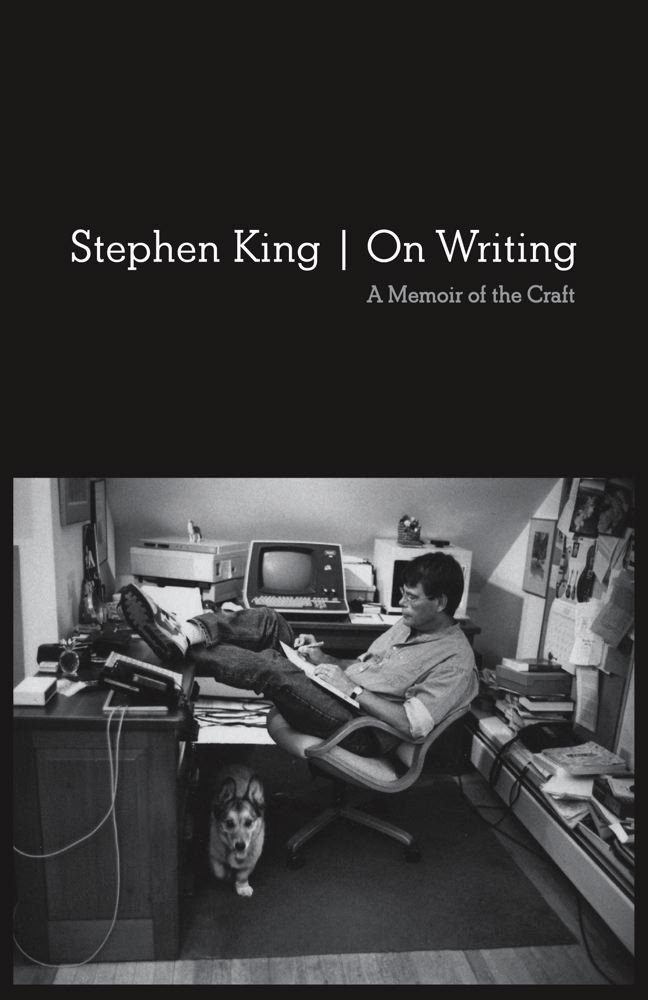
On Writing by Stephen KIng

"What I don't understand, Stevie," she said, "is why you'd write junk like this in the first place.  You're talented.  Why do you want to waste your abilities?"  She had rolled up a copy of V.I.B. #1 and was brandishing it at me the way a person might brandish a rolled-up newspaper at a dog that has piddled on the rug.  She waited for me to answer--but I had no answer to give.  I was ashamed.  I have spent a good many years since--too many, I think--being ashamed about what I write.  I think I was forty before I realized that almost every writer of fiction and poetry has been accused by someone of wasting his or her God-given talent.  If you write (or paint or dance or sculpt or sing, i suppose), someone will try to make you feel lousy about it, that's all.  I'm not editorializing, just trying to give you the facts as I see them.

The great charm of Stephen King's On Writing, much like Ann Lamott's Bird by Bird, is that it feels like it's been written by a real person.  And a real person of no tremendous insight or brilliance.  I don't mean that as a slight against King, who clearly possesses more than an equal share of talent.  But the moments of greatest wisdom about writing clearly come from a lifetime of hard work and dedication, of trying and failing over and over again.  Much of the book is autobiographical, a memoir in short, and sometimes it seems only tangentially related to writing, as with King's account of his own alcoholism.  King wants to puncture the myth of the drunk genius, to show that his writing was actually impeded by his drinking, not enhanced by it, but the overall effect is mostly the impression that Stephen King, millionaire superstar writer, is a pretty normal guy with normal flaws and failings.

Some of his advice on writing is laughably unhelpful.  For example, he suggests that you ought to able to write the first draft of a 180,000 word novel in about three months.  The math is simple: write two thousand words a day, every day.  He even wonders what those authors who only write one book in their lives are doing with the rest of their time.  But, of course, not all chunks of two thousand words are created equal, and few of us are going to be able to reproduce Stephen King's level of dedication, even as he protests that there are those who are much more prolific than he is.  HE writes while listening to "AC/DC, Guns 'n Roses, and Metallica," which sounds impossible to me.  There is also some general skepticism of writing classes in general, and a conviction, shared by most other writing guides, that some people just don't have the goods.  (Which, while it might be true, is not helpful for the teenagers in my creative writing class.)

But a lot of the advice is really terrific, and delivered in a blunt, conversational style that makes it hard to argue with.  For my purposes it's nice to see some of the things that I have said to my students emphasized and echoed, and usually in better, more convincing language:

If I had a nickel for every person who ever told me he/she wanted to become a writer but "didn't have time to read," I could buy myself a pretty good steak dinner.  Can I be blunt on this subject?  If you don't have time to read, you don't have the time (or the tools) to write.  Simple as that.

This isn't the Ouija board or the spirit-world we're talking about here, but just another job like laying pipe or driving long-haul trucks.  Your job is to make sure the muse knows where you're going to be every day from nine 'til noon or seven 'til three.  If he does know, I assure you that sooner or later, he'll start showing up, chomping his cigar and making his magic.

Plenty of writers resist this idea.  They feel like revising a story according to the likes and dislikes of an audience is somehow akin to prostitution.  If you really feel that way, I won't try to change your mind.  You'll save on charges at Copy Cop, too, because you won't have to show anyone your story in the first place.  In fact (he said snottily), if you really feel that way, why bother to publish at all?  Just finish your books and then pop them in the safe-deposit box, as J. D. Salinger is reputed to have been doing in his later years.

Other things that I think are extremely helpful about On Writing are: King is pretty candid as to which of his novels he thinks turned out not to be that good.  What an amazing thing, to hear a novelist say that about his own work!  He also includes two brief pieces of writing at the end: an original and an edited version of his story "1408."  That's bold, I think, not just to talk about the process, but to show it.

The last section of the book is an autobiographical account of how, in the middle of writing On Writing, King was hit by a car while taking a walk near his house in rural Maine and nearly died.  A half-dozen surgeries, learning to walk, to sit, to write again--it's an account as harrowing as any in his horror novels.  "Writing did not save my life," King writes at the end, "Dr. David Brown's skill and my wife's loving care did that--but it has continued to do what it always has done: it makes my life a brighter and more pleasant place."

Sunday, June 3, 2018

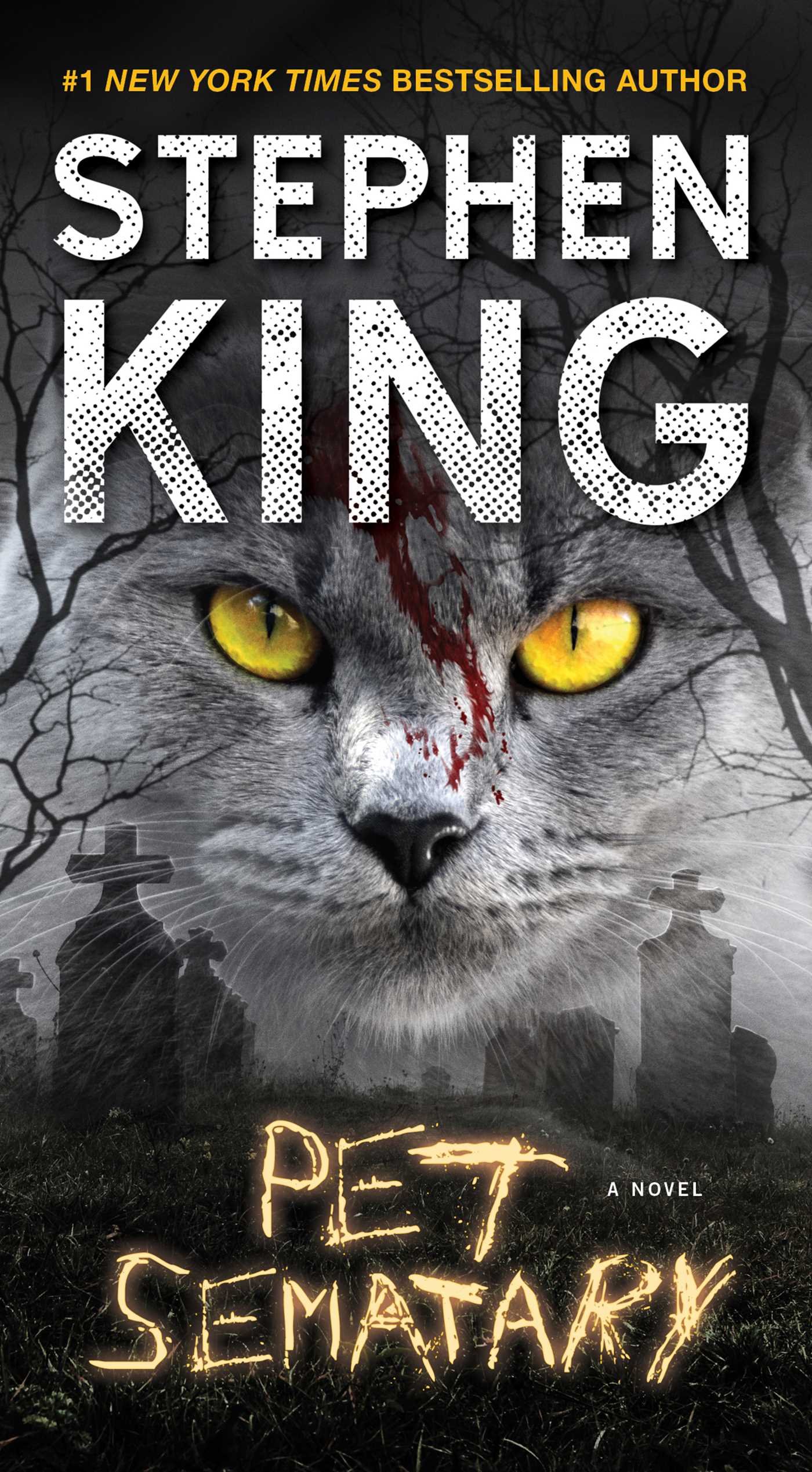
Pet Sematary by Stephen King

Louis and Gage knew him; they had met him and faced him down in New England.  He was waiting to choke you on a marble, to smother you with a dry-cleaning bag, to sizzle you in eternity with a fast and lethal boggie of electricity--Available at Your Nearest Switchplate or Vacant Light Socket Right Now.  There was death in a quarter bag of peanuts, an aspirate piece of steak, the next pack of cigarettes.  He was around all the time, he monitored all the checkpoints between the mortal and the eternal.  Dirty needles, poison beetles, downed live wires, forest fires.  Whirling roller skates that shot nurdy little kids into busy intersections.

(Spoiler alert, folks--if, like me, you've somehow avoided becoming familiar with King's books until now, you might want to turn back.)

The same painful image lies at the heart of Pet Sematary as Lincoln at the Bardo: a father lifting up the body of his deceased son, cradling it, unable to move past profound grief.  For the spirits in Saunders' novel, it's a symbol of shocking compassion and intimacy, a physical embrace past the point where such things can reasonably be expected.  In Pet Sematary, when the bereaved doctor Louis Creed steals his young son's body from the graveyard, the pathos runs the other way.  It's so grotesque that it borders on squeamish black comedy:

Somehow, panting, his stomach spasming from the smell and from the boneless loose feel of his son's miserably smashed body, Louis wrestled the body out of the coffin.  At last he sat on the verge of the grave with the body in his lap, his feet dangling in the hole, his face a horrible livid color, his eyes black holes, his mouth drawn down in a trembling bow of horror and pity and sorrow.

"Gage," he said and began to rock the boy in his arms.  Gage's hair lay against Louis's wrist, as lifeless as wire.  "Gage, it will be all right, I swear, Gage, it will be all right, this will end, this is just the night, please, Gage, I love you, Daddy loves you."

Louis rocked his son.

Louis' plan is to bury his son in the titular pet cemetery, an ancient Micmac burial ground that has the power to bring things back to life.  The scenes in the burial ground are effectively eerie, filled with fog and unidentifiable noises and the great black shape of the Wendigo moving through the mud.  Early in the novel he does the same thing with his daughter's cat Church, guided by an old Mainer who knows the supernatural history of the place.  Distraught folks have been burying their pets there for years--and maybe a few people, too.  Church comes back all wrong: torpid, bloodthirsty, without any kind of feline grace, and with an indelible stench of death.  Chances are Louis's son Gage, hit by a truck in their front yard, will come back changed, too.  But all the rational deliberation in the world can't overcome the depth of Louis' grief, and he goes through with the macabre plan despite knowing that.

Pet Sematary is a about 500 pages of meditation on the way death intrudes upon the banality of life, and another fifty pages of blood-soaked freakout horror.  King paints the life of Louis, his wife Rachel, and his children Ellie and Gage, in painstaking detail.  At times, too much detail--I'm not sure why we need to know, for instance, that "Rachel developed a mild infatuation with the blond bag boy at the A&P in Brewer and rhapsodized to Louis at night about how packed his jeans looked."  But death, like it does, breaks in on the Creeds' life again and again: in the form of a young man hit by a car on Louis' first day of work at the student clinic at the University of Maine, in the form of their elderly nextdoor neighbor, in memories about Rachel's sick and resentful sister, who died as a child.  Gage gets sick again and again, teasing you, almost, with the possibility of his death many times before it really happens.  As a doctor, Louis knows all about death, about the fragility of the body, but against grief such rationalism is powerless.

I was amazed by how painstakingly King builds up the life of this family, and then destroys it breezily and mercilessly.  The end, in which--hey, I meant that spoiler alert above--the toddler Gage comes back possessed by the murderous Wendigo and dispatches his own mother with a scalpel, was a real shock to me.  I guess I had underestimated how much ice runs in King's veins.  The message, I guess, is this: you'd better make friends with death, because you're just going to make it worse if you don't.  In a way, it's not so different from Lincoln in the Bardo, which also tells us that there is a danger in holding on to grief for too long, but with a gentler spirit. 

Thursday, October 14, 2010

The Dark Tower by Stephen King


Then I'll light the darkness with thoughts of those I love.

I haven't posted on the last few books of the Dark Tower series because I kind of felt combining them in one review would be more efficient and wouldn't take anything away from them. I have finally finished them all, so now here are my final thoughts.

Taking on the task of reading the Dark Tower series is almost an epic undertaking as the story itself: the series spans 7 books and thousands of pages. However, in the end I'd say it's definitely worth it. I'm sure Stephen King's stuff doesn't quite pass muster for true literature buffs, but for the amateur fiction reader his work, and especially this series, is quite enjoyable. As I've probably said before, the tale follows Roland, the last true gunslinger in all of the worlds (for there are other worlds than these) as he searches for the Dark Tower, the center and linchpin of all the worlds. The tower and the beams that hold it up are under attack by the Crimson King (a recurring villain in many of King's other works) and Roland and his ka-tet must try to prevent him from tearing it down, which would basically end existence. Though I wasn't 100% satisfied with the story the entire time, in the end I was very satisfied. Unfortunately there's not a lot more for me to say because I don't want to give anything away, but if you want to discuss the series with me away from the eyes of those who haven't read it, feel free.

Sunday, June 6, 2010

The Drawing of the Three by Stephen King


Maybe it wasn't so bad, he thought. He had staked everything, and that was all he had lost. [Then] the thunder of his own guns filled him with stupid wonder.

So I decided to take a break from the Song of Ice and Fire series (because none of the books really ends, they just pause and pick up again in the next one, making it like reading one several thousand page novel, which hasn't gotten tedious yet, but could...) and go back to the Dark Tower. Brent commented that as the series goes along the novels become more Stephen King-esque, and I can already see it in this installment. I enjoyed this book more than The Gunslinger and am looking forward to the third one.

This book was interesting because we got to know a little more about Roland and his relationship to his companions. When he draws Eddie, Eddie is hooked on heroin and struggling to handle himself, not to mention the trek and quest for the Tower. He hates and resents Roland, thinking only of himself. When Roland draws Odetta/Detta, she is still tormented by the split in her personality and is more of a liability and danger than an asset. But by the end Roland has basically saved Odetta/Detta from herself and she emerges as Susannah, capable and strong, but still kind and caring, while Eddie has found strength, love, and someone to take care of, undertaking some serious character building. By the end of the book, Roland acknowledges that he loves them both, though his profession intrigues me. It seems that in the end Eddie and Susannah are only Roland's tools and he'll use them in whatever way helps him get to the Tower. He admits to Eddie that even though he loves them, he won't hesitate to let them die or kill them, as he did the boy in The Gunslinger, but I think it goes further than that. Early in this one, he recognizes Eddie's capacity to love and the way he has let that capacity atrophy in himself in his single-minded pursuit of the Tower. Roland realizes that reaching the tower stripped of his humanity might be worse than not reaching the Tower at all, which makes me think that deep down he is only using Eddie and Susannah as people to love. I'm interested to see how this dynamic evolves over the course of the series.

Thursday, May 6, 2010

The Gunslinger by Stephen King


The man in black fled across the desert, and the gunslinger followed.

I have mixed feelings about this book. Despite the fact that it was really slow at the beginning and frustrated me to anger for the first two thirds or so, it has a much better aftertaste. Also, as Jim pointed out, it has one of the baddest ass opening lines (quoted above) of any book I've read in quite some time.

The Gunslinger is the first book in Stephen King's Dark Tower series and follows the gunslinger, Roland, as he chases the man in black, searching for answers. The frustrating part of the beginning of the book is that not only are we in the same position as Roland, desperate for answers, we don't even know most of the questions. This book intrigued me because it was so different from anything else I've ever read by Stephen King (which is at least 18 books, btw). It was much more serious, much more focused on character development than his other novels. Like I said before, it takes awhile for anything to really happen. Eventually, however, King reveals some of the puzzle pieces, even if he doesn't necessarily show us where they go. It is enough, though, that I downloaded the second one and am going to bring the third and fourth books in the series back to DC with me (I think I might have read one of them out of order at some point, but I can't remember). Also, once the frustration from the beginning of the book sort of melted away, it became easier to focus on the fact that Roland is a straight up BAMF, and that's awesome/makes me want to read more about him.

Saturday, January 23, 2010

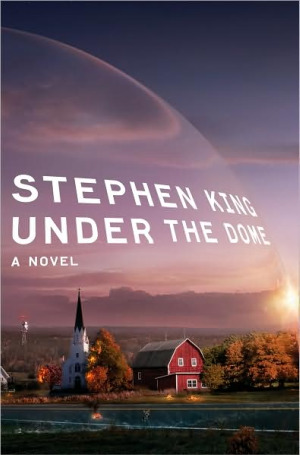
Under the Dome by Stephen King

Since Jim just wrote a very good and mostly spoiler free review of Under the Dome a week or so ago, I'm going to refer you to his review for the normal things like a plot summary. Most of this review is going to be taken up with my thoughts on the themes brought out in the story, there will be spoilers.

Under the Dome is, I believe, King's longest single novel, beating out The Stand by just a few pages, and it was solid. Fast-moving, exciting, even a little touching at times. If you've read King before, the things you love and hate about his writing are all here: heroic children, religious overtones, lots of folksy dialectical dialog, a large cast of idiosyncratic characters, a psychic child or two, and people getting killed in awful ways. It's a good book, but the most interesting things occur below the surface.

I SPOIL THE ENTIRE ENDING BELOW. HOVER OVER THE TEXT TO SEE IT.

After all human efforts fail to raise or destroy the dome, it's discovered that the force that created it is--drum roll--not of this world. That might not not be so strange on its face, since King has explored extraterrestrial life before, but in this case, the creatures wreaking the havoc don't appear to be extraterrestrial so much as supernatural. The antagonists--vague eyeless, leathery creatures--have more in common with Lovecraft's elder gods than with aliens or with the concept of an Old Testamental Abrahamic God, as King seems to indicate in his other novels. The creatures as described in terms of children massacring an anthill, incapable of feeling guilt or sorrow for what they do. Their ways are inexplicable and unexplained: the dome itself, in the end, appears to have been nothing more than some deistic prank, a giant lens placed over a town full of ants. It's interesting that King never attempts to answer the questions that would seem to be the thematic core of the work, except to say that there are no answers. Sometimes, the book leans toward God working in mysterious ways, but ultimately it goes a step further: the alien children, in this universe, are God, and nothing we do can induce guilt. We can only hope for pity.

As a result, I thought the story was a little bit of a downer. It's not really humanistic--nearly everyone in Chester's Mill is dead by the end of the book, and those that are saved are saved mostly by sheer luck, nor is it optimistic about any sort of supernatural intervention. The only ones who care about us are us, and there's nothing we can really do.

Sunday, January 17, 2010

Under the Dome by Stephen King

There was a tremendous hollow clang from behind him, followed by the boom of a secondary explosion, followed by the blast of heat that struck him from heels to nape. It shoved him on his way like a warm hand. Then all thoughts blew away and there was nothing but the body's brute need to survive.

Dale Barbara ran for his life.

Under the Dome
is the story of a small town in Maine (go figure, King fans) called Chester's Mill. Chester's Mill operates like any other small town: You've got your hospital, your police force, your school, your local government, etc. There's small-town gossip and romance and politics and strife. But everythinglez changes when one day a transparent, impervious, indestructible barrier encloses the exact borders of Chester's Mill. Completely cut off from the rest of civilization, the town is forced to fend for itself. In the chaos that follows Dome Day, local government becomes supreme government and human nature takes over. It's only days, not weeks or months, before blood is shed in order to protect that new government and its demagogic leader, Jim Rennie.

I really enjoyed Under the Dome. It's pretty much standard Stephen King fare but I certainly don't consider that to be a bad thing. I like King a lot... In most aspects. The guy is brilliant at coming up with fantastic, interesting premises. His endings... I don't love so much. You can always count on King to bail himself out of an intricate, compelling plot with some kind of harebrained supernatural twist. In some of his books it works, in some it doesn't. I think, in the case of Under the Dome, the ending fit the book.

Under the Dome has a humongous cast of characters. As a result, the town of Chester's Mill (population: 2,000) really comes to life and by the end of the book you feel like you've been there. One of my favorite things about King's writing is his characterization. His characters are always very fleshed out and behave realistically. With King, you can always count on intelligent characters to behave like intelligent people. King's characters always find themselves in extraordinary circumstances but they always react to those circumstances in ways that I feel I can relate to. I also love King's antagonists. Under the Dome did not disappoint in this category. Jim Rennie Senior and Junior were expertly crafted. Both evil but in different ways.

All in all, I recommend Under the Dome to anyone who isn't put off by a 1,100 page novel. I can attest that it reads more like its 500 pages or so. The story is a bit derivative, we've all read novels about how people devolve into animals if you separate them from society and turn them against each other. But we've never heard Stephen King tell that story and I'm glad I finally got to. King understands how to write an exciting story, its as simple as that. The guy writes like a novel a month, so it might be easy for this one to disappear in the fold (being in Africa, I have no idea if this book has been hyped at all). If you're a Stephen King fan, make sure not to pass this one up.

Highlights: The Chef is one of my all-time favorite characters
Lowlights: I was hoping for just a little bit more from the ending

Wednesday, July 8, 2009

From a Buick 8 by Stephen King

I don't have a whole lot to say about From a Buick 8. The book opens in the present day, but the story really begins years earlier, when a Buick is abandoned at a little gas station in the middle of nowhere, owing to the driver going to the bathroom and never coming back. It looks, in most ways, like a normal car, but there are a few things off about it. One side has more windows than the other, and somehow it's completely spotless. It doesn't even appear to have an engine. The police, including Ennis Rafferty who narrates most of the book, tow the car back to the station and put it in storage. Strange things start happening almost immediately: eerie midday lightshows, unidentifiable objects and creatures emerging from the trunk, and so on. Eventually, it becomes evident that the Buick isn't really a car at all, but some sort of dimensional gateway.


Eventually people start dying, of course, but that's where Buick gets interesting. Although Rafferty implies most of the officers believe that the various tragedies visited on the station are because of the car, the story never ties things up so neatly. Nothing really occurs, besides possibly the final scene, that couldn't have happened in the exact same way minus the car. An officer disappears, one is hit and killed by a semi, one's marriage begins dissolving. In the heat of things, it seems reasonable to assume that these things came with the title of the “car”, but it's also defensible that the car serves as a MacGuffin, a plot device to allow King to tell the story he really wants to, one about people. People with misplaced priorities, people who can't live in the present, people who make bad decisions. The various narrators mostly sound like people who've been through life and learned nothing from it. They take turns blaming the car for every bad thing that's happened in the last twenty years, none them considering that the real problem might lie not with the car, but with them.


In that sense, Buick actually has more in common with King's non-supernatural stories like The Body than with Christine. Human wickedness is all we conclusively see. The supernatural evil, such as it is, is never explained. No one ever steps through to the other dimension and confronts the makers of the Buick. There are no otherworldly messengers warning of imminent doom. Even the climax is understated, with victory arriving more by the passage of time than by any particular move on the part of the officers. That said, Buick is interesting and thought-provoking without being particularly good. If you like King, especially late-era rambly King, you'll probably like this. If you're not a fan or you've never read anything of his, start somewhere else.

Saturday, December 13, 2008

Pet Sematary by Stephen King

Sometimes dead is better.

Severe Spoilers.


I'd say I'm a fan of Stephen King. I've read 23 of his books, including On Writing and Danse Macabre, his only non-fiction as far as I know. Of the books I've read, I think I've enjoyed almost all of them, although King has a tendency (especially nowdays) to stretch a 30 page story into a 300 page one. I said that to say this, though: I've never been scared by one of King's books or short stories until I read Pet Sematary.


The plot is very simple, which is probably why it's so effective: Louis Creed to the town of Ludlow with his wife Rachael, his son Gage, and their pet cat, Winston Churchill. Soon after arriving, Winston Churchill is struck by a truck and killed, and Louis' old neighbor, Jud Crandall, tells Louis a secret. Behind their house, there's a cemetery. Animals buried in it come back to life. Louis buries Winston who does indeed come back, but something isn't quite right. One day while playing, Gage is hit by a truck and killed. You can connect the dots here.


The real horror of Pet Sematary doesn't really come from the plot, which is as old as the art of scary stories themselves. Be careful what you wish for. Don't tamper with cemeteries. Sometimes dead is better. It's the atmosphere, which is considerable and completely unrelenting, and in the realistic depiction of the Creed family as they struggle to deal with the death of their son. The book's climax, the resurrection of Gage, is both its centerpiece and, somehow, beside the point. Next to the horror of seeing your baby son run down, what's a zombie or two?


Pet Sematary is completely unmerciful. It never cuts its characters or its readers a break. Something about it is fundamentally disturbing in a way most of King's work (and most horror in general) isn't. It's nihilistic and hopeless, and that's why it works.

Wednesday, November 5, 2008

Stephen King's God Trip

I thought this was an interesting article/interview with Stephen King. I have not read The Stand, but this article -- and to some degree Brent -- made it sound very interesting.

http://www.salon.com/books/int/2008/10/23/stephen_king/

Listen to the interview:
http://media.salon.com/media/mp3/2008/10/conversations_sking.mp3

Thursday, September 11, 2008

The Dark Tower by Stephen King

The man in black fled across the desert, and the gunslinger followed.

Ka is a wheel.”

This review contains lots of spoilers, like all my others. I doubt anyone here is planning to read this whole series, but I'll try to split my thoughts into spoiler and spoiler-free sections.

The Dark Tower is Stephen King's self-proclaimed opus. Starting with The Gunslinger, written in 1978 and ending with The Dark Tower, published in 2004, it spans nearly his entire writing career and expands outward from the seven books of the series into the Stephen King universe. Novels as diverse as It, Hearts in Atlantis, and The Stand have ties back to The Dark Tower, and it was this interconnectedness (along with some meta-narrative which I'll discuss later) that initially inspired me to pick up The Gunslinger and give the series a try.

The premise is simple: Roland Dechain,the last gunslinger of Eld, a town for whom time has “moved on,” is on an obsessive quest to reach The Dark Tower, the center of the whole world, a pillar to which everything else is tied. Even Roland himself is unsure of his exact motivation, except that it is the driving force of his life. He is willing to (and has) sacrificed friends, family, health, love, and peace for his quest. As the series progresses, Roland forms his ka-tet, a group of gunslingers, made up of Eddie, a former heroin addict from modern day New York, Susannah, a wealthy, black, double amputee from the 1930s, Jake, a 12 year-old boy from 80's era new York, and Oy, a billy-bumbler doglike creature from Midworld, Roland's own world.

Throughout its seven volumes, the series cycles through a number of genres: The minimalistic Western of The Gunslinger, the more familiar horror/thriller setting of The Wastelands and The Drawing of the Three, Romance in The Wizard and the Glass, Adventure in Wolves of the Calla, crap in Song of Susannah, and a mishmash of all of the above with some self-referential postmodern meta-fiction thrown in. Because of this and the sometimes long periods between books, the series is of varying quality, and the variance in style means that readers may love some (The Wizard and the Glass) while hating others (Song of Susannah). For me, it meant the highs were high, and the lows were particularly low.

This is where the spoilers begin.

The Dark Tower, the book this review actually focuses on, is the last in the series, published only a few months after Song of Susannah, the penultimate volume. Song of Susannah was a mess, a meandering, dull mishmash of the cast wandering around doing nothing, focused on the schizophrenic pyscho-babble of Susannah, easily the worst and most annoying member of the ka-tet. If Song of Susannah had been, say, book 3 instead of book 6, I'm not sure I would have completed the series. As it was, I put off The Dark Tower for several months, not relishing the thought of 1000 more pages of King demolishing the story I'd enjoyed up until the previous book.

In summation, for anyone who's morbidly curious but wants to stop reading, The Dark Tower is a massive improvement on Song of Susannah. Unfortunately, being better than Song is only half the battle. In spite of having an actual plot and quite a few well-done scenes, The Dark Tower falters by ending several plotlines (one of them dating back to The Stand) with incoherent, out-of-left-field whimpers. For example, Mordred, the long-prophesied bastard son of Susannah and Roland by way of a demonic artificial insemination, spends most of The Dark Tower stalking Roland and his party, only to attack them when he's nearly dead and be killed by, no kidding, Oy, the little dog-like creature in the ka-tet. Mordred might be the second weakest link in the entire book, since he's also King's agent to pull off another on the books major faux pas, the death of Martin, a villain King has used as the embodiment of evil throughout his universe for decades. He's dispatched rather ignominiously (but fairly grotesquely) by Mordred who is, as mentioned, killed by a glorified raccoon.

A lot of readers were upset when King wrote himself into Song of Susannah, and those readers won't find much to like in parts of this book either. King is back, this time with a much larger role. Full disclosure though, the meta narrative with King was the only bright point in Song of Susannah for me, and I think it works here as well. Since King has posited that the Dark Tower is the center of the universe in all of his books, even those that don't reference it, it makes perfect sense that Stephen King the author would appear in the series. For the most part, fictionalized King is a bit of a bumbler, and, except for a couple bits of false modesty (including a less-than-subtle dig at critics who see him as nothing more than a schlock peddler), his character fits right into the narrative.

However, although fictional King sits just fine with me, real-life King decides to pull an ill-conceived trick several times during the book, speaking in the first person directly to the reader (“Now, dear reader, you're probably wondering where this disembodied voice is coming from...”). It happens several times throughout The Dark Tower, and it's always sort of annoying. For the most part, I overlooked it, because a) the entire book reads like King is trying to turn his series into some sort of post-modern mobius strip and b) most of the digressions were very short and easy to skim. However, at the very end of the book, directly before (SPOILER!) Roland reaches the Tower, King takes several pages to tell the reader to stop reading. Yes, that's right. He writes that the point of the quest isn't the destination but the journey, which is true as far as it goes, but a journey has to be heading somewhere. Whether King actually expected readers to take his advice or not, the interlude is intensely condescending and slows the narrative to a stop right before the ultimate denouement.

Strangely, the ending itself isn't bad at all, and although it made a lot of readers angry (just check out the Amazon reviews), it's surprisingly moving and seems like a logical way for this epic journey to end. Given King's tendency to write good books with bad endings, I was pleasantly surprised.

So, if I had it to do over again, would I still read The Dark Tower? Probably. The first four books are probably among the best work King has done, and I even enjoyed Wolves of the Calla. Song of Susannah was a major misstep though, and The Dark Tower run so hot-and-cold that the book itself can't help but be seen as a disappointment. Still, there is some truth to what King says about the journey being the point, and I'm not disappointed in the series as a whole. I just don't know if I'd recommend it.

Monday, June 9, 2008

The Green Mile by Stephen King

The Green Mile was originally a serial novel. I had no clue. It was published in six parts, each containing approximately ten chapters. The story is told by the aging Paul Edgecombe, who is writing his memoirs at a retirement home. Edgecombe was in charge of the section of Cold Mountain Penitentiary that housed the inmates on death row. This area was colloquially referred to as the Green Mile because of the color of the floor (it was green, Brent). In his writing, he focuses on the story of John Coffey, a man who came to the Green Mile in 1932, convicted of raping and murdering to little girls.

It didn't take long for Edgecombe and those that worked for him to realize that Coffey was unlike any other inmate they had encountered. He had certain powers that couldn't be explained and hardly believed. What was even harder for them was justifying Coffey's special abilities and calm demeanor with the heinous acts for which he was convicted.

It is obvious that he is working through some deep, dark issues. Sitting in the atrium at the retirement home, Edgecombe lays bare his past, "What I didn't realize was how many doors the act of writing unlocks, as if my Dad's old fountain pen wasn't really a pen at all, but some strange variety of skeleton key." Along with people from his past, Edgecombe is also dealing with the present. Brad Dolan, a particularly conniving and nasty orderly at the home, seems to have it in for Edgecombe.

The story jumps back and forth from the retirement home to the Green Mile, with excellent pacing. King takes time to develop interesting characters in both eras. These characters wrestle with the complex issues of death, love, justice, and religion. King strikes again.

Friday, April 25, 2008

Harry Potter and the Deathly Hallows by JK Rowling (pt. 1)

Note: In the interest of readability, and avoiding spoilers before Brent has read it, I have broken my review of Harry Potter and the Deathly Hallows into several parts--just like the film adaptation. The first is a general post-mortem review of the entire Harry Potter Series.

When the seventh and final Harry Potter book appeared in July of last year, it became officially time for the cultural establishments of our world to look at the series as a whole and begin to discuss its place in the scope of world literature. That Harry Potter has made zealots of both his supporters and detractors is no secret; the images of Potterites young and old decked in glasses and orange-and-maroon Gryffindor scarves are fresh in our minds, balanced on the other side by the now less-frequent news reports of suburban parents challenging the books’ inclusion in their children’s school libraries. (Let’s not forget, Harry opens “a doorway that will put untold millions of kids into Hell.”)

But there are Harry-haters more respectable than Jack Chick, and none has more literary gravitas than Harold Bloom, the famous Yale critic who might be the world’s most well-read man. In an article that leads with Bloom’s disgust over the National Book Foundation’s presentation of an award to Stephen King, he targets Harry Potter as a particularly nefarious cog in the war machine that’s been sent to obliterate the literary awareness of the Western world: “I suffered a great deal in the process [of reading it],” he writes. “The writing was dreadful; the book was terrible.” One shivers at the image of poor septuagenarian Bloom forcing himself choke down another page of such drivel, while his collection of Romantic busts look on with horror. Lining up with Bloom on the anti-Harry side are prominent literary figures like A.S. Byatt, and a gaggle of literary and social critics.

Of course, Bloom is describing only his reaction to the first book, which underwhelmed me as well, and when he states that the Harry Potter books are unlikely to introduce kids to better-written children’s novels, he’s probably correct. The idea that Harry Potter is a net social good because it gets kids reading is not only a well-meaning falsehood, it’s a red herring of Hagrid-like proportions. Even if it were true, it would do little to help us judge the books on an aesthetic level—not to mention the fact that our children’s literacy is a burden meant for us, not Rowling.

On the other side of the divide are folks like that bete noir of Bloom’s, Stephen King, whose defense of the Potter books borders on adulation. I have unfairly singled out this one of King’s commendations as patently ridiculous: “Talent is never static, it's always growing or dying, and the short form on Rowling is this: She was far better than R.L. Stine (an adequate but flavorless writer) when she started, but by the time she penned the final line of Deathly Hallows (''All was well.''), she had become one of the finer stylists in her native country — not as good as Ian McEwan or Ruth Rendell (at least not yet), but easily the peer of Beryl Bainbridge or Martin Amis.”

King might have chosen two names at random. While I happen to agree with King on sentiment—Rowling has become a much better writer, something which I believe began with the fourth book—this affirmation is nonsensical. Amis’ Money, a book which I love, is composed of an inspired satirical style that combines the beautiful with the crude. I found it quite affecting. But of course, that’s what Amis meant to do—he is a writer in control of his prose, and can use it to create emotion, pace, and meaning. Can we say any of these things of Rowling?

That Rowling has learned to get out of her own way by the seventh book is a testament to her growth as an author, but if we are serious we must admit that in the entirety of the series great stylistic moments are hard to come by. The image of Hogwarts is strong in our minds, but I can find no passages in which Rowling’s style is up to her extensive imagination; if our mental picture of Hogwarts is vivid it is because of what it is and not the way it is described (and is attributable, I think, in no small part to the films). The dialogue, while frequently clever when it comes to cracking jokes, stumbles mightily in moments of great intensity or meaning, except perhaps for some of the more intimate moments between Dumbledore and Harry. Even the line which King holds in such high regard as the exemplar of the series’ growth—Mrs. Weasley’s battle-cry of “NOT MY DAUGHTER, BITCH!”—seems guilty of the lazy trick of resorting to unexpected profanity. Cue the “ooooohs” from the soundtrack.

But even in the places of the final book where Rowling’s prose remains clumsy or wooden, I am seldom bothered by it anymore. Rowling isn’t Amis, but so what? Why do we need her to be? Is it necessary for the Harry Potter books to be a great work of literature for us to appreciate them?

If we look at them only as literature, I suppose. This may seem a strange thing to say—after all, literature is what they are, right?—but the truth is that by any serious metric, the reality about Rowling’s magnum opus is closer to the conceptions of Bloom and Byatt than that of King. The prose, while much improved, never quite reaches anything worthy of being called “good,” and the plot is frequently contrived to the point of absurdity. Too often the best ideas and characters are mired in a mish-mash of half-baked concepts, confusing plot points, and clichés.

But I maintain that the best way of viewing the Harry Potter series is not a simply literature, but as a cultural event. The books are a big part of it, of course—the biggest—but so are the films, the video games, the action figures, the fan fiction, all of that. We live in a world that perceives itself to be so embattled in the “culture wars” and lacking truly shared cultural icons that the emergence of Harry into the pantheon that includes Mickey Mouse, Superman, and Luke Skywalker is welcome as proof that pop culture remains well and alive in my generation. I mention those examples because they are ones I believe exist in our cultural consciousness not merely as envisioned by their creators but through the eyes of hundreds or thousands of creative minds. Of course, gentlemen named Disney, Siegel and Shuster, and Lucas own the lion’s share of the way those figures and their respective universes are perceived, but their pull on our imaginations is so strong that we have been reinventing them for decades.

There was long speculation that Rowling might kill Harry off at the end of the series; this idea was spurred on by the thought that by doing so Rowling could protect him from other writers—who are cast in this scenario in quite a predatory light—who might wish to continue his story by their own hand. But Rowling went in the opposite direction, ending Harry’s journey—and, as King writes, “if you think that's a spoiler at this late date, you were never much of a Potter fan to begin with”—with the simple sentence “All was well,” assuring not only Harry’s survival but his health and happiness. I do not know if Rowling has considered that this might leave Harry open to such literary poachers, but it is my hope that she considered the possibility and considered it good. Certainly such a move leaves the characters open to be perverted and diluted—I’m sure Harry Potter: The Animated Series isn’t too far off—but I think it also will help Harry to remain a living, vibrant character. Of course, I have no statistical evidence on the popularity of Superman to back myself up, but I feel as if having Harry alive is on its face the best thing for his legacy. This way, he belongs to us all now.

With all due respect to Dr. Bloom and Mr. King, I hold with the middle road walked by Christopher Hitchens, a man not known for his moderateness: “It is given to few authors to create a world apart, and to populate it as well as illustrate it in the mind. As one who actually did once go to boarding school by steam train, at 8, I enjoyed reading aloud to children and coming across Diagon Alley and Grimmauld Place, and also shuddering at the memory of the sarcastic schoolmasters (and Privet Drives) I have known.” I can think of no better description of the Potter series’ strengths: its endless and captivating inventiveness, and the way that it plays to our deeply held desire to find reflected in our literature the familiar and the mysterious both.

And if there’s really a culture war going on, put me squarely on King’s side against the Blooms and Byatts of this world. It’s a post-modern world now, the era of the lowbrow, no matter how tightly Bloom holds the keys to the canon.