Showing posts with label Scotland. Show all posts

Tuesday, July 15, 2025

Lanark by Alasdair Gray

Now he saw that Hell was the one truth and pain the one fact which nullified all others. Sufficient health was like thin ice on an infinite sea of pain. Love, work, art, science and law were dangerous games played on the ice; all homes and cities were built on it. The ice was frail. A tiny shrinkage of the bronchial tubes could put him under it and a single split atom could sink a city. All religions existed to justify Hell and all clergymen were ministers of it. How could they walk about with such bland social faces pretending to belong to the surface of life? Their skulls should be furnaces with the fire of Hell burning in them and their faces dried and thin like scorched leaves.

Where to start with Lanark? The beginning, maybe, but which beginning? An epic novel by Alasdair Gray--author of the novel that became the Lanthimos movie Poor Things--Lanark is split into four books, ordered 3, 1, 2, 4. The "outer" books are the story of Lanark, a man who wakes up to find himself in the strange, grotesque city of Unthank, where the sun never shines, controlled by a shadowy "Institute" where he soon finds himself a patient, growing scales and feasting on human flesh. The two "inner" books are a realist coming-of-age story about one Duncan Thaw, a clear stand-in for Gray himself, growing up in the lower-middle class of Glasgow and struggling to pursue a life of art and love. It's implied that Thaw and Lanark are the same person, but the exact mechanism of the transition is never really explained. Perhaps Unthank is the Glasgow of the afterlife, but if so, that means nothing good for Duncan Thaw.

Thaw is a sensitive kid, prone to bouts of depressive hysteria. His parents become accustomed to "curing" him by throwing him into a bathtub full of ice to shock him to his senses. Except for a brief exile to the Highlands during World War II, his life must be fashioned in the context of Glasgow, a gray industrialized city where beauty and passion seem in short supply. Thaw seems to feel more deeply than his peers; he excels in English but struggles to make himself care about mathematics, and so he stumbles toward an uncertain future. More than anything, he's frustrated by the attentions (and lack thereof) of girls, who are easily incorporated into his worlds of personal fantasy and dreaming but more difficult in real life. In Book 3, Thaw lucks into an art school scholarship, but this, too, is too repressive and prescriptive for his yearning for self-expression. He flunks out because, instead of doing his final project, he takes a commission painting a mural in a humble parish church. The mural balloons into a project of years, as Thaw tries to paint the entire story of creation. It attracts the attention of critics, but no money, and the parishioners, unable to use the church space, hate it. There is no space, Gray suggests, for the true artist in the social scene, which makes other demands: the demands of industry, capitalism, clergy, etc. Thaw's failure sends him into a manic episode where he possible, but maybe not, kills a young woman who spurns him.

I recently read Alistair Moffat's History of Scotland, and I noticed that Thaw's story draws in sneaky ways from Scottish history: he makes a rich friend at art school with the name of Kenneth McAlpin, the name of the legendary first king of Scotland;  another associate, more pointedly, is named Macbeth. A decorator that helps him in the parish church is named Rennie, like Charles Mackintosh Rennie, the modernist architect who designed the Glasgow School of Art. Someone more knowledgeable about Scotland than I might be able to pick apart the references and assemble them into a kind of interpretation, but for me, it made it clear enough that Gray thinks of Lanark as reflecting Scottish history at large.

The Lanark books are--weirder. The first takes place mostly at a hospital run by a mysterious institute. (Lanark arrives at the hospital by leaping into a mouth-shaped hole in the ground and being swallowed.) The hospital treats people who, like Lanark, have "dragonscale," a condition where they grow scales and slowly become lizard-people, then combust. Lanark is cured, but he discovers that those who don't make it become food for the other patients. This is a big theme in the novel--"man," Gray writes, "is the pie who bakes and eats himself." By making an annoyance of himself, Lanark is allowed to leave with his lover, Rima. The fourth book finds him back in Unthank, a place he despises and wants to leave, but with which he becomes increasingly entangled. Unthank, we discover, is due to be sacrificed for its "human energy"; the local administrators cow Lanark into acting as a delegate to the assembly in Provan (a version of Edinburgh) and speaking out for them. Time in this strange world moves more quickly than in ours, and Lanark finds himself over the course of what feels, in a narrative sense, like weeks or months, growing to old age. Rima has a son, Alexander, in a matter of days, then leaves Lanark; the next time Lanark sees him, he's a teenager, then a grown man.

Unthank is Glasgow; that's clear enough. But the strange, speculative recasting of the Duncan Thaw sections as "Lanark" has the effect of universalizing the story, even as it remains rooted in its specific Scottish cultural context. Man is the pie that bakes and eats himself, and the forces that threaten Unthank, and the people that Lanark has come to love in his short time in this strange world, are the same forces that threaten the world that That lives in: the rapacious demands of corporate interests, the disinterest of elected figures, a greedy idolization of economic progress, the disposability of common people. In the book's epilogue (which comes before the end, rather than after it) Lanark meets a man who claims to be the author of the book we're reading. The author and the reader control Lanark's life as surely as the social forces he battles--though there are hints, too, that Lanark has ways of escaping his creator's control. During the conversation, the author-figure (who is not named Gray, but is Gray) diagnoses the problem as being too little love. It seems a startling simplification for this enormous, inventive, complicated, perhaps over-complicated novel, but who can say it's not true?

Sunday, July 6, 2025

Scotland: A History from Earliest Times by Alistair Moffat

Reflecting on the immense journey that is our history, many competing interim conclusions crowd the landscape. But at least one theme is clear. Scotland was never an inevitable destination. As we approached several crossroads, our destiny might easily have turned in different directions. Scotland could have become Pictland, Alba, Norseland or Northern England. This recurring sequence of uncertainties, real enough at the time, is a useful corrective to the temptation to read history backwards.

On my recent trip to Scotland I saw many famous names: Stirling Bridge. Bannockburn. Culloden. William Wallace. Robert the Bruce. Rob Roy. Mary, Queen of Scots. John Knox. Loch Ness. Loch Lomond. Glen Coe. Iona. But at the same time they were arranged for me in a kind of mental geography, I needed a book like Alistair Moffat's Scotland: A History from Earliest Times to help me arrange them into chronology and narrative--a big fat history of this beautiful country. 

Moffat's history does indeed begin from earliest times, with the geological forces that created this landscape, with its volcanic islands and deep glacial lochs, and the prehistoric peoples whose mysterious "standing stones" still dot that landscape today. As Moffat moves forward through history, identifiable kingdoms begin to emerge: the Picts, the westerly Gaelic kingdom of Dal Riata, Northumbria, etc. Moffat shows how what we think of as Scotland and the Scottish people really emerge from a series of converging migrations and conquests: the indigenous Picts, the conquering Gaels, Romans, Norse, and Normans. (I found Moffat's reliance on DNA markers to trace this heritage a little tedious and suspicious, but I don't really know anything about it.) Scottish identity emerges only later on, with the battle of the Wars of Scottish Independence when William Wallace and Robert the Bruce fought to shake off English power and influence.

Scotland's relationship with its powerful neighbor to the south is a big theme in this history. To me, it seems as if the story goes something like this: after fending off English encroachment (and at times, direct control) for several hundred years, Scotland ends up sort of like the mouse that catches the cat when James VI becomes James I of England, bringing the two nations closer together than ever. But far from exerting a Scottish power over England, James' accession only further entrenches the entanglement that lasts all the way through the Acts of Union that create Great Britain in 1707 through the Jacobite uprisings, where forces loyal to the deposed line of James II tried to take the throne back from William of Orange, to the present day, when Scotland extracted the right to the reestablishment of its own parliament at the turn of the 21st century.

I knew some of that already, but there was much of it that was new to me, especially the line of hapless Stewarts that lead up, somehow, to the powerful reign of James VI and I, a narrative that's filled the expected gory and macabre details of medieval jockeying for power. I also enjoyed understanding better the internal conflict between Lowland and Highland Scots, which sometimes, but not always and never perfectly, maps to other conflicts: Protestant vs. Catholic, Scots vs. Gaelic, elite power vs. the hinterlands. Moffat makes a late point that really stuck with me, claiming that many of the symbols we associate with Scotland, like the kilt and the bagpipes, are cultural elements appropriated by a Lowland Scottish culture from a Highland culture where they're basically not found anymore--the irony of this being, of course, that through the Highland Clearances and the 19th century, these symbols were thought to be indicative of a primitive, savage backwardness.

To me, Moffat's book gets often too caught up in the details, the this-then-that, and misses the opportunity for a larger thematic understanding that might have helped a novice to Scottish history like me. I actually found the brief explanation of the Stewart line delivered by our tour bus driver on the Isle of Skye to be more digestible and understandable, though it must also be said that he illuminated the more detailed history of Moffat's I was already reading. I thought this was especially true of the military history, which gets bogged down in troop movements and strategies that I often felt myself straining to understand the larger importance of Stirling Bridge, or Bannockburn, or the massacre at Glen Coe. I actually found the most interesting and entertaining part of the book the little capsules Moffat includes about people, moments, and details that don't fit neatly into the overarching history. Scotland: A History from the Earliest Times is a big tome--I had to finish it on the 7-hour plane ride--but it ended up really enriching and elevating my exploration of this beautiful country.

Sunday, March 23, 2025

The View from Castle Rock by Alice Munro

Such frights will come and go.

Then there'll be one that won't. One that won't go.

But for now, the corn in tassel, the height of summer passing, time opening out with room again for tiffs and trivialities. No more hard edges on the days, no sense of fate buzzing around in your veins like a swarm of tiny and relentless insects. Back to where no great change seems to be promised beyond the change of seasons. Some raggedness, carelessness, even casual possibility of boredom again in the reaches of earth and sky.

And Alice wept, for there were no more worlds to conquer. In "What Do You Want to Know For?," the narrator--here, clearly a stand-in for Munro herself--undergoes a mammogram that reveals a lump in her breast. She prepares for the biopsy, and perhaps worse, but it's postponed twice, until the doctor responsible tells her that the lump has always been there, on every mammogram she's received, and it hasn't grown or changed. It's not worth cutting out. Routine accretes again around her life, which was briefly opened up into frightening possibilities, but as she writes, one day there will be a fright that doesn't go away. They're sobering words, one year after Munro's death, after the fright that did not go. And of course they are made more complicated by the revelation of Munro's complicity with the ongoing sexual abuse of her daughter. but not, I think, invalidated. Munro seems to have lied for a long time about her life, but in her stories, what she wrote had a way of being deeply true. So it's with a mix of sadness and relief that I can say there are no more Alice Munro stories left for me to read.

The View from Castle Rock may be Munro's most personal collection, even moreso than the autobiographical "Finale" that closes out Dear Life. The long first section, titled "No Advantages," is a history of Munro's Scottish family, which emigrated to Canada and the United States after the Highland Clearances in the 18th century. The title image of the book comes from one of those ancestors, who, as a little kid, was taken up a prominent hill in Edinburgh and jokingly told by his father that the body of water across the bay--really, Firth--was America. It must have seemed so close, so full of promise and threat, and it must have felt a little like fate, too, because that ancestor did become an emigrant, to the real America. These stories are fascinating and rich, although I had trouble keeping the different Williams and Andrews apart, and drawn from life as they are, they resist a kind of completeness that Munro's stories do, I think, typically possess. They are more ragged, diffuse. I loved the moment when a young boy, walking from Canada to the United States, sneaks his baby sister away from his mother and hides her in a shed, then blames the disappearance on an Indian servant they left back in Canada. (Suspicions of Indian magic make this a persuasive accusation.) The little girl is found, and the boy is never blamed, and so there is no hammer fall of the kind that Munro usually doesn't shy away from. Instead, the moment is another thread in a tapestry of immigrant life, the fabric from which the writer herself is woven.

From there, the stories move down the generations. Familiar images come back again. There's Munro's father, with his silver fox farm. There's her mother, who falls prey to a debilitating disease. We've heard these stories before, in The Lives of Girls and Women and elsewhere. But Munro had such a knack for making the same story seem new each time. She changes the name of the Ontario town--here, it's Blyth--and somehow, that's all it takes, for the story to be revived and refreshed. And of course, we get aspects of these lives we've never seen before, like the introduction of her father's new wife, a foolish and insensitive woman with the improbably name of Irlma. To what extent do the old stories develop and explain the new? Is it about historical contingency only, the obvious fact that, had these people not emigrated to Canada, there would be no Alice Munro? Or is it something else, about the way the old Laidlaws (Munro's maiden name) carved out a new home for themselves so far from Scotland, something we must always do for ourselves, no matter how far from our parents' doorstep we get? There is no permanence, of course. The lump in the breast reminds us of that. We fashion home for ourselves out of what's at hand, and even then, it's only for a little while.

I'll really miss reading a Munro story for the first time. At this moment, it's a hard thing to talk about her writing as writing. It might be nice to take a break from her for a year or two. But I can't imagine never returning to these stories again, and I do plan to come back to them someday. They'll be tinged with a double sadness--dismay or disgust on top of the lack of newness--but they are too much of home for me, too, to be left totally behind.

Monday, March 4, 2024

The Prime of Miss Jean Brodie by Muriel Spark

They were as dark as anything, and all marching in the straightest of files, with their hands raised at the same angle, while Mussolini stood on a platform like a gym teacher or a Guides mistress and watched them. Mussolini had put an end to unemployment with his fascisti and there was no litter in the streets. It occurred to Sandy, there at the end of the Middle Meadow Walk, that the Brodie set was Miss Brodie's fascisti, not to the naked eye, marching along, but all knit together for her need and in another way, marching along. That was all right, but it seemed, too, that Miss Brodie's disapproval of the Girl Guides had jealousy in it, there was an inconsistency, a fault. Perhaps the Guides were too much a rival fascisti, and Miss Brodie could not bear it. Sandy thought she might see about joining the Brownies. Then the group-fright seized her again, and it was necessary to put the idea aside, because she loved Miss Brodie.

Two years ago I finished the last of Muriel Spark's books, and I grieved. Last year I wanted to start reading them again, and I thought it would be fun to read them in the order I first read them--but my copy of The Prime of Miss Jean Brodie was lent somewhere to someone, who hopefully read and enjoyed it, whoever they may be. So I reread Robinson instead, a strange and charming book. But this year, I really wanted to get back to Jean Brodie, and to find out whether it really is the best of Spark's books, or if I only remember it so fondly because it was the first (and of course, most famous). I'm pleased to report that it really is that book: riotous, shocking, mean-spirited, and deeply sad.

This time around, I found myself strangely more sympathetic toward Miss Brodie. The first time around I was a rookie teacher, and I still found myself sympathizing with the students rather than the faculty. Fifteen years on (!), I see in Miss Brodie some teachers I have known: people who use their classrooms to enact fantasies of control, perhaps because so much of life outside the classroom is uncontrollable. Miss Brodie is a fascist, an admirer of Mussolini, and fascism, too, is a fantasy of control and a childish one at that; a fantasy of perfect order by the suppression and exclusion of undesirable elements--those things that are not, as Brodie says, the "creme de la creme."

But the childishness of the fantasy is what makes Brodie a sad figure. I see now how she reduces class, and life, to a series of rote cliches and performative gestures. The fantasy has deadly consequences, of course--she urges one girl toward the war in Spain, and her death--but that makes it somehow more pathetic. And in Sandy Stranger, Brodie's betrayer, I see less an avenging angel than another kind of pettiness. Sandy seizes upon Brodie's fascist leanings to have her sacked, but it's not out of concern for the dead girl in Spain, or for poor stupid Mary Macgregor who is at the bottom of the Brodie totem pole. It's out of some other kind of pique, a resentment that Brodie takes on the role of God, as if Sandy herself is not a kind of planner and schemer.

A couple other things I noticed this time around: the "flash-forward" technique that I've always considered characteristic of Spark's technique is really much more prominent here. It's so mean-spirited: Spark can barely mention Mary Macgregor without reminding us that one day she's going to die in a fire, running "hither and thither" like an idiot. But it also takes on an air of predestination, as if Mary's ultimate death is inseparable from her essential identity, as essential as Sandy's taking the veil, or Miss Brodie's eventual betrayal and death. At the risk of repeating myself, Spark is always God, pushing her characters around, assigning them destinies. She's a cruel God, Calvin's God--she clearly thinks Mary Macgregor's death is funny, and it is. Perhaps by striking out against Miss Brodie, Sandy is striking out against Spark, too, but the joke's on her, because it's Spark who puts her in the nunnery.

Another thing: Jean Brodie is more of an Edinburgh novel than nearly anything Spark has written. I can't remember off the top of my head if any of her other novels are set in Edinburgh--many are London--and though I'm sure some of them are, I don't know the city is really central to any of them. But, among other things, Jean Brodie is a novel about the awakenings that come with coming-of-age, and one of the things that Sandy learns is the particular shape of middle-class Edinburgh life that surrounds her, and how it may differ from other kinds of life: "All she was conscious now was that some quality of life peculiar to Edinburgh and nowhere else had been going on unbeknown to her all the time, and however undesirable it might be she felt deprived of it; however undesirable, she desired to know what it was, and to cease to be protected from it by enlightened people." Part of that Edinburgh life is the bourgeois standards that keeps Jean Brodie from consummating her love for the art teacher Teddy Lloyd, and which drives her to recruit Rose, then Sandy, as her surrogate. Another part is Calvinism, and perhaps it's reacting against the pervasiveness of that religion that drives Sandy--like Spark herself--to Catholicism.

In this case, I think the critics got this one right. I have a few personal favorites among Spark's books, like The Mandelbaum Gate and The Takeover, and I think that Loitering with Intent and A Far Cry From Kensington may actually be more indicative of her style and themes, but everything about The Prime of Miss Jean Brodie sings. There's no one like Miss Brodie--that particular mix of self-regard and pathetic smallness--in any of her other books, or any book, frankly. And it's enlivened by the irony of the young students' untutored viewpoints, which is a tactic Spark seems not to have much patience for in other books. It's the creme de la creme--Miss Muriel Spark in her prime.

Monday, May 27, 2013

The Private Memoirs and Confessions of a Justified Sinner by James Hogg

I felt greatly strengthened and encouraged that night, and the next morning I ran to meet my companion, out of whose eye I had now no life.  He rejoiced at seeing me so forward in the great work of reformation by blood, and said many things to raise my hopes of future fame and glory; and then, producing two pistols of pure beaten gold, he held them out and proffered me the choice one, saying, 'See what thy master hath provided thee!'  I took one of them eagerly, for I perceived at once that they were two of the very weapons that were let down from Heaven in the cloudy veil, the dim tapestry of the firmament; and I said to myself, 'Surely this is the will of the Lord.'

The Private Memoirs and Confessions of a Justified Sinner is a first hand account of religious fanaticism as told by the fanatic, who sees his deeds as divinely inspired.  It is also an account of the fanatic's mental, physical, and spiritual destruction, perhaps at his own hands, perhaps at the hands of darker forces.  Its narrator, Robert Wringhim Colwan--the "justified sinner"--is consumed, in both senses, by his fanaticism.

Legally, Robert is the son of the wealthy Laird Dalcastle, but his probable father--Robert calls him "my spiritual father"--is the Reverend Robert Wringhim, a severe Puritan Calvinist preacher who serves as the Lady Dalcastle's spiritual adviser.  Brought up in this strict Puritanism, Robert Jr. is well instructed in the tenets of Calvinism, which say that only the elect, those whom God has predestined, will be redeemed, and Robert wavers between a profound anxiety regarding his redemption and a snobbishness toward those he knows to be unchosen reprobates, like the Lord Dalcastle and his half-brother George.

One day, Robert meets a stranger in the woods who calls himself Gil-Martin and looks strangely like himself:

'My countenance changes with my studies and sensations,' said he.  'It is a natural peculiarity in me, over which I have not full control.  If I contemplate a man's features seriously, mine own gradually assume the very same appearance and character.  And what is more, by contemplating a face minutely, I not only attain the same likeness, but, with the likeness, I attain the very same ideas as well as the same mode of arranging them, so that, you see, by looking at a person attentively, I by degrees assume his likeness, and by assuming his likeness I attain to the possession of his most secret thoughts.'

What is Gil-Martin?  Is he a projection of Robert's own mind?  Is he, as is frequently suggested, a demon?  The novel is not particularly interested in providing answers to these questions.  Whatever he is, Gil-Martin has a knack for echoing Robert's own theology back to him in a way that strikes Robert as slightly askew, even as it seems to agree with him precisely.  Gil-Martin helps to assure Robert of his position in the elect, and persuades him that the Lord has chosen him to "cut off" the wicked by murdering those who are not along God's elect, including his father and half brother.

Justified Sinner is a parody of antinomianism--the idea that the elect are exempt from God's moral law because they are already redeemed, and their sins cannot affect their redemption.  But Robert's position in the elect looks increasingly like a membership in a group of one (or two, if you discount the fact that Gil-Martin frequently seems little more than a shadow of Robert's own self) and ultimately none, as Robert himself begins to unravel.  He begins to black out, losing long periods of time where he is told that he has been doing some serious sinning, including seducing a young girl and bringing about her ruin--and possibly murdering his own mother.  His self divorced, as antinomianism dictates, from his own deeds, he begins to dissolve:

Immediately after this I was seized with a strange distemper, which neither my friends nor physicians could comprehend... I generally conceived myself to be two people.  When I lay in bed, I deemed there were two of us in it; when I sat up, I always beheld another person, and always in the same position from the place where I sat or stood, which was about three paces off me toward my left side... The most perverse part of it was that I rarely conceived myself to be any of the two persons.  I thought for the most part that my companion was one of them, and my brother the other; and I found, that to be obliged to speak and answer in the character of another man, was a most awkward business at the long run.

Ultimately, Robert tries to run from his "companion," Gil-Martin, but he is unshakeable, because, as Gil-Martin tells him, "I am wedded to you so closely, that I feel as if we were the same person.  Our essences are one, our bodies and spirits being united, so, that I am drawn towards you as by magnetism, and wherever you are, there must my presence be with you."  There is no avoiding the tormentor, because Robert's tormentor may as well be himself.  The final scenes of Robert's account are feverish, terrifying visions of demonic torture that directly parody the book of Revalation.

Robert's account is book-ended by "The Editor's Narrative," in which the scientific-minded Editor tries to make some sense the story.  He dismisses the possibility of any supernatural truth, but his own biases hardly equal an objective take, and so the novel lies on shifting, indeterminate ground.  This quality--as well as a very strange and funny cameo by the author himself as a rustic shepherd--have led some to claim Justified Sinner as a precursor to the postmodern novel.

That's a fair description--and in fact, of all the books I read for my class on the 19th-century Romantic novel, this is the one that seems most attuned to 21st Century sensibilities, and one of only two I'd say are really worth reading (the other being The Monk).  But it also obscures the way that Justified Sinner is deeply invested in its own time and place, and what it meant to be a Calvinist in Scotland in the 1800's.  

Saturday, April 27, 2013

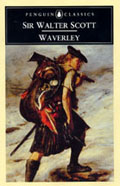
Waverley by Sir Walter Scott

From the minuteness with which I have traced Waverley's pursuits, and the bias which they unavoidably communicated to his imagination, the reader may perhaps anticipate, in the following tale, an imitation of the romance of Cervantes.  But he will do my prudence injustice in the supposition.  My intention is not to follow the steps of that inimitable author, in describing such total perversion of intellect as misconstrues the objects actually presented to the senses, but that more common aberration from sound judgment, which apprehends occurrences indeed in their own romantic tone and colouring.

Sir Walter Scott's first novel, Waverley, was a huge hit.  Let me repeat that: This book was a huge hit.  That is quite an amazing fact--almost as amazing as the fact that I somehow made it through this rambling, horrid turd of a book.

Why did people love Waverley so much?  It promises a rousing adventure tale: Edward Waverley, a young and diffident nobleman, joins a company of English military dragoons in Scotland, yet finds himself drawn to the charismatic rebel Fergus Mac-Ivor and his beautiful sister, Flora.  Eventually he forsakes his regiment to join with the rebels, who are about to stage a military campaign to put Prince Charles, the heir of the Stuart line deposed in 1688, on the British throne.

The first problem is that the book never really delivers on this promise, preferring interminable passages of exposition and terrible Gaelic poetry to actual battle scenes.  The second problem is that Waverley himself is about as engaging as a plate of haggis.  And yet everyone in this book, Brit and Scott, Whig and Tory, Anglican and Presbyterian, is constantly heaping praise on him, despite his general lack of personality and absence of actual achievement, military or otherwise.

Scott goes to great lengths to depict Waverley as someone who reads too much, and gets carried away in his "own romantic tone and colouring."  That's the reason he gets so caught up in the cause of the Scottish rebels.  But Scott's is a winking criticism, because the novel romanticizes the Scots as much as the protagonist himself does, and Waverley's romantic notions in practice only make people more affectionate toward him.  The earnestness, in fact, that marks the relationship between Waverley and Fergus--and for that matter Waverley and everyone else--is noxious.  Let's call that the third problem. Naturally, Waverley never receives any real punishment for joining the rebels (who Scott's readers would know failed in their attempts to restore the Stuart line) and only comes out of the ordeal preposterously more respected.  Scott even supplies a noble English captain who is captured by the Scots, just so he can blather on about how gallant Waverley is despite what is technically capital treason.

The fourth problem is that Waverley contains sentences like this one:

He was about to proceed, but Callum Beg said, rather pertly as Edward thought, that "Ta Cean Kinne did not like ta Sassenagh Duinhe-wassal to be pingled wi' mickle speaking, as she was na tat weil."

Scott means this impenetrable Scot dialect to be funny, but it's just exasperating, from the first instance to the thousandth.

And yet, people loved this book--even Jane Austen.  It was the Da Vinci Code of its day.  The history and the politics were probably more relevant to them, and even though the dialect would have been just as inscrutable to Scott's English audience, the depiction of the Scottish Highlanders would probably have accessed both some fascination toward their exoticness and a  nostalgia for the outdated modes of gentility they embody, neither of which is available to an American today.  Waverley is, at the very least, a reminder that the past is a very strange country indeed.