Showing posts with label william faulkner. Show all posts

Monday, August 15, 2022

As I Lay Dying by William Faulkner

He did not know that he was dead, then. Sometimes I would lie by him in the dark, hearing the land that was now of my blood and flesh, and I would think: Anse. Why Anse. Why are you Anse. I would think about his name until after a while I could see the word as a shape, a vessel, and I would watch him liquify and flow into it like cold molasses flowing out of the darkness into the vessel, until the jar stood full and motionless: a significant shape profoundly without life like an empty door frame; and then I would find that I had forgotten the name of the jar.

I remember being totally bowled over by As I Lay Dying when I read it in high school. I had no idea literature could do the things this novel does. So when a few of my colleagues mentioned they were thinking of teaching it in their own classes, I was tempted. It would really be something, I think, to pass the experience of teaching this book onto a new set of kids. But I wonder, looking back, how other students reacted to the novel, which is so difficult and circuitous, and frankly, grim.

What are some ways you might teach As I Lay Dying? I think the book itself is metaphysical: its chief concerns are with dying and personhood, and the way the former threatens the latter. It's what Addie's thinking about when she reflects on the insufficiency of words in the night, and the way that the name "Anse" seems only like a vessel that, in some sense, obliterates the actual nature of her husband. In that same section, which she seems to be narrating from inside the coffin being carried to Jefferson, she contemplates the way that having children seemed to be a violation of her own personhood, the way they came from her, carrying part of her person with her. This is what frightens characters like Darl, who is so sensitive as to be nearly psychic, and who goes slowly insane over the course of the novel, and Vardaman, the young boy who associates his mother's death with the fish he's caught so strongly that he says, "My mother is a fish." They're confused, bewildered, but in their confusion, both Darl and Vardaman sense something essential and frightening about the slipperiness of the self, which can be parceled out, then obliterated by death.

I think one way I might teach it is by focusing on the stream-of-consciousness techniques. How do we think? In full sentences? Or in images, or feelings, or scraps of logic that are halted and interrupted? How does one imitate that kind of thinking on the page? This might be a way of mitigating what is hardest about As I Lay Dying, of encouraging students to think about its methods as trying diligently to capture the sense of interiority that gets flattened by more traditional narrative techniques.

I also think one way of bringing As I Lay Dying to a Gen Z audience is to focus on its more feminist elements. It might seem strange, but I think the novel is deeply interested in the experiences of women: first, there's Addie, whose experience of motherhood is what shapes her metaphysical understanding, even to the point of horror. Consider the way that Anse insists on carrying Addie's body to "her people" in the city of Jefferson, saying that this is what she had wanted, when really--as the novel's final scene, like a sour joke, shows--what he wants is to go to town to buy a set of new teeth. (Not only does he come back with a new set of teeth, but a new Mrs. Bundren!) Addie's loss of autonomy, bodily and otherwise, is echoed in the experiences of Dewey Dell, who needs an abortion she doesn't know how to ask for, and who finds herself exploited by the depredations of a sex pest pharmacist because of it. Now more than ever, those themes might seem to speak with a renewed voice to students.

But I don't know. It's awfully tricky, and though I think I can get students to reflect on the purpose of the novel's stranger narrative methods, I'm not sure I can get them to actually enjoy them, or tolerate them for four weeks. And I wonder, too, if the southern accents that made the characters' language recognizable, if strange, to me, might be further beyond my students' grasp. So we'll see.

Sunday, November 24, 2019

Light in August by William Faulkner

At last the noise and the alarms, the sound and the fury of the hunt, dies away, dies out of his hearing.  He was not in the cottonhouse when the man and the dogs passed, as the sheriff believed.  He paused there only long enough to lace up the brogans: the black shoes, the black shoes smelling of negro.  They looked like they had been chopped out of iron ore with a dull axe.  Looking down at the harsh, crude, clumsy shapelessness of them, he said "Hah" through his teeth.  It seemed to him that he could see himself being hunted by white men at last into the black abyss which had been waiting, trying, for thirty years to drown him and into which now and at last he had actually entered, bearing now upon his ankles the definite and ineradicable gauge of its upward moving.

Lena Grove, in the last stages of her pregnancy, has walked all the way to Jefferson, Mississippi from her home in Alabama, looking for the man who promised to marry her.  He's there, but he's using a fake name--presumably so Lena can't find him--and working as a bootlegger alongside another outsider named Joe Christmas.  A mild-mannered millworker named Byron Bunch falls for Lena, and enlists his friend, a disgraced preacher named Hightower, to help keep her safe and hunt down her husband-to-be.  But this directive mixes them up not just with Lena and her beau, but also Christmas, who is the true center of Light in August: Christmas, a man tortured by the secret knowledge that he's half black, has, on the same day that Lena arrives in town, murdered his lover.  His lover, Joanna Burden, is an abolitionist who's widely hated in town, but Christmas' uncertain parentage makes the crime not just violent but transgressive: a white woman has been murdered by a black man.

What does Light in August have to say about race?  Well, for one thing, it reveals just how flimsy the whole thing really is.  Christmas is white-passing, and it seems that no one would know his secret at all if he didn't keep divulging it as if it were something rotten at the heart of him.  Those who learn Christmas' secret seem suddenly to forget who he is--a loner at the mill, mostly respectful, keeps to himself, not well-known but generally liked--because he's no longer that person, but a "n-----r."  When he kills Joanna, it sets into motion the machine of lynching, the social engine that overpowers the narrow limits of policemen and judges, and which exists to respond to threats it considers not just dangerous but existentially so.

But no one is more in the grip of the pathology of race than Christmas himself.  Faulkner uncovers his life history with the dramatic flair of an early modern revenge tragedy; we learn that his biraciality is the reason that his grandfather cast him out to be adopted in the first place.  He leads a troubled life, brought up by a man who is severe, religious, and cruel; when he finally escapes he's fit only to live a life of itinerant work and petty criminality.  Christmas is a victim; his alienation comes from a life of maltreatment, but his own anxiety about his racial identity supplants an honest reckoning.  He believes the brokenness of his life and his character--he is increasingly violent and dissociative--can be traced to his secret blackness, like a virus.  When he kills Joanna, it's because she presses him to attend a Negro college and become a Negro lawyer.  It's not her pity that enrages him; he believes himself to be pitiful.  It's the way she zeroes in on his own secret shame that his blackness is the root of that pitifulness.

One character, speaking against the possibility of a lynching, says he wants to see Christmas "Decently hung by a Force, a principle; not burned or hacked or dragged dead by a Thing."  That's a striking statement, but it makes you wonder: the racism that structures Southern society, is it a Force or a Thing?  Is it something separate from the more respectable institutions, the police, the judges, the mill, a shadow that haunts them, or is it just another piston in the engine?

Light in August is a novel of serious and deep questions like these.  It's hard for me to shake the sense that it might have been more incisive if it expressed more interest in black characters, beyond a supporting cast of unnamed sharecroppers and shack-dwellers.  Christmas isn't really black; he's a white man who fears his own blackness, and while Faulkner tells us that he moves between white and black communities in a kind of oscillating uncertainty, the black communities remain mostly opaque to the narrative voice.  You really have to wonder, if Christmas does spend time in black households, with black women, does he ever have to face the question, what's so bad about being black?  But even Faulkner, who I think really intends Light in August to be a critique of racism, is unable to get too far outside of white subjectivity.

I think one thing I learned from reading Light in August is that I have a limited patience when it comes to Faulkner.  The ones I've enjoyed most all have several discrete narratives, like the many voices of As I Lay Dying or three-fold structure of The Sound and the Fury, and especially the several connected stories of The UnvanquishedBy comparison, Light in August, which runs nearly 600 pages, seemed unnecessarily bloated to me, and I got easily bored by it.  Faulkner's high emotional intensity, which really does seem straight out of the 19th century Gothic genre, is difficult to sustain over so many pages.  And after a while, you really start to notice Faulkner's particular tics: this book probably uses the word myriad 50 times and chiaroscuro about a dozen.  For me, Light in August is just too much, too long.

Sunday, October 15, 2017

Sanctuary by William Faulkner

The worst one of all said boys thought all girls were ugly except when they were dressed.  She said the Snake had been seeing Eve for several days and never noticed until Adam made her put on a fig leaf.  How do you know? they said, and she said because the Snake was there before Adam, because he was the first one thrown out of heaven; he was there all the time.  But that wasn't what they meant and they said, How do you know, and Temple thought of her kind of backed up against the dressing table and the rest of them in a circle around her with their combed hair and their shoulders smelling of scented soap and the light powder in the air and their eyes like knives until you could almost watch her flesh where the eyes were touching it, and her eyes in her ugly face courageous and frightened and daring, and they all saying, How do you know? until she told them and held up her hand and swore that she had.

Sanctuary is Faulkner's "potboiler," a novel that takes his familiar themes and characters and weird, poor Mississippi setting and uses them to frame a salacious and prurient story.  There's an element of pulpiness in it--check out the trashy cover in the image above--but Faulkner is too idiosyncratic and elliptical for Sanctuary to really be shocking or titillating.

The first of the novel's two main characters is Temple Drake, a Mississippi undergrad who gets mixed up with a jerkoff alcoholic frat boy who takes her against her will to a bootlegger's house where he abandons her.  There she's raped by a petty criminal named Popeye, who whisks her away to a brothel in Memphis where he stashes her away.  The second is Horace Benbow, a conflicted lawyer who has just left his wife (because of his sexual feelings for his stepdaughter--nice one, Faulkner) and who takes up the defense of the bootlegger who has been charged with a murder that Popeye committed.

Horace and Temple's stories only intersect briefly.  Horace's sympathies are oriented toward Ruby, the wife of the bootlegger Lee, and her infant child; in fact, the townspeople begin to assume that he and Ruby are carrying on an affair, explaining his pro-bono work on Lee's case.  Faulkner wants us to see that Temple is pretty much forgotten; the case hinges on a murder that has nothing to do with Temple, and though Horace tracks her down to find out what happened, his priorities are elsewhere.

Temple's character is frustrating.  We're asked to accept that her feelings toward Popeye are conflicted, and that she's not exactly his prisoner, but neither is she exactly free to leave.  A kind of Stockholm syndrome makes sense, but Faulkner wants us to believe that the rape takes away Temple's agency to a degree that makes her passiveness in the face of her imprisonment sensible.  There are hints of a retrograde notion of female hysteria.  I think we're supposed to read Temple as a cautionary tale about the teenage desire to be inducted into the world of adult sexuality, the darker side of which she and her fellow coeds are unprepared for.  But there's something about the way that's coded according to gender that makes Sanctuary seem like it's trafficking in cheap literary archetypes.

Mostly, Faulkner's elliptical style makes it difficult to really figure out what's going on.  We learn that Popeye hasn't been having sex with Temple himself; instead, he's recruited a gangster named Red to do it while he watches.  Temple has fallen for Red, in a way, making Popeye jealous, but Faulkner neglects to include any of this in the narrative.  By the time we learn about Red's existence, Popeye's already shot him, and we're expected to fill in the blanks.  Faulkner keeps the most salacious part of the ordeal close to the chest, choosing to reveal it only in the final courtroom scene: Popeye is impotent, and the initial rape is performed with a corncob.  Okay.  Honestly, the "shocking reveal" is what makes Sanctuary seem more like a pulp novel than anything else.

Still, Sanctuary has all the elements that make Faulkner worth reading: the currents of sex and death, the lack of sentimentality, the tension between the impoverished setting and the flights of decorated prose, the black humor.  The savageness of Faulkner's novels makes us underestimate how funny they can be, I think.  But it's hard not to feel that Faulkner's slumming it a little, searching for a bestseller that his style won't let him fully commit to.

Monday, July 13, 2009

The Sound and the Fury by William Faulkner

"I give it to you not that you may remember time, but that you might forget it now and then for a moment and not spend all your breath trying to conquer it. Because no battle is ever won he said. They are not even fought. The field only reveals to man his own folly and despair, and victory is an illusion of philosophers and fools.”


Last year, after several aborted attempts, I finally made it through Faulkner's As I Lay Dying. It took some doing, but by the time I finished it, I was really enjoying Faulkner's mastery of the stream-of-consciousness style and especially his lyrical writing. I intended to follow up with The Sound and the Fury, but then I read Chris's review and, since it sounded approximately 10x more difficult than As I Lay Dying, I wussed out... until now.


The Sound and the Fury may be Faulkner's best known and most critically acclaimed work, and also his most complex, although this is coming before I've read Absolom Absolom. It follows one family, the Compsons, over about a decade. The actual storyline is a dark southern Gothic tale of family, betrayal, incest, and a mentally retarded manchild. So it's basically Anne of Green Gables.


The actual narrative is tough to summarize, and at some points, even to follow--I found out upon reading chapter summaries that I'd completely missed a major event; the book is really more about the characters and the way thy see and interact with one another than a storyline. Each section of the book is narrated by a different character, except the last which has an omniscient third-person narrator. The first section is narrated by Benjy, the aforementioned manchild who has no sense of time or place and whose narration skips from the past to the future without warning. The second is narrated by Quentin Compson, the neurotic, intelligent younger brother, and the third by Jason Compson, the cruel, cynical eldest child who takes an iron fist control over the family after the death of the father. Tying all these disparate narrators together is the enigmatic figure of Caddie Compson. Even with three different perspectives on her, we never get a firm grasp on what she actually is. To Quentin, she represents his repressed incestuous thoughts, but also his need for security and to protect. To Benjy, she is his only steady link to the real, linear world. To Jason, she is a thankless whore whose only contribution to the family was Quentin II, her illegitimate child and the bane of Jason's existence.


The Sound and the Fury is a tough book, both narratively and thematically. The Compson family and their neuroses are fully explored and the story itself is both intense and moving, but the actual heft of the book eludes me. At a base level, it seems to be about family and what constitutes it. Benjy, for example, is a much better brother to Caddie than Jason, and Dilsey, the Compsons' slave, is more of a mother to all the children than their own biological mother. I can't help but feel there's a lot that I'm missing here. Unlike Chris, I did feel myself connected to this band of misfits, but much like Benjy, I can't quite tie it all together.


I'm not sure my review makes it clear how much I enjoyed this book, but I thought it was great, and even enjoyed the Benjy section, which a lot of readers find offputting. Faulkner is a master stylist, and it was worth reading just for that, even if I can't quite figure it all out.

Thursday, December 13, 2007

As I Lay Dying by William Faulkner

As I Lay Dying currently holds the prize for the book I've started and put down the most times. I think I started it four times, got about 25% of the way through, and then realized I really didn't know what was going on. This last time I read it, I finally made it through, and now I'm not quite sure why it was so difficult.


As I Lay Dying tells the story of Addie Bundren, her death, and the subsequent trip to her hometown where she wanted to be buried. Each chapter is told from the point of view of a different person, and the book has quite a large cast. The sons: enigmatic Cash, borderline-empathic Darl, loner Jewel, youngest child Varadman; the daughter, confusingly named Dewey Dell; Anse, the selfish, uneducated father; and an extended cast of characters encountered along the way. Even Addie takes a single chapter to speak from beyond the grave.


Spoilers Follow.


Although the family's quest to bury Addie where she requested initially seems like a selfless act, some of the family members have ulterior motives for wanting to make the trip to the big(ger) city. Anse is already looking for a new wife and Dewey Dell is looking for a way to kill the baby no one knows she's carrying.


The tone of the entire book is pitch black and macabre, full of distasteful and distubring bits. Vardaman, drilling holes in the casket so his dead mother can “breathe”, drives a spike too far into the casket and into her face. Cash's leg is broken, so Anse encases it in cement, creating a makeshift oven in which it is eventually essentially baked alive. Dewey Dell is duped into a “Treatment” for her pregnancy that's essentially rape. Anse finds a new wife a day afer burying his old one. Not to mention that about halfway through the book, Addie Bundren's body begins to rot and smell so badly that the Bundren's are nearly arrested.


I read some analysis of this book after I finished it, and a lot of folks read it as a sort of black comedy. It's not an impossible viewpoint to adopt, but it requires a darker eye for humor than I have. I found the story mostly disturbing, but I also found that the initially confusing style added quite a lot to the narrative. We don't know if we can trust the narrators, and even if we could, their stories are delivered in a stream of conciousness style that is reinterpreted everytime a new character shares his viewpoint.


Overall, As I Lay Dying was a very good book, and I'm unsure if it made me want to read more of Faulkner's work or stay away from it. Faulkner reportedly wrote As I Lay Dying insix weeks and claims he didn't change a word. He is also quoted as saying that he wanted to write one book that his reputation could stand or fall upon. The book is a fish.


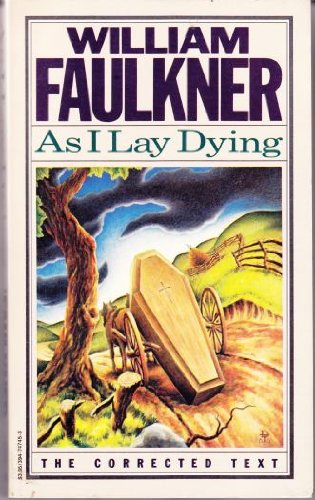
Edit: When I googled for this cover, the entire first page was the metalcore band As I Lay Dying. Lame. guys.

Tuesday, October 9, 2007

The Sound and the Fury by William Faulkner

This is the second time I've tried to make it through The Sound and the Fury; the first time I made it halfway through and just told everyone I finished it. Well, I didn't finish it. I'm sorry. I never meant to betray your trust. I've finished it now.

The Sound and the Fury is the story of a once proud Southern family, the Compsons, and their downfall. It is split into four parts: The first is narrated by Benjy, the family's youngest son and a mentally retarded person. His account jumps through time with little warning or help to figure out what's going on. The second is narrated by the neurotic son Quentin, who is sent off to Harvard and has trouble dealing with his childhood incestual feelings toward his sister Caddy. The third is narrated by Jason, who is an asshole and controls his mother and Caddy's daughter Quentin (confusing) with an iron fist. The fourth is a third person narrator. The plot itself is difficult to describe, but the central character seems to be Caddy, and how she's depicted throughout the book. She's presented as a tragic figure, who becomes sexually active at a young age and is ultimately the cause of her brother's suicide (guess which one), and is then kept from seeing her teenage daughter.

Faulkner, in fact, found the story so powerful that he said The Sound and the Fury caused him the most grief to write of all his books. But to me it seems that, like most Faulkner, The Sound and the Fury is best enjoyed at an intellectual level and not an emotional one. Faulkner is surely a genius, and the four-part narration (similar to As I Lay Dying) is an amazing thing to behold, but the book for me lacks emotional heft. The Benjy section in particular is too confusing to really be affecting, though Quentin's and Jason's sections fare a little better.

So, I've finished it. Between this and As I Lay Dying, I'll take the latter: it has a dude who can read minds.