Showing posts with label as i lay dying. Show all posts

Monday, August 15, 2022

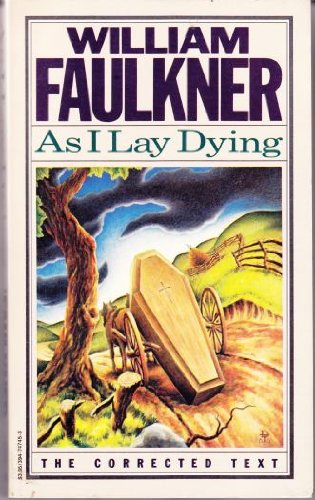
As I Lay Dying by William Faulkner

He did not know that he was dead, then. Sometimes I would lie by him in the dark, hearing the land that was now of my blood and flesh, and I would think: Anse. Why Anse. Why are you Anse. I would think about his name until after a while I could see the word as a shape, a vessel, and I would watch him liquify and flow into it like cold molasses flowing out of the darkness into the vessel, until the jar stood full and motionless: a significant shape profoundly without life like an empty door frame; and then I would find that I had forgotten the name of the jar.

I remember being totally bowled over by As I Lay Dying when I read it in high school. I had no idea literature could do the things this novel does. So when a few of my colleagues mentioned they were thinking of teaching it in their own classes, I was tempted. It would really be something, I think, to pass the experience of teaching this book onto a new set of kids. But I wonder, looking back, how other students reacted to the novel, which is so difficult and circuitous, and frankly, grim.

What are some ways you might teach As I Lay Dying? I think the book itself is metaphysical: its chief concerns are with dying and personhood, and the way the former threatens the latter. It's what Addie's thinking about when she reflects on the insufficiency of words in the night, and the way that the name "Anse" seems only like a vessel that, in some sense, obliterates the actual nature of her husband. In that same section, which she seems to be narrating from inside the coffin being carried to Jefferson, she contemplates the way that having children seemed to be a violation of her own personhood, the way they came from her, carrying part of her person with her. This is what frightens characters like Darl, who is so sensitive as to be nearly psychic, and who goes slowly insane over the course of the novel, and Vardaman, the young boy who associates his mother's death with the fish he's caught so strongly that he says, "My mother is a fish." They're confused, bewildered, but in their confusion, both Darl and Vardaman sense something essential and frightening about the slipperiness of the self, which can be parceled out, then obliterated by death.

I think one way I might teach it is by focusing on the stream-of-consciousness techniques. How do we think? In full sentences? Or in images, or feelings, or scraps of logic that are halted and interrupted? How does one imitate that kind of thinking on the page? This might be a way of mitigating what is hardest about As I Lay Dying, of encouraging students to think about its methods as trying diligently to capture the sense of interiority that gets flattened by more traditional narrative techniques.

I also think one way of bringing As I Lay Dying to a Gen Z audience is to focus on its more feminist elements. It might seem strange, but I think the novel is deeply interested in the experiences of women: first, there's Addie, whose experience of motherhood is what shapes her metaphysical understanding, even to the point of horror. Consider the way that Anse insists on carrying Addie's body to "her people" in the city of Jefferson, saying that this is what she had wanted, when really--as the novel's final scene, like a sour joke, shows--what he wants is to go to town to buy a set of new teeth. (Not only does he come back with a new set of teeth, but a new Mrs. Bundren!) Addie's loss of autonomy, bodily and otherwise, is echoed in the experiences of Dewey Dell, who needs an abortion she doesn't know how to ask for, and who finds herself exploited by the depredations of a sex pest pharmacist because of it. Now more than ever, those themes might seem to speak with a renewed voice to students.

But I don't know. It's awfully tricky, and though I think I can get students to reflect on the purpose of the novel's stranger narrative methods, I'm not sure I can get them to actually enjoy them, or tolerate them for four weeks. And I wonder, too, if the southern accents that made the characters' language recognizable, if strange, to me, might be further beyond my students' grasp. So we'll see.

Thursday, July 8, 2010

How to Read and Why by Harold Bloom

How to Read and Why is a book that seems to accomplish its goals a little early. I had imagined it as presenting a Grand Unified Theory of Reading, by which I might expand my appreciation of literature as a whole, and in its first section it does something of that, as Bloom presents a set of what he sees as essential principles for reading. Among other things, he puts forth what seems to me the most persuasive and encompassing rationale for reading I have ever encountered:

Reading well is one of the great pleasures that solitude can afford you, because it is, at least in my experience, the most healing of all pleasures. It returns you to otherness, whether in yourself or in friends, or in those who may become friends. Imaginative literature is otherness, and as such alleviates loneliness. We read not only because we cannot know enough people, but because friendship is so vulnerable, so likely to diminish or disappear, overcome by space, time, imperfect sympathies, and all the sorrows of familial and passional life.


Terry Eagleton--basically England's Harold Bloom--notes in his remarkably negative review that "[i]t sounds as though Harold is a bit short of mates and reads to make up for it." With all due respect to the achievements of Prof. Eagleton, such a statement reeks of petty snark and, worse yet, of intellectual dishonesty. Loneliness is the undiscussed companion of the human condition and if you do not feel at least a little bit like Prof. Bloom does, then I simply don't understand you.

With the why out of the way, Bloom turns to the how in the 200-odd pages that follow, and it is here that Eagleton's criticisms have some bearing. Bloom divides his book into five sections, one each for short stories, poetry, and drama, and two for the novel, and within each section he briefly treats five to six major authors or works. Each gives the impression of being somewhat less than Bloom has to offer; while the section on Keats may serve as a passable introduction to the poet and enlightens us as to why Bloom treasures "Le Belle Dame sans Merci," it fails to break free from Bloom's solipsism. Despite Bloom's notions that we should be forever reading the best literature available to us, knowing how to read Keats is not the same thing as knowing how to read; knowing how to read Keats exactly like Harold Bloom is more distant still. Furthermore, the meager selections of works suggest no reason for their being included together, and while Bloom tosses superlatives around with impunity (there is no "higher aesthetic achievement by a twentieth-century American writer than As I Lay Dying," no greater book by a living American than Blood Meridian, no greater book by an American black than Invisible Man), their ubiquity drains them of power and it is hard to shake the feeling that the works have been selected, not for their greatness, but by whim.

One notable exception to this piecemeal feeling is the final chapter, on the American novel since Melville, in which Bloom articulates an affinity among seven novels: Moby-Dick, As I Lay Dying, Miss Lonelyhearts, The Crying of Lot 49, Invisible Man, Blood Meridian, and Song of Solomon. These novels all express a "negative sublimity," a horrific transcendence in the tradition of Moby-Dick and a uniquely American and apocalyptic vision:

It is not the function of reading to cheer us up, or to console us prematurely. But I conclude by affirming that all of these American visions of the End of our Time offer us more, much more, than their cleansing negativity... There are survivors among these: Ishmael, Oedipa, Invisible Man. Why read? Because you will be haunted by great visions: of Ishmael, escaped alone to tell us; of Oedipa Maas, cradling the old derelict in her arms, of Invisible Man, preparing to come up again, like Jonah, out of the whale's belly. All of them, on some of the higher frequencies, speak to you and for you.


This, unsurprisingly, does not meet Terry Eagleton's expectations of serious criticism, and though my expectations were quite different it did not quite meet them, either. But to read Bloom is to be in the presence of someone who truly loves reading; I hope that one day I should love my own children as much as Bloom loves books. There is little concrete advice in How to Read and Why, but I do find that it inspires me to find something in books that speaks to me as loudly as these works speak to him. Insofar as the success of How to Read and Why is encountering another soul with its unique passions, a literary fellow traveler, it fails as literary criticism but succeeds as something of sister text to the books it idolizes, alleviating a trace of human loneliness.