Showing posts with label literary criticism. Show all posts

Sunday, July 7, 2024

How to Start Writing (and When to Stop) by Wislawa Szymborska

"My parting with summer springs forth like a white breast from a tunic bound with gems..." Many questions leap to mind: why a breast, why white, why springing, why from a tunic. The remaining poem leaves the questions unanswered. Instead Adam turns up, tempted by a snake--a bold innovation, but unlikely to catch on. Humanity has long since happily blamed it all on Eve."

How to Start Writing (and When to Stop) is a strange little book. Barely 100 pages long, it's a collection of responses to submissions made to the Polish magazine Literary Life, in the column Literary Mailbox. The responses are presented sans context, as the material or questions they're responding to aren't provided or summarized.

One interesting side effect is that this is the rare book where reading the introduction and afterward, a short interview with Szymborska, are more or less required, as they provide the historical and literary context in which the replies were written. Started in 1968 by Szymborska and her friend, author Wlodzimierz Maciag, Literary Mailbox doled out advice to writers who'd sent in various works--poems, stories, even novels--mostly in the form of cutting abut humorous bon mots or, occasionally, a paragraph or two of feedback:

The fear of straight speaking, the constant, painstaking efforts to metaphorize everything, the ceaseless need to prove you're a poet in every line: these anxieties beset every budding bard. They're curable, if caught in time. Your poems thus far resemble strained translations from direct speech into needless complication--we're tempted to ask for the originals on which this fruitless labor was based. For the moment, though, please believe us, a single metaphor organically linked to the poem's original concept is worth more than 1,500 embellishments added ex post. Please send us something new in a few months. 

Reading through them in bulk can be a bit of a dispiriting exercise, as most of the material collected here is fairly negative; but on the other hand, it's often very funny, and the advice given is good, if perhaps not particularly hard to come by: temper your highbrow language, make your work concrete, keep track of your metaphors and don't write poems about spring ("spring no longer exists in poetry"). Szymborska has the least patience, however, for the lazy or arrogant: her coldest replies are toward those who don't to rewrite, who write only about dour things, who demand publication. Perhaps the cruelest cut here is one of the shortest: "Does the enclosed work betray talent? It does."

But the cumulative effect, especially in conjunction with the closing interview, is that of someone who takes poetry, and writing in general, seriously while still recognizing that there is something a touch silly about treating every letter scrawled onto paper as holy writ. But I hope she never finds this review.

Saturday, August 10, 2019

Native American Fiction: A User's Manual by David Treuer

Somewhere along the way--in the eighteenth century perhaps--Indians became associated with a very specific set of virtues.  And then, at a later point Indians were perceived as having vanished.  Or, if we hadn't disappeared entirely, we were no longer perceived as being pure.  We were diluted by blood and experience.  This, in the imagination, happens during the start of the reservation period (because of the qualities of pride and independence and...)  Somehow the virtues have remained, though we are gone.  And Indians and Indianness persist as ghosts persist: as hovering presences that can be evoked and appealed to, linked to life but separate from it, no longer a reality, or in reality.  We became but an essence.

In one essay in his book Native American Fiction: A User's Manual, David Treuer tells an anecdote about signing books in Finland, where a man, dressed in jeans and a vest with a long black braid, asked him to sign a picture of himself, writing "To Lonely Wolf."  "Don't you mean Lone Wolf," Treuer asked, but no--his spiritual name was Lonely Wolf.  A parody of a Native American name, but sported with deadly earnestness.

I'm teaching a class in the spring on contemporary Native American fiction, and I'm pretty anxious about it.  The anxiety centers around being a figure like Lonely Wolf: a person whose sympathy with Native Americans, or the Native Americans he has imagined, precludes actually hearing or listening to the Native Americans of reality.  A person who likes the idea of Native America, but who's never met a real Native American.  As a teacher, it's a hard triangulation to make.  Students expect expertise, and while I'm certainly an expert in literature and reading it, my expertise in Native American issues is as shrunken as any white person's necessarily is.  But I think these texts, and these people, are worth listening to, as is only infrequently done--Treuer calls it "Indian silence"--and so I have to put myself in the position of a listener, too.  No braids, no vest.

Treuer's set of essays acts as a kind of manifesto about how to read Native fiction.  He talks about several authors and texts I'm planning on reading, like James Welch's Fools Crow and Louise Erdrich's Love Medicine.  One of his central arguments is that these novels are about culture, but they are not culture, even though that's the way we often read them, as tangible an artifact as a ribbon shirt or a piece of black-and-white Pueblo pottery.  I have trouble with the rigidity of that distinction.  Are no novels "culture" or is this a special distinction for novels by Native authors?  Culture, as Treuer describes, is embodied in the lifeways of his Ojibwe community, distinct from the literature that an Ojibwe person (like Erdrich) might reproduce.  But is that because the novel is necessarily a European form, and if so, how does that square with Treuer's own dismissal of the question of authenticity?  But Treuer's certainly right when he says that the novels are not allowed to be literature, a right which Anglo-American authors have enjoyed for centuries.  For this reason he even expresses doubt whether "Native American fiction" is a meaningful category at all (a bold move, given the title of the book).

In the process, Treuer dissects a lot of cant about Native American qualities in these novels.  Critics claim that Love Medicine employs the "polyvocality" of Ojibwe myth, but Ojibwe myths, as Treuer shows, are narratively straightforward.  The language of Fools Crow is modeled less on Blackfeet language than on the epic similes of The Odyssey.  The myth-poems of Leslie Marmon Silko's Ceremony have more in common with modern notions of poetry than Pueblo myths, which are not poetry at all.  (Though, one might argue, they're not really prose either.)  In all these cases, what the novels possess is not culture but a desire for culture, a longing for authentic indigenous experiences, constructed with the familiar tools of the American fiction tradition.  Though I'm not sure Treuer intended it, there's something tragic in that, a suggestion that, perhaps unknowingly, these authors are reaching for something with tools that can never accomplish it.  Treuer's essays end up being a kind of deconstructivist project.

Treuer warns that it might seem he's giving these novels "harsh treatment," but frequently stops to remind us that he has great admiration and love for Erdrich, Welch, Silko, etc.  He only wants them to be read honestly.  Except when it comes to Sherman Alexie, whose work he rips apart with the precision of a butcher working on a carcass.  He compares Alexie's Reservation Blues to a famous hoax novel, The Education of Little Tree, which was a popular memoir of a Native child until it was exposed as having been written by a white KKK leader.  In that essay he wants to undermine popular ideas of authenticity, and reclaim Little Tree as an "Indian novel" because it shares many qualities with other imaginative renditions of Indianness.  But the opposite is also true: Alexie's work, as described by Treuer, is chock-full of bad stereotypes and nonsense about racial purity.  I've never actually read Alexie, but Treuer's account confirmed a lot of what I've intuited--plus, it's always fun to read a good takedown.

Thursday, April 11, 2013

"In a letter written by Dostoevsky to an old friend sixteen years later, the writer of so many great confession scenes depicted Dickens baring his creative soul..."

“...All the good simple people in his novels, Little Nell, even the holy simpletons like Barnaby Rudge, are what he wanted to have been, and his villains were what he was (or rather, what he found in himself), his cruelty, his attacks of causeless enmity toward those who were helpless and looked to him for comfort, his shrinking from those whom he ought to love, being used up in what he wrote. There were two people in him, he told me: one who feels as he ought to feel and one who feels the opposite. From the one who feels the opposite I make my evil characters, from the one who feels as a man ought to feel I try to live my life. ‘Only two people?’ I asked.”


Hell of a story, that--almost too good to be true.  In fact, appeared in several biographies of Dickens before anyone noticed that it was certain to be false.  But who invented it, and why?

In The Times Literary Supplement, Eric Naiman traces the history of this hoax.  The truth is, shockingly, even more fascinating than the lie.  What Naiman uncovers seems to be a single disaffected scholar who has created a labyrinthine network of false identities to give his publications--including not only literary criticism but science-fiction, satirical novels, and nipple-themed erotica--an aura of respectability.  Naiman's account seems at first like a story of runaway hubris, but somewhere toward the end, when he writes about how the culprit, using one of his sock puppet aliases, purchased a small brochure for the British Library about his own novel with "no ISBN and held together by staples," it becomes something deeply tragic and extremely fascinating.

Thursday, March 28, 2013

Deconstructing Jacques

Jacques Derrida, who I'm not smart enough to read yet, was an interesting guy. My favorite thing about this review of Derrida: A Biography by BenoƮt Peeters, however, is its wonderful explanation of one of the key tenants of deconstructionism, exclusion:

Through a series of deft and delicate maneuvers, Derrida sought to show that speech is inextricable from writing, no more or less authentic. The difference between the two depends, as all differences do, on a process of enforced absence or repression: a is a only because it is not b, and thus b is never entirely out of the picture. With the tenacity of a gumshoe, he haunted texts by Plato, Rousseau, Saussure, Levi-Strauss, Marx, and Hegel, among dozens of others, exposing the ways in which the subjugated or banished half of a crucial pair—inside/outside, man/woman, reason/madness, signifier/signified—continued to plague its partner.
The rest of the article is well worth reading. Check it out here.

Monday, January 28, 2013

The King James Bible After 400 Years

The King James Bible isn’t just a Bible—in English, it’s the Bible. It’s no longer the most read or bestselling, but the quotes everyone knows—“Let he who is without sin cast the first stone”, “An eye for an eye”, “I am my lover’s, and my lover is mine”—come from the KJV. When someone is lampooning biblical language, they don’t satirize the milquetoast prose of the NIV; it’s the King’s English all the way. And that’s without even touching on all the literature it has, and continues to, inspire. The King James Bible is one of the crowning achievements of the English language, and its enduring power testifies to this.

The King James Bible After 400 Years seeks to engage with its legacy, not so much on religious grounds but on social and literary ones. This isn’t an attack on the historicity of the Bible or an expose of the difficult passages. It’s (mostly) laser-focused on the past, present, and future of the King James Bible itself. All of the essays are interesting and thought-provoking. I particularly enjoyed “The materiality of English printed Bibles from the Tyndale New Testament to the King James Bible”, on the different bindings and printings of the versions leading up the King James Bible, and “Postcolonial notes on the King James Bible”, which, although it maintained the volume’s academic tone, did cause me to reflect seriously on respecting other cultures when presenting Christianity.

The essays in the literary section were of consistently high quality as well, although James Wood’s “To the Lighthouse and Biblical language” seemed like Wood had written an essay on To the Lighthouse and added in the KJV-referencing content in order to qualify it for this book.

If this sounds dry to you, it probably will be—I was excited by the title and the list of contributors and found it all very engaging. I highly recommend it to anyone interested in the King James Bible, religious history or literary criticism. Everyone else might be better off just reading a couple Psalms before bed.

Friday, January 4, 2013

Flesh of My Flesh by Kaja Silverman

Finitude is the most capacious and enabling of the attributes we share with others, because unlike the particular way in which each of us looks, thinks, walks, and speaks, that connects us to a few other beings, it connects us to every other being.  Since finitude marks the point where we end and others begin, spatially and temporally, it is also what makes room for them--and acknowledging these limits allows us to experience the expansiveness for which we yearn, because it gives us a powerful sense of our emplacement within a larger Whole.  Unfortunately, though, finitude is the most narcissistically injurious of all the qualities we share with others, and therefore the one we are most likely to see in them, and deny in ourselves.

One day you will die.  This is an astonishingly hard concept to accept.  Many, I imagine, never do, at least not until death intrudes upon them.  Death is always something that happens to somebody else, not to me--I've even rejected it in this very paragraph, by opening in the second person.  A more truthful beginning would be: One day I will die.

The thesis of Kaja Silverman's book is that the unwillingness or inability to see ourselves as mortal is the greatest cause of suffering, cruelty and violence in human history, and that if we recognize mortality (what she calls "finitude" above") as the essential similarity between all of us--we become capable of the very transcendent experience we seek by denying death.  She calls this "analogical thinking," and traces it through a series of works from Ovid, Leonardo, Rilke,  Freud, Terence Malick, and contemporary painter Gerhard Richter.  Silverman works mostly in a psychoanalytic vein, yet the breadth of the study makes it incredibly persuasive.

The fundamental story of this way of thinking, she argues, is the story of Orpheus, whose gaze at Eurydice banishes her back to a land of death from which he is excluded.  Boldly, Silverman argues that there is an "Orpheus inside every Oedipus," shoving Freud's quintessential human narrative aside to argue for another primal story.

I thought this book was incredible.  I think it ought to resonate with anyone who has felt the fear of death, and especially those of us who have found some comfort in the idea that if it is an inscrutable terror, it is an inscrutable terror that each of one us will face.  For Silverman (and every other atheist critic, to be sure) religion is an offshoot of man's fear of death.  The violence done in religion's name, then, is sadly consistent with its purpose, which is to say, "Death for thee, but not for me."  I'm not willing to go that far, but I think that Silverman's thinking can be accommodated by a believing psyche, as her brief thoughts on analogical thinking in Donne shows.

Perhaps most impressive: Flesh of My Flesh is a rigorous and thoughtful piece of academic criticism that is neither unintelligible nor pointless.  That's a rare breed.

Sunday, September 23, 2012

Literary Theory: An Introduction by Terry Eagleton

Any attempt to define literary theory in terms of a distinctive method is doomed to failure.  Literary theory is supposed to reflect on the nature of literature and literary criticism.  But just think of how many methods are involved in literary criticism.  You can discuss the poet's asthmatic childhood, or examine her peculiar use of syntax; you can detect the rustling of silk in the hissing of the s's, explore the phenomenology of reading, relate the literary work to the state of the class-struggle or find out how many copies it sold.  These methods have nothing whatsoever of significance in common.  In fact, they have more in common with other 'disciplines'--linguistics, history, sociology, and so on--than they have with each other.  Methodologically speaking, literary criticism is a  non-subject.  If literary theory is a kind of 'metacriticism,' a critical reflection on  criticism, then it follows that it too is a non-subject.

Terry Eagleton's primer on literary theory pretty quickly establishes the impossibility of identifying "literature" as a definable category, and continues its own self-dismantling by establishing that literary theory, too, is meaningless, less a discipline in itself than a wholesale borrowing from other university departments.  Well, for those of us who find the specter of "Theory" to be intimidating, that's something of a relief: if it doesn't exist then we don't have to deal with it.

I'm half-joking.  In one sense, Literary Theory: An Introduction does a really excellent job of demystifying the practice of literary criticism, partly by exploding the idea of it, and partly by just giving a really clear historical account of it.  Eagleton goes through the major schools of literary thought of the 20th Century, one by one, illuminating both their strengths and their weaknesses: phenomenology, structuralism, post-structuralism, psychoanalysis.

For Eagleton, most of these approaches come up short, especially those that in his view are divorced from any examination of the real world and its structures of power.  Yet it's possible to come away from Literary Theory wanting to dive more into one of the methodologies Eagleton dislikes; such is his clarity and even-handedness, though perhaps he would consider that faint praise.  Eagleton wants to guide us to a political (that is, Marxist or feminist) approach to literature, an approach he emphasizes is not a methodology but a reappraisal of what it is we want to get out of literature.  And while he has me convinced that any approach that fails to deal with the connection between the text and real social implications is wanting, I don't think I can endorse his ultimate conclusions that we ought to study literature to become better people.  Especially when he claims that "there is a point in studying literature, and that this point is not itself, in the end, a literary one."  Beyond the fact that somehow this political focus on literature always ends up supporting the same kind of politics, that strikes me as a viewpoint that ultimately devalues literature by considering it not a integral part of the social fabric, but as a means of understanding that might be replaced by an anthropological dig or a demographic study.  When Eagleton begins to argue that the proper place for literary theory to go is championing workers' revolutions in Eastern Europe, I've already hopped off his train of thought.

But at the same time, if you're interested in the current state of argument about how we ought to look at literature, I highly recommend it.  Nothing for me has been as clear or comprehensive on the subject.

Thursday, August 9, 2012

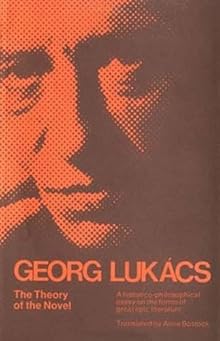
The Theory of the Novel by Georg Lukacs

The soul goes out to seek adventure; it lives through adventures, but it does not know the real torment of seeking and the real danger of finding; such a soul never stakes itself; it does not yet know that it can lose itself, it never thinks of having to look for itself.  Such an age is the age of the epic.

I know very few are interested in the wonky lit crit books I'm assigned for my graduate school classes, but I want to blog every book I read, so I'll keep this brief.  Georg Lukacs' The Theory of the Novel seeks to explain why we read and write novels, when once we wrote epics.  The short version is that "The novel is the epic of a world that has been abandoned by God."

A longer explanation would show that our fundamental relationship to the world is not what it was for the Greeks, whose "answers came before their questions."  The rift that occurs between our interior selves and our exterior world makes our adventures ones of interiority, of struggling against the paradox of having to live in an unknowable world, unlike the epic heroes who are "only the luminous centre around which this unfolded totality revolves, the inwardly most immbole point of the world's rhythmic movement."  Something similar is described in Josipovici's Whatever Happened to Modernism?, but more lucidly.

That, so far, I think I understand.  But Lukacs' attempts to provide a more nuanced schematic of the novel tend toward utter impenetrability.  There are too many sentences like this one:

The world of distances lies sprawling and chaotic beneath the radiant celestial rose of sense made sensuous; it is visible and undisguised at every moment.


I won't front.  I don't have the first idea what that means.  Lukacs' foreword basically recants the book in its entirety, saying that in retrospect it was bad form to make generalizations and then try to fit individual examples to them.  But The Theory of the Novel is, as far as I can tell, almost bereft of any real evidence that might clarify thoughts like the ones above.  When it does discuss real literature, as in late chapters on Goethe's Wilhelm Meister and Tolstoy, it does so only in the most abstract way possible.  I teach my high schoolers that the most important skill they can develop in writing about literature is the ability to support their argument with textual evidence.  Is that too much to ask of Georg Lukacs?

Tuesday, February 28, 2012

Untimely Matter in the Time of Shakespeare

Jonathan Gil Harris' Untimely Matter in the Time of Shakespeare is an exercise in the burgeoning field of thing studies, the quasi-literary exploration of material things and their roles in shaping human experience. The title is misleading, not only because Harris draws from diverse literary sources (up to and including the 20th century), but because at the outset he disavows the reductive practice of historicizing things, or considering them as products of a singular time and place:

We might call this the national sovereignty model of temporality. Although it licenses trade between different moments (allowing, say, the "modern" to import elements from the "early modern" and to export others to the "postmodern"), it grants each moment a determining authority reminiscent of a nation-state's: that is, firmly policed borders and a shaping constitution. As a result, any historical phenomenon tends to be regarded as a citizen solely of one moment-state, And from the vantage point of the present, the past becomes a foreign country, or several foreign countries.


On the contrary, Harris argues, material things contain traces of multiple times that coexist. Matter, he says, is typically "palimpsested," a word derived from the monastic practice of re-using parchment, which would allow the past to peek through to the present.

Harris describes three types of palimpsests: Supersessions, in which the present seeks to overwrite or appropriate the past; explosions, in which the past "fracture[s]" the present; and conjunctions, in which the two are combined in a more mutual and cooperative sense. He accompanies each of these with an example from Shakespeare and an example from another writer, some more successfully than others. The most interesting of these is, for me, his analysis of John Stow's description of Jewish characters on London's Ludgate. The Ludgate, named for London's mythical founder King Lud, is emblematic of the city's history and heritage. Having been repaired with stones appropriated from the houses of the city's nearby Jewish minority, whose past "explodes" into the present, fracturing the gate's symbolism and creating a paradoxical cultural hybridism.

I find it harder to buy Harris' attempt to connect the olfactory experience of gunpowder squibs used in Macbeth to the Gunpowder Plot, in which Catholic agents attempted to assassinate King James I in the Houses of Parliament. The house of cards--the smell of gunpowder is palimpsested not only by the suggestion of the devil and Judgment Day but the now-absent smell of Catholic incense--just seems too flimsy.

The last chapter, which deals with the conjunction of the human body in Helene Cixous and Margaret Cavendish, I must admit I did not understand. This is partly because Harris' crit-speak goes into overdrive (there's a lot about "rhizomes" and "texxts") but I hope also because I'm not familiar with either writer.

Tuesday, November 8, 2011

Liturgy and Literature in the Making of Protestant England

This is in part because, despite criticism's frequently professed desires to "make the past strange," it much more often makes it overly familiar. The depth, passion, and occasional ferocity of early modern religious belief simply doesn't resonate in a secular modern culture committed to toleration and agnosticism, so we tend to reduce its alienness by overlooking it, or translating it into terms we are more comfortable with. But those are by definition not the terms in which these things existed and operated historically; when we use them as the basis of our critical practice, we are looking not at the past but an image of modernity in hose and ruffs.

The influence of the Book of Common Prayer is everywhere, though you may not realize it--it is responsible, for example, the phrases "ashes to ashes, dust to dust," and "dearly beloved, we are gathered here today..." But the author of Liturgy and Literature in the Making of Protestant England, Timothy Rosendale, believes that it has been insufficiently explored as a literary document.

Rosendale gives a brief account of the Book's creation, depicting it as an attempt--or rather, a series of attempts--at negotiating the bitter Protestant-Catholic tensions of post-Henry VIII England. Interestingly, he argues that much of the Book's efficacy comes from its calculated ambiguity that, like Elizabeth I's public religious persona, deliberately left room for residual Catholic practice. By creating a national uniform liturgy in English, it also helped to create and bolster an English national identity, negotiating the need for the monarch's supremacy over religious practice and deeply held Protestant beliefs about the importance of individual priesthood. In the final chapters, Rosendale turns to the Book's literary influence, tracing its impact on Sidney, Shakespeare, Milton and Hobbes. I particularly liked the chapter on political power in Shakespeare's histories, in which Rosendale argues that the history plays, from Richard II to Henry VI, map the transition to a monarchical system in which power is maintained through representation and symbolism, mirroring the Prayerbook's vision of the Eucharist.

What I appreciated most about Rosendale's book is what I have quoted above. One of my deepest misgivings about modern criticism is a sneaking suspicion that it does not treat texts seriously, using them as templates for various ideological, political, or philosophical agendas. While Rosendale happily points out the positive aspects of various critical schools (for example, he praises the way in which New Historicism has "emphasized... the idea that the literary is not walled off from other spheres of culture"), he is careful to treat the religious impulses that created the Book of Common Prayer as genuine and not outward manifestations of psychological or political pressures.

Furthermore, books like this (and too a lesser extent, McCoy's) allay my fears that scholarly language need be obtuse or somehow "beyond me;" not only is Rosendale's text highly engaging and fluid (his paraphrases of his critical sources tend to be far more lucid than they), but occasionally he'll do something like this:

"...even the Zwinglian sacrament is clearly set apart to operate in a different symbolic register; after all, a completely desacralized Eucharist would be nothing more than a snack(rament).


Zing!

Sunday, November 6, 2011

Alterations of State by Richard McCoy

Richard McCoy's Alterations of State is a survey of Reformation-era literature that seeks to investigate changing ideas about sacred kingship. To those of us who, in our high school history classes, congratulated ourselves for not belonging to a society that believes in divine right, McCoy's book does a good job outlining the theological complexities of that philosophy, which give it force beyond the need to consolidate a monarch's power.

McCoy argues that the idea of sacred kingship was ultimately a response to the Reformation's abolition of "real presence" from the sacraments, churches, and relics of England. He takes us back to Marburg (cue Ford Madox Ford) where Zwingli rejects Luther's claim to Christ's presence in the Eucharist and tells us that "Monarchy's enduring power derives in part form a vague but persistent desire for a real presence in the face of an 'essential absence.'" That is, because we could no longer locate Christ's presence in the traditions and icons of the church, a national vision of Christianity required that presence to be relocated in the figure of the King himself.

Alterations of State is persuasive and thorough, yet highly readable. Most of the chapters are organized by the authors in whom McCoy tracks the conflicts over sacred kingship, including Skelton, Shakespeare, and Marvell. Perhaps the most interesting of these, for me, was the chapter on Shakespeare, in which McCoy contends the relationship between Hamlet and his father's ghost mirrors the Reformation-era compulsion for an obviated spiritual presence in the Catholic sacraments. Though I wouldn't recommend this for most readers here, I found it fascinating.

Tuesday, January 4, 2011

The Things That Matter by Edward Mendelson

In the process of applying to graduate school, I have been seized by a fear--perhaps one I should not detail too thoroughly in this, a public forum--a fear that I am entering into a world of obscurism and arcana, the kind of universe that inspired the late Dennis Dutton's yearly bad writing contest. For this reason I have gravitated toward critics like Harold Bloom, James Wood, and Edward Mendelson, a Columbia professor of English who in The Things That Matter writes:

[Novels]were not written to be read objectively or dispassionately, as if by some nonhuman intelligence, and they can be understood most fully if they are interpreted and understood from a personal point of view, not only from historical, thematic, or analytical perspectives. A reader who identifies with the characters in a novel is not reacting in a naive way that ought to be outgrown or transcended, but is performing one of the central acts of literary understanding.


Mendelson divides The Things That Matter into seven parts, each corresponding to the Seven Ages of Man. Each age is embodied by a book; for Mendelson, Frankenstein becomes a novel about birth, Wuthering Heights about childhood, Jane Eyre, adolescence; Middlemarch, marriage. Love, parenthood, and "the future" are given to three novels of Virginia Woolf's: Mrs. Dalloway, To the Lighthouse, and Between the Acts, respectively.

This works better than it probably should. Mendelson is a thoughtful and--if this is a thing that can be said--a creative reader, seeing in novels what I had not imagined. He has the kind of wisdom that sees wisdom, and I found myself moved by several thoughts. Who would have thought that Frankenstein--which I disliked--had such subtleties as this, in an explanation of Victor's fascination with alchemy:

Magic is different from modern science in two crucial ways. First, magic promises results that are spectacularly vast in comparison with the amount of effort that goes into them, and, second, only exceptional individuals can wield magical powers. The words of a magical spell can be spoken as easily as any ordinary words, but when spoken by the right person, they cause earthquakes and thunders... Part of the appeal of the alchemist's magic is that it claims to give you something for nothing, provided that you are special enough to deserve it. (A similar fantasy of getting something for nothing seems to be behind the idea of "magic" in the realm of human relations: the husband or wife who complains that "the magic has gone out of my marriage" is perhaps disappointed at no longer being given something for nothing.)


Or this, about Jane Eyre and Mr. Rochester:

Jane Eyre and Edward Rochester have each endured loneliness and solitude in order to arrive at this point, because in the world perceived by Charlotte Bronte all roads to the gardens of intimacy lead through deserts of solitude, and no one can attain intimacy who has not accepted loneliness.


I certainly do not agree with everything that Mendelson says. He makes a bold claim in his introduction that our foremost novelist of the past two centuries is Virginia Woolf, and that our sacred cows--specifically, Eliot, Yeats, and Joyce--are exalted by the assumption that pattern and myth are superior to human emotion and psychology. It is easy to appreciate the underlying sentiment, which appeals to the non-professional reader and forsakes the academic, but understates the ways in which pattern and myth anchor and organize human spirits and personalities. Nor does Mendelson quite believe it, I think, as he spends quite a bit of the section on Mrs. Dalloway explaining how it is patterned after Ulysses--itself patterned after The Odyssey.

But The Things That Matter rekindles my excitement for graduate work. Writers like Mendelson (and Bloom, and Wood) maintain, like the keeper of the vestal flame, the vitality of literature, and leave good maps for those who might follow them.

Sunday, July 25, 2010

How Fiction Works by James Wood

So let us replace the always problematic term “realism” with “truth”… Once we throw the term “realism” overboard, we can account for the ways in which, say, Kafka’s Metamorphosis and Hamsun’s Hunger and Beckett’s Endgame are not representations of likely human activity but are nevertheless harrowingly truthful texts.

How Fiction Works was not what I expected. Because Chris recommended it, I expected it to be drab and lifeless, full of terms like mimesis, queer theory, and death of the author. I was expecting something more like the small book I own titled Literary Theory, which has a bookmark between pages 12 and 13 that will probably never be moved.

But seriously, this book was great. It was extremely readable, probably moreso than something by, say, Chuck Palahniuk, and Wood’s exuberance for his topic really comes through. He’s read everything worth reading apparently, but still seems free of snobbery. This might be the least snobbish nonfiction book about books I’ve ever read.

As far as the content, the book is short, and I don’t feel the need to summarize it, but I really enjoyed the last section of the book, about realism. It tied in closely with a discussion I was having the other day about how some literature seems more true than the truth—that is, how a novel about, say, sexual deviants, can seem more real than a nonfiction work about a real one. It seemed silly to me, even though I’d felt it, but the excerpt at the beginning of this review crystallizes it so clearly, I don’t feel like I can add much. I’d like to force read it to every idiot who’s ever said “I don’t read fiction” with a condescending look on their face. Nonfiction will make you smarter; reading (good) fiction will make you a better person.

So, good book, even though I don’t read nonfiction. If you have any interest in the thesis of the title, check it out.

p.s. When I Google image searched "How Fiction Works", the first result was Chris's cover image from his review for this very site. Moving up, fellas!

Thursday, July 8, 2010

How to Read and Why by Harold Bloom

How to Read and Why is a book that seems to accomplish its goals a little early. I had imagined it as presenting a Grand Unified Theory of Reading, by which I might expand my appreciation of literature as a whole, and in its first section it does something of that, as Bloom presents a set of what he sees as essential principles for reading. Among other things, he puts forth what seems to me the most persuasive and encompassing rationale for reading I have ever encountered:

Reading well is one of the great pleasures that solitude can afford you, because it is, at least in my experience, the most healing of all pleasures. It returns you to otherness, whether in yourself or in friends, or in those who may become friends. Imaginative literature is otherness, and as such alleviates loneliness. We read not only because we cannot know enough people, but because friendship is so vulnerable, so likely to diminish or disappear, overcome by space, time, imperfect sympathies, and all the sorrows of familial and passional life.


Terry Eagleton--basically England's Harold Bloom--notes in his remarkably negative review that "[i]t sounds as though Harold is a bit short of mates and reads to make up for it." With all due respect to the achievements of Prof. Eagleton, such a statement reeks of petty snark and, worse yet, of intellectual dishonesty. Loneliness is the undiscussed companion of the human condition and if you do not feel at least a little bit like Prof. Bloom does, then I simply don't understand you.

With the why out of the way, Bloom turns to the how in the 200-odd pages that follow, and it is here that Eagleton's criticisms have some bearing. Bloom divides his book into five sections, one each for short stories, poetry, and drama, and two for the novel, and within each section he briefly treats five to six major authors or works. Each gives the impression of being somewhat less than Bloom has to offer; while the section on Keats may serve as a passable introduction to the poet and enlightens us as to why Bloom treasures "Le Belle Dame sans Merci," it fails to break free from Bloom's solipsism. Despite Bloom's notions that we should be forever reading the best literature available to us, knowing how to read Keats is not the same thing as knowing how to read; knowing how to read Keats exactly like Harold Bloom is more distant still. Furthermore, the meager selections of works suggest no reason for their being included together, and while Bloom tosses superlatives around with impunity (there is no "higher aesthetic achievement by a twentieth-century American writer than As I Lay Dying," no greater book by a living American than Blood Meridian, no greater book by an American black than Invisible Man), their ubiquity drains them of power and it is hard to shake the feeling that the works have been selected, not for their greatness, but by whim.

One notable exception to this piecemeal feeling is the final chapter, on the American novel since Melville, in which Bloom articulates an affinity among seven novels: Moby-Dick, As I Lay Dying, Miss Lonelyhearts, The Crying of Lot 49, Invisible Man, Blood Meridian, and Song of Solomon. These novels all express a "negative sublimity," a horrific transcendence in the tradition of Moby-Dick and a uniquely American and apocalyptic vision:

It is not the function of reading to cheer us up, or to console us prematurely. But I conclude by affirming that all of these American visions of the End of our Time offer us more, much more, than their cleansing negativity... There are survivors among these: Ishmael, Oedipa, Invisible Man. Why read? Because you will be haunted by great visions: of Ishmael, escaped alone to tell us; of Oedipa Maas, cradling the old derelict in her arms, of Invisible Man, preparing to come up again, like Jonah, out of the whale's belly. All of them, on some of the higher frequencies, speak to you and for you.


This, unsurprisingly, does not meet Terry Eagleton's expectations of serious criticism, and though my expectations were quite different it did not quite meet them, either. But to read Bloom is to be in the presence of someone who truly loves reading; I hope that one day I should love my own children as much as Bloom loves books. There is little concrete advice in How to Read and Why, but I do find that it inspires me to find something in books that speaks to me as loudly as these works speak to him. Insofar as the success of How to Read and Why is encountering another soul with its unique passions, a literary fellow traveler, it fails as literary criticism but succeeds as something of sister text to the books it idolizes, alleviating a trace of human loneliness.

Sunday, January 31, 2010

Serendipities: Language and Lunacy by Umberto Eco

Let us for­get for a mo­ment that some of these false tales pro­duced pos­itive ef­fects, while oth­ers pro­duced hor­ror and shame. All cre­at­ed some­thing, for bet­ter or worse. Noth­ing in their suc­cess is in­ex­pli­ca­ble. What rep­re­sents a prob­lem is rather the way they man­aged to re­place oth­er tales that to­day we con­sid­er true. Some years ago, in an es­say of mine on fakes and coun­ter­feits, I con­clud­ed that al­though in­stru­ments, whether em­pir­ical or con­jec­tural, ex­ist to prove that some ob­ject is false, ev­ery de­ci­sion in the mat­ter pre­sup­pos­es the ex­is­tence of an orig­inal, au­then­tic and true, to which the fake is com­pared. The tru­ly gen­uine prob­lem thus does not con­sist of prov­ing some­thing false but in prov­ing that the au­then­tic ob­ject is au­then­tic.

Serendipities is a collection of essays by Umberto Eco chronicling the attempts of linguists and historians to trace language back to its original form, the mother tongue or linguistic matrix that forms the basis for all modern language and grammar. In tracing it back, he also touches extensively on the topics of religion, natural instinct, conspiracies, and various historical events that either prove or illustrated the points he's trying to make.

In all honesty, this was a pretty nerdy book. I really enjoyed it, but unless you have a vested interest in linguistics, it's probably not going to be too appealing. Eco does write in a very accessible style, even when talking about complex, unfamiliar concepts, so if you want to dip your toes in this might be a good place to start. if you just want to read some Eco though, I'd suggest picking up The Name of the Rose.

Sunday, January 25, 2009

How Fiction Works by James Wood

No, not James Woods, acclaimed actor--this book was written by James Wood, acclaimed literary critic. If it had been written by James Woods, I would have enjoyed it a lot more, but as it is, I enjoyed it pretty well, so I guess it's hard to complain.

How Fiction Works is basically a fundamental treatment of what Wood feels are the essentials of the modern novel: dialogue, character, and detail among others, and what makes them work in some books and not in others. It is inspired by similar books, like E.M. Forster's Aspects of the Novel and Milan Kundera's The Art of the Novel, but those books belong to the last century and James seems to have cannily realized that it's time for an update. Also, those books are by novelists; Wood's book is unique in that it comes from a critic's outside--dare I say less biased--perspective.

Outside of Brent and Helen, I have trouble imagining that this book would interest anyone here, though I found it pretty engaging; Wood does an excellent job dissecting the genre and explaining the guts. The book starts, oddly enough, with a discussion of free indirect style, which can be perfunctorily described as the attribution to the narrator words or statements that really belong to a character:

Free indirect style is at its most powerful when hardly visible or audible: "Ted watched the orchestra through stupid tears." In my example, the word "stupid" marks t he sentence as written in free indirect style. Remove it, and we have standard reported thought: "Ted watched the orchestra through tears." The addition of the word "stupid" raises the question: Whose word is this? It's unlikely that I would want to call my character stupid merely for listening to some music in a concert hall. No, in a marvelous alchemical transfer, the word now belongs partly to Ted. He is listening to the music and crying, and is embarrassed--we can imagine him furiously rubbing his eyes--that he has allowed these "stupid" tears to fall. Convert it back into first-person speech, and we have this: "'Stupid to be crying at this silly piece of Brahms,' he thought." But this example is several words longer; and we have lost the complicated presence of the author.


I'll understand if you could care less about free indirect style, but I'm pretty fascinated by what Wood has to say here--especially that an aspect of literature could be so small and indiscernible, but so powerful. Keep an eye out for free indirect style when you read; I think you'll be surprised how omnipresent it really is.

Ultimately, this is a book for book nerds--but it's also quite a bestseller. I had been wondering what makes a piece of literary criticism--not exactly on par with The Da Vinci Code--so popular. I think part of it has to do with the breadth of Wood's topic; which could possibly attract any reasonably curious book-reader (unlike a treatise on gender imagery in the latter works of Poe, or something). Another part is Wood's style, which is smoothly readable and without waste. Wood isn't a novelist, but you wouldn't know it by reading How Fiction Works, which is remarkably uncluttered for a work of non-fiction.

Bonus points: That retro-simple cover is totally sweet and you'll never convince me otherwise.