Showing posts with label Orpheus. Show all posts

Monday, September 18, 2017

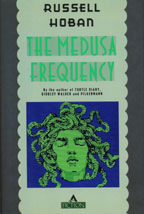
The Medusa Frequency by Russell Hoban

There are two ways to tell a story *.

The first is to come up with a plotline--boy meets, loses, regains, mutates girl--and play it out beat by beat until it reaches its natural endpoint. This is a great method! Most books are like this, in my experience.

The other, of which Hoban seems to be a fan, is to take a concept like, say, the ephemerality of life or the reality of real aloneness or the permenance of loss, and pick a seemingly arbitrary entry point and follow it through to an equally arbitrary endpoint, and make the reader do the hard work of making an end-to-end narrative out of it. In The Medusa Frequency, he cops directly to this tendency, or maybe just to its origin:

Page one? I didn’t think so. Suddenly the idea of turning one’s experience into a story seemed not only bizarre but perverted. Where was the beginning of anything, how could I draw a line through endless cause and effect and say, 'Here is page one?’

And Hoban sometimes seems to fully embrace the quixotic nature of that question in the novel, starting with half-made-up conversation with the mythical Kraken that takes place on the green and black screen of an old Apple II, and ending with a comic book adaptation about a monster who is the plug in the plughole of the universe. Its name is The Great Snyukh. Oh, and the decapitated head of Orpheus, which manifests as any rounded object, probably has more dialog than anyone else in the book.

But in between, and often during, these fantasias, Herman Orff, the epically (lol) named protagonist of the book struggles to come to terms with the loss of Luise, an ex who acts as his own incarnation of the mythical Eurydice. With his act of looking at her too soon, he has lost her--although, as Orpheus informs him, the real crime is looking away. And the cyclical nature of the world means this story will happen again and again, with different details but the same prosaic, banal ending--loss and some form of either death or rebirth. As Herman says:

"The death of a moment's longer than the moment. The goneness is what we're left with. It's very hard to have anything, isn't it?"

In summation, this doesn’t sound like the kind of book that would be much fun to read. But Hoban has a light touch and squeezes a lot of humor--often actual jokes--into less than 150pp. I enjoyed his explanation of why villains in pulp stories never get inappropriately sexual with the heroines:

“For the same reason they can never shoot straight: they’ve got no self-confidence. That’s why they’re the bad guys--repeated failures have made them bitter and antisocial.”

And, of course, as in the equally strange Riddley Walker, Hoban nails the moments of pathos, making real flesh-and-blood out of Herman, Orpheus, and a number of delightfully-named minor characters (surely Pynchon is a fan--Melanie Falsepercy, Gom Yawncher). What could have been a tedious meta exercise in navel gazing instead functions almost like poetry in the end.

When Herman, rapidly falling apart in his confusion and post-breakup malaise, says, "It seemed so little to ask, that the next moment should come." it feels real, even when he’s saying it to a talking cabbage.

*I know there are a lot more than two ways, but this is a rhetorical device, dear reader.

Monday, April 24, 2017

The Medusa Frequency by Russell Hoban

I went down to the kitchen and opened the fridge.  There were three cans of beer, most of a salami, a mouldering of old cheeses, half a tub of margarine, half a pint of milk and the head of Orpheus.

'Loss!' it said.  'That's what she was to me, you know: she was the loss of her even when she was apparently the finding of her, the having of her.  And I was the same to her, I was her the loss of me.  We were the two parts of a complementarity of loss, and that being so the loss was already an actuality in our finding of each other.  From the moment that I first tasted the honey of Eurydice I tasted also the honey of the loss of her.  What am I if not the quintessential, the brute artist?  Is not all art a celebration of loss?  From the very first moment that beauty appears to us it is passing, passing, not to be held.'

Herman Orff makes a living turning classic novels into comic books, and at night he tries to write his third novel.  He has writer's block; he's hung up with the loss of his ex Luise, who left him years ago.  He visits a London shop advertising a solution for his problem, and they give him a brief electrocution, after which he begins to see the severed head of Orpheus in the place of various spherical objects around the city.

Hoban's version of the Orpheus story--if I can try to compress what's so loose and variegated in the novel--is a story of the connection between art and loss.  Orpheus tells the story of his creation of the lyre, which was first made out of a tortoise shell, necessitating the murder of the tortoise:

The tortoise was in my left hand and my knife was in my right; my idea was the tortoise-shell empty and two posts and a yoke and some strings for a kind of little harp with the shell as a soundbox.  The man's eyes were still on me, his wide-open eyes; almost I wanted to use the knife on him to make him stop looking at me.  He let his hands drop to his sides when I cut the plastron loose and dug the body out of the shell, ugh! what a mess and my hands all slippery with blood and gore.  The entrails were mysterious.  I think about it now, how those entrails spilled out so easily when I made an emptiness for my music to sound in.  Impossible to put those entrails back.

The creation of art, then, is inseparable from the experience of loss, the distance we feel from those we have loved.  Not a way of coping, Hoban insists, but very nearly the experience of loss itself.  Into this central conceit Hoban ties a shaggy collection of symbols and motifs--the head of the Medusa, something called the "world child," Vermeer's Lady with a Pearl Earring.  In one memorable sequence, the hero Herman Orff ("her man, Orpheus"--LOL) boards a boat to Holland to see the painting in real life; but it's on loan in America so he's forced to contemplate its absence.  Hoban shares a tendency with Muriel Spark, I think, to overload slim narratives with images and ideas so that you're prevented from really seeing the whole.  But as Hoban writes about writing, "Where was the beginning of anything, how could I draw a line through endless cause and effect and say, 'Here is page one?'"

With all that cramming the fewer than 150 pages of the novel, it's surprising that Hoban is able to make it as funny as it is.  Hoban has a field day with the comic scenarios in which the head of Orpheus appears, in place of a boulder, or a globular street lamp, or half a head on a plate where half a grapefruit ought to be.  (Orff runs home trying to keep in the brains.)  I've been struck by how different Hoban's books are from each other, but here I see common links with the gleeful pantheistic personification of Kleinzeit, and the sad-sack lonely Londoners of Turtle Diary.  (One wonders what Orpheus, the turtle-killer, would think about the couple in that novel releasing their inscrutable turtles into the wild.)  But like those novels, The Medusa Frequency is truly, unforgettably, weirdly unique.

Friday, January 4, 2013

Flesh of My Flesh by Kaja Silverman

Finitude is the most capacious and enabling of the attributes we share with others, because unlike the particular way in which each of us looks, thinks, walks, and speaks, that connects us to a few other beings, it connects us to every other being.  Since finitude marks the point where we end and others begin, spatially and temporally, it is also what makes room for them--and acknowledging these limits allows us to experience the expansiveness for which we yearn, because it gives us a powerful sense of our emplacement within a larger Whole.  Unfortunately, though, finitude is the most narcissistically injurious of all the qualities we share with others, and therefore the one we are most likely to see in them, and deny in ourselves.

One day you will die.  This is an astonishingly hard concept to accept.  Many, I imagine, never do, at least not until death intrudes upon them.  Death is always something that happens to somebody else, not to me--I've even rejected it in this very paragraph, by opening in the second person.  A more truthful beginning would be: One day I will die.

The thesis of Kaja Silverman's book is that the unwillingness or inability to see ourselves as mortal is the greatest cause of suffering, cruelty and violence in human history, and that if we recognize mortality (what she calls "finitude" above") as the essential similarity between all of us--we become capable of the very transcendent experience we seek by denying death.  She calls this "analogical thinking," and traces it through a series of works from Ovid, Leonardo, Rilke,  Freud, Terence Malick, and contemporary painter Gerhard Richter.  Silverman works mostly in a psychoanalytic vein, yet the breadth of the study makes it incredibly persuasive.

The fundamental story of this way of thinking, she argues, is the story of Orpheus, whose gaze at Eurydice banishes her back to a land of death from which he is excluded.  Boldly, Silverman argues that there is an "Orpheus inside every Oedipus," shoving Freud's quintessential human narrative aside to argue for another primal story.

I thought this book was incredible.  I think it ought to resonate with anyone who has felt the fear of death, and especially those of us who have found some comfort in the idea that if it is an inscrutable terror, it is an inscrutable terror that each of one us will face.  For Silverman (and every other atheist critic, to be sure) religion is an offshoot of man's fear of death.  The violence done in religion's name, then, is sadly consistent with its purpose, which is to say, "Death for thee, but not for me."  I'm not willing to go that far, but I think that Silverman's thinking can be accommodated by a believing psyche, as her brief thoughts on analogical thinking in Donne shows.

Perhaps most impressive: Flesh of My Flesh is a rigorous and thoughtful piece of academic criticism that is neither unintelligible nor pointless.  That's a rare breed.