Saturday, June 7, 2025
The Fifth Head of Cerberus by Gene Wolfe
Saturday, February 1, 2025
The Employees by Olga Ravn
It's our experience that the objects from the valley of New Discovery want to stay with us here. It feels like they're ours, and at the same time like we belong to them. As if they in fact are us. The Six Thousand Ship can't function without our work. No, I don't want to say anything else to you now. Impending violence is by no means inconceivable. We're only just beginning to understand what we're capable of.
Who are "the employees" of The Employees? Some of those working aboard the Six Thousand Ship are human, and some are "humanoid," biological androids who resemble, but are not exactly like, their human coworkers. The novel takes the form of a series of interviews done with a mysterious HR wing of the ship's administration, and though at first the distinction between these two types of interlocutor is unclear, over time the differences--and divisions--between the two classes of coworker become clear. Over the course of the interviews, it's revealed that the ship has taken on board several mysterious "objects" from a valley on a planet called New Discovery. These objects--perhaps like the humanoids--seem somehow both mineral and organic, and they call out to the workers of the ship in subtle ways--through colors, dreams, smells.
Though the mechanism is kept ambiguous, the presence of the objects seems to create an awareness in the humanoids of the difference between them and their human coworkers. Already at the beginning of the novel, Ravn hints at a redacted moment of violence and banishment; this is, perhaps, the first signal of the objects' effect. I read The Employees as a book about the development of a class consciousness: though the Six Thousand Ship is structured in such a way to elide the differences between humans and humanoids, the humanoids are really a lower class of worker, a kind of android proletariat, and their connection to the objects allows them to see the differences for the first time. The novel's HR speak--starting with its title--point to a satire on the language of modern employment. It made me think about the way that companies like Uber intentionally blur the line between "employees" and "contractors," and other ways that modern workplaces are striated and stratified under the guise of the "we're a family here" attitude. Of course, it also brings up certain anxieties about the future workplace under automation. What if all those self-checkout machines at the CVS decided they didn't want to do our bidding anymore?
The Employees has a kind of too-good-for-science-fiction vibe, for both better and worse. Better, in that the language is sharper and the images often striking, and in the way that Ravn eschews lengthy exposition about the nature of the objects or the scientific mechanisms of their functioning. Worse, in that the world of the Six Thousand Ship seems undercooked, drawing from stock ideas about space travel that feel obvious or dilettantish. Brent said that he wanted the story to be either more ambiguous or more unambiguous, and that feels right; the littleness and spareness of the method end up giving the impression of an allegory or a fable, rather than a novel.
Sunday, May 12, 2024
Solenoid by Mircea Cartarescu
The essential ambiguity of my writing. Its irreducible insanity. I was in a world that cannot be described, and definitely not understood, through any other kind of writing, insofar as it can truly be comprehended. Revealing is one thing, and the painful process of reverse engineering, which is true understanding, quite another. You have before your eyes an artifact of another world, with other dawns and other gods, an enigmatic Antikythera mechanism that shines, floating in the air, in all the details of its metal brackets covered with symbols and small gears. It was difficult to retrieve it from the bottom of the sea, from all its oyster beds and undulating algae, to meticulously clean off the crust of petrified and and rust, to grease it with glittering oil, to set every gear in place so all the teeth fit together, and this is what my manuscript has done, up to this point: it has revealed, brought to light, unveiled what was hidden behind veils, it has decrypted what was locked in the crypt, it has deciphered the cipher of the box where it lay, without even a dash of the unknown object's shadow and melancholy dripping into our world.
Solenoid is narrated by an alternative version of Mircea Cartarescu, the writer whose 600-page phantasmagoria has made him famous (in book terms) around the world as well as in his native Romania. This version of Cartarescu, instead of achieving acclaim for his poetry early in life, had his work mocked and rejected, and ended up as a teacher of Romanian literature in a Bucharest middle school. He goes home each night to his "boat-shaped house," where a strange mechanical device--the title solenoid--generates a field that allows him to float above his bed at night. The solenoid provides the key, perhaps, to the strange and otherworldly occurrences that punctuate his life: the dream-like "visitors" that appear at his bedside, the invisible aliens who capture the school janitor, the enormous automaton that stomps a man to death, the secret chambers beneath the factory beside the school, the window into another world peopled by mites and other animalcules blown up to size of elephants.
If you know one thing about Solenoid, it's that it includes seven pages of nothing but the word "help!" repeated over and over. It's a cry that comes from deep within the narrator's being: help me! Get me out of this life, where I am imprisoned in a body, a body that will ultimately die. One of the funnier bits of Solenoid involves a group of protesters called the "Picketists" who demonstrate against death. Their protests are useless, of course, but who doesn't spend much of their life wondering about their own end, and why it has to be so, why it can't be otherwise? "Otherwise" is a key word for Solenoid, a word that resounds in its many doppelgangers and doubles, of which the second Cartarescu is one. (Another can be found in the way the narrator tells us he was raised as a girl by his parents, in effect, as his own dead or vanished twin sister.) Why must things be one way rather than another? Why must we be trapped in this existence, both metaphysically and physically?
I don't think I can explain to you what exactly the solenoids of the novel are, or what they're supposed to do, or how exactly they fit into the larger novel. I do get the sense that their power is in enabling that otherwise, in giving the narrator and others the ability to see life from another vantage point than their own limited one. Solenoid insists that, even though our own perspectives are by nature limited by our physical being, there is a world greater and more expansive that interacts with our own. The narrator's obsession with tesseracts is one example of this: four-dimensional shapes that change and transform as they pass through our own three-dimensional world, just as a three-dimensional cube passed through a plane creates a diamond that opens like a flower.
Another are the many, many images of microscopic animals, first arrayed in a kind of museum (accessible, House of Leaves-like, through a mysterious door in the narrator's own home), then glimpsed through a magical window. Cartarescu describes the mites as looking like the long-legged elephants from Dali; only later did I come to understand that what the narrator is given a glimpse of is not an alien planet, but our own world at a different scale, a world that is part of our own but has as little relation to our world as ours does to the world of the fourth-dimension--or the world of God. In one climactic scene--maybe the highlight of the long, bizarre novel--the narrator is transformed by a sympathetic librarian into a mite, where he is tasked with becoming the "Christ of the mites." How does a mite talk about? Through stomach waves and magnetic fields, it seems. The narrator's gospel "inspired in them an attitude they hadn't felt before, a longing toward what is impossible to imagine," and his description of the divine "they could not imagine except as an endlessly lazy and incredibly sad mite, wrapped in baroque-fetid scents, in whom putridness and sandalwood, formaldehyde and oleander, cinnamon and hydrogen sulfide, as well for us inconceivable smells of eyes, sky, spider, scream, hunger, claw, bronze, god, near, and, nor, probably weave together into a metaphysical robe of endless grandeur." This is, I think, wildly funny and poignant: all your religion, Cartarescu seems to say, is a cribbed and malformed understanding of that divine otherwise, and yet, by pointing the way outside of the self, it points to truth.
Once in my life I believed that the best novels are more metaphysical than political; they explore certain truths about human life that are beyond history and culture. I don't really believe that anymore; at least, I don't believe that the political is a sphere separate from the metaphysical, and I feel that claims to expressions about "the human condition" often ignore the ways that humans actually interact with one another. But Solenoid inspires the old feeling in me, that there is a truth at the bottom of human life, and it deals with the mystery of existence and the inescapable tragedy of death. Help! You said it, brother.
Friday, October 27, 2023
Dhalgren by Samuel R. Delany
They exhaust my eyes. My ears are on fire. There is nothing left to watch but fire and the night: circle within circle, light within light. Messages arrive in the net where discrete pulses cross. Parametal engines of joy and disaster give them wave and motion. We interpret and defeat their terms by terminus. The night? What of it. It is filled with bestial watchmen, trammeling the extremities and the interstices of the timeless city, portents fallen, constellated deities plummeting in ash and smoke, roaming the apocryphal cities, the cities of speculation and reconstituted disorder, of insemination and incipience, swept round with the dark.
Something has happened in Bellona. We don't know what it is--maybe nobody does--but it has turned the Midwestern city into a place isolated from the rest of the country, without government or utilities, cut off from commerce, largely abandoned. Gangs of "scorpions," petty thugs hidden in giant hologram animals, roam the street. Geography shifts; streets and neighborhoods change places. A second moon appears in the sky; a new sun absorbs the sky and threatens to set everything on fire. A man makes his way into this city wearing only one shoe and unable to remember his name. Called "The Kid," he takes up with a commune living in the park, then with a nest of scorpions, who make him their leader. He gets a girlfriend, and then also a boyfriend, and he writes a book of poetry, which becomes--well, not a bestseller, because money in Bellona is no good, but whatever the equivalent is.
What is Dhalgren? It's science fiction, maybe. The scorpions, the second moon, the claw-like "orchid" he wears for protection, all seem like images taken from old pulps. Stylistically, Dhalgren lies somewhere between those pulps and Beat writing, with a dash of the exploitation movies of the 1970s. Bellona is post-apocalyptic in its way, though I'm not sure I've ever seen a self-contained dystopia, one that crumbles while the rest of the world trucks on as usual.
What is Dhalgren? Well, it's long for one--my copy is exactly 800 pages. It's very metatexual: the notebook that the Kid discovers, and scribbles his poems in, seems to be a copy of the book itself. After the successful publication of "Brass Orchids," a critic who's seen this notebook--we're never allowed to see any of the Kid's poems ourselves--remarks that he thinks they've been cribbed right from the notebook, which means that the character is somehow a collaborator in the work itself, which is also therefore circular, feeding on itself. Like Finnegans Wake, the final sentence wraps around to the beginning. The last section is, ostensibly, a facsimile of the notebook itself, written in the first person and crowded with disordered fragments. What is text and what is commentary, exactly? And how does the fragmented writing capture the fragmented self of the Kid, who does not know his identity and who frequently "loses" hours and days in time?
I want to make a suggestion: Dhalgren is about, among other things, the city of the 1970s. Bellona is less the Thunderdome than Cleveland or Detroit, emptied out by years of white flight and suburbanization, and with the coffers so empty that the normal course of life threatens to break down. The scorpions that Kid hangs out with--who have evocative names like Copperhead, Filament, Tarzan, Glass, Dragon Lady, Lady of Spain--are undoubtedly violent, going on "runs" for food and supplies that make little distinction between homes that are occupied and those that aren't, but they also provide community for each other, in the manner of an urban underclass who have been shunted aside. Bellona's disintegration is a catastrophe, but also an opportunity: it allows the family unit to be reimagined. The scorpions follow a kind of free-love philosophy that allows Kid to have his throuple with Lanya and Denny. (Much of the book's second half is taken up with scenes of tedious, queasy sex. Let's pass over the fact that Denny is fifteen.)
Not everyone can embrace the change. The best parts of Dhalgren, in my opinion, come when the Kid, new to the city, is given a job moving furniture from one floor of an apartment building to another for a middle-class family. The mother stays inside, clinging to a version of normalcy. Her husband pretends to go to work each day, because there is no work. (For that matter, there is no good reason for Kid to have a "job," when their money--which they plan to stiff him anyway--is good nowhere in Bellona.) But their daughter June is obsessed with George, a charismatic character from Bellona's Black neighborhood, and whose immense penis, for reasons that were never clear to me, is plastered on posters all over town. When her kid brother discovers the poster, June may or may not push him down an empty elevator shaft with a rolled up carpet. This is the novel's most shocking act of violence, far worse than anything the scorpions cook up, and it seems to suggest the futility of the family's attempt to keep the city locked outside, or escape it by moving two floors up.
Kid, however, comes to embrace the possibilities of Bellona, and for this he's made king of the scorpions. The final chapter, the notebook, troubles this somewhat: in its fragmented form, the violence and dissolution seem more frightening, as if they are also part of the Kid's unraveling. But more than anything I think Dhalgren, science fiction or not, captures the pulp era's dizzy sense of possibility, and applies it to the American metropolis. Here anything is possible. "I come to wound the autumnal city," the first--and last--sentence goes: a city in decline, but which perhaps can be reconstituted, made into something new. When the end is reached, there's the beginning.
Sunday, April 23, 2023
The Invention of Morel by Adolfo Bioy Casares
Now I understood why novelists write about ghosts that weep and wail. The dead remain in the midst of the living. It is hard for them, after all, to change their habits--to give up smoking, or the prestige of being great lovers. I was horrified by the thought that I was invisible; horrified that Faustine, who was so close to me, actually might be on another planet; but I am dead, I am out of reach, I thought; and I shall see Faustine, I shall see her go away, but my gestures, my pleas, my efforts will have no effect on her. And I knew that those horrible solutions were nothing but frustrated hopes.
When I read Robinson Crusoe a few years ago, the most surprising thing was just how long it took him to get to the island. Not only are there several chapters before the marooning, there are multiple shipwrecks, after which Crusoe returns to dry land and sets out again. It’s only the third shipwreck that leaves Crusoe stuck on the island that would bring him literary immortality, a whole genre bearing his name, the Robinsonade.
The Invention of Morel, on the other hand, takes the opposite tack. From page one we are on the island, inside the head of one man, a nameless narrator on the run from the law, likely due to some sort of revolutionary activity he’s involved with in his native Venezuela. The narration takes the form of a diary, much of which, in the early going, is dedicated to describing the strange island, for prosperity. Small and fully traversable in a day, the island has a number of strange features: tides which do not precisely follow the moon, a number of mysterious, island-spanning machines that perform some initially unidentifiable work, and three structures, a museum (which is really more like a hotel), a chapel, and a swimming pool. And initially, our narrator is alone.
But after some days, a ship, populated with about a dozen people, lands. At first fearful of being discovered, the narrator grows bolder upon seeing Faustine, a pale woman who sits on the beach each day, whom he immediately falls madly in love with. But she doesn’t seem to see him--literally, he jumps out in front of her in an ill-conceived plan and she reacts not at all. He plants a garden and she doesn’t see it. He sits beside her and she never speaks. There are other inhabitants, including a man who rouses the narrator’s jealousy, the titular Morel, and they all seem similarly stricken. And so about one-third of the way into the book the central mystery is established, and the rest of the book will be spent speculating on and eventually solving it. Spoilers follow.
As the excerpt above indicates, and as I initially assumed, the narrator first believes he is dead, then that he is slowly being caught in some elaborate trap, then that the interlopers, including Faustine, might be aliens of some sort, but every scenario is eventually dismissed, and the narrator begins to notice that certain things seem to be repeating themselves: one day he wakes up and the ship is gone, the next it returns. Finally it becomes clear to him that he’s stuck in a loop--not that he is looping himself but that somehow the events around him are. After spending a little while creeping on Repeating-Faustine, he finally manages to follow the sequence of events and hear Morel’s speech wherein he lays out exactly what’s happening.
It turns out that Morel is something of a mad scientist and has invited his friends here to live a perfect week while being recorded by the giant machines around the island. Not recorded on video or audio only--no, Morel’s machines record everything to the extent that reality is impacted. Every movement, every smell, the position of every molecule in a person’s body, even the positions of the moons and the tides. But! It turns out that recording all this information requires something like the soul-stealing properties cameras were once thought to have, a process that causes a swift degenerative sickness and finally death as the person’s soul itself is duplicated--or trapped--within the machine, repeating the same set of events for eternity.
The friends are all horrified but of course it’s too late--they’ve already been captured. The facsimiles(?) though, have no idea that they’re in a loop, since their captured forms have only the memories they had at the moment of capture, and the big question of the book is finally whether their situation is really bad at all: are they metaphorically in Hell or in Heaven? Is it really so bad to repeat a perfect week forever for the first time, over and over and over? After all, the narrator is able to have novel experiences and what good has it done him?
Ultimately, he decides he’d rather be part of the loop than live the life he’s got, so he arranges, over a series of months, a sequence of events that integrate him into the narrative, with the intent that when this island is eventually discovered, those who see the diorama will think he and Faustine were great lovers, or at least a great love. And maybe somehow they are, even though Faustine will never, can never, know.
Saturday, February 25, 2023
The Investigation by Stanislaw Lem
“Maybe even God only exists from time to time,” the Chief Inspector added quietly. He had leaned forward, and with his face averted was listening attentively to what Gregory was spewing forth with such difficulty from deep inside himself.
“Maybe,” Gregory replied indifferently, “But the gaps in his existence are very wide, as you know.”
Inspector Gregory is called upon by Scotland Yard to investigate a strange series of crimes--corpses are disappearing from their caskets, only to be found a short ways away, the twist being that a few of them have been spotted in transit. In short, is this a case of prankish grave robbery, or are they something stranger and more destabilizing: a sort of resurrection?
The summary makes The Investigation sound like a horror story, or perhaps an existential detective novel in the vein of New York Trilogy or Death in Her Hands. And it is, in some ways, both of those things. I don’t think it’s much of a spoiler to say that, like in those two novels, the “crimes” such as they are, are never solved and the investigators undergo an identity crisis. Nor can it really be surprising that some parts are very creepy: a reel to reel recording of a witness dying as he spends his last breaths describing a writhing corpse; Gregory’s dream of his landlord as a puppet master who contacts the dead through his manipulation of a pair of mannequins; an interview with Sciss, a police statistician(?) that devolves into a strange psychosexual encounter complete with mysterious negative depicting snuff films.
Spoilers follow, to the extent that this can be spoiled.
The climax, no less unsettling for its predictability, sees Gregory, whose entire life has slowly been consumed by the case and its myriad unprovable causes--a psychopath, a virus, alien technology, God--given a plausible explanation by his chief, an explanation that posits a trucker who’s been slowly driven mad by driving through the foggy winter nights. He protests, he points out the facts that don’t fit the explanation, he protests about the arbitrary nature of it all; ultimately though, he accepts it, because to not do so would upset the constructions that allow Scotland Yard, religion, government, human relationships, et al, and the premise that lies behind it all: that there is some concrete meaning in the world, and that we can discover and comprehend it. That actions can be explained, crimes solved, and corpses safely assumed to be dead.
And yet, the book as a whole is somewhat inert, consisting largely of long conversations between various detectives, officers, scientists, and doctors. Entire chapters pass with no real action, and many of the characters outside of Gregory, Sciss, and the Landlord blur together so that much of the book reads more like a philosophical dialogue than a novel. Outside of Gregory’s increasingly emotive responses (he’s always angry, confused, certain), his descent into obsession lacks the texture than makes New York Stories work so well, and the pathos Moshfegh gives the widow in Death in Her Hands. In spite of its compelling big ideas and exciting final quarter, I found this, my first Lem, to be underwhelming--but I’m still looking forward to reading more.
Sunday, November 27, 2022
The Lathe of Heaven by Ursula K. Le Guin
"No!"
"What is his purpose, then?"
"I don't know. Things don't have purposes, as if the universe were a machine, where every part has a useful function. What's the function of a galaxy? I don't know if our life has a purpose and I don't see that it matters. What does matter is that we're a part. Like a thread in cloth or a grass-blade in a field. It is and we are. What we do is like wind blowing on the grass."
Like most people, George Orr has bad dreams. But unlike most people, George's dreams come true: he imagines the death of his abusive aunt, and suddenly she has died in a car wreck. Not dies, has died: as soon as George emerges from the dream he knows that his aunt has been dead for several weeks; his dreams have literally change not just the future but the past, and no one remembers but him. In George memory has a doubleness; he remembers both what happened in this new timeline and the one from before his dreams. Distraught, he tries to keep himself from dreaming through pharmaceutical means, but his abuse of drugs lands him in the hand of a court-appointed therapist, Dr. Haber, who believes he can use George's abilities to create a better world.
My favorite scene in The Lathe of Heaven, I think, is when Dr. Haber, experimenting with his many dream-inducing machines, instructs a hypnotized George to dream of something innocuous: a horse. When George awakes, the mural of Mt. Hood on Haber's wall has become a portrait of a horse. It's a neat little moment of shock, dealt with organically in a way that's almost like a jump cut from a horror movie. Things escalate from there, with each of Haber's attempts at fixing the world having strange and grotesque consequences: by instructing George to make the world less overcrowded, he kills off billions in a plague. By instructing him to make the world peaceful, he conjures up an alien invasion--aliens that turn out to look like giant sea turtles. By instructing him to eliminate racial prejudice, he makes everyone a shade of even gray.
I don't think it was Le Guin's intention, but there's a conservative streak to The Lathe of Heaven: a belief that the best intentions of liberal reformers will always have unintended consequences that are worse than the problems they try to solve. Interestingly, Lathe has mixed success in diagnosing what humanity's problems will be. For 1971, the depiction of a world ravaged by the greenhouse effect is frighteningly prescient. But the belief that the world at seven billion people will be devastatingly overcrowded--she imagines a Portland of three million, with even larger cities emerging in Oregon's interior--looks like awfully silly Malthusian nonsense. Still, there is some wisdom in George's harried warning to Dr. Haber that the ends don't justify the means because "the means are all we have." What Le Guin understands is that the world is an unfolding process with no teleological end; utopian dreams of ending history will always be dreams, and not the kind that become real.
I read in Divine Invasions that Lathe was inspired by the Philip K. Dick novels of the 60's. Le Guin and Dick had a friendly correspondence, and that's not difficult to see here: the spineless subaltern whose dreams become real might have emerged directly from Dick's pages. The love interest, a spidery and abrasive woman named Heather Lalache, seems very "Phildickian" too. But I was struck by the process, outlined in Divine Invasions, by which Dick crafted a novel by smashing two separate ideas together, something that explains the sense of doubling and instability that characterizes his best work. Lathe is a classic, but it suffers in comparison to Dick's work, for me, because it really only has a single layer. And Dick never got caught up in the tedious technobabble that Le Guin writes whenever Dr. Haber starts talking about his dream machine, the Augmentor. I ended up tuning most of that stuff out. Still, Lathe speaks to a modern world that feels constantly on the edge of crisis, when one feels like solutions are simple but elusive.
Saturday, November 26, 2022
Divine Invasions: A Life of Philip K. Dick
But let's put aside theories for now and try first to determine just what happened in 2-3-74 and the months that followed. Be forewarned that Phil's experiences during this time simply do not fall into a neat, overarching pattern--to fashion one for them is to distort them irrevocably. They include moments of doubt, panic, and anguish such as to make them seem all too human. But there are also times of startling sublimity, not to mention sheer breathtaking wonder. They neither prove that Phil was crazy, nor do they establish the existence of a Saint Phil. In fact, the 2-3-74 experiences resemble nothing so much as a wayward cosmic plot from a Phil Dick SF novel--which is hardly surprising, given who the experiencer was.
Philip K. Dick was a twin: his sister, Jane, died in her infancy. Dick never quite got over his sister's death, according to Lawrence Sutin, the biographer who writes about Dick in Divine Invasions. For one, he never ceased to blame his mother for his sister's death. But traces of Jane can also be found in the constant doubling and dissociation of Dick's novels. Jane, Sutin writes, was never far from Dick's mind, and his impressions of the person she would have been had she lived--he imagined her, interestingly, as a lesbian--were a more permanent relationship than any Dick had with real "flesh and blood" women.
This is the first really fascinating thing about Philip K. Dick, and it forms a kind of tentpole with the other thing: a series of visions that occurred in February and March 1974, and which Dick called "2-3-74." Details of these visions were known to me, as they are to anyone who has read VALIS and The Divine Invasion, the novels that deal most directly with these experiences: a belief that time stopped during the Roman Empire, that the modern world is an illusion, that this information was beamed down to Dick in the form of a beam of pink light from a kindly alien divinity somewhere in the vicinity of the star Fomalhaut. But the actual visions were much more complex and varied, and never cohered into a single understanding, as much as Dick wanted them to. The last years of his life Dick spent coldly and rationally dissecting his visions, an effort that produced the 1000-page religious tome published as The Exegesis. They sound like the visions of a mentally ill man--and they almost certainly were--but Dick was well and sober often enough to look at them with a kind of skepticism that resembled the patterns of his books: the humdrum suburbanite who must decide whether his reality is really real. And in the visions, as Sutin describes, with their doublings, their sense of a realer reality that lies inaccessibility, there are intimations of the lost Jane.
Divine Invasions is as thorough a biography as I've ever read. Dick's life between Jane's death and the 2-3-74 visions is, if I'm being honest, not all that fascinating, dominated as it was by scrounging for royalties and a tawdry series of doomed marriages. (If anyone out there decides Dick needs to be canceled, there's plenty of material in here.) But Sutin has gone through it all with a fine-toothed comb, stocking it with commentary from all of Dick's wives, friends, and acquaintances, as well as important passages from Dick's letters and the Exegesis. Sutin has done his homework: he even informs us that, when he played Monopoly, Dick would always choose to the old shoe. But more importantly, Sutin illuminates how the threads of Dick's life become woven into the books themselves. And it ends, as every authorial biography should, with a chronological assessment of all of Dick's writings, each with a ranking out of 10. (Among other things, the ranking of The Transmigration of Timothy Archer, Dick's best book, is scandalously low at 7.) The overall impression is of a prolific madman--Dick could write a whole book in a couple weeks, apparently, working through the day and night--but also a genius who produced 10 to 15 books of outstanding innovation, and about twice as many that are merely good.
Saturday, June 25, 2022
The Citadel of the Autarch by Gene Wolfe
You that read this, who have never, perhaps, possessed more than a single consciousness, cannot know what it is to have two or three, much less hundreds. They lived in me and were joyful, each in his own way, to find they had new life. The dead Autarch, whose face I had seen in scarlet ruin a few moments before, now lived again. My eyes and hands were his, I knew the work of the hives of the bees of the House Absolute and the sacredness of them, who steer by the sun and fetch gold of Urth's fertility. I knew his course to the Phoenix Throne, and to the stars, and back. His mind was mine and filled mine with lore whose existence I had never suspected and with the knowledge other minds had brought to this. The phenomenal world seemed dim and vague as a picture sketched in sand over which an errant wind veered and moaned. I could not have concentrated on it if I had wished to, and I had no such wish.
The Citadel of the Autarch is the final book in Gene Wolf's Book of the New Sun series, about the torturer Severian living in a distant future in which the sun is dying. We know, from the first book, that Severian has somehow risen to the office of the Autarch, the leader of the immense leader of the southern part of the world; Citadel tells this final part of the story, though a reader expecting a more traditional story of sword-and-shield conquest, or even of recognizable cause-and-effect logic, might find themselves disappointed. At the end of the third book, The Sword of the Lictor, Severian has discovered that a race of hideous aliens called hierodules has a vested interest in raising him to the office, and that the office holds more than earthly power: by raising him to the level of Autarch, they hope that Severian will be the one who brings the New Sun to the world, reversing the planet's inevitable decline and death.
I felt, a little, that The Sword of the Lictor was strangely ordinary among the Book of the New Sun novels; and speculated that the final book would be stranger and quicker in pace. It was strange to see, then, that most of the first third of The Citadel of the Autarch, finds Severian languishing in a field hospital among the soldiers fighting the Autarch's war against the northern Ascians. Severian passes the time hear listening to stories by several of the prisoners, who have asked him to judge their quality--Wolfe seems to really love a story-within-a-story. The most memorable of these is by a captured Ascian, whose race has been taught only to speak in a combination of a few thousand stock phrases extolling the virtues of their ruling leadership. And yet, the Ascian tells a whole story this way, relying on interpretation by a woman who has learned to understand what lies behind what is said. As Severian notes, most of us only speak with a limited number of phrases and sentences we have picked up from somewhere else; but the paucity of our language conceals a great depth of feeling and experience.
After leaving the hospital, the novel picks up pace, sending Severian off into the battlefield. One of the most memorable moments is Severian's mission to the Last House, a difficult-to-find place where every floor exists at a different point in time. As Severian looks out from the top floor over a sheet of ice--one possible future for his world--the resident, Ash, explains that he has been sent to monitor the past. Time travelers are a big motif in these novels; Severian's android friend Jonas is one, and so are the 20th-century tourists who appear as if ghosts in the Botanic Gardens of the series' first novel. The alien hierodules, and the mysterious figures they represent, can do it, too. And yet all this time travel has not dimmed the urgency of the mission of bringing forth the New Sun; still the common destiny of humanity, and the promise of rebirth, governs the whole logic of the series.
The final sections of the novel are about Severian's ascent to the office of Autarch. The old Autarch, whom Severian met in an earlier novel disguised as a lower official in his own great house, rescues Severian from the war and is badly wounded in the process. Before he dies, he insists that Severian drink from a vial around his neck and drink a little of his blood, which will incorporate his own consciousness into Severian's. This process is reminiscent of the ritual of the alzabo from the second book, by which Severian eats the flesh of his former love Thecla and takes her consciousness in him. But the Autarch, as Severian will be, is the end point of such a process repeated thousands of times, and contains thousands of consciousnesses. Part of Severian's role as Autarch and hero of the New Sun is to take on all these consciousnesses, the literal embodiment of his burden.
The Catholic Wolfe called Severian a "Christian" figure, pointedly distinct from a "Christian figure." It's interesting to think about the way that Severian's role as the Autarch is a kind of Christian story in spirit. As the novel closes, Severian is planning on attempting a vague test administered by the alien hierodules that will either end with the coming of the New Sun or Severian's castration; these images of rebirth and renewal seem deeply rooted in Christian mysteries. And Severian's accretion of consciousness seems to me not so different from Christian ideas of the Holy Spirit, or the language inherent in the term "Son of Man." And of course, you can't forget that in a literal sense, all these people are dead, and Severian offers them an incarnation and rebirth. For Severian to succeed is for the multitude to succeed. In this way, The Book of the New Sun subverts the kind of "chosen one" narratives familiar from fantasy novels, that raise one special figure above the others. One might wonder: "Why Severian?" But in some sense this question becomes moot as Severian becomes a vessel for many people.
I'm sad for this series to be over for me. It has the kind of intense imaginativeness and creativity that I'm always hoping to find in a science fiction book, and which I feel like I rarely find. I'm more convinced now than I was when I started it that these books are true classics, works that expand the notion of what not only genre literature can be, but literature full stop. And I have a greater appreciation for the prose, which touches on the parodic, but is capable of great subtlety and power. (I remember seeing on Twitter that someone said they stopped reading the first book after ten pages because the writing was so bad; I really think that person Did Not Get It.) And though it's a shame to think this story is over, I'm looking forward to checking out some of the other novels that Wolfe wrote set in the same universe.
Monday, October 11, 2021
The Game-Players of Titan by Philip K. Dick
The board was so enormous that it petrified him. Its sides, its two ends, faded, disappeared into the understructure of reality in which he sat. And yet, directly before him, he made out cards, clear-cut and separable. The vugs waited; he was supposed to draw a card.
It was his turn.
Pete Garden, after having a little too much to drink, makes too large a bet around the gambling table. By the time the game is over, he's lost Berkeley, California, a region he controls as its "Bindman." He's also lost his wife; his marriage dissolved. Bad luck. In the future of The Game-Players of Titan, the human race is radically reduced after an intense war with a race of aliens from Titan they dismissively call "vugs." The vugs make the remaining Terrans play a board game in which huge regions of the Earth are swapped for one another and marriages swapped and recombined to search for what every one calls luck: the ability to get pregnant, a rare feat in the aftermath of immense weapons that failed to defeat the vugs but which rendered much of humanity infertile. Pete, determined to win back Berkeley, finds it's already been sold to the world's greatest and luckiest player of the game; to defeat him Pete will end up mixed up with the secret machinations of the vugs on earth.
At the heart of The Game-Players of Titan is a crude sort of social satire: power and wealth are determined through a set of obscure rules unavailable to ordinary people, and though the game itself requires luck, you can't really say that advancement is available to all. It reminded me of Old Spencer from The Catcher in the Rye telling Holden that "Life is a game one plays according to the rules," to which Holden wisely observes that this is only true for the "hot-shots" who find themselves winning. Life for the Bindmen is still fluid and precarious; livelihoods and marriages are always on the chopping block, but Dick notes wryly that this is not so different from the way things have always been:
But marriage had always been primarily an economic entity, Schilling reflected as he steered his auto-auto up into the early-morning New Mexico sky. The vugs hadn't invented that; they had merely intensified an already existing condition. Marriage had to do with the transmission of property, of lines of inheritance. And of cooperation in career-lines as well. All this emerged explicitly in The Game and dominated conditions; The Game merely dealt openly with what had been there implicitly before.
In fact, you might even say The Game is fairer than life on the old free Earth we live in; the rules of the Game are at least laid out ahead of time and clear to all. Pete's quest to get back his Berkeley bind leads him to another playing group whose members, after a few feints and false reveals, turn out to be vugs in disguise, a radical group of warmongers who work outside of the game to undermine humanity: essentially, cheaters. Through this group Pete learns to play the game as the vugs play it, with their psionic powers, which makes bluffing a very different thing. Instead of pretending to read an eleven as a twelve, for instance, your vug opponents might infiltrate your mind and make you see your twelve as an eleven.
Through this door come Dick's old familiar tropes: pre-cogs who can preview the future, telekinetics, real things that look fake and fake things that look real, and of course psychotropic drugs, which dampen the abilities of vugs and psionics and make the playing level fair, if such a thing is even possible. The final "game," which pits Pete and his playing group against the vugs with the whole Earth staked, is Dick at his very pulpiest, though his ability to describe states of irreality and transformation makes The Game-Players of Titan more interesting and more sophisticated than its antecedents. It's one of the least memorable of Dick's novels that I've read; but even the least memorable of them are stupendously rich with ideas, and supremely strange.
Tuesday, June 22, 2021
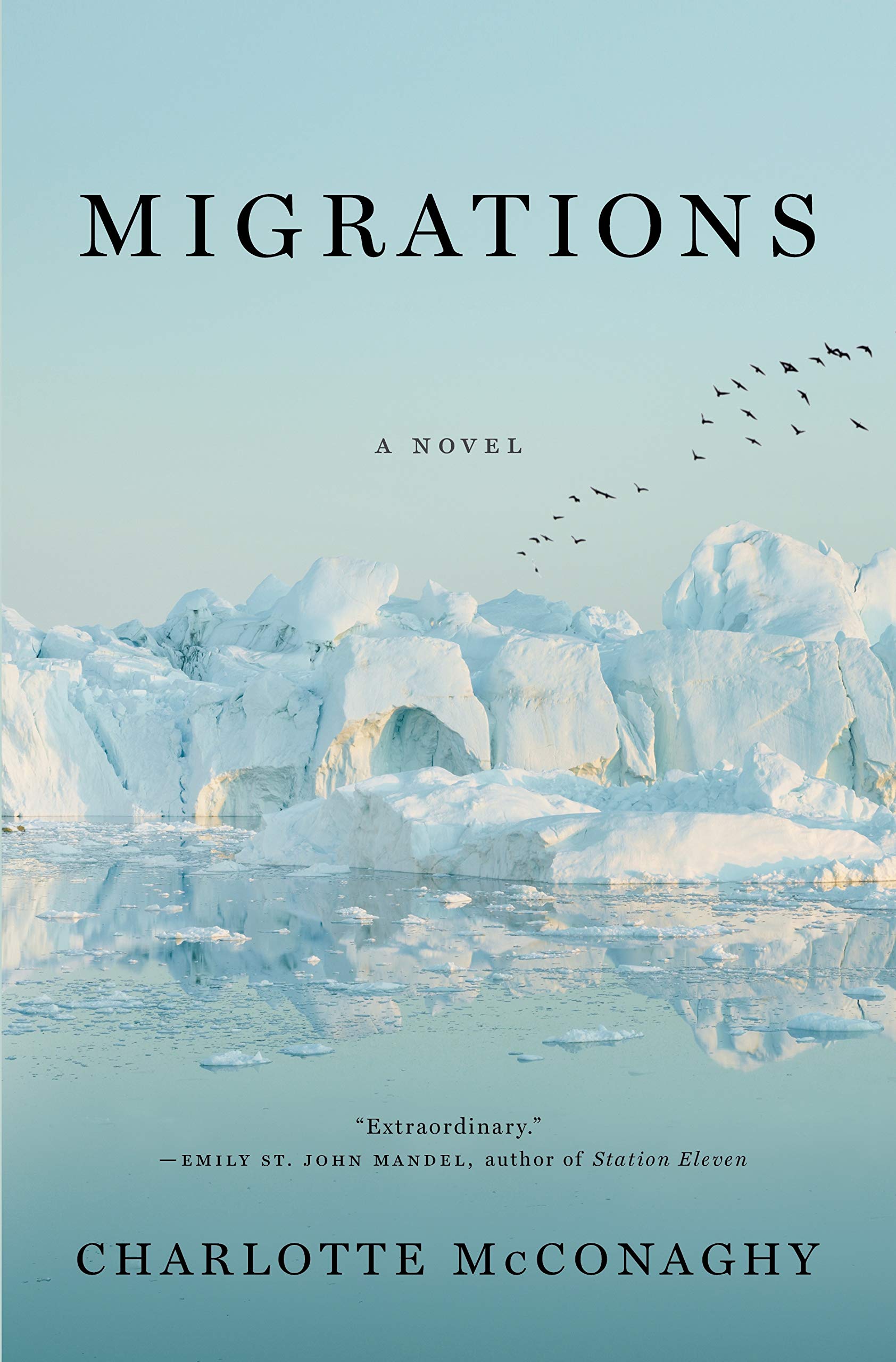
Migrations by Charlotte McConaghy
But there won't be any more journeys after this one, no more oceans explored. And maybe that's why I'm filled with calm. My life has been a migration without a destination, and that in itself is senseless. I leave for no reason, just to be moving, and it breaks my heart a thousand times, a million. It's a relief to at last have a purpose. I wonder what it will feel like to stop. I wonder where we go, afterward, and if we are followed. I suspect we go nowhere, and become nothing, and the only thing that saddens me about this is the idea of never seeing Niall again. We are, all of us, given such a brief moment of time together, it hardly seems fair. But it's precious, and maybe it's enough, and maybe it's right that our bodies dissolve into the earth, giving our energy back to it, feeding the little creatures in the ground and giving nutrients to the soil, and maybe it's right that our consciousness rests. The thought is peaceful.
It is the near future and the earth is on the precipice of ecological collapse. Most animal species have gone or are going extinct: wolves, rhinoceroses, crows. Franny Stone is in Greenland, putting trackers on Arctic terns, one of the few species of bird remaining, and one of the most resilient. They travel from the Arctic to the Antarctic every year in search of food, the longest migration in the world. But the fish, too, are mostly gone, and so despite their resilience, the days of the Arctic terns are numbered, too. Franny, having no other way to track the terns, makes a deal with the captain of a fishing boat--someone who should be an enemy--telling him that if they follow the terns, the terns will bring them to fish. But Franny does not divulge that she's not associated with any university or research program; that she's following the terns for deeper and darker reasons.
I did not enjoy this book. The tone is poisonously, unceasingly serious, and the heroine seems cut from the cloth of television serials like Mare of Easttown--a woman whose self-destructive tendencies cause her to lash out, but who must learn to master her trauma. That's what this book is all about, TRAUMA in big capital letters. Interwoven with the story of the fishing boat, the Saghani, are bits of Franny's backstory, an endlessly unspooling narrative of trauma: an absent father, a disappeared mother, a habit of committing violence while sleepwalking, a tendency to run away for no reason, a stint in jail, a prickly disposition. All of this smaller traumas lead up to a bigger trauma that is only teased, although it's easy enough to fill in the blanks: Franny has, through an act of negligence, killed her researcher husband, and through this guilt she is driven to track the terns that were his own project.
I'd have to paraphrase it, but Charles Baxter described this kind of narrative in his book on fiction Burning Down the House, outlining a belief that the most important thing anyone can do in life, or in a story, is to find and name the source of one's trauma. It makes for dreary reading. On the other hand, there's an interesting thought at the heart of Migrations: that the traumas we receive on an individual level mirror the trauma we inflict on the earth. But Migrations is so wrapped up in the first kind of trauma that the second kind seems only partially fleshed out. Toward the end of the book, after a series of violent setbacks, only Franny and the captain of the Saghani are left out of the crew, and as they sail into the waters of Antarctica, the captain admits he is running, too, from a wife with a terminal illness who didn't want him to see her waste away. But why does anyone in the midst of ecological collapse need an excuse to act irrationally? Migrations struck me as a book about the end of the world that doesn't really think the end of the world is all that interesting.
Friday, May 28, 2021
Klara and the Sun by Kazuo Ishiguro
'I think I hate Capaldi because deep down I suspect he may be right. That what he claims is true. That science has now proved beyond doubt there's nothing so unique about my daughter, nothing there our modern tools can't excavate, copy, transfer. That people have been living with one another all this time, centuries, loving and hating each other, and all on a mistaken premise. A kind of superstition we kept going while we didn't know better. That's how Capaldi sees it, and there's a part of me that fears he's right.'
Klara is an Artificial Friend, model B2. She begins her life sitting in a shop, chatting with other AFs, hoping that the Manager will rotate her into the window where she will be seen by a boy or girl, chosen, purchased. For an AF, she is observant: from her vantage point in the store window, she notices much about the people who walk by, perceiving their attitudes and desires by their body language and physical appearance. She gets her wish one day when a girl named Josie appears with her mother to buy her and take her to their house in what seems to be the Hudson Valley.
The home Klara enters is one marked by turmoil. Josie, we learn, is very sick thanks to a botched gene editing operation. Her next door neighbor and boyfriend, Rick, is one of the few kids in this world who have not been "lifted" as Josie has, but both suffer the consequences of their parents' choices: Rick's future is drastically narrowed by a culture that denies opportunities to "unlifted" children, and Josie may ultimately die of the flaw introduced in her genes, as her older sister did. Josie's father, who lives back in the city, is what is called "post-employed," having been replaced in his job as an engineer by the exact kind of AI that Klara represents. Klara, then, represents both a problem and its would-be solution; technocapitalism has produced a system of increasing inequality and alienation, but so too has it provided the disaffected with a dubious kind of companionship.
In the store, it's explained to Klara that she gets her energy from the sun--that is, she's solar-powered. On cloudy days, she can sense herself becoming weaker, and she mistakenly generalizes this understanding to Josie, too. She begins to believe that, if only the Sun can be appeased, he will provide Josie with his "special nourishment," reenergizing her and bringing her back to health. It's in this way that Klara resembles Ishiguro's other narrators, all of whom live under misunderstandings they perpetuate at an unconscious level. Here it's one of the novel's greatest flaws. It's difficult to believe that Klara--whom we're asked to believe is especially perceptive, for an AF--sustains this childish misunderstanding for so long. When she runs off to a barn on the western end of the family property, where the sun sets every night, we recognize her pleading and bargaining as a form of prayer.
On a trip back to the city, Josie's mom reveals--spoiler! spoiler!--that a "portrait" she has commissioned of Josie is actually an animatronic facsimile, and she intends, if Josie were to die, to ask Klara to take her place inside this body. The implications of this request are deeply troubling. Personhood and personality--are these things that can be "learned" through observation? If observant Klara watches Josie close enough, will she really be able to "continue" her after her death? It seems obvious that the answer is no, but there's a critique here of artificial intelligence, and the possibilities for it of which we dream. It's foolish, Ishiguro suggests, to think that we can build machines to approximate ourselves. Yet, this reveals the novel's central flaw, I think: it makes this critique while narrating from the position of artificially intelligent Klara, whose credibility and sympathy make her so very human.
Monday, March 15, 2021
His Master's Voice by Stanislaw Lem
With an exaggeration that is necessary for the clarification of my meaning, I will say that in the course of my work (it is difficult to say exactly when this occurred) I began to suspect that the "letter from the stars" was, for us who attempted to decipher it, a kind of psychological Rorschach test. For a subject, believing he sees in the colored blotches angels or birds of ill omen, in reality fills the vagueness of the thing shown with what is "on his mind," so did we attempt, behind the veil of incomprehensible signs, to discern the presence of what lay, first and foremost, within ourselves.
Like many of the world's great scientific discoveries, the "letter from the stars" is discovered by sheer accident: a recording of a stream of neutrinos emitted from the region of Canis Minor, used--because of its presumed randomness--to generate random number tables for industrial use, proves not to be so random after all. In fact, it appears to repeat at a regular interval, a trait that should not appear if the source of the neutrino stream is natural. It is suggested that the neutrino stream may encode a message from a distant civilization; from this suggestion all the resources of the American military are marshaled in the distant Nevada desert, where hundreds of the world's top scientists are dedicated to a project codenamed, with a bit humor, "His Master's Voice."
Hogarth, the pugnacious mathematician whose reflections on the Project are recorded here, tells us from the very beginning that His Master's Voice has been a failure: "The reader who has plowed his way to this point and is waiting, with growing impatience, to be led into the inner sanctum of the famous enigma, in the hope that I will regale him with thrills and chills every bit as delightful as those he experiences viewing horror movies, I advise to set my book down now, because he will be disappointed." Only Stanislaw Lem could write a book about first contact in which no one is really contacted, or a book about aliens in which there are no aliens--and perhaps there never were. His Master's Voice, rather, becomes a treatise on exactly why translating the neutrino message is so impossible. Lem offers several deft metaphors to illustrate the disadvantage of our knowledge and our capabilities. Once we are like amoebas, receiving a telegram about a human funeral; next we are like ancient Egyptians trying to interpret a modern paper about the chemical composition of Amenhotep's funeral mask.
Science-minded folks, sometimes a little too glibly, like to say that there are no failures in science. Our knowledge is built on many such experimental failures. But such an attitude, and such glibness, are predicated on the perspective of those who have little interest in the way knowledge is really accumulated. His Master's Voice is, above everything else, a treatise on the function and practice of science, its history and limitations. Unlike people that follow the "I F*cking Love Science" Facebook page, Lem offers a fairly jaundiced view of the way science operates: balkanized into hermetic pursuits, ways of seeing the world that do not touch, and tainted always by the bias of the observer. Several fascinating hypotheses emerge from His Master's Voice--perhaps the neutrinos are a message from a dead universe, or perhaps it isn't a message at all, but a kind of cosmic excretion, like urine--but none will or can be disentangled from the hypothesizer. When knowledge is in short supply, Lem shows, what is human in us will fill in the gaps.
In many ways, His Master's Voice is reflection of the story of science in the 20th century: the great paradigm shifts of relativity and quantum theory, and the emergence of Heisenberg's uncertainty principle, which more or less did away with the idea that we can ever understand the universe from a position of true objectivity. (No doubt a real scientist would quibble with this formulation, but I think I got it more or less.) But it also reflects how the greatest discoveries of the 20th century became fodder for human history's bloodiest projects. One of the peculiar traits of the "letter" is that seems to be both a recipe for life and a catalyst for life: from the snippet that the researchers are able to "decode" organic compounds are created; these organic compounds in turn change and grow when subjected to the neutrino stream itself. For this reason some researchers believe the "letter" is meant to encourage life to grow throughout the universe. But these traits threaten to destroy life, also; Hogarth and his peers discover that these compounds are capable of propagating nuclear fission at a distance--imagine pressing a button that could release a nuclear blast anywhere on earth, of any size, without warning.
Is this property intentional? Is the "letter" the instructions for a weapon? Or is it "the kind of error, whereby someone reads, in a kitchen recipe, the word 'amanita' instead of 'amandine,' and concocts a dish that sends all his guests to their graves?" The question, like nearly all the questions surrounding the Project, will never be answered, even as it threatens the end of the earth. Lem seems to tell us that the process that led to the atom bomb was not simply the work of good scientists perverted by those with evil intentions; war, like science, is a process in which we take part but which we do not control:
A perfect equilibrium of forces, an exact equals-sign between them, was a state so improbable as to be virtually impossible. One could arrive at such a balance only by coincidence. Social fusion was one series of process, and the acquiring of instrumental knowledge was another series.
That is, perhaps the "letter" is a kind of poisoned present: for a society advanced enough in both social fusion and instrumental knowledge, it acts as an invitation to join a brotherhood in the stars. For a society advanced enough in instrumental knowledge but deficient in social fusion, like ours, it will rub us out before we become a threat. This is only one of many theories, and not the one that the more optimistic Hogarth prefers. But if it's the right one, we needn't have worried; for now, we haven't proved smart enough to end ourselves.
Monday, August 17, 2020
Counter-Clock World by Philip K. Dick
Even in the daytime it was a forbidding place. Despite the nascent life beneath the ground potentially crying out for aid. Then shall the eyes of the blind be opened, he thought in quotation from vaguely remembered portion of the Bible. And the tongues of the dead unstopped. A lovely passage; and now so factually, accurately true. Who would have thought? All those centuries, regarded as a pretty and comforting fable by the world's intellectuals, something to lull people into accepting their fate. The understanding that, as predicted, it would one day be literally true, that it was not a myth--
Philip K. Dick's Counter-Clock World is one of those science fiction novels spun from a single hypothetical question: what if time began moving backwards? In 1986, the world entered "the Hobart Phase," in which normal processes suddenly began moving in the other direction. People began getting younger, not older, and soon the dead began reviving in their coffins. (Causality, it seems, still moves in the same direction, otherwise the shaggy intrigue of the novel wouldn't work.)
Dick seizes on this idea for several sly jokes. People open their conversations with "goodbye" and end them with "hello." Instead of eating, they anally ingest a substance called "sogum" around the dinner table, and then disgorge food in shameful privacy. Instead of "shit," they said "food." But the implications, as they often do in Dick's novels, touch on the theological; the Biblical promise that the dead will be reborn has finally been fulfilled. And yet, the resurrection of the dead has not exactly ushered in a peaceable kingdom. Instead of senescence and death, people can now look forward to their inevitable regression to a child, then an infant, and then a fetus which must be reinserted into a human host. (The process is complete when the host woman copulates with a man, and you're split into a sperm and egg. Neat!)
The plot centers on Sebastian Hermes, the owner of a "vitarium"--an organization responsible for digging the "old-born" out of their graves when they wake, then selling them (!) to family or friends--who discovers the burial spot of Anarch Thomas Peak, a leader of a mysterious religion who is expected shortly to be reborn. The Anarch Peak is a hot commodity for a vitarium, and Hermes finds himself in the middle of a violent war for Peak between Peak's followers, the Church of Udi, the Church of Rome, and the nefarious Public Library, who want to eradicate Peak's ideas as they eradicate, bit by bit, all the new information and learning written since 1986.
Hermes himself is an "old-born," but like most people, his memory of death is minimal. He tells his team at the vivarium that his principal recollection is a feeling of overwhelming smallness:
"We have to be little," Sebastian said, "so there ca be so many of us. So billions of billions of separate creatures can live; if one of us were big, the same size of God, then how many would there be? I see it as the only way by which every potential soul can--"
The Udi practice a drug-induced rite that supposedly unites users in a single mind; there is hope that the resurrected Peak may be able to shine some light on the relationship between the individual soul and God, who, despite death's reversal, remains mysterious and aloof.
In addition to the religious and metaphysical angle, I was interested in the way Counter-Clock World deals with race. Peak, like most of the Uditi, is black, and the religion is most popular in a splinter portion of the United States known as the Free Negro Municipality. It's not hard to see echoes in the racial violence of the 1960's, and perhaps even Martin Luther King's assassination, in the struggle over Peak; does the reversal of time perhaps promise an ultimate return to pre-racial humanity, a common ancestor? Does the Uditi's religion of the single mind promise to obliterate racial strife? And how does that fit into the idea that the "old-born" are essentially chattel slavery at the mercy of those who dig them up? Dick handles these questions too obliquely to be answered in any meaningful way, and a Balkanized United States is such a common trope in his novels it's hard to see how the idea fits in here. But the ideas are here, below the surface.
My feeling is that Dick's best novels, like Martin Time-Slip and Flow My Tears, The Policeman Said always seem to break out of the orbit of their central idea. Counter-Clock World never quite does that; it seizes on the time-reversal thing and sticks with it until the bitter end. As always, it's heady and compelling, but I wouldn't place it on the level of his best work.
Friday, June 12, 2020
The Sparrow by Mary Doria Russell
"So God just leaves?" John asked, angry where Emilio had been desolate. "Abandons creation? You're on your own, apes. Good luck!"
"No. He watches. He rejoices. He weeps. He observes the moral drama of human life and gives meaning to it by caring passionately about us, and remembering."
"Matthew ten, verse twenty-nine," Vincenzo Giuliani said quietly. "'Not one sparrow can fall to the ground without your Father knowing it.'"
"But the sparrow still falls," Felipe said.
Well, this is the quickest I've ever got to fifty. All in all, I'd trade this year's fast pace for not having a deadly pandemic, but here we are.
Mary Doria Russell's The Sparrow is about the first mission to make contact with a newly discovered alien species, only the catch is this: it's not the governments of the world who send the mission, but the Society of Jesus, or Jesuits, who get the jump on everyone else. The heart of the mission is a Puerto Rican Jesuit priest and linguist named Emilio Sandoz, who undertakes the mission secretly with the help of a ragtag crew. The novel works in flashback, beginning when Sandoz is captured on the alien planet of Rakhat and sent back to Earth as the most hated man in the universe, a prostitute and murderer, and the only member of the mission to survive. The central question the novel withholds is, how did a mission of Christian love go so wrong?
This novel really ought to be right up my alley. In fact, I selected it for my 50th because I thought I would love it, but I didn't. The first 300 pages or so are all prelude, as we see Sandoz connect with the group of loved ones who will become his fellow missionaries/astronauts: a beautiful Jewish programmer, a Texan pilot, an eager young radio operator, an older couple who serve as surrogate parents. That Sandoz's friends and relations turn out to have discrete and necessary skills for the mission is described as a kind of fate, a suggestion that God has blessed and arranged the mission. And the novel works hard, too hard, to establish the connection between these characters, mostly with bad jokes and scenes of bonhomie that mostly made me impatient to get into space.
Once the mission gets to Rakhat, things improve: Doria Russell, who I believe is an anthropologist, describes a stratified society where two species are locked in a cultural state of predator-prey dependency: the more developed Jana'ata keep the simpler Runa as contracted gatherers and servants. The missionaries befriend both species, and Sandoz works his linguistic magic so they can converse, but the introduction of humans threatens the ancient arrangement. As with a lot of science fiction, my principal reaction was that the aliens aren't weird enough: what are the chances that life on other planets is bipedal, or capitalist, or has a language humans are able to reproduce with speech? I can get on board with Star Trek, but it seems to me a novel about the challenges first contact loses some credibility when aliens look and talk so much like us.
Doria Russell make several allusions to earlier Jesuit missions of the kind that accompanied European colonists in the New World. Maybe it's just because I read Fathers and Crows, but I think it's hard to look at those Jesuits with anything but contempt. Sandoz and company don't try to convert the people of Rakhat; their intentions are only to learn. But it seems to me there's a puzzling lack of thought about the destabilizing presence of humans, given what the Jesuits and colonizers of the early modern era did to human communities. In The Sparrow, it's the introduction of food gardens that spark violence, giving the friendly Runa the excess energy to reproduce without Jana'ata permission. I mean, who could have thought that planting species from another planet might have long-reaching effects?
But that gets to what I felt was the larger failing of The Sparrow. Like the Jesuit colonizers, it has a severe lack of interest in how first contact might affect the contacted, and chooses to focus on the consequences for the colonizers instead. The pain that becomes the focus of the novel is Sandoz's, having returned from Rakhat in a ruined state both physically and psychologically. The metaphor of the sparrow is applied to his own suffering, but if there are rippling effects on Rakhat of the Jesuits' actions, the novel isn't interested in them except as facets of Sandoz's guilt. That didn't work for me.
Thursday, June 11, 2020
The Chrysalids by John Wyndham
A word again... When the minds have learnt to mingle, when no thought is wholly one's own, and each has taken too much of the other ever to be entirely himself alone; when one has reached the beginning of seeing with a single eye, loving with a single heart, enjoying with a single joy; when there can be moments of identity and nothing is separate save bodies that long for one another... When there is that, where is the word? There is only the inadequacy of the word that exists.
As a child, David is taught by his father that genetic aberration is a sin. When a crop shows signs of mutation, it is burned, and the same is done--in secret--when genetic aberrations appear on infant children. This belief is woven into the society in which David and his father live: according to their Bible, because man is made in the image of God, those things which seem to differ from the standard image are works of the Devil to be feared and destroyed. "Accursed is the mutant," goes one verse, "in the eyes of God and Man."
These ideologies, Wyndham suggests, are the result of some kind of nuclear cataclysm. David and his family live in post-apocalyptic Labrador (sweet), ringed in by "Fringes" where mutants are exiled, which themselves bleed into the horrible "Badlands." Nuclear disaster, it seems, has caused these "aberrations," but so too has it created a religion in which the pre-disaster "Old People" are revealed and genetic purity seen as the route back to a pre-lapsarian state. Truth be told, it's an idea that's been done to death, from X-Men to Divergent: mutants are always symbolic of the repressed other, but Wyndham did it early and well; nothing about The Chrysalids seems hackneyed or shallow.
There's only one way this kind of story can go: David slowly comes to realize, by befriending a mutant, that not all difference is bad. Here that's Sophie, a young girl who David plays with before noticing, after she gets her foot stuck in a crevice, that she has six toes. But as David grows up, he realizes that he himself is a kind of mutant: he shares a telepathic link with six other young people in his community, including his cousin and lover Rosalind and his little sister Petra. What feels natural to him turns out to be a genetic aberration so severe that its discovery could send his entire community into uproar and lead to his own destruction.
The link between David and the others seems like a classic symbol for radical empathy. I've been thinking about that, empathy. You see it in books everywhere. Is it a copout? You could make a case, I think, that a science fiction novel like The Chrysalids offers an insufficient solution to social diseases like nationalism and racism. Individual empathy is good, but only to the extent that informs structural and systemic reform. But there's a reason, I think, that the most dogmatically social realist books seem so forced: a novel can reflect social structures and propose new ones, but it can't enact them. A novel, however, enacts empathy by putting us in someone's head; here, it puts us in several heads, minds that are so closely tied together they become one mind. As a political solution, it doesn't help, but it makes The Chrysalids something more than a mere allegory or fable.
The Chrysalids hit a real sweet spot for me. It's not afraid to go for broke: Petra's telepathy skills turn out to be so powerful she can communicate with a colony of telepaths in New Zealand, who come to the rescue of the protagonists. It seemed to draw from some of the best parts of mid-century pulp science fiction, but it was written before those aspects had to be done with a tongue in cheek to seem relevant. The worldbuilding is smart, but not too smart or complex, and the simple chase narrative of the second half really worked.
Thursday, March 26, 2020
The Claw of the Conciliator by Gene Wolfe
Here I pause. If you wish to walk no farther with me, reader, I do not blame you. It is no easy road.
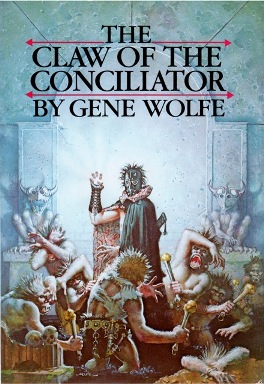
The Claw of the Conciliator is the second book in Gene Wolfe's Book of the New Sun tetralogy, following the torturer Severian as he continues his journey away from the Citadel of his upbringing toward--well, what exactly? At one point he tells us of his various missions, each of which seems to be of vital importance, but which strain against each other not just for him, but the reader, making it difficult to read the book as a quest narrative like you expect: he wants to make his way to Thrax, the city where he's supposedly posted as a torturer after having been exiled from the Citadel; he wants to find and protect Dorcas, the waif-like girl who appeared in a lake; he wants to serve the rebel Vodalus, who fights the ruling Autarch; he wants to return the all-powerful healing crystal known as the Claw of the Conciliator to the religious order who guards it. Along the way, here are some of the things he encounters:
A cave full of aggressive glowing aps-people. An ancient giant who seeks to control Urth, and wants to seduce Severian to live at the bottom of the sea. Flying bat-like creatures made of night that burrow into your body for warmth, and that separate into two creatures when you cut them with your sword. A robot who's been grafted with flesh and organs. (Not, significantly, a person who's been grafted with robotics.) The House Absolute, seat of the Autarch, which turns out to be build entirely underground. The Second House, a--well--second house built in secret around the House Absolute, full of mysterious and hidden passageways. Hideous cacogens, disguised as human beings, but who really have thousands of eyes laid out like a pinecone. A secret ceremony in which he is invited to ingest the flesh of his dead love Thecla, after which her memories continue to live on him.
...And a lot of other stuff, besides. Looking at the list, you get the impression that The Book of the New Sun is a particularly inventive but also fairly formulaic fantasy series. But what makes Claw of the Conciliator, like The Shadow of the Torturer, so engaging is the sense I get that it's not really interested in being a fantasy or science fiction book at all, and that the whole thing is a kind of papier mache facade that's concealing another kind of book entirely, or perhaps nothing at all. More than once, Wolfe pauses the narrative to include another kind of genre entirely: first a book of legends, then a script for a play that Severian performs, which is so mind-boggling that it reminded me of nothing more than Faust.
Everything comes at you whip-fast, introducing new characters and ideas and then undoing or recontextualizing them in a way that makes the reader's footing supremely unsure. No sooner does Severian meet the rebel Vodalus in the woods and agree to carry a message to a spy in the House Absolute than the spy turns out to be the Autarch himself. Is the rebellion just a red herring? If so, what's the "real story" here? Is it about the giants that live in the sea who want to exert dominion on the land, or are they a red herring, too? Maybe every herring here is red.
Again, Wolfe suggests that the world of Urth may be a figment: in The Shadow of the Torturer, interlopers from our own time appear on a kind of safari. Here, Severian's friend Jonas suggests that he comes from a different place and time, and is perhaps thousands of years old. In a room of mirrors in the House Absolute he disappears--presumably, having known how to return to our own era, perhaps slipping through time, but perhaps because Urth itself is a fiction or a metafiction.
I feel like I haven't entirely captured just how strange these books are. Talking about them makes them seem ordinary, but they outstrip the capacity of my language to really capture, and that's part of what makes them so uneasy and unsettling. The quest continues, but it's almost like the book, and the very nature of its book-ness, is falling apart, and I have a hard time imagining these qualities intensifying for two more novels.
Sunday, March 15, 2020
Dune by Frank Herbert
The vision made him want to freeze into immobility, but this, too, was action with its consequences.
The countless consequences--lines fanned out from this cave, and along most of these consequence-lines he saw his own dead body with blood flowing from a gaping knife-wound.
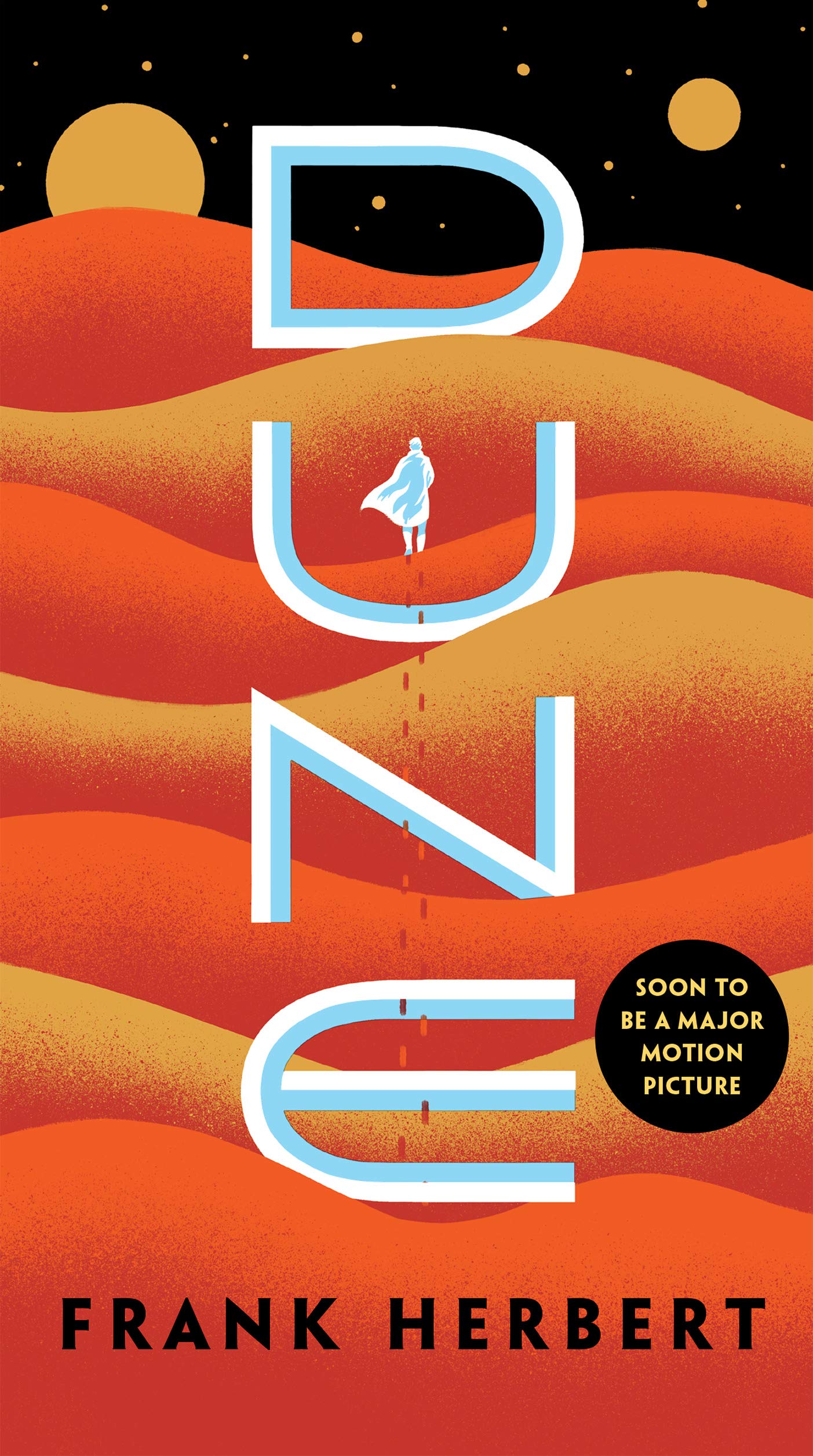
Last weekend I visited America's second-newest national park, Indiana Dunes. (Remember travel? Maybe we'll be able to do it again someday.) I took along with me Frank Herbert's science fiction masterwork Dune, only partly as a pun and a joke: Herbert claimed that he was inspired to write the novel by the sand dunes he knew so well in Oregon. The planet Arrakis in Dune is not so much a giant beach but a giant desert, and I had forgotten--I read this book, like I think a lot of young boys did, as a teen--how it's meant to be an amalgamation of the different desert landscapes of the earth. The planets of Dune are all sort of biological manifestations of what the book calls mankind's "terran" origins, and so Arrakis is filled not just with sand and spice and giant worms but also saguaros, eagles, kangaroo mice. It supports the plants and animals of the American southwest but the culture of the Fremen--the roving bands who live there and who prop up the spice trade--cribs a lot from the Islamic desert cultures of the Middle East and North Africa.
I was really interested in seeing how Dune stacked up against my memory. At first blush, my reaction was that the novel seems like a high-quality version of many of the same narratives and archetypes that we see so often in fantasy. It begins with a quarrel between "great houses": House Atreides, led by Duke Leto and his young son, Paul, and House Harkonnen. The Emperor has recently replaced the Harknonnen monopoly on Arrakis, which produces the galactically valuable spice, giving it to the Atreides, but it's a trap: the Harkonnens and the Emperor are working together to destroy the Atreides. Add to that a "chosen one" narrative: in the opening scenes of the book, Paul Atreides survives the trial of the gom jabbar, suggesting that he might be the Kwisatz Haderach, a prophet-like figure who is the end result of millennia of eugenic breeding by the secretive Bene Gesserit. So far, so good.
The Harkonnen trap more or less works, but Paul and his mother Jessica survives, though they are pushed out into the desert where no one expects them to survive. They're taken in, however, by the Fremen, who suspect that Paul might be their own chosen one: a messiah figure called the Mahdi. (Paul has about a billion names in this thing: Mahdi, Muad'Dib, Usul, Kwisatz Haderach, Lisan al-Gaib, etc., etc.--like the many epithets of Jesus or something.) One of the more interesting ideas in Dune is that local religions, like that of the Fremen, have actually been planted by the Bene Gesserit over thousands of years in order to enable them to do their secretive work among the many peoples of the universe. Religion, for the Bene Gesserit, is a sociopolitical sham.
I think Dune ultimately rejects that view of religion. Paul fits neatly into the chosen-one narratives of both the Bene Gesserit and the Fremen, but he manages to overshadow them both. With the help of the spice, he gains incredible powers of seeing, into the future and the past, and the ability to see the consequences of billions of tiny choices. Almost everyone in Dune has special powers--the hyperintelligence of the Mentats, who are like human computers, the mind-control training of the Bene Gesserit--but Paul outstrips them all. In that way he suggests a power beyond reason, beyond history, something religious or prophetic in nature that cannot be controlled by the sociopolitical. With these powers he seeks not only revenge on the Harkonnens but a way to guide the future of humanity, and part of his vision is that he will unerringly unleash a terrible jihad on the universe through his Fremen followers.
The best thing about Dune, in the end, is this: it has that quality of great science fiction that seems to collapse millennia into the space of a book. It's big in a way that only Isaac Asimov's Foundation series really resembles, as far as I can recall. In his desert stronghold, Paul considers the fate of humanity over a thousand years, and Herbert really makes you believe that he's doing it.
Saturday, February 8, 2020
The Stars My Destination by Alfred Bester
The acid of fury ran through him, eating away the brute patience and sluggishness that had made a cipher of Gully Foyle, precipitating a chain of reactions that would make an infernal machine of Gully Foyle. He was dedicated.
'Vorga, I kill you filthy.'
Gully Foyle is the lone survivor of a wrecked spaceship, struggling to survive in the indifference of outer space. When another ship, the Vorga, marked with the symbol of one of Earth's wealthiest tycoons, passes by, he thinks he's been saved--but then the ship moves on, despite his distress signal. Its indifference to Gully's life breeds in him a bloody need for revenge, so after saving himself, he returns to Earth, intent on destroying whose who left him to die at any cost.
What a crazy book this is! Despite a relatively simple and recognizable throughline--Gully's lust for revenge--it's packed with enough ideas to power a hundred science fiction books. Gully lives in a distant future in which the planets of the Solar System are at war with their satellites, and all human beings have learned to teleport, or "jaunte." In a prologue, Bester describes the discovery of this ability as a new understanding of the will: the first jaunter is a man who, about to drown, zaps himself out of the water through the sheer force of his desire to keep living. There's a connection here between the jaunting and Gully's bloodlust; Gully himself is a man reduced to nothing but will.
The teleportation produces some great and absurd facets to Bester's vision of the future: women, suddenly vulnerable to perverts jaunting into their bedrooms and showers, are repressed in a neo-Victorian cultural shift. The rich flaunt their wealth by never teleporting anywhere, but instead traveling in the most ornate and cumbersome ways possible. This leads to a scene in which Gully, having accumulated wealth and prestige in his pursuit of revenge, arrives at a party via a railway train that lays its own tracks out ahead of it on the street. But there's more, much more, too much even to really dig into: primitive asteroid-dwellers who tattoo Gully's face with tiger stripes against his will, a blind albino woman who "sees" infrared, an enormous underground prison, a radioactive investigator who can only be around others for 30 minutes, ascetics who have all of their senses surgically removed. The Stars My Destination reads a little like Bester was afraid that he might die before he got all of his ideas down on the page.
Stars is weakest, for me, when it relies most heavily on its pulp sources. The novel is insanely action-heavy and fast-paced, but not always in a way that produced, for me, the actual tension that a movie scene might. And I often rolled my eyes at the way that women keep falling head over heels for Gully, despite his dreary singlemindedness. The women characters reminded me of the Frank Frazetta women you see on the covers of old science fiction magazines, wearing mostly ripped-up clothes and pressing their bosoms to the hero. And although we're meant to believe in Gully's moral transformation over the course of the book, I didn't find his rape of one of those characters to be worthwhile or necessary.
About that transformation: when the novel begins, Gully is an idiot. He speaks in a kind of patois we're meant to understand is the language of the interstellar lower classes, and he's so literally stupid that he tries to blow up Vorga the ship instead of whoever was inside of it, in his bloodlust literally blaming the vessel itself. Like Edmond Dantes in The Count of Monte Cristo, he becomes a rich and powerful man for the sole purpose of wreaking his revenge, but in becoming a rich and powerful man, he himself changes. He becomes more intelligent, his dialect changes, and eventually he begins to question the moral quality of his revenge.
Gully's transformation is social, cultural, economic, moral, intellectual, and eventually, transhumanist. His will to survive after the wreck makes him the only human able to jaunte in space; later, he discovers the ability to jaunte through space-time. By the end of the novel--with an assist from a cataclysmic space weapon--Gully becomes an ubermensch who can travel at will to the ends of the universe. This climax produces some of Bester's best writing, and to capture the new way that Gully experiences the world Bester has to turn to Dadaist shape poetry. In the end, Gully exhorts the "common" people of earth to be like him, and shake the bonds of contingent reality:
'You pigs, you. You rut like pigs, is all. You got the most in you, and you use the least. You hear me, you? Got a million in you and spend pennies. Got a genius in you and think crazies. Got a heart in you and feel empties. All of you. Every you...'
Although the future Bester imagines is a familiarly capitalist hellscape, The Stars My Destination is ultimately optimistic about humanity's future. Technology gives Gully the ability to enact his will without limitation; this, to me, expresses a belief in the future perfectibility of humankind. It's not a vision I find particularly compelling: I think it's obviously overlaid with classism and sexism, and it skirts pretty close to the Nazi way of reading Nietzsche. But Gully is compelling, and so is this book.