Showing posts with label birds. Show all posts

Friday, October 1, 2021

Vesper Flights by Helen Macdonald

But there is something else. As it passes overhead, the rook tilts its head to regard me briefly before flying on. And with that glance I feel a prickling in my skin that runs down my spine, my sense of place shifts, and the world is enlarged. The rook and I have shared no purpose. For one brief moment we noticed each other, is all. When I looked at the rook and the rook looked at me, I became a feature of its world as much as it became a feature of mine. Our separate lives coincided, and all my self-absorbed anxiety vanished in one fugitive moment, when a bird in the sky on its way somewhere sent a glance across the divide and stitched me back into a world where both of us have equal billing.

Helen Macdonald's H is for Hawk, a memoir of her experience training a falcon in the wake of her father's death, might be my favorite non-fiction book of the past several years. I don't read a lot of non-fiction, and part of its appeal was its literariness: Macdonald interweaves her own story with rich threads of fiction, like that of fellow falconer T. H. White, and history and myth. But it also resonated with me because, like several people have in the wake of the COVID-10 pandemic, I have become more interested in birding and birds. Though training a hawk and birdwatching are very different pursuits, they share an inexplicable sense of satisfaction that derives from the way human and animal life intersects.

One of my favorite essays from Macdonald's new collection Vesper Flights hits much closer to home: Macdonald describes watching fall migrants in New York City from the observation deck of the Empire State Building, whose bright lights both attract and confuse the birds. In her account they "resemble stars, embers, slow tracer fire" and "ghostly points of light." In this moment Macdonald captures a very specific sense of amazement that occurs when one realizes that New York City, the concrete jungle, is--and has always been--a place where birds have lived lives that precede and overwrite us. Birding in New York puts me in touch with the transitory nature of life, as if the earth wears the city lightly.

The experience of reading Vesper Flights can't compare to H is for Hawk. The strength of that memoir is not just in the incision of its insight but the power of its narrative: the tortuous twin processes of training the hawk and coming to terms with the death of a father. The essays in Vesper Flights can feel too brief and too numerous, and when there are so many the form begins to show. The epiphanies come, as they never do in life, with a little too much regularity. The strongest essays are often the ones that linger the longest, like a long profile of a researcher who uses Chile's Atacama Desert as a stand-in for the surface of Mars, or an account of the yearly ritual of "swan upping," in which the Queen's swans--she owns most of the swans in the country, I guess--are tracked and tagged.

A theme does eventually emerge: several of the essays address the way that our ideas of the natural world intersect with the burgeoning forces of nationalism. In more than one piece, Macdonald describes how, during World War II, species that were considered notably "British" became rallying cries for preservation, as if British identity were to hinge on the continued existence of these birds. She makes much of the fact that birds don't know borders, even as they are enlisted in our most parochial disputes about who belongs where. She talks about how immense murmurations of starlings helped develop wartime radar technology, and hapless migrators whose leg tags have been mistaken for spy technology by suspicious powers. This is such an interesting perspective that I found myself longing for a book that might have been--not a collection of brief essays, but a book that develops this theme as fully and insightfully as H is for Hawk.

Tuesday, June 22, 2021

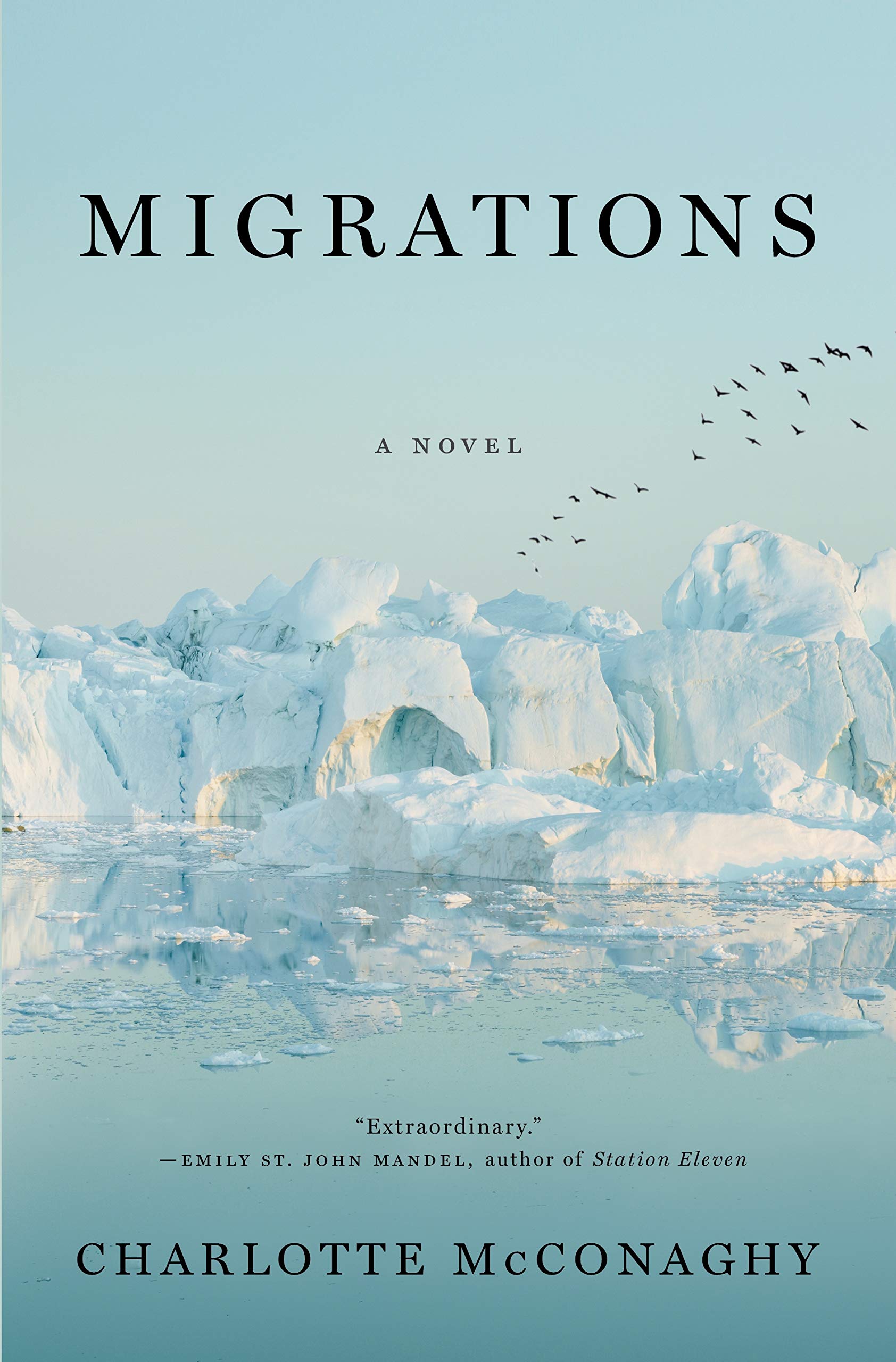
Migrations by Charlotte McConaghy

But there won't be any more journeys after this one, no more oceans explored. And maybe that's why I'm filled with calm. My life has been a migration without a destination, and that in itself is senseless. I leave for no reason, just to be moving, and it breaks my heart a thousand times, a million. It's a relief to at last have a purpose. I wonder what it will feel like to stop. I wonder where we go, afterward, and if we are followed. I suspect we go nowhere, and become nothing, and the only thing that saddens me about this is the idea of never seeing Niall again. We are, all of us, given such a brief moment of time together, it hardly seems fair. But it's precious, and maybe it's enough, and maybe it's right that our bodies dissolve into the earth, giving our energy back to it, feeding the little creatures in the ground and giving nutrients to the soil, and maybe it's right that our consciousness rests. The thought is peaceful.

It is the near future and the earth is on the precipice of ecological collapse. Most animal species have gone or are going extinct: wolves, rhinoceroses, crows. Franny Stone is in Greenland, putting trackers on Arctic terns, one of the few species of bird remaining, and one of the most resilient. They travel from the Arctic to the Antarctic every year in search of food, the longest migration in the world. But the fish, too, are mostly gone, and so despite their resilience, the days of the Arctic terns are numbered, too. Franny, having no other way to track the terns, makes a deal with the captain of a fishing boat--someone who should be an enemy--telling him that if they follow the terns, the terns will bring them to fish. But Franny does not divulge that she's not associated with any university or research program; that she's following the terns for deeper and darker reasons.

I did not enjoy this book. The tone is poisonously, unceasingly serious, and the heroine seems cut from the cloth of television serials like Mare of Easttown--a woman whose self-destructive tendencies cause her to lash out, but who must learn to master her trauma. That's what this book is all about, TRAUMA in big capital letters. Interwoven with the story of the fishing boat, the Saghani, are bits of Franny's backstory, an endlessly unspooling narrative of trauma: an absent father, a disappeared mother, a habit of committing violence while sleepwalking, a tendency to run away for no reason, a stint in jail, a prickly disposition. All of this smaller traumas lead up to a bigger trauma that is only teased, although it's easy enough to fill in the blanks: Franny has, through an act of negligence, killed her researcher husband, and through this guilt she is driven to track the terns that were his own project.

I'd have to paraphrase it, but Charles Baxter described this kind of narrative in his book on fiction Burning Down the House, outlining a belief that the most important thing anyone can do in life, or in a story, is to find and name the source of one's trauma. It makes for dreary reading. On the other hand, there's an interesting thought at the heart of Migrations: that the traumas we receive on an individual level mirror the trauma we inflict on the earth. But Migrations is so wrapped up in the first kind of trauma that the second kind seems only partially fleshed out. Toward the end of the book, after a series of violent setbacks, only Franny and the captain of the Saghani are left out of the crew, and as they sail into the waters of Antarctica, the captain admits he is running, too, from a wife with a terminal illness who didn't want him to see her waste away. But why does anyone in the midst of ecological collapse need an excuse to act irrationally? Migrations struck me as a book about the end of the world that doesn't really think the end of the world is all that interesting.

Friday, May 21, 2021

Kingfisher by Ildiko Szabo

The present volume deals extensively with the iconology of the chaste European common kingfisher and their North American counterpart, the belted kingfisher, plus their antithesis, the Australian swashbuckling, laughing kookaburra. The bulk of the kingfisher's appearance in Anglophone culture focuses on these three birds. It is extremely unfair to judge an entire bird family of 114-plus species on only a few iconic ones. Doubly so when considering how diverse, how bizarre and how resourceful the rest of the kingfisher clan is. Many of these lesser-known kingfishers are sensationally beautiful and fascinating in their own right. It is the iridescent plumage of the majority of them that transforms them into dazzling feathered jewels. For the birds themselves, their splendid attire is both a benefit and a curse. Some civilizations have venerated kingfishers, but more commonly they were, and still are in a few regions, hunted for food or for the economic value of their dazzling plumage.

I have a tattoo of a kingfisher on my right arm. It's a reference to Gerard Manley Hopkins' poem "As kingfishers catch fire," a sonnet whose central idea is that the bronze flash of the common kingfisher is part of its essential, God-bestowed essence, and an expression of God's own being. So we all, Hopkins argues, express God through our essential qualities. The bird on my arm is not the common kingfisher, found in Europe and Asia, but the belted kingfisher, one of the first birds I remember really noticing as a child, sitting on a wire in the same spot every day on my ride to school. Today, when I see a belted kingfisher buzzing over or diving through water, or sitting by the waterside, I feel a thrill of familiarity and kinship.

Ildiko Szabo's Kingfisher is one in a series called Animal, published by Reaktion Books, each of which focuses on a different animal, detailing not only its behavior and taxonomy, but its cultural significance. Kingfisher was a knowing gift by a friend. Szabo centers his biography of the kingfisher on the Greek myth of Ceyx and Alcyone, which still provides many kingfishers with their scientific genera: Alcyone, grief-stricken by the drowning of her husband Ceyx, dives into the sea, killing herself--as kingfishers dive into the water to find a meal. Like Ceyx and Alcyone, Szabo describes, kingfishers are mongamous birds who share responsibilities with their mates--though perhaps the ancient Greeks did not know that they are frequently found in polycules with a third "helper" male.

Other cultural depictions outlined by Szabo include the Arthurian legend of the Fisher King, the Apache legend of the Fox and the Kingfisher--and, of course, Hopkins' poem. A long chapter is devoted to the Chinese practice of tian-tsui, in which the shining turquoise barbs of kingfisher feathers are painstakingly glued into ornate headdresses and jewelry. A similar practice in Angkor Wat, Cambodia, Szabo tells us, seems to have decimated the kingfisher population there--an early example, perhaps of man-made ecological collapse.

More than anything, Kingfisher--and I expect, a lot of the books in this series--provides a lot of fun knew knowledge. Did you know that the kookaburra will eat snakes too large to fit in its stomach, letting them dangle from its beak until their heads are digested and they can finish swallowing? Or that the design of Japanese bullet trains is borrowed from the kingfisher's familiar beak, which, studies show, is perfectly made to minimize the sonic booms produced by air resistance? The other principle pleasure the book provides is simply the many colorful photographs of these "family-centric kamikaze killing machines," as Szabo describes them. It's easy to see why they captured Gerard Manley Hopkins' attention all those years ago.

Wednesday, May 16, 2018

The Peregrine by J. A. Baker

Warm and firm-footed in long grass smelling of the sun, I sank into the skin and blood and bones of the hawk.  The ground became a branch to my feet, the sun on my eyelids was heavy and warm.  Like the hawk, I heard and hated the sound of man, that faceless horror of the stony places.  I stifled in the same filthy sack of fear.  I shared the same hunter's longing for the wild home none can know, alone with the sight and smell of the quarry, under the indifferent sky.  I felt the pull of the north, the mystery and fascination of the migrating gulls.  I shared the same strange yearning to be gone.  I slept into the feather-light sleep of the hawk.  Then I woke him with my waking.

In H is for Hawk, Helen Macdonald describes how much she dislikes J. A. Baker's The Peregrine.  As someone who knows and trains hawks, she finds Baker's sense of a hawk's alienness off-putting.  Though Macdonald warns against easy anthropomorphizing, she sees in her hawks a number of moods--playfulness, fear, shyness--that aren't represented in Baker's account of peregrine falcons, whom he describes mostly as single-minded murder machines.

The Peregrine is a strange book.  It really is very little more than a diary following the movements of a pair of peregrine falcons on the northeast coast of England from the fall through the spring of a single year.  Baker watches his hawks sleep, kill, eat, soar, and play games with their prey.  His observations are drawn with an understated poetic flair: the peregrine flies in a "tremendous wing-lit parabola"; it drives apart a flock of gulls, "shattering them apart like flinging white foam."  But I don't think the most exquisite poetry in the world could keep The Peregrine from being what it is: a six-month birdwatching diary.

I suspect part of the problem is me.  Do I lack such a sense of the variety of the natural world that the finely-tuned observations of The Peregrine are lost on me?  We lack a language of flora and fauna in the 21st century; we see trees instead of sycamores and oaks, flowers instead of columbine and thistle.  I wonder if, in another time and place, I would be more sensitive to the kinds of landscape that Baker describes.  I might have more patience then, and be able to see the finer distinctions being made.  But still, there's little drama to The Peregrine beyond the quotidian and repetitive game in which the peregrines hunt and kill ducks and mice.

Baker finds himself, after months of watching and writing, turning into a peregrine himself, turning away from human society (not that there's any in this book to turn away from) and sympathizing with the hawk's indifference to anything but hunting.  The transformation is incomplete, of course, because Baker can never enter the peregrines' confidence: "No pain, no death, is more terrible to a wild creature than its fear of man," he writes.  The hawk regards him as "part hawk, part man; worth flying over to look at from time to time, but never wholly to be trusted; a crippled hawk, perhaps, unable to fly or kill cleanly, uncertain and sour of temper."  Kind of like Brundlefly, I guess--Bakerhawk?

Honestly, I didn't believe it.  First of all, I don't think a dude that spends six months tramping around the countryside doing nothing but birdwatching needs to be seduced into being indifferent or antisocial.  But mostly, it feels too stagey, too inevitable, too much like a desperate injection of mysticism.  A refusal, perhaps, to let the book be the mundane and quotidian thing that it really is.