Showing posts with label Stanislaw Lem. Show all posts

Saturday, February 25, 2023

The Investigation by Stanislaw Lem

“Maybe even God only exists from time to time,” the Chief Inspector added quietly. He had leaned forward, and with his face averted was listening attentively to what Gregory was spewing forth with such difficulty from deep inside himself.

“Maybe,” Gregory replied indifferently, “But the gaps in his existence are very wide, as you know.”

Inspector Gregory is called upon by Scotland Yard to investigate a strange series of crimes--corpses are disappearing from their caskets, only to be found a short ways away, the twist being that a few of them have been spotted in transit. In short, is this a case of prankish grave robbery, or are they something stranger and more destabilizing: a sort of resurrection?

The summary makes The Investigation sound like a horror story, or perhaps an existential detective novel in the vein of New York Trilogy or Death in Her Hands. And it is, in some ways, both of those things. I don’t think it’s much of a spoiler to say that, like in those two novels, the “crimes” such as they are, are never solved and the investigators undergo an identity crisis. Nor can it really be surprising that some parts are very creepy: a reel to reel recording of a witness dying as he spends his last breaths describing a writhing corpse; Gregory’s dream of his landlord as a puppet master who contacts the dead through his manipulation of a pair of mannequins; an interview with Sciss, a police statistician(?) that devolves into a strange psychosexual encounter complete with mysterious negative depicting snuff films.

Spoilers follow, to the extent that this can be spoiled.

The climax, no less unsettling for its predictability, sees Gregory, whose entire life has slowly been consumed by the case and its myriad unprovable causes--a psychopath, a virus, alien technology, God--given a plausible explanation by his chief, an explanation that posits a trucker who’s been slowly driven mad by driving through the foggy winter nights. He protests, he points out the facts that don’t fit the explanation, he protests about the arbitrary nature of it all; ultimately though, he accepts it, because to not do so would upset the constructions that allow Scotland Yard, religion, government, human relationships, et al, and the premise that lies behind it all: that there is some concrete meaning in the world, and that we can discover and  comprehend it. That actions can be explained, crimes solved, and corpses safely assumed to be dead.

And yet, the book as a whole is somewhat inert, consisting largely of long conversations between various detectives, officers, scientists, and doctors. Entire chapters pass with no real action, and many of the characters outside of Gregory, Sciss, and the Landlord blur together so that much of the book reads more like a philosophical dialogue than a novel. Outside of Gregory’s increasingly emotive responses (he’s always angry, confused, certain), his descent into obsession lacks the texture than makes New York Stories work so well, and the pathos Moshfegh gives the widow in Death in Her Hands. In spite of its compelling big ideas and exciting final quarter, I found this, my first Lem, to be underwhelming--but I’m still looking forward to reading more.


Monday, March 15, 2021

His Master's Voice by Stanislaw Lem

With an exaggeration that is necessary for the clarification of my meaning, I will say that in the course of my work (it is difficult to say exactly when this occurred) I began to suspect that the "letter from the stars" was, for us who attempted to decipher it, a kind of psychological Rorschach test. For a subject, believing he sees in the colored blotches angels or birds of ill omen, in reality fills the vagueness of the thing shown with what is "on his mind," so did we attempt, behind the veil of incomprehensible signs, to discern the presence of what lay, first and foremost, within ourselves.

Like many of the world's great scientific discoveries, the "letter from the stars" is discovered by sheer accident: a recording of a stream of neutrinos emitted from the region of Canis Minor, used--because of its presumed randomness--to generate random number tables for industrial use, proves not to be so random after all. In fact, it appears to repeat at a regular interval, a trait that should not appear if the source of the neutrino stream is natural. It is suggested that the neutrino stream may encode a message from a distant civilization; from this suggestion all the resources of the American military are marshaled in the distant Nevada desert, where hundreds of the world's top scientists are dedicated to a project codenamed, with a bit humor, "His Master's Voice."

Hogarth, the pugnacious mathematician whose reflections on the Project are recorded here, tells us from the very beginning that His Master's Voice has been a failure: "The reader who has plowed his way to this point and is waiting, with growing impatience, to be led into the inner sanctum of the famous enigma, in the hope that I will regale him with thrills and chills every bit as delightful as those he experiences viewing horror movies, I advise to set my book down now, because he will be disappointed." Only Stanislaw Lem could write a book about first contact in which no one is really contacted, or a book about aliens in which there are no aliens--and perhaps there never were. His Master's Voice, rather, becomes a treatise on exactly why translating the neutrino message is so impossible. Lem offers several deft metaphors to illustrate the disadvantage of our knowledge and our capabilities. Once we are like amoebas, receiving a telegram about a human funeral; next we are like ancient Egyptians trying to interpret a modern paper about the chemical composition of Amenhotep's funeral mask.

Science-minded folks, sometimes a little too glibly, like to say that there are no failures in science. Our knowledge is built on many such experimental failures. But such an attitude, and such glibness, are predicated on the perspective of those who have little interest in the way knowledge is really accumulated. His Master's Voice is, above everything else, a treatise on the function and practice of science, its history and limitations. Unlike people that follow the "I F*cking Love Science" Facebook page, Lem offers a fairly jaundiced view of the way science operates: balkanized into hermetic pursuits, ways of seeing the world that do not touch, and tainted always by the bias of the observer. Several fascinating hypotheses emerge from His Master's Voice--perhaps the neutrinos are a message from a dead universe, or perhaps it isn't a message at all, but a kind of cosmic excretion, like urine--but none will or can be disentangled from the hypothesizer. When knowledge is in short supply, Lem shows, what is human in us will fill in the gaps.

In many ways, His Master's Voice is reflection of the story of science in the 20th century: the great paradigm shifts of relativity and quantum theory, and the emergence of Heisenberg's uncertainty principle, which more or less did away with the idea that we can ever understand the universe from a position of true objectivity. (No doubt a real scientist would quibble with this formulation, but I think I got it more or less.) But it also reflects how the greatest discoveries of the 20th century became fodder for human history's bloodiest projects. One of the peculiar traits of the "letter" is that seems to be both a recipe for life and a catalyst for life: from the snippet that the researchers are able to "decode" organic compounds are created; these organic compounds in turn change and grow when subjected to the neutrino stream itself. For this reason some researchers believe the "letter" is meant to encourage life to grow throughout the universe. But these traits threaten to destroy life, also; Hogarth and his peers discover that these compounds are capable of propagating nuclear fission at a distance--imagine pressing a button that could release a nuclear blast anywhere on earth, of any size, without warning.

Is this property intentional? Is the "letter" the instructions for a weapon? Or is it "the kind of error, whereby someone reads, in a kitchen recipe, the word 'amanita' instead of 'amandine,' and concocts a dish that sends all his guests to their graves?" The question, like nearly all the questions surrounding the Project, will never be answered, even as it threatens the end of the earth. Lem seems to tell us that the process that led to the atom bomb was not simply the work of good scientists perverted by those with evil intentions; war, like science, is a process in which we take part but which we do not control:

A perfect equilibrium of forces, an exact equals-sign between them, was a state so improbable as to be virtually impossible. One could arrive at such a balance only by coincidence. Social fusion was one series of process, and the acquiring of instrumental knowledge was another series.

That is, perhaps the "letter" is a kind of poisoned present: for a society advanced enough in both social fusion and instrumental knowledge, it acts as an invitation to join a brotherhood in the stars. For a society advanced enough in instrumental knowledge but deficient in social fusion, like ours, it will rub us out before we become a threat. This is only one of many theories, and not the one that the more optimistic Hogarth prefers. But if it's the right one, we needn't have worried; for now, we haven't proved smart enough to end ourselves.

Tuesday, April 18, 2017

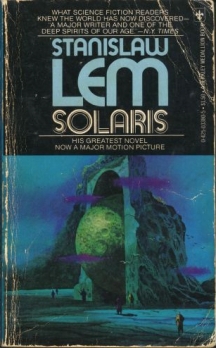
Solaris by Stanislaw Lem

We don't want to conquer the cosmos, we simply want to extend the boundaries of Earth to the frontiers of the cosmos.  For us, such and such a planet is as arid as the Sahara, another as frozen as the North Pole, yet another as lush as the Amazon basin.  We are humanitarian and chivalrous; we don't want to enslave other races, we simply want to bequeath them our values and take over their heritage in exchange.  We think of ourselves as the Knights of the Holy Contact.  This is another lie.  We are only seeking Man.  We have no need of other worlds.  We need mirrors.

Kris Kelvin arrives at a base orbiting the planet Solaris, home of the living ocean, excited to study the strange life form--if it is that--that has captivated not just his imagination but all of mankind's.  When he arrives, he finds the station in shambles, his contact dead by his own hand, and two other scientists having descended into degrees of insanity.  He's told to be wary; there are strange visitors on the station.  And sure enough, the first night he's there, he's visited by an old girlfriend who committed suicide many years ago--a kind of Ghost of Girlfriends Past.

I never saw the famous Tarkovsky film, but I did see the (surprisingly good) George Clooney remake.  My recollection of the film was that the appearance of Clooney's old girlfriend (Vera Farmiga?) was a mystery.  But in the book, the mystery is tempered by the fact that Solaris has been throwing up strange mysteries for a hundred years.  The planet is covered in ocean, but the ocean exhibits a kind of intelligence, perhaps even sentience.  The liquid shifts, changes, in purposeful ways; it even hardens into facsimiles of the human objects it "sees."  Some say it present models of places and people in their memories, but what happens to Kelvin and the others on the station has never happened before.

Solaris is best when it's diving into the knotty question of whether the ocean-planet is sentient, or even alive.  One school, to which Kelvin belongs, thinks the ultimate goal of Solaristics is contact--to talk to the planet in some meaningful way.  But the major theme of Solaris is the way that our narcissism shadows even our high-minded scientific work.  We can only conceive of extrasolar life that reflects ourselves in some way, but when it comes, if it comes, it will probably be so foreign to us that we won't be able to fit it into our solipsistic categories of "life."  Is the ocean alive?  That's not a scientific question, Lem says, it's an introspective one.  What do we see in ourselves that we think is living?

The manifestation of Kelvin's ex, Rheya, could be Solaris making a kind of contact of its own--witnessing something in Kelvin's pysche that it reproduces as a kind of recognition.  The depiction of Rheya--mysterious, fragile, shadowy--seemed to me to come from the women-sure-are-mysterious genre of masculine writing.  It makes sense, I guess, if Rheya is a kind of manifestation of Kelvin's own inner thoughts, rather than a real flesh-and-blood person.  But something about the way that the mystery of women became a stand-in for the mystery of Solaris made me wary of the book as a whole.  Still, it's another piece of evidence that shows just how underrated Lem is here in America.

Thursday, February 9, 2017

A Perfect Vacuum by Stanislaw Lem

Do you consider it probable that owing to the principle of fireworks and kicking, people will soon be taking walks upon the moon, while their perambulations will at the very same moment be visible to hundreds of millions of other people in their homes on Earth?  Do you consider it possible that soon we will be able to make artificial heavenly bodies, equipped with instruments that enable one from cosmic space to keep track of the movement of any man in a field or on a city street?  Do you think it likely that a machine will be built which plays chess better than you, composes music, translates from language to language, and performs in the space of a few minutes calculations which all the accountants, auditors, and bookkeepers in the world put together could not accomplish in a lifetime?  Do you consider it possible that very shortly there will arise in the center of Europe huge industrial plants in which living people will be burned in ovens, and that these unfortunates will number in the millions?

Stanislaw Lem's A Perfect Vacuum is a collection of book reviews, but only of books that don't exist.  There's a rich tradition of this sort of thing, going back to Carlyle's Sartor Resartus and Jorges Luis Borges' story "Pierre Menard, author of the Quixote."  Like those books, Lem's having a little bit of fun--imagining books that would be too outrageous, or else too tedious, to actually write, but using them as a foundation for some difficult ideas as well.

The first review in the collection is one of the most fun.  It purports to be a review of a French take on Robinson Crusoe called Le Robinsonade, about a shipwrecked man who peoples his island with fictitious servants, friends, and would-be lovers.  These invented people refuse to do what the shipwrecked man wants, and he finds himself dismissing his servant, who somehow continues to prowl around the island.  He invents a beautiful women, and then is forced to invent a way to prevent himself from actually sleeping with her, since she's not real:

I am Master, here I can do anything!--he says to himself immediately, for courage, and takes on Wendy Mae.  She is, we conjecture, and allusion to the paradigm of Man Friday.  But this young, really rather simple girl might lead the Master into temptation.  He might easily perish in her marvelous--since unattainable--embraces, he might lose himself in a fever of rut and lusting, go mad on the point of her pale, mysterious smile, her fleeting profile, her bare little feet bitter from the ashes of the campfire and reeking with the grease of barbecued mutton.  Therefore, from the very first, in a moment of true inspiration, he makes Wendy Mae... three-legged.

The shipwrecked man isn't mad, Lem argues, he's just caught in a bind: the more realistic his inventions, the more difficult it becomes to maintain the fantasy of illusion.  The book becomes more and more obscure as the shipwrecked man gets more and more trapped in his own inventions, which produces a sentence that I'm inducting into the great sentence hall of fame:

From this point on, we must confess, the book grows more and more difficult to understand and demands no little effort on the part of the part of the reader.  The line of the development, precise till now, becomes entangled and doubles back upon itself.  Can it be that the author deliberately sought to disturb the eloquence of the romance with dissonances?  What purpose is served by the pair of barstools to which Wendy Mae has given birth?  We assume that the three-leggedness is a simple family trait--that's clear, fine; but who was the father of these stools?  Can it be that we are faced with the immaculate conception of furniture?

Elsewhere, Lem uses these parodies to make critical statements about both literature and science.  Gigamesh is a really hilarious parody of James Joyce's Ulysses, in which the structure of the book (a retelling of the Epic of Gilgamesh, just like Ulysses retells the Odyssey) is jam-packed with so much arcane meaning that it actually encapsulates all of human knowledge.  Lem goes off on long, riotous parodies of academic jargon:

Opening the book to random, we find on page 131, fourth line from the top, the exclamation "Bah!"  With it Maesch refuses the Camel offered to him by the driver.  In the index of the Commentary we find twenty-seven different bahs, but to the one from page 131 corresponds the following sequence: Baal, Bahai, Baobab, Bahleda (one might think that Hannahan was in error here, giving us an incorrect spelling of the name of the Polish mountaineer, but no, not at all!  The omission of the c in that name refers by, the principle already known to us, to the Cantorian c as symbol of the Continuum in its transfiniteness!), Bapohmet, Babelisks (Babylonian obelisks--a neologism typical of the author), Babel (Isaac), Abraham, Jacob, ladder, hook and ladder, fire department, hose, riot, Hippies (h!), badminton, racket, rocket, moons, mountains, Berchtesgarden--the last, since the h in "Bah" also signifies a worshiper of the Black Mass, as was, in the twentieth century, Hitler.  [Berchtesgarden was Hitler's mountain retreat in Bavaria.--ED.]

All this is in the service of mocking the elitism of literary critics whose work suggests a privileged kind of reading not accessible to everyday readers.  In another review, Lem talks about the rise and fall of a DIY book called U-Write-It, which would allow readers to rearrange classic works of literature.  There's much handwringing about what this will do to the classics by professors of English, but the project is a failure: "No one cared to play U-Write-It, not because he nobly forebore to pervert quality, but for the simple reason that between the book of a fourth-rate hack and the epic of Tolstoy he saw no difference whatever."

The most thought-provoking of these is a review of a science book called Non Serviam, about the (fictional) science of personetics.  Personetics involves creating mathematical models of human beings inside computed mathematical space, and recording the way that they interact.  This serves as a backdrop for the story of a mathematically-modeled civilization who begins to wonder who their creator is , engaging in the same kind of theological arguments that human beings have engaged in for centuries.  They conclude that God does not love them, and that they owe him nothing, and insofar as it's some schlub scientist in a lab, they're right.  In other reviews, Lem takes on the Einsteinian understanding of the universe and the idea of probability.

Lem's methods can seem a little cheap--after all, where's the good faith in taking down books no one has written, and taking down arguments no one has made?  Or to present half-assed ideas he wouldn't want to commit to?  But A Perfect Vacuum becomes an image of a man laying out his own conflicted visions, talking to himself--hence the title.  And besides, Lem makes the very same point from the beginning, when he opens the book with a critical review of A Perfect Vacuum itself.  "Did Lem really think he would not be seen through in his machination?" Lem writes.  "It is simplicity itself: to shout out, with laughter, what one would dare not whisper in earnest."

Thursday, August 13, 2015

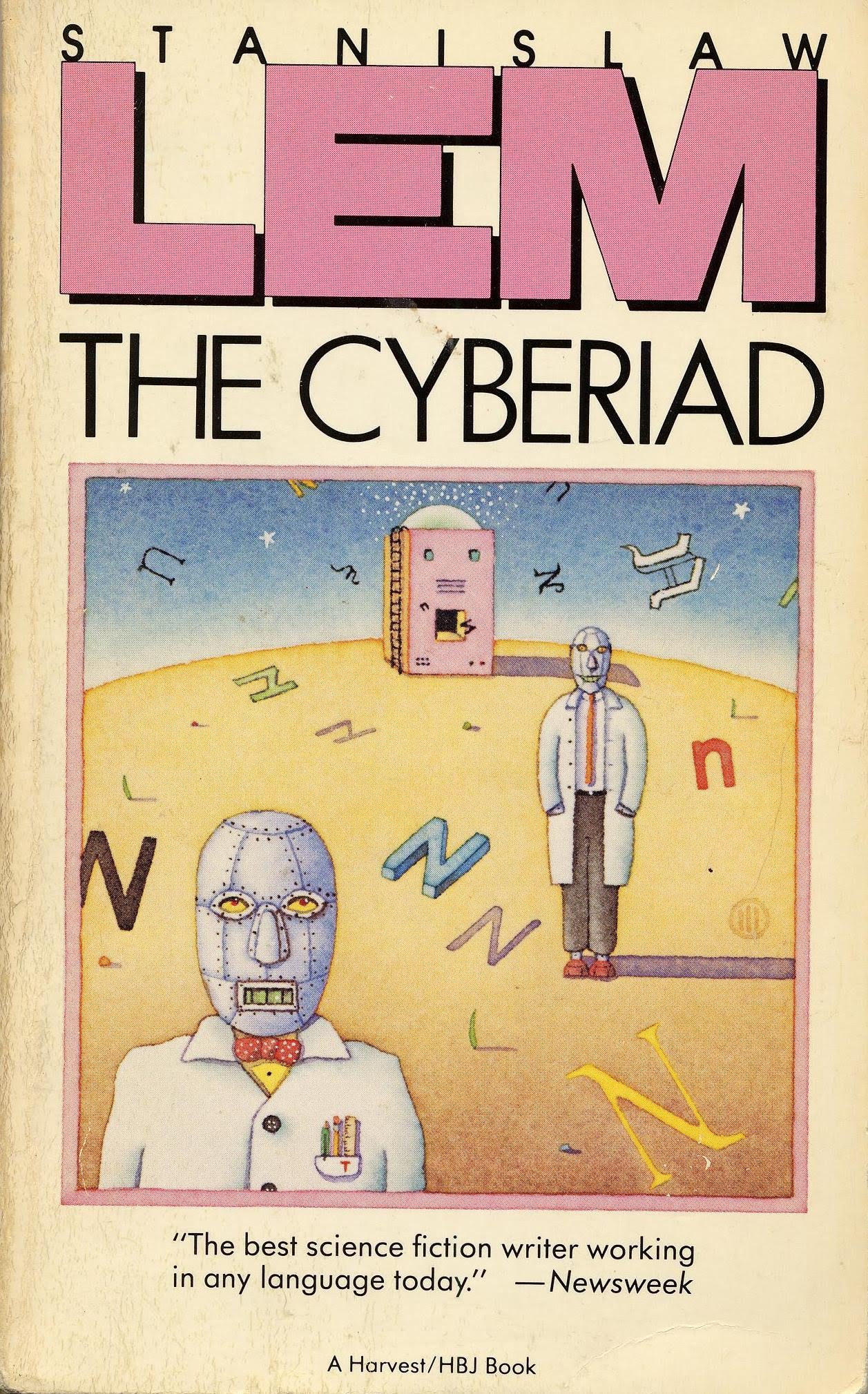
The Cyberiad by Stanislaw Lem

The bombardment began a week later, at midnight.  The cannons, primed by veteran cannoneers, were aimed, muzzles raised, straight at the white star of the Emperor's empire, and they fired--not death-dealing, but life-giving missiles.  For Trurl had loaded the cannons with newborn babies, which rained down upon the enemy in gooing, cooing myriads and, growing quickly, crawled and drooled over everything; there were so many of them, that the air shook with their ear-splitting ma-ma's, da-da's, kee-kee's and waa's.  This infant inundation lasted until the economy began to collapse under the strain and the kingdom was faced with the dread specter of a depression, and still out of the sky came tots, tads, moppets and toddlers, all chubby and chuckling, their diapers fluttering.

Trurl and Klapaucius are constructors, robots who have studied the art of making machines.  They travel throughout the universe, selling their services to various feudal robot kings, and frequently try to one-up each other in their creations.  For example, Trurl boasts that he has created a machine which can produce anything in the world that begins with the letter "N," until Klapaucius challenges it to create "nothing," at which point it begins to deconstruct the entire universe.  Eventually--once Klapaucius apologizes to the machine--everything is put back to rights, but the machine can only replace the things it has disappeared which start with N, meaning never again will the universe have gruncheons, shupops, or thists.

Translating The Cyberiad from Polish must have been quite an undertaking, and Lem's translator Michael Kandel deserves recognition for somehow preserving the alliteration and wordplay that characterizes Lem's style.  The stories which make up The Cyberiad swing deftly from the language of Arthurian romance to mechanical and mathematical jargon:

Trurl and Klapaucius were former pupils of the great Cerberon of Umptor, who for forty-seven years in the School of Higher Neantical Nillity expounded the General Theory of Dragons.  Everyone knows that dragons don't exist.  But while this simplistic formulation may satisfy the layman, it does not suffice for the scientific mind... The brilliant Cerberon, attacking the problem analytically, discovered three distinct kinds of dragon: the mythical, the chimerical, and the purely hypothetical.  They were all, one might say, nonexistent, but each nonexisted in an entirely different way.  And then there were the imaginary dragons, and the a-, anti- and minus-dragons (colloquially termed nots, noughts, and oughtn'ts by the experts), the minuses being the most interesting on account of the well-known dracological paradox: when two minuses hypercontiguate (an operation in the algebra of dragons corresponding roughly to simple multiplication), the product is 0.6 dragon, a real nonplusser.

The Cyberiad is a great work of science fiction because it's so clearly conversant with the theory and practice of the hard sciences--their language, their intellectual and ethical challenges--but never relies on them or allows them to dampen the imaginative impulse.  It's easy to see a reflection of the absurdity of Philip K. Dick (whom Lem praised, but who in turn believed Lem to be a pseudonym of a composite of Soviet authors, amazingly).  It's also a clear precursor to the Hitchhiker's Guide to the Galaxy books, of which certain elements, like the Infinite Improbability Drive that powers space travel, are basically spelled out already by Lem.  All in all, The Cyberiad is funny and thoughtful--two qualities that science fiction has all too rarely.

Check out this Google Doodle inspired by The Cyberiad.