Showing posts with label Poland. Show all posts

Sunday, July 7, 2024

How to Start Writing (and When to Stop) by Wislawa Szymborska

"My parting with summer springs forth like a white breast from a tunic bound with gems..." Many questions leap to mind: why a breast, why white, why springing, why from a tunic. The remaining poem leaves the questions unanswered. Instead Adam turns up, tempted by a snake--a bold innovation, but unlikely to catch on. Humanity has long since happily blamed it all on Eve."

How to Start Writing (and When to Stop) is a strange little book. Barely 100 pages long, it's a collection of responses to submissions made to the Polish magazine Literary Life, in the column Literary Mailbox. The responses are presented sans context, as the material or questions they're responding to aren't provided or summarized.

One interesting side effect is that this is the rare book where reading the introduction and afterward, a short interview with Szymborska, are more or less required, as they provide the historical and literary context in which the replies were written. Started in 1968 by Szymborska and her friend, author Wlodzimierz Maciag, Literary Mailbox doled out advice to writers who'd sent in various works--poems, stories, even novels--mostly in the form of cutting abut humorous bon mots or, occasionally, a paragraph or two of feedback:

The fear of straight speaking, the constant, painstaking efforts to metaphorize everything, the ceaseless need to prove you're a poet in every line: these anxieties beset every budding bard. They're curable, if caught in time. Your poems thus far resemble strained translations from direct speech into needless complication--we're tempted to ask for the originals on which this fruitless labor was based. For the moment, though, please believe us, a single metaphor organically linked to the poem's original concept is worth more than 1,500 embellishments added ex post. Please send us something new in a few months. 

Reading through them in bulk can be a bit of a dispiriting exercise, as most of the material collected here is fairly negative; but on the other hand, it's often very funny, and the advice given is good, if perhaps not particularly hard to come by: temper your highbrow language, make your work concrete, keep track of your metaphors and don't write poems about spring ("spring no longer exists in poetry"). Szymborska has the least patience, however, for the lazy or arrogant: her coldest replies are toward those who don't to rewrite, who write only about dour things, who demand publication. Perhaps the cruelest cut here is one of the shortest: "Does the enclosed work betray talent? It does."

But the cumulative effect, especially in conjunction with the closing interview, is that of someone who takes poetry, and writing in general, seriously while still recognizing that there is something a touch silly about treating every letter scrawled onto paper as holy writ. But I hope she never finds this review.

Monday, March 15, 2021

His Master's Voice by Stanislaw Lem

With an exaggeration that is necessary for the clarification of my meaning, I will say that in the course of my work (it is difficult to say exactly when this occurred) I began to suspect that the "letter from the stars" was, for us who attempted to decipher it, a kind of psychological Rorschach test. For a subject, believing he sees in the colored blotches angels or birds of ill omen, in reality fills the vagueness of the thing shown with what is "on his mind," so did we attempt, behind the veil of incomprehensible signs, to discern the presence of what lay, first and foremost, within ourselves.

Like many of the world's great scientific discoveries, the "letter from the stars" is discovered by sheer accident: a recording of a stream of neutrinos emitted from the region of Canis Minor, used--because of its presumed randomness--to generate random number tables for industrial use, proves not to be so random after all. In fact, it appears to repeat at a regular interval, a trait that should not appear if the source of the neutrino stream is natural. It is suggested that the neutrino stream may encode a message from a distant civilization; from this suggestion all the resources of the American military are marshaled in the distant Nevada desert, where hundreds of the world's top scientists are dedicated to a project codenamed, with a bit humor, "His Master's Voice."

Hogarth, the pugnacious mathematician whose reflections on the Project are recorded here, tells us from the very beginning that His Master's Voice has been a failure: "The reader who has plowed his way to this point and is waiting, with growing impatience, to be led into the inner sanctum of the famous enigma, in the hope that I will regale him with thrills and chills every bit as delightful as those he experiences viewing horror movies, I advise to set my book down now, because he will be disappointed." Only Stanislaw Lem could write a book about first contact in which no one is really contacted, or a book about aliens in which there are no aliens--and perhaps there never were. His Master's Voice, rather, becomes a treatise on exactly why translating the neutrino message is so impossible. Lem offers several deft metaphors to illustrate the disadvantage of our knowledge and our capabilities. Once we are like amoebas, receiving a telegram about a human funeral; next we are like ancient Egyptians trying to interpret a modern paper about the chemical composition of Amenhotep's funeral mask.

Science-minded folks, sometimes a little too glibly, like to say that there are no failures in science. Our knowledge is built on many such experimental failures. But such an attitude, and such glibness, are predicated on the perspective of those who have little interest in the way knowledge is really accumulated. His Master's Voice is, above everything else, a treatise on the function and practice of science, its history and limitations. Unlike people that follow the "I F*cking Love Science" Facebook page, Lem offers a fairly jaundiced view of the way science operates: balkanized into hermetic pursuits, ways of seeing the world that do not touch, and tainted always by the bias of the observer. Several fascinating hypotheses emerge from His Master's Voice--perhaps the neutrinos are a message from a dead universe, or perhaps it isn't a message at all, but a kind of cosmic excretion, like urine--but none will or can be disentangled from the hypothesizer. When knowledge is in short supply, Lem shows, what is human in us will fill in the gaps.

In many ways, His Master's Voice is reflection of the story of science in the 20th century: the great paradigm shifts of relativity and quantum theory, and the emergence of Heisenberg's uncertainty principle, which more or less did away with the idea that we can ever understand the universe from a position of true objectivity. (No doubt a real scientist would quibble with this formulation, but I think I got it more or less.) But it also reflects how the greatest discoveries of the 20th century became fodder for human history's bloodiest projects. One of the peculiar traits of the "letter" is that seems to be both a recipe for life and a catalyst for life: from the snippet that the researchers are able to "decode" organic compounds are created; these organic compounds in turn change and grow when subjected to the neutrino stream itself. For this reason some researchers believe the "letter" is meant to encourage life to grow throughout the universe. But these traits threaten to destroy life, also; Hogarth and his peers discover that these compounds are capable of propagating nuclear fission at a distance--imagine pressing a button that could release a nuclear blast anywhere on earth, of any size, without warning.

Is this property intentional? Is the "letter" the instructions for a weapon? Or is it "the kind of error, whereby someone reads, in a kitchen recipe, the word 'amanita' instead of 'amandine,' and concocts a dish that sends all his guests to their graves?" The question, like nearly all the questions surrounding the Project, will never be answered, even as it threatens the end of the earth. Lem seems to tell us that the process that led to the atom bomb was not simply the work of good scientists perverted by those with evil intentions; war, like science, is a process in which we take part but which we do not control:

A perfect equilibrium of forces, an exact equals-sign between them, was a state so improbable as to be virtually impossible. One could arrive at such a balance only by coincidence. Social fusion was one series of process, and the acquiring of instrumental knowledge was another series.

That is, perhaps the "letter" is a kind of poisoned present: for a society advanced enough in both social fusion and instrumental knowledge, it acts as an invitation to join a brotherhood in the stars. For a society advanced enough in instrumental knowledge but deficient in social fusion, like ours, it will rub us out before we become a threat. This is only one of many theories, and not the one that the more optimistic Hogarth prefers. But if it's the right one, we needn't have worried; for now, we haven't proved smart enough to end ourselves.

Friday, November 29, 2019

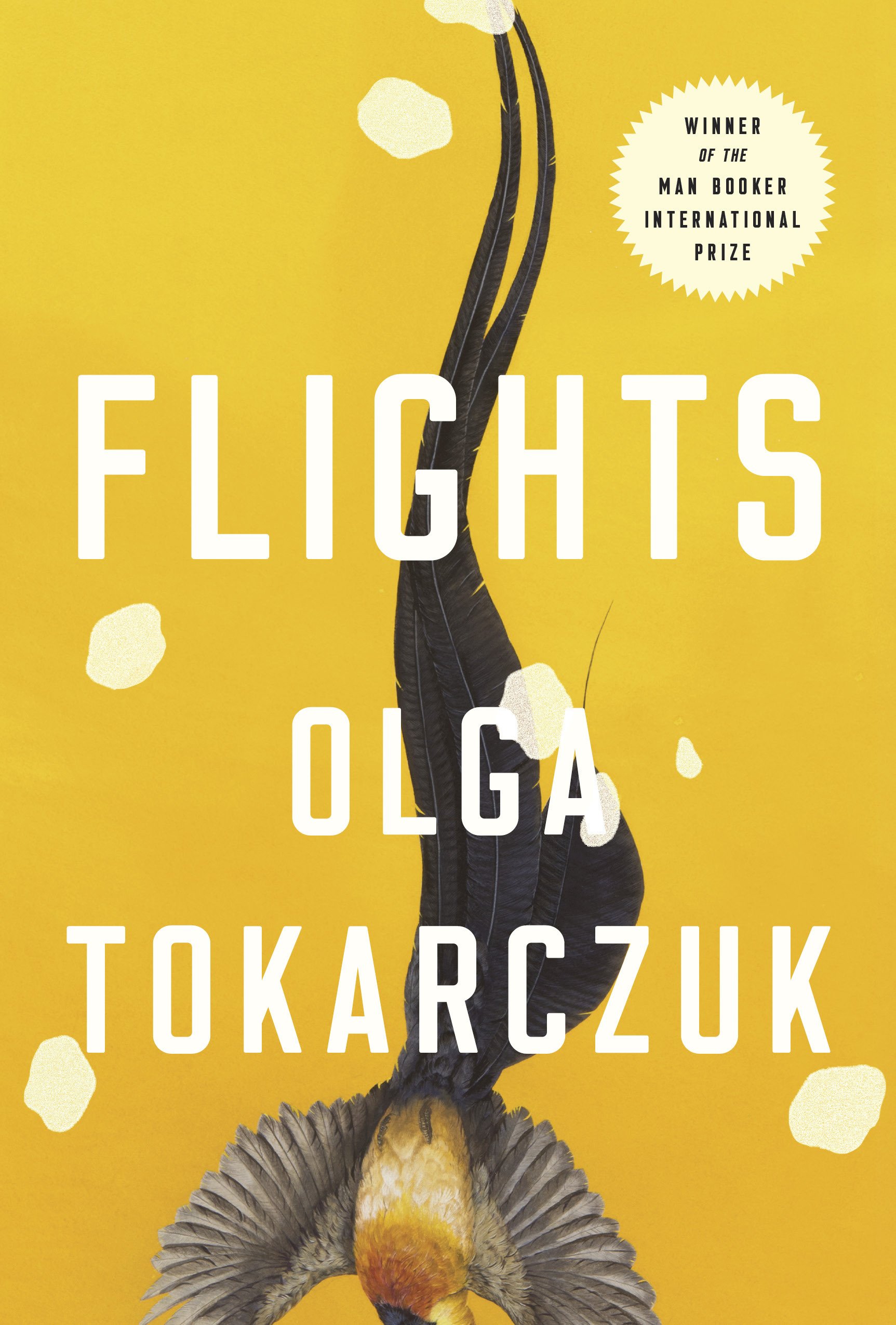
Flights by Olga Tokarczuk

Standing there on the embankment, staring into the current, I realized that--in spite of all the risks involved--a thing in motion will always be better than a thing at rest; that change will always be a nobler thing than permanence; that that which is static will degenerate and decay, turn to ash, while that which is in motion is able to last for all eternity.

The narrator of Flights, a novel by recent Nobel Prize winner Olga Tokarczuk, is a traveler by nature.  She spends her entire life flying from one place to another, supporting her travels by odd jobs, but it's the only life she can imagine: staying in one place is a kind of death; it's movement that means life.  The style of Flights, too, reinforces this idea, flitting--flying--from one narrative to another, or from vignette to vignette.  Scenes only hold her interest for so long: accounts of certain airplane flights, or certain passengers, a lecture series on "travel psychology" that takes place in airports, meditations on what airports look like from above and what it is like to have no home but hotels.

But the best parts of Flights are when the narrative, despite itself, settles down and tells a longer narrative.  There are probably seven or eight "major" stories in Flights, each one broken into pieces and scattered to appease the narrator's need for movement.  In one, titled "Kunicki," a Polish man traveling on a Croatian island searches for his wife and son after their sudden and unexplained disappearance.  Later, they return with an improbable story of falling ill and hiding in an abandoned home for days, but their disappearance has changed his life irrevocably; not only can he no longer trust her, the very sight of his home seems to have changed somehow.  Did she leave on a whim, abandoning him, only to return?  A counterpart is the unrelated story of Annushka, who leaves her distant husband and critically ill son to live underground in Moscow's metro system, choosing homelessness--movement--over safety and stillness.

The narratives in Flights are haunted by death and by the body.  Death, of course, is the ultimate kind of stillness, and the body the site at which it enters, or perhaps the natural state of motion leaves.  One strange motif in these narratives is plastination, the process by which human tissue is preserved after death, stasis imposed against the forces of decay, which are also a kind of motion.  In one longer narrative, a doctor desperately searches for a secret formula which will provide a superior form of plastination; in another, a man discovers the Achilles' tendon by operating on his own amputated leg, which has been preserved.  A collection of preserved organs nearly causes a mutiny on board a ship when the sailors discover they've been preserved in (gross) brandy.

Flights seems like that truly rare thing: a book that understands something critical about contemporary life.  The "Jet Age" may seem like an antiquated term, but the fact of widespread global travel is only a few decades old, and we are only now perhaps beginning to understand what that means for the human mind and spirit.  An extended meditation on Wikipedia--an attempt to encapsulate the whole of human knowledge, which must reckon with its need to reflect change and its capability to impose permanence--seems wise and true rather than forced, which is not something I think most writers could do.  Writing a novel is an inherently backward-looking exercise; Flights looks forward to what we might become.  In the future, will we all be like Tokarczuk's narrator, who dismisses the obligations of mortgages, of time zones?  And if so, is that tragedy or victory?

Tuesday, January 27, 2009

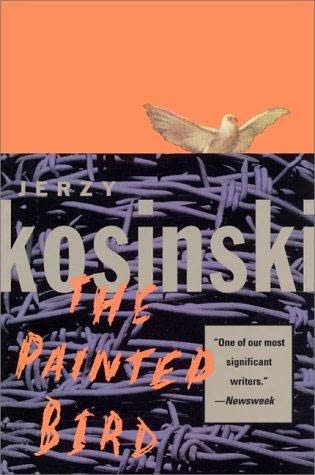
The Painted Bird by Jerzy Kosinski

When a sufficient number of birds gathered above our heads, Lekh would give me a sign to release the prisoner. It would soar, happy and free, a spot of rainbow against the backdrop of clouds, and then plunge into the waiting brown flock. For an instant the birds were confounded. The painted bird circled from one end of the flock to the other, vainly trying to convince its kin that it was one of them. But, dazzled by its brilliant colors, they flew around it unconvinced. The painted bird would be forced farther and farther away as it zealously tried to enter the ranks of the flock. We s aw soon afterwards how one bird after another would peel off in a fierce attack. Shortly the many-hued shape lost its aplce in the sky and dropped to the ground. When we finally found the painted bird it was usually dead.

Here is a rare book: a book about the Holocaust that does not take place in a concentration camp or on the field of battle, and in fact contains very few German characters. The Painted Bird is a parable, rather, of human cruelty, mean to contextualize what we know about the practices of the Nazi regime.

There are two ways to read it, I think: One is a wholly negative view, which states that the sadistic peasants who people the Polish countryside are the foundations of a European culture that allows Nazism to happen. The narrator, a young and unnamed boy has been abandoned by his parents, not out of malice but, we infer, in order to save him from the Nazis who have marked his parents as agitators. Somehow, the boy has ended up in the care of a superstitious peasant woman who regards his dark complexion and eyes as the harbingers of a great curse, and the cruelty that follows the boy around seem to validate this view. The old woman dies early in the book, and the boy wanders from one peasant home to another, witnessing a Bosch-like panorama of evil: savage beatings, men devoured in rat-filled bunkers, Russian mercenaries who castrate husbands and rape their wives, a peasant man who watches as his son and daughter couple with goats. In one protracted stay he is daily made to hang from a pair of hooks for hours on end while a ravenous dog nips at his feet below.

For a moment he stays with a bird-catcher who has a nasty habit of painted a captured bird bright colors and then releasing it to its flock. Unrecognized, the flock always tears the painted bird to pieces--a not-so-subtle metaphor for the severity and ubiquity of bigotry.

The other way to read it is more charitable: Europe, under the control of the Nazis, has become a cruel place. The fish, as they say, rots from the head. But I think Kosinski, who is Polish, includes few German characters for a reason. Instead of pointing his finger at the Third Reich, he turns his criticism on the primitive culture that lets such evil arise. Cruelty is not the domain of Germany here, and maybe not even Europe--perhaps it is a human trait.

Brooke asked me if I was enjoying this book; I told her that I do not think it means to be enjoyed. It gave me a lot to think about, and it made a strong impression on me, but it won't show up on my list of favorite books any time soon and I doubt that there are many people who would truly say they liked it. It was a chore.

Note: In reading about the book, I found some of the controversies surrounding it interesting: For one, Kosinski seems to have maintained privately for some time that it was autobiographical, but his foreword claims that it isn't and was never meant to be. Another, stranger, controversy is that some have claimed that Kosinski didn't write it; and barely knew English at the time. I really wouldn't know, but I think that that would make him a bit like the bird who paints himself.

Monday, February 5, 2007

The History of Love by Nicole Krauss

Just like the last book I read, this book very much resembles Jonathan Safran Foer’s Everything is Illuminated (stylistically, at least), although in the case of Nicole Krauss’ book it’s easy to see why (they’re married). This book was written wonderfully, and at times it’s hard to imagine where she found so much of her creativity. Told mostly from the perspective of two main characters, The History of Love tells the story of a Polish Jewish immigrant who came to the United States to escape the Second World War, and to find the woman he loved who had emigrated before him. Beginning with his first-person narration of his self-described old, empty life, the book then switches to and from the perspective of a 14 year-old girl, of Jewish parents, who describes her attempts to find happiness for her widowed mother.

This book demonstrates Krauss’ incredible versatility; she easily switches gears from an aging Jewish immigrant to a 14 year-old girl narrating through her journal. Krauss even manages to write a book within this book, or at least part of one. Krauss’s book centers around an obscure novel, also called ‘The History of Love,’ which is supposed to act as the sort of key that eventually unites the two distinct narratives. The excerpts from this book that she includes are so well-written, and completely different from the way she writes the rest of the book, that I felt myself wishing I could read it in its non-existent entirety. One of my favorite passages was written about the characteristics of angels:
HOW ANGELS SLEEP. Unsoundly. They toss and turn, trying to understand the mystery of the Living. They know so little about what it’s like to fill a new prescription for glasses and see the world again, with a mixture of disappointment and gratitude. The first time a girl named Alma puts her hand just below your bottom rib: about this feeling, they have only theories, but no solid ideas. If you gave them a snow globe, they might not even know enough to shake it.
This book was captivating and told a moving story, but it ended so unexpectedly that I found myself wondering if it was even Krauss who wrote the last 50 pages. It wasn’t that they were written poorly, just that so much was left unresolved that I felt like she had gotten lazy, and thought she would just write some pseudo-profound conclusion, hoping that the reader might just say “Ahh, how unique,” and be satisfied. As Krauss’s second book, The History of Love was a success, at least through page 200 or so. Personally, I was disappointed.

EDIT: On further reflection, this book was much better than I originally thought. I didn't recognize right away how astutely she deals with love in so many forms, not all of them beautiful. Her alternating narration and intertwining plot lines show each character's own form of love for someone (or something) else. It was a beautiful book, especially if you're quicker than I am and able to realize it.