Showing posts with label Love. Show all posts

Tuesday, July 26, 2011

07 Tender Is The Night-F. Scott Fitzgerald


I never liked Gatsby, but I like recommendations. Tender is the spectacular study of one man, Mr. Dick Diver. Told in the third person, the three sections are dominated by three characters thoughts: Rosemary, Dick, and Nicole. Tender is a somewhat autobiographical look into Fitzgerald’s own life of love and mental illness. They are expats living it up on the French Riviera during the depression. I’m remembering why I didn’t like Fitzgerald in high school and college; while reading Tender I did begin to appreciate and even love his style.
We first meet Rosemary, the young American actress that has just hit the big time in a Hollywood production. She stumbled to the French Riviera with her mother and while on the beach, happens upon a lovely young couple-Dick and Nicole Diver. She falls in love with Dick, and we learn of all the upstanding and admirable qualities that Dick possesses. The three of them get along famously, and nothing scandalous occurs.
Dick is a young American psychologist writing a book about mental treatments. In Book two, his life is explained. He married Nicole, who was a mental patient, but not his patient. She is the youngest daughter of Chicago “old money.” The love they share is a fantastic thing. They have two children. Dick grows weary of the mental episodes Nicole displays and runs away to work and write and lecture. There is nothing funny about the sadness of the love between these two. It’s meant to fall apart.
I’m willing to give Gatsby another chance, I was young, and it’s easier now to appreciate style, and not use one’s personal life as a reason to not enjoy good writing.

Thursday, June 23, 2011

Sons and Lovers by D. H. Lawrence

He was brooding now, staring out over the country from under sullen brows. The little, interesting diversity of shapes had vanished from the scene; all that remained was a vast, dark matrix of sorrow and tragedy, the same in all the houses and the river-flats and the people and the birds; they were only shapen differently. And now that the forms seemed to have metled away, there remained the mass from which all the landscape was composed, a dark mass of struggle and pain. The factory, the girls, his mother, the large, uplifted church, the thicket of the town, merged into one atmosphere--dark, brooding, and sorrowful, every bit.


Paul Morel loves his mother. Saddled with a violent, unhappy marriage to an uncouth coal-miner, she dotes on her son, with whom she forms a tight friendship. As Paul grows to become handsome and ambitious, he becomes attached to two different girls, which strains his relationship with his mother. The grammatical ambiguity of the title is no accident; at times Paul seems more like a boyfriend to his mother than a son, and more a son to his girlfriends than a lover. It is difficult, Paul shows us, to inhabit these social roles at the same time, which threaten to cleave you into parts and prevent you from devoting all of your being to anyone, even yourself.


Sons and Lovers hits many of the same settings and themes as Lady Chatterley's Lover, but it is also hugely different. The latter book is a paean to the physical act of love, which frees Constance Chatterley into herself, but sex in Sons and Lovers is (accurately, I might add) a messy, confusing affair. Paul resists giving himself physically to his lover, Miriam, until very late in the book, and it is not an unqualified success:


And afterwards he loved her--loved her to the last fibre of her being. He loved her. But he wanted, somehow, to cry. There was something he could not bear for her sake. He stayed with her till quite late at night. As he rode home he felt that he was finally initiated. He was a youth no longer. But why had he the dull pain in his soul? Why did the thought of death, the after-life, seem so sweet and consoling?


I thought that Lady Chatterley's Lover seemed strangely void of the Christian mysticism that Lawrence is known for. Sons and Lovers has it in spades, and though I'm sure others have taken to forming a precise catechism of Lawrence's religious philosophy, I must admit that such an endeavor is beyond me. There is the "sweet and consoling" after-life, and the paradoxical life that comes with being still (unlike Lady Chatterley!), and much to do with images of size and importance:


All the while the peewits were screaming in the field. When he came to, he wondered what was near his eyes, curving and strong with life in the dark, and what voice it was speaking. Then he realised it was the grass, and the peewit was calling. The warmth was Clara's breathing heaving. He lifted his head, and looked into her eyes. They were dark and shining and strange, life wild at the source staring into his life, stranger to him, yet meeting him; and he put his face down on her throat, afraid. What was she? A strong, strange, wild life, that breathed with his in the darkness through this hour. It was all so much bigger than thamselves that hewas hushed. They had met, and included in their meeting the thrust of the manifold grass stems, the cry of the peewit, the wheel of the stars.


But mostly I enjoyed reading Sons and Lovers more than Lady Chatterley because it is a novel more in tune with its protagonist's psychology, more interested in human detail. Lady Chatterley's reputation as pornographic, I feel, may have as much to do with its positivity about sex as its graphicality. Most of us, I think, simply have never felt as unabashedly pure and overjoyed about human intimacy as Connie does--though if you feel otherwise, I am quite happy for you. I feel much more in tune with the confused, needy, insolent Paul, who says things like this:


"You know," he said, with an effort, "if one person loves, the other does."

"Ah!" she answered. "Like mother said to me when I was little, 'Love begets love.'"

"Yes, something like that, I think it must be."

"I hope so, because, if it were not, love might be a very terrible thing," she said.

"Yes, but it is--at least with most people," he answered.


Love is a terrible thing, as Paul will find out, at least terrible in capability. Paul is never able to give himself wholly to either Miriam or Clara because the prospect is too frightening; he uses words like "freedom" but the subtext is of diminishing, of vanishing into the other, which is both appealing and horrifying.

Wednesday, May 11, 2011

Dr. Zhivago by Boris Pasternak

Oh, what a love it was, utterly free, unique, like nothing else on earth! Their thoughts were like other people's songs.

Dr. Zhivago is usually remembered as a love story. And it is that, to be sure, but so much more: It is an epic in the Russian style, with a massive cast of characters (who all seem to be running into each other improbably over the course of their lives, as if it were no big deal to stumble across your childhood friend from Moscow in the desolation of Siberia). It is a war novel, about the upheaval in Russia created by the Russian Revolution. Much like Parade's End, it is about the way that the world changed fundamentally in the early part of the 20th century, ravaged by war and forced to find its footing again.

And it is a love story. The titular Yuri Zhivago grows up in Moscow, only occasionally entering the orbit of Lara Guishar, who he will meet later as a field nurse and then will become his lover. By then both are married and have children, but war has separated them from their spouses: Zhivago having been captured and impressed into medical service by a roving band of Bolsheviks; Lara's husband having become the renowned Bolshevik commander Strelnikov. The war brings them together, but ultimately it must also drive them apart.

The ultimate verdict on the Revolution is decidedly mixed. It drives lovers apart; it drives them together. It does away with the poisonous old system, but what does it have to offer but violence and instability instead? Yuri regards it with something near awe:

He realized that he was a pygmy before the monstrous machine of the future; he was anxious about this future, and loved it and was secretly proud of it, and as though for the last time, as if in farewell, he avidly looked at the trees and clouds and the people walking in the streets, the great Russian city struggling through misfortune--and was ready to sacrifice himself for the general good, and could do nothing.


And yet, in the individual moment of human lives, the Revolution proves horrific:

They stood around a bleeding stump of a man lying on the ground. His right arm and left leg had been chopped off. It was inconceivable how, with his remaining arm and leg, he had crawled to the camp. The chopped-off arm and leg were tied in terrible bleeding chunks onto his back with a small wooden board attached to them; a long inscription on it said, with many words of abuse, that the atrocity was in reprisal for similar atrocities perpetrated by such and such a Red unit--a unit that has no connection with the Forest Brotherhood.


No wonder the book was suppressed by the Soviet Union; Dr. Zhivago is a vile account of its national mythology. Yuri and Lara's love prospers in spite of their terror and their grief, and perhaps is even enhanced by it. Yet they live a doomed love, with no future, because they live in a futureless world. The Russia that emerges is utterly foreign to Yuri, and though he is wise, kind, and upright he is unable to deal with the totality of her changes.

There is a moment when Yuri is in the Bolsheviks' service that he sees a young boy with a head wound trying dutifully to keep his hat on straight and exacerbating his wound meanwhile. His comrades try to help him, through their misbegotten and shallow vision of goodness; the only one who has the power to see the deeper goodness is the doctor, Zhivago. He plays this same role as a poet--a sort of physician of the soul--and tries desperately to preserve sanity in an increasingly maddened world. Like Tietjens, he is too good for it. Pasternak himself lived daily with the heritage of that madness, and Dr. Zhivago--like Yuri with his poems--is the record of that struggle.

Tuesday, February 22, 2011

06 The Bread of Those Early Years-Heinrich Böll

Böll is known for his simplicity. In its original German, his books are often taught to German language learners because of that simple precise style. Truly lovely:

I sat down on the running board of Wickweber’s van, but instead of staring at the doorway I closed my eyes and looked for an instant into the darkroom, seeing the image of the only person who I know has never shouted, never bawled out another person—the only person whose devoutness I have found convincing: I saw Father. In front of him was the little blue wooden box we used to keep our dominoes in. the box is always stuffed with memo slips, all cut by Father to the same size from waste paper: paper is the only thing he hoards. From letters begun and then discarded, from copybooks not fully used up, he cuts out the blank parts, from wedding and death announcements he cuts off the unprinted parts, and as for those impressive circulars, those requests on deckle-edged paper to appear at some rally or other, those invitations on linen paper to do something for the cause of Liberty—this printed matter fills him with childish delight because each one yields him a least six memo slips, which he then deposits as treasures in the old domino box. He is obsessed by bits of paper, inserts them in his books, his wallet bulges with them, matters both important and trivial are all confided to these slips. I was forever coming across them when I was still living at home. “Button on undershorts” was written on one of them, on another “Mozart,” on another “pilageuse—pilage,” and once I found one saying: “On the streetcar I saw a face such as Jesus Christ must have had in His Agony.” Before going shopping he takes out the slips, riffles through them as though a deck of cards, lays them out like a game of solitaire, and arranges them in order of priority, forming little piles just as one separates aces, kings, queens, and jacks.

From all his books they stick halfway out between the pages, most of them yellowed and spotted because the books often lie about for months before he gets around to making use of the slips. During school vacations he collects them, rereads the passages he has made notes on, and sorts the slips, on most of which he has noted English and French words, grammatical constructions, idioms whose meaning is not fully clear to him till he has come across them two or three times. He carries on a voluminous correspondence about his discoveries, orders dictionaries to be sent to him, chicks back with his colleagues, and with gentle persistence needles the editors of reference works.

And there is one slip that he always carries in his wallet, one marked in red pencil and being particularly important, a memo that is destroyed after each of my visits buy is then soon written out again—the slip that says: “Have a talk with the boy.”


This passage takes me into his father’s house and life, but Böll does this with ease throughout the novella.

Simply put, The Bread is a love story that takes place in one day. Boy meets girl, boy falls in love, boy desires girl, girl acquiesces. Unlike modern writers, Böll doesn’t have his characters have sex or even kiss. They are proper post-war Germans, marriage is the only option. The flashbacks within the first person narration are digressions of beauty. Did I mention Bolaño was influenced by Böll?

Mr. Walter Fendrich is a washing machine repairman. He is completely afraid of famine and just as the title suggests, he loves bread because it was something he rarely had when growing (yes, it's a metaphor). In his search for his identity he has gone through several apprenticeships and quit all of them. He hates his current job but is excellent at diagnosing the problem, fixing it, and moving on. He can’t seem to do this in his real life. He makes good money, but still buys bread every chance he gets; he buys so much bread that most days he is forced to give it away.

Hedwig Muller is moving to the city to pursue a teaching career. They are united only by their hometown, but after finding her an apartment at her father’s request, he picks her up at the railway station. Fendrich decides right then, he is going to give up everything for this woman. It’s quite romantic really. He buys her flowers, postcards, cake, coffee, and of course, bread.

Tuesday, January 19, 2010

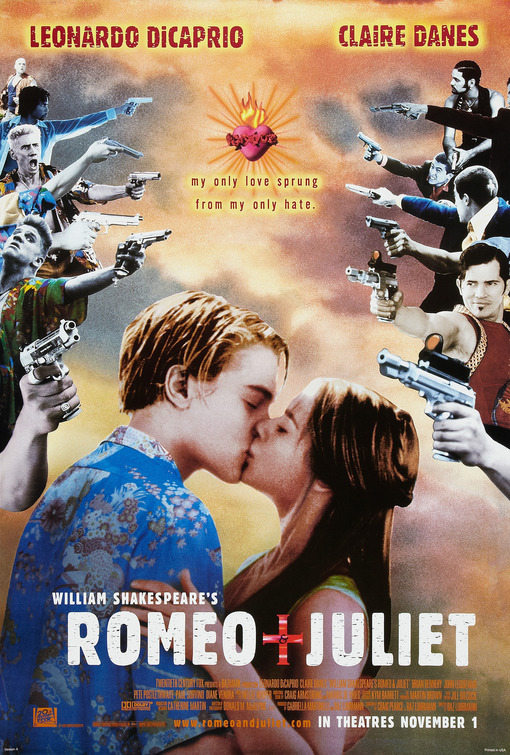
Romeo and Juliet by William Shakespeare

What is left to say about Romeo and Juliet? Re-reading this one wasn't quite the experience that King Lear was, for many reasons. For one, Lear is just better. Secondly, would anyone deny that Romeo and Juliet is near-ubiquitous in our culture? I mean, how many bad sitcoms have a scene where a high schooler moons vicariously over their crush under the pretense of being cast in Romeo and Juliet together? It is nearly impossible to read this play with fresh eyes.

(Of course, Lear gets a point taken away for not having as many dick jokes. Seriously, if you go by this editor's gloss, just about every word in Shakespearean English is a euphemism for either a penis or a vagina.)

So, I find myself without having much to say. The most interesting question that came to my mind is this--do Romeo and Juliet really love each other? That sounds ridiculous on its face, but my reading of the play in college--at the height of my cynicism--was that Romeo's love for Juliet was of the same stripe as his love for Rosaline, for whom he pines in the first act. This would be appropriate in the sense that in most classical tragedies the final catastrophe is the result of one's own actions, and as such we might be encouraged to see Romeo's infatuation with Juliet as childish, or foolish, and ultimately destructive.

But several things make me change my mind, including the realization that valuing Romeo's feelings over Juliet's is probably a form of mild sexism. Though Romeo appears moody, fickle, and kind of a douchebag, Juliet never seems to be anything but calm, and never lets her passion for Romeo bring out the same kind of lamentation and breast-beating that he indulges in (leading the Friar to call him womanly, and certainly suggesting swapped gender roles).

But also, the tone of Romeo's love is different. His love for Rosaline is expressed in oxymoron, typical of Petrarchan love sonnets:

Why then, O brawling love, O loving hate,
O anything of nothing first created!
O heavy lightness, serious vanity,
Misshapen chaos of well-seeming forms!
Feather of lead, bright smoke, cold fire, sick health,
Still-waking sleep that is not what it is!
This love feel I, that feel no love in this.


For Petrarch, the ideal was courtly love, which by its nature is external to marriage and can never be realized. The agony that arises is to be expected, and makes love a largely joyless thing, which Romeo expresses when he says, "This love feel I, that feel no love in this." And yet, his love for Juliet is neither unrequited nor agonizing:

O blessed, blessed night! I am afeard,
Being in night, all this is but a dream,
Too flattering sweet to be substantial.


Is it Juliet? Or is it merely the fact that, unlike Rosaline, Juliet returns his feelings?

Finally, I am convinced by something the editor, Mario DiGangi, says in his introduction:

The most elevated dramatic genre, tragedy traditionally dealt with the fall of great men--"great" because both aristocratic and historically important. Romeo and Juliet are neither... As such an Elizabethan audience might have felt skeptical about the value of a tragedy centered on their lives and loves... In order to find Romeo and Juliet figures worthy of tragic treatment, then, Shakespeare's audience would have to find value in their love.


The implication being, of course, that love is a kind of substitute for greatness, that true love can make a man or woman great. Furthermore, for Romeo and Juliet this occurs not only without the sort of social admiration that aristocracy and history might import, but despite its opposite, the social revilement that their union causes when Juliet reveals her intention to her parents. Contrary to my younger, cynical self, I think there's something sweet and wonderful about that.

The question remains, then--is Romeo correct when he says on his wedding day, "But come what sorrow can, / It cannot counteract the exchange of joy / That one short minute gives me in her sight"? If their love is what we hope that it is--true, pure, and deeply felt--is the short time which they have it worth their demise? And would it be true for you or me?

Saturday, June 20, 2009

The Time Traveler's Wife by Audrey Niffenegger

Why The Time Traveler's Wife? Why not The Time Traveler? Or better yet, why not The Time Traveler and His Wife? After all, it's the dashing librarian and accidental time traveler Henry who is the real focus of this novel, not his perpetually abandoned wife, Clare, or at the very least they should share top billing. Is the author, Audrey Niffenegger, trying to emphasize Clare's experience as the Other in this novel, the one left behind, the one who has to deal with the constant abandonment and frustration? That perhaps would have made a more interesting novel. Such are the things that perplexed me about The Time Traveler's Wife.

My friend Rachel Bethany bought this book for me at the Strand, hoping that I would love it as much as she did; I'm sad to say that I didn't much care for it. But, in deference, let's start with what the book does well: It's amazingly well-plotted. The plot centers around Henry DeTamble, who has the unique ability to travel through time, but not the ability to control when he goes or to when. As a result, he is constantly appearing in strange places and times, stark naked. He is married--at some point--to Clare Abshire, a beautiful redhead who is--or will become--an artist. But the nature of their relationship is unusual; she meets him for the first time when she is a child and he appears in the meadow outside her family's home, thirty years old and nude. He meets her for the first time when they are the same age; she jumps for joy because she has been waiting for years to meet him in her own timeline, and yet he has no idea who she is.

There's a sort of fascinating circuity here: Clearly Henry and Clare are meant to be together, but what is the force that drives them together? He appears that first day in the meadow because has a deep connection to Clare, but without that first appearance--and those thereafter--that connection would never have been formed. It's an interesting question that Niffenegger does disappointingly little to develop.

Yet, everything has been thought ought with the utmost care and precision; the overlapping timelines must have taken an extraordinary effort to map out. Nothing seems to be out of place; the novel is refreshingly clear of the little nonsense paradoxes that seem to creep into bad science fiction. Even more impressively, Niffenegger finds a way to arrange these time traveling episodes so that they have some semblance of true chronology, and yet still manages to ratchet the tension up considerably in the novel's closing chapters.

Now for the bad: I could not have cared any less about what happened to these characters, who were absolutely obnoxious. Niffenegger tries to impose some sort of troubled past on Henry through his mother's death in a car accident and his father's ensuing alcoholism, but Henry hardly seems to have any character flaws for it. He is an accomplished fighter and thief, but develops these traits only as a necessity due to his time traveling; otherwise he's just a dashing librarian. Clare is worse, little more than a cipher, with the personality of a sock.

Niffenegger substitutes taste for character. Over the 500+ pages of the novel, we're told what kind of music the characters listen to, what kind of art they enjoy, and what kind of fucking dinner they eat. Everything is so tasteful and cultured, it's hard to shake the impression that Niffenegger is, in some sense, projecting her own awesome tastes onto her characters, begging that we be impressed. Even when Henry and Clare differ, it's obnoxious:

How can Clare listen to Cheap Trick? Why does she like the Eagles? I'll never know, because she gets all defensive when I ask her. How can it be that the woman I love doesn't want to listen to Musique du Garrot et de la Farraille?


Barf. Here's another scene where we open on Clare:

I'm sitting by myself at a tiny table in the front window of Cafe Pregolisi, a venerable little rat hole with excellent coffee. I'm supposed to be working on a paper on Alice in Wonderland for the History of the Grotesque class I'm taking this summer; instead I'm daydreaming, staring idly at the natives, who are bustling and hustling in the early evening of Halsted Street.


Double barf. Henry and Clare teach a lesson to a couple "baby punks":

Henry sits down at the kitchen table, and Bobby sits down across from him. "Okay," says Henry. "You have to go back to the sixties, right? You start with the Velvet Underground, in New York. And then, right over here in Detroit, you've got the MC5, and Iggy Pop and the Stooges. And then back in New York, there were the New York Dolls, and the Heartbreakers--"

"Tom Petty?" says Jodie. "We've heard of him."

"Um, no, this was a totally different band," says Henry. "Most of them died in the eighties."

"Plane crash?" asks Bobby.

"Heroin," Henry corrects. "Anyway, there was Television, and Richard Hell and the Voidods, and Patti Smith."

"Talking Heads," I add.

"Huh. I dunno. Would you really consider them punk?"


A plane crash? Seriously, Bobby? Here are Henry and Clare at dinner:

Kimy gets up and clears our salad plates and brings in a bowl of green beans and a steaming plate of "Roast Duck with Raspberry Pink Peppercorn Sauce." It's heavenly. I realize where Henry learned to cook. "What do you think?" Kimy demands. "It's delicious, Kimy," says Mr. DeTamble, and I echo his praise. "Maybe cut down on the sugar?" Henry asks. "Yeah, I think so, too," says Kimy. "It's really tender though," Henry says, and Kimy grins.


It goes on like this, inanely. After 500 pages, I knew what magazines Henry reads, and what concerts Clare goes to, and what they like to eat for dessert, and I knew that Clare's family lives in a house designed by Frank Lloyd Wright. Why Frank Lloyd Wright? Why not?

In her review, Amanda complained that the novel is bogged down by unnecessarily pornographic material:

They just bother me when they aren't needed for the story to move forward, when they're in there for shock value. It feels completely unrealistic, for instance, for a new mother to lay on her bed, sigh, and say, "My cunt hurts." Who really says that? No one I've ever met, at least.


Usually I'm unsympathetic to complaints that a novel is too graphic, but I think Amanda has it exactly right, or at least part of it exactly right: Somewhere in here is a 200-page novel filled out with nonsense. These scenes aren't just unnecessarily graphic, they're unnecessary. Why does Niffenegger devote ten pages to Clare and Henry discuss how much more sex they have than other couples, and how great it is? To make the rest of us feel bad? Or just to make us think, hey, these two, they're cool, I wish I could be like them. Niffenegger certainly seems to want to.

And the tragedy is that, somewhere between Richard Hell and the Roast Duck with the Pink Peppercorn Sauce, is a story with tremendous symbolic power that speaks to the nature of fate, of time, and of love. I think that maybe if Niffenegger had spent more time thinking about those things, and less about how to convince us Henry and Clare are awesome, it might have been an infinitely better book.

Tuesday, January 27, 2009

House of Sand and Fog by Andre Dubus III

He would drive to San Bruno and look for Kathy there. it was practically their entire geographical frame of reference. If she wasn't at the storage shed or the truck-stop bar or the El Rancho Motel, then he would try Carl's Jr. on the other side of the freeway. And if that didn't pan out he'd drive south to Millbrae to the Cineplex, where she could possibly be at the movies. Ahead of him in the fog, Corona's main street ended at the base of the hills and the intersection for the turn to Hillside Boulevard and San Bruno. The blinking yellow traffic light above was so obscured it looked to Lester more like a silent pulse. Kathy would not be at her stolen house up in the hills but the colonel would, and there was no crime in cruising slowly by; he was off-duty and out of uniform.

House of Sand and Fog
by Andre Dubus III is the story of Kathy Nicolo, Sheriff Lester Burdon, Colonel Massoud Amir Behrani and their tragic crossing of paths. Kathy wakes one morning to find Sheriff Burdon at her door, informing her that she has been evicted by the county for failing to pay back taxes. Ms. Nicolo informs the Sheriff that there must have been a clerical error, that she owes no taxes. Her pleas prove ineffectual, and her home is auctioned off to Colonel Behrani, a Persian immigrant set on reselling the house for a profit to provide for his family. Behrani is determined to see his family returned to the dignified position they once held in Iran. Kathy's home was all she had left after her husband suddenly left her and she is not willing to let it go easily. Lester find himself falling in love with Kathy and refuses to sit idly by while she suffers a grave injustice. The collosion of these three forces of will leaves families destroyed, lives ruined, and blood spilt.

Dubus' writing is smooth and has its own flow to it. His style is really a pleasure to read. But I have a hard time saying I enjoyed this book. There's really not much to come away from feeling good about. Simply put, House of Sand and Fog is a tragedy. More Shakespearean than Greek, I think. While Kathy and Behrani have their flaws, Lester reminded me of Paris in Romeo and Juliet in the sense that he was merely a victim of circumstance. More or less a simple man, Lester is driven to the edge by his love for a woman he barely knows. Like Paris, he strikes me as the most tragic character in the story, for his life (and that of his family) are ruined because of his involvement in the clash between Behrani and Nicolo.

I suppose if I had one problem with this story, it was the unbalanced portrayal of the plights of Kathy and Behrani. I don't know if Dubus intended to make Behrani seem more at fault than Kathy, but I think it's more likely that he simply failed at making Behrani's motives as justifiable as Kathy's. A young woman has her house stolen out from her because of an improperly addressed envelope. She finds herself homeless with nothing in the bank. She calmly explains this to the man who has bought her home from the county, and yet he refuses to help her rectify the situation by complying with the county when they try to rescind the sale. Now, I understand that Behrani is simply trying to enter the real estate market and provide for his wife and son. I understand that Behrani feels he has committed no wrongdoing in legally purchasing the house from the county. I understand that he has suffered greatly since the fall of the Shah's regime and his flight from Iran. But even with all that, I can't help but look at him as a stubborn, greedy man who knowingly held on to stolen property even after the situation was laid out in front of him. To me, this weakened the story a bit. It wasn't what Dubus (probably) intended, the story of two people with equal stake and righteousness battling for stability. It was an unlucky woman struggling to take back what's hers from a man who refuses to do whats right.

That said, there are enough mitigating factors to make the reader at least somewhat sympathetic to Behrani. And in the end, I suppose this imbalance is rectified as he is the one to lose everything, whereas Lester and Kathy lose only most everything.

Check this out if you like Steinbeck, as Dubus' writing style reminds of his, or if you're a fan of tragedies in general. It's really quite moving and you'll be surprised at how quickly you find yourself swept up in the rise and fall of the principle characters.

Highlights: Lester's mustache, the surprisingly action-packed final act, picturing Jennifer Connelly during all of Kathy's sex scenes.
Lowlights: Behrani's recalcitrance, The inevitably depressing ending

Monday, March 3, 2008

Persuasion by Jane Austen

This is the first Jane Austen book that I have read. I was not intentionally avoiding Austen's writing...just never had the urge to read anything by her. At the end of last year, I compiled a list of books that I probably should have read by this point in my life, as well as authors that I should probably be familiar with. Austen made the second list.

In some ways Persuasion reminded me of Anna Karenina. Both Tolstoy and Austen were writing about the societies in which they lived. Granted, Austen takes a comedic approach, skewering the "sensibilities" of the British upperclass. Like Anna Karenina, Persuasion is full of characters (albeit not as many principles as AK) with complex family relations and convoluted romantic situations.

The main character, and one of the few consistently likable characters throughout the novel, is Anne Elliot. Her father and older sister are the epitome of obnoxious, elitist socialites; and are rarely depicted in any way other than despicable. It would be impossible to adequately describe the various characters that inhabit the pages of Persuasion without this review pushing the lengths of common sense (i.e. Christopher's Goblet of Fire review).

Short summary:
Anne is largely surrounded by vacuous people, many of whom are vying for beneficial marriages. Anne is not. She almost married a young man many years back, but backed out at the last minute at the behest of a close friend. But this man, Captain Wentworth, reappears and stirs up her otherwise stolid life.

I often had a little trouble keeping some of the characters straight. Some were not fleshed out as much as others, so when they reappeared after being absent for many pages, I had a little trouble remembering who they were. It didn't help that there were at least three characters named Charles. I thought this was an odd thing for Austen to do. I wonder if it was Austen's way of subtly conveying the air of confusion that surround these people and their relationships.

I liked the book well enough to read something else by Austen.

Monday, January 7, 2008

The Kreutzer Sonata by Leo Tolstoy

I had to read Anna Karenina for a class on Russian History. Despite the fact that it was assigned to me, and that it is just shy of 900 pages, I really enjoyed the book. I was told by my professor that I should check out some of Tolstoy’s short stories. This was 2003, and I am just now getting around to taking his advice.

The Kreutzer Sonata, named after a piece by Beethoven, begins with the narrator – we never get his name – remembering a train ride that he took not that long ago. A little ways into the trip he became involved in a conversation about men and women, marriage, and love. A number of people were contributing to the lively discussion until an old man, who had kept to himself up to this point, injected himself into the conversation. He asserted that love, as those party to this conversation were defining it, simply did not exist. This brought a rise out of many of the people there. Someone responded that the fact that marriages existed proved that there was such a thing as love. To which the man responded, “[People] enter into marriage without seeing in it anything except copulation, and it usually ends in either infidelity or violence. Infidelity is easier to put up with.” “Yes, there’s no doubt that married life has its critical episodes,” someone responded. The man brought silence with his reply, “Pozdnyshev’s the name. I’m the fellow who had one of those critical episodes you were talking about. So critical was it, in fact, that I ended up murdering my wife.” The narrator of our story later seeks out Pozdnyshev and begins talking with him. The old man opens up and tells his story, which essentially occupies the rest of the novella.

As he did in Anna Karenina, Tolstoy does a good job of creating characters to which the reader can relate. The situations that he puts them in are situations that could essentially happen this day.

The picture that he paints of married life is extremely bleak. The Kreutzer Sonata is really an indictment of marriage, with Tolstoy arguing that most marriages are simply a sham. I found it interesting that Tolstoy drew on his own experiences with marriage when writing this book, much to the shock and dismay of his wife. The Kreutzer Sonata was a quick read and was very interesting.

Tuesday, April 24, 2007

The Time Traveler's Wife by Audrey Niffenegger

Why is love intensified by absence? Long ago, men went to sea, and women waited for them, standing on the edge of the water, scanning the horizon for the tiny ship. Now I wait for Henry.

This is easily the best book I’ve read this year, and probably the most moving book I’ve ever read. I couldn’t put it down. It was great.

Henry, the time traveler of the title, has a genetic disorder that causes him to travel through time, mostly his own past, without warning. His episodes can be triggered by stress, illness, surprise, or even standing up too quickly. He finds himself whenever and wherever, completely naked, often vomiting, and occasionally surrounded by very confused strangers. Some of the most interesting parts of the novel were when Henry had to cope with being dropped in different situations that were completely out of his control, often having to seek help from his past or future self. Clare is Henry’s wife, in some, but not all, layers of time that the story follows. The story is almost evenly divided between her narration and Henry’s. She plays Penelope to Henry’s Odysseus, and a lot of her plot is figuring out how to cope with this strange part of their relationship, but she does it gracefully. "Love conquers all," or so I've heard.

As you can probably imagine, a lot of Niffenegger’s plot is very circular. Henry grows up, meets Clare, marries her, then travels back into the past and meets her as a six year-old girl. Clare grows up, recognizes Henry in a library, and asks him out. This is the first time Henry meets Clare. There are all kinds of situations like this one: one of them has almost always experienced the majority of their relationship before the other, past and future. Often times, something very important to their life and the story happens only as a result of Henry accidentally (or intentionally) affecting their past or future. But, and here’s the only place where the book teeters on the frontier of science-fiction land, everything that’s ever happened, or will happen, or is happening, is unchangeable, and on the same plane. Time is viewed as something very parallel. The whole novel is written in the present tense to emphasize this, which I liked very much. You might expect a plot that constantly jumps backwards or forwards in time any number of years or days to be a headache, as I did, but Niffenegger handled it perfectly, and managed to completely avoid any redundancy that probably could have sprung up very easily.

The most beautiful thing about this book is the joy or pain that they share (or that Henry keeps from Clare) at knowing certain inevitable parts of their future, good or bad. The Time Traveler’s Wife raises a lot of questions about how much of our lives are actually in our own hands, and I don’t mind that it doesn’t bother to answer them, or speculate as to whose hands they might be in. That’s not the point. The point is that they fell in love, and they couldn’t help it, and nothing can change it. It’s completely new to see love overcome something like a genetic time travel disorder, but it still feels familiar. Anyone who’s ever fallen in love, or cared deeply for anyone, will be able to understand a lot of what Henry and Clare go through, even if they don’t have a genetic disorder that causes them to instantaneously travel through time and space, completely naked.

Niffenegger, although she has a silly name, wrote a great novel. And I don’t care what you think about love stories; this is a great story no matter what you call it. Read it.

Tuesday, April 10, 2007

On Beauty by Zadie Smith

This is not an easy book to summarize; I’ve been typing and erasing reviews for the past 20 minutes. On Beauty is Zadie Smith’s third novel, but it hardly shows.

The story follows an upper-class family of academics in the fictional New England college town of Wellington. It’s a lot more interesting than it sounds. Smith explores different issues of personal growth and identity that are relevant to almost anyone through each of the five family members. Howard, a white, English, art professor, slowly alienates everyone in his family with a series of stupid infidelities. Kiki, his black, Floridian wife, asks herself tough questions about what it means to fall in love, to give your life to someone, and how much love can actually overcome. Their three children all deal with growing up and forging their own identities in their respective close-knit communities. One tries to make a name for herself as a liberal intellectual at Wellington College, the oldest breaks away from his parents close-minded liberal ideologies by adopting Christian, conservative values, and the youngest awkwardly tries to come to terms with his racial identity in his upper-class, New England suburb. In dealing with each of these personal challenges, Smith manages to expand the small world of college politics and New England social life into something much more familiar to her readers. In no way is this book limited in its scope.

Her characters, while unique in their professions, racial identities and beliefs, could be anyone. On Beauty is guaranteed to touch on at least one problem that each of its readers has dealt with at some point. Smith explores problems of identity, such as what it means to be white or black, old or young, conservative or liberal.

The older we get the more our kids seem to want us to walk in a very straight line with our arms pinned to our sides, our faces cast with the neutral expression of mannequins, not looking to the left, not looking to the right, and not—please not—waiting for winter. They must find it comforting.

If you can’t relate to what it’s like to grow old or fall out of love, you can almost certainly recognize some of the personal struggles that the younger characters face as they learn more about themselves and what it means to long for someone else. And she writes it all so well that it’s easy to forget that her characters aren’t actually having affairs in a small New England town, or that Smith herself hasn’t experienced all of this. Her prose is sharp and witty, and the way she so effortlessly follows around different characters is very refreshing.

Smith has a very fluid style, and manages to slowly, and naturally, leak out more details of the plot without relying on forced dialogue, so characters aren’t saying things like “remember that time when I did that thing that relates very much to an important plot development we’ll soon face?” The only problem I had was that sometimes she didn’t seem to say much about the issues she brought up. She seemed to point excitedly to the fact that the oldest son was a conservative Christian in a family of liberal atheists, and then just lose interest. Overall, I’d imagine that this book can speak to just about anyone, even though it leaves you to draw perhaps too many of your own conclusions. Plus, the cover is very pretty.

Monday, February 5, 2007

The History of Love by Nicole Krauss

Just like the last book I read, this book very much resembles Jonathan Safran Foer’s Everything is Illuminated (stylistically, at least), although in the case of Nicole Krauss’ book it’s easy to see why (they’re married). This book was written wonderfully, and at times it’s hard to imagine where she found so much of her creativity. Told mostly from the perspective of two main characters, The History of Love tells the story of a Polish Jewish immigrant who came to the United States to escape the Second World War, and to find the woman he loved who had emigrated before him. Beginning with his first-person narration of his self-described old, empty life, the book then switches to and from the perspective of a 14 year-old girl, of Jewish parents, who describes her attempts to find happiness for her widowed mother.

This book demonstrates Krauss’ incredible versatility; she easily switches gears from an aging Jewish immigrant to a 14 year-old girl narrating through her journal. Krauss even manages to write a book within this book, or at least part of one. Krauss’s book centers around an obscure novel, also called ‘The History of Love,’ which is supposed to act as the sort of key that eventually unites the two distinct narratives. The excerpts from this book that she includes are so well-written, and completely different from the way she writes the rest of the book, that I felt myself wishing I could read it in its non-existent entirety. One of my favorite passages was written about the characteristics of angels:
HOW ANGELS SLEEP. Unsoundly. They toss and turn, trying to understand the mystery of the Living. They know so little about what it’s like to fill a new prescription for glasses and see the world again, with a mixture of disappointment and gratitude. The first time a girl named Alma puts her hand just below your bottom rib: about this feeling, they have only theories, but no solid ideas. If you gave them a snow globe, they might not even know enough to shake it.
This book was captivating and told a moving story, but it ended so unexpectedly that I found myself wondering if it was even Krauss who wrote the last 50 pages. It wasn’t that they were written poorly, just that so much was left unresolved that I felt like she had gotten lazy, and thought she would just write some pseudo-profound conclusion, hoping that the reader might just say “Ahh, how unique,” and be satisfied. As Krauss’s second book, The History of Love was a success, at least through page 200 or so. Personally, I was disappointed.

EDIT: On further reflection, this book was much better than I originally thought. I didn't recognize right away how astutely she deals with love in so many forms, not all of them beautiful. Her alternating narration and intertwining plot lines show each character's own form of love for someone (or something) else. It was a beautiful book, especially if you're quicker than I am and able to realize it.