Showing posts with label shakespeare. Show all posts

Tuesday, November 7, 2023

Shakespeare by Mark Van Doren

What now of his vices, and why is it that they have not the sound of vices? None of them is an end in itself--that is their secret, just as Falstaff's character is his mystery. He does not live to drink or steal or lie or foin o' nights. He even does not live in order that he may be the cause of wit in other men. We do not in fact know why he lives. The great boulder is balanced lightly on the earth, and can be tipped with the lightest touch. He cannot be overturned. He knows too much, and he understands too well the art of delivering with every lie he tells an honest weight of profound and personal revelation.

Years ago I set a goal for myself: I wanted to read all of Shakespeare's plays. It helped to have read a bunch of them already, but if you try to stick to one book by an author per year like I do, filling in the gaps takes a while, and soon you find you're down to the dregs: the Henry Sixes, the Pericleses, the Titi Andronici. So for a few years I let it slip. What I needed, I suppose, was inspiration: a Shakespeare-loving voice to bring me back into love with the words again. This collection of essays by Mark Van Doren--professor an father of Charles Van Doren, the Quiz Show cheat--serves quite nicely for the purpose.

Writing a little essay about each play--what a fusty old pastime, with a smell of New Criticism. Bloom had his, but I'm sure he and Van Doren are not alone in having written their little Shakespeare books. Like Bloom, if I remember correctly, Van Doren arranges his by what was accepted as chronology at the time, beginning with the Henry VI plays and ending with Henry VIII. Like Bloom and the New Critics before them, Van Doren is chiefly in love with the words of Shakespeare's poetry: history and historiography, the wrangling of source material, the political and social context of the plays, these are all asides at best. What one gets instead is a lot of words, and though Van Doren says in his introduction that he will keep quotations as brief as possible, he actually loves to stack quotations one after the other, in full pages of text, as if to overpower us with the power of the poetry--or sometimes, depending on the judgment, its lack. Furthermore, Van Doren likes to thread words and phrases borrowed from the plays into his own words, leaving the reader--me--not always certain if a lovely turn of phrase is Van Doren's, an accomplished stylist, or Shakespeare's.

Shakespeare is chiefly concerned with passing judgments. Shakespeare is in control of his genius, or not in control of his genius, or reaching toward genius. He controls his theme, or the theme controls him, or the theme escapes his control and becomes genius. Most of the judgments are as expected, but a few plays come in for surprising disregard--All's Well That Ends Well--while some are lifted surprisingly to the ranks of the greats--like Antony and Cleopatra. It's all sort of an antiquated-seeming exercise, but let's be honest, it's what most of us dilettantes love to do: argue about which plays we love and which ones we don't quite get. It was enough to whet my appetite to dive back into the plays--even Henry VI.

Wednesday, April 3, 2013

"Romeo and Juliet—a play about children—is full of terrible, deeply childish ideas about love."

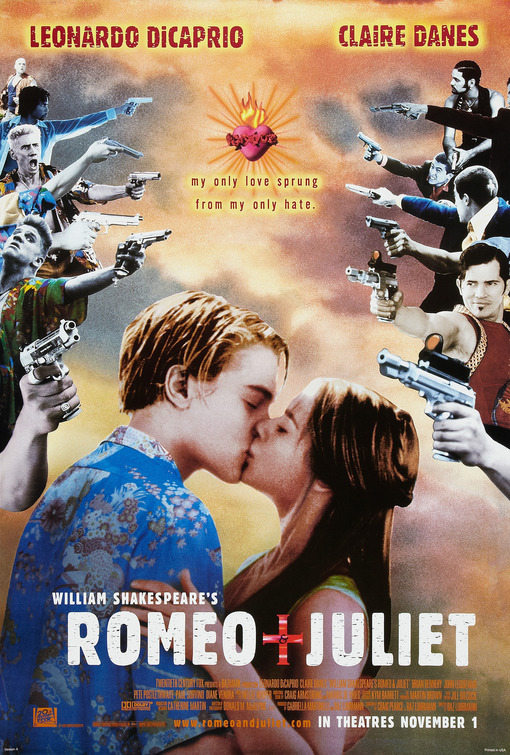
Condola Rashad from David Laveaux's ROMEO AND JULIET
Brent asked me for my thoughts on Alyssa Rosenberg's appraisal of David Laveaux's plans to stage an interracial Romeo and Juliet on Broadway.  Rosenberg's not into it, not because of Laveaux's plan, but because it's Romeo and Juliet:


Romeo and Juliet itself hasn’t aged well. The story follows Juliet Capulet, who is 13 when she meets Romeo Montague at a party, falls head over heels in love with him, and marries him within a day of meeting him. Romeo's age isn't specified in the play, but the quickness with which he throws over a former flame for Juliet doesn’t suggest a particularly mature man. Maybe this works on the page, when we’re not forced to watch actors and actresses who are clearly in their 20s and 30s behave like early teenagers. But the effect is embarrassing and unsettling for today’s theater audiences, perhaps already fretting over suspended adolescence and stunted millenials.


So, here goes.  Thought 1: It's probably not even worth blogging about, partly because Rosenberg's getting one hell of a pushback in the Slate comments section without my input, and partly because there's nothing new to Rosenberg's criticism of the play anywayThere are many people who share this view, not least among them every freshman who's ever read this play.  And do you know what?  For a long time, I was of the same mind.  Romeo and Juliet had always seemed juvenile in its way, and teaching it to high schoolers who think it's too childish for them made me very sour on it.  I didn't really come back to it until I took a Shakespeare seminar for teachers at Columbia University, where I was reminded of some of the play's great qualities--especially its poetry, which comes closer than any other play to matching the lyric beauty of the sonnets.

Now that I'm on the other side of my distaste for the play, I think that a lot of what I felt--and a lot of what my students feel--was a revulsion that came out of my entrenched need to feel mature.  I believed, as my students do, in true love, but I knew that it was not something I could or should expect at eighteen, and my insistence on being sternly realistic about it was compensation for that lack.  Dismissing the love Romeo and Juliet share for each other because of their age was always more about my need to be an adult than theirs; my realism was a projection.  I think that some people never outgrow that put-on cynicism.

I reject the persistent notion that Romeo and Juliet's love is nothing more than an infatuation.  It may be a mistake, but it isn't a mistake because it's a delusion.  It's impossible for me to read the play now and see the way that Romeo changes when he's around Juliet; his very language alters at the sight of her.  Romeo begins the play speaking in stilted, oxymoronic words that ape Petrarchan traditions of courtly love:

Feather of lead, bright smoke, cold fire, sick health!
Still-waking sleep, that is not what it is!
This love feel I, that feel no love in this


And the moment he sets eyes on Juliet, suddenly becomes the personification of all of Shakespeare's powers:

If I profane with my unworthiest hand
This holy shrine, the gentle fine is this:
My lips, two blushing pilgrims, ready stand
To smooth that rough touch with a tender kiss.


Thought 2: Rosenberg's admission that the play doesn't hold up well sounds very sheltered and solipsistic to me, and makes me think unpleasantly about how I've made similar observations about other works.  But in her attachment to the modern perspective, I think she misses the importance of the period in which the play is set, the universe it inhabits.  She can complain about Romeo's maturity based on the fact that he marries Juliet within a day, but how much different are Capulet's plans for Juliet?  ("Monday! ha, ha! Well, Wednesday is too soon, / O' Thursday let it be: o' Thursday, tell her, / She shall be married to this noble earl.")

To put it another way, I think that Rosenberg misses something that the play is crucially about: The way in which Romeo and Juliet's love opposes the official authority of both their parents and their society at large.  Whether you believe Romeo and Juliet's love is real or valid, it is theirs, defined by the very fact that is unsanctioned.  Those who ridicule the idea of Romeo and Juliet dying for their love fail to see that love only half of what they die for, the other half being the social structure that makes that love transgressive and dangerous.  By tut-tutting the propriety of their relationship, Rosenberg is, in a way, modeling these very structures.  And yet the versatility of that story--the love that dare not speak its name, if you will--is what makes the play so attractive to directors like Laveaux, who see in it an opportunity to talk about social issues more important to the present.

Thought 3: Rosenberg's complaints that the plot doesn't make much sense don't make much sense:

Why are the families fighting? What was the inciting incident? The absence of a reason does mean that adaptations can fill in space that Shakespeare left behind, making the warring parties Puerto Rican and Polish-American, for instance, or Israeli and Palestinian. But even then, having the two lovers kill themselves through a series of misunderstandings doesn't translate well in a setting that takes any sort of modern communications for granted. And it's hard to believe the couple, no matter how lovelorn, would lack the patience to wait 24 hours to get hitched—not to mention the savvy to check up on a bad report from Verona.


Who cares what the "inciting incident" was?  Would knowing why the two families are fighting make the play one jot better?  If Grandpa Montague stole Grandpa Capulet's cow back in the day, wouldn't that affect the way we evaluate guilt on both sides?  Coleridge called Iago a "motiveless malignity," and Shakespeare makes the same kind of choice here--he's not interested in the causes of hatred, but its effects.  Rosenberg's assertion about "modern communications," on the other hand, is too silly to take seriously.

What about her argument that the couple's death is "an adolescent fantasy of death solving all problems, a 'won't they miss me when I'm gone' pout?"  To that I'll only say this: When we ourselves are past the point where it takes tragic acts of violence to force us to see our own flaws, our crookedness, our backwardness, then maybe Romeo and Juliet will truly--happily--be irrelevant.

Tuesday, November 8, 2011

Liturgy and Literature in the Making of Protestant England

This is in part because, despite criticism's frequently professed desires to "make the past strange," it much more often makes it overly familiar. The depth, passion, and occasional ferocity of early modern religious belief simply doesn't resonate in a secular modern culture committed to toleration and agnosticism, so we tend to reduce its alienness by overlooking it, or translating it into terms we are more comfortable with. But those are by definition not the terms in which these things existed and operated historically; when we use them as the basis of our critical practice, we are looking not at the past but an image of modernity in hose and ruffs.

The influence of the Book of Common Prayer is everywhere, though you may not realize it--it is responsible, for example, the phrases "ashes to ashes, dust to dust," and "dearly beloved, we are gathered here today..." But the author of Liturgy and Literature in the Making of Protestant England, Timothy Rosendale, believes that it has been insufficiently explored as a literary document.

Rosendale gives a brief account of the Book's creation, depicting it as an attempt--or rather, a series of attempts--at negotiating the bitter Protestant-Catholic tensions of post-Henry VIII England. Interestingly, he argues that much of the Book's efficacy comes from its calculated ambiguity that, like Elizabeth I's public religious persona, deliberately left room for residual Catholic practice. By creating a national uniform liturgy in English, it also helped to create and bolster an English national identity, negotiating the need for the monarch's supremacy over religious practice and deeply held Protestant beliefs about the importance of individual priesthood. In the final chapters, Rosendale turns to the Book's literary influence, tracing its impact on Sidney, Shakespeare, Milton and Hobbes. I particularly liked the chapter on political power in Shakespeare's histories, in which Rosendale argues that the history plays, from Richard II to Henry VI, map the transition to a monarchical system in which power is maintained through representation and symbolism, mirroring the Prayerbook's vision of the Eucharist.

What I appreciated most about Rosendale's book is what I have quoted above. One of my deepest misgivings about modern criticism is a sneaking suspicion that it does not treat texts seriously, using them as templates for various ideological, political, or philosophical agendas. While Rosendale happily points out the positive aspects of various critical schools (for example, he praises the way in which New Historicism has "emphasized... the idea that the literary is not walled off from other spheres of culture"), he is careful to treat the religious impulses that created the Book of Common Prayer as genuine and not outward manifestations of psychological or political pressures.

Furthermore, books like this (and too a lesser extent, McCoy's) allay my fears that scholarly language need be obtuse or somehow "beyond me;" not only is Rosendale's text highly engaging and fluid (his paraphrases of his critical sources tend to be far more lucid than they), but occasionally he'll do something like this:

"...even the Zwinglian sacrament is clearly set apart to operate in a different symbolic register; after all, a completely desacralized Eucharist would be nothing more than a snack(rament).


Zing!

Wednesday, March 9, 2011

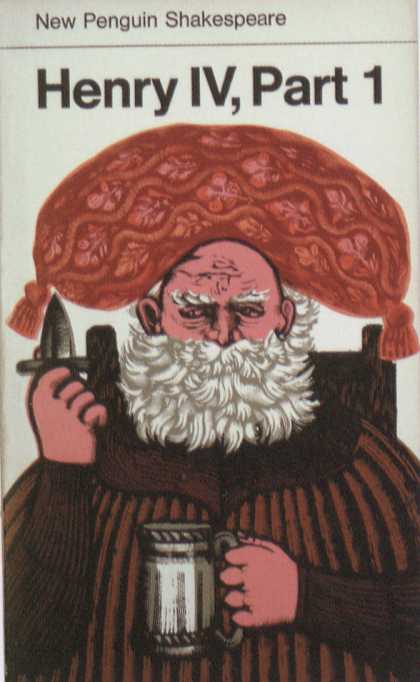
Henry IV, Part One

Henry IV is not the main character of Henry IV, Part One. He barely clocks in fourth--behind the impetuous rebel, Hotspur. But who is? Conventional wisdom would say that the center of the play is Hal, the future Henry V, who over the course of the Henry IV plays must learn to abandon his life of carousing in Eastcheap taverns, but Hal's drinking buddy Falstaff was perhaps his most popular creation, and according to Harold Bloom is one of the two greatest Shakespearean achievements (along with Hamlet).

The play opens with Henry IV wishing openly that his son were Harry Percy, or Hotspur, who within an act will be in open rebellion towards him:

Oh, that it could be proved
That some night-tripping fairy had exchanged
In cradle-clothes our children where they lay,
And called mine "Percy," his "Plantagenet,"
Then would I have his Harry, and he mine.


And yet, what strikes me is that from his very first appearance, Hal appears to have no qualms about leaving his life in the taverns behind in order to become more like Hotspur:

I know you all and will awhile uphold
The unyoked humor of your idleness.
Yet herein will I imitate the sun,
Who doth permit the base contagious clouds
To smother up his beauty from the world,
That when he please again to be himself,
Being wanted, he may be more wondered at
By breaking through the foul and ugly mists
Of vapors that did seem to strangle him.


Both Hal and his father have a nasty streak of uncharitableness; Henry's toward his son and Hal toward his friends. In particular I find Hal's insistence that he is better than his surroundings to be both ignorant and distasteful, as if his entire life he were merely "slumming it," waiting for an opportunity to show his true colors. It only makes it worse that Hal's self-assessment is essentially correct, and that he takes to the battlefield with natural ease, because it is unclear that the "true" persona is more valuable or honorable than the counterfeit.

This runs afoul of many readings of Henry IV (and here it seems as good a time as any to mention I have not read Part Two) which depict Hal as struggling to transform himself into the capable ruler of Henry V and Falstaff as his obstacle. But on Hal's part there is no struggle, no inner conflict about leaving his friends. On the other hand, Falstaff seems to overflow with love for Hal. In one scene, Hal and Falstaff are play-acting at being Henry and Hal, respectively, when Hal-Henry upbraids his Falstaff-Hal for the company he keeps. Falstaff's reply--clearly and pathetically not true to Hal's sentiments--becomes an endearing self-defense:

FALSTAFF: But to say I know more harm in him than in myself were to say more than I know. That he is old, the more the pity; his white hairs do witness it. But that he his, saving your reverence, a whoremaster, that I utterly deny. If sack and sugar be a fault, God help the wicked. If to be old and merry a sin, then many an old host that I know is damned. If to be fat be to be hated, then Pharoah's lean kine are to be loved. No, my good lord, banish Peto, banish Bardolph, banish Poins, but for sweet Jack Falstaff, kind Jack Falstaff, true Jack Falstaff, valiant Jack Falstaff, and therefore more valiant being as he is old Jack Falstaff, banish not him thy Harry's company, banish not him thy Harry's company. Banish plump Jack and banish all the world.

HAL: I do; I will.


Hal's banishment of Falstaff is completed in Part Two, and in the course of it he does in a way banish the world, as the pursuit of honor and glory is a lonely one by nature. Hal echoes this when he says to Hotspur before their final battle, "I am the Prince of Wales; and think not, Percy, / To share with me in glory any more. / Two stars keep not their motion in one sphere." Hal banishes his doppelgangers: first Hostpur, then his Eastcheap self.

Falstaff, impressed by Hal into service, is on the same battlefield and fakes his own death to spare his life. Is this cowardly? Soliloquizing, he seizes upon the symbolism of counterfeiting that Hal has long been employing:

Counterfeit? I lie; I am no counterfeit. to die is to be a counterfeit, for he is but the counterfeit of a man who hath not the life of a man; but to counterfeit dying when a man thereby liveth is to be no counterfeit, but the true and image of life indeed.


This is Falstaff's finest hour, a rejection of Hotspur's glories, which court death. Falstaff is a prophet of life; life is truth, and death a falsehood. In his war poem "Dulce et Decorum est," Wilfred Own would call it "the old lie," that there is value, or goodness, or sweetness in death on the battlefield. Falstaff's vitality is the overflowing of his insistence on life--"Give me life," he says--and he has no respect for the empty vanities of honor:

Can honor set to a leg? No. Or an arm? No. Or take away the grief of a wound? No. Honor has no skill in surgery, then? No. What is honor? A word. What is in that word "honor"? What is that "honor"? Air. A trim reckoning. Who hath it? He that died o' Wednesday. Doth he feel it? No. Doth he hear it? No. 'Tis insensible, then? Yes, to the dead.


We feel this deeply because we like Falstaff and want him to exist; for that reason Shakespeare wrote more total lines for him than any other character. Nothing is lost when Hotspur meets his end at Hal's hands, mostly because the two of them have been spent the entire play planning to eradicate each other. Falstaff values life and Hotspur values honor; in Part One at least they reap their rewards. I am suspicious of Bloom's desire to turn Falstaff into some sort of ubermensch, but if there is a choice to be made, I'll take Falstaff's worldview over Hal's.

Thursday, January 20, 2011

Titus Andronicus by William Shakespeare

Why, there they are both, baked in that pie;
Whereof their mother daintily hath fed,
Eating the flesh that she herself hath bred.
'Tis true, 'tis true; witness my knife's sharp point.


So, apparently Titus Andronicus is pretty much universally considered Shakespeare’s worst play. Even Harold Bloom, Bard booster extraordinaire, says the play can’t be taken seriously, and must be read as satire if anything at all is to be gotten from it at all; other critics attack its extreme—sometimes comically so—violence; still others point to the less than nuanced characters, none of which are really worth cheering for, as the play’s biggest weakness. And, I have to admit, on one level, it’s hard to disagree. Apart from Aaron, who’s certainly one of the most despicable villains in all of Shakespeare, most of the players are notable mainly for the gruesome ways in which they die. There are no “Alas, poor Yorick” moments, the poetry is spare, and the genuine emotion is thin—I felt revulsion more strongly than anything else while reading Titus Andronicus.

So, the story: Titus is returning from battle, bearing with him Tamora, Queen of the Goths and her sons, one of which he commands to be mutilated, in spite of Tamora’s pleas for mercy. This act of butchery sets off the whole play, most of which is taken up with Tamora’s revenge, which she plans with Aaron, her Moorish lover, and Titus’s response. You know the drill; it’s a Shakespearean tragedy—everyone dies, pretty much.

The thing is, while the criticisms of Titus Andronicus are basically true, they don’t make it a bad play. For Shakespeare, the man who gave us Hamlet, Lear, Macbeth, and scads of literature’s most famous characters, it’s definitely lower-tier. As an entertainment, though, it’s not bad. It’s grotesquely funny, fast-moving, and, as mentioned, Aaron is basically evil personified. It’s not going to change your life, but it’ll probably pass an afternoon, and, at the end (SPOILER) a mother’s sons are served to her in pies. Shakespeare knows pulp.

Sunday, December 26, 2010

Macbeth by William Shakespeare

MACBETH: ...Come, seeling night,
Scarf up the tender eye of pitiful day
And, with thy bloody and invisible hand,
Cancel and tear to pieces that great bond
Which keeps me pale. Light thickens,
And the crow makes wing to th' rooky wood.
Good things of day begin to droop and drowse,
Whiles night's black agents to their preys do rouse.
Thou marvel'st at my words, but hold thee still.
Things bad begun make strong themselves by ill.

My aunt gave me a copy of Harold Bloom's Shakespeare: The Invention of the Human for Christmas. In it, Bloom professes a special love for Macbeth, and calls him the most imaginative of Shakespeare's tragic heroes. Of course, Macbeth blurs the line between real apparitions and false. Some visions, like the witches on the heath are certainly real--Banquo sees them too--and others, like the "air-drawn dagger" that Macbeth sees just before killing King Duncan are certainly imagined. Others, like Banquo's ghost, lie somewhere between.

But the fact remains that Macbeth, in all his imaginative power, is someone who knows exactly what he's getting into. From the first, he seems to understand that the actions foretold of him spell his own doom:

I am Thane of Cawdor.
If good, why do I yield to that suggestion
Whose horrid image doth unfix my hair
And make my seated heart knock at my ribs
Against the use of nature?


So why does Macbeth do it? There are many answers, none of which feel quite sufficient. The worst of these is that Macbeth is prodded to it by his more domineering wife. Yet Bloom notes also that the Macbeths present us, ironically, what may be the strongest and most equal marriage in all of Shakespeare's tragedy. For my part, I note that long after Lady Macbeth has gone mad from guilt and committed suicide, Macbeth himself remains, showing a greater reserve of inner strength which belies this explanation.

Explanations that focus on Macbeth's destiny seem also insufficient, insofar as they downplay the natural qualities in Macbeth (and Lady Macbeth) that make him agreeable to the murder of Duncan, as well as those of Banquo and the family of Macduff. Nor do they fully embrace the chicken-and-the-egg ambiguity inherent in the witches' prophecy.

Bloom's suggestion is something I would never have considered on my own. It centers around Lady Macbeth's strange assertion in 1.7:

I have given suck and know
How tender 'tis to love the babe that milks me.


We know that the Macbeths are childless; what child is this? Is it from a former marriage? Or a child that has died? In any case, there is now no child and Macbeth has no issue. It is this fact that propels his murders: The witches foretell his kingship, but also that the line of Banquo will become king afterward, supplanting the heirless Macbeth.

Children make the fear of death more bearable. Our lives are by their nature too short to accomplish all that seems to us our potential, but while our children live something of us lives, too. Macbeth's frenzy, then, may be seen as a desperate rebellion against death, to take all power unto himself though the consequences are clear. He strikes at the children of others: It is Fleance, Banquo's son, he really wants to kill, and he succeeds in murdering Macduff's son. Blood, which is suggestive of both generative and destructive power, obsesses him:

It will have blood, they say. Blood will have blood.


Macbeth's wanton violence wavers somewhere between a will to destroy the issue of others and a perverse attempt at leaving a sort of negative legacy--rather than no legacy at all--and it is worth noting that the play has at least one example of a child born from violence, Macduff, who was "from his mother's womb / untimely ripped."

But Macbeth must ultimately face the fact that his only capabilities are negative capabilities; he engenders nothing but destroys all. His most poignant moments are late in the play, after Lady Macbeth's suicide, when his imaginative powers are transmuted into a prescient clarity about his own worth. His "tomorrow, tomorrow, and tomorrow" soliloquy is the most famous of these and is possibly bettered only by Hamlet's "to be or not to be." But almost as good is this less infamous one:

I have lived long enough. My way of life
Is fall'n into the sere, the yellow leaf,
And that which should accompany old age,
As honor, love, obedience, troops of friends,
I must not look to have, but in their stead
Curses, not loud but deep, mouth-honor, breath
Which the poor heart would fain deny and dare not.


Lear's tragedy is that he spends the entire play driving himself mad thinking that he does not have what he truly does, Cordelia's love. Macbeth's tragedy is that he has never made a Cordelia, and cannot escape such truths, like Lear and Lady Macbeth do, into madness. He is instead tormented by his sanity. Finally, the only thing left for him is to go into that abyss that he has created.

Note: This will be my last book of the year. The first book I read in 2010 was King Lear. Like all things, the year begins and ends with Shakespeare...

Wednesday, June 2, 2010

King Lear by William Shakespeare

Close pent-up guilts,
Rive your concealing continents, and cry

These dreadful summoners grace. I am a man

More sinn'd against than sinning.


So, four years into 50 Books, I’ve finally read my first Shakespeare. I can’t say, not having read anything else by the bard, whether King Lear was a good or bad choice. It seems like a mixed blessing. On the one hand, I was unfamiliar with the story, so there was some suspense that wouldn’t have been present had I chosen, say, Romeo and Juliet. On the other hand, King Lear may be Shakespeare’s most complex play, and, reading it mostly without commentary like I did, I’m sure I missed a lot.

But the real question is, is it good? And I am thankful to validate Shakespeare scholars everywhere when I say, yes, it is. King Lear is a seriously dense play, full of double crosses, emotional subtleties, eye gouging, and swordfighting. The basic gist is this: One day, King Lear, old and ready to pass on his power, gathers his three daughters, Gonreil, Regan, and Cordelia. He asks each of them how much they love him, and while Gonreil and Regan answer with flattering hyperbole, Cordelia attempts to give an honest answer, and, for her troubles, is banished. The remaining daughters set in motion a fairly complex plot, most of it out of their control, which ends with almost the entire cast dead, including King Lear himself, who first has a short period of being completely bonkers. And yes, these are spoilers, but Lear is a tragedy, after all.

I don’t feel competent to really dissect Lear, but here are a few observations. King Lear himself is a pitiful character, overthrown by his own pride but unable to see it. It’s ironic that he makes almost as much sense crazy as he does sane, having the gall to claim himself wronged after banishing his truest daughter for the unforgivable sin of honesty.Not that the moral/sane characters get off much better. Many of them receive their unearned comeuppance. In spite of Albany’s late declaration that divine justice has been served, it’s difficult to see any justice or order at all by the end of King Lear. In that way, the play functions as a critique of divine intervention, and takes no sides. Good does prevail in the end, but at what cost? Is justice gained through injustice just at all? In the same vein, it’s interesting that Shakespeare chose to set Lear in a pre-Christian world. It allows him to ask difficult questions that nevertheless require some transposition to consider in a Christian context.

Although Lear is hundreds of years old, it’s likely to always be resonant. Leaders don’t change much, and neither do men. Kings will always be brought low by pride, the good will always die at the hands of the wicked, and the question will always remain, can it really be any different?

Chris's Review

Tuesday, January 19, 2010

Romeo and Juliet by William Shakespeare

What is left to say about Romeo and Juliet? Re-reading this one wasn't quite the experience that King Lear was, for many reasons. For one, Lear is just better. Secondly, would anyone deny that Romeo and Juliet is near-ubiquitous in our culture? I mean, how many bad sitcoms have a scene where a high schooler moons vicariously over their crush under the pretense of being cast in Romeo and Juliet together? It is nearly impossible to read this play with fresh eyes.

(Of course, Lear gets a point taken away for not having as many dick jokes. Seriously, if you go by this editor's gloss, just about every word in Shakespearean English is a euphemism for either a penis or a vagina.)

So, I find myself without having much to say. The most interesting question that came to my mind is this--do Romeo and Juliet really love each other? That sounds ridiculous on its face, but my reading of the play in college--at the height of my cynicism--was that Romeo's love for Juliet was of the same stripe as his love for Rosaline, for whom he pines in the first act. This would be appropriate in the sense that in most classical tragedies the final catastrophe is the result of one's own actions, and as such we might be encouraged to see Romeo's infatuation with Juliet as childish, or foolish, and ultimately destructive.

But several things make me change my mind, including the realization that valuing Romeo's feelings over Juliet's is probably a form of mild sexism. Though Romeo appears moody, fickle, and kind of a douchebag, Juliet never seems to be anything but calm, and never lets her passion for Romeo bring out the same kind of lamentation and breast-beating that he indulges in (leading the Friar to call him womanly, and certainly suggesting swapped gender roles).

But also, the tone of Romeo's love is different. His love for Rosaline is expressed in oxymoron, typical of Petrarchan love sonnets:

Why then, O brawling love, O loving hate,
O anything of nothing first created!
O heavy lightness, serious vanity,
Misshapen chaos of well-seeming forms!
Feather of lead, bright smoke, cold fire, sick health,
Still-waking sleep that is not what it is!
This love feel I, that feel no love in this.


For Petrarch, the ideal was courtly love, which by its nature is external to marriage and can never be realized. The agony that arises is to be expected, and makes love a largely joyless thing, which Romeo expresses when he says, "This love feel I, that feel no love in this." And yet, his love for Juliet is neither unrequited nor agonizing:

O blessed, blessed night! I am afeard,
Being in night, all this is but a dream,
Too flattering sweet to be substantial.


Is it Juliet? Or is it merely the fact that, unlike Rosaline, Juliet returns his feelings?

Finally, I am convinced by something the editor, Mario DiGangi, says in his introduction:

The most elevated dramatic genre, tragedy traditionally dealt with the fall of great men--"great" because both aristocratic and historically important. Romeo and Juliet are neither... As such an Elizabethan audience might have felt skeptical about the value of a tragedy centered on their lives and loves... In order to find Romeo and Juliet figures worthy of tragic treatment, then, Shakespeare's audience would have to find value in their love.


The implication being, of course, that love is a kind of substitute for greatness, that true love can make a man or woman great. Furthermore, for Romeo and Juliet this occurs not only without the sort of social admiration that aristocracy and history might import, but despite its opposite, the social revilement that their union causes when Juliet reveals her intention to her parents. Contrary to my younger, cynical self, I think there's something sweet and wonderful about that.

The question remains, then--is Romeo correct when he says on his wedding day, "But come what sorrow can, / It cannot counteract the exchange of joy / That one short minute gives me in her sight"? If their love is what we hope that it is--true, pure, and deeply felt--is the short time which they have it worth their demise? And would it be true for you or me?

Sunday, January 3, 2010

King Lear by William Shakespeare

Back when Jim and I took a Shakespeare class together, I chose not to review each play, or even the plays as a set because, for the most part, they didn't take very long to read. Plus, I just didn't read a lot of them. Shakespeare hasn't changed, but I have--King Lear is one of Shakespeare's most challenging works, and when I teach it in class I would like to know what I am talking about (or be able to fake it convincingly). So with this one I took my time.

That Shakespeare is better experienced with great patience and caution, savoring his wit and multiple layers of meaning, will come as a surprise to no one. Whether I enjoyed the experience more I cannot say. It's been years since I've read any of the other plays and, more importantly, King Lear isn't really a work meant to be enjoyed. It is inconceivably bleak--so bleak, in fact, that until the twentieth century, most of the time if you saw it performed you would see a version doctored by a scholar named Nahum Tate, which went so far as to add extra characters and replace Shakespeare's unhappy ending with a more palatable one.

Shakespeare's Lear is taken from the mythological Leir, a king of ancient Britain long before Roman conquest, and the story begins essentially the same: Lear, deciding to retire, wishes to split his kingdom among his three daughters, Goneril, Regan, and Cordelia, and says that he will give the largest portion to whoever professes that they love him the best. He expects that his favorite, Cordelia, will win this prize, but her humility and honesty prevent her from giving the same kind of empty, fawning answer as her sisters, and she is cut out of the inheritance and leaves to marry the King of France. Afterward, powerless Lear is mistreated by Goneril and Regan and their husbands, the Dukes of Albany and Cornwall, who strip from him his retinue of attendants and insult him until he is essentially driven out of both of their homes.

There is a subplot with another nobleman, Gloucester, and his sons Edmund and Edgar. Edmund, who is illegitimate and cannot inherit anything of Gloucester's, fakes a letter from Edgar professing to plan their father's murder, and Edgar must escape and take the disguise of an escaped lunatic. Eventually, the whole thing comes to a head when Cordelia and the King of France invade Britain to retake it from the forces of Goneril, Regan, Albany, Cornwall, and Edmund.

But Tate isn't the only revisionist. The Leir story, as recounted in Geoffrey Monmouth's Historia Regum Britanniae, ends with Cordelia victorious, and she goes on to rule Britain after Leir's death. But Shakespeare pulls a reverse-Tarantino and ends Lear for the worst, with Cordelia captured and eventually executed, Lear having long been driven mad by his indignation and shame. At the end, only Edgar, Albany, and Lear's loyal servant Kent are left alive.

Why did Shakespeare change the ending of the Leir story? I think this is the most interesting question that Lear presents. One reason may be political, as the events of the play reflect somewhat the reign of James I, who had attempted to do the reverse of Lear's actions and unite England, Scotland, and Wales, though it is unclear to me whether Lear supports or condemns James' efforts.

Another answer I think can be found in one of the play's most significant themes, the significance of nature. Lear is full of disguises, trickery, and false speech, and the "truth" is always clearer to the audience than it is to the characters of the play. In one great scene, Lear, Edgar, and Lear's fool have taken shelter from a storm in an old house, and they babble and talk circuitously--a man becoming mad, a sane man pretending to be mad, and a court jester, whose riddles belie the most wisdom of anyone in the play. These men appear to be quite similar, but in truth their natures are wholly different from one another. In another way, Lear's absurd wish that Cordelia appear to love him more than Goneril or Regan is what sets the entire tragedy in motion.

The purpose of the bleak ending, then, may be that Shakespeare is telling us something about life. At one point the half-mad Lear says to Edgar, "Nature's above art in that respect," i.e., the respect of suffering--more suffering occurs in life than can be truly captured in art. If this is the case, Shakespeare may be asking us to view King Lear, at its heart cruel, unforgiving, and senseless, as a mimetic work, imitating the cruelty of an unforgiving and senseless world.

Monday, August 27, 2007

The Wednesday Wars by Gary D. Schmidt

“When gods die, they die hard. It's not like they fade away, or grow old, or fall asleep. They die in fire and pain, and when they come out of you, they leave your guts burned. it hurts more than anything you can talk about. And maybe worst of all is you're not sure if there will ever be another god to fill their place. Or if you'd ever want another god to fill their place. You don't want fire to go out inside you twice.”

This was one of my favorite passages from the book. However, it doesn't really fit with the rest of this review. I just thought I would share it.

I thought I knew what I wanted to say about this book. But as I thought more about it, it became less clear. Initially, I felt that the first half of the book was great – funny, witting, creative. As compared to the last half which was a little more somber. But I have come to the conclusion that the two halves worked well in concert.

The books begins, “Of all the kids in seventh grade at Camillo Junior High, there was one kid that Mrs. Baker hated with heat whiter than the sun. Me.” The “me” is Holling Hoodhood (a downright Nabokovian name), who thinks that his homeroom teacher has it in for him because he is a Presbyterian. This means that every Wednesday, when all the other kids in his class go either to temple or mass – depending on which side of town they are from – Holling remains at the school, meaning that the teacher has to figure out what to do with him. After a wide range of chores, she finally settles on making him read Shakespeare.

Each chapter focuses on one month out of the school year, complete with mean teachers, trips to the principal’s office, surly playground bullies, and revenge meted out with snowballs. If Bill Watterson had lacked the ability to draw, he would have written something like The Wednesday Wars.

The last half of the book gives the first half of the book some meaning and importance. The last few chapters also make it evident that Holling has grown up quite a lot in less than a year. Although portions of the book are a little over the top, most of it smacks with the realism of growing up in the 1960s. The day-to-day stories of Holling’s life are framed by the Vietnam War, the Civil Rights Movement, the threat of nuclear war, and somewhat serious – although not that unusual – family problems.

I wonder how much of this book is autobiographical. Schmidt did grow up on Long Island during the 60s. Regardless, The Wednesday Wars was definitely worth the read.