Showing posts with label william shakespeare. Show all posts

Monday, October 20, 2025

Henry VIII by William Shakespeare

WOLSEY

This is the state of man. Today he puts forth
The tender leaves of hopes; tomorrow blossoms,
And bears his blushing honours thick upon him;
The third day comes a frost, a killing frost,
And when he thinks, good easy man, full surely
His greatness is a-ripening, nips his root,
And then he falls, I do. I have ventured,
Like little wanton boys that swim on bladders,
This many summers in a sea of glory,
But far beyond my depth.

So let's start by saying that Henry VIII is not very good. It really has two claims to fame among Shakespeare's play: one, it has more stage directions than any other. These are mostly descriptions of kingly processions and pomp, and not the fun kind about being chased by bears. Two, it was long controversially argued, and now widely accepted, that Henry VIII is a collaboration between Shakespeare and his contemporary John Fletcher. This composite composition helps to explain why the play is often seen as a kind of incoherent mash of parts, even by contemporary-ish observers like Samuel Pepys.

I actually found Henry VIII to be fairly coherent and unified as a play. It read to me as being about the way that the elite are locked into a cycle of rise and fall, from Henry's scheming cardinal Wolsey to Queen Katherine (of Aragon), at one moment on top of the world, and the next exiled or sentenced to death. The king himself is depicted as being rather weak and fickle, led by Wolsey as much as he is his lust for the woman called here "Anne Bullen." Wolsey engineers the downfall of the Duke of Buckingham, and later sits in judgment of Katherine, who has been suspicious of his influence, but later on, Wolsey himself--caught writing to the Pope in opposition to the king's marriage to Anne--is the meteor who falls.

As a result, the best parts of Henry VIII seemed to me to be those moments where a character speaks elegiacally about their own downfall and doom. I liked Katherine's incensed rejoinders to Wolsey:

Sir,
I am about to weep; but, thinking that
We are queen, or long have dreamed so, certain
The daughter of a king, my drops of tears
I'll turn to sparks of fire.


And even Wolsey's sudden realization that his life of glory is over:

I have touched the highest point of all my greatness,
And from that full meridian of my glory
I haste now to my setting. I shall fall
Like a bright exhalation in the evening,
And no man see more.

Anne speaks wisely to her maid when she says, ignorant of the heights to which she is about to be raised, that "'tis better to be lowly born / And range with humble livers in content / Than to be perked up in a glistering grief / And wear a golden sorrow." I expect that those lines resonated quite loudly with Shakespeare's audience, who were not all that far removed from Anne's execution. And yet, the play must hedge a little on the wisdom of Henry and Anne's union, because it produced the legendary Elizabeth (who had died and been succeeded by James I by the time of Henry VIII's performance), who gets held up and prophesied over in a bit that felt like pure propaganda. One can only imagine what James' court thought, though, of these depictions of great people doomed to fall.

Saturday, December 21, 2024

Pericles, Prince of Tyre by William Shakespeare

PERICLES:

O Helicanus, strike me, honour'd sir;
Give me a gash, put me to present pain;
Lest this great sea of joys rushing upon me
O'erbear the shores of my mortality,
And drown me with their sweetness. O, come hither,
Thou that beget'st him that did thee beget;
Thou that wast born at sea, buried at Tarsus,
And found at sea again! O Helicanus,
Down on thy knees, thank the holy gods as loud
As thunder threatens us: this is Marina.

Pericles, Prince of Tyre is in that grab-bag of lesser Shakespeare plays, rarely performed, rarely read, except among the real Bard-heads. It's easy to see why: it's largely unsatisfying, an unfocused series of episodic melodramas that never quite seems to add up to a real play. It was one of the firt of Shakespeare's plays to be considered a collaboration (in this case, with John Fletcher), and it shows. And yet, it's easy to imagine its strangeness working on the stage, where costumes and sets might play up its oddities, and the exotic ports that the Prince of Tyre calls upon might come alive.

The story goes something like this: Pericles attempts to win the hand of a princess by solving a riddle; when he realizes that the princess is in an incestuous relationship with her father, he is forced to flee the king's vengeance. In a port of refuge, he joins a tournament for the hand of another princess, which he wins, securing the hand of the beautiful Thaisa. But when Thaisa dies in childbirth at sea, he has her tearfully buried overboard and his daughter Marina put in safekeeping with (yes, another) king Cleon. Cleon and his jealous wife try to kill Marina, but she is kidnapped by pirates and sold into a brothel, where her virtue converts her customers to chastity--much to the chagrin of her bawd. Cleon tells Pericles that Marina has died, and he gets really upset, until he finds Marina again, where she has been rescued by the local governor. Then, in a dream, Diana tells him to go to her temple, where he finds Thaisa, having been resurrected by a sorcerer and made a priestess. It's really quite a happy ending.

Pericles is among those plays that seem unclassifiable--are they a history? a tragedy? a comedy?--but to me, it clearly forms a trio with Timon of Athens and Titus Andronicus, a trio of plays that use the characters and settings of ancient literature to create a kind of elevated reality or fantasy world. When Pericles joins the contest for the hand of Thaisa, he is reminiscent of Odysseus, playing games and contests in foreign lands for favor of foreign kings. There are other similarities: the shape of Pericles is dictated by the Wheel of Fortune, the rapid rise and fall of luck and disaster, and this structure, to me, seems to share a lot with the forms of ancient literature. And of course, the happy ending--perhaps the happiest ending in all of Shakespeare's play--is reminiscent of Odysseus' return to Penelope.

One of the things I liked best about Pericles was actually the part that Shakespeare likely didn't write: the creepy opening where Pericles solves the riddle of king Antiochus's incest. Antiochus stresses to Pericles that all who have tried to solve the riddle have failed, and the punishment for failure is death. Pericles--invoking another Greek story, Oedipus and the Sphinx--is smitten and courageous enough to try anyway, but as soon as he reads it--like, instantly--he realizes that Antiochus has hidden his dirty secret inside the riddle, more or less in plain sight:

I am no viper, yet I feed
On mother's flesh which did me breed.
I sought a husband, in which labour
I found that kindness in a father:
He's father, son, and husband mild;
I mother, wife, and yet his child.
How they may be, and yet in two,
As you will live, resolve it you.

I thought this was one of the more interesting scenes in the play, the way Antiochus both reveals and does not reveal his deed. There's something here about the fragile justifications we set up around ourselves, not exactly denying what we are unable to deny, but couching it in such a way that we soothe our own conscience and hide it from others. Of course, it's all very stupid; he should have just made a riddle about something else. It also, especially in the hands of a brave director, brings unsettling layers to the recognition scene, in which Pericles and his daughter Marina have their reunion. After all, Marina has been plucked from the brothel from the governor, who came first as a customer, and is now perhaps not entirely reformed by her virtue; he offers her to the distraught Pericles because he thinks their experiences will draw them together. It's not un-erotic, is all I'm saying.

So, Pericles is not my favorite. And yet, I think if someone were to stage it, I'd go see it, and with more excitement than even some of the plays which I like better. 

Sunday, November 12, 2023

Henry VI, Part 1 by William Shakespeare

EXETER: Ay, we may march in England or in France,
not seeing what is likely to ensue,
This late dissension grown betwixt the peers
Burns under feigned ashes of forged love
And will at last break out into a flame.
As festered members rot but by degree
Till bones and flesh and sinews fall away,
So will this base and envious discord breed.
And now I fear that fatal prophecy
Which in the time of Henry named the Fifth
Was in the mouth of every sucking babe:
That Henry born at Monmouth should win all,
And Henry born at Windsor should lose all,
Which is so plain that Exeter doth wish
His days may finish ere that hapless time.

Henry VI, Part One is not very good. It was one of Shakespeare's first plays, if not the first, and probably a collaboration with others, which may account for how its parts sometimes seem at odds with each other. Then again, "parts at odds with each other" is on-brand for this play, which is all about how internal divisions brought the defeat of English forces under the early reign of Henry VI. Henry VI, Part One is a startlingly jingoistic play, one that depicts the French as a "fickle wavering nation," full of fay schemers, dabbling in witchcraft, relying on a woman--Joan of Arc--to do their dirty work. How in the world, the play asks, did we let these people take back the lands that were conquered under the heroic Henry V? The answer is that only the English can defeat the English: bickering and squabbling between the English powers are what led to military losses.

There are many factions among the English: there's the Cardinal Winchester, representative of the Church, who hates Gloucester, the Protector of the the king, who is not yet of age to rule alone, and thus the true power behind the throne. But these squabbles are minor compared to the enmity that rises up between Richard, later the Duke of York, and the Duke of Somerset, the representative of the Lancastrians. Henry VI, Part One is, among other things, about the birth of the Wars of the Roses: in one memorable scene, York and Somerset's partisans literally pick white and red roses from the bushes of the royal gardens to express their allegiances. It's these squabblers that doom Talbot, the commander in the French field and one of the last remaining icons of English courage and bravery. It's Talbot who gets some of the better lines, railing against Joan of Arc and her forces: "Pucelle or puzel, dauphin or dogfish, / Your hearts I'll stamp out with my horse's heels / And make a quagmire of your mingled brains." But these are empty promises: without the material support of York or Somerset, too busy fighting each other to commit their forces to the English cause, Talbot is defeated and killed.

The war stuff, honestly, is very boring. What nearly redeems the play is Joan of Arc, styled as "Pucelle," the maiden, whose language bears the imprint of the Shakespeare to come. Shakespeare's Pucelle is a vulgar braggart who asserts dominance over the French king by the sheer brazenness of her self-promotion. It's Joan who understands better than anyone on the French side what the death of Henry V and the rise of the boy king means: "Glory is like a circle in the water, / Which never ceaseth to enlarge itself, / Till by broad spreading it disperse to naught." She consorts with spirits, who refuse to help her in the final moments of French defeat. Knowing that France is doomed, she tries desperately to save herself, rejecting her own father to continue claiming a noble birth, then quickly discarding her "virgin" reputation by suggesting that she's pregnant to the English forces who would burn her at the stake.

No doubt she's meant to be a representation of fickle, filthy Frenchiness, but at times she seems like the only person worth rooting for. I loved how, when an English commander piles a heap of empty titles on the dead Talbot, Joan cuts through his blowhard patriotism: "Him that thou magnifi'st with all these titles / Stinking and flyblown lies here at our feet." This is ugly and vulgar, perhaps, but it's persuasive, and Shakespeare would later elevate a similar attitude to a kind of undeniable humanist dignity in Falstaff. Joan, at least, of all the characters in the play, knows that war is a dirty business.

Tuesday, December 1, 2020

As You Like It by William Shakespeare

ROSALIND: Love is merely a madness, and, I tell you, deserves as well a dark house and a whip as madmen do; and the reason why they are not so punished and cured is that the lunacy is so ordinary that the whippers are in love too.

It was a real pleasure to read As You Like It; it's been such a long time since I've read a Shakespeare play I felt a little out of touch with that part of my reading identity. I once decided to read all of them, and although I've read most, it's been a while since I worked on that particular resolution. And As You Like It is such a pleasant one to return to, as whimsical and free-wheeling as the Forest of Arden that provides its setting.

The plot--though it isn't really a play where much happens--goes like this: Duke Senior, having been usurped by Duke Ferdinand, has fled to the Forest of Arden. Senior's daughter Rosalind has been allowed to remain because she is besties with Celia, Ferdinand's daughter, but not for long: when the jealous Ferdinand exiles Rosalind, she flees in disguise as a young man, Ganymede, with Celia in tow. Meanwhile, Orlando has been denied any inheritance by his cruel brother, Oliver, and, having fallen in love with Rosalind, flees to Arden as well. In Arden, Rosalind--as Ganymede--promises to "cure" Orlando of his lovesickness by pretending to be Rosalind.

As You Like It reminded me strongly of A Midsummer Night's Dream, another play that differentiates the civilized world from a "green" space where freedom and fluidity reign. The Duke's kingdom is a nasty place, where brother conspires against brother, and "civilized" institutions, like the primogeniture that robs Orlando of an education and an income, perpetuate misery. But civilized hierarchies collapse in Arden, a place whose essence is inherited from Roman pastorals. (It's a funny place, this forest: for one, there seem to be a lot of shepherds and sheep for a forest.) In Arden, plot seems to stop almost entirely; the most exciting action--including, amazingly, a lion attack--all happens off stage. Instead, what Shakespeare stages is a series of interactions and dialogues between residents and outsiders about the nature of love and the relative virtues of life in country versus life at court. Arden is a space for wit, which might be describes a kind of verbal free play, free of the consequences they may have in the ivilized world.

It's only in Arden that Rosalind can get away with the gender and identity slippage that she enjoys. The irony of Rosalind's identity--she's pretending to be a man who is pretending to be herself--is one of the core pleasures of the play, and as elegant a setup as it is, I don't think I've ever seen anything quite like it. Rosalind is often described as Shakespeare's wittiest female character, and that's probably true, but Orlando, who is never quite more than a decent and victimized lunk, never seemed to live up to her. As a result, their relationship lacks some of the heat of Beatrice and Benedick in Much Ado About Nothing. But Arden is too gentle a place for that kind of sparring, and instead what stands out about Rosalind is the way she exerts control over her identity, and thus the relationships in Arden. She withholds her true identity until she knows she can use it to arrange everyone's lives in harmony: she with Orlando, Celia with Orlando's brother Oliver, and the shepherd Silvius with Phoebe--a young maiden who, as genre demands, has fallen in love with "Ganymede."

There's a feminist reading in there somewhere: only in Arden, a place of fantasy, can a woman even as intelligent and perceptive as Rosalind have real control over herself and her place. And even that has its limitations, because her last-minute sorting has the ironic result of reinscribing everyone into the rigid hierarchies of the civilized world. It's hard to imagine the marriage between Rosalind and Orlando surviving back in the Dukedom, even with Senior on the throne. But Shakespeare allows her at least the right of the play's epilogue, in which she stakes a final claim to total freedom: "If I were a woman, I would kiss as many of you had beards that pleased me, complexions that liked me, and breaths that I defied not. And I am sure as many as have good beards, or good faces, or sweet breaths will for my kind offer, when I make curtsy, bid me farewell."

Tuesday, January 30, 2018

Henry IV, Part One by William Shakespeare

FALSTAFF: Can honor set to a leg?  No.  Or an arm?  No.  Or take away the grief of a wound?  No.  Honor hath no skill in surgery, then?  No.  What is honor?  A word.  What is in that word "honor?"  What is that "honor?"  Air.  A trim reckoning.  Who hath it?  He that died o' Wednesday.  Doth he feel it?  No.  Doth he hear it?  No.

The theme of the ninth grade is, at my school like so many of others, "coming of age."  It doesn't really mean much, in practice, but it "sells" to the students that the arc of the year has a purpose.  And in some moments it lends a shape to cross-textual conversations.  How is the process of growing up different for Holden Caulfield than it is for Jeanette Winterson in Oranges Are Not the Only Fruit, or Pip from Great Expectations?  Unfortunately, it also means that we teach Hamlet way before kids, in my opinion, are really old enough to read it.  (Who is, though?)

My solution was this: I asked my assistant principal to order Henry IV, pt. 1.  Even more than Hamlet, I think of H4pt1 as Shakespeare's quintessential coming-of-age story, centering as it does on the young Prince Hal and his need to grow up and straighten out in order to inherit the throne of his father, the title king.  The dissolute prince, always hanging out with Falstaff and his cronies, pales when compared to the hotheaded bravery of Percy Hotspur, who drives the rebellion against Hal's father.  (In fact, I learned while reading about the play, that until relatively recently, most performances treated Hotspur as the protagonist, and relegated Hal to a supporting role.)

Reading it again this time, my attention was focused on these themes, and what would be accessible to my students.  Will they relate to the pressure put on Hal to be a model son?  Perhaps not as much as students at some of the schools I have taught.  Will they sympathize with the moralizing Henry IV, as they sympathize with Holden's stuffy old teacher who tells him, "Life is a game you play according to the rules?"  (It may sound weird, but teenagers have a conservative streak they have trouble growing out of.)  Or will they find Falstaff's catechism on honor, as I do, some of the truest words in literature?

One thing that struck me during this re-reading is that the conflict isn't really what I remembered it being.  It's not about Hal struggling with the decision to throw off Falstaff and his life in Eastcheap.  In fact, it seems that decision is made well before the play starts.  The love that Hal bears to Falstaff is pretty scant, and he can't really find a kind word to say to or about the man until he thinks he's died on the battlefield.  It's entirely believable that Hal hangs out in Eastcheap for exactly the reason he says he does: it will make his enemies underestimate him and make his ultimate rise to power seem all the more awesome.  If that reasoning is to believed, he's not a traitor to Falstaff, he's a psychopath.  And yet it will take literally another play to get to the point where Hal dismisses Falstaff for good.  Is that Machiavellian strategizing or real inner conflict?

I don't think this play will be easy to teach.  There are a lot of war-room strategy meetings that I often want to glaze over, as I do with those same scenes in Othello and Julius Caesar.  It's going to be important to find what matters about these scenes--Percy's hotheadedness, the eerie magic that hangs around Shakespeare's version of Wales, the parallel father-and-son relationships--and not skip them over to get to the tavern scenes and the grandiose speeches.  We'll see how that goes.

Tuesday, February 28, 2017

Othello by William Shakespeare

IAGO: Virtue? A fig! 'Tis in ourselves that we are thus or thus. Our bodies are our gardens, to the which our wills are gardeners. So that if we will plant nettles or sow lettuce, set hyssop and weed up thyme, supply it with one gender of herbs or distract it with many—either to have it sterile with idleness, or manured with industry—why, the power and corrigible authority of this lies in our wills.

Reading my review of Othello from years ago, I'm amazed at some of the things I said: I failed to see, for instance, that Iago's many rationalizations for his hatred of Othello are far less than the sum of their parts.  Or how highly I thought of Othello himself, who now seems, though noble and capable, short-sighted and overconfident in not just his powers but the very stability of his nature.  Like Julius Caesar who calls himself the "North Star" because he doesn't change, Othello's belief in his own stability (and Iago's) becomes dangerous.  It's Iago who doesn't change, because what he is is a nullity, a living paradox: "I am not what I am."  He's so theatrical that I begin to wonder if there is anything beneath his playacting, if even his hatred for Othello is not another kind of act.

I admit that Othello is not my favorite of the tragedies.  It doesn't have the scope of Hamlet or King Lear, or the sheer poetry of Macbeth.  For that reason, I'm really excited to teach it, which I never have before--I think it'll force me to find new things to admire about it.  It's got a few really nice moments: Iago's salesman-like manipulation of Roderigo with the simple phrase, "put money in your purse"; Desdemona's mind-boggling shock at the idea that Iago's wife Emilia considers herself to be sometimes motivated by lust, like men are.  I have always felt that the best lines are Othello's final speech, which seem like a desperate attempt to manage his own legacy, or perhaps his conception of himself:

Speak of me as I am; nothing extenuate,
Nor set down aught in malice: then must you speak
Of one that loved not wisely but too well;
Of one not easily jealous, but being wrought
Perplex'd in the extreme; of one whose hand,
Like the base Indian, threw a pearl away
Richer than all his tribe; of one whose subdued eyes,
Albeit unused to the melting mood,
Drop tears as fast as the Arabian trees
Their medicinal gum. Set you down this;
And say besides, that in Aleppo once,
Where a malignant and a turban'd Turk
Beat a Venetian and traduced the state,
I took by the throat the circumcised dog,
And smote him, thus.

"Speak of me as I am," says Othello--but what is that?  Iago has reduced him to almost nothing; and these last words give the impression of a man who knows that his words are all that is left of him.  He is reduced, at last, to this final speech.  He tells a story about killing a Turk, but he's really talking about himself.  Is he the noble Venetian or the traitorous foreigner?  When nothing's left of him but these words, in a way, he can be both.

Saturday, May 7, 2016

Tempest-Tost by Robertson Davies

In the production of every play there comes a low point of rehearsal, after which the piece climbs to whatever climax it is destined to reach.  There could be no doubt about it, the day Geordie killed the horse marked that point for The Tempest, as produced by the Salterton Little Theatre.

I brought two books with me on my Canadian trip: Anne of Green Gables, and The Fifth Business, by Thamesville, Ontario's favorite son, Robertson Davies.  Davies, like the Tragically Hip, seems to be one of those Canadian cultural icons that never quite made it across the border into the United States, so I was eager to find out what I had been missing.  But before I left, a coworker told me that her favorite Davies book was actually Tempest-Tost, about an amateur production of Shakespeare's The Tempest in a rural Ontario town, which is exactly the kind of thing I'm into, so when I found a copy of it in a used bookstore in Charlottetown, P.E.I., I figured I'd go ahead and read it instead.

Amateur theater is always marked by a measure of pretension.  Shakespeare is for all people, as Harold Bloom loves to say, but the puffed-up cultural cache surrounding him is at odds with the very idea of the amateur, and the image of small-town people taking themselves seriously as actors is ripe for satire.  In this Davies doesn't disappoint, but he also has a great sympathy for the people of Salterton--the fictitious Ontario town where Tempest-Tost, and two sequel novels, take place--who engage in petty vanities and squabbles against the backdrop of the production.

Davies reminds me of Penelope Fitzgerald in his ability to create a large cast of characters with highly individuated, and interesting personalities, though perhaps he doesn't have quite her subtlety or inventiveness.  There's Professor Vambrace, whose overinflated ego makes him perfect for the role of Prospero; Nellie Forrester, the head of the Little Theatre who takes herself, and the organization, far too seriously; Geordie Shortreed, the practical-joke lover playing Caliban who accidentally kills a beloved old horse by driving him over an exposed electrical cable; Humphrey Cobbler, the eccentric but canny musician who provides music for the play; the vain and idle, but oddly perceptive, Griselda Webster, playing Ariel, with whom half the rest of the cast falls in love.  One of my favorite minor characters is a busty young woman who most people just call "The Torso."

The main character, to the extent that the novel has one, is Hector Mackilwraith, a mathematics teacher who has little in the way of culture or artistic skill, but who chases a wild impulse to act, and takes the role of Gonzalo.  Hector has credited his success as a teacher, though his sphere is small, to "planning and common sense," which he applies to every situation.  Hector's the kind of guy who makes a pro and con list before he does anything, and the "con" column for his decision to take up acting includes entries like, "Couldn't take part of lover, clown or immoral person -- plays full of these -- Shakes often vulgar."  Davies makes it clear that Hector has no feeling or understanding for The Tempest, or art in general:

He found The Tempest somewhat baffling.  He had supported the suggestion that the Little Theatre present a Shakespearean play, for he was strongly in favour of plays which were "worth while"; it was widely admitted that Shakespeare was worth while.  But in what precise union of qualities this worthwhileness lay was unknown to him.  His first encounter with The Tempest was like that of the man who bites a peach and breaks a tooth upon the stone.

In the very first scene, for instance, there was a coarse reference to the Female Functions.  He read it again and again; he consulted the notes, but they were unhelpful; in spite of a conviction held over from school days that poets were people who hid their meaning, such as it was, in word puzzles it seemed clear enough that in this case Shakespeare meant to be Smutty.  Obviously this was a play to be approached with the utmost caution.  He might even have to change his mind about acting.

Hector doesn't change his mind, but when he, like many others, falls in love with the 19-year old Griselda, he discovers that even planning and common sense are little help in seducing a woman, or even understanding the profound suffering of love.  There are certain thematic overlaps there with The Tempest, but mercifully, that's it.  Davies declines to force parallels between the plot; there is no elderly statesman with a grievance against his brother, no cloistered young Miranda who is introduced to a "brave new world, with such people in it."  Instead, Davies mines the contrast between the grand drama of the play and the small-town players for humor and pathos.  Hector isn't a wizard, or a shipwrecked sailor, but his petty griefs are stirring enough in their own way.

Anyway, I'll end this review with a great paragraph, spoken to Hector by the musician Humphrey Cobbler, which I think is good advice and doesn't fit elsewhere in this post:

Well, allow me to introduce myself to you as an advocate of Ornamental Knowledge.  You like the mind to be a neat machine, equipped to work efficiently, if narrowly, and with no extra bits or useless parts.  I like the mind to be a dustbin of scraps and of brilliant fabric, odd gems, worthless but fascinating curiosities, tinsel, quaint bits of carving, and a reasonable amount of healthy dirt.  Shake the machine and it goes out of order; shake the dustbin and it adjusts itself beautifully to its new position.


Tuesday, December 15, 2015

Love's Labour's Lost by William Shakespeare

BEROWNE:
...From women's eyes this doctrine I derive.
They sparkle still the right Promethean fire;
They are the books, the arts, the academes,
That show, contain, and nourish all the world;
Else none at all in aught proves excellent,.
Then fools you were these women to forswear,
Or,  keeping what is sworn, you will prove fools.
For wisdom's sake, a word that all men love,
Or for love's sake, a word that loves all men,
Or for men's sake, the authors of these women,
Or women's sake, by whom we men are men--
Let us once lose our oaths to find ourselves,
Or else we lose ourselves to keep our oaths.

Love's Labour's Lost promises us a love story, and delivers a bitter pill.  The setup is right out of some Medieval rom-com: The King of Navarre and his retinue, Dumaine, Longaville, and Berowne, take an oath to forswear women for three years so they might devote themselves to serious study.  Only Berowne sense that this is a bad idea, and predicts that they'll all break their oaths before long:

Necessity will make us all forsworn
Three thousand times within this three years' space:
For every man with his affects is born,
Not by might mast'red, but by special grace.
If I break faith, this word shall speak for me,
I am forsworn "on mere necessity."

The predictable thing happens next: women arrive, in the form of the Princess of Aquitaine and her retinue, and the King and his men fall deeply in love, each with a different woman.  Each man tries vainly to woo his love's object while keeping it hidden from the others.  This leads to a very funny scene in which each male character enters reading aloud a love poem of his own devising, and then, when he hears the next one approaching, scuttles into hiding.  Each poem is worse and worse, until finally there are three guys hiding, to various degrees of each others' awareness, listening to Longaville's shitty poem, which begins "On a day--alack the day!-- / Love, whose month is every may, / Spied a blossom passing fair / Playing in the wanton air."

Once they spend a little while shaking their fingers at each other, the menfolk put their heads together to try to woo the Princess and her maids.  Though his prediction is proved correct, Berowne comes in for the worst criticism, because his beloved, Rosaline, is supposedly exceedingly ugly and "black," or dark-skinned.  As the King says, "I'll find a fairer face not washed today."  This echoes with the presence of the "dark lady" of the sonnets, who is equally ugly ("My mistress' eyes are nothing like the sun"), equally crass and sordid, and yet whose attraction is--for Berowne as for the speaker of the sonnets--unavoidable.

Love in Love's Labour's Lost has all the dressing of poetry and courtly romance, but at its bottom, it's like Berowne's love for Rosaline: inexplicable, physical, almost bestial.  Rosaline treats Berowne with bitter jabs, and he is helpless.  The other women, sensing that the men's sincerity is questionable, play a trick on them by switching their masks.  (Why are they wearing masks?  Why not?)  The men, as they suspect, cannot tell one from the other without their physical likenesses.  The play which seemed, at the beginning, to set up a predictable course toward resolution, seems to suggest that the dynamics of human love and sex are irresolvable: men obsess, and women rebuff.

The play ends when the real world interrupts the childish play of love: a messenger comes to inform the Princess that her father has died.  The King, like an entitled MRA, demands to be loved: "Now, at the latest minute of the hour / Give us your loves."  The women impose harsh penitences in exchange, perhaps knowing that the men will not keep them: The King must spend a year as a hermit, and Berowne, healing the sick.  Some sources suggest there is a lost sequel to the play--Love's Labour's Won--perhaps in which the King, Berowne, and all the rest complete their hairshirt requirements and win the ladies they sought to woo.  But I doubt it.

Sunday, June 14, 2015

Nothing Like the Sun by Anthony Burgess

'Life,' so went Quedgeley on, 'is in a sense all lies.  We watch ourselves act every day.  Philip drunk and Philip sober.  One is inside the other watching the other.  And so I am John Quedgeley and Jack Quedgeley and Jockey Quedgeley and Master Quedgeley, Justice of Peace, and all.  It is all acting.'  And WS saw that this was true, revolving it in the murk of the bottom of his cider-tankard.  Had he not himself watched WS and WS watched Will?  Where was truth, where did a man's true nature lie?  There was, as it were, an essence and there was also an existence.  It was, this essence, at the bottom of a well, of a Will.

"Is it true that Shakespeare was gay?"  I get this question a lot, as a high school teacher.  The answer isn't easy.  I talk about the sonnets, and the twin figures of the "dark lady" and "WH," and how all of the sex in the sonnets seems to have been saved for the former, but all the love for the latter, and I talk about the surprisingly romantic language that Elizabethan men used to talk about their friends.  I try to explain that "gay" was not a concept that would have made sense to Shakespeare.  My students, like lots of people over the past 400 years, find the erotic power of the sonnets difficult to deny, and they too want to have faces, names, and facts to ground the sonnets' complex attitude toward love and sex in a real life.  I like the ambiguity as it is, but I understand the impulse.

Anthony Burgess' Nothing Like the Sun is a creation of that impulse.  It imagines a young William Shakespeare--here called WS--as he matures and becomes a playwright and a poet, but with a special focus on his sex life.  Burgess' WS is what we might today call a pansexual; he likes anything and everything, from the older woman whose pregnancy traps him in a marriage he didn't want (Shakespeare's wife Anne Hathaway) to the teenage boy he tutors, though, when the boy's father finds out, he isn't a tutor for long.  He sees a black woman for the first time:

He turned, his heart near fainted.  Dressed in a fair loose gown of virtuous, though dirty, white, her shoulders and bosom glowing to the empty street, she leaned, her arms folded, at ease against the doorpost, smiling.  If Englishmen were white, he thought, then she must be called black; but black she could not in truth be called, rather gold, but the not gold, nor royal purple neither, for when we say colours we see a flatness, as of cloth, but her was flesh that moved and swam on the light's tide, ever changing in hue but always of a richness that could only be termed royal; her colour was royalty.

The dark lady turns out not to be black, or a dark-skinned white woman, but a Middle Eastern woman named Fatimah.  WS vacillates between his love and lust for her and that he has for his young patron, Henry Wriothesley--the most common guess for the "WH" the sonnets are addressed to--and rages when Wriothesley seduces the former with his wealth.  Things end badly and strangely--spoiler alert--when WS discovers that he has contracted syphilis.  The bitter and obscure works of Shakespeare's late life, Burgess seems to imagine, are a product of his disease and his deep disillusionment:


What is your great crime, then?

Love, love, and it is always love.  Not wisely but too.  Faimiah.  I will distribute copies of that sonnet after the lecture.  You can never win, for love is both an image of eternal order and at the same time the rebel and destructive spirochaete.  Let us have no nonsensical talk about merging and melting souls, though, binary suns, two spheres in a single orbit.  There is the flesh and the flesh makes all.

It's a cynical turn for the novel, and unsettling, but perhaps in thoughtful accord with Shakespeare's own writing about love and lust--"Th'expense of spirit in a waste of shame / Is lust in action."

In fact, I think Burgess does a pretty impressive job of capturing something of Shakespeare's spirit--not an easy thing to do--while retaining his own unique and modern voice.  Nothing Like the Sun, like A Clockwork Orange, is verbally dense and unapologetically challenging.  Burgess' vocabulary is cobbled together from Elizabethan and anachronistic sources--check out the word "spirochaete" above--and stuff that's just plain made up.  It doesn't sound like Shakespeare, but it shares Shakespeare's freewheeling and experimental method when it comes to language.  It succeeds in giving us an idea of what it might have been like to hear Shakespeare's words when they were written, fresh and new, rather than calcified by the past four centuries of adoration.

Tuesday, August 19, 2014

A Thousand Acres by Jane Smiley

Perhaps there is a distance that is the optimum distance for seeing one's father, farther than across the supper table or across the room, somewhere in the middle distance: he is dwarfed by trees or the sweep of a hill, but his features are still visible, his body language still distinct.  Well, that is a distance I never found.  He was never dwarfed by the landscape--the fields, the buildings, the white pine windbreak were as much my father as if he had grown them and shed them like a husk.

A Thousand Acres is the other Iowa book I read on my trip, though by the time I started it, we were driving through the red rock formations of southern Utah and it no longer made much sense.  Interestingly, it shares more with Marilynne Robinson's Home than just a setting.  Like Home, it is in part the story of a black sheep's homecoming, except Jess Clark isn't an alcoholic like Jack Boughton--worse, he's a draft dodger, and a vegetarian.  Like Home, A Thousand Acres is concerned with the difficulty of coming home again, and the way that putting things back together can be as disruptive as tearing them apart.

But where Home takes its literary archetypes from the Bible, A Thousand Acres is a straight up re-telling of King LearJess is the Edmund figure, come home to threaten his brother's inheritance, but the focus of the story is on Ginny, whose name is an echo of "Goneril."  The plot is set in motion when Ginny's father, like Lear, prematurely leaves his immense farm (the thousand acres of the title) to his three daughters, Ginny, Rose, and Caroline.  (Guess which one is which.)

I have said before that adapting Shakespeare is a dangerous move, because it's not likely that you're going to be able to do it better, and even when you do it well half the time the reader is simply reminded of how good Shakespeare is.  What makes A Thousand Acres work in spite of this is a simple tweak Smiley makes in the story: all of the "good" characters from Lear are bad, and the "bad" characters are good.  Ginny's father, Larry, is a cruel and inscrutable old man, who quickly realizes that he has given away his livelihood and responds by lashing out at everyone and driving around Iowa piss drunk.  He rediscovers his love for the distant Caroline only because her demurral of his offer means that she doesn't share in his resentment.  Ginny, on the other hand, does her best to please her tyrannical father, who responds with this parodic version of Lear's epic "Suspend thy purpose if thou didst intend / To make this creature fruitful" speech:

He leaned his face toward mine.  "You don't have to drive me around any more, or cook the goddamned breakfast or clean the goddamned house."  His voice modulated into a scream.  "Or tell me what I can do and what I can't do.  You barren whore!  I know all about you, you slut.  You've been creeping here and there all your life, making up to this one and that one.  But you're not really a woman, are you?  I don't know what you are, just a bitch, is all, just a dried-up whore bitch."

[Spoiler alert for this paragraph.]  This soliloquy hits especially hard because Ginny has tried and failed for years to have a child, suffering through multiple miscarriages, and her father's accusation that she is a slut becomes tragically ironic when Rose helps Ginny remember late in the novel that their father sexually assaulted them both as children.  The switched valences don't end there--even Ty, Ginny's husband and the Albany figure, is reimagined so that his sympathy with Lear is conceived as a kind pusillanimous avoidance of conflict, and a failure to support his wife in any meaningful way.

Smiley is no Robinson, and the writing itself is nothing to speak of, but the plot spirals out of control in an especially Shakespearean, and violent, way that was refreshing after the plodding pace of Home, which is mostly about people crying around a kitchen table.   I'm not sure, though, what a reader who wasn't familiar with Lear would get out of it--half the fun for me, or even most of it, was seeing the way that each of the characters was flipped. 

Thursday, January 3, 2013

Three Plays by Shakespeare

I read three plays by Shakespeare which I have not before reviewed on this site for a class last year.  Here are my brief thoughts on each of them, from the one I liked the least to the one I liked the most:

Titus Andronicus: I couldn't stop thinking about Titus when I saw Django Unchained last week.  Both are revenge narratives--the revenge aspect of Django I won't go into needlessly here (you can read the plot summary on IMDB) but Titus gets his revenge on the Goth queen Tamora, her Moorish companion Aaron, and her sons Chiron and Demetrius, who have raped Titus' daughter Lavinia and killed his step-brother with the aid of the other two.  Shakespeare plumbs the sordid depths of folklore and myth to cobble this plot together, but he feels compelled to outdo his sources: Like in the story of Philomel, the brothers rip out Lavinia's tongue so that she cannot identify them as the perpetrators, but for good measure they cut her hands off as well.

Since Tamora is seeking revenge in turn for Titus' sacrifice of her son as a prisoner of war, it is possible Shakespeare is making some commentary on the cyclical, all-devouring nature of revenge.  Yet, it seems plain that the greatest joy of seeing Titus performed is to watch the brutality of each escalating incident of vengeance, which I think reduces the power of that commentary.  It reminds me too much of Django, which I thought was entertaining but fundamentally shallow.  It is a rare Shakespearean play where the fun is in the spectacle, not the language, which is really devoid of anything interest except for what comes out of the mouth of Aaron, more eloquent than his Roman masters.  Here he is determined to protect the child he has with Tamora from Chiron and Demetrius, though the child's skin tone gives reveals their intimacy:

What, what, ye sanguine, shallow-hearted boys,
Ye whitelimed walls, ye alehouse painted signs,
Coal-black is better than another hue,
In that it scorns to bear another hue;
For all the water in the ocean
Can never turn the swan's black legs to white
Though she lave them hourly in the flood.

Timon of Athens: I am convinced by those who contend this play is not finished; it was never performed, and it has a strange raggedness.  That's a shame, because it's really fascinating.  Timon is a wealthy patron in Athens, noted for his generosity, but when he finally runs into debt he finds that all of his former "friends" have abandoned him.  Disgusted, he leaves Athens in self-exile and wanders around the forest heaping scorn on all mankind.

Timon's about-face is too exaggerated and compressed to be convincing; he never quite becomes a human being.  Yet, his long rants against Athens and all of humanity are a lot of fun, and some of Shakespeare's most bitter and ornate poetry.  I particularly like when Timon, digging for roots to sustain himself, accidentally digs up the last thing he wants--gold:

What is here?
Gold?  Yellow, glittering, precious gold?
No, gods, I am no idle votarist:
Roots, you clear heavens.  Thus much of this will make
Black white, foul fair, wrong wright,
Base noble, old young, coward valiant.  Why this, what, this,  you gods?  Why, this
Will lug your priests and servants frm your sides,
Pluck stout men's pillows from below their heads.
This yellow slave
Will knit and break religions, bless th'accursed,
Make the hoar leprosy adored, place thieves,
And give them title, knee, and approbation
With senators on the bench.

A Midsummer Night's Dream: I have been saying for years that the freshmen where I teach should read A Midsummer Night's Dream instead of Romeo and Juliet.  They read one tragedy a year, and come away with the idea that all Shakespeare is murder, suicide and madness.  (Plus, Romeo and Juliet is 30-40% penis jokes.)  Midsummer, on the other hand, is a lot of fun, and what's more, it's the only play of Shakespeare's that I would actually call funny.  The inept play the Mechanicals put on for the noble characters at the play's end never fails to crack me up in its badness:

BOTTOM [as Pyramus]: Thus die I: thus, thus, thus.
[He stabs himself]
Now am I dead,
Now am I fled,
My soul is in the sky.
Tongue, lose thy light;
Moon, take thy flight.
Now die, die, die, die, die.

I'm actually laughing as I write this.  Although, maybe my freshmen wouldn't really get the humor--they might think this is the most moving passage in the play, and post it on their tumblrs.  Of course, Midsummer also offers the really fantastic scenes where Puck transforms Bottom's head into that of an ass, and then gives the Fairy Queen Titania a potion which makes her fall in love with him.  People have been doing cheap transformation scenes for hundreds of years, and they're always the same: Michael J. Fox stares into the mirror, his hair, nails and teeth start to grow, and he screams.  OH NO, I'M A TEEN WOLF.  Shakespeare, five hundred years ago, gave us the most original and amusing take on transformation scenes; Bottom just rolls with it, unfazed by it all, not noticing he's changed, and not being in the least shocked that a Fairy Queen wants to get her bone on with him.  The rest of the scattershot plot is all great, but it's the Bottom scenes that really elevate this, for me, to one of Shakespeare's greatest works.

EDIT: I accidentally wrote that Tamora's sons kill Lavinia, when in fact they only rape and mutilate her.  Titus himself kills Lavinia, in fact, out of either shame or an overflow of vengeful feelings.

Tuesday, October 30, 2012

Henry VI Part II by William Shakespeare

I have been very busy, and although I've been reading, I haven't been able to post like I've wanted to.  I'm taking a class on Shakespeare now, and as such I've been reading these plays at a pretty fast clip--faster than I'm able to post on them--and I know that our readers aren't as interested in them probably, but I've committed to posting about each book, and I'm gonna do that, dammit.

Henry VI Part II reflects my mental state perfectly: it's a hot mess.  It's hectic; it's disjointed; it's scatterbrained.  It's probably a lot more fun if you're familiar with the history of Henry VI, who apparently was not fondly remembered by Shakespeare's age.  Otherwise it's hard to keep track of the various subplots: There's the Duchess Eleanor, caught summoning demons to foretell her husband's political future.  There's the Queen Margaret, carrying on an affair the Duke of Suffolk.  There's Richard of York, scheming for the throne.  There's a popular insurrection, led by the charismatic rebel Jakc Cade.  And there's Henry himself, impotent as all this revolves around him, preferring to pray in his room than try to control his state.

If there's an overarching narrative to be found, it's that: The realm is going bonkers because Henry is an ineffective king.  Each weird mini-plot is in some way a response to the void in power that Henry represents; Eleanor, Margaret, Suffolk, York, Cade--each asserts their own power because they perceive that the king cannot or will not assert his own.

The most entertaining of all of these is Cade, and I enjoyed the play most when he is in it.  Cade is York's plant, suborned to destabilized the country's political situation, but Cade himself often approaches a compelling anarchist vision of political and economic freedom:

CADE: I think you good people!--there shall be no money.  All shall eat and drink on my score, and I will apparel them all in one livery that they may agree like brothers, and worship me their lord.

BUTCHER: The first thing we do let's kill all the lawyers.

CADE: Nay, that I mean to do.  Is not this a lamentable thing that of the skin of an innocent lamb should be made parchment?  That parchment, being scribbled o'er, should undo a man?


Cade and his followers condemn and kill for the crime of merely knowing how to read.  Shakespeare intends this to be satirical, of course, but there is sense in the satire:

CADE: ...Though has most traitorously corrupted the youth of the realm in erecting a grammar school; and whereas before, our forefathers had no other books but the score and the tally, thou hast caused printing to be used and, contrary to the King his crown and dignity, thou hast built a paper-mill.  It will be proved to thy face that thou hast men about thee that usually talk of a noun and a verb and such abominable words as no Christian ear can endure to hear.  Thou hast appointed justices of peace to call poor men before them about matters they were not able to answer.  Moreover, thou hast put them in prison, and, because they could not read, thou hast hanged them when indeed only for that cause they have been most worthy to live.


Here an ironic silliness (I love that "noun and a verb and such abominable words as no Christian ear can endure to hear...") is transformed unexpectedly to a very pointed criticism of a political system which is stacked against the poor and uneducated.  Cade is engaging because he is the center of the play's ambiguity.  Like the noble characters of the play, Cade shallowly seeks his own self-interests, and yet he manages also to give voice to a number of unsettling moral issues.

The rest of the play, I'm afraid, is something of a slog.  I could never keep the Suffolks and the Somersets straight, nevermind the Beauforts and the Buckinghams, much less the two characters named Clifford.  Seeing it on stage is probably good fun, but even then I suspect that Cade usually steals the show.

Wednesday, October 3, 2012

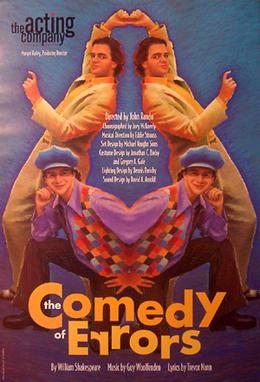
The Comedy of Errors by William Shakespeare

Never have I had less to say about a Shakespeare play than I do about Comedy of Errors.  Not that it isn't great--it is, but its charms lie mostly on the surface.  It's probably a lot more fun to see than read, and it's probably even less fun to read someone else talking about it.

It's the classic mistaken-identity sitcom episode, more or less.  Two brothers, separated as children, both named Antipholus (I just missed the other kid so much, I named the one I kept Antipholus too, says the bereaved father) end up in Ephesus, where one lives.  In case that's not absurd enough for you, they each have a manservant named Dromio.  When Antipholus of Syracuse comes to Ephesus, well... you can probably imagine what kind of hijinks ensue.

Comedy of Errors is true to its name, delivering up a series of pretty funny set pieces that involve the Antipholuses and Dromios confusing one another.  The best moment, I think, comes when Dromio of Syracuse encounters the wife of Dromio of Ephesus, whom he describes this way:

DROMIO OF SYRACUSE: ...She is spherical, like a globe.  I could find out countries in her.

ANTIPHOLUS OF SYRACUSE: In what part of her body stands Ireland?

DROMIO: Marry, sir, in her buttocks.  I found it out by the bogs.

ANTIPHOLUS: Where Scotland?

DROMIO: I found it by the barrenness, hard in the palm of her hand.

ANTIPHOLUS: Where France?

DROMIO: In her forehead, armed and reverted, making war against her heir.

ANTIPHOLUS: Where England?

DROMIO: I looked for the chalky cliffs, but I could find no whiteness in them.  But I guess it stood in her chin, by the salt rheum that ran between France and it.

ANTIPHOLUS: Where Spain?

DROMIO: Faith, I saw it not, but I felt it hot in her breath.

ANTIPHOLUS: Where America, the Indies?

DROMIO: O, sir, upon her nose, all o'er embellished with rubies, carbuncles, sapphires, declining their rich aspect to the hot breath of Spain, who sent whole armadas of carracks to be ballast at her nose.

ANTIPHOLUS: Where stood Belgia, the Netherlands?

DROMIO: O, sir, I did not look so low.

If ever Shakespeare needed a rimshot, it's here.  If there is any real depth to the play, it comes from the theme of losing one's identity, which is what worries the Syracusan Antipholus:

He that commends me to mine own content
Commends me to the thing thing I cannot get.
I to the world am like a drop of water
That in the ocean seeks another drop,
Who, falling forth there to find his fellow forth,
Unseen, inquisitive, confounds himself.

Antipholus sets up a paradox in which he searches for his brother to individuate himself, to become again a whole drop of water, even though to do so he must confront his own sameness by finding him.  The water-drop motif is repeated unintentionally by Adriana, the wife of Ephesian Antipholus, whose worry about her husband's disinterest is only exacerbated by the fact that he no longer seems to recognize her:

Ah, do not tear thyself away from me;
For know, my love, as easy mayst thou fall
A drop of water in the breaking gulf,
And take unmingled thence that drop again
Without addition or diminishing,
As take from me thyself, and not me too.

The bittersweetness of these lines is not like anything else in the play, and stands out in sharp relief.  By contrast the Ephesian Antipholus, in whom the identities of his wife and brother are so intimately tangled, walks through the play caddishly unconcerned with anyone else.  Perhaps, if you want to look past the slapstick, the message here is that real human relationships imply the risk of losing one's own identity--but the alternative is just being a selfish jackass.

Thursday, June 14, 2012

Troilus and Cressida by William Shakespeare

TROILUS: This she?  No, this is Diomed's Cressida.
If beauty have a soul, this is not she;
If souls guide vows, if vows be sanctimonies,
If sanctimony be the gods' delight,
If there be rule in unity itself,
This is not she.  O madness of discourse
That cause sets up with and against itself!
Bifold authority, where reason can revolt
Without perdition, and loss assume all reason
Without revolt.  This is and is not Cressid.

My students react very strongly to the fact that Shakespeare derived most of his plots from established sources.  They have been admonished about plagiarism for years, and now they find that the "greatest author of all time" was nothing but a plagiarist?  But they do not know (as most of us don't) the original Leirs and Macbeths, who are mere legends out of which Shakespeare wrings high tragedy.  His reimaginative power is more obvious in Troilus and Cressida, which repurposes a much more famous story--the Trojan War--but instead of elevating it, Shakespeare makes it nasty, pathetic, and human; he drags it into the mud.

King Nestor complains that Achilles, making unflattering imitations of the Greek warriors, "sets Thersites," his cynical slave, "To match us in comparisons with dirt."  His complaint seems to strike Shakespeare himself, who emphasizes the most unlikeable traits in the Greek and Trojan heroes: Achilles is a petulant brat; Ulysses an unscrupulous politician; Diomedes a vulgar philanderer; Helen a bimbo; Ajax an idiot; Nestor a decrepit old man.  At the outset of the play, Achilles, the Greeks' greatest warrior, has refused to fight, entertaining himself instead with his "masculine whore" Patroclus.  The Trojan Hector issues a challenge that can only be met by Achilles, but Ulysses and Nestor scheme to have Ajax answer it instead, reasoning that a triumphant Achilles is worse than an indigent one:


ULYSSES: What glory our Achilles shares from Hector,
Were he not proud, we should all share with him;
But he already is too insolent,
And it were better parch in Afric sun
Than in the pride and salt scorn of his eyes
Should he scape Hector fair...
If the dull brainless Ajax come safe off,
We'll dress him up in voices; if he fail,
 Yet we go under our opinion still
That we have better men.  But, hit or miss,
Our project's life this shape of sense assumes:
Ajax employed plucks down Achilles' plumes.


Absent, of course, is any conception of how the challenge affects the war aims; no one in Troilus and Cressida cares about anything or anyone beyond themselves.

The parallel story follows Troilus, a Trojan prince, and his love for Cressida, whose father has abandoned the city and defected to the Greeks.  He arranges a union with her through Pandarus, a sort of comedic Friar Lawrence, but worries about her fidelity to him when she is suddenly used as a bartering chip and and traded to the Greeks for a captured warrior:


TROILUS: I cannot sing,
Nor heel the high lavolt, nor sweeten talk,
Nor play at subtle games--fair virtues all,
To which the Grecians are most prompt and pregnant.
But I can tell that in each grace of these
There lurks a still and dumb-discursive devil
That tempts most cunningly.  But be not tempted.

CRESSIDA: Do you think I will?

TROILUS: No.
But something may be done that we will not,
And sometimes we are devils to ourselves
When we will tempt the frailty of our powers,
Presuming on their changeful potency.


There is both a truth and an evasion in those lines, which sound like the excuses of a politician caught at the brothel: "Something may be done that we will not."

The relationship turns out to be rotten on both sides.  Troilus has no real regard for Cressida beyond lust; once they've spent the night together he basically rushes out the door, hustling her back into bed.  Once he has possessed her, his jealousy is only inflamed when she is taken away, like a child's regard for a toy.

For her part, Cressida turns out to be exactly as Troilus fears.  There is a remarkable scene in which Cressida enters the Greek camp, and is kissed in turn by each of the warrior-kings.  It seems--I hope this isn't too strong--like the prelude to a date-rape, until Cressida reveals a willing playfulness:


ULYSSES: May I, sweet lady, beg a kiss of you?

CRESSIDA: You may.

ULYSSES: I do desire it.

CRESSIDA: Why, beg two.


What's happened here?  The Cressida of Act I is clever and playful but also prudent, refusing to reveal her fondness for Troilus because she knows that "Men prize the thing ungained more than it is."  Her willingness to flirt with the Greek kings seems to contradict this, but Troilus and Cressida is about the impossibility of pinning down the substance and identity of a human being.  Troilus, spying on Cressida as she gives away the scarf he has given her as a love-token to the Greek Diomedes, frets, "This is and is not Cressid."  But is there any other way to respond to a external system of valuation than to keep changing?  No one has a constant identity in Troilus and Cressida, because no one has intrinsic value.  Hector, the most heroic of the Trojans, argues otherwise:


But value dwells not in particular will;
It holds his estimate and dignity
As well wherein 'tis precious of itself
As in the prizer.


And yet, Hector himself vacillates between identities, at one point arguing that Helen should be returned and then arguing the opposite; mercifully letting his opponent Achilles live and then hunting down an unidentified Greek for his brilliant armor.  The characters of the play, as boldly detailed as they are, have no constancy and therefore their only value is "in the prizer."  The war itself is an illustration of this; as Troilus says, "Helen must needs be fair / When with your blood you daily paint her thus."  Why is Helen valuable?  Because we fight over her.  The brokenness of that logic is not hard to perceive.

The result is a vision of humanity that is venal, commodified, and bleak.  The only character that recognizes this is the slave Thersites, who wanders around heaping scorn on every Greek and Trojan, and on the war itself.  But Thersites himself is a vulgar coward, and makes for an uncomfortable authorial proxy.  You may agree with me that human nature is pathetic and nasty, Shakespeare seems to say to us, but that doesn't make you not a part of it.

It's not hard to see why Troilus and Cressida fails to be as well-loved as, say, Romeo and Juliet.  Its principal goal is to rob us of our legends, to make them look as ugly and trivial as our own lives.  It's a systematic hollowing-out of the Troy legend.  The result is (as many have noted, including Jonathan Gil Harris in his afterword to the Folger edition) a very modern-seeming play.  Troilus' agony as he tries to make sense of Cressida's infidelity reminds me of nothing more than The Good Soldier's John Dowell, looking for sense in his dead wife's affair and coming up empty.

Sunday, June 10, 2012

The Shakespeare Wars by Ron Rosenbaum

In the mid-90's, journalist and author Ron Rosenbaum fired a volley into a battle that had, until that point, been strictly confined to the fields of academia: He claimed in the pages of The New York Observer that critic Don Foster's attribution to Shakespeare of a long poem called "The Funeral Elegy" was erroneous.  "The Funeral Elegy" is tedious and long, but it is signed W.S., and Foster claimed that by using a database called SHAXICON that compared word usage in the "Elegy" to Shakespeare's body of work he could positively identify the work as the Bard's.  Nonsense, Rosenbaum said (more or less), just read it:


He from the happy knowledge of the wise
Draws virtue to reprove secured fools
And shuns the glad sleights of ensnaring vice
To spend his spring of days in sacred schools.


The "Elegy" is shallow, clunky and just plain bad, but it is bad in a way that doesn't sound like Shakespeare.  In the early 2000's, after years of public sniping that was probably more contentious than it might have been had Rosenbaum not stepped in, Foster conceded the battle, admitting that the "Elegy" was probably the work of Shakespeare's contemporary John Ford.  (In defense of Ford, he also composed one of the all-time best dramatic titles: 'Tis Pity She's a Whore.)  It wasn't exactly V-E Day, to be sure, but in his book The Shakespeare Wars, Rosenbaum tells us why we should care by putting the controversy in context:


Now all that wooly literary judgment stuff could be junked--number-crunching had arrived at a state of Fosterian sophistication.  Literary value was to be defined by digitized statistics.  And the only reason his opponents, mostly in the United Kingdom, couldn't abide his claim was that they were--like fearful and ignorant primitives (bardolaters, idolaters)--primitives now forced to bow before the superior judgmental power of the number-crunching computer.

Literary judgment, literary value was already under assault from the pseudo-science of Theory whose partisans believed their job was to demonstrate that literary judgment was always incoherent, inconsistent, irredeemably subjective, the product of unacknowledged personal prejudice.  Or that "literary value" was just a construct, a slavish reflection of the internalized values of the power relations of an oppressive hegemony.


In other words, the "Elegy" controversy reflects something rotten at the heart of modern criticism, and forces us to confront why Shakespeare--and all great literature--matters to us.  What does it mean to be fundamentally "Shakespearean," and is it something that we can describe and discern?  And what is all the "fuss about," as one of the critics quoted in The Shakespeare Wars puts it?

In The Shakespeare Wars, Rosenbaum sets out to investigate a handful of arguments about Shakespeare's works.  The "Elegy" question is the most fascinating--and bloodiest--but there are others.  What do the different endings of Hamlet and Lear in the Quarto and Folio versions tell us about how Shakespeare wrote, edited, and regarded his own work?  Does the play Sir Thomas More contain a passage written by Shakespeare, in his own handwriting at that?  These questions matter, Rosenbaum says, because they are at the heart of why Shakespeare matters.

Nor are all the questions academic--some of the most fascinating arguments deal with Shakespeare on film and on stage, with the way Shakespeare's words are presented.  How, for example, should one play Shylock, the villainous Jew of The Merchant of Venice?  As a victim of prejudice, lashing out at his oppressors, or as an anti-Semitic stereotype?  (In this case, I agree with Rosenbaum--the play is virtually impossible to perform for modern audiences in its intended spirit.)  Or, for a simpler question: Can Shakespeare be effectively performed on film?

The back half of The Shakespeare Wars largely drops this premise, and instead becomes a kind of free-form investigation into what Rosenbaum sees as the most valuable of modern Shakespeare criticism.  Rosenbaum, who once abandoned the English department at Yale and in a way straddles the line between critic and journalist, is especially suited to this task, but something about these chapters seems half-baked.  Rosenbaum has a way, I find, of introducing an interesting idea, but never concluding it satisfactorily before moving on to the next.  (It would take too much space to really show what I mean, but much of it is present in a chapter about critic Stephen Booth and his concept of ambiguity--which Rosenbaum treats with too much ambiguity himself.)

But even when the thread is lost, The Shakespeare Wars is enjoyable because Rosenbaum's love of Shakespeare is so palpable.  It reminds me of reading Harold Bloom, though Rosenbaum would hate that I said that.  (He excoriates Bloom in a chapter about "recovering" Henry IV's Falstaff from Bloom's "overblown generalizations.)  Like Bloom, Rosenbaum believes that Shakespeare is vital--that's why these questions are so important.

Wednesday, May 23, 2012

Henry IV, Part Two by William Shakespeare

CHIEF JUSTICE: Well, God send the Prince a better companion.


FALSTAFF: God send the companion a better prince.  I cannot rid my hands of him.

What is the point of Henry IV, pt. II?  I cannot tell.  The fundamental conflicts seem warmed over from Henry IV, pt. I: Prince Hal feels compelled to cast of Falstaff in order to claim his birthright; King Henry thinks little of Hal; there are some rebels.  The scene in which Hal, now Henry V, condemns Falstaff, is one of the best scenes in either play, but it lacks the impact it ought to have because we've been here already, when the Falstaff of Part I begs not to be "banished" by Hal, who replies, "I do; I will."

The rebels enter even more limply.  Instead of Hotspur--the furious, headstrong foil of Part I--Part II gives us his father Northumberland, whose defining trait is that he fails to actually show up to the rebellion.  Shakespeare promises another showdown between the rebel forces and the King's, but instead has the Prince's brother John capitulate to all their demands and then arrest them when their guard is down.  (In this case I imagine Shakespeare laughing maniacally while writing this scene, delighted to frustrate his audience's expectations.)  For these reasons it seems hard to regard Henry IV, pt. II as anything but an attempt to further capitalize on the popularity of the first part, and on Falstaff in particular.

As a play it's underwhelming, but it also seems to be a product of perverse genius.  In a way, Shakespeare gives us exactly the play we want--that is, a repeat of the last play--but refuses to give it to us the way that we want.  Probably Shakespeare knew that the greatest moments of Part I were the interactions between Falstaff and Hal, and he purposely kept their two storylines (mostly) separate until the final scene.

What a final scene it is, though.  Hal's vicious rejection of Falstaff is almost worth the price of admission:


FALSTAFF: My king, my Jove, I speak to thee, my heart!

KING: I know thee not, old man.  Fall to thy prayers.
How ill white hairs becomes a fool and jester.
I have long dreamt of such a kind of man,
So surfeit-swelled, so old, and so profane;
But being awaked, I do despise my dream.
Make less thy body hence, and more thy grace;
Leave gormandizing.  Know the grave doth gape
For thee thrice wider than for other men.
Reply not to me with a fool-born jest.
Presume not that I am the thing I was,
For God doth know--so shall the world perceive--
That I have turned away my former self.
So I will those that kept me company.


The bit about Falstaff being part of Hal's dream is especially telling, because we know that dreams will be few and far between for Hal.  In the play's other truly moving scene, Hal sees his ailing father asleep and thinks that he has died.  Reluctantly, he takes the crown as his, knowing that it represents a sleepless future:


Why doth the crown lie there upon his pillow,
Being so troublesome a bedfellow?
O polished perturbation, golden care,
That keep'st the ports of slumber open wide
To many a watchful night!  Sleep with it now;
Yet not so sound and half so deeply sweet
As he whose brow with homely biggen bound
Snores out the watch of night.


Henry will return to this thought in Henry V as he walks incognito through his military camps, soliloquizing that the trappings of a king, "laid in bed majestical, / Can sleep so soundly as the wretched slave..."  Of course, Henry IV is not dead, and when he discovers that Hal has come and gone with his crown, his response could not be more off the mark:


How quickly nature falls into revolt
When gold becomes her object!


And yet this gives Hal the opportunity to admit the truth to his father--that he regards the crown not as a prize, but that creature "that hath fed upon the body of my father."  It is a rare moment of honesty from Hal, who seems so often to be nothing but a collection of performances.  And it is a deeply tragic moment, because Hal takes up a burden that he does not want to honor a man who has loved him little.  Perhaps Hal's greatest tragedy is that he will make a great king.

Whether a noble self-sacrifice or a fetishization of honor, Hal's attitude in this scene is not something he has learned from Falstaff.  But the skills that make him a great king--the play-acting and manipulation of words--show the evidence of Falstaff's tutelage.  As Hal has been proving since Part I, he is a greater jokester than even his mentor, once again outwitting him by posing as a waiter to eavesdrop on what Falstaff says about him.  (This, in turn, is a pale imitation of Hal's trickery during the Gad's Hill robbery of Part I).  I really enjoyed Falstaff's soliloquy attributing Hal's skills to heavy drinking, of which I'll share only a part:


Hereof comes it that Prince Harry is valiant, for the cold blood he did naturally inhehrit of his father he hath, like lean, sterile, and bare land, manured, husbanded, and tilled with excellent endeavor of drinking good and good store of fertile sherris, that he is become very hot and valiant.  If I had a thousand sons, the first human principle I would teach them should be to forswear thin potations and addict themselves to sack.


This is not correct, of course, but neither is it wrong.  Hal could not have got his peculiar brand of histrionic valor from his father, but with Falstaff as his father he would never have possessed the cruelty kingship requires.  In a sense Hal has two fathers; though Falstaff imagines "a thousand sons," we know that he is thinking of only Hal.  That is why it is so painful to hear Hal say, "I know thee not, old man."

But as great as that scene is, and a handful of others (including Hal's trick and the snatching of the crown, as well as some of the comic Falstaff-only scenes) Henry IV, pt. II feels awfully shoddy, like a sagging tent held up with two few poles.  Though Henry is dead and Hal is king, nothing seems to have changed or been accomplished.  It is probably for the best that Shakespeare did not make good on his epilogue, which promises another play "with Sir John [Falstaff] in it," or else Henry V might have been just as inconsequential.

Tuesday, February 28, 2012

Untimely Matter in the Time of Shakespeare

Jonathan Gil Harris' Untimely Matter in the Time of Shakespeare is an exercise in the burgeoning field of thing studies, the quasi-literary exploration of material things and their roles in shaping human experience. The title is misleading, not only because Harris draws from diverse literary sources (up to and including the 20th century), but because at the outset he disavows the reductive practice of historicizing things, or considering them as products of a singular time and place:

We might call this the national sovereignty model of temporality. Although it licenses trade between different moments (allowing, say, the "modern" to import elements from the "early modern" and to export others to the "postmodern"), it grants each moment a determining authority reminiscent of a nation-state's: that is, firmly policed borders and a shaping constitution. As a result, any historical phenomenon tends to be regarded as a citizen solely of one moment-state, And from the vantage point of the present, the past becomes a foreign country, or several foreign countries.


On the contrary, Harris argues, material things contain traces of multiple times that coexist. Matter, he says, is typically "palimpsested," a word derived from the monastic practice of re-using parchment, which would allow the past to peek through to the present.

Harris describes three types of palimpsests: Supersessions, in which the present seeks to overwrite or appropriate the past; explosions, in which the past "fracture[s]" the present; and conjunctions, in which the two are combined in a more mutual and cooperative sense. He accompanies each of these with an example from Shakespeare and an example from another writer, some more successfully than others. The most interesting of these is, for me, his analysis of John Stow's description of Jewish characters on London's Ludgate. The Ludgate, named for London's mythical founder King Lud, is emblematic of the city's history and heritage. Having been repaired with stones appropriated from the houses of the city's nearby Jewish minority, whose past "explodes" into the present, fracturing the gate's symbolism and creating a paradoxical cultural hybridism.

I find it harder to buy Harris' attempt to connect the olfactory experience of gunpowder squibs used in Macbeth to the Gunpowder Plot, in which Catholic agents attempted to assassinate King James I in the Houses of Parliament. The house of cards--the smell of gunpowder is palimpsested not only by the suggestion of the devil and Judgment Day but the now-absent smell of Catholic incense--just seems too flimsy.

The last chapter, which deals with the conjunction of the human body in Helene Cixous and Margaret Cavendish, I must admit I did not understand. This is partly because Harris' crit-speak goes into overdrive (there's a lot about "rhizomes" and "texxts") but I hope also because I'm not familiar with either writer.

Tuesday, January 31, 2012

Richard III by William Shakespeare

I, that am curtailed of this fair proportion,
Cheated of feature by dissembling nature,
Deformed, unfinished, sent before my time
Into this breathing world scarce half made up,
And that so lamely and unfashionable
That dogs bark at me as I halt by them--
Why, I, in this weak, piping time of peace,,
Have no delight to pass away the time,
Unless to see my shadow in the sun
And descant on mine own deformity.
And therefore, since I cannot prove a lover
To entertain these fair well-spoken days,
I am determined to prove a villain,
And hate the idle pleasures of these days.

I probably can't describe Richard III any better than the introduction to the Folger edition of the play, which tells us to prepare for a "moral holiday." Shakespeare manipulates his audience into sharing the greatest part of their sympathy with Richard, for whom "Conscience is but a word that cowards use, / Devised at first to keep the strong in arm." There's no real trick to it; simply by keeping Richard alone on stage, hoarding the play's soliloquies, we are given the impression that we are intimate with the Duke (and later king), who puts his arm around us while we watch the rest of the kingdom toil as though behind plate glass. Shakespeare would use this technique to better effect with Iago and Edmund, but those are better, scarier villains.

Not that you would know that there was anything pedestrian about Richard from reading the play. It's sensationalistic in the extreme, alternating scenes of brutal violence with hand-wringing about how destructive Richard is. Queen Elizabeth, wife of the late Edward IV (who dies, incidentally, not at Richard's hands), tells Richard, "No doubt the murd'rous knife was dull and blunt / Till it was whetted on thy stone-hard heart, / To revel in the entrails of my lambs." And for a while, the glee of watching Richard remorselessly cut down his enemies for four acts makes for a considerable "moral holiday." His first victim is his own brother, Clarence, whom he has convinced the ailing Edward IV is the murderer of his children mentioned by prophecy. (Guess who it really turns out to be.) Clarence gets the best long speech of the play, recounting a dream:

As we passed along
Upon the giddy footing of the hatches,
Methought that [Richard, Duke of] Gloucester stumbled, and in falling
Struck me, that thought to stay him, overboard
Into the tumbling billows of the main.
O Lord, methought what pain it was to drown,
What dreadful noise of waters in my ears,
What sights of ugly death within my eyes.
Methoughts I saw a thousand fearful wracks,
A thousand men that fishes gnawed upon,
Wedges of gold, great anchors, heaps of pearl,
Inestimable stones, unvalued jewels,
All scattered in the bottom of the sea.


Clarence is too trusting of Richard, and cannot see that the dream portends his own death, much less the downfall of Richard, and the laying to waste of all the riches and power sought by the battling houses of York and Lancaster.

Almost as entertaining is the scene in which Richard, for no seeming reason other than to give his faculties for lying a challenge, seduces Lady Anne over the body of her father, King Henry VI, whom Richard killed. (He also killed her husband, because, why not?) I am not sure the scene does enough to earn Anne's acceptance of Richard, but it does make for pretty good theater:

ANNE: And thou unfit for any place but hell.
RICHARD: Yes, one place else, if you will hear me name it.
ANNE: Some dungeon.
RICHARD: Your bedchamber.


Zing!

But after these promising beginnings, Richard III failed to keep my attention, devolving into an interminable slog of murders, punctuated by curses, and followed by murders. There is a great dramatic intensity to Richard's interactions with the young heir Edward V and his brother Richard, Duke of York, whom Shakespeare's audience knows will be "disappeared" from their protective cell in the Tower of London and never heard from again. But Shakespeare lingers too long, and overstays his welcome, ignoring the very good advice of the Duchess of York: "Why should calamity be full of words?"

Ultimately, Richard is defeated on the battlefield by the Earl of Richmond, who will become Henry VII and the grandfather of Elizabeth I, under whose reign Richard III was written. That may provide a justification for the thinly angelic Richmond and the irredeemable Richard, but not for the play's tediousness.

Wednesday, January 25, 2012

Coriolanus by William Shakespeare

Let me have war, say I. It exceeds peace as far as day does night. It's sprightly, waking, audible, and full of vent. Peace is a very apoplexy, lethargy; mulled, deaf, sleepy, insensible; a getter of more bastard children than war's a destroyer of men.

Coriolanus (expertly recounted by Brent here) begins as a political parable and mutates into something much stranger and more horrifying. From the very first scene Caius Martius (later Coriolanus) is at odds with the Roman plebeians, his illustrious military service to Rome overshadowed by his open disdain for common folk. Much of Coriolanus' hatred is bitterly prejudicial ("Bid them wash their faces / And keep their teeth clean," he says after being cajoled into eliciting their support for his consulship). And yet, his tirades against flattery still seem fresh and incisive in the era of the 24-hour media campaign:

CORIOLANUS: I will, sir, flatter my sworn brother, the people, to earn a dearer estimation of them. 'Tis a condition they account gentle; and since the wisdom of their choice is rather to have my hat than my heart, I will practice the insinuating nod and be off to them most counterfeitly.


He says he will, but he will not; he cannot; he simply isn't capable. The closest he can come to glad-handing the people is to say that he will, and in prose, rather than the iambic pentameter reserved for conversing with patricians. As grotesque as Coriolanus is, his unwillingness to dissemble, and the sharp contrast between him and the duplicitous tribunes that plot his downfall, Sicinius and Brutus, are what maintain our sympathy toward him.

When the tribunes successfully rouse the people into exiling Coriolanus, he joins forces with the Volscian general Aufidius, whom he had formerly routed in the name of Rome, and turns to attack his native city. I have to respectfully disagree with Brent that Aufidius is not "fleshed out;" though he has little stage time his relationship with Coriolanus is fascinating. I usually don't fall in for critical theories that see homoeroticism everywhere, but there is no doubt in my mind that Aufidius' obsession with Coriolanus is sexually charged:

AUFIDIUS: Let me twine
Mine arms about thy body, whereagainst
My grained ash an hundred times hath broke,
And scarred the moon with splinters...
Know thou first,
I loved the maid I married; never man
Sighed truer breath. But that I see thee here,
Thou noble thing, more dances my rapt heart
Than when I first my wedded mistress saw
Bestride my threshold.


Coriolanus, for his part, says of Aufidius, "And were I any thing but what I am, / I would wish to be only he." But once allied with his enemy, Coriolanus quickly forgets his former regard and retreats into himself. On the brink of exile, he rails that "There is a world elsewhere," but Coriolanus deems himself too large, too limitless, to admit any one or thing into his own private world. At the head of the Volscian army, he seems to have transformed into something superhuman, a terror unbound to the world:

He was a kind of nothing, titleless,
Till he had forged himself a name o' th' fire
Of burning Rome.


These words are Cominius', the current consul and Coriolanus' former friend. Brilliantly, Shakespeare establishes the report of the march on Rome before the march itself, in a dialogue between Cominius and Coriolanus' mentor Menenius that sounds like the conversation between two men on death row, or the same having arrived together at the gates of Hell. "If he could burn us all into one coal," says Menenius to the tribunes, "We have deserved it." The theme of their exchange is that Coriolanus, no coward before, has become all the more frightening having shaken off the ties of family, friendship, and state:

COMINIUS: I offered to awaken his regard
For's private friends. His answer to me was
He could not stay to pick them in a pile
Of noisome, musty chaff. He said 'twas folly,
For one poor grain or two, to leave unburnt
And still to nose th' offense.

MENENIUS: For one poor grain or two?
I am one of those! His mother, wife, his child,
And this brave fellow too, we are the grains.


As his mother, Volumnia, sallies forth from the city walls to beg for mercy, Coriolanus himself echoes this, saying, "I'll never / Be such a gosling to obey instinct, but stand / As if a man were author of himself / And knew no other kin."

Volumnia is a grotesque, seen in the opening act bragging about sending her son to war and thanking the gods for his wounds. At the end, her plea for mercy begins sympathetically but becomes increasingly desperate and unpleasant, parodying her former praise of an honorable death. Coriolanus breaks down and relents, though his words suggest he knows that to do so will mean the undoing of both his honor and his life:

O mother, mother!
What have you done? Behold, the heavens do ope,
The gods look down, and this unnatural scene
They laugh at. O my mother, mother! O!
You have won a happy victory to Rome;
But for your son--believe it, O believe it!--
Most dangerously you have with him prevailed,
If not most mortal to him.


And indeed, Coriolanus, returning empty-handed from Rome, is killed by the people of Corioles, the city he had sacked single-handedly and from which he had taken his name.

This is the final irony of Coriolanus: Convinced he needs no one but his self, he tries to fashion himself into a sort of ronin, loosed from any relationship or deed that might seek to define him, to become the "author of himself." But Coriolanus is not Hamlet and he has no inner wellspring from which to draw. He can cast off "Caius Martius," the name his mother gave him, but in the end he is his mother's son. Even the name "Coriolanus," which Aufidius denies him on the precipice of his murder, anchors him to a place outside of himself.

Not knowing that Coriolanus' mother has begged peace of him, Menenius continues to despair, but his praise is rendered absurd: "The tartness of his face sours ripe grapes." When the myth of Coriolanus' making is undone, he is left with nothing. And though he loathes flattery, even of himself, and loathes the people for preferring his "hat" to his "heart," he fails to realize that he is more hat than heart--it is the accounting of his deeds that most defines him, more than his deeds and far more than his character. Though he disdains their speech, calling them mere "voices," without their voices he exists hardly at all.