Showing posts with label Iowa. Show all posts

Sunday, January 21, 2024

Blood Run by Allison Adelle Hedge Coke

Civic, ceremonial, elegant effigy--Snake--
our purposes funerary, fundamental, immaculate.

Until sons of Orpheus, fools of fortune,
looters, anthros, squatters--their tractors, rakes--
altered, removed on superiority-driven raids.

When the animals leave this place,
now without protective honorary sculpture.
When River returns with her greatest force.

When flora, fauna will themselves back,
here where we all began ago, long for.
When our people return, to the place
offerings kept free, balanced, hallowed,

when The Reclaiming comes to pass,
all will know our great wombed hollows,
the stores of Story safely put by.
All will come to truth.

I first read about Allison Adelle Hedge Coke's poetry cycle Blood Run in Chadwick Allen's book Earthworks Rising about the literary uses and abuses of Native American mounds. Allen approached Hedge Coke's poems, at least in part, as a numerological exercise, counting the many voices and their place in the narrative: the Mounds, the River, the Deer, the Skeletons, the Ghosts, the Beaver, etc., etc. It all seemed a little silly to me, but I was interested in what Allen had to say about the importance of the voices themselves, which represent the different aspects of the Blood Run Mounds in Iowa's far northwest corner, how the act of letting the mounds themselves speak--as opposed to being spoken for by white historians and anthropologists--constitutes a radical act.

I wish I hadn't left Allen's book at work, because I'd like to go back and read through what it is he said about Hedge Coke's poems, and not rely on my former review, or on memory. For myself, what struck me most about the poems is the unfolding of their chronological structure: first, the Mounds speak from memory, from prehistory, and then they witness--along with the animals and the skeletons and the ghosts--the cataclysmic arrival of settlers, who tear the Mounds to pieces and interrupt the wholeness of the ecology of which the Mounds are a part. I liked the Serpent, a snake-shaped mound like the famous one in Ohio that has since been obliterated, who predicts his own return: "Though my body / suffered sacrifice / to railway fill, / my vision bears/ all even still. / Be not fooled. / Be not fooled. / I will appear again. / Sinuous, I am." And true to form, the poem then moves toward a narrative of future return, in which the river and the mounds are made whole again.

As poetry, it felt a little clunky to me. I love the sinuousness of the snake, the turning of its simple lines, but other poems struck me as being rather plodding. Perhaps that's all right, perhaps they're meant to be solid and earthlike. I did laugh when I got to the cycle's only rhyming poem, narrated by "The Jesuits"--Europeans who brought their ways of poetry with them as surely as their religion and their ways. But in the end I did enjoy the sense of the land speaking, and the interconnectedness of things, and the cycle's proud insistence that things which many have insisted are lost might return again, to their rightful place.

Sunday, February 12, 2023

Kick the Latch by Kathryn Scanlan

A lot of my friends have gotten killed. A lot of them have steel rods down their spines. One guy lot his leg. He was a jockey who lost his leg, but he'd still gallop horses and pony them to the gate. Sometimes his fake leg would fall off when he was riding and someone had to run out and pick it up for him.

There's a lot of pain and pill abuse. You learn some of them are drunks. They show up to hot walk and they're drunk. When they say they're hungry, you don't give them money. You take them to get a bite instead.

Kathryn Scanlan's Kick the Latch is the story of a horse trainer named Sonia. Sonia grows up with a love for horses and wants to be a jockey, but she's too tall; as a child, she stacks books on her head to keep her from growing. She becomes a successful trainer, working mostly at low-rent tracks, which are worlds away from the mint juleps and fancy hats of the Kentucky Derby. It's a hard life: back-breaking and highly physical. The "backside" of the tracks are little universes of their own, places where people spend all their time because of the grueling nature of the job, and they have their own small and large human dramas. It's a tough place for women, and Sonia is belittled and doubted, and once, raped. But she's good at what she does.

Kick the Latch is based, the afterword notes, on a series of interviews with the real "Sonia," but the result is a fictional version of the real person's life. If there are seams between reality and fiction, they don't show: Scanlan captures the earthy and reflective voice of Sonia; each vignette sounds like what it is, a story told over the phone. As a result, Kick the Latch has a powerful verisimilitude. You're convinced by the specificity of the detail, the truth of the language: the Bowie Clay and leg paint, the doping, the untrustworthy jockeys who shock their horses with electrical devices to give them an edge, the horrible accidents that leave some jockeys and trainers wrecked or paralyzed. It's a convincing portrait of a person in an unglamorous profession; sometimes there's nothing more captivating than a portrait of a person who is utterly devoted to some niche and invisible task.

Sonia's life is long and varied. Her successes are bringing horses that no one believed in into the winner's circles. The challenges are tough--the physical labor, the instability of track life--and she ends up getting seriously injured and going into a coma. When she emerges, she has to give up the life she's loved. For a while she takes a position as a groomer with more expensive, Derby-bound stables, but the rigidity and absurdity of the high-stakes world is distasteful. She leaves horses entirely and takes a job as a prison warden, which is, as you might expect, no easier for women. The parallels between the two jobs--the hard hours, the detailed care required toward captive creatures, the way those creatures are devalued and abused, the sexism--are there, but never overdone; Sonia's life never becomes a metaphor or an allegory. She is only what she is: dedicated, strong, even in a small way, heroic.

Sunday, June 5, 2022

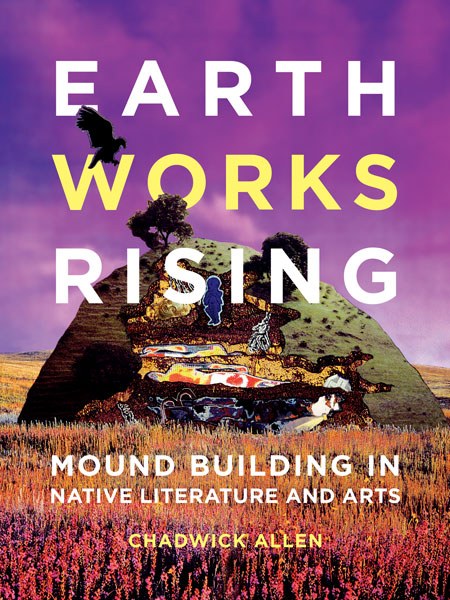
Earthworks Rising by Chadwick Allen and Shell Shaker by LeAnne Howe

For many who either seek or stumble upon them, burial mounds signal loss, herald doom: dead Indians, dead savage civilizations, dead pagan pasts ground to dust and now overgrown in brush, obscured by weeds and trees. And yet for others burial mounds announce regeneration, the possibilities of reclamation and renewal; they continue to connect and bloom. Native individuals, families, communities, and nations rise up against narratives of loss and doom to reclaim and repatriate, restore and reactivate. On their lived experiences and felt knowledges. On their abilities to dream intensely. But there are no easy divisions, no clear-cut binaries of Indigenous and settler in the twenty-first century (if there ever were), and there are no easy escape routes out of dominant ideologies and worldviews.

Two weeks ago, I got to visit Effigy Mounds National Monument in Iowa, a place I have long wanted to go: a green bluff overlooking the Mississippi, the monument is dotted with Indigenous earthwork mounds, some in the shapes of birds and bears, some perhaps over two thousand years old. In most cases they're no more than a few feet tall--you might miss them completely if they hadn't been cleared of trees and neatly mowed--but where else in what is now the United States can you see human architecture that old? To walk around them is to connect with a deeper past, and reform a present understanding of the land. Photographed from above, the bird and the bear appears, but on the ground, no effigy can be seen totally at once; you have to walk around and experience the shifting perspective of the earth to really "see."

Effigies like these have, from time to time, captured the imagination of modern writers and artists, both Indigenous and non-Indigenous. Chickasaw scholar Chadwick Allen's Earthworks Rising is a new critical work that examines some of the ways that Native American mounds and earthworks have been used in art and literature. His scope is vast, taking in non-Native works like Alice Walker's novel Meridian and 20th-century pulp novels like Mog the Mound Builder and The Horror From the Mound by Conan the Barbarian creator Robert Howard. In non-Native imaginations, earthworks tend to speak of vanished races, whose creation of the mounds is shrouded in irrecoverable mystery. No one knows why they were created, we are told, and no one knows what happened to those who made them. (Of course, we do know, because their descendants--Choctaws and Chickasaws and other Native nations--are still around.)

By contrast, the Indigenous works Allen explores offer interpretations of the earthworks that emphasize the possibility that they are still sites that produce meaning, for Native peoples and through Native epistemologies. Allen devotes chapters to the work of visual artists Jimmie Durham and Alyssa Hinton, whose brightly colored photo collages of burial mounds are contrasted with the kind of clinical cross-sections you might find in a museum gallery. Literary sources include Allison Hedge Coke's Blood Run, a poem cycle in which the Mounds themselves--and associated elements like the River and Trees--are allowed to "speak," not as mute or ghostly voices--like the Indian curse unleashed in The Horror from the Mound--but as interlocutors that connect the present to the past and the future both, and sit at the axis mundi between earth and sky. Allen's methods are a mix of recognizably academic cultural criticism and more Indigenous ways of knowing. I rolled my eyes a little at Allen's reliance on numerology to understand the structure of Blood Run, but an anecdote where Allen watches on as Choctaw scholar LeAnne Howe records a song she hears being sung by a "little girl" in a burial mound seems beyond my powers of judgment or evaluation.

Attention woman, listen to my remarks. The gravediggers are wrong. Not all the ancient burial mounds were stuffed with beloved leaders. Some contain bad people who were given everything in death that they had coveted in life. Shell beads, copper, axes, knives, pottery bowls, baskets, animal skins, blankets. There were times when good people followed the bad ones into the spirit world to care for them. Like the parent of a spoiled child, they were there to give things to the band ones. Make them comfortable so that they would not want to leave their resting place and harass the living. But when the mounds were opened by gravediggers, these flawed spirits escaped like flesh-eating flies. They passed through many changes. Always becoming predatory. Put your dead chief in a mound so he will be protected from escaping again. Give him everything in death he wanted in live. That way he will never leave it again.

Howe figures large in Allen's book, as a colleague who helps guide his thinking about the mounds themselves and their significance. On more than one occasion, Allen describes traveling to a significant earthwork site with Howe, walking around it, laying down upon it and feeling its physical presence. I'd read a couple of Howe's works--the excellent play Savage Conversations and the baseball novel Miko Kings--but not Shell Shaker, which Allen analyzes at length. Shell Shaker is a novel about two murders, which take place at different points in time but which are presented as analogs of one another: in the present, Choctaw vice chief Auda Billy's apparent murder of the chief Redford Macalester. In the past, the murder of Red Shoes, a Choctaw warrior who played the English and French off of each other and who ended up igniting a bloody war between the colonial powers, Choctaw factions, and neighboring tribes.

Redford, like Red Shoes before him, begins his career with noble ambitions that are corrupted by greed and violence. The casino he brought into the Choctaw Nation has brought economic prosperity, but also an alliance with the mafia, from whom he has been embezzling money in order to send to the Irish Republican Army (!). Like Red Shoes, he has become too much warrior and not enough peacemaker, and his belief that he can play one side of hostile forces off the other threatens to bring a lot of violence. Moreover, his ego has made him into a monster: when the book opens, we see him raping his longtime assistant and former lover Auda.

Auda, like Redford, has an analog in the past, named Anoleta. Like Auda, Anoleta is accused of Red Shoes' murder, and Auda's mother Susan--like Anoleta's mother Shakbatina--takes credit for the deed to spare her daughter's life. The parallels don't end there: Auda's two sisters each have an analog, as do her father, her uncle, her cousin. Howe gives us a sense not so much of the past repeating itself as a kind of mythical story that emanates in different temporal registers; past and present are brought together and made the same, thus rejecting traditional notions of Indigenous disappearance or disintegration. It was too much for me, frankly. Howe juggles the two time periods, and the numerous figures between them, with careful dexterity, but I found myself easily lost, wishing that the two stories had been simplified. The particulars of the Choctaw Civil War that Red Shoes ushers in were especially opaque to me. I had a much better time with the present narrative, whose magical realist elements and focus on generational ties reminded me of Louise Erdrich, and not merely, or even particularly, because of the novel's Indigenous themes.

In one memorable scene, which looms large in Allen's analysis of the novel, Auda's aunts are kneading dough in the kitchen when it turns into mud. And not just any mud: the rich black earth of the family's ancestral Choctaw homelands, in Mississippi. In visions they are instructed to take the dead chief Macalester's body to Mississippi and bury it in a mound for safekeeping, along with the embezzled cash. Far from being the burial of an honored person, the mound becomes a way to keep a troublesome spirit from making more trouble, and perhaps from reappearing in a different time, in a different guise, the way that Red Shoes reappears as Redford Macalester. There's some resonance here with the despised "curse" narrative of The Horror From the Mound that goes unremarked upon, but both Allen and Howe depict the act of burying Redford in a mound as a sort of kindness as well as a defense. By reintegrating Redford into the land, they are not merely imprisoning him, but bringing him back into the fold--bringing him home.

Along the railings at Effigy Mounds National Monument, you can see prayer ties, little scraps of cloth tied there, that mark it as a sacred site. Not a site of death or disappearance, of a vanished mystery, but a living place that still speaks to Indigenous people who visit it. I really got a kick of reading both Earthworks Rising and Shell Shaker, which helped me see these mounds a little more fully, a little more clearly.

Sunday, October 21, 2018

Jesus' Son by Denis Johnson

The man hanging out of the wrecked car was still alive as I passed, and I stopped, grown a little more used to the idea now of how really badly broken he was, and made sure there was nothing I could do.  He was snoring loudly and rudely.  His blood bubbled out of his mouth with every breath.  He wouldn't be taking many more.  I knew that, but he didn't, and therefore I looked down into the great pity of a person's life on this earth.  I don't mean that we all end up dead, that's not the great pity.  I mean that he couldn't tell me what he was dreaming, and I couldn't tell him what was real.

Denis Johnson's story "The Other Man" begins: "But I never finished telling you about the two men."  And sure enough, you recall: earlier in the collection Jesus' Son, there is a story called "Two Men," but it's really just about one man: a deaf-and-dumb giant of a dude who ends up in the narrator's car, signaling that he'd like to be taken somewhere.  He's a stranger, but somehow his inability to speak fends off a fight, and compels the narrator to comply.  The man in "The Other Man" is a tourist who pretends, convincingly, to be a Polish tourist until he admits it was a prank all along.  Yet the reveal doesn't reveal all:

When I've told others about this man, they've asked me, "Did he make a pass at you?"  Yes, he did.  But why is that out come to this encounter obvious to everyone, when it wasn't at all obvious to me, the person who actually met and spoke with him?

What's the connection between the two men?  Are they both liars?  And why does it take the narrator so long to remember to finish the story?  All of Jesus' Son is like that, within and across stories: obscure connections are made and broken; time skips unpredictably and without warning.  In "Out on Bail," the narrator is at a bar commiserating with a friend about to go to prison, until he remembers that the moment was actually one of celebration, because the friend was acquitted.  In the virtuosic "Emergency," he tells us a story about getting stuck in a car in the snow, and accidentally kills a nest of newborn rabbits he'd been trying to protect.  Then he says, "Or maybe that wasn't the time it snowed."  This moment that he's thinking of, "The bunnies weren't a problem yet, or they'd already been a problem and were already forgotten, and there's nothing on my mind."  The fractured nature of the narrative reflects the drunken, drug-addled mindset of the narrator--nicknamed, unfortunately, "Fuckhead."

Does that sound frustrating?  Does it sound like the worst excesses of our most masculine hacks?  Our Bukowskis, our Palahniuks, our Bret Easton Ellises?  Certainly you can their shadows in a story like "Car Crash While Hitchhiking," which spares little in the way of violence or gore, or the black humor of the moment in "Emergency" when the strung-out orderly glibly removes the knife in a man's eye while prepping him for the surgery that's supposed to do exactly that.  Denis Johnson is the writer those guys all wish they could be, or maybe think they are.  For one thing, he can write circles around them, as in this drugged-out vision of the Iowa countryside:

Glaciers had crushed this region in the time before history.  There'd been a drought for years, and a bronze fog of dust stood over the plains.  The soybean crop was dead again, and the failed , wilted cornstalks were laid out on the ground like rows of underthings.  Most of the farmers didn't even plant anymore.  All the false visions had been erased.  It felt like the moment before the Savior comes.  And the Savior did come, but we had to wait a long time.

But also, Jesus' Son has a kind of warmth and generosity those authors can't match.  Johnson has a sincere affection for those who are down and out, like Fuckhead, which is all the more remarkable because it doesn't require the kind of gritty realism that we usually think of us being the hallmark of empathetic literature about the lowest strata of our society.  Dreams and visions, induced by pills or otherwise, are respected as part of human creativity and ingenuity.  And both Johnson and Fuckhead are aware that much of human life is the product of circumstance and luck:

"You just don't realize.  Being a cheerleader, being on the team, it doesn't guarantee anything.  Anybody can take a turn for the worse," said Richard, who'd been a high school quarterback or something himself.

About Dundun, a sadistic man who tortures a friend of Fuckhead's, he writes:

Will you believe me when I tell you there was kindness in his heart?  His left hand didn't know what his right hand was doing.  It was only that certain important connections had been burned through.  If I opened up your head and ran a hot soldering iron around in your brain, I might turn you into something like that.

The collection zips from Iowa to Chicago to Seattle, but it ends in Arizona, where Fuckhead is all cleaned up and trying to live a sober life as an orderly in an old folk's home.  He spends his afternoons and evenings spying on a Mennonite couple who live nearby, trying to peer into their inner life.  He's interested in them before he knows they are Mennonite, but the story says something like this: even the most straitlaced of us have inner lives that are unique, perhaps even bizarre, that we are all as weird as the drifters and addicts of Jesus' Son, thought not all of us live close enough to risk for that part of us to emerge.  "All these weirdos," Fuckhead writes serenely at the end, "and me getting a little better every day right in the midst of them.  I had never known, never even imagined for a heartbeat, that there might be a place for people like us."

Thursday, June 1, 2017

Universal Harvester by John Darnielle

In open spaces people begin to think about the world of possibilities, about things that might happen that they couldn't have foreseen: possibly our daughter will grow up to be president, possibly swords will be beaten into plowshares, possibly we will all climb into spaceships and go live on the moon.  The substance of things hoped for, an endless open field.  But there's another region in that realm, and it's actually the biggest spot on the map: that place in which none of this will happen at all, and everything instead will remain exactly as it is--quiet, unremarkable, well ordered and well lit, just exactly enough of everything for the people within its boundaries.  A little drab from the outside, maybe: slow, or plain.  But who will ever see it, or learn the subtleties of its textures, the specific tensions of its warp and weft?  You have to get inside to see anything worth seeing, you have to listen long enough to hear the music.  Or possibly that's a thing you just tell yourself when it becomes clear you won't be leaving.  Sometimes that seems more likely.  It's hard to say for sure.

In his work as The Mountain Goats, John Darnielle has always had an ear for a sort of young small-town anguish.  Jeremy, the Nevada, Iowa video store clerk in his new novel Universal Harvester is one of those, toiling not unhappily in his small and unexceptional place in the universe.  When he considers "getting out" of Nevada, it's not the dream of rock and roll stardom he indulges in, but the possibility of taking a shipping job in Des Moines.

Against this backdrop Darnielle introduces a story drawn from the horror tropes of the Blair Witch Project.  Jeremy, watching one of the video store tapes, finds a scene spliced in of a woman with a burlap sack over her head, in what seems to be an empty building in a local cornfield.  Others are found by customers, each brief and chilling.  Some of these scenes are tremendously affecting, as when an unidentified hand draws a menacing face on the sack over the subject's face.

It's a great premise that Darnielle, I'm sad to say, mostly squanders.  He teases the possibility of a teen-movie partnership between Jeremy and his local crush, who's interested in the tapes, but keeps getting distracted by the minutiae--fast food restaurants and big box stores, a kind of particular American poetry that Darnielle loves--of Jeremy's world.  And then, with the mystery of the tapes still in its amniotic stages, he shuffles us off to narrative in which a woman, who is obscurely connected to the tapes, slowly detaches from her family to join a Christian cult.

Spoiler alert--it's the abandoned daughter from this narrative who's been splicing the tapes.  To what end?  No satisfactory end is given to this question, and I think we are meant to take the unsatisfactoriness as a sign of human mystery, but mostly it leaves the book feeling limp and unconsidered.  A third narrative, in which a brother and sister discover the tapes a decade after Jeremy does, shuttles the promise of returning to the story of Jeremy completely.  Universal Harvester is like a book started three times, but never really ended.

I was disappointed not to like Universal Harvester more; I love Darnielle's music and I liked his first novel, Wolf in White Van.  The two novels share a lot, including the way Darnielle sets the ghoulish against the troubling banality of the 20th century American landscape.  In Darnielle's imagination, monsters don't appear at the windows of charming New England cottages, but at, like, an Arby's.  And the meditations on small-town prairie life are some of the best parts of Universal Harvester, but they hang loosely from an ungainly plot.

Monday, January 26, 2015

Lila by Marilynne Robinson

She thought, An unborn child lives the life of a woman it might never know, hearing her laugh or cry, feeling the scare that makes her catch her breath, tighten her belly.  For months its whole life would be all dreams and no waking.  The steps in the road, the thought of the knife, then the dread sinks away for a while, and how is a child to know why?  She could only guess what it was that Doll was afraid of, or ashamed of, but she lived her fear and her shame with her, taking off through the woods with an apple thumping in her lunch bucket and Doll wearing a big straw hat she must have hoped would shade her face enough to hide it a little.  More than once Doll took her hand to hurry her along and wouldn't let her catch her breath and never told her why.  She always stayed back from the firelight even when the night was cold and even when there were no strangers there to see.  Doane and the others saw, of course, but Lila was the only one she ever really trusted to look into her face.  Well, child, Lila thought, I will see you weltering in your blood.  And mine.  Lonely, frightened, my own child.  If the wildness doesn't carry us both away.  And if it does.

Marilynne Robinson's Gilead and Home tell two sides--let's say faces, like a polygon--of a story about a pair of families in rural Iowa in the mid-20th century.  Gilead, a lyrical novel written as a series of letters from the aging Reverend John Ames to the child he knows he will leave behind, is a beautiful but muted reflection on death and the bittersweetness of leaving a life behind you.  Home, about the prodigal son Jack Boughton (son of Ames' best friend), is about trying to create or recover a home that has long been broken, but compared to Gilead, it felt to me relatively stale and saccharine.

Lila tells the story of Ames' wife, a formerly vagrant drifter who finds herself thrust together with the much older Ames, and who asks him to marry her on an impulse.  Soon, she is carrying the child who will become the son who is the recipient of the letters of Gilead.  It's not in the first perspective, but the strength of voice that was missing in Home returns here, modulating Robinson's perfect liturgical prose with Lila's earthier language and mannerisms.  Lila also reaches back to Robinson's first novel, Housekeeping, for a sense of wildness and danger that the two other novels, meditative and sedate, largely forego.

The narrative begins when Lila is a child, viciously neglected by her family.  She's stolen away by a boarder named Doll, and they live for years together with a small band of migrant workers who drift throughout the Midwest.  She learns to trust no one except for Doll; she learns how to use a knife for fishing, cleaning, self-defense.  Eventually, Doll is arrested for using her knife--how exactly, and to what extent is never clear, but it seems to be on some member of Lila's family who's come looking for her--and the two part ways forever.  This parting lingers in Lila's spirit; without Doll she seems both lost to the world and vice versa.

In Ames' home, the two pass the time talking about the Bible.  Lila is attracted to a passage from Ezekiel, when God talks about his rescuing the nation of Israel: "And when I passed by thee, and saw thee weltering in thy blood, I said unto thee, Though thou art in the blood, live; yea, I said unto thee, Though thou art in thy blood, live."  She sees God's pity for Israel in Doll's pity for herself, a pity which she struggles to comprehend and honor.  She is smart, though uneducated, and challenges the staid Calvinist Ames in his views.  She chafes against thinking of Doll as unbaptized and lost:

Doll probably didn't know she had an immortal soul.  It was nothing she ever mentioned, if she ever thought about it.  She probably wouldn't even have known the words for it.  All those people out there walking the roads all those ears, hardly a one of them remembering the Sabbath.  Who would work when there was work to be done?  What use was there in calling a day by a certain name, or thinking of it as anything but the weather?  They knew what time of the year it was the timothy bloomed, when the birds were fledging.  They knew it was morning when the sun came up.  What more was there to know?  If Doll was going to be lost forever, Lila wanted to be right there with her, holding to the skirt of her dress.

Ames, and Robinson, come pretty close to answering this question with the idea of universal salvation.  Ames says,

If the Lord is more gracious than any of us can begin to imagine, and I'm sure He is, then your Doll and a whole lot of people are safe, and warm, and very happy.  And probably a little bit surprised.  If there is no Lord, then things are just the way they look to us.  Which is really much harder to accept.  I mean, it doesn't feel right.  There has to be more to it all, I believe.

Lila isn't a theological tract (and not half as close to one as Gilead), but rather an exploration of human uncertainty, and the valuable wisdom of instinct.  Lila's intelligence challenges Ames, and you get the sense that it challenges Robinson, as well, who carves a space for comfort for her characters without simple answers.  Though Lila seems to constantly have one foot out the door, called back by her life of wildness, she ultimately comes to recognize domestic tranquility as a kind of divine grace, a manifestation of the kind of pity that looks on a child weltering in its own blood and cares for it.  And then, with the birth of her son (who, as we know, will eventually be orphaned) she becomes a participant in that grace as well.

Lila is a staggeringly beautiful book.  I was disappointed that Home was such a bore, since Gilead strikes me as one of the best--maybe the best--novel of the 21st century.  But perhaps it was merely a sign that she's a human being.  Lila is almost as good, which is saying quite a lot.

Tuesday, August 19, 2014

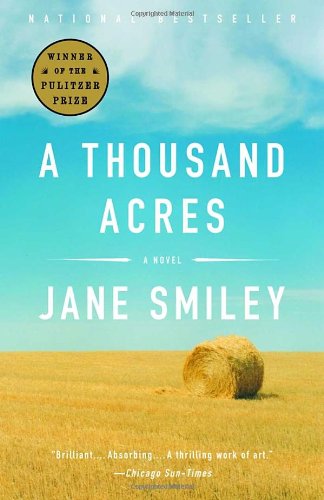
A Thousand Acres by Jane Smiley

Perhaps there is a distance that is the optimum distance for seeing one's father, farther than across the supper table or across the room, somewhere in the middle distance: he is dwarfed by trees or the sweep of a hill, but his features are still visible, his body language still distinct.  Well, that is a distance I never found.  He was never dwarfed by the landscape--the fields, the buildings, the white pine windbreak were as much my father as if he had grown them and shed them like a husk.

A Thousand Acres is the other Iowa book I read on my trip, though by the time I started it, we were driving through the red rock formations of southern Utah and it no longer made much sense.  Interestingly, it shares more with Marilynne Robinson's Home than just a setting.  Like Home, it is in part the story of a black sheep's homecoming, except Jess Clark isn't an alcoholic like Jack Boughton--worse, he's a draft dodger, and a vegetarian.  Like Home, A Thousand Acres is concerned with the difficulty of coming home again, and the way that putting things back together can be as disruptive as tearing them apart.

But where Home takes its literary archetypes from the Bible, A Thousand Acres is a straight up re-telling of King LearJess is the Edmund figure, come home to threaten his brother's inheritance, but the focus of the story is on Ginny, whose name is an echo of "Goneril."  The plot is set in motion when Ginny's father, like Lear, prematurely leaves his immense farm (the thousand acres of the title) to his three daughters, Ginny, Rose, and Caroline.  (Guess which one is which.)

I have said before that adapting Shakespeare is a dangerous move, because it's not likely that you're going to be able to do it better, and even when you do it well half the time the reader is simply reminded of how good Shakespeare is.  What makes A Thousand Acres work in spite of this is a simple tweak Smiley makes in the story: all of the "good" characters from Lear are bad, and the "bad" characters are good.  Ginny's father, Larry, is a cruel and inscrutable old man, who quickly realizes that he has given away his livelihood and responds by lashing out at everyone and driving around Iowa piss drunk.  He rediscovers his love for the distant Caroline only because her demurral of his offer means that she doesn't share in his resentment.  Ginny, on the other hand, does her best to please her tyrannical father, who responds with this parodic version of Lear's epic "Suspend thy purpose if thou didst intend / To make this creature fruitful" speech:

He leaned his face toward mine.  "You don't have to drive me around any more, or cook the goddamned breakfast or clean the goddamned house."  His voice modulated into a scream.  "Or tell me what I can do and what I can't do.  You barren whore!  I know all about you, you slut.  You've been creeping here and there all your life, making up to this one and that one.  But you're not really a woman, are you?  I don't know what you are, just a bitch, is all, just a dried-up whore bitch."

[Spoiler alert for this paragraph.]  This soliloquy hits especially hard because Ginny has tried and failed for years to have a child, suffering through multiple miscarriages, and her father's accusation that she is a slut becomes tragically ironic when Rose helps Ginny remember late in the novel that their father sexually assaulted them both as children.  The switched valences don't end there--even Ty, Ginny's husband and the Albany figure, is reimagined so that his sympathy with Lear is conceived as a kind pusillanimous avoidance of conflict, and a failure to support his wife in any meaningful way.

Smiley is no Robinson, and the writing itself is nothing to speak of, but the plot spirals out of control in an especially Shakespearean, and violent, way that was refreshing after the plodding pace of Home, which is mostly about people crying around a kitchen table.   I'm not sure, though, what a reader who wasn't familiar with Lear would get out of it--half the fun for me, or even most of it, was seeing the way that each of the characters was flipped. 

Monday, August 18, 2014

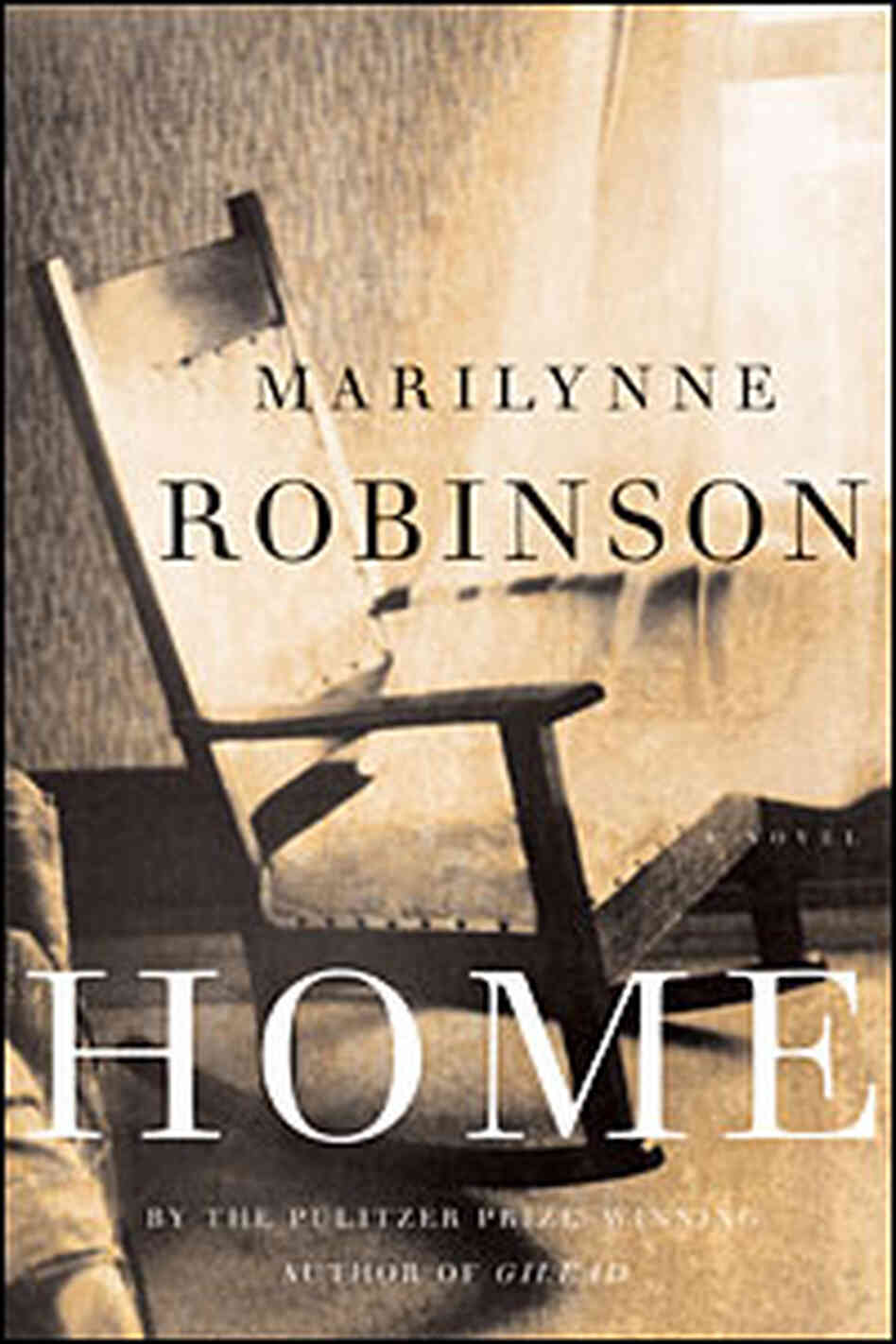
Home by Marilynne Robinson

What does it mean to come home?  Glory had always thought home would be a house less cluttered and ungainly than this one, in a town larger than Gilead, or a city, where someone would be her intimate friend and the father of her children, of whom she would have no more than three.  Then she could learn what her own tastes were, within the limits of their means, of course.  She would not take one stick of furniture from her father's house, since none of it would be comprehensible in those spare, sunlit rooms.  The walnut furbelows and carved draperies and pilasters, the inlaid urns and flowers.  Who had thought of putting actual feet on chairs and sideboards, actual paws and talons?

She had dreamed of a real home for herself and the babies, and the fiance, a home very different from this good and blessed and fustian and oppressive tabernacle of Boughton probity and kind intent.  She knew, she had known for years, that she would never open a door on that home, never cross that threshold, never scoop up a pretty child and set it on her hip and feel it lean into her breast and eye the world from her arms with the complacency of utter trust.  Ah well.

Until my recent road trip, I had never been to those corn-strewn centers of the American Heartland: Kansas, Nebraska, Iowa.  I decided that I would only take with me books that took place in those states that were new to me, to immerse myself in them twice over.  I brought Willa Cather's O Pioneers, which I did not read, and two books that take place in Iowa: Jane Smiley's A Thousand Acres and Marilynne Robinson's Home.  I was reading the latter when we drove through the southwest corner of Iowa on our way to Omaha from Kansas City.  We were there for only about five minutes before entering Nebraska.  Ah well.

Home tells the same story as Robinson's amazing novel, Gilead: Jack, the alcoholic black sheep of the Boughton family, comes home at last, carrying the burden of his estrangement from his wife in St. Louis, who is black.  But instead of telling the story through a first-person narrative, as with the Boughton's friend and neighbor Reverend Ames in Gilead, Home uses the third person, focused on Jack's sister Glory, who has herself recently "come home."  But Ames' voice and reflection were the strength of Gilead, and their absence drains the story of what was most appealing.  Glory, while sensitively and carefully rendered as a character, cannot make up the lack.

I'm not sure what the point of this novel is.   Gilead is the Abraham story, I suppose--the old man blessed with a child late in life, concerned with what kind of inheritance and legacy he will leave.  Home offers the prodigal son story that is ancillary in Gilead, the main focus instead of a B-plot.  And yet, outside of the (pretty vanilla) relationship between Jack and Glory, Home fails to offer any fresh viewpoint on what's already been told.  The most interesting gap in Gilead--the relationship between Jack and his wife in the racially charged St. Louis of the 1950's (sad to say that it seems not much has changed on that front)--remains a gap.

Robinson's writing is characteristically stellar, but the humble Heartland nature of the story bleeds into the prose, which is lacking in the kind of show-stopping pyrotechnics of Housekeeping and, to a lesser extent, Gilead.  Ultimately, however, it's a frustrating read, unsatisfying and unnecessary.  The good news is that Robinson's newest novel, which is about Reverend Ames' wife Lila, comes out in October.  Her character is so mysterious and lightly sketched in these novels that a whole book about her should be illuminating in the way that Home wants and fails to be.

Sunday, June 16, 2013

Gilead by Marilynne Robinson


For me writing has always felt like praying, even when I wasn't writing prayers, as I was often enough.  You feel that you are with someone.  I feel I am with you now, whatever that can mean, considering that you're only a little fellow now and when you're a man you might find these letters of no interest.  Or they might never reach you, for any of a number of reasons.  Well, but how deeply I regret any sadness you suffered and how grateful I am in anticipation of any good you have enjoyed.  That is to say, I pray for you.  And there's an intimacy in it.  That's the truth.

I actually read Gilead a few months ago, but then my roommate stole it before I could post on it.  In his defense, it's a good book to steal; as lyrically accomplished as Robinson's Housekeeping and even more emotionally affecting--affecting, in fact, in a way that few books written in the last half century seem to me.

The narrator of Gilead is John Ames, a minister in Iowa who is, he knows, in the final stages of his life, writing a last series of letters to his young son, the product of a marriage to a much younger woman.  These letters become an exploration of ideas that Ames knows he won't live to share with his son, an exploration of the nature of God as well as of his own history, his relationship with his wife, and his relationship with his father and grandfather, tracing his family history all the way back to the Civil War.  Like in Housekeeping, Robinson's prose is really something to marvel at, but writing from Ames' perspective forces Robinson to curtail some of her more baroque tendencies.  Yet somehow, that limitation strengthens the writing by giving it a colloquial groundedness:

I feel sometimes as if I were a child who opens its eyes on the world once and sees amazing things it will never know any names for and then has to close its eyes again.  I know that this is all mere apparition compared to what awaits us, but it is only lovelier for that.  There is a human beauty in it.  And I can't believe that, when we have all been changed and put on incorruptibility, we will forget our fantastic condition of mortality and impermanence, the great bright dream of procreating and perishing that meant the whole world to us.  In eternity this world will be Troy, I believe, and all that has passed here will be the epic of the universe, the ballad they sing in the streets.  Because I don't imagine any reality putting this one in the shade entirely, and I think piety forbids me to try.

There is something beautiful and audacious about calling life "the great bright dream of procreating and perishing," yet those words seem as if they come from Ames, and not from Robinson speaking through him, and that's a really difficult tightrope to cross.

Ames' project becomes troubled when Jack Boughton, the black-sheep son of his closest friend, returns home after a long absence.  Robinson cannily keeps the sins which Boughton is guilty of under wraps for most of the novel, instead focusing on the anxiety that overcomes Ames when he sees how close Boughton is becoming with his wife and son.  But Ames needs Boughton; his return allows him to confront his own believes about forgiveness, family, and love:

There is no justice in love, no proportion in it, and there need not be, because in any specific instance it is only a glimpse or a parable of an embracing, incomprehensible reality.  It makes no sense at all because it is the eternal breaking in on the temporal.  So how could it subordinate itself to cause or consequence?

I wish that my thoughts on this book were a little bit fresher, because looking through the pages I've dog-eared, I see any number of really striking, heartfelt passages like the one above that I'd like to talk about in relation to the novel as a whole.  But what I recall about it the most is that it resounds with a real sense of humanity--one that Housekeeping, though fantastic, often lacked.