Showing posts with label Denis Johnson. Show all posts

Friday, March 27, 2026

The Stars at Noon by Denis Johnson

I crossed the frontier from Costa Rica in the south, down from the cool hills, through the soggy checkpoints, and right into the factory of bugs in the towering grass this side of the border, bugs raining down through the air, a perpetual cloud of them overshadowing the Lago de Nicaragua so that they cake, absolutely putty--I'm talking about bugs--all these leprous diesel-spewing vehicles trying to crawl through the choking deluge... I don't know at what point, maybe it's as you pass the second or third miserable sugar refinery looking like a prison, that you realize you've been ejected from Paradise. And whatever these stunned, drenched people did to get themselves banished here is an absolute mystery. Like your own mortal error...

The narrator of Denis Johnson's The Stars at Noon is an American in Nicaragua during the time of the conflict between the ruling Sandinistas and the U.S.-backed contras. She claims at one point to be connected to an organization called for "Eyes for Peace," and at another point to be a journalist, though when she calls her publication, it seems to be a two-bit fashion magazine that has no interest in Nicaragua, or, frankly, her. Professionally, the most that can be said about her for certain is that she is a prostitute, picking up various men for favors or money. One of these is a pasty Englishman who turns out to be in a lot of hot water for divulging oil business secrets to a neighboring government. In an uncharacteristic fit of empathy, and perhaps because she has fallen for him in a way that only makes sense as the exception that proves the rule of her own hardened heart, she seeks to help him, but she's a poor helper, being in hot water herself: she desperately needs someone to exchange her Nicaraguan money for U.S. dollars, the only currency that can pay for a way out of Nicaragua.

Johnson once said something to the effect of, "I am Graham Greene" (I dunno, look it up), a sentiment that makes little sense of all you've read of him are Angels or Jesus' Son. But this book really is Johnson in Greene mode, a la The Laughing Monsters or the Vietnam sections of Tree of Smoke, thick in the middle of a foreign crisis where intelligence is always shifting and any given person may be an ally or an enemy. Johnson is really good in this mode, and his books capture something of the inherent uncertainty of espionage, where nothing is ever truly revealed and even your own motivations are somehow concealed. The pair of lovers in The Stars at Noon are really fucked, because neither of them knows what they are doing, and any shrewdness or spark of insight they exhibit pales, we see, in comparison to the forces that wish to punish the Englishman for his corporate transgressions. I was reminded not only of Greene but of another writer who wrote about Americans adrift in banana republics, Joan Didion.

The Stars at Noon is no Tree of Smoke, and I thought it wasn't quite a Laughing Monsters, either, but it succeeds on the strength of the voice of the main character: bitter, desperate, sarcastic, fatalistic. We never really learn what it is she's doing there or how she got there, but it's easy to buy her as a two-bit schemer whose guile conceals a fundamental waywardness. The central romance, if that's what it is, works because it seems so improbable, and the two are so ill-matched; the Englishman (as he's called) is as reserved and buttoned-up as she is uncouth. Somehow they seem to complement each other, and not just because they are both in desperate straits. The novel moves from Managua to the pair's attempt to escape to the Costa Rican border, and it seems they know as well as the reader does that they are only hurtling toward their own doom. Johnson's Nicaragua is a chaotic mess, a literal hell as the narrator describes it, but as a failed state it seems only to match the inner life of the narrator.

Saturday, August 30, 2025

The Name of the World by Denis Johnson

What brought Flower Cannon to mind right then I don't know, but I have to say that the passing parade put my recent experiences with her into a kind of perspective. The experiences were mostly about seeing her, laying eyes on her--not about hearing her words, certainly not about touching her. And now I think this narrative might cohere, if I ask you to fix it with this vision: luminous images, summoned and dismissed in a flowing vagueness. The difference being that I didn't take Flower for a message, but a ghost, the ghost of my daughter--yes, and for a while  she came and went in the flow of events like my Elsie in the silent cataract of memory.

Michael Reed is an academic at one of those huge frosty schools in the American Midwest. His life is, as for all academics, fairly banal, except that he's haunted by the death of his wife and daughter in a car crash several years back. Wherever he goes, he seems to confront symbols of his own life in the wake of their death: the painting in the art gallery that makes concentric shapes, each one becoming more perverse; the students ice-skating around the unreachable monolith on the campus rink. Reed's life is like that, moving around the fundamental absence of his family, never able to break free and form a new trajectory. In his final year at the college, he becomes obsessed with a beautiful red-headed cellist who may offer him the key to a way of living again.

Written plainly, it sounds like an eye-roller: middle-aged academic finds new life in an affair with a beautiful young student. It's what BlueSky Y.A. mavens think all "classic" fiction is like. And there are some elements of that, in fact. Yet, Michael and the absurdly named Flower Cannon never sleep together, though he does see her naked twice: once, in an artsy "performance piece" where she shaves her mons pubis, and again in a racy strip contest at a local casino. (The satire on the academy and modern art that juxtaposition makes isn't exactly subtle.) But more interesting still is the slippage of Michael's attitude toward Flower, who reminds him at times of his wife, at other times his daughter, or someone he would have liked his daughter to grow up into. The Y.A. mavens might object at how available Flower is to the older, homely (self-described) Michael, and how easily Johnson associates her sexiness with mystery and healing. But I was really struck by the strange story that Flower tells about why she's so open to Michael hanging around, in which she tells him that he reminds her of a strange man who kidnapped her when she was young. It's so weird and difficult to integrate into the novel that it seemed like an acknowledgement that Flower Cannon is no archetype but a person with a strange and luminous life of her own.

This felt like a strange sort of novel for Johnson. His work, it seems to me, often focuses on precarity: the precarious lives of the poor and addicted, or the precarity of spies whose are always gambling with their life or safety. His characters always seem to live well outside the margins of ordinary society--a description that might even take in the post-apocalyptic strivers of Fiskadoro or the rustic hermit of Train Dreams. Compared to the protagonists of those other novels, Michael Reed is frustratingly ordinary, and it's possible to read The Name of the World as a novel by a guy who got so comfortable in the world of academia that he found himself detached from the worlds he once thought important to put down on the page. (OK, I guess being an academic is also quite precarious these days, but that isn't quite what I mean, either.) But Johnson writes about grief in ways that feel devastating and true, and quite different than the ordinary bromides one gets, and so in that way The Name of the World is a reminder of the ways that deep interior experiences, too, can put us outside the common life. And of course, with Johnson there are always the sentences, the incredible sentences.

Wednesday, March 20, 2024

The Largesse of the Sea Maiden by Denis Johnson

Writing. It's easy work. The equipment isn't expensive, and you can pursue this occupation everywhere. You make your own hours, mess around the house in your pajamas, listening to jazz recordings and sipping coffee while another day makes its escape. You don't have to be high-functioning or even, for the most part, functioning at all. If I could drink liquor without being drunk all the time, I'd certainly drink enough to be drunk half the time, and production wouldn't suffer. I've gone from rags to riches and back again, and more than once. Whatever happens to you, you put it on a page, work it into a shape, cast it in a light. It's not much different, really, from filming a parade of clouds across the sky and calling it a movie--although it has to be admitted that the clouds can descend, take you up, carry you to all kinds of places, some of them terrible, and you don't get back where you came from for years and years.

There's a moment in Denis Johnson's collection The Largesse of the Sea Maiden that stopped me cold. At the end of "Triumph Over the Grave," an elegiac story in which the narrator reminisces on the decline and death of two friends, he writes: "It doesn't matter. The world keeps turning. It's plain to you that at the time I write this, I'm not dead. But maybe by the time you read it." I nearly set the book down and cried. Famously, Johnson completed Largesse right before his death at age 67; I think it may have even come out just after he died. Johnson must not have imagined when he wrote those words that the maybe would become a certainty so soon, or perhaps he did: the word "maybe" contains so many possibilities. But it's hard not to read these words, too, and feel the loss of other possibilities, of many years of incredible literature, and the life of, by all accounts, a humane teacher and good man.

"Triumph Over the Grave" is my favorite of the five long-ish stories in Largesse of the Sea Maiden. It has a nested structure that makes its true core elusive. Two deaths, two griefs, framed one within the other. One, a talented writer and teacher wasting away on a Texas ranch; the visits from his sister and brother-in-law, long dead, turn out to be emanations of the brain cancer he doesn't know he has. The other a friend whose wife, long since remarried, has succumbed to dementia, and whose now-husband drives her to see him on his deathbed. (Both of these stories, in fact, are framed with the shocking news of another, third death, which it seems, is too fresh a grief to be part of the story--only, perhaps, its instigation.) The diers in "Triumph Over the Grave" take a long time dying. When does it begin, one wonders? The writer, does his death begin when the first cell mis-multiplies, unknown and unseen within the body? Or is it when he retreats to the ranch, isolated from the world? Or is it when he sees these visions of his dead family that show he has one foot in the grave? Does the other man's ex keep him alive, having regressed in her mind to a point of life before the point of decay? Or is her forgetting, too, a kind of death, an obliteration of so many years? Whatever else, "Triumph" offers that final line, which is no less true and necessary because it is so often said: "The world keeps turning." The maybe happens to us all.

"Triumph" is followed by "Doppelganger, Poltergeist," which you might call the collection's "showstopper." In it, a brilliant poet becomes obsessed with a theory that Jesse, the twin brother of Elvis Presley who supposedly died at birth, in fact was sold to a midwife, who later schemed with Colonel Parker to murder Elvis and replace him with Jesse. The story is not so much about the theory but the poet's obsession with it; he's even arrested for digging up baby Jesse's grave. The story is narrated from the perspective of the poet's former teacher, a half-talented academic who becomes the poet's confessor. The theory, we come to find out, was actually--stay with me here--the poet's brother's who died, a brother who himself had a twin who died in childbirth like Presley. There's your doubles, your doppelgangers, your poltergeists. The narrator has his double in the professorial figure who haunts the poet's poems, a figure given the name of the dead twin.

It's all very complicated, as a good doppelganger story should be. A good doppelganger story never has just one doppelganger; it's always sensitive to the way that a double can divide again, like mitosis. It's sensitive to the way that things are never repeated only once. On top of everything else, it's a 9/11 story, and contains perhaps the best description of the towers falling I've ever seen in literature. The obvious connection--twins, twin towers--is lost on our narrator until the poet makes it. More richly, the little griefs are reduplicated as big griefs; worlds are shaken on every scale. Elvis arrives to a kindly farm couple to let them know he has seen their aunt Gladys in Paradise. This, to the poet, proves that Elvis had already died when he was supposed to be alive, but perhaps we can be haunted by our futures as well as our pasts.

Jesus's Son gave Johnson a reputation as a writer of the down-and-out. Two stories here make good on that legacy. The first is "Starlight on Idaho," an epistolary story that takes the form of a collection of letters from a man enduring rehab in a former motel in California. (The Starlight Motel--you know, on Idaho Street.) The voice here, rattled and ranting, desperate but determined, is one of the book's many victories. The other, "Strangler Bob," actually brings back one of the characters from Jesus' Son, Dundun, this time as a prisoner in a jail of violent and mercurial figures. This story--perhaps because it has a little too much going on--struck me as the weakest of the five. 

But for the most part, The Largesse of the Sea Maiden is a book not about the down-and-out, but the up-and-in, or at least the moderately successful. The middle-aged academic of "Doppelganger," who admits abashedly that he dreams of tenure at his small Midwestern college, the lightly famous writer of "Triumph"; these are people with comfortable lives. One wonders if they are versions of Johnson himself, having become himself a widely regarded writer and teacher, and having (to my understanding) left youthful vagaries behind. "Doppelganger" isn't really about the tortured genius of the poet; it's about the narrator's comfortable mediocrity, which itself is a kind of torture. The first and title story, too, is about an ad man living a life of relative comfort and ease. It's a funny story, arranged as a series of short flash pieces, without what I'd call a clear through line. But even the most comfortable and ordinary man is prone to fantastic dreams, some of which come true:

Once in a while I lie there, as the television runs, and I read something wild and ancient from one of several collections of folk tales that I own. Apples that summon sea maidens, eggs that fulfill any wish, and pears that make people grow long noses that fall off again. Then sometimes I get up and don my robe and go out into our quiet neighborhood looking for a magic thread, a magic sword, a magic horse.

Sunday, August 20, 2023

Train Dreams by Denis Johnson

And three years later still, he lived in his second cabin, precisely where the old one had stood. Now he slept soundly through the nights, and often he dreamed of trains, and often of one particular train: He was on it; he could smell the coal smoke; a world went by. And then he was standing in that world as the sound of the train died away. A frail familiarity in these scenes hinted to him that they came from his childhood. Sometimes he woke to hear the sound of the Spokane International fading up the valley and realized he'd been hearing the locomotive as he dreamed.

Robert Grainier is, for all purposes, born on a train: he arrives at his aunt's home in Idaho on a train as a child from some place he cannot remember. He is a man of the New West, without a birthplace or history, and he aids the railroad in opening up the West by cutting down trees and laying track. When he's not working on the railroad he takes a job as a delivery driver, crossing over the backwoods tracks of Idaho's panhandle and western Montana. But he also has in him that spirit of the Old West, which is not marked by the march toward civilization and industry but a place where one goes to be alone: for much of the year he subsists alone in a cabin he built himself in a deep wooded valley, a cabin situated in the very spot where his wife and newborn died in a wildfire.

To me, Denis Johnson's Train Dreams is about the contradictions of the American west and its opening in the late 19th and early 20th centuries. Grainier, when the whole of his life is laid out, lives through a grand transition, beginning life on a train in the wilderness and, later, seeing Elvis Presley performing on a train. Train Dreams is funnily meandering for a novella, passing from incident to incident, simultaneously grotesque and humorous, like the time he serves as an ambulance for a man who was shot by his dog. (How did it happen? Well, he tried to shoot the dog instead, but the dog got the better of him.) Or the story of Grainier's friend Kootenai Bob, who's given alcohol for the first time in his life and ends up so obliterated by a (heavily symbolic) train it takes his people weeks to find and ritually bury all the pieces.

But the through-line that keeps the novella grounded is the untimely death of Grainier's wife and child, who try fruitlessly to escape the wildfire in Grainier's absence. Their disappearance haunts Grainier, who wants to believe against odds that they might have found safety, but his wife appears to him in a dream, or perhaps as a kind of spirit, and shows him her death, but Grainier stays by the cabin out of a belief that the newborn Kate might somehow have survived. And he's right, in a way: Kate has been transformed into a half-woman half-wolf who visits Grainier's cabin one day with her pack, and though Grainier wishes profoundly that he could recover her, or perhaps domesticate her like his dog, her life can only intersect his at this single and infrequent point. Kate is a symbol, perhaps, of a return to wildness, the dream that people brought with them on the railroads and which was obliterated by the railroads.

Is it crazy to say that I didn't think Train Dreams reaches the heights of Johnson's best books, like Jesus's Son, Angels, and Tree of Smoke? Mostly because those books are so great, and their achievements are hard to equal, especially in a small and minor-seeming novella like this one. There's something intentionally and ironically understated about Train Dreams, I think, that subverts our expectations about the great epics of the West. It's a small book about a small life, but a life haunted, as many of us small people are, by the greatness of the country at our back door.

Wednesday, August 10, 2022

Fiskadoro by Denis Johnson

Being different from other men sometimes sent him walking far down the beach, down among the huge green flies and the stink that rose off the garbage pit and the hooting gulls that never seemed to mind the stink or eat any of the flies. Belinda's ashes would be thrown away here after her body was burned.

The gulls argued with him as he came too close to their nests in the weedy sand near the pit. They rose in flocks, their shadows whirling all around him on the beach. Farther upshore he always saw them walking in little groups, ignoring each other, wise and smug, looking at nothing. They reminded him of Mr. Cheung.

More than once he saw others here, also different from other men: ghosts who had appeared out to sea--from the shipwrecks, from the End of the World, from the plagues, from the cold time, from the kill-me--drowned sailors and frozen children, young maidens bleeding down their legs, sick old men and women and cancer-wasted fishwives who seems to wander hopelessly near the place of their burning; but all of them were smiling and no longer touched with pain.

Some decades ago we all thought the end of the world would be quick. A bomb would go off, and the explosion, or its immediate aftermath, would split time into a before and an after. We don't think about the apocalypse much in these terms anymore, because our possible apocalypses have been replaced with a near-certain one, one which will be slow coming. Though it will be no less transformative, it will be leisurely enough to allow some of us to ignore it. And yet the threat of the other kind of apocalypse may be no less real than it used to be, certainly no less than in 1985, when Denis Johnson wrote the post-nuclear apocalypse novel Fiskadoro.

Society in Fiskadoro, such as it is, clings to the Florida Keys. In Miami, ashy skeletons are still sitting in their cars, but Key West, now called Twicetown because the two bombs that fell on it both proved to be duds, is a thriving center of what one might call enterprise. People's shanties are cobbled together from whatever they can find, from carseats and old church pews, and what work there is seems to mostly be limited to subsistence fishing boats. Many people speak a kind of Spanish-English patois that makes the book seem like the closest thing out there to Riddley Walker. Civilization may have survived in its more developed forms in Cuba; the citizens of Twicetown get Cuban radio stations. Into this life Fiskadoro is born, a son of an ordinary fisherman, who cries when his father is killed and who wants Anthony Cheung, who plays with the Miami Symphony Orchestra--a ragtag group of amateur musicians who have appropriated the name in a gesture of desperation for civilization--to teach him out to play the clarinet.

Fiskadoro is a book about remembering and forgetting. Mr. Cheung and his associates gather weekly to be read to from the few books that remain, including a child's book on dinosaurs and, apparently, The Sun Also Rises. They grasp after the knowledge that will keep them connected to a past which has disappeared, but the knowledge itself is partial and flimsy: "The dinosaur tracks in England all went west to east," Mr. Cheung recounts. But "[by] what light was this fact called 'knowledge'? Wasn't it just one more inexplicable thing to mystify them, didn't it subtract from what they knew rather than add to it?" When the society barters for a book about the bombing of Nagasaki, a book which can at last tell them how they got to where they are, the reading causes consternation and disbelief, even a vague conviction that reading it alone has brought the hurricane that rages outside--to know about apocalypse is to invite it again. Mr. Cheung's Grandmother Wright is one of the few people who can truly remember the "before" times; she spends much of her day reminiscing privately about her experiences as a girl during the Fall of Saigon and her escape by helicopter--a set of carefully drawn memories which seem as if they were lifted out of another of Johnson's novels, like Tree of Smoke.

But if Grandma Wright is the past and Mr. Cheung a baffled, uneasy present, Fiskadoro is the future. One day he wanders off from his home on the old Key West army base and is taken in by a group of "swamp-men" who practice a form of Islam and believe Fiskadoro to possess the soul of another teenager who drowned. They inflict on him a ritual circumcision--which they call a "subincision," and which he must do himself, with a sharpened rock--that leaves him without the ability to generate new memories. When he returns to Twicetown, he remembers no one, but he has become an expert clarinetist: "He has forgotten how not to play," Mr. Cheung notes. Fiskadoro represents a hope for the future that lies in forgetting the past; unlike Mr. Cheung, he has unshackled himself from the need to know what has happened before:

He'd been assured by Martin and Martin's companion Sammy that Fiskadoro's memory would come back to him in a while--though they didn't seem to think he'd ever remember his past--but, for now, each time the boy witnessed the sunrise he saw it for the first time.

There was something to be envied in that. In a world where nothing was familiar, everything was new. And if you can't recall the previous steps in your journey, won't you assume you've just been standing still? If you can't remember living yesterday, then isn't your life only one day long?

The thought gives Mr. Cheung panic, but the novel suggests that there is a kind of hopefulness in the innocence of Fiskadoro. A belief, perhaps, that saving the world lies not in remembering the past, Santayana-like, but in forgetting it, and embracing the eternal present. In this light, one begins to see the cobbled-together, resourceful nature of the society that has grown up around Fiskadoro as something beautiful. The novel ends with an image of great ambiguity: a white shape on the horizon that may be a ship from Cuba coming to "save" them, or perhaps even another explosion, marking a new kind of destruction. But Fiskadoro suggests that whatever happens, it won't be another line in the sand that divides the before from the after, but another turn in a constant renewing.

Tuesday, February 2, 2021

The Laughing Monsters by Denis Johnson

True or false, what does it matter? Michael's truth lives only in the myth. In the facts and the details, it dies.

And while you, my superiors, may think I've come to join him in Africa because you dispatched me here, you're mistaken. I've come back because I love the mess. Anarchy. Madness. Things falling apart. Michael only makes my excuse for returning.

And if he thinks I'd like an army and a harem, Michael mistakes me too. I don't want to live like a king--I just want to live. I can't make it happen by myself. I've got all the ingredients, but I need a wizard to stir the cauldron. I need Michael.

"Since nine-eleven," a U.S. naval officer tells Roland Nair, who has been captured by the Lord's Resistance Army in the Congo and ransomed, more or less, by the United States, "chasing myths and fairy tales has turned into a serious business. An industry. A lucrative one." It's an idea that's obvious enough: just imagine Colin Powell, standing before the United Nations and spinning a myth, a fairy tale, about weapons of mass destruction. It would be too much to say the world went crazy, because it always has been, or to say that myths and fairy tales took control of the world after 9/11; they always have been in control. But there's something canny in Johnson's observation here, something about the way that mythmaking became a way of focusing the enormous powers of the intelligence and military leviathans, and a funnel for lots and lots of money.

Nair, the narrator of The Laughing Monsters, has returned to Freetown, Sierra Leone on assignment for NATO looking for an old friend, a Congolese named Michael Adriko. Michael--affable, garrulous--and Nair--cynical and sour--have a long history stretching back to Afghanistan. On the surface, it seems that Nair is meant to spy on Michael, but Michael is a charismatic actor who charms and spellbinds nearly everyone, including--perhaps most of all--his old friend. When Nair agrees to partner with Michael in a harebrained scheme to sell the location of a non-existent cache of fissionable uranium to the Mossad, is he planning on snitching, or is NATO the mark? You get the sense that Nair doesn't really know, and that like Schrodinger's cat, the truth will be revealed when the box is open, even the truth about his own intentions and motivations. The one thing that is clear is that Nair's attachment to Michael is more than mercenary, and so is his attachment to Michael's American fiancee Davidia St. Claire.

I made these connections in my review of Johnson's epic Tree of Smoke, but I see Graham Greene's fingerprints all over The Laughing Monsters. If Tree of Smoke is Johnson's The Quiet American, The Laughing Monsters is his The Heart of the Matter. Like Greene, Johnson understands spycraft as something perpetrated not by nations but by people, whose loyalties are as liquid as their desires. And like Greene, for Johnson's spies there is always a layer of knowledge that remains inaccessible, another shoe left to drop. "More will be revealed," Michael says about his vague plan to cross the Ugandan border into the Congo, but what is revealed is only more confusion, a chaotic descent into the African bush where even the native Michael is a stranger. Like I said that Tree of Smoke review, Johnson is like DeLillo in this way: intelligence always ends up being self-referential, the spies end up unraveling spycraft itself, a recursion that has no bottom. And of course Michael, Nair, and Davidia's journey into inland Africa is a revision of Heart of Darkness.

Throughout the novel, Johnson's wonderful sense of moment and detail, sputtering like a half-dead lamp, illuminates:

Now a beggar dressed in rags came out of the dark and wrote swiftly on the floor with white chalk: MR. PHILO KRON / DR. OF ACROBATICS. He started doing cartwheels in place while holding a platter of raw rice, never spilling a grain. He repeated the trick, now holding a glass of water, also without spilling.

The staff, the patrons, everybody ignored him, but Davidia said, "Michael, give him something."

Michael only offered him a scowl and said, "Don't encourage these people."

Davidia smiled and met the acrobat's eyes, or one of his eyes--the other's socket was scarred and pinched shut--and this inspired him to talk, or to signal his thoughts by a series of squeaks, as he seemed to be missing, also, one of his vocal cords. "Sometimes it's feeling like the Prophet was just here," he told Davidia, kneeling before her, touching her hand, trembling with the intensity of his message, "the Prophet himself, on that spot, and he went around the corner of the building there, and see, there, the dust still stirred up by the motion of his garments." Satisfied with that, Dr. Kron took himself and his piece of chalk back into the night, and one of our waiters came quickly with a rag and wiped away his title and his name.

Isn't that wonderful? As Nair gets further and further involved with Michael's schemes, the possibility of being cut off from everything becomes greater and greater, the possibility of breaking off from NATO, from the US, from Denmark, in whose army Nair seems to be a captain, from the vast intelligence networks that cross Africa like a net and which are waiting to be exposed at the right price. The possibility of complete self-erasure, like Dr. Kron, and becoming the fake name on the cheap Ghanaian passport. After 9/11, can you really disappear? Can you become a myth or a fairy tale?

Sunday, June 14, 2020

Nobody Move by Denis Johnson

He put his fingers around the phone in his lap. The phone slipped away with a clatter that echoed in the concrete cylinder, and he let himself collapse toward it. He had his mouth by the phone. He had a finger on the button. He needed to make his finger press it. He couldn't make it happen.

No problem. If he could keep his eyes open, he wasn't dead. Lying on his belly he stared at the red spectacle of his life as it traveled past his face and headed away from him through the dust. That's all he needed to do now. He needed to keep seeing his blood.

Jimmy Luntz is competing with his barbershop chorus in the city of Alhambra outside Los Angeles when Gambol, a stooge working for a man who holds Luntz's gambling debts, picks him up and drives him far out of town. The plan is to break one of his legs or arms but in the woods seven hours north Luntz manages to overtake Gambol and shoot him in the leg. While tossing the gun into a river, he encounters Anita Desilvera, a woman who's recently been framed by her husband and a corrupt judge for embezzling two million dollars. The pair gravitate toward each other, both on the run, and together they might be able to make off with the stolen money and escape from Gambol and his associates.

Nobody Move is a love letter to the hard-boiled fiction of Raymond Chandler and Dashiell Hammett. The prose is brisk and filled with quips, and the story is violent: one of the best moments comes when Anita rips out the wheelchair-bound judge's colostomy bag and hits him in the face with it. (In case you're wondering, it does, in fact, burst.) To me, it was most reminiscent of No Country for Old Men, a book about ordinary people whose mixup with criminal elements thrusts them into a race against time, against violence, and for a great deal of money, and which is equally indebted to Chandler and Hammett. And like No Country for Old Men, I only had an approximate sense of the causality behind the various twists and turns. To his credit, Johnson knows that sometimes even hapless Luntzes get the better of wizened criminals like Gambol; violence is difficult to control and luck more likely to run out than remain.

The main thing a book like this has to do is be fun, and it is. It just zips by; I read the whole thing yesterday. But the pared-down prose robs you of some of the expected joys of reading a Denis Johnson book, and I liked the novel best when there were flashes of Johnsonian weirdness, as when Anita--having, spoiler alert, just killed her husband--sees his apparition copying her movements across a river. Or the fact that one of the goons is, without explanation, called "the Tall Man" for pages before you find out he's five-foot-eight.

The thing that connects it best to books like Angels or Jesus' Son is that it's about a couple of real down and out losers. Luntz is a loser because he has a gambling addict (and a member of a barbershop chorus), and Anita is made a loser by her husband (although she's also clearly an alcoholic), but Nobody Move is driven by the tantalizingly equivalent possibilities that they'll make off with a million dollars or be unceremoniously shot. You might even read the title, which might as well be the title of an Elmore Leonard novel, as a subtle hint at the explosive possibilities of crime to punish and reward.

Saturday, May 11, 2019

Angels by Denis Johnson

She looked up out of her voice and saw the angel.

He will have ears like a cartoon of organic growth.  He is yellow with light but covered with mobile shadows, animated tattoos.  His face kept changing.  His voice will come from far off, like a train's.  His body is steady and beautiful and hairless, the wings white, incinerating, and pure, but the head changes rapidly--the head of an eagle, a goat, an insect, a mouse, a sheep with spiraling horns that turn and lengthen almost imperceptibly--and the entire message had no words.  The entire message will be only the beat and direction of time.  Yes is Now.

The angel who says, "It's time."

"Is it time?" she asked.  "Does it hurt?"  He will have the most beautiful face she has ever seen.

"Oh, babe."  The angel starts to cry.  "You can't imagine," he says.

Angels begins on a cross-country Greyhound bus.  There, Jamie Mays is traveling with her two young children, away from her husband.  She is desperate, confused, and alone; she has thoughts like this one: "She wished she could smother the baby.  Nobody would know.  They were four days out of Oakland."  On the bus she meets Bill Houston, who has beer enough to share, and over the course of several days they are drawn together.  It's not exactly sweet--it's their willingness to ply their pain with chemicals that brings them together, at least in part--but the connection is genuine.  They part ways, but she goes seeking him in Chicago, only to be raped by a would-be Good Samaritan.  It's his reading about the paper that puts them back together, and cements their relationship to one another.  The rape itself is ghoulish and macabre, facilitated with drugs and written accordingly, but Johnson writes about its role in their relationship with cold-blooded clarity:

They started calling it The Rape, and it came to stand for everything: for coming together while falling apart; for loving each other and hating everybody else; for moving at a breakneck speed while getting nowhere; for freezing in the streets and melting in the rooms of love.  The Rape was major and useless, like a knife stuck in the middle of things.  They could hate it and arrange their picture of themselves around it.

Bill pulls Jamie back across the country, to Phoenix, where he grew up.  They connect with his brothers, James and Burris, each of them tied up with petty criminality and chemical abuse to different degrees, like Bill.  These characters are familiar from Tree of Smoke, where Bill and James are terrorized by their army service and Burris is just a kid developing the drug habit that will be his albatross in Angels.  Tree of Smoke is the later book, a prequel to this one in a way, it reads like a natural sequel.  Those who read the two novels in the other order probably read Tree of Smoke with additional foreboding, knowing where Bill Houston's tragic life is headed.  Back in Phoenix, the three brothers get involved in a scheme to rob a bank at gunpoint.

Things go wrong.  I'm going to mention exactly how they go wrong, so consider yourself appropriately warned.  A bank guard, shooting at James, is himself shot to death by Bill.  All three brothers are arrested, and Bill is tried and sentenced to execution.  At the same time, Jamie, perhaps pushed over the edge by Bill's predicament, is admitted to a mental hospital.  The pair, who were seemingly driven together by fate, are ripped apart for the book's final third by two very different forms of incarceration.  Johnson's account of Bill's trial and his time on Death Row is one of the most desperate and heartbreaking pieces of writing I can think of, rendered in a kind of hallucinatory realism that reliably describes how strange and unbelievable it must be:

He watched his trial from behind a wall of magic, considering with amazement how pulling the trigger had been hardly different--only a jot of strength, a quarter second's exertion--from not pulling the trigger.  And yet it had unharnessed all of this, these men in their beautiful suits, their gold watches smoldering on their tanned wrists, speaking with great seriousness sometimes, joking with one another sometimes, gently cradling their sheafs of paper covered with all the reasons for what was going on here.  And it had made a great space of nothing where Roger Crowell the bank guard had been expecting to have a life--a silence that took up most of Bill Houston's hearing.  It was a word that couldn't be spoken, because nobody knew what it might have said.

Johnson, better than maybe any writer, seems to understand people like Bill Houston: people who can't get ahead, whose poverty is endemic, who devote themselves to alcohol and opioids, who turn to petty crime, and even not-so-petty crime.  He doesn't gild them; they're not good people just trying to make it in this crazy world.  Most of them are fairly bad people.  But lots of people are bad people; they're just not so easy to get rid of--you can't ignore them or ship them off to the gas chamber.  They are invisible in this novel, the people whom Bill calls "the outraged owners of the establishment... [t]he bankers, the people with tie-pins and jeweled letter openers and profoundly lustrous desks of mahogany, the workers of all this machinery of law and circumstance."  He calls them "[t]he people he couldn't fight--the people who were never here."  Bill Houston, toward the end of the novel, gets to make a few gestures of selflessness, but they're no more than prayers.  When are "the people who were never here" to make their own contritions?

Angels is terrific.  It's a shame to think I probably won't be able to put it on my year-end list, because I try not to include more than one author, but it's close to the masterpiece that is Tree of Smoke. It begins shamblingly, with buses crossing the country and back again with no clear destination, and ends with the knife-edged inevitability of what seems like doom.  It left me with a feeling of profound, gut-rocking sadness.

Wednesday, January 2, 2019

Tree of Smoke by Denis Johnson

...Kathy reflected, certainly not for the first time, that the war hadn't been only and exclusively terrible.  It had delivered a sense, at first dreadful, eventually intoxicating, that something wild, magical, stunning might come from the next moment, death itself might erupt from the fabric of this very breath, unmasked as a friend...

Why did the U.S. bother itself in Vietnam?  Tens of thousands of Americans dead, ten times as many Vietnamese, the great waste of life and money and time, for what?  To say that it was to stem the tide of Communism sounds right in a high school history sort of way, and the protagonist of Tree of Smoke, CIA op William "Skip" Sands, sure seems keen on beating Communism.  But the line between the ideology and the great material fact of war seems to have a gap in it somewhere, not at all like the great war of the previous generation.  Tree of Smoke is a novel that presents the Vietnam War as a kind of immense fever dream, not just in the confusion of the jungle, but in the bungled ethos of the war itself.

At first, Tree of Smoke seems like a loving homage to Graham Greene.  Kathy Jones, a Canadian missionary, makes the allusion explicit by comparing Skip, masquerading in the Philippines as a corporate stooge for Del Monte, to the Quiet American.  Skip bristles at the comparison, his motives are not so rigid and his methods, he'd like to think, not so brash.  Skip is part of CIA's Psy Ops--psychological operations, that is--under the tutelage of his uncle, Colonel F. X. Sands.

The Colonel is a living legend, a former POW and war hero who has developed unconventional ideas about how to wage war.  "War is ninety percent myth anyway, isn't it?" he says.  "In order to prosecute our own wars we raise them to the level of human sacrifice, don't we, and we constantly invoke our God.  It's got to be about something bigger than dying, or we'd all turn deserter."  The Colonel advocates complete immersion into local culture and turning myth, "the other fellow's gods," into a psychological tool.  He also advocates a philosophical separation from the CIA chain of command, with predictably problematic results.  For the Colonel, myth and mystery, enemies of clarity, are the only way to wage war:

He woke from an hour's nap and went to the veranda to drink hot, strong coffee less reviving than his thrilling vertigo before the vista of his mistakes, all the wrongness he'd wandered into on the tails of his uncle, the aboriginal Man of Action.  Neanderthal, had been Rick Voss's term.  Mr. Tho came out with a burning mosquito coil in a dish and set it on the arm of the opposite chair, and there you are, simplicity itself, the ember of the foul-smelling incense bead, orange bead tunneling along its spiral path toward extinction and nonentity.  He felt surrounded, assailed, inhabited by such serpentine imagery--the tunnels, Project Labyrinth, the curling catacombs of the human ear... But over all loomed the central and quite different image: the Tree of Smoke.  Yes, his uncle meant to unfold himself like a dark wraith and take on the whole Intelligence service, the very way of it, subvert its unturnable tides.  Or assault it on the handball court.

The Greene pastiche halts early on; the whiskey priest-figure, a Catholic gun-runner for the Communists, is murdered by a blowgun.  If Skip is assigned to keep tabs on the priest, who kills him and why?  Another faction of the CIA?  The Filipinos?  Like Greene, Johnson's warriors are self-defeating, but it's not at all clear that what happens is a mistake rather than a grand mystery.  Johnson's language, with its touches of Beatnik mysticism and high prophecy, are far from Greene's deflating realism.

All of that is prologue.  When the action moves to Vietnam, things get worse and worse.  The project that the Colonel has Sands working on--cultivating a double agent to infiltrate the North Vietnamese--never really gets off the ground, which is impressive in a book that stretches to 700 pages.  It blows up, the Colonel dies under mysterious circumstances, but becomes a kind of myth himself, rumored to have let himself be captured in order to promulgate false info to the Viet Cong.  What info?  Does it matter?  As one character says, "I'd venture the truth is in the legend."  In a different book, that would be a platitude.

Tree of Smoke fills out its considerable bulk with several minor characters.  Besides the Colonel, Skip, and Kathy Jones, there's Bill and James Houston, a pair of down-and-out Arizona brothers who bring the desolation of their lives to the jungle and then bring the madness of the jungle back to Arizona.  Both are petty criminals, frightened children, irresponsible addicts, and while Tree of Smoke doesn't argue that Vietnam ruined them--they were pretty fucked up in the first place--it does want us to see that the war provides no better way.  Johnson, with his loving attention toward junkies and lowlifes, refuses to give us a Vietnam novel without the grunts.  Their connection to the main narrative is tenuous, but they remind us that the Colonel's spooky mythologizing engenders true violence.  But neither does Johnson ignore the Vietnamese: several locals, all of whom are mixed up with the Colonel's double agent scheme, get their turn in the narrative.  And while not all of these are worthwhile (I didn't need to linger so long with the mysterious German assassin, who returns to muse about his Nazi father), the scope of the novel mimics the way the war grows and spins out of control.

I can't tell you what I'd give to be able to write like Johnson.  He's one of those rare writers whose every word seems perfectly considered.  Every now and then, out of the morass of war, a perfect phrase emerges: A bowling ball "traveling away like a son, beyond hope of influence."  James' fear that a man caught by an exploding grenade would "splash around him like paint."  A corpse is described--horribly, but memorably--with its "rag of brain."  And the dialogue zips, right at the edge of sense, as really good dialogue often does.  It's hard to find a book of this immensity where the writing seems so precise and sharp, especially one whose big theme is confusion and mystery.

Sunday, October 21, 2018

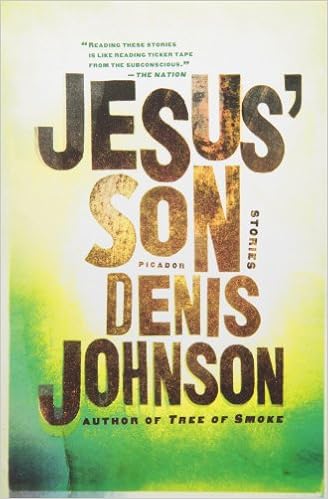
Jesus' Son by Denis Johnson

The man hanging out of the wrecked car was still alive as I passed, and I stopped, grown a little more used to the idea now of how really badly broken he was, and made sure there was nothing I could do.  He was snoring loudly and rudely.  His blood bubbled out of his mouth with every breath.  He wouldn't be taking many more.  I knew that, but he didn't, and therefore I looked down into the great pity of a person's life on this earth.  I don't mean that we all end up dead, that's not the great pity.  I mean that he couldn't tell me what he was dreaming, and I couldn't tell him what was real.

Denis Johnson's story "The Other Man" begins: "But I never finished telling you about the two men."  And sure enough, you recall: earlier in the collection Jesus' Son, there is a story called "Two Men," but it's really just about one man: a deaf-and-dumb giant of a dude who ends up in the narrator's car, signaling that he'd like to be taken somewhere.  He's a stranger, but somehow his inability to speak fends off a fight, and compels the narrator to comply.  The man in "The Other Man" is a tourist who pretends, convincingly, to be a Polish tourist until he admits it was a prank all along.  Yet the reveal doesn't reveal all:

When I've told others about this man, they've asked me, "Did he make a pass at you?"  Yes, he did.  But why is that out come to this encounter obvious to everyone, when it wasn't at all obvious to me, the person who actually met and spoke with him?

What's the connection between the two men?  Are they both liars?  And why does it take the narrator so long to remember to finish the story?  All of Jesus' Son is like that, within and across stories: obscure connections are made and broken; time skips unpredictably and without warning.  In "Out on Bail," the narrator is at a bar commiserating with a friend about to go to prison, until he remembers that the moment was actually one of celebration, because the friend was acquitted.  In the virtuosic "Emergency," he tells us a story about getting stuck in a car in the snow, and accidentally kills a nest of newborn rabbits he'd been trying to protect.  Then he says, "Or maybe that wasn't the time it snowed."  This moment that he's thinking of, "The bunnies weren't a problem yet, or they'd already been a problem and were already forgotten, and there's nothing on my mind."  The fractured nature of the narrative reflects the drunken, drug-addled mindset of the narrator--nicknamed, unfortunately, "Fuckhead."

Does that sound frustrating?  Does it sound like the worst excesses of our most masculine hacks?  Our Bukowskis, our Palahniuks, our Bret Easton Ellises?  Certainly you can their shadows in a story like "Car Crash While Hitchhiking," which spares little in the way of violence or gore, or the black humor of the moment in "Emergency" when the strung-out orderly glibly removes the knife in a man's eye while prepping him for the surgery that's supposed to do exactly that.  Denis Johnson is the writer those guys all wish they could be, or maybe think they are.  For one thing, he can write circles around them, as in this drugged-out vision of the Iowa countryside:

Glaciers had crushed this region in the time before history.  There'd been a drought for years, and a bronze fog of dust stood over the plains.  The soybean crop was dead again, and the failed , wilted cornstalks were laid out on the ground like rows of underthings.  Most of the farmers didn't even plant anymore.  All the false visions had been erased.  It felt like the moment before the Savior comes.  And the Savior did come, but we had to wait a long time.

But also, Jesus' Son has a kind of warmth and generosity those authors can't match.  Johnson has a sincere affection for those who are down and out, like Fuckhead, which is all the more remarkable because it doesn't require the kind of gritty realism that we usually think of us being the hallmark of empathetic literature about the lowest strata of our society.  Dreams and visions, induced by pills or otherwise, are respected as part of human creativity and ingenuity.  And both Johnson and Fuckhead are aware that much of human life is the product of circumstance and luck:

"You just don't realize.  Being a cheerleader, being on the team, it doesn't guarantee anything.  Anybody can take a turn for the worse," said Richard, who'd been a high school quarterback or something himself.

About Dundun, a sadistic man who tortures a friend of Fuckhead's, he writes:

Will you believe me when I tell you there was kindness in his heart?  His left hand didn't know what his right hand was doing.  It was only that certain important connections had been burned through.  If I opened up your head and ran a hot soldering iron around in your brain, I might turn you into something like that.

The collection zips from Iowa to Chicago to Seattle, but it ends in Arizona, where Fuckhead is all cleaned up and trying to live a sober life as an orderly in an old folk's home.  He spends his afternoons and evenings spying on a Mennonite couple who live nearby, trying to peer into their inner life.  He's interested in them before he knows they are Mennonite, but the story says something like this: even the most straitlaced of us have inner lives that are unique, perhaps even bizarre, that we are all as weird as the drifters and addicts of Jesus' Son, thought not all of us live close enough to risk for that part of us to emerge.  "All these weirdos," Fuckhead writes serenely at the end, "and me getting a little better every day right in the midst of them.  I had never known, never even imagined for a heartbeat, that there might be a place for people like us."