And while you, my superiors, may think I've come to join him in Africa because you dispatched me here, you're mistaken. I've come back because I love the mess. Anarchy. Madness. Things falling apart. Michael only makes my excuse for returning.
And if he thinks I'd like an army and a harem, Michael mistakes me too. I don't want to live like a king--I just want to live. I can't make it happen by myself. I've got all the ingredients, but I need a wizard to stir the cauldron. I need Michael.
"Since nine-eleven," a U.S. naval officer tells Roland Nair, who has been captured by the Lord's Resistance Army in the Congo and ransomed, more or less, by the United States, "chasing myths and fairy tales has turned into a serious business. An industry. A lucrative one." It's an idea that's obvious enough: just imagine Colin Powell, standing before the United Nations and spinning a myth, a fairy tale, about weapons of mass destruction. It would be too much to say the world went crazy, because it always has been, or to say that myths and fairy tales took control of the world after 9/11; they always have been in control. But there's something canny in Johnson's observation here, something about the way that mythmaking became a way of focusing the enormous powers of the intelligence and military leviathans, and a funnel for lots and lots of money.
Nair, the narrator of The Laughing Monsters, has returned to Freetown, Sierra Leone on assignment for NATO looking for an old friend, a Congolese named Michael Adriko. Michael--affable, garrulous--and Nair--cynical and sour--have a long history stretching back to Afghanistan. On the surface, it seems that Nair is meant to spy on Michael, but Michael is a charismatic actor who charms and spellbinds nearly everyone, including--perhaps most of all--his old friend. When Nair agrees to partner with Michael in a harebrained scheme to sell the location of a non-existent cache of fissionable uranium to the Mossad, is he planning on snitching, or is NATO the mark? You get the sense that Nair doesn't really know, and that like Schrodinger's cat, the truth will be revealed when the box is open, even the truth about his own intentions and motivations. The one thing that is clear is that Nair's attachment to Michael is more than mercenary, and so is his attachment to Michael's American fiancee Davidia St. Claire.
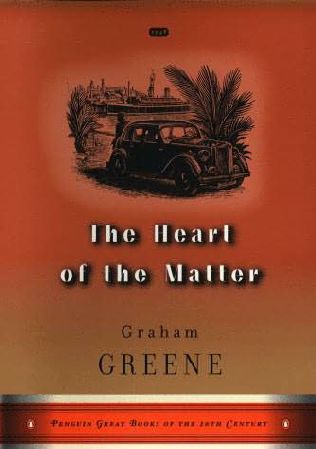
I made these connections in my review of Johnson's epic Tree of Smoke, but I see Graham Greene's fingerprints all over The Laughing Monsters. If Tree of Smoke is Johnson's The Quiet American, The Laughing Monsters is his The Heart of the Matter. Like Greene, Johnson understands spycraft as something perpetrated not by nations but by people, whose loyalties are as liquid as their desires. And like Greene, for Johnson's spies there is always a layer of knowledge that remains inaccessible, another shoe left to drop. "More will be revealed," Michael says about his vague plan to cross the Ugandan border into the Congo, but what is revealed is only more confusion, a chaotic descent into the African bush where even the native Michael is a stranger. Like I said that Tree of Smoke review, Johnson is like DeLillo in this way: intelligence always ends up being self-referential, the spies end up unraveling spycraft itself, a recursion that has no bottom. And of course Michael, Nair, and Davidia's journey into inland Africa is a revision of Heart of Darkness.
Throughout the novel, Johnson's wonderful sense of moment and detail, sputtering like a half-dead lamp, illuminates:
Now a beggar dressed in rags came out of the dark and wrote swiftly on the floor with white chalk: MR. PHILO KRON / DR. OF ACROBATICS. He started doing cartwheels in place while holding a platter of raw rice, never spilling a grain. He repeated the trick, now holding a glass of water, also without spilling.
The staff, the patrons, everybody ignored him, but Davidia said, "Michael, give him something."
Michael only offered him a scowl and said, "Don't encourage these people."
Davidia smiled and met the acrobat's eyes, or one of his eyes--the other's socket was scarred and pinched shut--and this inspired him to talk, or to signal his thoughts by a series of squeaks, as he seemed to be missing, also, one of his vocal cords. "Sometimes it's feeling like the Prophet was just here," he told Davidia, kneeling before her, touching her hand, trembling with the intensity of his message, "the Prophet himself, on that spot, and he went around the corner of the building there, and see, there, the dust still stirred up by the motion of his garments." Satisfied with that, Dr. Kron took himself and his piece of chalk back into the night, and one of our waiters came quickly with a rag and wiped away his title and his name.
Isn't that wonderful? As Nair gets further and further involved with Michael's schemes, the possibility of being cut off from everything becomes greater and greater, the possibility of breaking off from NATO, from the US, from Denmark, in whose army Nair seems to be a captain, from the vast intelligence networks that cross Africa like a net and which are waiting to be exposed at the right price. The possibility of complete self-erasure, like Dr. Kron, and becoming the fake name on the cheap Ghanaian passport. After 9/11, can you really disappear? Can you become a myth or a fairy tale?