Showing posts with label Germany. Show all posts

Thursday, August 24, 2023

Memoirs of a Polar Bear by Yoko Tawada

Homo sapiens is sluggish in its movements, as if it had too much superfluous flesh, but at the same time it is pathetically thin. It blinks too often, particularly at decisive moments when it needs to see everything. When nothing's happening, it finds some reason for frenetic movement, but when actual danger threatens, its responses are far too slow. Homo sapiens is not made for battle, so it ought to be like rabbits and deer and learn the wisdom and the art of flight. But it loves battle and war. Who made these foolish creatures? Some humans claim to be made in God's image--what an insult to God. There are, however, in the northern reaches of our Earth, small tribes who can still remember that God looked like a bear.

Yoko Tawada's Memoirs of a Polar Bear is actually the memoirs of three polar bears: the first, an unnamed matriarch who writes an autobiography that becomes a best-seller in the Soviet Union; the second, Tosca, the matriarch's daughter, a circus performer who forges a close relationship with her trainer, Barbara; and finally Tosca's son Knut, who is brought up by human trainers at the Berlin zoo. Tosca and Knut are real--Tosca's "rejection" of Knut and the baby bear's successful adolescence at the zoo apparently having been the subject of much media obsession--but in imagining the writer-bear, Tawada gives Tosca and Knut a kind of formal pedigree that elevates them above mere bearness. The novel plays pretty loose with just how a polar bear might walk among human society: while the matriarch speaks Russian, and learns German so that she might write in it, Tosca seems to lose interest in speaking with anyone but Barbara. Knut, in the end, is the most "bear-like" of all, perhaps having lost the matriarch's gift of speech--though there are a precious few who seem to understand him, like his friend--I am not kidding--Michael Jackson.

The three sections of Memoirs of a Polar Bear do some interesting things with point of view and elements of metafiction. The matriarch's section seems to encompass both the best-selling autobiography and the process of writing it; much of it is taken up by the bear's grueling writer's block while living in exile in West Germany. Tosca's section is actually written from Barbara's perspective, though the two become so close that Tosca's "I" eventually starts to melt into Barbara's. And Knut's section pulls of what I thought was a neat trick: for a long time, it seems to be in third person, until another bear in the zoo mocks young Knut for referring to himself as "Knut"--and suddenly, as Knut learns what an "I" is, the narrative switches into the 1st person. Knut has been narrating all along. The tricks are neat, and it's a testament to Tawada's skill that the book can contain all of them without seeming gimmicky are overstuffed, but they point to certain interesting thoughts about the process of memoir and speaking about oneself. Does Tosca's need to have Barbara write her autobiography, for example, reflect a rejection of her mother's need to account for herself--to become more "bear-like" by rejecting the world of talky, wordy humans for the immediacy of bear life? And does it leave young Knut without the capability to communicate, when what he wants to do most in the world is be understood by his beloved caretaker and "mother" Matthias?

I was interested, too, in the way that the political overlays the three bears' stories. The matriarch's is a familiar story of Soviet dissidence, in which her autobiography is first celebrated, and then suddenly and mysteriously verboten; she defects to West Germany when it looks as if she'll be exiled to Siberia. (Though perhaps this would have been all right for a polar bear, who is always dreaming of cold environments, and who finds Berlin to be insufferably hot.) The politics of this section seemed sort of strange to me, as if they were a literary parody uninterested in being linked to anything contemporary. The contrast between West and East Germany is an important element of the novel, as it probably was for Tawada, who moved from Japan to West Germany in the 80s and who writes alternatingly in Japanese and German. Knut's section, on the other hand, has the bear grappling with the burden of being an avatar for climate change. Though little Knut lacks the stature or the tools of his matriarch, his notoriety at the zoo demands a kind of public account of himself, one that will stress to the world the need for conservation--a huge burden for such a little bear.

I thought Memoirs of a Polar Bear was really fun. I preferred the first and last sections, I think, perhaps not surprisingly, given the intentional narrative distance that Tawada imposes on Tosca, and which the aloof Tosca seems to impose on herself. I imagine they would frustrate a kind of reader who prizes internal consistency--when is a bear like a human being and when is it like a bear?--but the shagginess and slipperiness of Tawada's novel is part of its charm, I think.

Tuesday, August 16, 2022

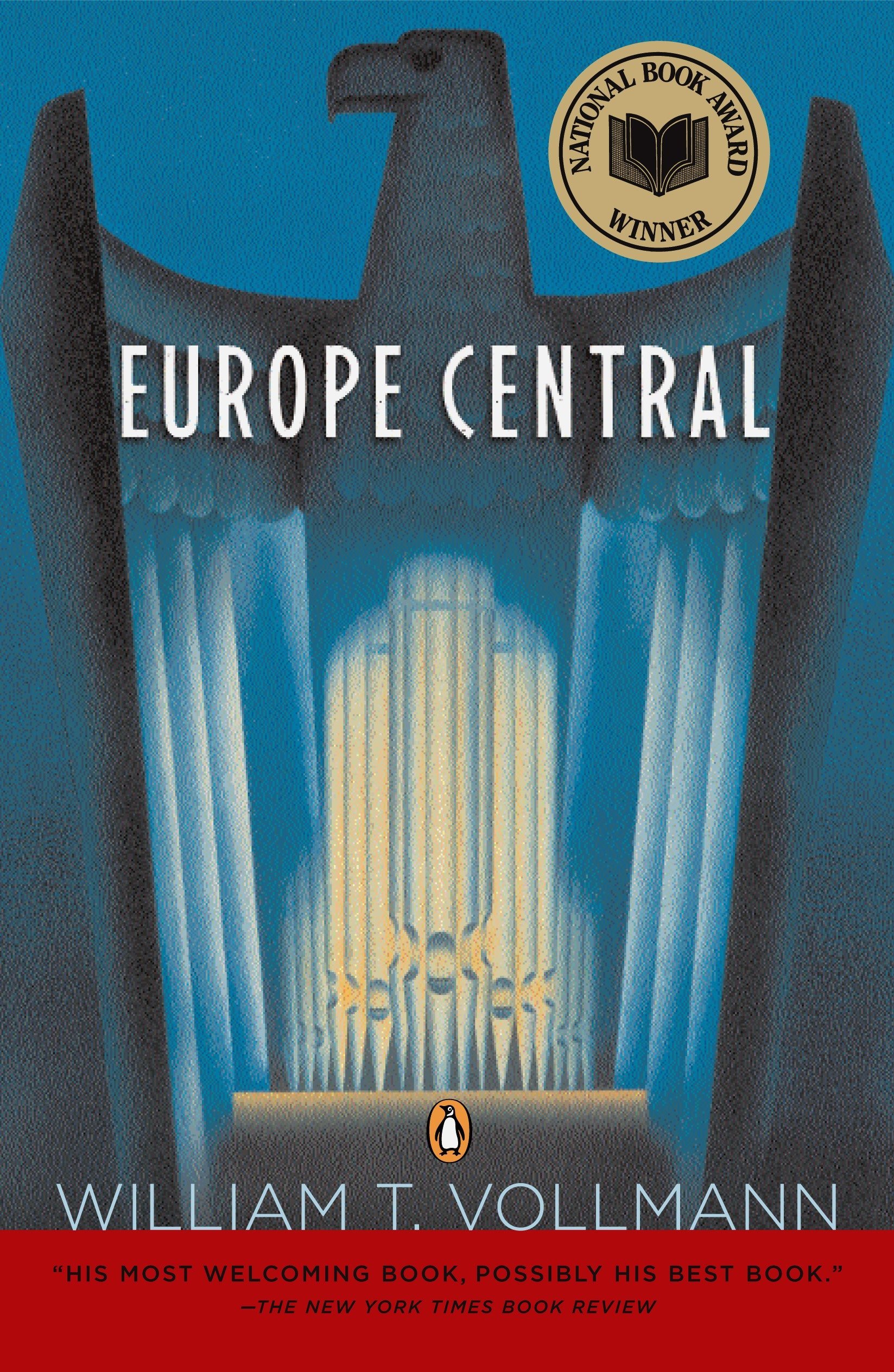
Europe Central by William T. Vollmann

About this quartet the most fundamental thing which can be said is that it is too sad even to rise from a moan into a wail at death's uncompassed crescendo. To be sure, the danse macabre of the second movement glows sickeningly vivid as a sodium flare at night (so much for flamelessness!); it's as bright as the electric light which illuminates the gas chamber when it's time to ascertain whether all the Jews are dead; while the menace of the third remains more chilling than those screams of terror in Leningrad when the German bombs come down; they'll never stop coming down. Yet on the whole the effect is of somebody drowning, his most desperate convulsions already behind him; he's begun to inhale water; the green water he sees is going black; and he's settling down into the muck. Some listeners who close their eyes during the second movement claim to perceive a whirling red eye-ball or domino, and the more rapidly it speeds, the more balefully it glows. This eidetic image seems to symbolize the approach of something evil. I myself have never seen the red spot, perhaps because Opus 110 already threatens me so perfectly that no kinesthesia is needed to extend or refine the threat. While Shostakovich's music wriggles like the worming of black-gloved fingers behind a policeman's back, the Bronze Horseman sinks down under sandbags and planks. Leningrad strangles in a loop of barbed wire.

It's a time and a place we all know, though perhaps when we Americans think of it, we're more likely to think of the beaches of Normandy, or the Battle of the Bulge, than the enormous front between Germany and Russia that brought millions under conflagration during World War II. Stalingrad, that six month siege that killed two million, doesn't feature very highly in our American memories. William T. Vollmann's epic Europe Central is a book that presents fictionalized versions of some of the Germans and Russians who lived through those years of intensity and destruction. Some are military figures, like generals A. A. Vlasov and Friedrich Paulus, or the SS member Kurt Gerstein; many are creative types: German artist Kathe Kollwitz, Russian poet Anna Akhmatova, and the novel's protagonist, more or less, the Russian composer Shostakovich.

The central image that introduces the book is a black, octopus-like telephone--"Europe Central" evokes not just central Europe but a kind of immense telephone switchboard--that snakes into the lives of its characters, making orders and demands. The same black telephone that rings in Shostakovich's house to summon him to the Stalin's secret police is the same one that rings in the field tent of Field-Marshal Paulus to inform him that he is expected to commit suicide before retreating from where he is encircled by Soviet forces. I was most interested, perhaps, in the twin stories of Vlasov and Paulus, both generals who ended up being captured by the enemy, then recruited against their former masters. Vlasov led a regiment of Russians under the Nazi army; Paulus became a spokesman for an anti-fascist Germany under the auspices of the Soviet Union, though their "betrayals" came for different reasons and they came to--unsurprisingly, given the outcome of the war--very different ends.

I was also really taken by the story of Kurt Gerstein, who "infiltrated" the SS in an attempt to save as many people as he could. Gerstein's story, which I'd never heard, is one of a noble man who tries very hard, with limited results, to stave off a great cruelty. He pretends that shipments of Zyklon-B have gone bad, to give those condemned to death more time; he tries, mostly in vain, to alert authorities outside of Germany to the horrors of the concentration camp system. For these efforts, he is put on trial as a Nazi collaborator by his French captors, ultimately committing suicide. "I consider him a hero," Vollmann writes in the (characteristically compendious) footnotes, but Gerstein's story makes one question what a hero truly is--can one be a hero when what they accomplish is so minimal, because the forces allayed against them are so great? As Vollmann grimly notes, Gerstein's name is not one of those compiled in the "Righteous Among the Nations" for their efforts to save the Jews of Europe. For all that, he's a very Vollmann-like hero, something like the noble but ineffectual Chief Joseph of The Dying Grass.

I was less sure of what to make of the novel's focus on Shostakovich, whose story gives the book its backbone. Vollmann invents, seemingly out of whole cloth, a lovelorn Shostakovich, unable to get over his early lover Elena Konstantinovskaya, who later marries the famous Soviet filmmaker R. L. Karmen. Shostakovich obsesses over Elena, even as he marries a succession of other women. What's this got to do with the political themes of a book like Europe Central? Well, perhaps in one way it's merely an observation that what drives our innermost lives is not always, or even typically, questions of justice and struggle, like those that animate Vlasov, Paulus, Gerstein, Kollwitz, Akhmatova. Shostakovich, for all his genius, is an ordinary man unable to get over the one who got away; all the grand movements of the Soviets and Germans--he lives through the siege of Leningrad--count for less than Elena. But also, there's an interesting parallel in the way that Shostakovich debases himself for Elena and for the Soviet regime. Shostakovich, a "formalist" who loved dissonance and hated the mindless patriotism of Soviet realism, was constantly in trouble with the Soviet censors. But Vollmann depicts him as absolutely spineless, falling over himself to apologize and genuflect to the apparatchiks who want him to be more conformist, though he never seems to be able to actually constrain the shape of his genius in the way they desire. Eventually, Shostakovich does what he said he never would, joining the Communist Party, and alienating all of his more principled associates. Yet clearly Vollmann finds something heroic in him, too, though perhaps it is a kind of heroism that operates at a level beneath the conscious, in the place where creativity works.

The subject matter of Europe Central doesn't resonate with me like the Native American-European culture clashes of Vollmann's Seven Dreams books. And at a subconscious level, I think I had been suspicious of Europe Central because of a vague intuition that the Seven Dreams stuff was never taken all that seriously by critics until the publication of Europe Central, with its more familiar and shopworn settings. (Who needs another World War II novel?) But I am forced to admit that the later sections of Europe Central contain some of Vollmann's most accomplished writing: the strange chapter "Airlift Idylls," narrated by a German assassin targeting Shostakovich, who seems to be more of a metaphor than anything else--have you ever seen a chapter narrated by a metaphor?--and the freewheeling, associative horror-scape of "Opus 110," which details Shostakovich's spiraling instability and debasement with a prose to match. Ultimately, Europe Central struck me as an accomplishment on the level of Vasily Grossman's Life and Fate, a novel from which it clearly takes some inspiration.

Monday, December 21, 2020

The Blue Flower by Penelope Fitzgerald

'As things are, we are the enemies of the world, and foreigners to this earth. Our grasp of it is a process of estrangement. Through estrangement itself I earn my living from day to day. I say, this is animate, but that is inanimate. I am Salt Inspector, that is rock salt. I go further than this, much further, and say this is waking, that is a dream, this belongs to the body, that to the spirit, this belongs to space and distance, that to time and duration. But space spills over into time, as the body into the soul, so that the one cannot be measured without the other. I want to exert myself to find a different kind of measurement.

'I love Sophie more because she is ill. Illness, helplessness, is in itself a claim on love. We could not feel love for God Himself if he did not need our help. -- But those who are well, and have to stand by and do nothing, also need help, perhaps even more than the sick.'

Approaching the end of the year I decided to return to a book I very much love: Penelope Fitzgerald's The Blue Flower. The first of her books I read and also the best, and what seems to me one of few very perfect novels, The Blue Flower seems to shine on every page. It's funny, sad, touching, clever. Reading it put me in the spirit of Fritz's mother, seeing her old home for the first time in years, the feeling of "coming home after having done one's best."

The question posed by The Blue Flower--or, perhaps, the earthly and practical question posed by it, because there are a number of philosophical and aesthetic questions--is, why does the brilliant philosopher-poet Fritz von Hardenberg, later known as Novalis, choose Sophie von Kuhn, a largely unremarkable young girl, to be his betrothed? Fritz calls her his "Philosophy," but she is largely unphilosophical, disinterested in writing, amused primarily by trinkets and dogs, touched but sort of befuddled by Fritz's interest. And yet, Fritz is not the only member of the family who ends up being captured by Sophie's charms: first his brother Erasmus, who had been against the match, and then his severe, businesslike father, follow Fritz. "It is quite unsuitable," Fritz's precocious six-year old brother the Bernhard repots: "It is our business to see the beauty of that."

In a way, Sophie is like philosophy: she is the generator of questions, rather than the solution to them; Fritz's undying ardor for her is the given that generates wonder. "A story that begins with finding," Fritz says, "must end with searching." That, perhaps, describes philosophy and Sophie both--and poetry, too, and all kinds of human endeavors that Sophie comes to stand in for. Perhaps what impresses me most about Fitzgerald's warmth and humanity is that the legitimacy of Fritz's love for Sophie is never in question; it's not played for irony or laughs. It's puzzling, sure, but Fitzgerald also suggests that there is something eminently reasonable in it, that there is a quality in Sophie that is worth admiration but eludes our narrow definitions of intelligence, of talent, of human worth. "I don't want to become," Sophie says to Fritz when they first meet, suggesting that a purity and immutability that eludes, but foreshadowing, too, Sophie's sudden and debilitating consumption.

Reading The Blue Flower for the second time, I was struck by just how immense and how vivid the cast of characters is. Sophie and Fritz are the stars, of course, but Fitzgerald manages to people the novel with a dozen memorable figures: the Bernhard, wise beyond his years, stands out, but also Sophie's pragmatic sister known as "the Mandelsloh," Sophie's jovial stepfather Herr Rockenthien, Fritz's sister Sidonie, his lovesick friend Karoline, Sophie's mischievous brother George, several other siblings, and even the insular and pretentious "Jena crowd" that includes well-known philosophers like Schiller and Schlegel. The Blue Flower transports you into the world of late 18th century Prussia, not because it's meticulously researched (although Fitzgerald is clearly knowledgeable), but because the world seems so recognizably human. 

Someone who knows more about Romanticism and German philosophy could probably tell you a lot about the subtext of The Blue Flower. I don't feel like I have anything particularly smart of knowledgeable to say about it. As heady as it may seem, The Blue Flower hits me in the purest pleasure zones of the brain, the places that light up after a really good story, well-told.

Thursday, May 28, 2020

Grand Hotel by Vicki Baum

It's just a silly fairy tale that says hotel chambermaids spy through keyholes. Hotel chambermaids have no interest whatsoever in the people behind the keyholes. Hotel chambermaids have a lot to do and are tired out, and they are all a little disillusioned, and besides they are entirely occupied with their own affairs. Nobody bothers about anybody else in a big hotel. Everybody is alone with himself in this great pub that Doctor Otternschlag not inaptly compared with life in general. Everyone lives behind double doors and has no companion but his reflection in the mirror or his shadow on the wall. People brush past one another in the passages, say good morning or good evening in the Lounge, sometimes even enter into a brief conversation painfully raked together out of the barren topics of the day. A glance at another doesn't go as far up as the eyes. It stops at his clothes. Perhaps it happens that a dance in the Yellow Pavilion brings two bodies into contact. Perhaps someone steals out of his room into another's. That is all. Behind it lies an abyss of loneliness.

Remember hotels? They were strange places: little approximations of home, crowded with people. In the ones I remember best every room opened onto a hallway overlooking a tremendous corridor, so you could look down and see all the other guests walking about. They were designed to give you the impression that all kinds of human interactions might take place there, though they rarely did; for the most part, even if you dined in the restaurant or went to the overpriced bar, you ended up keeping to yourself.

Vicki Baum's Grand Hotel is a story about several strangers at Berlin's fanciest hotel who really do end up colliding, in a way, and changing each other's lives. There's Doctor Otternschlag, a World War I doctor whose face is half-ravaged by an enemy shell; Herr Preysing, a middle manager at a linen company desperate to salvage a big merger; Grusinskaya, a still-beautiful but sort of washed up ballet dancer whose inability to excite audiences drives her to thoughts of suicide; Baron Gaigern, a dashing burglar who has designs on Grusinskaya's pearls, and then herself; and Otto Kringelein, a low level functionary in Preysing's linen company who has just discovered he has only weeks to live, and has decided to cash in everything he owns and live his final moments in style.

Though the cynical, morose Otternschlag is the hotel's--and the novel's--conscience, it's Kringelein who is the novel's heart. Poor and working class, he's come to the Grand Hotel because he knows Preysing frequents it, and although he hates Preysing for what he represents, he also represents Kringelein's only model for what it means to really live: to spend money like a comfortable bureaucrat. First Otternschlag, then Gaigern try to show Kringelein a good time--although Gaigern has his designs on Kringelein's money--and little by little he does begin, at last, to live. He rides in a speeding automobile; he flies in a plane; he watches a boxing match--but most importantly, he finds the courage at last to tell of Preysing, the petit bourgeois manager who doesn't even recognize him in the hallway. The Grand Hotel is the dream of the fruits of labor, and only when it's been exposed can Kringelein actually seize what makes him live: a measure of independence from the soul-crushing constraints of capitalist exploitation.

Grand Hotel struck me as the obverse of Borumil Hrabal's I Served the King of England, which focuses on service industry workers, rather than consumers, in the same period of European history. Baum gives brief, but sharp, images of the various porters and chambermaids who live in constancy while the revolving doors of the hotel turn, but mostly it's interested in the possibility that the hotel presents for change. Each of her protagonists, she notes toward the end, leaves the hotel in a condition opposite to the one in which they entered--Grusinskaya rejuvenated, Preysing humiliated, Kringelein ennobled. On the other hand Doctor Otternschlag, who asks every day at the desk whether a letter has arrived for him, never leaves. But the Grand Hotel is a place where lives are transformed, and as such its an interesting symbol for the Weimar Republic in which its set, whose transformation--Baum couldn't have known when she wrote it--turned pretty sour indeed. Leaving that aside, the novel, like the hotel, is filled with captivating and empathetic human lives that play out their little dramas, and then depart.

Saturday, October 28, 2017

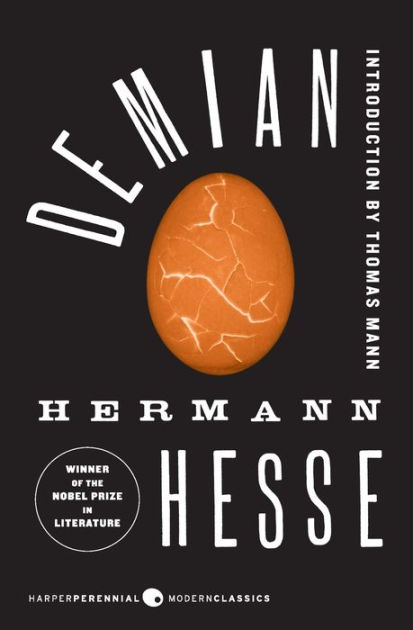
Demian by Herman Hesse

Novelists when they write novels tend to take an almost godlike attitude toward their subject, pretending to a total comprehension of the story, a man's life, which they can therefore recount as God Himself might, nothing standing between them and the naked truth, the entire story meaningful in every detail.  I am as little able to do this as the novelist is, even though my story is more important to me than any novelist's is to him--for this is my story; it is the story of a man, not of an invented, or possible, or idealized, or otherwise absent figure, but of a unique being of flesh and blood.

Brent hates this book so much I just had to read it for myself.  Is it really that bad, or does Brent just have really bad taste?  The answer, as I expected, was a little bit of both.

We agree that Hesse's Demian starts out well: the narrator, Emil Sinclair, recounts a particular story of his childhood.  He makes up a story about stealing apples from an orchard to impress a local bully, Franz Kromer, which Kromer--clearly seeing through the lie--uses to blackmail Sinclair for months on end, pressing him into a kind of servanthood.  It's a great story, written in clever detail, and amplified with the ironic touch of a child's perspective and lack of understanding.  It's all the more interesting because of the inward agony it causes Sinclair, whose Manichaean view of the world is challenged by Kromer's cruelty.  If the world is divided into the good and the bad, has Sinclair's fib aligned him with the bad; with Cain instead of Abel?

But like Brent says, the beginning of the book is the high point.  Sinclair's agony is put to rest by his classmate Max Demian, who not only wards off Kromer but forces Sinclair to see the story of Cain and Abel--which operates as the principal symbol of the novel--in a different way:

"It's quite simple!  The first element of the story, its actual beginning, was the mark.  Here was a man with something in his face that frightened the others.  They didn't dare lay hands on him; he impressed them, he and his children.  We can guess--no, we can be quite certain--that it was not a mark on his forehead like a postmark--life is hardly ever as clear and straightforward as that.  It is much more likely that he struck people as faintly sinister, perhaps a little more intellect and boldness in his look than people were used to.  This man was powerful: you would only approach him with awe.  He had a 'sign.  You could explain this in any way you wished.  And people always want what is agreeable to them and puts them in the right.  They were afraid of Cain's children: they bore a 'sign.'  So they did not interpret the sign for what it was--a mark of distinction--but its opposite.  They said: 'Those fellows with the sign, they're a strange lot'--and indeed they were.  People with courage and character always seem sinister to the rest.  It was a scandal that a breed of fearless and sinister people ran about freely, so they attached a nickname and myth to these people to get even with them, to make up for the many times they had felt afraid--do you get it?

Cain, in this version, represents not the "dark side," but a rebuke to the Manichaean worldview that separates dark from light, bad from good, and right from wrong.  Demian becomes the story of Sinclair's long, slow education in this worldview, the development of his own "mark of Cain."  The God of the Bible is replaced by Abraxas, a pagan deity who represents a mixture of both God and Satan in one.  In literal terms, this manifests itself in Sinclair's slow disillusion in the structures of pre-war European society and his drift back toward the figures of Demian and his alluring, androgynous mother.  Gender becomes another binary to be deconstructed (which is, admittedly, anticipates a lot of our modern conversations) and Sinclair falls in love with Demian's mother precisely because she looks like Demian with a little bit of the feminine principle superadded.  These two run a cult in the mountains which Sinclair joins with great enthusiasm.

There's a lot of interesting ideas there--okay, one interesting idea--but the story itself becomes dull after Kromer is dispatched.  The conflict is no longer with petty bullies but with the antimetaphysical bourgeois worldview, which isn't exactly a gripping adventure.  I think Demian might be more compelling if it didn't point toward an ultimate conclusion that seems retrograde for us who are able to look back on the bloody twentieth century: Demian's mother insists that the upcoming war--World War I--will offer an opportunity for man to grow and change in the crucible of violence, and for individuals to transform themselves in to enlightened Demianesque supermen.  That kind of searching for meaning in violence may have been possible before, and even after, World War I, but not after World War II and the Holocaust.

Sunday, August 18, 2013

All Quiet on the Western Front by Erich Maria Remarque

To no man does the earth mean so much as to the soldier.  When he presses himself down upon her long and powerfully, when he buries his face and his limbs deep in her from the fear of death by shell-fire, then she is his only friend, his brother, his mother; he stifles his terror and his cries in her silence and security; she shelters him and releases him for ten seconds to live, to run, ten seconds of life; receives him again and often for ever.

Earth!--Earth!--Earth!

There is a generally prevalent notion, among literary authors if not among historians, that World War I marks a sort of dividing line in history, a point of irreversible transformation.  The map of Europe was transformed, of course, but along with it came cultural and psychological transformations.  In a reductive sense, much of what defines modern literature--alienation, deracination, nihilism, existentialism, abstractism--has its origin in the that conflict.

Yet I know of very few good literary accounts of the war itself.  My favorite World War I book, Parade's End, provides a few good scenes of Christopher Tietjens being shelled in the trenches, but for the most part it's about what goes on at the fringes of the war, and back home in England.  For the French and Germans, there was no "back home" in that sense, and perhaps for that reason All Quiet on the Western Front could only have come from a continental writer like Remarque.

All Quiet is narrated by a young German soldier, Paul Bremer, who recounts the experiences of his tightly knit group of friends.  It is at times disturbingly graphic about the reality of war, as in one memorable scene in which Paul, unexpectedly finding himself occupying the same foxhole as a French soldier, stabs his enemy to death.  The fear of being murdered is one particular horror, and the murdering another, but it is worse still that Paul must spend the remainder of the skirmish with the man he has killed, looking into his open eyes.  The French soldier is relatively lucky; Remarque goes to great lengths to show us that there are much more gruesome deaths to be had on the front lines.

Even in the midst of the physical actuality of war, Paul and his friends are keenly aware of the way that the war has changed them.  Paul is granted a couple of weeks' leave, but at home he is uneasy and fails to fit in as he once did; home is not what it was because Paul is not what he was.  Remarque clearly spells out the break between the war generation and its predecessors:

For us lads of eighteen they ought to have been mediators and guides to the world of maturity, the world of work, of duty, of culture, of progress--to the future.  We often made fun of them and played jokes on them, but in our hearts we trusted them.  The idea of authority, which they represented, was associated in our minds with a greater insight and a more humane wisdom.  But the first death we saw shattered this belief.  We had to recognize that our generation was more to be trusted than theirs.  They surpassed us only in phrases and in cleverness.  The first bombardment showed us our mistake, and under it the world as they had taught it to us broke into pieces.

...We loved our country as much as they; we went courageously into every action; but also we distinguished the false from the true, we had suddenly learned to see.  And we saw that there was nothing of their world left.  We were all at once terribly alone; and alone we must see it through.

You might certainly read something similar by an Englishman or an American, but there's a special poignancy in that Remarque writes from the German perspective.  The knowledge that Germany will lose this war hangs over the novel, the knowledge that the atrocities come to nothing.  One might ask what the victors of World War I got for their troubles, too--but I think that only the losing side could produce a novel that really lays bare the pointlessness of the bloodshed.  There's a great scene in which Paul and his friends, stationed near the front lines in France, sneak out in the middle of the night to have sex with a group of French girls, whose brothers and cousins perhaps they may kill the very next day.  The scene with the French soldier in the foxhole says something similar about the two sides:

This dead man is bound up with my life, therefore I must do everything, promise everything in order to save myself; I swear blindly that I mean to live only for his sake and his family, with wet lips I try to placate him--and deep down in me lies the hope that I may buy myself off in this way and perhaps even get out of this; it is a little stratagem: if only I am allowed to escape, then I will see to it.  So I open the book and read slowly:--Gerard Duval, compositor.

With the dead man's pencil  write the address on an envelope, then swiftly thrust everything back into his tunic.

I have killed the printer, Gerard Duval.  I must be a printer, I think confusedly, be a printer, printer--

You can see why the Nazi regime banned All Quiet; Paul's experiences do not leave room for the kind of trenchant nationalism the Third Reich required.  But beyond that there is a tangle of guilt and victimhood that threatens the Nazi justification for war.  Is Paul morally responsible for the soldier's death in the way that he feels at this moment, or does that feeling conflict with the feeling of victimhood, of being pushed into war without understanding it, that pervades the rest of the novel?  I'm so fascinated by Paul's feverish need to "become" the man he has killed--partly to reanimate him, to retract the act of murder, partly out of a sense of justice, but also because to become the printer, Gerard Duval, is to relinquish the role of killer in exchange for the role of the killed.  Is it better to be the dead, or to go on living, as Paul must, with his conscience?

Bonus: Brent's review from 2010.

Tuesday, February 22, 2011

06 The Bread of Those Early Years-Heinrich Böll

Böll is known for his simplicity. In its original German, his books are often taught to German language learners because of that simple precise style. Truly lovely:

I sat down on the running board of Wickweber’s van, but instead of staring at the doorway I closed my eyes and looked for an instant into the darkroom, seeing the image of the only person who I know has never shouted, never bawled out another person—the only person whose devoutness I have found convincing: I saw Father. In front of him was the little blue wooden box we used to keep our dominoes in. the box is always stuffed with memo slips, all cut by Father to the same size from waste paper: paper is the only thing he hoards. From letters begun and then discarded, from copybooks not fully used up, he cuts out the blank parts, from wedding and death announcements he cuts off the unprinted parts, and as for those impressive circulars, those requests on deckle-edged paper to appear at some rally or other, those invitations on linen paper to do something for the cause of Liberty—this printed matter fills him with childish delight because each one yields him a least six memo slips, which he then deposits as treasures in the old domino box. He is obsessed by bits of paper, inserts them in his books, his wallet bulges with them, matters both important and trivial are all confided to these slips. I was forever coming across them when I was still living at home. “Button on undershorts” was written on one of them, on another “Mozart,” on another “pilageuse—pilage,” and once I found one saying: “On the streetcar I saw a face such as Jesus Christ must have had in His Agony.” Before going shopping he takes out the slips, riffles through them as though a deck of cards, lays them out like a game of solitaire, and arranges them in order of priority, forming little piles just as one separates aces, kings, queens, and jacks.

From all his books they stick halfway out between the pages, most of them yellowed and spotted because the books often lie about for months before he gets around to making use of the slips. During school vacations he collects them, rereads the passages he has made notes on, and sorts the slips, on most of which he has noted English and French words, grammatical constructions, idioms whose meaning is not fully clear to him till he has come across them two or three times. He carries on a voluminous correspondence about his discoveries, orders dictionaries to be sent to him, chicks back with his colleagues, and with gentle persistence needles the editors of reference works.

And there is one slip that he always carries in his wallet, one marked in red pencil and being particularly important, a memo that is destroyed after each of my visits buy is then soon written out again—the slip that says: “Have a talk with the boy.”


This passage takes me into his father’s house and life, but Böll does this with ease throughout the novella.

Simply put, The Bread is a love story that takes place in one day. Boy meets girl, boy falls in love, boy desires girl, girl acquiesces. Unlike modern writers, Böll doesn’t have his characters have sex or even kiss. They are proper post-war Germans, marriage is the only option. The flashbacks within the first person narration are digressions of beauty. Did I mention Bolaño was influenced by Böll?

Mr. Walter Fendrich is a washing machine repairman. He is completely afraid of famine and just as the title suggests, he loves bread because it was something he rarely had when growing (yes, it's a metaphor). In his search for his identity he has gone through several apprenticeships and quit all of them. He hates his current job but is excellent at diagnosing the problem, fixing it, and moving on. He can’t seem to do this in his real life. He makes good money, but still buys bread every chance he gets; he buys so much bread that most days he is forced to give it away.

Hedwig Muller is moving to the city to pursue a teaching career. They are united only by their hometown, but after finding her an apartment at her father’s request, he picks her up at the railway station. Fendrich decides right then, he is going to give up everything for this woman. It’s quite romantic really. He buys her flowers, postcards, cake, coffee, and of course, bread.

Monday, February 9, 2009

The Last of Mr. Norris by Christopher Isherwood

I had planned on reading all of Isherwood's The Berlin Stories, which is basically two novels sandwiched together: This, The Last of Mr. Norris, and Goodbye to Berlin, which is the basis of the musical Cabaret. I've never seen Cabaret, but I think the idea is pretty intriguing--a bunch of non-German socialites fritter their time away with trivialities while Berlin succumbs to Nazism.

But I needed a break after The Last of Mr. Norris, so I'm reading (and posting) these as two separate novels. While not really bad, or even unpleasant, I found there just wasn't enough in The Last of Mr. Norris to keep me interested; in fact, I'm not totally sure what to say in this review.

Mr. Norris is Arthur Norris, a seemingly well-to-do Englishman (or American? I think he's English) living in Berlin who makes the acquaintance of Bill Bradshaw, the narrator. Bradshaw falls head-over-heels in bromantic love for Arthur, though I admit I don't get the appeal: Isherwood seems to suggest that Arthur is a genteel and affable rapscallion but really he's kind of obnoxious. He seems to abound in wealth and taste; I think perhaps those traits carry less weight with a modern reader than they did in the mid-century.

Arthur is a secret communist and also a petty sham artist; two roles which often seem in conflict with one another. In the plot's climax, Arthur uses the narrator to unwittingly engineer a scam on a mutual friend and Nazi cabinet member. In a plot twist that is a lot more dull than it ought to be, the scam itself turns out to be a ruse and Arthur turns out to be a spy for the French. Congratulations, Isherwood: you made Nazis boring.

What this means, unfortunately, is that I'm stuck at 49 1/2 on the Times 100 Book List, which counts the books as one. One day soon I'll get over that hump.

Wednesday, July 30, 2008

The Good German by Joseph Kanon

I wrote a couple paragraphs, summarizing this book, but scrapped them when I realized that they made The German Sound sound interesting. This is the first book that I have read this year that I truly disliked. It was such a waste of my time. Kanon relied much too heavily on sub-par dialogue to progress the plot. His characters were either stiff or incredibly clichéd...some managed to be both.
When I was about halfway through I realized that I didn't care at all what happened in the rest of the book. I just wanted it to be over. When I finally did get to the ending, it was extremely predictable and boring. There is no reason that you should ever read this book. And I heard the movie based on the book was also awful.

Monday, November 12, 2007

Ship of Fools by Katherine Porter

I realized with some chagrin the other day that I've posted nine books for class since the last one I finished as a personal choice, Tropic of Cancer. That's awfully depressing. To make matters worse, I had to suffer the ignominy of actually renewing the book I'd been reading, Katherine Porter's Ship of Fools, which had passed its one-month checkout limit. Clearly, school takes up far too much of my time, but at long last, here it is.

I decided to read Ship of Fools after I read one of Katherine Porter's short stories, "Flowering Judas," in the textbook for my 20th Century American Literature class (instead of actually paying attention to the lecture). It was a really beautifully written story, full of bright imagery and concentrated more on relating certain moods and images than advancing a plot.

Ship of Fools isn't like that; it lacks the hazy-but-languid style of "Flowering Judas" and replaces it with something dryer, but it isn't without its flashes of beauty. Instead, it's a character-based novel that examines what happens when a large group of strangers--an ensemble cast somewhere in the twenties--comes together on a transatlantic voyage from Mexico to Germany in the period leading up to the Second World War. Some of these characters are more interesting than others, and these are the most interesting: Jenny Brown and David Scott, a pair of American artists and lovers whose relationship is falling apart, Wilhelm Freytag, a young German who is banished from the captain's table when it's revealed that his wife is Jewish and who cultivates a relationship with Jenny, Dr. Schumann, the ship's conservative doctor who falls in love with La Condesa, an upper-class Mexican political prisoner and drug addict on her way to exile in the Canary Islands, and a group of Spanish zarzuela dancers who are also thieves, pimps, and prostitutes. Apart from being a well-developed character study, Ship of Fools is also somewhat of a political allegory that traces the rise of Nazism in Germany in the way that not only Herr Lowenthal, the voyage's only Jew, is treated by the censorious Germans, but also the uber-Gentile Freytag and the "unrespectable" lower-class passengers quartered in steerage.

I wasn't sure of this book at first, but I grew to really like it; by focusing on the more interesting and affecting strands and relegating others to B-plots, it actually becomes a heartbreaking study in human cruelty and loneliness. The most moving part, I think, is when Ric and Rac, the two troublesome twins that travel with the zarzuela company, throw overboard Bebe, a bulldog that belongs to a professor and his wife. Bebe is saved by a steerage passenger, who dies in the process. Porter offers the man's name--Echegaray, a common Basque name--but nothing else about him, and so we are forced to examine him uncomfortably through the eyes of the well-to-do first-class passengers on the upper deck, who regard his funeral with disdain or amused detachment. He is buried at sea without any known family to contact, forgotten somewhere in the Atlantic.

Its flaw is that many of the ensemble characters are wholly single-faceted, like profane, racist Texan William Denny or the Jew-hating Herr Rieber, but the detail given to the other characters more than makes up for it, I think. All in all, I enjoyed this book, though I think the next one I choose for myself will have to be a bit shorter than Ship of Fools' 497 pages.

Friday, February 16, 2007

Berlin, City of Stones by Jason Lutes


(Yes, Alsyon, I did read another comic book. And there's nothing you can do about it!)

It’s hard not to be moved by something written about the holocaust, or simply about war, especially something very well-written. Jason Lutes' Berlin: City of Stones, however, was something surprisingly powerful. Rather than focusing on the plight of Jewish families in war-torn Germany, Lutes writes (and draws) about the tensions between opposing factions in the years leading up to the Second World War. This is one of probably a very small selection of historical graphic novels, and I would wager that it’s easily the best.

If nothing else, Jason Lutes can certainly draw. His grasp of human anatomy and emotion isn’t the best I’ve seen, but all of his figures are stylistically pleasing, and his attention to detail in faces, dress and gestures does a lot in terms of advancing the plot without a narrator. I was impressed by his ability to draw (as far as I can tell) a completely believable 1920’s German cityscape, down to each stone in the road. His bird’s-eye-view opening or closing scenes alternatively give a strong feeling of the city’s European beauty and then of its decrepitude. I found myself lingering over panorama landscapes, picking out individual faces in Lute’s carefully drawn crowds. But it was his impressive ability to pack so much into an image without making it to busy that I found most pleasing about his style.

The story itself follows the dialogue of a few main characters, internal monologues of complete strangers, and first-person narration through journals. The beauty of Lute’s Berlin was that he didn’t have to explicitly guide the reader to conclusions about public discontent, rising discrimination against the Jews, and tensions between National Socialist and Communist worker parties that all come to the point of erupting by the end of the book. But Lutes doesn’t have to show all of this coming to a head; his reader clearly knows how the story ends. I was surprisingly moved by the personal narratives mixed into the story and was made to view the effects of such a grotesque war from a new, very human perspective. I forget which publication rated this as one of the top 10 graphic novels of all time, but I would suggest it to anyone with an interest in a wide range of subjects from the war itself to European architecture. Overall, an unexpectedly strong book, visually and in its plot; Lutes’ drawing and writing style complement each other perfectly to make a powerful end product. I found myself reading it so quickly that I was worried I wouldn’t fully appreciate it, but I couldn’t slow myself down.