Showing posts with label nazism. Show all posts

Monday, February 9, 2009

The Last of Mr. Norris by Christopher Isherwood

I had planned on reading all of Isherwood's The Berlin Stories, which is basically two novels sandwiched together: This, The Last of Mr. Norris, and Goodbye to Berlin, which is the basis of the musical Cabaret. I've never seen Cabaret, but I think the idea is pretty intriguing--a bunch of non-German socialites fritter their time away with trivialities while Berlin succumbs to Nazism.

But I needed a break after The Last of Mr. Norris, so I'm reading (and posting) these as two separate novels. While not really bad, or even unpleasant, I found there just wasn't enough in The Last of Mr. Norris to keep me interested; in fact, I'm not totally sure what to say in this review.

Mr. Norris is Arthur Norris, a seemingly well-to-do Englishman (or American? I think he's English) living in Berlin who makes the acquaintance of Bill Bradshaw, the narrator. Bradshaw falls head-over-heels in bromantic love for Arthur, though I admit I don't get the appeal: Isherwood seems to suggest that Arthur is a genteel and affable rapscallion but really he's kind of obnoxious. He seems to abound in wealth and taste; I think perhaps those traits carry less weight with a modern reader than they did in the mid-century.

Arthur is a secret communist and also a petty sham artist; two roles which often seem in conflict with one another. In the plot's climax, Arthur uses the narrator to unwittingly engineer a scam on a mutual friend and Nazi cabinet member. In a plot twist that is a lot more dull than it ought to be, the scam itself turns out to be a ruse and Arthur turns out to be a spy for the French. Congratulations, Isherwood: you made Nazis boring.

What this means, unfortunately, is that I'm stuck at 49 1/2 on the Times 100 Book List, which counts the books as one. One day soon I'll get over that hump.

Monday, November 12, 2007

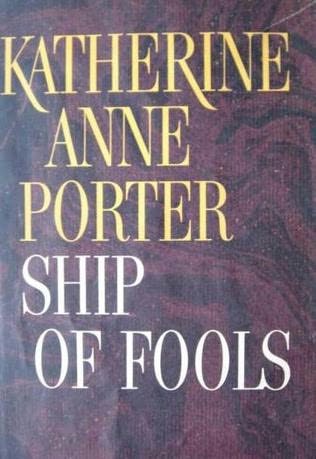
Ship of Fools by Katherine Porter

I realized with some chagrin the other day that I've posted nine books for class since the last one I finished as a personal choice, Tropic of Cancer. That's awfully depressing. To make matters worse, I had to suffer the ignominy of actually renewing the book I'd been reading, Katherine Porter's Ship of Fools, which had passed its one-month checkout limit. Clearly, school takes up far too much of my time, but at long last, here it is.

I decided to read Ship of Fools after I read one of Katherine Porter's short stories, "Flowering Judas," in the textbook for my 20th Century American Literature class (instead of actually paying attention to the lecture). It was a really beautifully written story, full of bright imagery and concentrated more on relating certain moods and images than advancing a plot.

Ship of Fools isn't like that; it lacks the hazy-but-languid style of "Flowering Judas" and replaces it with something dryer, but it isn't without its flashes of beauty. Instead, it's a character-based novel that examines what happens when a large group of strangers--an ensemble cast somewhere in the twenties--comes together on a transatlantic voyage from Mexico to Germany in the period leading up to the Second World War. Some of these characters are more interesting than others, and these are the most interesting: Jenny Brown and David Scott, a pair of American artists and lovers whose relationship is falling apart, Wilhelm Freytag, a young German who is banished from the captain's table when it's revealed that his wife is Jewish and who cultivates a relationship with Jenny, Dr. Schumann, the ship's conservative doctor who falls in love with La Condesa, an upper-class Mexican political prisoner and drug addict on her way to exile in the Canary Islands, and a group of Spanish zarzuela dancers who are also thieves, pimps, and prostitutes. Apart from being a well-developed character study, Ship of Fools is also somewhat of a political allegory that traces the rise of Nazism in Germany in the way that not only Herr Lowenthal, the voyage's only Jew, is treated by the censorious Germans, but also the uber-Gentile Freytag and the "unrespectable" lower-class passengers quartered in steerage.

I wasn't sure of this book at first, but I grew to really like it; by focusing on the more interesting and affecting strands and relegating others to B-plots, it actually becomes a heartbreaking study in human cruelty and loneliness. The most moving part, I think, is when Ric and Rac, the two troublesome twins that travel with the zarzuela company, throw overboard Bebe, a bulldog that belongs to a professor and his wife. Bebe is saved by a steerage passenger, who dies in the process. Porter offers the man's name--Echegaray, a common Basque name--but nothing else about him, and so we are forced to examine him uncomfortably through the eyes of the well-to-do first-class passengers on the upper deck, who regard his funeral with disdain or amused detachment. He is buried at sea without any known family to contact, forgotten somewhere in the Atlantic.

Its flaw is that many of the ensemble characters are wholly single-faceted, like profane, racist Texan William Denny or the Jew-hating Herr Rieber, but the detail given to the other characters more than makes up for it, I think. All in all, I enjoyed this book, though I think the next one I choose for myself will have to be a bit shorter than Ship of Fools' 497 pages.

Friday, February 16, 2007

Berlin, City of Stones by Jason Lutes


(Yes, Alsyon, I did read another comic book. And there's nothing you can do about it!)

It’s hard not to be moved by something written about the holocaust, or simply about war, especially something very well-written. Jason Lutes' Berlin: City of Stones, however, was something surprisingly powerful. Rather than focusing on the plight of Jewish families in war-torn Germany, Lutes writes (and draws) about the tensions between opposing factions in the years leading up to the Second World War. This is one of probably a very small selection of historical graphic novels, and I would wager that it’s easily the best.

If nothing else, Jason Lutes can certainly draw. His grasp of human anatomy and emotion isn’t the best I’ve seen, but all of his figures are stylistically pleasing, and his attention to detail in faces, dress and gestures does a lot in terms of advancing the plot without a narrator. I was impressed by his ability to draw (as far as I can tell) a completely believable 1920’s German cityscape, down to each stone in the road. His bird’s-eye-view opening or closing scenes alternatively give a strong feeling of the city’s European beauty and then of its decrepitude. I found myself lingering over panorama landscapes, picking out individual faces in Lute’s carefully drawn crowds. But it was his impressive ability to pack so much into an image without making it to busy that I found most pleasing about his style.

The story itself follows the dialogue of a few main characters, internal monologues of complete strangers, and first-person narration through journals. The beauty of Lute’s Berlin was that he didn’t have to explicitly guide the reader to conclusions about public discontent, rising discrimination against the Jews, and tensions between National Socialist and Communist worker parties that all come to the point of erupting by the end of the book. But Lutes doesn’t have to show all of this coming to a head; his reader clearly knows how the story ends. I was surprisingly moved by the personal narratives mixed into the story and was made to view the effects of such a grotesque war from a new, very human perspective. I forget which publication rated this as one of the top 10 graphic novels of all time, but I would suggest it to anyone with an interest in a wide range of subjects from the war itself to European architecture. Overall, an unexpectedly strong book, visually and in its plot; Lutes’ drawing and writing style complement each other perfectly to make a powerful end product. I found myself reading it so quickly that I was worried I wouldn’t fully appreciate it, but I couldn’t slow myself down.