Showing posts with label Polish. Show all posts

Monday, March 15, 2021

His Master's Voice by Stanislaw Lem

With an exaggeration that is necessary for the clarification of my meaning, I will say that in the course of my work (it is difficult to say exactly when this occurred) I began to suspect that the "letter from the stars" was, for us who attempted to decipher it, a kind of psychological Rorschach test. For a subject, believing he sees in the colored blotches angels or birds of ill omen, in reality fills the vagueness of the thing shown with what is "on his mind," so did we attempt, behind the veil of incomprehensible signs, to discern the presence of what lay, first and foremost, within ourselves.

Like many of the world's great scientific discoveries, the "letter from the stars" is discovered by sheer accident: a recording of a stream of neutrinos emitted from the region of Canis Minor, used--because of its presumed randomness--to generate random number tables for industrial use, proves not to be so random after all. In fact, it appears to repeat at a regular interval, a trait that should not appear if the source of the neutrino stream is natural. It is suggested that the neutrino stream may encode a message from a distant civilization; from this suggestion all the resources of the American military are marshaled in the distant Nevada desert, where hundreds of the world's top scientists are dedicated to a project codenamed, with a bit humor, "His Master's Voice."

Hogarth, the pugnacious mathematician whose reflections on the Project are recorded here, tells us from the very beginning that His Master's Voice has been a failure: "The reader who has plowed his way to this point and is waiting, with growing impatience, to be led into the inner sanctum of the famous enigma, in the hope that I will regale him with thrills and chills every bit as delightful as those he experiences viewing horror movies, I advise to set my book down now, because he will be disappointed." Only Stanislaw Lem could write a book about first contact in which no one is really contacted, or a book about aliens in which there are no aliens--and perhaps there never were. His Master's Voice, rather, becomes a treatise on exactly why translating the neutrino message is so impossible. Lem offers several deft metaphors to illustrate the disadvantage of our knowledge and our capabilities. Once we are like amoebas, receiving a telegram about a human funeral; next we are like ancient Egyptians trying to interpret a modern paper about the chemical composition of Amenhotep's funeral mask.

Science-minded folks, sometimes a little too glibly, like to say that there are no failures in science. Our knowledge is built on many such experimental failures. But such an attitude, and such glibness, are predicated on the perspective of those who have little interest in the way knowledge is really accumulated. His Master's Voice is, above everything else, a treatise on the function and practice of science, its history and limitations. Unlike people that follow the "I F*cking Love Science" Facebook page, Lem offers a fairly jaundiced view of the way science operates: balkanized into hermetic pursuits, ways of seeing the world that do not touch, and tainted always by the bias of the observer. Several fascinating hypotheses emerge from His Master's Voice--perhaps the neutrinos are a message from a dead universe, or perhaps it isn't a message at all, but a kind of cosmic excretion, like urine--but none will or can be disentangled from the hypothesizer. When knowledge is in short supply, Lem shows, what is human in us will fill in the gaps.

In many ways, His Master's Voice is reflection of the story of science in the 20th century: the great paradigm shifts of relativity and quantum theory, and the emergence of Heisenberg's uncertainty principle, which more or less did away with the idea that we can ever understand the universe from a position of true objectivity. (No doubt a real scientist would quibble with this formulation, but I think I got it more or less.) But it also reflects how the greatest discoveries of the 20th century became fodder for human history's bloodiest projects. One of the peculiar traits of the "letter" is that seems to be both a recipe for life and a catalyst for life: from the snippet that the researchers are able to "decode" organic compounds are created; these organic compounds in turn change and grow when subjected to the neutrino stream itself. For this reason some researchers believe the "letter" is meant to encourage life to grow throughout the universe. But these traits threaten to destroy life, also; Hogarth and his peers discover that these compounds are capable of propagating nuclear fission at a distance--imagine pressing a button that could release a nuclear blast anywhere on earth, of any size, without warning.

Is this property intentional? Is the "letter" the instructions for a weapon? Or is it "the kind of error, whereby someone reads, in a kitchen recipe, the word 'amanita' instead of 'amandine,' and concocts a dish that sends all his guests to their graves?" The question, like nearly all the questions surrounding the Project, will never be answered, even as it threatens the end of the earth. Lem seems to tell us that the process that led to the atom bomb was not simply the work of good scientists perverted by those with evil intentions; war, like science, is a process in which we take part but which we do not control:

A perfect equilibrium of forces, an exact equals-sign between them, was a state so improbable as to be virtually impossible. One could arrive at such a balance only by coincidence. Social fusion was one series of process, and the acquiring of instrumental knowledge was another series.

That is, perhaps the "letter" is a kind of poisoned present: for a society advanced enough in both social fusion and instrumental knowledge, it acts as an invitation to join a brotherhood in the stars. For a society advanced enough in instrumental knowledge but deficient in social fusion, like ours, it will rub us out before we become a threat. This is only one of many theories, and not the one that the more optimistic Hogarth prefers. But if it's the right one, we needn't have worried; for now, we haven't proved smart enough to end ourselves.

Tuesday, April 18, 2017

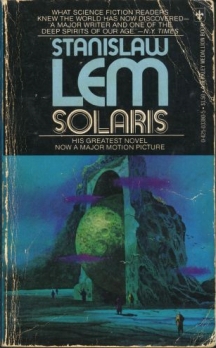
Solaris by Stanislaw Lem

We don't want to conquer the cosmos, we simply want to extend the boundaries of Earth to the frontiers of the cosmos.  For us, such and such a planet is as arid as the Sahara, another as frozen as the North Pole, yet another as lush as the Amazon basin.  We are humanitarian and chivalrous; we don't want to enslave other races, we simply want to bequeath them our values and take over their heritage in exchange.  We think of ourselves as the Knights of the Holy Contact.  This is another lie.  We are only seeking Man.  We have no need of other worlds.  We need mirrors.

Kris Kelvin arrives at a base orbiting the planet Solaris, home of the living ocean, excited to study the strange life form--if it is that--that has captivated not just his imagination but all of mankind's.  When he arrives, he finds the station in shambles, his contact dead by his own hand, and two other scientists having descended into degrees of insanity.  He's told to be wary; there are strange visitors on the station.  And sure enough, the first night he's there, he's visited by an old girlfriend who committed suicide many years ago--a kind of Ghost of Girlfriends Past.

I never saw the famous Tarkovsky film, but I did see the (surprisingly good) George Clooney remake.  My recollection of the film was that the appearance of Clooney's old girlfriend (Vera Farmiga?) was a mystery.  But in the book, the mystery is tempered by the fact that Solaris has been throwing up strange mysteries for a hundred years.  The planet is covered in ocean, but the ocean exhibits a kind of intelligence, perhaps even sentience.  The liquid shifts, changes, in purposeful ways; it even hardens into facsimiles of the human objects it "sees."  Some say it present models of places and people in their memories, but what happens to Kelvin and the others on the station has never happened before.

Solaris is best when it's diving into the knotty question of whether the ocean-planet is sentient, or even alive.  One school, to which Kelvin belongs, thinks the ultimate goal of Solaristics is contact--to talk to the planet in some meaningful way.  But the major theme of Solaris is the way that our narcissism shadows even our high-minded scientific work.  We can only conceive of extrasolar life that reflects ourselves in some way, but when it comes, if it comes, it will probably be so foreign to us that we won't be able to fit it into our solipsistic categories of "life."  Is the ocean alive?  That's not a scientific question, Lem says, it's an introspective one.  What do we see in ourselves that we think is living?

The manifestation of Kelvin's ex, Rheya, could be Solaris making a kind of contact of its own--witnessing something in Kelvin's pysche that it reproduces as a kind of recognition.  The depiction of Rheya--mysterious, fragile, shadowy--seemed to me to come from the women-sure-are-mysterious genre of masculine writing.  It makes sense, I guess, if Rheya is a kind of manifestation of Kelvin's own inner thoughts, rather than a real flesh-and-blood person.  But something about the way that the mystery of women became a stand-in for the mystery of Solaris made me wary of the book as a whole.  Still, it's another piece of evidence that shows just how underrated Lem is here in America.

Wednesday, January 21, 2009

Water for Elephants by Sara Gruen

"I meant what I said, and I said what I meant...
An elephant's faithful -- one hundred percent!"
--Theodore Seuss Geisel, Horton Hatches the Egg

In this book, an elephant kills the bad guy. On purpose. Sound far-fetched? I thought so too, even after I was done reading.

Water for Elephants begins with a prologue that tells the story of a murder. Readers don't know the who or the why, but have a pretty good idea of whodunnit. And they're wrong. Wrong wrong wrong. After the enticing prologue, the book slows down considerably as we are introduced to Jacob, the narrator who is "either ninety, or ninety-three" and lives in a rest home. The arrival of a circus in town stirs Jacob's memories, and the story progresses as a series of flashbacks.

The year is 1931, and young Jacob is just finishing up his veterinary degree at Cornell when he receives word both that his parents have been killed in a car accident and that he is now without home, money or prospects for the future. So he does what any logical twenty-two year old would do and runs away, leaving in the middle of finals and neglecting to collect his degree. He hops a train (is it bad that all I could think of while reading this part was John Hodgman's account of the hobo wars?) that happens to be carrying none other than The Benzini Brothers Most Spectacular Show on Earth.

As the story progresses, young Jacob is welcomed to the circus world, if a little begrudgingly, as the veterinarian. He busies himself with the menagerie of exotic animals and steals looks at the pretty circus performer Marlena, who works with the horses on stage. Marlena is married to a real class act, the moody and abusive August, who also happens to be head of the equestrian program for the circus.

The story picks up when the circus acquires an elephant who appears clever but won't listen to a word her trainer says. The elephant, named Rosie, and Jacob share a special bond from their earliest meeting, and Jacob is the only one at the circus that recognizes Rosie's sensitivity and intelligence. The poor creature undergoes quite a bit of abuse at the hands of the apoplectic August before Jacob realizes that she only understands Polish commands.

The plot thickens when August picks a fight with Jacob and Marlena over their friendship, and commences to give them both a beating. Marlena decides to leave August once and for all, and she and Jacob begin to have an affair. August tries to win his wife back by force, and Jacob begins to craft a getaway plan for them both. It comes too late for his unlucky friends, who are murdered in a plot meant for Jacob himself. The very next day, as Jacob plans his and Marlena's escape, a stampede breaks out in the big top. In the ensuing chaos (which was the focus of the prologue and is repeated at the end of the book, but more clearly) we finally learn that it was not Marlena who kills August after all. The maniacal trainer had a much larger enemy to contend with.

Jacob and Marlena live happily ever (and so does Rosie the elephant). At book's end, Jacob, now ninety, or ninety-three, finds himself the focus of a modern-day circus manager's attention. This ending is at once fitting and heartwarming.

I quite enjoyed reading this book, all the way up until the ending, which I found a little beyond the realm of my imagination. For a work of historical fiction, the details of August's violent end seem a bit sketchy. It was a quick read, and for the most part I could sympathize with Jacob, the book's clear protagonist. It was only at the end, when the elderly Jacob frets more about his lie of omission (never telling Marlena that her first husband was killed by their pet elephant) than about the fact that his two best friends essentially died in his place. Walter, a circus dwarf, befriends Jacob when the two are forced to share living quarters on the train. Camel is a roustabout, a hobo working for the circus who falls ill and is cared for by Walter and Jacob. Both suffer the wrath of the general manager's henchmen, who raid their living quarters while Jacob is out.

It bothered me that beyond a paragraph or two when it happens, Jacob-as-narrator never returns to the subject of his friends. That he feels guiltier about keeping an elephant's secret was off-putting to me and made me like him a bit less.

I'm aware that this review has degenerated to the point of a middle school book report (but possibly worse, since Mrs. Oldham frowned on summarization). My only excuse is that it's getting late and while I enjoyed this book, it didn't really move me.