Showing posts with label existentialism. Show all posts

Saturday, February 25, 2023

The Investigation by Stanislaw Lem

“Maybe even God only exists from time to time,” the Chief Inspector added quietly. He had leaned forward, and with his face averted was listening attentively to what Gregory was spewing forth with such difficulty from deep inside himself.

“Maybe,” Gregory replied indifferently, “But the gaps in his existence are very wide, as you know.”

Inspector Gregory is called upon by Scotland Yard to investigate a strange series of crimes--corpses are disappearing from their caskets, only to be found a short ways away, the twist being that a few of them have been spotted in transit. In short, is this a case of prankish grave robbery, or are they something stranger and more destabilizing: a sort of resurrection?

The summary makes The Investigation sound like a horror story, or perhaps an existential detective novel in the vein of New York Trilogy or Death in Her Hands. And it is, in some ways, both of those things. I don’t think it’s much of a spoiler to say that, like in those two novels, the “crimes” such as they are, are never solved and the investigators undergo an identity crisis. Nor can it really be surprising that some parts are very creepy: a reel to reel recording of a witness dying as he spends his last breaths describing a writhing corpse; Gregory’s dream of his landlord as a puppet master who contacts the dead through his manipulation of a pair of mannequins; an interview with Sciss, a police statistician(?) that devolves into a strange psychosexual encounter complete with mysterious negative depicting snuff films.

Spoilers follow, to the extent that this can be spoiled.

The climax, no less unsettling for its predictability, sees Gregory, whose entire life has slowly been consumed by the case and its myriad unprovable causes--a psychopath, a virus, alien technology, God--given a plausible explanation by his chief, an explanation that posits a trucker who’s been slowly driven mad by driving through the foggy winter nights. He protests, he points out the facts that don’t fit the explanation, he protests about the arbitrary nature of it all; ultimately though, he accepts it, because to not do so would upset the constructions that allow Scotland Yard, religion, government, human relationships, et al, and the premise that lies behind it all: that there is some concrete meaning in the world, and that we can discover and  comprehend it. That actions can be explained, crimes solved, and corpses safely assumed to be dead.

And yet, the book as a whole is somewhat inert, consisting largely of long conversations between various detectives, officers, scientists, and doctors. Entire chapters pass with no real action, and many of the characters outside of Gregory, Sciss, and the Landlord blur together so that much of the book reads more like a philosophical dialogue than a novel. Outside of Gregory’s increasingly emotive responses (he’s always angry, confused, certain), his descent into obsession lacks the texture than makes New York Stories work so well, and the pathos Moshfegh gives the widow in Death in Her Hands. In spite of its compelling big ideas and exciting final quarter, I found this, my first Lem, to be underwhelming--but I’m still looking forward to reading more.

Saturday, December 10, 2016

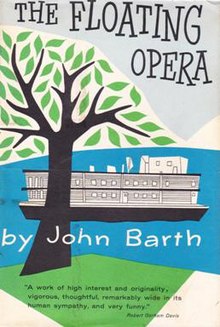
The Floating Opera by John Barth

Why The Floating Opera?  I could explain until Judgment Day, and still not explain completely.  I think that to understand any one thing entirely, no matter how minute, requires the understanding of every other thing in the world... Well, The Floating Opera.  That's part of the name of a showboat that used to travel around the Virginia and Maryland tidewater areas: Adam's Original and Unparalleled Floating Opera; Jacob R. Adam, owner and captain; admissions 20, 35, and 50 cents.  The Floating Opera was tied up at Long Wharf on the day I changed my mind, in 1937, and some of this book happens aboard it.  That's reason enough to use it as a title.  But there's a better reason.  It always seemed a fine idea to me to build a showboat with just one big flat open deck on it, and to keep a play going continuously.  The boat wouldn't be moored, but would drift up and down the river on the tide, and the audience would sit along both banks.  They could catch whatever part of the plot happened to unfold as the boat floated past, and then they'd have to wait until the tide ran back to catch another snatch of it, if they still happened to be sitting there.  To fill in the gaps they'd have to use their imaginations, or ask more attentive neighbors, or hear the word passed along from upriver or downriver.  Most times they wouldn't understand what was going on at all, or they'd think they knew, when actually they didn't... I needn't explain that that's how much of life works: our friend float past; we become involved with them; they float on, and we must rely on hearsay or lose track of them completely; they float back again, and we either renew our friendship--catch up to date--or find that they and we don't comprehend each other anymore.  And that's how this book will work, I'm sure.

John Barth's The Floating Opera is about the day that the narrator, Todd Andrews, decides not to kill himself.  That intriguing detail is laid out at the very beginning of the text, and then returned to after a number of long, digressive interludes about Todd's life.  We learn that his father committed suicide, and that he long had an affair with the wife of his friend, the pickle magnate Harrison Mack.  We learn about a long legal case he adjudicated that involved, among other things, the proper possession of hundreds of jars of human urine.  But the question laid out at the beginning of the novel--why did Todd consider killing himself, and why did he change his mind--hangs over the shaggy, humorous narrative:

So.  Todd Andrews is my name.  You can spell it with one or two d's; I get letters addressed either way.  I fear you'd say, "Tod is German for death: perhaps the name is symbolic."  I myself use two d's, partly in order to avoid that symbolism.  But you see, I ended by not warning you at all, and that is because it just occurred to me that the double-d Todd is symbolic, too, and accurately so.  Tod is death, and this book hasn't much to do with death; Todd is almost Tod--that is, almost death--and this book, if it gets written, has very much to do with almost-death.

The central image of the novel is the Floating Opera, a Vaudeville-esque show that takes place off shore in the town where Todd lives.  (Weird aside: this is the second novel I've read this year that takes place on Maryland's eastern shore.)  The Opera is central to Todd's existential pondering: he decides that suicide is the logical extension of the absurdity of life:

III. There is, therefore, no ultimate "reason" for valuing anything.

Now I added including life, and at once the next proposition was clear:

IV. Living is action.  There's no final reason for action.
V. There's no final reason for living.

But--and here goes the spoiler alert--what the reader has not realized is that when Todd decides to kill himself, he decides to sabotage the ventilation system of the Floating Opera and blow up hundreds of people along with him, including his friends, and a girl who his possibly his own daughter.  This decision is so starkly at odds with the light-hearted silliness of the narrative, that it comes as an explosive surprise.  Todd's decision to not kill himself, in the end, is linked to the failure of this attempt to blow up the Opera.

The ultimate message of The Floating Opera is this: if life is meaningless, you might as well live it as do anything else.  As a moral statement, it's not quite profound, but it matches the absurd and digressive nature of the novel, which is clearly modeled on the proto-modernist excess of Tristram Shandy.  Everyone lives on, but at the dark center of the novel is the awareness that it might have been otherwise.

Thursday, September 11, 2008

The Plague/The Stranger by Albert Camus

Much like last year's Cormac McCarthy duo, I've decided to review The Plague and The Stranger, both by Albert Camus, together. Partly because I'm so far behind on reviews, but also because both books cover almost the exact same idealogical ground in different contexts.


In The Stranger, Mersault, a young Frenchman, attends his mother's funeral, spends some time with a girl, and accidentally kills an Arab on the beach. The second part of the book is more philosophical, delving into Mersualt's thought processes while he's in prison, awaiting death. The Plague chronicles the escalation of the bubonic Plague in a small French town, following the efforts of several townfolk as they do their best to save those afflicted.


While the plots of the two books aren't very similar, the points they make are similar. At first glance, both appear to be nihilistic, and there is a hint of nihilism in Camus' philosophy. Mersualt, in The Stranger, doesn't care if he lives or dies. He is not angry at the injustice of being executed for a murder he didn't intend to commit; he does not mourn at his mother's funeral; he is uninterested in confessing his sins before he dies. He is interested in life only to the extent that it interests him--when he begins getting bored, he goes along with whatever comes up.


The protagonists in The Plague are mostly Mersault's opposites. Dr. Rieux, the narrator, spends a year caring for people dying of a plague he can't even slow down, much less stop. Even as those around him die, or give up, he continues on selflesslessly, even though he, like Mersault, doesn't believe in a God or an eternal reward. He presses on because it is the best thing to do, because it is the only thing he can live with.


In both these novels, the protagonists ultimately find a tenuous fulfillment, when they decide that nothing is significant, and, if nothing they do matters, all that matters is what they do (Thanks, Angel). In some ways, it makes existentialism as I understand it is either the most pessimistic or the most optimistic of systems. There is no ultimate reward, no ultimate justice, but there is what we do right here, right now.


In The Stranger, Mersault claims a person who lived only one day would have enough memories to last a lifetime. That's what stuck with me the most. That's the end of this review.

Monday, May 19, 2008

The Moviegoer by Walker Percy

When I finished Walker Percy's The Moviegoer, I had the strange inkling to turn it to the cover and start over again, because I had the feeling that there was a lot to it that I had missed, a lot of insight that I failed to pick up on. Ultimately I decided to put some time between readings, but more than most books I have read I think that The Moviegoer promises to be a repeat read, a book that offers a new insight every time you read it.

It has only the barest bones of plot: It is the first-person narrative of Binx Bolling in the week leading up to Mardi Gras, as well as Binx' thirtieth birthday. He is a stockbroker in the suburbs of New Orleans, pleased with his lot but overcome with strange existential angst, finally waking up one morning and deciding that he must go on "the search"--but the search for what? Percy is never so unsubtle to supply the answer to this, though in many ways it seems that it is the sort of thing that Binx will only be able to identify when he finds it. It reminded me of Rabbit, Run, where Rabbit tells the Reverend Eccles that there must be a "thing behind things." Is it God? God, as much as He can be a member of any set, is a part of it, but pinning it down seems beyond even Percy's well-honed authorial grasp.

Binx calls himself a "moviegoer" because--well, obviously--he goes to a lot of movies, but the significance of this is that in some way films anchor and validate existence. Here is a passage in which Binx and his foil, a distant cousin named Kate whose angst is greater than Binx', go to see a film:

There is a scene which shows the very neighborhood of the theater. Kate gives me a look--it is understood that we do not speak during the movie.

Afterwards in the street, she looks around the neighborhood. "Yes, it is certified now."

She refers to a phenomenon of moviegoing which I have called certification. Nowadays when a person lives somewhere, in a neighborhood, the place is not certified for him. More than likely he will live there sadly and the emptiness which is inside of him will expand until it evacuates the entire neighborhood. But if he sees a movie which shows his very neighborhood, it becomes possible for him to live, for a time at least, as a person who is Somewhere and not Anywhere.


I think this insight is particularly cunning--who among well-traveled people hasn't thought that the experience of a film seems more real than their own experiences? My mental image of Piazza San Marco in Venice is constructed of as much--if not more--the numerous depictions of it in film as my own experience there. There is something validating, certifying about films that informs our own experience and soothes our own existential angst.

I made a casual agreement with an old teacher of mine; if he would read Lolita, I would read this book. I hadn't been looking forward to it, because I tried to read it once in high school and barely got past the first few pages (which I thought were mind-numbing) and I brought it back to the library. I think I lucked out to some extent; I don't know that I would have been able to sympathize with Binx Bolling in high school--that is to say, at least in my experience, the peculiar kind of despair that Binx possesses doesn't occur until the teenage years are coming to a close. I appreciate much more now than I would have then, and I highly recommend it.