Showing posts with label walker percy. Show all posts

Sunday, October 27, 2019

Lancelot by Walker Percy

How strange it is that a discovery like this, of evil, of a kinsman's dishonesty, a wife's infidelity, can shake you up, knock you out of your rut, be the occasion of a new way of looking at things!

In the space of one evening I had made the two most important discoveries of my life.  I discovered my wife's infidelity and five hours later I discovered my own life.  I saw it and myself clearly for the first time.

Lancelot Andrewes Lamar is a scion of the old Louisiana guard: he lives in his family's plantation house outside New Orleans, a house open to tourists, having become a kind of theme park version of its old self.  His wife, Margot, has offered it to a group of filmmakers to stage a movie she's appearing in; the movie, too, is a symbol of the way that old traditions survive only in nostalgic simulacra.

Lance himself is a victim of the hollowing-out of the modern world.  Once he was a star football player.  In a particularly Percy-esque detail, he set the NCAA punt return record against Alabama.  (Southerners in Percy's fiction can never keep from including things like golf and football in the list of disappearing values.)  For years he lived on autopilot, until, as he tells his mysterious conversation partner, he discovered that his daughter Siobhan was not really his daughter at all.

Lancelot takes the form of an interview or confession: Lance, speaking from a cell at an institution called the Center for Aberrant Behavior, recounts how he ended up murdering the film director who was his wife's lover before blowing up his plantation home, killing his wife and a pair of other actors.  He speaks to an old friend, a psychiatrist and priest, who may not really exist.  Certainly his name, "Percival," and Lance's obsession with a lost golden age of mythic virtue, reflected in the names of those knights, suggests he's not really there.  Oh, and Lance also tells him about the woman in the room next to his, a mute rape victim who can only communicate through taps, and with whom he plans on starting a new Eden.

Reading Lancelot is... upsetting.  There's a black heart to it that isn't present in any of Percy's other novels.  Lance's megalomania, racism, sexism, and violence, make it difficult.  He enlists a clever black servant named Elgin to help him bug a hotel where his wife is staying, and every time he talks about Elgin's technical acumen he sounds like a man describing a dog who learned to talk.  Lance describes his reputation as a "liberal lawyer" defending black clients, but his politics are reactionary to the extreme.  He idolizes Robert E. Lee and talks about the Civil War as the "Second Revolution," a failed attempt to beat back the forces of modernization.  (That's why, in his fantasies, he and the mute woman next door move to Virginia, the locus of the first two revolutions and the third, which he imagines himself at the center of.)

What am I supposed to do with a narrator like this?  What makes it complicated is that Lance doesn't seem so different from Percy's other protagonists.  For Percy, the alienation of modernism always manifests as mental illness.  Like Will Barrett in The Second Coming and Binx Bolling in The Moviegoer, Lance seeks wholeness through companionship with a woman who is also mentally ill.  Lance's complaints about modern society--commercialism, pornography, the lost sense of history and myth--are reflected in the parodic dystopia of The Thanatos Syndrome.  And doesn't this sound like a really sharp diagnosis, by Lance, of The Moviegoer's Binx, who can't feel he really lives somewhere until he sees it in a movie?:

The world had gone crazy, said the crazy man in his cell.  What was nutty was that the movie folk were trafficking in illusions in a real world but the real world thought that its reality could only be found in the illusions.  Two sets of maniacs.

But it's also hard to imagine Binx Bolling, Will Barrett, or Tom More, saying a thing like this:

What the poor dears discovered is the monstrous truth lying at the very center of life: that their happiness and the meaning of life itself is to be assaulted by a man.

Yes, that's right: at one point in this novel, Lance says that the point of life is to rape and be raped.

The destabilizing effects of modernism in Percy, along with the cobbled-together language of mysticism and self-help, make them very knotty and difficult to tease out.  I find this statement particularly difficult to reconcile, even among Lance Lamar's nasty opinions.  But at the very least I'm sure it's connected to Lance's sublimated anger at his wife's infidelity, which becomes transmuted into an apocalyptic fantasia about a new world order.  In fact, Lancelot seems prophetic in a way: don't incel murderers like Elliot Rodger follow this pattern exactly when they transform their frustrations with women into fantasies of social upheaval?

What's most difficult about Lance is the way he seems to take things Percy genuinely believes, based on a wide reading of his novels, to murderous extremes.  Percy clearly agrees that modernity breeds alienation and mental illness, and I think his nostalgia for the old South is genuine to some degree.  It's possible that Lancelot is one of those rare novels in which an author looks critically at their own darker impulses.  (Doesn't Ford Madox Ford do something similar with his own Toryism in Parade's End?)

But it's not very pleasant.  I don't think Lancelot is a book made for anybody to love.  You can survive it, maybe, as Lance's wife and her lover do not.  But this is the last of Percy's novels for me, and I'm disappointed to know that my experience with them ends in such a discomfiting place.

Sunday, August 26, 2018

The Last Gentleman by Walker Percy

The South he had come home to was different from the South he had left.  It was happy, victorious, Christian, rich, patriotic and Republican.

The happiness and serenity of the South disconcerted him.  He had felt good in the North because everyone else felt so bad.  True, there was a happiness in the North.  That is to say, nearly everyone would have denied that he was unhappy.  And certainly the North was victorious.  It had never lost a war.  But Northerners had turned morose in their victory.  They were solitary and shut-off to themselves and he, the engineer, and got used to living among them.  Their cities, rich and busy as they were, nonetheless looked bombed out.  And his own happiness had come from being onto the unhappiness beneath their happiness.  It was possible for him to be home in the North because the North was homeless.  There are many things worse than being homeless in a homeless place--in fact, this is one condition of being at home, if you are yourself homeless.  For example, it is much worse to be homeless and then to go home where everyone is at home and then still be homeless.  The South was at home.  Therefore his homelessness was much worse in the South because he had expected to find himself at home there.

Will Barrett is a Southerner, by way of Louisiana and Alabama, living in New York City.  He is intelligent, kind, and diligent, but Percy tells us that "he looked better than he was" and that in him "something was missing."  He suffers from psychological maladies both specific and abstract: he suffers from amnesia and fugue states, sometimes forgetting who he is, and more general ennui.  He engages a psychiatrist, and does everything prescribed to him, but in years of therapy has made no progress.  Still he wants to know, why does he feel so bad when he ought to feel good?  Why do good environments make him feel bad and bad environments make him feel good?  A detail shows that he suffers from the same modernism that Binx Bolling does in Percy's The Moviegoer: he visits the Metropolitan Museum of Art, but the Velazquez looks dead and inert to him until a worker falls through a ceiling light.  Suddenly it is "glowing like a jewel"--proximity to tragedy elevates life, though momentarily.  For Binx it's the movies that make things real; for Will it's his telescope, that makes the bricks on the buildings across Central Park suddenly alive.  Both of them have the same problem: How is it possible, they ask, to live from one moment to the next?

Though existential angst must be universal, for Percy it's always tied to geography.  Will's self-imposed exile from the South is a kind of self-abegnation:

New York is full of people from small towns who are quite content to live obscure lives in some out-of-the-way corner of the city.  Here there is no one to keep track.  Though such a person might have come from a long line of old settlers and a neighborhood rich in memories, now he chooses to live in a flat on 231st Street, pick up the paper and milk on the doorstep every morning, and speak to the elevator man.  In Southern genealogies there is always a mention of a cousin who went to live in New York in 1922 and not another word.  One hears that people go to New York to seek their fortunes, but many go to seek just the opposite.

I don't feel that way--I feel quite at home in New York--but as an ex-pat Southerner I recognize some of the shape of Will's life.  Hell, I finished the novel on a plane this morning headed back to New York from visiting my own ancestral home.  The South is central to Will's identity; he embraces it, right down to college football and golf (Percy is the novelist of golf), but he runs from it because embracing it doesn't make him feel any better.  It makes him feel worse because the embrace of it does so little.

Will's return to the South happens this way: using his telescope, he spies a beautiful girl retrieving a secret message on a bench in Central Park.  He follows her to a hospital in Washington Heights (Columbia Medical School, where Percy himself once studied) to find her attending to her terminally ill teen brother, Jamie.  Will ingratiates himself into the family, who turn out to be old-school Alabamians, too, fellow aliens.  The family's patriarch, Chandler Vaught, employs Will to be a kind of caretaker for Jamie, and return to Alabama with them.  His daughter, Kitty, falls dutifully but difficultly in love with Will.  Added to these are Rita, a dutiful sister-in-law who manages Jamie's care and is suspicious of Will; Val a sister to Jamie and a sister of the cloth (she's a nun), and Sutter, a disgraced doctor and self-professed pornographer whose influence on Jamie is considered slightly less dangerous than his illness.

Left in New York by the family, Will hitches a ride with a John Howard Griffin-style photographer disguised as a black man.  Together they're ambushed in Levittown by a mob thinking they've come to "bust the block," meaning sell a house to a black man.  It's a weird and funny digression, meant to highlight, perhaps, the rottenness at the heart of the century of the American suburb (Levittown is America's first), and deflect the idea that racial tension is the property of the south.  There's a touch of real gallantry in Will when he snaps at his companion not to give in to the mob by showing them the remaining spot of Caucasian skin.  It's a nice moment, especially because Percy, like Will, often keeps his black characters at arm's length.

When Will is finally reunited with the Vaughts, the plot remains comic and frenzied, and sometimes borders on nonsense.  There's an inherent but understandable silliness in the way the family hinges on Jamie's wishes: when he wants to go to school, Jamie, Will, and Kitty all enroll at the University of Alabama; when he wants to jet off to New Mexico, Will's got withdraw from school and climb in the camper van.  Take a step back and you'll see how wild it is that this family invites this genial stranger into their life this way at all.  But perhaps they know, like Will, that in the proximity of danger and death everything changes, even as they uphold the banners of the rectitudinous country-club South.

Will's return to the South might have played like Milkman's in Song of Solomon: an expedition to an ancestral home that allows the protagonist to discover who they are.  And Will does go home: to his uncle's, who lives in a weird hermit state with his black servant, and to his childhood home, where his father once committed suicide.  But he doesn't see his aunts who still live there, he sneaks in and sleeps in the attic.  And it's his house--he owns it!  But there are no answers there, and the same old problems return.  Kitty becomes exactly the kind of old-fashioned southern sorority girl that he thinks he desires, and it repulses him.  Deracination--uprootedness--hurts more when the roots are deepest, as they are in the American south, Percy tells us.  The intensity of its myths and manners are no match for the modern condition.

The final section of the novel takes place outside Santa Fe, where Jamie has decamped to live out the last days of his life.  As a setting, New Mexico does strange work in this novel.  It means an abandonment of the dialectic of North and South, an escape to a place that has nothing to do with those old polarities.  It represents the possibility, perhaps, of a kind of transcendence, and a death for Jamie on his own terms.  My wife and I had our honeymoon in New Mexico.  We talk sometimes about moving there for good.  Our relationship to the place isn't very strong, or knowledgeable, but I understand how it functions as the idea of a place.  And it's strange, the way this novel seems to share a kind of mental map with me, and which made it meaningful to me in particular.  The ending, which centers on the question of whether a delirious Jamie will allow himself to be baptized by the hospital chaplain, resolves nothing, but it is funny, strange, ragged, and deeply sad.

The Last Gentleman is a novel I wish I could go on talking about.  What do you make, for instance, of the fact that Will is typically identified as "the engineer," though it refers to his title as a custodial engineer in the basement of Macy's, a job he gives up in the first 100 pages?  What's he making, what's he fixing?  Much of it seems like it ought to fail, but it hovers somewhere outside the realm of rational sense, and does so beautifully.  More than any of the other novels I've read of Percy's, it shares the kind of madcap logic and unexpected prose of The Moviegoer.  It's a book that, when I was done with it, I wanted to turn it over and start it again, to prod it into some kind of structure and sense.  But to do that, to make a thesis statement of it, might rob it of the brilliance of its mystery. 

Tuesday, June 21, 2016

The Thanatos Syndrome by Walker Percy

Old-fashioned shrinks are out of style and generally out of work.  We, who like our mentor Dr. Freud believe there is a psyche, that it is born to trouble as the sparks fly up, that one gets at it, the root of trouble, the soul's own secret, by venturing into the heart of darkness, which is to say, by talking and listening, mostly listening, to another troubled human for months, years--we have been superseded by brain engineers, neuropharmacologists, chemists of the synapses.  And why not?  If one can prescribe a chemical and overnight turn a haunted soul into a bustling little body, why take on such a quixotic quest as pursuing the secret of one's very self?

Walker Percy is one of the last authors I ever expected to turn to science fiction, if that's what it is.  And to be sure, for the most part, the Louisiana of The Thanatos Syndrome resembles that of The Moviegoer: lovingly rendered, at times both exotic and banal, as full of country clubs as it is swamps.  But Percy infrequently reminds us that this world is not our own.  There are the qualitarian centers, for example, that engage in euthanasia for the very old and the very young, if they are disabled or unfit.  The modern psychopharmaceutical industry of The Thanatos Syndrome is much like ours, though it cast its shadows just a little longer.

Tom More, the "failed but not unhappy" therapist who is the novel's protagonist (and the protagonist of Percy's previous novel Love in the Ruins--why do I keep accidentally picking up his sequels?) is a traditional doctor in world that no longer seems to have a place for them.  But in his practice he begins to notice what others have not: that the people of Feliciana Parish are acting strangely.  They are taciturn, obedient, less troubled, but computer-like.  Ask them where St. Louis is, and they might tell you that it is 600 miles north of New Orleans.  And the women, for some reason, keep coming on to Dr. More by turning around and presenting their butts.

With the help of his sexy cousin (I know) Lucy Lipscomb, an epidemiologist, Tom unravels a conspiracy, concocted by his hospital associates, to flood the water supply with "heavy sodium," which reduces people to a more primitive psychological state.  The benefits are manifold: lower crime, lower drug use, fewer unplanned pregnancies.  Okay, so that last one comes about because women no longer menstruate, instead going into heat once a month like a farm animal.  But it's hard to argue with results.  But even the well-meaning conspirators are unaware that their solution is being used at the local boarding school to stupefy children, making them more amenable to sexual abuse.

The details of the child abuse Tom and Lucy uncover are as detailed as they are grotesque.  They are a reminder that The Thanatos Syndrome is more serious than a pulpy Dean Koontz novel, which the plot at times resembles.  Like The Moviegoer and The Second Coming, the novel alerts us to the importance of human psychological fragility.  Anger, hatred, lust, anxiety, and the other spiritual beasts the heavy sodium is meant to eliminate are as much a part of what it means to be human as our better angels.  A long interlude, in which a minor character talks about his experience with the Hitler Youth in Germany, reminds us that our best intentions can lead to our most monstrous actions, a criticism which is pointed directly at the Ritalin- and Prozac-hawkers of the 20th century.

The Thanatos Syndrome is tonally bizarre.  The minor characters never quite come into their own, and the sexual relationship between Tom and Lucy seems as contrived as the romances in more commercially contrived conspiracy novels.  It doesn't quite work as pulp, and it doesn't quite work as a Percy novel.  But, like its protagonist, it's happy despite, or perhaps because of its failures:

What is failure?  Failure is what people do ninety-nine percent of the time.  Even in the movies: ninety-nine outtakes for one print.  But in the movies they don't show the failures.  What you see are the takes that work.  So it looks as if every action, even going crazy, is carried off in a proper, rounded-off way.  It looks as if real failure is unspeakable.  TV has screwed up millions of people with their little rounded-off stories.  Because that is not the way life is.  Life is fits and starts, mostly fits.  Life doesn't have to stop with failure.

Thursday, August 6, 2015

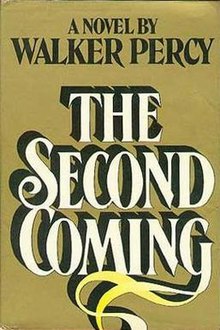
The Second Coming by Walker Percy

The present-day unbeliever is crazy because he finds himself born into a world of endless wonders, having no notion how he got here, a world in which he eats, sleeps, shits, fucks, works, grows old, gets sick, and dies, and is quite content to have it so.  Not once in his entire life does it cross his mind to say to himself that his situation is preposterous, that an explanation is due to him and to demand such an explanation and to refuse to play out another act of the farce until an explanation is forthcoming.  No, he takes his comfort and ease, plays along with the game, watches TV, drinks his drink, laughs, curses politicians, and now and again to relieve the boredom and the farce (of which he is dimly aware) goes off to war to shoot other people--for all the world as if his prostate were not growing cancerous, his arteries turning to chalk, his brain cells dying off by the millions, as if the worms were not going to have him in no time at all.

I started Walker Percy's The Second Coming not knowing it was set in the North Carolina mountains in the vicinity of Asheville.  It was a happy accident, I thought, since I was going to Asheville in a couple weeks, and I have a well-professed fondness for reading books set in the places I'm traveling.  Then I fractured some bones in my foot in a freak karaoke accident and had to cancel the trip.  An accident, but not a happy one.

But that's okay, I'm not quite unraveling to the extent that Will Barrett, the protagonist of The Second Coming, is.  Will, who also appeared in Percy's The Last Gentleman (I didn't know this was a sequel when I started it) is a millionaire.  He plays a lot of golf.  But his game has gone to seed, and he's started to have fainting spells, and he's obsessively revisiting the moment in his youth when his father shot him--maybe accidentally?--on a hunting trip.  He's also convinced that all the Jews have left North Carolina, and that this is a sign of the End of Days.  Will isn't sure if he believes in God, but he decides to put the question to a test: he will hide out in a nearby cave without food for weeks, and if he survives or is saved, he will believe:

Who else but a madman could sit in a pod of rock under a thousand feet of mountain and feel better than he had felt in years, so good that he smiled again and snapped hsi fingers as if he had made a discovery?  I've got you both, he said aloud, God-seekers and suicides, I've got you all, God, Jews, Christians, unbelievers, Romans, Jutes, Angles, Saxons, Yankes, rebs, blacks, tigers.  At last at last at last.  It took me a lifetime, but I've got you by the short hairs now.  One of you has to cough it up.  There is no way I cannot find out.

Even if the worst comes to worst, he thought with a smile, to suicide, it will turn out well.  My suicide will represent progress in the history of suicide.  Unlike my father's, it will be done in good faith, logically, neatly, and unobtrusively, unobtrusive even to the Prudential Insurance Company.

Will's experiment throws him into the care of Allison, a much younger woman who has recently escaped from a nearby sanitarium.  She's living in a greenhouse, and spending her time scheming how to hoist an old stove through the windows.

When he landed on the floor of her greenhouse, knocking himself out, he was a problem to be solved, like moving the stove.  Problems are for solving.  Alone.  After the first shock of the crash, which caught her on her hands and knees cleaning the floor, her only thought had been to make some sense of it, of him, a man lying on her floor smeared head to toe with a whitish grease like a channel swimmer.  As her mind cast about for who or what he might be--new kind of runner?  masquerader from country-club party?  Halloween trick-or-treater?--she realized she did not yet know the new world well enough to know what to be scared of.  Maybe the man falling into her house was one of teh things that happened, albeit rarely, like a wood duck flying down the chimney.

The Second Coming follows the same basic pattern as The Moviegoer.  Will and Allie, like Binx and Kate, find each other as a revelation, mental illness finding comfort and support in mental illness.  Allie's mental illness, which manifests as a strange rhyming speech pattern that only Will can understand, is not the same thing as Kate's manic-depression, but it's a degree of difference and not of kind.  Will, like Binx, undergoes a kind of cosmic search that is ever only nebulously defined, and the answers come not in the form of a mystical revelation, but in the flesh-and-blood arms of another person.

But Percy is the kind of novelist who can write the same book without it seeming like the same book.  The Second Coming is rich in detail and subtlety, and Will and Allie are distinctly drawn enough to feel like characters in a new story rather than a rehash of the old.  And while The Second Coming never matches the excellence of The Moviegoer, it struck a special chord in me because of its insights about my home state, about which Willie says he "lived in the most Christian nation in the world, the U.S.A., in the most Christian part of that nation, the South, in the most Christian state in the South, North Carolina, in the most Christian town in North Carolina."  I doubt that's true (more Christian than Alabama or Mississippi?) but I liked the way the novel explores the search for God in a place which presupposes the search is already over.

In a certain way, I identify with Percy's novels more than any others, between the religious and metaphysical subject matter and the regional specificity of the South.  I'd like to read the predecessor to this novel, The Last Gentleman, about Will's youth as a Southerner living in New York, but I'm afraid it'll be too much like looking in a mirror.

Thursday, February 4, 2010

The Neon Bible by John Kennedy Toole

The story of John Kennedy Toole is a pretty infamous one: In 1969, Toole committed suicide by connecting a garden hose to his exhaust pipe through the window of his car. In 1980, after pressing upon author Walker Percy, Toole's mother succeeded in publishing a novel that Toole left behind. In 1981, Toole was posthumously awarded the Pulitzer Prize for that novel, A Confederacy of Dunces.

But Toole left behind another manuscript: a novel he had written in 1954, at the age of seventeen, called The Neon Bible. Toole's mother, who had been so adamant about publishing Confederacy, fought the rest of his family to keep The Neon Bible from public eye, an effort which failed with her death.

The introduction--a sort of bitter defense penned by Toole's literary executor, who promised Toole's mother he would prevent the publication--does not say why she was so reticent to give up The Neon Bible, but perhaps it was because the woman who saw so much genius in her son's second novel realized the first was pretty mediocre.

The Neon Bible opens with a young man on a train, his first time. This gets him thinking about trains:

But I had a train of my own. It was a toy one I got for Christmas when I was three. That was when Poppa was working at the factory and we lived in the little white house in town that had a real roof you could sleep under when it rained, and not a tin one like the place on the hill that leaked through the nail holes too.


This clumsy segue leads to a long story about the man's upbringing in a small Louisiana valley town, and the struggles of his impoverished family. The narrative tracks the way that, as he grows up, he becomes increasingly aware of the damaging effect by the town's preacher and religious establishment, which scrutinizes his family--especially his eccentric Aunt Mae--and generally antagonizes all individuality and creativity. The neon bible sits on top of the local church, its color and brightness serving as a stark contrast for the darkness beneath.

To discover in The Neon Bible the seeds of what made Confederacy so fantastic requires deep digging. The philosophical streak of Ignatius Reilly is non-existent; Boethius, for instance, makes no appearances. The broad, pointed comedy that makes Reilly so over-the-top here is veiled by youthful earnestness. Take, for instance, Toole's description of the local grade school teacher:

Mr. Farney was different from the other people in the valley. I heard he was from Atlanta, but that wasn't why he was different. It was the way he acted that made him strange. He didn't walk the way other men did. He walked more like a woman who swayed her hips.


This may surprise you, but I believe Mr. Farney is a homosexual. I say veiled, but only in the sense that Toole chooses to view everything through the lens of a child--not that it is in any way subtle. In fact, The Neon Bible seems to be an exercise in unsubtlety. We might charitably call it earnestness. But Toole's style here reminds one of Picasso, who only felt free to twist his figures into Cubism when he had mastered the realist form.

Of course, it's barely fair to criticize the effort of a seventeen-year old, but there are so many wonderful things to say about Confederacy that Toole's legacy seems safe. Unfortunately, The Neon Bible is vastly more interesting as an artifact than a novel, and serves as a valuable lesson regarding the publication of the works of the deceased, both in controversies past, like Nabokov's, and possible, like Salinger's. Moreover, it is a lesson for the aspiring writer that first novels don't have to be masterpieces.

Monday, May 19, 2008

The Moviegoer by Walker Percy

When I finished Walker Percy's The Moviegoer, I had the strange inkling to turn it to the cover and start over again, because I had the feeling that there was a lot to it that I had missed, a lot of insight that I failed to pick up on. Ultimately I decided to put some time between readings, but more than most books I have read I think that The Moviegoer promises to be a repeat read, a book that offers a new insight every time you read it.

It has only the barest bones of plot: It is the first-person narrative of Binx Bolling in the week leading up to Mardi Gras, as well as Binx' thirtieth birthday. He is a stockbroker in the suburbs of New Orleans, pleased with his lot but overcome with strange existential angst, finally waking up one morning and deciding that he must go on "the search"--but the search for what? Percy is never so unsubtle to supply the answer to this, though in many ways it seems that it is the sort of thing that Binx will only be able to identify when he finds it. It reminded me of Rabbit, Run, where Rabbit tells the Reverend Eccles that there must be a "thing behind things." Is it God? God, as much as He can be a member of any set, is a part of it, but pinning it down seems beyond even Percy's well-honed authorial grasp.

Binx calls himself a "moviegoer" because--well, obviously--he goes to a lot of movies, but the significance of this is that in some way films anchor and validate existence. Here is a passage in which Binx and his foil, a distant cousin named Kate whose angst is greater than Binx', go to see a film:

There is a scene which shows the very neighborhood of the theater. Kate gives me a look--it is understood that we do not speak during the movie.

Afterwards in the street, she looks around the neighborhood. "Yes, it is certified now."

She refers to a phenomenon of moviegoing which I have called certification. Nowadays when a person lives somewhere, in a neighborhood, the place is not certified for him. More than likely he will live there sadly and the emptiness which is inside of him will expand until it evacuates the entire neighborhood. But if he sees a movie which shows his very neighborhood, it becomes possible for him to live, for a time at least, as a person who is Somewhere and not Anywhere.


I think this insight is particularly cunning--who among well-traveled people hasn't thought that the experience of a film seems more real than their own experiences? My mental image of Piazza San Marco in Venice is constructed of as much--if not more--the numerous depictions of it in film as my own experience there. There is something validating, certifying about films that informs our own experience and soothes our own existential angst.

I made a casual agreement with an old teacher of mine; if he would read Lolita, I would read this book. I hadn't been looking forward to it, because I tried to read it once in high school and barely got past the first few pages (which I thought were mind-numbing) and I brought it back to the library. I think I lucked out to some extent; I don't know that I would have been able to sympathize with Binx Bolling in high school--that is to say, at least in my experience, the peculiar kind of despair that Binx possesses doesn't occur until the teenage years are coming to a close. I appreciate much more now than I would have then, and I highly recommend it.