Showing posts with label Louisiana. Show all posts

Thursday, June 4, 2026

Lives of the Saints by Nancy Lemann

Summer whites, green gardens, Mississippi, white summer suits and seersucker suits, those were the sights. In the Garden District, Claude stopped and pointed out the jasmine and the cicadas in the night. That was his innocence to me. He had the sweetness of the town itself and broken my heart completely into a million pieces on the floor, as he himself would say, for he touched my heart, to such degree, that I had to steel myself, or my heart would break, like his, into a million pieces on the floor. For in Claude Collier I saw my very youth, a fateful green garden, parades on the Avenue, an orchestra on a bandstand, my youth in New Orleans.

Louise Brown is in love with Claude Collier, a young man from her faintly genteel social set in New Orleans. Claude's main character traits are his extreme kindness and compassion and a general tendency toward haplessness, toward nervous breakdowns. In fact, everyone in Nancy Lemann's Lives of the Saints seems to be on the verge of a nervous breakdown. Or maybe they just claim to be on the verge of a nervous breakdown because it is, as it still is, a fashionable thing to say, but for Claude Collier it is God's honest truth. It is, perhaps, like the southern Gothics of Truman Capote, a trait of New Orleans itself, and as Louise describes above, Claude is for her the embodiment of the city and her experience in it, which is what makes it such a tragedy when he runs off to the Northeast.

Structurally, Lives of the Saints is an odd, tricky book. The sections are typically quite brief, marked by bon mots and sudden revelations of character among Louise's New Orleans set. (It reminded me, actually, of Renata Adler's Speedboat, transposed to a very different setting and voice.) A reader gets the quick impression that plot is secondary to the adumbration of a particular place and time, and is happy enough to go along, because Lemann's evocation of New Orleans is so simply and beautifully drawn ("summer whites, green gardens"--sometimes it's as simple as that). But tragedy sneaks into the corners and sets the novel moving: Claude's brother Saint falls out of a tree and is killed. Lemann's prose is so simple (sorry, that word again) that I had to go back and reread the paragraph to make sure that I hadn't missed anything. But it's this death that sends Claude and his tweedy father, Mr. Collier, both reading, and sends Claude off to New York and Boston, leaving Louise to pine for him.

There's really not much more to the book than that. There were times when I felt frustrated by the staccato style of the novel, by the way it seems to turn in place, but after the death of Saint, I was impressed by its humor and lightness of touch, and the way it balances the melancholy. And I was frequently struck by the loveliness of Lemann's writing:

And yet one felt such a melancholy or downright sorrow, as when there is something amiss, as when you wake up in the middle of the night or early in the morning suddenly, before it is time to wake up, with the distinct feeling that something is wrong--something with this life you are reading is very wrong--except you do not know what it is. It is a nameless wrong. The nameless wrong follows you wherever you go but you can't put your finger on it.

Tuesday, August 27, 2024

South and West by Joan Didion

At the center of this story there is a terrible secret, a kernel of cyanide, and the secret is that the story doesn't matter, doesn't make any difference, doesn't figure. The snow still falls in the Sierra. The Pacific still trembles in its bowl. The great tectonic plates strain against each other while we sleep and wake. Rattlers in the dry grass. Sharks beneath the Golden Gate. In the South they are convinced they have bloodied their place with history. In the West we do not believe that anything we do can bloody the land, or change it, or touch it.

How could it have come to this?

I am trying to place myself in history.

Joan Didion's South and West isn't really a book, or if it is, it's a failed book, the scaffolding to a book. Published in 2017, it was taken from her notes, and mostly about a trip that Didion took throughout the deep South in the 1970s, followed by a brief collection of memories of California occasioned by the abduction of Patty Hearst. Whether Didion meant to contrast the two, I have no idea, but the contrast is there from the beginning of her journey through the South, which she writes attracted her because it seemed to be "for America what people were still saying California was, and what California seemed to me not to be: the future, the secret source of malevolent and benevolent energy, the psychic center." It was also a kind of return for Didion, who spent a few turbid years in Durham, North Carolina. Never mind the vast difference between Durham and Birmingham; the South may be, for Didion, a kind of shadow life not lived.

It's clear enough to me why the manuscript of the "South" section of South and West, at least, waited years to be published: Didion has no idea what to do with the South. She applies her journalistic eye, her withering eye, everywhere, but what she sees lies only at the surface of things: signs, gravestones, the front porches of houses. The language that Didion uses to describe the South is the language of mystery; the kudzu and tropical greenery seem, at every vantage point, to conceal an essential impenetrability. Uncharacteristically, Didion seems to shrink from the South. She seems to spend much of the trip in hotel swimming pools. She even tells us that she finds these pools, with their familiar interchangeability, comforting.

The greatest insights of the South instead come from the mouths of the few people that Didion interviews--all of whom seem to be known acquaintances from the world of writing and the academy. Like the white southerners of V. S. Naipaul's A Turn in the South, they offer up a fear of change and integration dressed up in the language of moderation. One interviewee laments how he has been forced by integration to send his kids to private school, and somehow manages to make it sound like a tragedy for the Black kids, too. (Didion interviews no Black Southerners, though they linger at the margins of the scrupulously reported scenery.) Is this the dark heart that Didion gestures at? It seems to me that these cultural dynamics, while vile, are not particular difficult to understand, and do not amount to any kind of essential mystery. But Didion has no interest in probing further into this or anything else, and it seems to me that in the place of insight she offers a number of Gothic metaphors, chief among them that of the snake pit. The still brown waters of the Mississippi provides a "sense of water moccasins." An anecdote tells of dripping gasoline down a snake hole to make the snake emerge, "drunk" and easy to kill. Over and over again--in a way she might have toned down, I think, if she'd ever fashioned these notes into something more--she imagines snakes lurking in the greenery. No wonder she doesn't want to touch.

We get Didion's tremendous power of noticing, but no understanding. At a movie theater in Meridian--another fungible place and easy escape from the part of the world she supposedly wanted to discover--she describes the crowd as gazing at the screen "as if the movie were Czech." But how does a Mississippian watch a movie any differently than a Californian? And why should they understand it any less? It seems like a rich comment, to me, from someone so obviously stymied by her own choice of subject. Better to say that Joan Didion looked at the audience as if they were Czech.

The "West" part of South and West is even less polished, more partial. It's slapdash in a way that reveals the true nature of the book as "notes"; "South," by contrast, seems to have gone through at least some process of arrangement and shaping. And yet, it has a richness to it that "South" never manages, especially with regards to the effusive material culture of the Californian upper middle class: the "Lilly Dache and Mr. John hats, the vicuna coats, the hand-milled soap and the &60-an-ounce perfume." In these shop-items Didion gets deeper into the identity and culture of the Californian West than she ever allows herself to do in "South"--or, at least, that's how it seems to me as a Southerner. Maybe a Californian would feel differently. But I don't think so. "West" reads like a quickly abortive attempt by Didion to find her own place in the world, her "place in history," as she writes, and though she quickly hits a wall--it's not easy to write about yourself--it made me go back and think about "South" as an attempt to do the same thing by contrast, to discover the Californian Didion by discovering the Didion-that-was-not in the South. Perhaps it's not the South that Didion was shrinking away from in those hotel pools--maybe it was herself.

Thursday, June 6, 2024

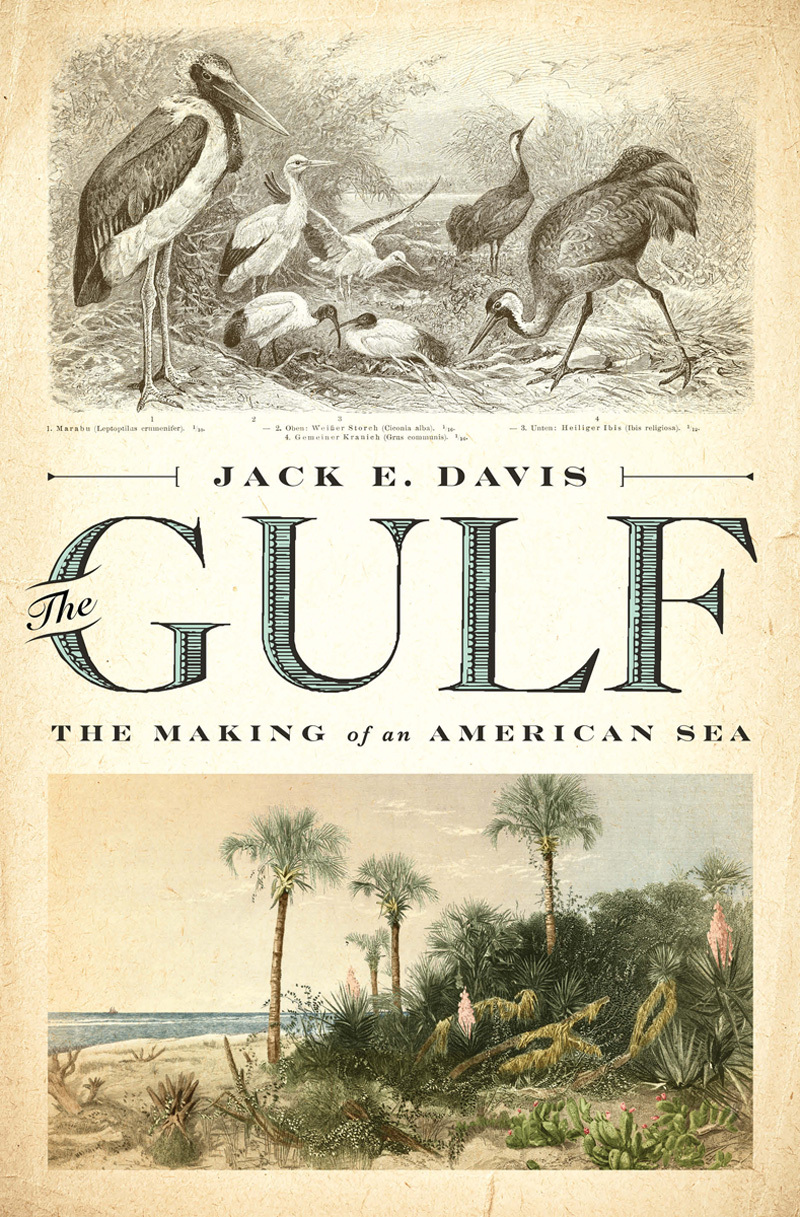
The Gulf: Making of an American Sea by Jack E. Davis

The Gulf's history, as we shall see, is America's history; the energies of one are shared with the other. Our school books taught us that there were thirteen British colonies caught up in the war for American independence, yet in truth there were fifteen: the forgotten two were the Gulf colonies of East Florida and West Florida. The Gulf was on the frontier line that advanced from the original US states, delivered opportunities to Americans and immigrants searching for a better life, and nourished the nation's coming-of-age--doing so not in just western woodland, mountain, and river valley, but on the southern sea itself... With every new train line that reached the coast, every new hotel that opened ,and every new craving for a marketable resource, the region drew closer to the furious pace of change and consumption that possessed the rest of the nation--and then surpassed it. The Gulf had become America's sea.

I've traveled a lot in the United States, but to my mind, the Gulf of Mexico has seemed elusive and inaccessible: the first time I saw it was from the remote western edge of the Everglades, a part of the national park where few venture. Then, I saw it from a small fishing village that seemed intent on disappearing from the map of Louisiana. A third time, just recently, I saw it from Texas' beautiful Padre Island National Seashore. Three times might seem like many, but we're talking a big old gulf here--and many fewer encounters than I've had with the Atlantic or Pacific. The Gulf, Jack E. Davis contends, is rather forgotten, dimmer in the American imagination than either of the great oceans. And yet, it's the Gulf that's truly an "American sea"; though Mexico has nearly as much shoreline on it (and claims the name), the waters of the Gulf emerge almost entirely from the Mississippi, America's river. Its history, he says, is American history, from the birth of European colonization to the modern mega-business of tourism, commercial fishing, and, of course, oil.

What distinguishes The Gulf is the way that Davis brings together various genres and methods: it's a history book, but also a natural science book, and a work of cultural criticism. He begins by describing the arrival of Spanish colonizers and describing their interactions, typically fraught, with local tribes in Florida and Texas. Though the Gulf's shores were the first point of mainland contact for Europeans, the Gulf itself was long forgotten in the making of the American colonial experiment; only in the mid- to late-20th century, Davis says, did the prospect of fishing bring American attention. (Davis describes the Spanish sailors as unable or unwilling to eat the immense bounty of shrimp, oysters, and fish that provided sustenance to the Calusa and Karankawa, even as they ate their own horses and boot leather.) And even then, we learn, it's sport fishing--not commercial fishing--that makes the Gulf, where Americans first learned to hook the tarpon, a massive fish who had eluded anglers for a century.

In each section, Davis relies on the stories of individuals to tell the story of the Gulf. Some, like early settler Leonard Destin (namesake of Destin, Florida) and Key West resident Ernest Hemingway, are familiar, but others are more underheralded figures, like the environmental lawyer working to clear the Gulf of industrial pollution, or the reckless brothers who turned west Florida into a sinking morass of real estate grotesqueries. I was especially stuck by the story of Walter Anderson, an artist I'd never heard of, who basically abandoned his family to live on the remote islands of what are now the Gulf Islands National Seashore, and whose painted shack walls are preserved in a museum in Ocean Springs, Mississippi. Davis never wants the reader to forget that the story of the Gulf is the story not just of birds and sawgrass and oil but the story of people, too.

The Gulf isn't shy about its political and ecological agenda. Perhaps partly because it is so ignored in the American imagination, the Gulf of Mexico is uniquely endangered. The fish are overfished; the birds, even after the early 20th century push to preserve their habitats to keep them safe from plume hunters, are diminishing in number. Oil, of course, is the number one threat, but it's joined by the effects of heavily polluting factories and the effects of eliminating marshland in favor of landfill and sea wall. "We cannot destroy or control the sea," Davis notes, "but we can diminish its gifts, and when we do, we turn away from our providence and diminish ourselves."

Sunday, April 14, 2024

The God of Nightmares by Paula Fox

During the months I lived in New Orleans, I loved more people than I had ever loved in my life. I drowned in waters of love. My heart beat strongly in anticipation of seeing them. I never wearied of their faces, their voices.

Helen lives with her mother in upstate New York, in the long shadow of her father's abandonment. When word comes that her father has finally died, her mother's tenuous hopes of reunion are shattered, and the life that they've been living together suddenly seems dreary and intolerable. Her mother sends Helen to New Orleans to find her sister, Helen's aunt, who, like Helen's mother, was once a glamorous cabaret girl. Ostensibly, Helen is sent to ask Aunt Lulu to return to New York and help manage their humble inn, but as soon as she sees Lulu in the flesh--drunk and nude, cantankerous, living in a converted old ballroom where the ceiling is plastered with stars--she understands that her mother has really sent her to free her, to show her other ways she might live. And sure enough, she finds in New Orleans a new community with whom she falls deeply in love: bohemians, poets, and queers.

Among them are Len, an enigmatic and silver-haired young man whom she falls for, and Nina, a fellow northern emigre, whom she falls for equally intensely, but in a different way. Among these Helen navigates the changing world of the American South in the 1940's: in Europe, the specter of the Nazis is looming, and here in New Orleans the old orthodoxies of race and gender fight jealously for preservation. Claude, the beautiful scion of a wealthy family, faces the threat of vengeance by the local mafia who resent Claude's attentions to one of their own young scions. Her poet friend, Gerald, suffers a lifelong injury inflicted by the very rural swamp-dwellers who form, to their great chagrin, the core of his poems. Helen, out of her stony northern element, treats these conflicts as challenges to be navigated. It's Nina, on the other hand, who shows up at the department store where Helen works and impulsively drinks from the Colored water fountain, inviting the attention and ire of witnesses. It's this boldness that both attracts and terrifies Helen.

I loved Fox's novel Desperate Characters, which takes place over a couple of days in Brooklyn, and has a kind of Sparkian slightness that you know I'm into. The God of Nightmares, with its larger cast, richer backdrop, and wider temporal scope, is a different kind of book entirely, and yet it has something of the same slightness, two qualities which I thought were rather at odds with one another. The novel evokes New Orleans less effectively, I found, than it does the spartan Hudson Valley of Helen's childhood. But the central triangle of Helen-Len-Nina is an effective and fascinating one, with Helen's aunt as a kind of star around which these planets orbit. The most interesting part, I thought, was actually the novel's slim "Part Two," which sees Helen, married to Len and living in New York, reencountering Nina for the first time in decades--only to understand for the first time that Nina and Len had had a brief affair all those years ago. That moment, where a whole history is upended by the slight turn of revelation, reminded me most of Desperate Characters.

Tuesday, December 20, 2022

The Passenger by Cormac McCarthy

The Kid turned and faced him.

What you want me to believe, said Western, is that you came here to help her in some way.

Help her in what way? She's dead.

When she was alive.

Jesus. How do I know? You see a figure drifting off the screen and you pick up the phone. How do you know that the call of the coletit from the bracken is not really the lamentations of the damned? The world's a deceptive place. A lot of thing that you see are not really there anymore. Just the after-image in the eye. So to speak.

What did she know?

She knew that in the end you really cant know. You cant get a hold of the world. You can only draw a picture. Whether it's a bull on the wall of a cave or a partial differential equation it's the same thing. Jesus.

Bobby Western has been a lot of things. Right now he's a salvage diver, plumbing the depths of the Gulf of Mexico to ransack wrecks and tinker with pipelines. Once upon a time he was a student of physics, a mathematical whizkid who received his genius from his father, a Manhattan Project engineer, and who was yet in the shadow of his even more brilliant sister, Alicia. After that, he was a race car driver, a profession that put him in a coma. When he emerged from this coma, Bobby discovered that Alicia--his greatest love, his soulmate in perhaps the most literal sense--had committed suicide. The Passenger's companion novel, Stella Maris, is her story; this is Bobby's, although Alicia is here too, in the form of italicized flashbacks in which she faces her own hallucinatory attendants: a crude, disfigured figure called the Thalidomide Kid and a troop of Vaudevillean goblins.

When The Passenger begins, Bobby has been sent to scout a plane crash in the Gulf, the kind with moldering corpses inside. There's no sign of entry on the plane, but the black box is missing, and one of the passengers seems to be, too. Bobby makes a few quick investigations, finding little; but shortly after he finds himself the subject of a mysterious investigation: he's menaced by agents of unknown affiliation, his apartment is ransacked, his car and bank account are seized with no explanation, his fellow diver is killed under mysterious circumstances. Are Bobby's pursuers connected with the crashed plane? Or are their interests related to Bobby's father, who worked at Oak Ridge and Los Alamos, helping to usher the world into an age of atomic cataclysm?

The Passenger's refusal to bring these mysteries to a satisfying conclusion seemed like an affront to me personally. Maybe there are answers in Stella Maris, but I doubt it. So one must think of the plane crash as a symbol: a symbol, perhaps, of Bobby, who survives his wreck and his coma but emerges into a world that is missing its most important soul, and which refuses now to make any sense. Alicia, perhaps, is the passenger of the title, whose significance is reduced in death to a mere absence, and whom Bobby spends the entire book fretting that he will forget. (For what its worth, in the post-Game of Thrones era, sibling incest seems too anodyne to be shocking, even a kind of literary cliche.) Amd the forces of grief and despair that pursue him can not even be named, much less mollified.

And yet, I found Bobby's dives to be some of the most interesting and engrossing parts of the novel. Much has been made of McCarthy's newfound interest in physics and mathematics, apparently gathered from his friendship with quark-discoverer Murry Gell-Mann and a connection with the research department at the University of New Mexico. But McCarthy's interests haven't changed, it seems to me; he's still the Gnostic, terrified by the world's indifference and unknowability. Mathematics is, like diving, another way of plumbing the deaths, searching for a truth that will not be made known. As the Thalidomide Kid tells Bobby--who sees him also, like a kind of dispensation--"Whether it's a bull on the wall of a cave or a partial differential equation it's the same thing."

The Passenger is an awfully strange book, even for McCarthy. On one level it's sort of an espionage novel, a classic noir of the man who got into deep. But in practice it's mostly talky, composed of a dozen or so lengthy conversations: with down-and-outs from New Orleans to Knoxville, with Bobby's shrewd private investigator, with his fellow divers, with a friend of Alicia's from the period of her commitment. One of Bobby's interlocutors is a trans escort named Debussy Fields (LOL) who is touchingly and sympathetically drawn in a way I really would not have expected McCarthy to have in him. But all these conversations, all these parts--diver driver mathematician apparition--have difficulty cohering. The Paassenger could only be a late period work. It reminds me of those late Shakespeare plays in which he stopped bothering trying to make sense to anybody but himself.

But it's a Cormac book, no doubt, and who else is going to give you a book like that? Who else is going to give you those sentences? The language is plainspoken and hushed, with fewer forays into the OED, but the rhythm of those words is unmistakable, inimitable. And though the mathematics, it seems to me, betrays a dilettante's eye, they give a new language, perhaps even a better one, to ideas that have troubled McCarthy's books for a long time. We've had a long time to live with books like Blood Meridian, even The Road. Something tells me that we'll have to live with this one a little longer to really see it as it is.

Monday, June 14, 2021

Other Voices, Other Rooms by Truman Capote

Before birth; yes, what time was it then? A time like now, and when they were dead, it would be still like now: these trees, that sky, this earth, those acorn seeds, sun and wind, all the same, while they, with dust-turned hearts, change only. Now at thirteen Joel was nearer a knowledge of death than in any year to come: a flower was blooming inside him, and soon, when all tight leaves unfurled, when the noon of youth burned whitest, he would turn and look, as others had, for the opening of another door. In the woods they walked the tireless singings of larks had sounded a century, and more, and floods of frogs had galloped in moonlight bands; stars had fallen here, and Indian arrows, too; prancing blacks had played guitars, sung ballads of bandit-buried gold, sung songs grieving and ghostly, ballads of long ago: before birth.

Joel Knox is thirteen. He has been living in New Orleans with a caretaker most of his life, until a letter finally comes from a far-flung estate in the Louisiana backwoods: yes, Joel's biological father, Edward Sansom, would like for Joel to come and stay with him. Arriving at the estate, Joel finds a small cadre of strange and reclusive people: his father's anxious wife Amy; effeminate "cousin" Randolph; Zoo, a black servant who provides the closest thing Joel will get to parenting in this strange place; her ancient father Jesus Fever; the redheaded tomboy Idabel and her twin sister. A strange white-haired lady appears at a window like a ghost and is never seen again. Life with this group turns out to be quiet and strange, like "living in a glass bell," and where is his father anyway?

I picked up Other Voices, Other Rooms because I was inspired, in a perverse way, by Jenn Shapland's My Autobiography of Carson McCullers: Capote and McCullers, she contends, were bitter enemies--McCullers, it seems, accused Capote of cribbing from her. (It's hard not to see her point: look how young Joel longs for nothing more to see snow, like Frankie in The Member of the Wedding, published just two years before. And I have no idea if this is borne out by timing, but the descriptions of cousin Randolph striding through the empty manse in his silk kimono certainly seems to recall McCullers herself, who cultivate this look to accommodate her long-term illness.) With McCullers in mind, though, I became impatient with the familiarity of Capote's southern Gothic: the overgrown mansion, the woman with the scar around her neck, the identical twins.

But I was eventually won over by the dreamlike quality of Other Voices, Other Rooms. Joel is frustrated by the strangeness and loneliness of his new home, but as the days wear on, its strangeness seems to seep into his mind, and his outlook becomes more and more feverish, prone to visions and hysterias. When he is at last allowed to see his father, he is only unsettled more: Edward Sansom is a paraplegic whose eyes are perpetually open, and who tosses tennis balls into the sitting room to demand attention. At last Randolph tells him the full story: many years ago, his girlfriend began an affair with a handsome boxer. Randolph, enraged not by her unfaithfulness but the unwelcome realization that he too was in love with the boxer, tried to shoot them--but hit Sansom, the boxer's manager instead. Now they live here in this house, caring for each other--each an abandoned half, cast off to make a unity.

The estate is an outpost at the end of the earth where the injured and guilty flee. It's only here that Randolph can really live, in his kimono and painted toenails--that white-haired lady at the window, of course, is him, too. It's where Zoo can live and be safe from the possessive lover who gave her the scar, though she lives with the daily fear of his return. This strange place is a haven, but a fragile haven, and it hardly seems a place for a boy as young, and as sensitive, as Joel. Thirteen year old boys have such active imaginations already, and Joel is no exception, but life at Skully Landing threatens to push that imagination into overdrive. An abortive attempt at running away with Idabel is no good; he brings the madness of the place with him, and when he's felt up on a Ferris wheel by a little person--I am not joking--he nearly breaks from reality completely. Only when he's dragged back to his newfound home can he really begin to find himself again.

The strong implication here is that Joel, like Randolph, must learn to accept his own homosexuality, and that Randolph, who nurses him through his pneumonia, is his true exemplar and father figure. (His love for Idabel, we presume, is a response to her masculine nature as opposed to her more feminine sister Florabel.) And yet the book suggests that there are few places in the world where people who have become truly themselves can live without degradation and shame, places that must seem strange to a world to whom they've turned their back.

Thursday, April 23, 2020

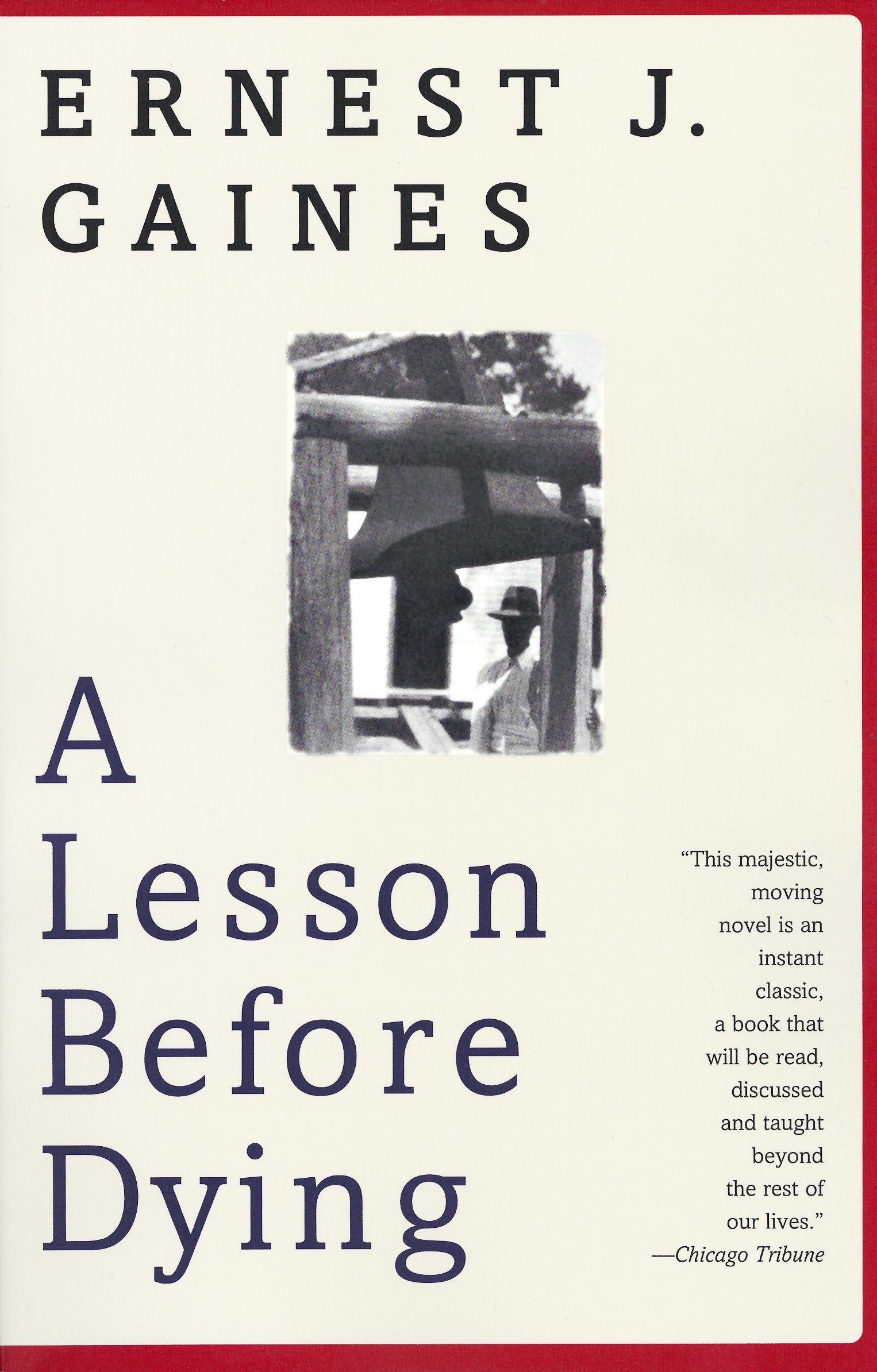
A Lesson Before Dying by Ernest J. Gaines

"Let me explain it to you, let me see if I can explain it to you," I said.  The brandy was really working now.  "We black men have failed to protect our women since the time of slavery.  We stay here in the South and are broken, or we run away and leave them alone to look after the children and themselves.  So each time a male child is born, they hope he will be the one to change this vicious circle--which he never does.  Because even though he wants to change it, and maybe even tries to change it, it is too heavy a burden because of all the others who have run away and left their burdens behind.  So he, too, must run away if he is to hold on to his sanity and have a life of his own.  I can see by your face you don't agree, so I'll try again.  What she wants is for him, Jefferson, and me to change everything that has been going on for three hundred years.  She wants it to happen so in case she ever gets out of her bed again, she can go to that little church there in the quarter and say proudly, 'You see, I told you--I told you he was a man.'  And if she dies an hour after that, all right; but what she wants to hear first is that he did not crawl to that white man, that he stood at that last moment and walked."

Jefferson, a young black men, has been sentenced to death for killing a white storeowner.  He's innocent, a bystander, but it hardly matters in front of a white jury.  Even his lawyer tries to defend him by saying that he's too stupid and inhuman to be responsible for what happened; to kill Jefferson would be, the lawyer says, like killing a hog.  Grant Wiggins is a schoolteacher in the same Louisiana parish, and Jefferson's godmother, a friend of Grant's aunt, wants Grant to visit Jefferson on death row to teach him one more lesson before the date of his execution--that he is a man, and not a hog.

Grant is resistant to these claims being made on him, that he can, or should, try to teach Jefferson anything.  Grant is a bitter man and a bad teacher who hates his job, hates living in the South, and dreams only of moving away to California when his girlfriend, Vivian, is finally able to secure a divorce.  His aunt, Jefferson's godmother, to Grant they want him to do something that would entail reversing hundreds of years of history.  But he goes, and finds that Jefferson is just as recalcitrant as he expected, and refuses to talk to him.  At one point, he brings a dish of Jefferson's godmother's food, which Jefferson eats on the floor with no hands--like a hog.

It's not hard to see where this novel is going, where, in fact, it has to go: Jefferson opens up to Grant, and Grant is able to help him walk toward his fate with dignity, but Jefferson too turns out to have something to teach Grant.  (The ambiguity is baked into the title, yeah?)  I often felt like A Lesson Before Dying moved with a kind of cinematic necessity.  The voice of black and Creole Louisiana is powerful and effective, but I often felt the heavy hand of Gaines behind it.  (It's hard to put that critique into the right words; I don't doubt that everyone in the parish is thinking constantly about Jefferson and the date of his execution, or thinking through it in sophisticated and traumatic terms, just that the scriptlike directness of the dialogue detracted from the sense of place and atmosphere.)

The best part of the book, I felt, was when Jefferson gets to speak in his own words, writing his final thoughts down, diary-style in a notepad that Grant's bought him:

i just can't sleep no mo cause evertime i shet my eyes i see that dore an fore i get there i wake up and i dont go back to sleep cause i dont want walk to that door no mo cause i dont know what back o there if its where they gon put that cher or if it spose to mean def or the grave or heven i dont know

The rawness of Jefferson's language, contrasted with Grant's proud and educated voice, rings forth with a truth and pathos I wanted more of from A Lesson Before Dying.  Jefferson is terrified, brave, dignified, human--no hog.  It's hard to read his words without thinking of the nearly three thousand people on death row in the United States right now, whose dignity and humanity, like Jefferson's, have been taken from them--no matter whether, like Jefferson, they are innocent.  And though the novel is flawed and little less compelling than I'd hoped, it didn't have to do much to evoke rage and despair from me.  A Lesson Before Dying captures the stifling social borders of the mid-century South--it drives you nearly insane to see the way the intelligent and accomplished Grant is abused and minimized by white power-holders.  It would be comforting to think of it, like Green Book, as a historical snapshot of a time past which we've progressed, but Jefferson's story is sadly timely.

Sunday, October 27, 2019

Lancelot by Walker Percy

How strange it is that a discovery like this, of evil, of a kinsman's dishonesty, a wife's infidelity, can shake you up, knock you out of your rut, be the occasion of a new way of looking at things!

In the space of one evening I had made the two most important discoveries of my life.  I discovered my wife's infidelity and five hours later I discovered my own life.  I saw it and myself clearly for the first time.

Lancelot Andrewes Lamar is a scion of the old Louisiana guard: he lives in his family's plantation house outside New Orleans, a house open to tourists, having become a kind of theme park version of its old self.  His wife, Margot, has offered it to a group of filmmakers to stage a movie she's appearing in; the movie, too, is a symbol of the way that old traditions survive only in nostalgic simulacra.

Lance himself is a victim of the hollowing-out of the modern world.  Once he was a star football player.  In a particularly Percy-esque detail, he set the NCAA punt return record against Alabama.  (Southerners in Percy's fiction can never keep from including things like golf and football in the list of disappearing values.)  For years he lived on autopilot, until, as he tells his mysterious conversation partner, he discovered that his daughter Siobhan was not really his daughter at all.

Lancelot takes the form of an interview or confession: Lance, speaking from a cell at an institution called the Center for Aberrant Behavior, recounts how he ended up murdering the film director who was his wife's lover before blowing up his plantation home, killing his wife and a pair of other actors.  He speaks to an old friend, a psychiatrist and priest, who may not really exist.  Certainly his name, "Percival," and Lance's obsession with a lost golden age of mythic virtue, reflected in the names of those knights, suggests he's not really there.  Oh, and Lance also tells him about the woman in the room next to his, a mute rape victim who can only communicate through taps, and with whom he plans on starting a new Eden.

Reading Lancelot is... upsetting.  There's a black heart to it that isn't present in any of Percy's other novels.  Lance's megalomania, racism, sexism, and violence, make it difficult.  He enlists a clever black servant named Elgin to help him bug a hotel where his wife is staying, and every time he talks about Elgin's technical acumen he sounds like a man describing a dog who learned to talk.  Lance describes his reputation as a "liberal lawyer" defending black clients, but his politics are reactionary to the extreme.  He idolizes Robert E. Lee and talks about the Civil War as the "Second Revolution," a failed attempt to beat back the forces of modernization.  (That's why, in his fantasies, he and the mute woman next door move to Virginia, the locus of the first two revolutions and the third, which he imagines himself at the center of.)

What am I supposed to do with a narrator like this?  What makes it complicated is that Lance doesn't seem so different from Percy's other protagonists.  For Percy, the alienation of modernism always manifests as mental illness.  Like Will Barrett in The Second Coming and Binx Bolling in The Moviegoer, Lance seeks wholeness through companionship with a woman who is also mentally ill.  Lance's complaints about modern society--commercialism, pornography, the lost sense of history and myth--are reflected in the parodic dystopia of The Thanatos SyndromeAnd doesn't this sound like a really sharp diagnosis, by Lance, of The Moviegoer's Binx, who can't feel he really lives somewhere until he sees it in a movie?:

The world had gone crazy, said the crazy man in his cell.  What was nutty was that the movie folk were trafficking in illusions in a real world but the real world thought that its reality could only be found in the illusions.  Two sets of maniacs.

But it's also hard to imagine Binx Bolling, Will Barrett, or Tom More, saying a thing like this:

What the poor dears discovered is the monstrous truth lying at the very center of life: that their happiness and the meaning of life itself is to be assaulted by a man.

Yes, that's right: at one point in this novel, Lance says that the point of life is to rape and be raped.

The destabilizing effects of modernism in Percy, along with the cobbled-together language of mysticism and self-help, make them very knotty and difficult to tease out.  I find this statement particularly difficult to reconcile, even among Lance Lamar's nasty opinions.  But at the very least I'm sure it's connected to Lance's sublimated anger at his wife's infidelity, which becomes transmuted into an apocalyptic fantasia about a new world order.  In fact, Lancelot seems prophetic in a way: don't incel murderers like Elliot Rodger follow this pattern exactly when they transform their frustrations with women into fantasies of social upheaval?

What's most difficult about Lance is the way he seems to take things Percy genuinely believes, based on a wide reading of his novels, to murderous extremes.  Percy clearly agrees that modernity breeds alienation and mental illness, and I think his nostalgia for the old South is genuine to some degree.  It's possible that Lancelot is one of those rare novels in which an author looks critically at their own darker impulses.  (Doesn't Ford Madox Ford do something similar with his own Toryism in Parade's End?)

But it's not very pleasant.  I don't think Lancelot is a book made for anybody to love.  You can survive it, maybe, as Lance's wife and her lover do not.  But this is the last of Percy's novels for me, and I'm disappointed to know that my experience with them ends in such a discomfiting place.

Sunday, August 26, 2018

The Last Gentleman by Walker Percy

The South he had come home to was different from the South he had left.  It was happy, victorious, Christian, rich, patriotic and Republican.

The happiness and serenity of the South disconcerted him.  He had felt good in the North because everyone else felt so bad.  True, there was a happiness in the North.  That is to say, nearly everyone would have denied that he was unhappy.  And certainly the North was victorious.  It had never lost a war.  But Northerners had turned morose in their victory.  They were solitary and shut-off to themselves and he, the engineer, and got used to living among them.  Their cities, rich and busy as they were, nonetheless looked bombed out.  And his own happiness had come from being onto the unhappiness beneath their happiness.  It was possible for him to be home in the North because the North was homeless.  There are many things worse than being homeless in a homeless place--in fact, this is one condition of being at home, if you are yourself homeless.  For example, it is much worse to be homeless and then to go home where everyone is at home and then still be homeless.  The South was at home.  Therefore his homelessness was much worse in the South because he had expected to find himself at home there.

Will Barrett is a Southerner, by way of Louisiana and Alabama, living in New York City.  He is intelligent, kind, and diligent, but Percy tells us that "he looked better than he was" and that in him "something was missing."  He suffers from psychological maladies both specific and abstract: he suffers from amnesia and fugue states, sometimes forgetting who he is, and more general ennui.  He engages a psychiatrist, and does everything prescribed to him, but in years of therapy has made no progress.  Still he wants to know, why does he feel so bad when he ought to feel good?  Why do good environments make him feel bad and bad environments make him feel good?  A detail shows that he suffers from the same modernism that Binx Bolling does in Percy's The Moviegoer: he visits the Metropolitan Museum of Art, but the Velazquez looks dead and inert to him until a worker falls through a ceiling light.  Suddenly it is "glowing like a jewel"--proximity to tragedy elevates life, though momentarily.  For Binx it's the movies that make things real; for Will it's his telescope, that makes the bricks on the buildings across Central Park suddenly alive.  Both of them have the same problem: How is it possible, they ask, to live from one moment to the next?

Though existential angst must be universal, for Percy it's always tied to geography.  Will's self-imposed exile from the South is a kind of self-abegnation:

New York is full of people from small towns who are quite content to live obscure lives in some out-of-the-way corner of the city.  Here there is no one to keep track.  Though such a person might have come from a long line of old settlers and a neighborhood rich in memories, now he chooses to live in a flat on 231st Street, pick up the paper and milk on the doorstep every morning, and speak to the elevator man.  In Southern genealogies there is always a mention of a cousin who went to live in New York in 1922 and not another word.  One hears that people go to New York to seek their fortunes, but many go to seek just the opposite.

I don't feel that way--I feel quite at home in New York--but as an ex-pat Southerner I recognize some of the shape of Will's life.  Hell, I finished the novel on a plane this morning headed back to New York from visiting my own ancestral home.  The South is central to Will's identity; he embraces it, right down to college football and golf (Percy is the novelist of golf), but he runs from it because embracing it doesn't make him feel any better.  It makes him feel worse because the embrace of it does so little.

Will's return to the South happens this way: using his telescope, he spies a beautiful girl retrieving a secret message on a bench in Central Park.  He follows her to a hospital in Washington Heights (Columbia Medical School, where Percy himself once studied) to find her attending to her terminally ill teen brother, Jamie.  Will ingratiates himself into the family, who turn out to be old-school Alabamians, too, fellow aliens.  The family's patriarch, Chandler Vaught, employs Will to be a kind of caretaker for Jamie, and return to Alabama with them.  His daughter, Kitty, falls dutifully but difficultly in love with Will.  Added to these are Rita, a dutiful sister-in-law who manages Jamie's care and is suspicious of Will; Val a sister to Jamie and a sister of the cloth (she's a nun), and Sutter, a disgraced doctor and self-professed pornographer whose influence on Jamie is considered slightly less dangerous than his illness.

Left in New York by the family, Will hitches a ride with a John Howard Griffin-style photographer disguised as a black man.  Together they're ambushed in Levittown by a mob thinking they've come to "bust the block," meaning sell a house to a black man.  It's a weird and funny digression, meant to highlight, perhaps, the rottenness at the heart of the century of the American suburb (Levittown is America's first), and deflect the idea that racial tension is the property of the south.  There's a touch of real gallantry in Will when he snaps at his companion not to give in to the mob by showing them the remaining spot of Caucasian skin.  It's a nice moment, especially because Percy, like Will, often keeps his black characters at arm's length.

When Will is finally reunited with the Vaughts, the plot remains comic and frenzied, and sometimes borders on nonsense.  There's an inherent but understandable silliness in the way the family hinges on Jamie's wishes: when he wants to go to school, Jamie, Will, and Kitty all enroll at the University of Alabama; when he wants to jet off to New Mexico, Will's got withdraw from school and climb in the camper van.  Take a step back and you'll see how wild it is that this family invites this genial stranger into their life this way at all.  But perhaps they know, like Will, that in the proximity of danger and death everything changes, even as they uphold the banners of the rectitudinous country-club South.

Will's return to the South might have played like Milkman's in Song of Solomon: an expedition to an ancestral home that allows the protagonist to discover who they are.  And Will does go home: to his uncle's, who lives in a weird hermit state with his black servant, and to his childhood home, where his father once committed suicide.  But he doesn't see his aunts who still live there, he sneaks in and sleeps in the attic.  And it's his house--he owns it!  But there are no answers there, and the same old problems return.  Kitty becomes exactly the kind of old-fashioned southern sorority girl that he thinks he desires, and it repulses him.  Deracination--uprootedness--hurts more when the roots are deepest, as they are in the American south, Percy tells us.  The intensity of its myths and manners are no match for the modern condition.

The final section of the novel takes place outside Santa Fe, where Jamie has decamped to live out the last days of his life.  As a setting, New Mexico does strange work in this novel.  It means an abandonment of the dialectic of North and South, an escape to a place that has nothing to do with those old polarities.  It represents the possibility, perhaps, of a kind of transcendence, and a death for Jamie on his own terms.  My wife and I had our honeymoon in New Mexico.  We talk sometimes about moving there for good.  Our relationship to the place isn't very strong, or knowledgeable, but I understand how it functions as the idea of a place.  And it's strange, the way this novel seems to share a kind of mental map with me, and which made it meaningful to me in particular.  The ending, which centers on the question of whether a delirious Jamie will allow himself to be baptized by the hospital chaplain, resolves nothing, but it is funny, strange, ragged, and deeply sad.

The Last Gentleman is a novel I wish I could go on talking about.  What do you make, for instance, of the fact that Will is typically identified as "the engineer," though it refers to his title as a custodial engineer in the basement of Macy's, a job he gives up in the first 100 pages?  What's he making, what's he fixing?  Much of it seems like it ought to fail, but it hovers somewhere outside the realm of rational sense, and does so beautifully.  More than any of the other novels I've read of Percy's, it shares the kind of madcap logic and unexpected prose of The MoviegoerIt's a book that, when I was done with it, I wanted to turn it over and start it again, to prod it into some kind of structure and sense.  But to do that, to make a thesis statement of it, might rob it of the brilliance of its mystery. 

Tuesday, June 21, 2016

The Thanatos Syndrome by Walker Percy

Old-fashioned shrinks are out of style and generally out of work.  We, who like our mentor Dr. Freud believe there is a psyche, that it is born to trouble as the sparks fly up, that one gets at it, the root of trouble, the soul's own secret, by venturing into the heart of darkness, which is to say, by talking and listening, mostly listening, to another troubled human for months, years--we have been superseded by brain engineers, neuropharmacologists, chemists of the synapses.  And why not?  If one can prescribe a chemical and overnight turn a haunted soul into a bustling little body, why take on such a quixotic quest as pursuing the secret of one's very self?

Walker Percy is one of the last authors I ever expected to turn to science fiction, if that's what it is.  And to be sure, for the most part, the Louisiana of The Thanatos Syndrome resembles that of The Moviegoer: lovingly rendered, at times both exotic and banal, as full of country clubs as it is swamps.  But Percy infrequently reminds us that this world is not our own.  There are the qualitarian centers, for example, that engage in euthanasia for the very old and the very young, if they are disabled or unfit.  The modern psychopharmaceutical industry of The Thanatos Syndrome is much like ours, though it cast its shadows just a little longer.

Tom More, the "failed but not unhappy" therapist who is the novel's protagonist (and the protagonist of Percy's previous novel Love in the Ruins--why do I keep accidentally picking up his sequels?) is a traditional doctor in world that no longer seems to have a place for them.  But in his practice he begins to notice what others have not: that the people of Feliciana Parish are acting strangely.  They are taciturn, obedient, less troubled, but computer-like.  Ask them where St. Louis is, and they might tell you that it is 600 miles north of New Orleans.  And the women, for some reason, keep coming on to Dr. More by turning around and presenting their butts.

With the help of his sexy cousin (I know) Lucy Lipscomb, an epidemiologist, Tom unravels a conspiracy, concocted by his hospital associates, to flood the water supply with "heavy sodium," which reduces people to a more primitive psychological state.  The benefits are manifold: lower crime, lower drug use, fewer unplanned pregnancies.  Okay, so that last one comes about because women no longer menstruate, instead going into heat once a month like a farm animal.  But it's hard to argue with results.  But even the well-meaning conspirators are unaware that their solution is being used at the local boarding school to stupefy children, making them more amenable to sexual abuse.

The details of the child abuse Tom and Lucy uncover are as detailed as they are grotesque.  They are a reminder that The Thanatos Syndrome is more serious than a pulpy Dean Koontz novel, which the plot at times resembles.  Like The Moviegoer and The Second Coming, the novel alerts us to the importance of human psychological fragility.  Anger, hatred, lust, anxiety, and the other spiritual beasts the heavy sodium is meant to eliminate are as much a part of what it means to be human as our better angels.  A long interlude, in which a minor character talks about his experience with the Hitler Youth in Germany, reminds us that our best intentions can lead to our most monstrous actions, a criticism which is pointed directly at the Ritalin- and Prozac-hawkers of the 20th century.

The Thanatos Syndrome is tonally bizarre.  The minor characters never quite come into their own, and the sexual relationship between Tom and Lucy seems as contrived as the romances in more commercially contrived conspiracy novels.  It doesn't quite work as pulp, and it doesn't quite work as a Percy novel.  But, like its protagonist, it's happy despite, or perhaps because of its failures:

What is failure?  Failure is what people do ninety-nine percent of the time.  Even in the movies: ninety-nine outtakes for one print.  But in the movies they don't show the failures.  What you see are the takes that work.  So it looks as if every action, even going crazy, is carried off in a proper, rounded-off way.  It looks as if real failure is unspeakable.  TV has screwed up millions of people with their little rounded-off stories.  Because that is not the way life is.  Life is fits and starts, mostly fits.  Life doesn't have to stop with failure.

Monday, April 1, 2013

The Silence of Bonaventure Arrow by Rita Leganski

I'm a big fan of the slow build. It's a storytelling device that works particularly well in written storytelling. And when it's done well, it's hard to beat. The problem with the slow build is that it puts pressure on the climax of the story. People are expecting something big. The payoff is kind of the point of the slow build.
 
The Silence of Bonaventure Arrow is one big slow build. No sooner does Leganski introduce a character in her tale, than she is dropping hints about their arc, punctuating her story with spots of foreshadowing. Leganski lays out the basic plot of her novel in the first eight pages. She introduces her readers to Bonaventure as he is being introduced to the world, immediately signaling to her readers that there is something unique--something special--about this little baby, and that this special something is the organizing force of the novel. She describes him as being able to "hear conjured charms and sanctified spirits deep in the marrow of New Orleans. He could hear the movements of voodoo queens and the prayers of long dead saints. He could hear the past and the present." Two paragraphs later, Leganski introduces Trinidad Prefontaine as "a kindred spirit" that Bonaventure needed to join up with. Bonaventure and Trinidad don't meet for another 170-some pages.

Leganski lets her readers in on the story piece by piece, jumping back a generation when backstory is necessary, and all the while bouncing between three story lines, seemingly disparate except that Leganski has explicitly told her readers that they will converge. She conjures a mystical mid-20th century Louisiana and populates it with equally mystical characters.

Leganski does a better job with the slow build, than she does with the ending. There is no real climax to the story. That's not to say that loose ends are not tied up, that story lines are not put to rest. But the story didn't crescendo like I expected it would.

Thursday, February 4, 2010

The Neon Bible by John Kennedy Toole

The story of John Kennedy Toole is a pretty infamous one: In 1969, Toole committed suicide by connecting a garden hose to his exhaust pipe through the window of his car. In 1980, after pressing upon author Walker Percy, Toole's mother succeeded in publishing a novel that Toole left behind. In 1981, Toole was posthumously awarded the Pulitzer Prize for that novel, A Confederacy of Dunces.

But Toole left behind another manuscript: a novel he had written in 1954, at the age of seventeen, called The Neon Bible. Toole's mother, who had been so adamant about publishing Confederacy, fought the rest of his family to keep The Neon Bible from public eye, an effort which failed with her death.

The introduction--a sort of bitter defense penned by Toole's literary executor, who promised Toole's mother he would prevent the publication--does not say why she was so reticent to give up The Neon Bible, but perhaps it was because the woman who saw so much genius in her son's second novel realized the first was pretty mediocre.

The Neon Bible opens with a young man on a train, his first time. This gets him thinking about trains:

But I had a train of my own. It was a toy one I got for Christmas when I was three. That was when Poppa was working at the factory and we lived in the little white house in town that had a real roof you could sleep under when it rained, and not a tin one like the place on the hill that leaked through the nail holes too.


This clumsy segue leads to a long story about the man's upbringing in a small Louisiana valley town, and the struggles of his impoverished family. The narrative tracks the way that, as he grows up, he becomes increasingly aware of the damaging effect by the town's preacher and religious establishment, which scrutinizes his family--especially his eccentric Aunt Mae--and generally antagonizes all individuality and creativity. The neon bible sits on top of the local church, its color and brightness serving as a stark contrast for the darkness beneath.

To discover in The Neon Bible the seeds of what made Confederacy so fantastic requires deep digging. The philosophical streak of Ignatius Reilly is non-existent; Boethius, for instance, makes no appearances. The broad, pointed comedy that makes Reilly so over-the-top here is veiled by youthful earnestness. Take, for instance, Toole's description of the local grade school teacher:

Mr. Farney was different from the other people in the valley. I heard he was from Atlanta, but that wasn't why he was different. It was the way he acted that made him strange. He didn't walk the way other men did. He walked more like a woman who swayed her hips.


This may surprise you, but I believe Mr. Farney is a homosexual. I say veiled, but only in the sense that Toole chooses to view everything through the lens of a child--not that it is in any way subtle. In fact, The Neon Bible seems to be an exercise in unsubtlety. We might charitably call it earnestness. But Toole's style here reminds one of Picasso, who only felt free to twist his figures into Cubism when he had mastered the realist form.

Of course, it's barely fair to criticize the effort of a seventeen-year old, but there are so many wonderful things to say about Confederacy that Toole's legacy seems safe. Unfortunately, The Neon Bible is vastly more interesting as an artifact than a novel, and serves as a valuable lesson regarding the publication of the works of the deceased, both in controversies past, like Nabokov's, and possible, like Salinger's. Moreover, it is a lesson for the aspiring writer that first novels don't have to be masterpieces.

Thursday, February 12, 2009

Dead Until Dark by Charlaine Harris

It all started with Twilight. This summer I went on a business trip to Salt Lake City. While I was there, the last book in Stephanie Meyers' Twilight series was released at midnight. After seeing countless girls and women (no dudes) waiting in line hours before the release, I walked into the Barnes and Noble and casually edged by the vampire book table. Yes, every Barnes and Noble or Borders worth their salt has a vampire table now. I wasn't really keen on being seen actually looking at a book on the cheesily decorated vampire table...nevermind buying one then.

It took a few more months (and some friends' testimonials) to actually buy Twilight. Which I read in a night. I finished the series in 5 days. In order to do this, I read in public. I read at work. I read on the Metro. I removed the covers from the books so people wouldn't realize I was reading the newest tween phenomenon. I loved those books. And I covertly began recommending the book to my friends. Well, the ones who wouldn't make fun of me.

So when I heard about this series, the "Southern Vampire" books or the "Sookie Stackhouse" novels, I was more open-minded. I checked one out at the library. I was well-pleased by its glittery cover. My esteem for it was bolstered by the fact that a new HBO series, TrueBlood, was based on it. And while it didn't quite live up to Twilight, it was pretty good. Not literary masterpiece good (by far), but entertaining.

Sookie Stackhouse is a waitress living in Northern Louisiana, a few years after vampires, now a nationally recognized minority group, have "come out of the coffin." Sookie is a sweet girl but doesn't have much luck with the menfolk because she can read their minds. However, most people in town don't really believe she has a special power. The just think she's kind of crazy. Sookie meets a vampire for the first time when one named Bill walks into her bar one night. Typical romance novel ensues for a bit - he senses she's different, she saves his life, he saves hers, they start to date, have descriptive-but-not-graphic sex scenes. Their relationship unfolds along the backdrop of a string of unsolved murders in town. Additionally, it turns out that some other vampires, ones that aren't trying to "mainstream" into human society like Bill, get a whiff of Sookie's gift. Bill and Sookie find themselves trying to solve a murder mystery and protect Sookie from some vampires that really, really vant to suck her blood (haha).

This book was great for what I wanted right now - something light and fun after the dryer book I just finished. I wouldn't recommend it to any of you guys, it's definitely a chick book. I don't even know if I'd recommend it to all Twilight fans. Twilight had a little something extra going on, kind of a darkly gothic vibe. This book, even given its subject matter, was strictly romance and mystery. No undertones. And for all you haters out there (Mr. Chilton), I fully recognize that this book is no literary treasure. Some lines were awkwardly red-neck, and Bill and Sookie's relationship was a little too earnest at times for the lighthearted spirit of the rest of the book. Overall, this book probably falls somewhere in between The Princess Diaries and The Devil Wears Prada in the great literary scheme of things.

I'm totally going to read the other 8 books in these series. And blog about them. But not right away. Next, I need to read something just a touch more edifying. And then, when I'm ready, I'll return to Sookie and Bill.