Showing posts with label Alabama. Show all posts

Wednesday, September 24, 2025

Why Did I Ever by Mary Robison

"I need plywood," said my son, Paulie, in his sleep. Or I heard wrong. I know it was "need" something.

That was my first day there, at his flat on St. Anne, before the NYPD began hiding him.

He looked like this: in white cotton socks and frayed blue jeans, a cowhide belt and a petal-green sweater. his hands in their horrible bandages must've been on his lap and I couldn't see them because he was bent over, with his plate pushed aside and his face on the dining room table, and he was all-the-way asleep, with a tiny chip of emerald glinting there in the lobe of his ear.

Money Breton lives in Alabama with her friend Hollis ("Hollis not my ex-anything and not my boyfriend. He's my friend. Maybe not the best friend I have in the world. He is, however, the only."). Her daughter Mev has a kindly heart and a need for methadone. She has a boyfriend in New Orleans named Dix who is as dumb as a concrete levee. She works as a "script doctor," polishing up a script about Bigfoot and flying out to Los Angeles every few weeks to get yelled at by the producer, Belinda. Her son Paulie is in the witness protection program, readying to testify against some unnamed assailant (she calls him the "Evil Snake Parts Criminal," among other things) who is responsible for raping and torturing Paulie. And her cat has gone missing.

Why Did I Ever is made up of 500+ mini-chapters, some stretching to a couple of pages, but many more only a sentence or two long. They're clever little snapshots of frustration, of interpersonal tension, of annoyance and grief, of professional hardship and, when Money lets herself think about him, a deep, deep anguish about the state of her son. Most of them aren't all that important to the plot, the plot that isn't all that important to the novel. They are funny and weird:

I would say to one particular ex: "Twit was too short a word and Pigboy was unkind. I should never have said such ugly things about you. Bumpkin, however, and Thieving, Lying Wino can stay right where they are."

I liked the ones about Dix especially:

Dix says, "You don't gotta worry. I'm not one of those guys gets his rocks off beatin' on a woman."

"God love you," I say.

"You do gotta worry, though, that at times I can be verbally abusive."

"No, you really can't," I say. "To do that you'd have to know the language better, Dix. You'd ahve to know, first of all, what is a verb."

"Everything that you own," he says, "is the BEST STUFF MONEY CAN BUY!"

One can easily recognize Why Did I Ever as the work of the same woman who wrote Oh!, a book I also found to be riotously funny. Except Oh! has a kind of forward energy, a propulsiveness that makes it impossible to put aside, but Why Did I Ever takes a deliberately antithetical strategy, delivering the novel in halting chunks that only seem to come together in the aggregate. But this works, because it's easy to see that Money's life itself is similarly in tatters. The story with Paulie, which is only rarely directly addressed but seems to run under every other misfortune and sadness, as if Money cannot let herself look at or think about her son directly, is extremely touching and sad. I was skeptical for most of the novel that Robison would pull it off, but I thought the ending especially really brought things to an effective (if very sad) conclusion.

Tuesday, August 27, 2024

South and West by Joan Didion

At the center of this story there is a terrible secret, a kernel of cyanide, and the secret is that the story doesn't matter, doesn't make any difference, doesn't figure. The snow still falls in the Sierra. The Pacific still trembles in its bowl. The great tectonic plates strain against each other while we sleep and wake. Rattlers in the dry grass. Sharks beneath the Golden Gate. In the South they are convinced they have bloodied their place with history. In the West we do not believe that anything we do can bloody the land, or change it, or touch it.

How could it have come to this?

I am trying to place myself in history.

Joan Didion's South and West isn't really a book, or if it is, it's a failed book, the scaffolding to a book. Published in 2017, it was taken from her notes, and mostly about a trip that Didion took throughout the deep South in the 1970s, followed by a brief collection of memories of California occasioned by the abduction of Patty Hearst. Whether Didion meant to contrast the two, I have no idea, but the contrast is there from the beginning of her journey through the South, which she writes attracted her because it seemed to be "for America what people were still saying California was, and what California seemed to me not to be: the future, the secret source of malevolent and benevolent energy, the psychic center." It was also a kind of return for Didion, who spent a few turbid years in Durham, North Carolina. Never mind the vast difference between Durham and Birmingham; the South may be, for Didion, a kind of shadow life not lived.

It's clear enough to me why the manuscript of the "South" section of South and West, at least, waited years to be published: Didion has no idea what to do with the South. She applies her journalistic eye, her withering eye, everywhere, but what she sees lies only at the surface of things: signs, gravestones, the front porches of houses. The language that Didion uses to describe the South is the language of mystery; the kudzu and tropical greenery seem, at every vantage point, to conceal an essential impenetrability. Uncharacteristically, Didion seems to shrink from the South. She seems to spend much of the trip in hotel swimming pools. She even tells us that she finds these pools, with their familiar interchangeability, comforting.

The greatest insights of the South instead come from the mouths of the few people that Didion interviews--all of whom seem to be known acquaintances from the world of writing and the academy. Like the white southerners of V. S. Naipaul's A Turn in the South, they offer up a fear of change and integration dressed up in the language of moderation. One interviewee laments how he has been forced by integration to send his kids to private school, and somehow manages to make it sound like a tragedy for the Black kids, too. (Didion interviews no Black Southerners, though they linger at the margins of the scrupulously reported scenery.) Is this the dark heart that Didion gestures at? It seems to me that these cultural dynamics, while vile, are not particular difficult to understand, and do not amount to any kind of essential mystery. But Didion has no interest in probing further into this or anything else, and it seems to me that in the place of insight she offers a number of Gothic metaphors, chief among them that of the snake pit. The still brown waters of the Mississippi provides a "sense of water moccasins." An anecdote tells of dripping gasoline down a snake hole to make the snake emerge, "drunk" and easy to kill. Over and over again--in a way she might have toned down, I think, if she'd ever fashioned these notes into something more--she imagines snakes lurking in the greenery. No wonder she doesn't want to touch.

We get Didion's tremendous power of noticing, but no understanding. At a movie theater in Meridian--another fungible place and easy escape from the part of the world she supposedly wanted to discover--she describes the crowd as gazing at the screen "as if the movie were Czech." But how does a Mississippian watch a movie any differently than a Californian? And why should they understand it any less? It seems like a rich comment, to me, from someone so obviously stymied by her own choice of subject. Better to say that Joan Didion looked at the audience as if they were Czech.

The "West" part of South and West is even less polished, more partial. It's slapdash in a way that reveals the true nature of the book as "notes"; "South," by contrast, seems to have gone through at least some process of arrangement and shaping. And yet, it has a richness to it that "South" never manages, especially with regards to the effusive material culture of the Californian upper middle class: the "Lilly Dache and Mr. John hats, the vicuna coats, the hand-milled soap and the &60-an-ounce perfume." In these shop-items Didion gets deeper into the identity and culture of the Californian West than she ever allows herself to do in "South"--or, at least, that's how it seems to me as a Southerner. Maybe a Californian would feel differently. But I don't think so. "West" reads like a quickly abortive attempt by Didion to find her own place in the world, her "place in history," as she writes, and though she quickly hits a wall--it's not easy to write about yourself--it made me go back and think about "South" as an attempt to do the same thing by contrast, to discover the Californian Didion by discovering the Didion-that-was-not in the South. Perhaps it's not the South that Didion was shrinking away from in those hotel pools--maybe it was herself.

Thursday, June 6, 2024

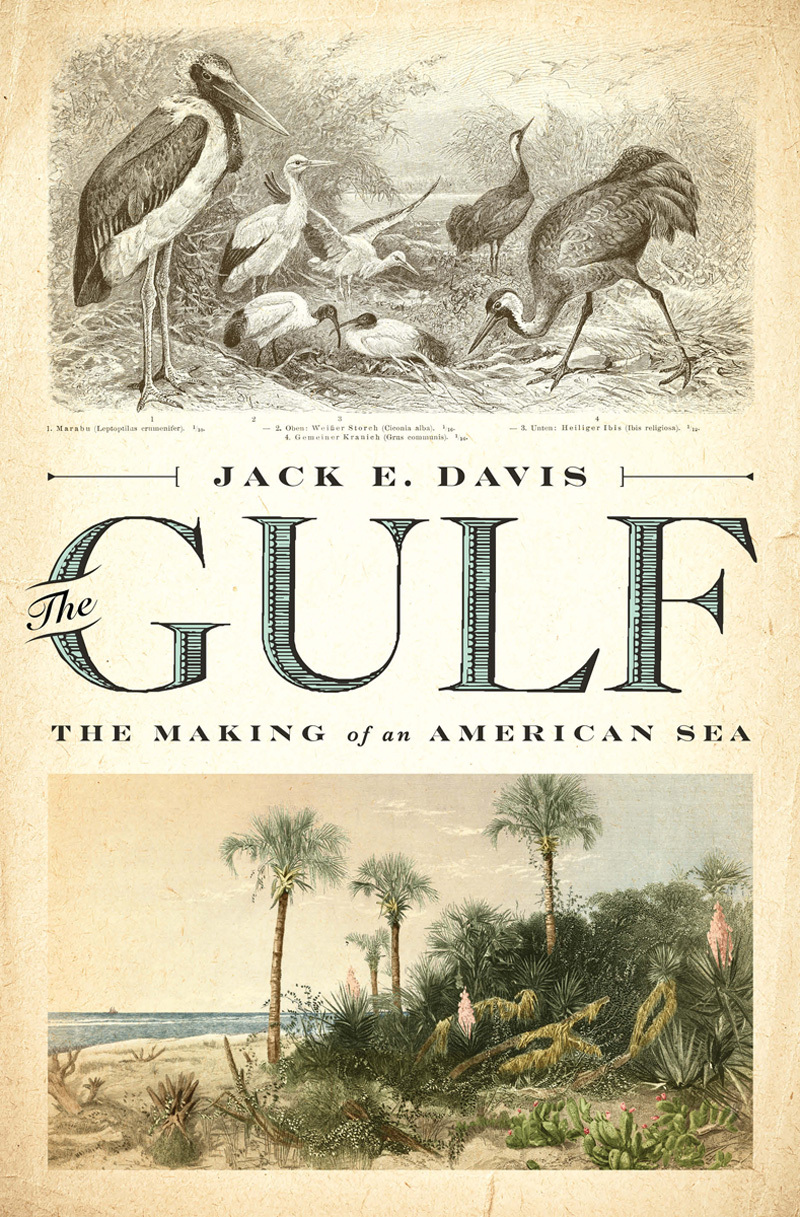
The Gulf: Making of an American Sea by Jack E. Davis

The Gulf's history, as we shall see, is America's history; the energies of one are shared with the other. Our school books taught us that there were thirteen British colonies caught up in the war for American independence, yet in truth there were fifteen: the forgotten two were the Gulf colonies of East Florida and West Florida. The Gulf was on the frontier line that advanced from the original US states, delivered opportunities to Americans and immigrants searching for a better life, and nourished the nation's coming-of-age--doing so not in just western woodland, mountain, and river valley, but on the southern sea itself... With every new train line that reached the coast, every new hotel that opened ,and every new craving for a marketable resource, the region drew closer to the furious pace of change and consumption that possessed the rest of the nation--and then surpassed it. The Gulf had become America's sea.

I've traveled a lot in the United States, but to my mind, the Gulf of Mexico has seemed elusive and inaccessible: the first time I saw it was from the remote western edge of the Everglades, a part of the national park where few venture. Then, I saw it from a small fishing village that seemed intent on disappearing from the map of Louisiana. A third time, just recently, I saw it from Texas' beautiful Padre Island National Seashore. Three times might seem like many, but we're talking a big old gulf here--and many fewer encounters than I've had with the Atlantic or Pacific. The Gulf, Jack E. Davis contends, is rather forgotten, dimmer in the American imagination than either of the great oceans. And yet, it's the Gulf that's truly an "American sea"; though Mexico has nearly as much shoreline on it (and claims the name), the waters of the Gulf emerge almost entirely from the Mississippi, America's river. Its history, he says, is American history, from the birth of European colonization to the modern mega-business of tourism, commercial fishing, and, of course, oil.

What distinguishes The Gulf is the way that Davis brings together various genres and methods: it's a history book, but also a natural science book, and a work of cultural criticism. He begins by describing the arrival of Spanish colonizers and describing their interactions, typically fraught, with local tribes in Florida and Texas. Though the Gulf's shores were the first point of mainland contact for Europeans, the Gulf itself was long forgotten in the making of the American colonial experiment; only in the mid- to late-20th century, Davis says, did the prospect of fishing bring American attention. (Davis describes the Spanish sailors as unable or unwilling to eat the immense bounty of shrimp, oysters, and fish that provided sustenance to the Calusa and Karankawa, even as they ate their own horses and boot leather.) And even then, we learn, it's sport fishing--not commercial fishing--that makes the Gulf, where Americans first learned to hook the tarpon, a massive fish who had eluded anglers for a century.

In each section, Davis relies on the stories of individuals to tell the story of the Gulf. Some, like early settler Leonard Destin (namesake of Destin, Florida) and Key West resident Ernest Hemingway, are familiar, but others are more underheralded figures, like the environmental lawyer working to clear the Gulf of industrial pollution, or the reckless brothers who turned west Florida into a sinking morass of real estate grotesqueries. I was especially stuck by the story of Walter Anderson, an artist I'd never heard of, who basically abandoned his family to live on the remote islands of what are now the Gulf Islands National Seashore, and whose painted shack walls are preserved in a museum in Ocean Springs, Mississippi. Davis never wants the reader to forget that the story of the Gulf is the story not just of birds and sawgrass and oil but the story of people, too.

The Gulf isn't shy about its political and ecological agenda. Perhaps partly because it is so ignored in the American imagination, the Gulf of Mexico is uniquely endangered. The fish are overfished; the birds, even after the early 20th century push to preserve their habitats to keep them safe from plume hunters, are diminishing in number. Oil, of course, is the number one threat, but it's joined by the effects of heavily polluting factories and the effects of eliminating marshland in favor of landfill and sea wall. "We cannot destroy or control the sea," Davis notes, "but we can diminish its gifts, and when we do, we turn away from our providence and diminish ourselves."

Sunday, December 24, 2023

Lover Man by Alston Anderson

Lots of girls were leaning on the sills behind the screens in their windows. Some of them were smiling and others were just looking at us. I was about to help load the trash barrels on to the truck when I saw her. She had long, black hair curling down around her shoulders, but what with the screen and all I couldn't see her face properly. So I walked over and stood below her kitchen. As I stood there looking up at her it looked to me like she was saying 'yes' with her eyes. I didn't know yes what; just yes. I thought she was the prettiest girl I'd ever seen; even prettier than Maybelle, the first girl I ever loved. I just stood there, looking at her, much as a starving man would a ripe orange that's just out of his jumping reach.

'I'm going marry you,' I said.

She laughed as if she'd been goosed. 'You and who else?' she said.

The stories in Alston Anderson's Lover Man stretch from small-town Alabama to a residential school in eastern North Carolina to the streets of Harlem. Their heroes are a loosely connected gathering of Black men and women engaged in the petty business of small town life: courting, drinking and playing games, marrying and cheating, razzing one another in the slightly formalized fashion known as "the dozens," working, working, working, pining, dying. Their voices are marked by the off-kilter music of vernacular speech, which, for Anderson, is made of malapropisms made good: scrucial for crucial, innercent for innocent (and of course, doesn't that reflect something of the spiritual coin that innocence provides?). As the stories move northward, the vernacular is overlaid with the language and patterns of jazz, with man and kats and pad and mother-hubbers.

Lover Man, written in the late 50's, is published here by McNally Editions as a kind of lost text, and the afterword by Kinohi Nishikawa describes its falling out of favor as a consequence of its apolitical nature at a time when the pointedly political work of writers like James Baldwin and Richard Wright was in ascendance. But as they say, the personal is political, and all the great world-turning themes of class and race and sex boil just beneath the surface. Sexuality, in particular, sits just behind the narrative of a story like "North Carolina School Days," about Aaron (or "Lil One"), who, shortly after a tearful goodbye to his roommate, finds himself in bed with the girlfriend he idolizes, unable to perform. As an ending, it's--pardon me--anticlimactic, but perhaps only because Aaron must face it mutely, with a lack of understanding; he's no Baldwin character. As the reader, it's not lost on us--or it least it shouldn't be--that the roommates at this particular boarding school call each other "old gal" as a custom. Similarly, the protagonist of "Dance of the Infidels" does not, and likely cannot, explain why he gets on a train to travel hundreds of miles uninvited to the Harlem apartment of an acquaintance with whom he shared a passing love of jazz LPs.

The two characters that interest me most among these stories are the title character of "Old Man Maypeck" and the German Herr Schaub of "Comrade." The former is black, the latter white; yet, in a way, they share a worldview that makes them stand out among the "apolitical." Old Man Maypeck is the oldest man in town, and the only one who can remember slavery; he describes to a younger man (Lil One/Aaron again) the difference between "house n--ers and field n--ers": "Field n--ers walk like they ain't a care in the world, and house n--ers is right nervous and prissy-like, most like a white man. You is a house n--er. Eat up, son." It's meant to be a complement. Maypeck encourages Aaron, 
"Don't you be letting nobody put no race problem foolishness in your head up North; else you'll be just like Conscrucious"--a cautionary tale with a suspicious-sounding name--"The first thing you got to learn about the race problem is that there ain't no race problem. People ain't like cattle or hosses what you can breed and put labels on."

In "Comrade," the protagonist is stationed in Germany after the end of World War II, and helps nurse a stray dog to health before locating its owner, Herr Schaub, and returning it. Schaub is genial and appreciative, and invites the narrator into his home, but nearly provokes a fight by using the German word for "Black man," neger. Herr Schaub explains, and the narrator feels foolish, but he goes on to explain that the "N-word" itself is a Cockney corruption of German, and so it's not worth getting so upset about that either. The etymology is as dubious as the moral claim, but the narrator ends the story by saying, "But if Herr Schaub ever reads this I'd like him to know that Comrade is OK by me, and I hope we never have to fight one another no more."

What interests me about both Old Man Maypeck and Herr Schaub is that their moral outlooks are layered in irony, and not so easily dismissed. We turn away from Old Man Maypeck's toadyism, his love for the "Old Master," but we must admit that he's right that people "ain't like cattle or hosses," and the narrator's father's assertion that he's simply crazy doesn't sit right, either. Herr Schaub's wisdom curdles quickly with his bad etymology, but the narrator seems to understand that behind even this misguided claim there is a deep desire to show friendship and acceptance, to hope that fighting will end. In both figures there is a straining to understand, and find sympathy for, the "Why can't we all just get along" approach to racial reconciliation, even as it seems deeply misguided. Although, as the afterword notes, Anderson once wrote a letter in support of William F. Buckley's beliefs regarding civil rights, so what do I know? Maybe we're supposed to take Old Man Maypeck at his word.

But I don't think so. Irony is Anderson's bread and butter, and it appears throughout these stories as a kind of verbal trickery, even warfare. It's there in "The Dozens," about a boy who drowns in the middle of that teasing game that skirts the line between irony and truth, and the guilt that his friend must live with thereafter. It's there most often in the conversations between women and men, especially the Lover Men of the title, whose thickly layered irony is a ploy toward getting a woman into bed. One of the best stories is "A Sound of Screaming," about a man who takes his mistress for an abortion, and who must sit with her for the next several hours as the fetus is painfully passed. The conversation between them teeters on an ironic edge; in a moment of crisis they are simultaneously desperate for and despising one another. In "North Carolina School Days," Aaron's ironic capacity fails as surely as his libido; stuck one-on-one with Del he can think of nothing to say. By contrast, the muteness of the friendly jazz-lovers in "Dance of the Infidels" seems to suggest a total failure of irony in the face of a kind of relationship that, for the Alabamian at least, has no social governance because it's simply too unthinkable. The stories of Lover Man may seem at times quite simple. ("That's it? He couldn't get it up?") But I think those who pay close attention to the dialogue will see how multi-layered they are, and what's happening just beneath the surface.

Tuesday, May 30, 2023

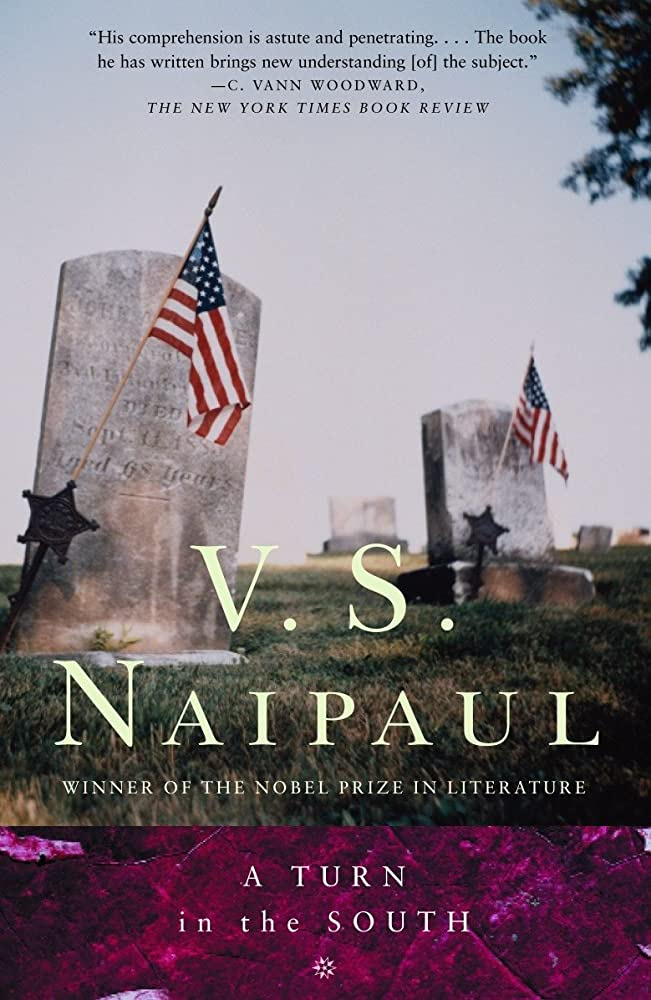
A Turn in the South by V. S. Naipaul

Satan and God fighting for Paula's soul, Paula herself not responsible for the movements of her passion, helpless, capable only of choosing salvation and asking God to reveal his will: a medieval idea of chaos, and the solitude and helplessness of men, and the necessity of salvation. But this was not set in a medieval world of plague and disease and deprivation, the arbitrariness of the sovereign and the humility of the poor. We were in a town of the Research Triangle; and the theme of this culture was abundance and choice, the paramountcy of the individual (if only as consumer), with the beauty and luxury and sensual satisfactions as imminent possibilities for all.

In 1985, fifteen years before he won the Nobel Prize but nearly as many since the publication of A House for Mr. Biswas, V. S. Naipaul traveled through the American South. Though Naipaul is best remembered for his fiction now, he spent nearly as much time writing travelogues, first of the West Indies, then India, and then among Islamic states in Among the Believers. But the South presented a special challenge for Naipaul, who wrote that America "cannot be alien in the simple way an African country is alien. It is too well known, too photographed, too written about; and, being more organized and less informal, it is not so open to casual inspection." And yet, casually inspect, Naipaul does: in metropolitan Atlanta, genteel Charleston, deep swamps and bottomland in Tallahassee and Jackson, and in the up-and-coming cities of the New South, Nashville and Raleigh.

A Turn in the South made me rethink a lot of things, not least among them Naipaul himself. For someone with a reputation as a crank and a bully, Naipaul comes off in A Turn in the South as remarkably open and empathetic. He lets people talk and talk, guiding conversation in only the subtlest of ways, and though perhaps it is only thanks to the writerly tactic of hiding his own questions in narrative voice while faithfully recording the responses of his interlocutors, the effect is of someone reserving judgments: a listener. Sometimes this is frustrating, as when Naipaul interviews an archconservative pastor in Elizabeth City, NC who calls himself a "Jesse-crat" after notorious senatorial douchebag Jesse Holmes, or any number of old white folks who perform paternalistic sadness at the degradation of Black life post-segregation. But it's a gift to get people to say what they probably know they ought not to say, and there's no doubt that in doing so Naipaul really does reveal something at the heart of Southern life. He gets more out of "ordinary people" than he does the black politicos of Atlanta, who are too cagey to stray from their talking points, or Eudora Welty, who is summoned for two paragraphs to talk about the long-gone fad for fur hats.

Naipaul really does empathize with white "rednecks"--a word that's more or less new to him--and with the Black Southerners he meets. Fascinatingly, that empathy seems to emerge from Naipaul's own Caribbean identity, which colors everything he sees in the South. Naipaul makes careful and articulate distinctions between the two regions of the New World, noting, among other things, the crucial lack of a white laborer class after the collapse of slavery and colonialism in Trinidad. "The possibilities" for a Black American, he writes, "were far greater than those of a West Indian. But there could be no easy movement forward for the mass; they had lived through too much; the irrationality of slavery and the years after slavery had made many irrational and self-destructive." And yet, when he writes that the culture of the South is defined by loss and by grief, one hears the echoes of his novels, in which colonial subjects struggle to forge an identity unchained by the weight of history: "The grief was special and was like religion; it would last beyond the decline of the nineteenth century empires, beyond the idea of empire itself." I think that, as a Caribbean, Naipaul is able to understand the South in a way that's difficult for an American Northerner, like Paul Theroux.

But it was the last section, titled "Smoke," which really hit home--literally--for me. The last stop on Naipaul's journey is in the "Research Triangle" of North Carolina, where I grew up, and I perhaps have never heard as insightful or as accurate a description of the place as Naipaul's:

...poor North Carolina pineland landscaped into the discreetest kind of industrial garden, many modern technological names represented by new buildings, long low lines of brick or concrete and glass, giving an impression of spaciousness and order and elegance, the land of rural poverty remade to suit its new function, the South seemingly abolished here, as it had been abolished at the space-research town of Huntsville in Alabama.

Durham poet Jim Applewhite, descendant of tobacco planters, takes Naipaul on a tour of the dying industry: the golden-leafed farms that scan still be found growing between the fresh new medical and research facilities, the meticulous handicraft of the curing barns and the packing process. "[I]t is close to the paradox of civilization itself," Applewhite tells Naipaul, "That this essentially poisonous substance formed the basis of a way of life that had so many attractive aspects--a formalized, seasonal cycle to it, which left the land combed into its even furrows after the stalks had been cut in the autumn." There can be no mourning the death of tobacco, if tobacco is dying, and yet the transition from the "folk art" and "nonutilitarian" practice of the small tobacco farm to the sleek anywhere technologies of biomedicine leave the land and its people bereft of something.

Tobacco, Naipaul notes, comes from the name of Tobago, Trinidad's junior island. Though tobacco planting was quickly abandoned there for the more lucrative sugarcane, Naipaul feels a kind of historical link between himself and the tobacco poet. And I felt it, too. Roughly ten months after Naipaul passed through the tobacco fields of the Research Triangle, I was born there. And it strange to read the great writer writing about the place that I would shortly be ushered into, and which I  have not quite always understood. I started A Turn in the South pleased to know a little more about Naipaul; I was unsettled at the end to find Naipaul looking back. But if that's the feeling I got from A Turn in the South, it's because, in Naipaul's own words, we share something way, way back--but not all that far back--in our histories.

Saturday, May 20, 2023

Homegoing by Yaa Gyasi

Esi learned to split her life into Before the Castle and Now. Before the Castle, she was the daughter of Big Man and his third wife, Maame. Now she was dust. Before the Castle, she was the prettiest girl in the village. Now she was thin air.

Homegoing begins with the story of two half-sisters who have never met: Effia is a Fante woman who becomes the wife of the white colonial administrator on Ghana's Cape Coast; her marriage elevates her to a status and lifestyle that most of her countrymen could never dream about. Esi is the daughter of the "Big Man," the local tribal leader, but in a nighttime raid she is caught and enslaved. She's kept in the lower floors of the same castle in which Effia now lives. As she struggles to breathe, packed with her fellow enslaved like stacks of cordwood, Effia trods the boards above her head, not knowing that her half-sister struggles down below.

Homegoing follows the lineages of these two women over the next two and a half centuries: Esi's descendants are raised in slavery in the American South, sometimes escaping into freedom and sometimes being pulled back into bondage; when slavery ends, they find themselves at the mercy of the forces that have shaped Black life in the 19th and 20th centuries: sharecropping, Jim Crow, jazz. Effia's descendants experience the tumult of Ghana's colonial history: alliance and enmity with the British, colonial subjugation, Christian proselytizing, independence, diaspora. They are sometimes powerful and sometimes lowly. In the novel's end, the two threads are tied together again: Effia's descendant Marjorie migrates to America with her family and falls for her millionth-cousin-a-billion-times-removed, Esi's descendant Marcus.

The power of Homegoing is in its scope. In a world where the practice of slavery has obscured the lineage of most Black Americans, it's fascinating to see the way the generations may, for one family, unfold. The impression that you get is that a few centuries really seem like nothing at all; for both Esi and Effia's lines, it takes only seven generations to get from then to now. Just a handful of names, not difficult at all to memorize. The novel smartly avoids making any grand over-statements about the sisters' two paths; we are not, for example, asked to believe that Marjorie has ended up in a better place than Marcus because she has not suffered from the historical effects of slavery. If anything, Homegoing seeks to remind us that the conquest of white supremacy has many consequences, and touches everyone and everything, though in different ways. And Gyasi insists over and over again that Ghanaian complicity with European slavery must be made part of the story, too.

But as a book, it really didn't work for me. Seven generations and two lineages means fourteen vignettes in 300 pages, and though many of the stories have compelling elements--I liked the one about the Baltimore freedman whose freeborn wife is abducted under the Fugitive Slave Law, and the one about the Ghanaian teacher who falls in love with his housekeeper--Gyasi is too intent on packing these characters' whole lives into each vignette. As a result, Homegoing speeds through too much summary, and none of the characters really live. That packed-sardine quality might explain, too, why she so often has the characters pointedly explain the themes to us:

How many more times could he pick himself up off the dirty floor of a jail cell? How many hours could he spend marching? How many bruises could he collect from the police? How many more letters to the mayor, governor, president could he send? How many more days would it take to get something to change? And when it changed, would it change? Would America be any different, or would it be mostly the same?

It's a familiar enough sentiment, but it feels trite to me, as much of the book does. You can see Gyasi straining to get in all the major elements of Black U.S. history--here's where the Great Migration goes, and here's the Fugitive Slave Law, and we can't forget prison. There might be a way to do that without seeming forced, but Homegoing doesn't manage it. That might explain, actually, why the Ghana scenes are more convincing: thought they hit the same pointed historical notes, it's a history that's not familiar to me, so it all feels a little bit fresher.

With the addition of Ghana, my "countries read" list is up to 80!

Tuesday, December 6, 2022

Deep South by Paul Theroux

Reverend Lyles said he was proud of what had been done at the old Rosenwald school, how it had been fixed up and was now a well-attended community center. The Auburn Rural Studio was still building ingenious low-cost houses. It was not the town of Agee and Evans anymore. It was still struggling, but it was improving, and hopeful.

On a single visit I would not have seen this, but over the course of a year, in four seasons, the true condition of the town had become apparent. This was not a trip about my having had a good meal or a bad meal, or my laboring toward a destination in the old travel-book manner. It may have seemed to some people I met that I was headed somewhere, but I was still traveling in widening circles, happily, on back roads, meeting people, and revisiting friends.

Paul Theroux has traveled all over the world: India, Southeast Asia, Africa. But until he steps out of his door on Cape Cod in Massachusetts one morning and hops in his car, he has never been in the American South. He heads down the interstate, making brief stops in Virginia, North Carolina, South Carolina, Georgia, heading deeper and deeper into a land that is familiar but unfamiliar, recognizable but unrecognizable. His travels in Africa become a specific touchpoint: the poverty Theroux sees in Alabama, Mississippi, and Arkansas is not just a reminder of the third world, but an instantiation of it, right under the American nose. Deep South explores these forgotten places, which are not just unknown to Theroux, but to nearly every American, because they lie in the places that even the highways have passed by, where industry and work have vanished, and which the cultural and political leaders of the United States would just as soon turn a blind eye toward.

I'm a Southerner, though I have always thought of my home in North Carolina as quite different from the "deep south" of Mississippi and Alabama. It is interesting to read about yourself, or at least a region to which you are allied, from an anthropological perspective. At first, I felt a kind of bemusement at the Northerner who carries with him a set of bromides about the South, without wondering whether or not they are accurate or true. When Theroux writes that the church is the center of social life in a Southern town, and claims this is one way it differs from his native New England, I thought about how a few weeks ago, I visited Sandwich, Massachusetts--where Theroux literally lives--and ended up at a church festival where a bunch of elderly white Catholics were selling wreaths and dolls and chili hot dogs. Certainly for those folks, the church is at the center of social life in Sandwich. And what do we do with the increasing number of white Americans, southerners included, who no longer go to church but claim evangelical as an identifier? There's an awful lot of cant about the South, is all I'm saying, and it can be hard to set it aside and see the place clearly, especially if you carry your expectations with you.

This feeling was amplified, for me, by Theroux's pointed aversion toward urban life in the South. Charleston, Asheville, Natchez: Theroux passes these places by, stopping in them briefly, if only to tell us their charms have no interest for him. To Theroux, this is a way of side-stepping the tourist sheen of the South, of skirting the guidebooks. But it also presupposes a real South that lies in rural places. Of course you are going to find the South to be poor and rural if you define it from the beginning as rural and poor. But moreover, I found myself wondering if Theroux doesn't miss something crucial about the South by not interrogating the "New South," the cities where industry has fled, where investment in the tech sector, for instance, has created new opportunities for gentrification and dispossession. I'm not sure you can understand the depreciation of Greenville, Alabama, for instance, unless you understand the boom in Huntsville.

But anyway. Most of my reservations about Deep South came to little, because in the end, what makes Theroux seem reliable is the fact that he keeps coming back. Deep South is the story of not just a single trip, but four different trips, each in a different season. Theroux keeps coming back to the same locations over and over again, meeting with the same non-profit leaders, the same black farmers and unemployed whites, the same Indian motel owners. Out of this investment in time a real picture of a region emerges: a place rich in pride and cultural power, but torn inside out by the deprecations of global capitalism and political neglect. By the end of the book, Theroux is no longer ignoring the cities: he spends several chapters on his time in Hot Springs, Arkansas and the capital of Little Rock, integrating them into the larger story of the South as he sees it.

I brought this book with me on a trip to Mississippi last weekend. We didn't quite get up to the Delta, the poorest part of the state and where Theroux spends most of his time, but we did see much of what Theroux saw. For me, it was the sight of a roofless, wrecked building on the main street of Port Gibson, sitting next to a restaurant: someone's business and dream. Everywhere he goes, Theroux wonders why Africa gets so much aid from the USA while its own communities suffer. (I thought Theroux was a little silly in the way he would compare the money given to say, Ghana, population 31 million, to the federal aid provided to a town of 800, but still, point taken.) But among the neglect are people whose roots are deep, and who spend their lives trying to make those communities thrive.

Sunday, August 26, 2018

The Last Gentleman by Walker Percy

The South he had come home to was different from the South he had left.  It was happy, victorious, Christian, rich, patriotic and Republican.

The happiness and serenity of the South disconcerted him.  He had felt good in the North because everyone else felt so bad.  True, there was a happiness in the North.  That is to say, nearly everyone would have denied that he was unhappy.  And certainly the North was victorious.  It had never lost a war.  But Northerners had turned morose in their victory.  They were solitary and shut-off to themselves and he, the engineer, and got used to living among them.  Their cities, rich and busy as they were, nonetheless looked bombed out.  And his own happiness had come from being onto the unhappiness beneath their happiness.  It was possible for him to be home in the North because the North was homeless.  There are many things worse than being homeless in a homeless place--in fact, this is one condition of being at home, if you are yourself homeless.  For example, it is much worse to be homeless and then to go home where everyone is at home and then still be homeless.  The South was at home.  Therefore his homelessness was much worse in the South because he had expected to find himself at home there.

Will Barrett is a Southerner, by way of Louisiana and Alabama, living in New York City.  He is intelligent, kind, and diligent, but Percy tells us that "he looked better than he was" and that in him "something was missing."  He suffers from psychological maladies both specific and abstract: he suffers from amnesia and fugue states, sometimes forgetting who he is, and more general ennui.  He engages a psychiatrist, and does everything prescribed to him, but in years of therapy has made no progress.  Still he wants to know, why does he feel so bad when he ought to feel good?  Why do good environments make him feel bad and bad environments make him feel good?  A detail shows that he suffers from the same modernism that Binx Bolling does in Percy's The Moviegoer: he visits the Metropolitan Museum of Art, but the Velazquez looks dead and inert to him until a worker falls through a ceiling light.  Suddenly it is "glowing like a jewel"--proximity to tragedy elevates life, though momentarily.  For Binx it's the movies that make things real; for Will it's his telescope, that makes the bricks on the buildings across Central Park suddenly alive.  Both of them have the same problem: How is it possible, they ask, to live from one moment to the next?

Though existential angst must be universal, for Percy it's always tied to geography.  Will's self-imposed exile from the South is a kind of self-abegnation:

New York is full of people from small towns who are quite content to live obscure lives in some out-of-the-way corner of the city.  Here there is no one to keep track.  Though such a person might have come from a long line of old settlers and a neighborhood rich in memories, now he chooses to live in a flat on 231st Street, pick up the paper and milk on the doorstep every morning, and speak to the elevator man.  In Southern genealogies there is always a mention of a cousin who went to live in New York in 1922 and not another word.  One hears that people go to New York to seek their fortunes, but many go to seek just the opposite.

I don't feel that way--I feel quite at home in New York--but as an ex-pat Southerner I recognize some of the shape of Will's life.  Hell, I finished the novel on a plane this morning headed back to New York from visiting my own ancestral home.  The South is central to Will's identity; he embraces it, right down to college football and golf (Percy is the novelist of golf), but he runs from it because embracing it doesn't make him feel any better.  It makes him feel worse because the embrace of it does so little.

Will's return to the South happens this way: using his telescope, he spies a beautiful girl retrieving a secret message on a bench in Central Park.  He follows her to a hospital in Washington Heights (Columbia Medical School, where Percy himself once studied) to find her attending to her terminally ill teen brother, Jamie.  Will ingratiates himself into the family, who turn out to be old-school Alabamians, too, fellow aliens.  The family's patriarch, Chandler Vaught, employs Will to be a kind of caretaker for Jamie, and return to Alabama with them.  His daughter, Kitty, falls dutifully but difficultly in love with Will.  Added to these are Rita, a dutiful sister-in-law who manages Jamie's care and is suspicious of Will; Val a sister to Jamie and a sister of the cloth (she's a nun), and Sutter, a disgraced doctor and self-professed pornographer whose influence on Jamie is considered slightly less dangerous than his illness.

Left in New York by the family, Will hitches a ride with a John Howard Griffin-style photographer disguised as a black man.  Together they're ambushed in Levittown by a mob thinking they've come to "bust the block," meaning sell a house to a black man.  It's a weird and funny digression, meant to highlight, perhaps, the rottenness at the heart of the century of the American suburb (Levittown is America's first), and deflect the idea that racial tension is the property of the south.  There's a touch of real gallantry in Will when he snaps at his companion not to give in to the mob by showing them the remaining spot of Caucasian skin.  It's a nice moment, especially because Percy, like Will, often keeps his black characters at arm's length.

When Will is finally reunited with the Vaughts, the plot remains comic and frenzied, and sometimes borders on nonsense.  There's an inherent but understandable silliness in the way the family hinges on Jamie's wishes: when he wants to go to school, Jamie, Will, and Kitty all enroll at the University of Alabama; when he wants to jet off to New Mexico, Will's got withdraw from school and climb in the camper van.  Take a step back and you'll see how wild it is that this family invites this genial stranger into their life this way at all.  But perhaps they know, like Will, that in the proximity of danger and death everything changes, even as they uphold the banners of the rectitudinous country-club South.

Will's return to the South might have played like Milkman's in Song of Solomon: an expedition to an ancestral home that allows the protagonist to discover who they are.  And Will does go home: to his uncle's, who lives in a weird hermit state with his black servant, and to his childhood home, where his father once committed suicide.  But he doesn't see his aunts who still live there, he sneaks in and sleeps in the attic.  And it's his house--he owns it!  But there are no answers there, and the same old problems return.  Kitty becomes exactly the kind of old-fashioned southern sorority girl that he thinks he desires, and it repulses him.  Deracination--uprootedness--hurts more when the roots are deepest, as they are in the American south, Percy tells us.  The intensity of its myths and manners are no match for the modern condition.

The final section of the novel takes place outside Santa Fe, where Jamie has decamped to live out the last days of his life.  As a setting, New Mexico does strange work in this novel.  It means an abandonment of the dialectic of North and South, an escape to a place that has nothing to do with those old polarities.  It represents the possibility, perhaps, of a kind of transcendence, and a death for Jamie on his own terms.  My wife and I had our honeymoon in New Mexico.  We talk sometimes about moving there for good.  Our relationship to the place isn't very strong, or knowledgeable, but I understand how it functions as the idea of a place.  And it's strange, the way this novel seems to share a kind of mental map with me, and which made it meaningful to me in particular.  The ending, which centers on the question of whether a delirious Jamie will allow himself to be baptized by the hospital chaplain, resolves nothing, but it is funny, strange, ragged, and deeply sad.

The Last Gentleman is a novel I wish I could go on talking about.  What do you make, for instance, of the fact that Will is typically identified as "the engineer," though it refers to his title as a custodial engineer in the basement of Macy's, a job he gives up in the first 100 pages?  What's he making, what's he fixing?  Much of it seems like it ought to fail, but it hovers somewhere outside the realm of rational sense, and does so beautifully.  More than any of the other novels I've read of Percy's, it shares the kind of madcap logic and unexpected prose of The Moviegoer.  It's a book that, when I was done with it, I wanted to turn it over and start it again, to prod it into some kind of structure and sense.  But to do that, to make a thesis statement of it, might rob it of the brilliance of its mystery. 

Saturday, June 2, 2018

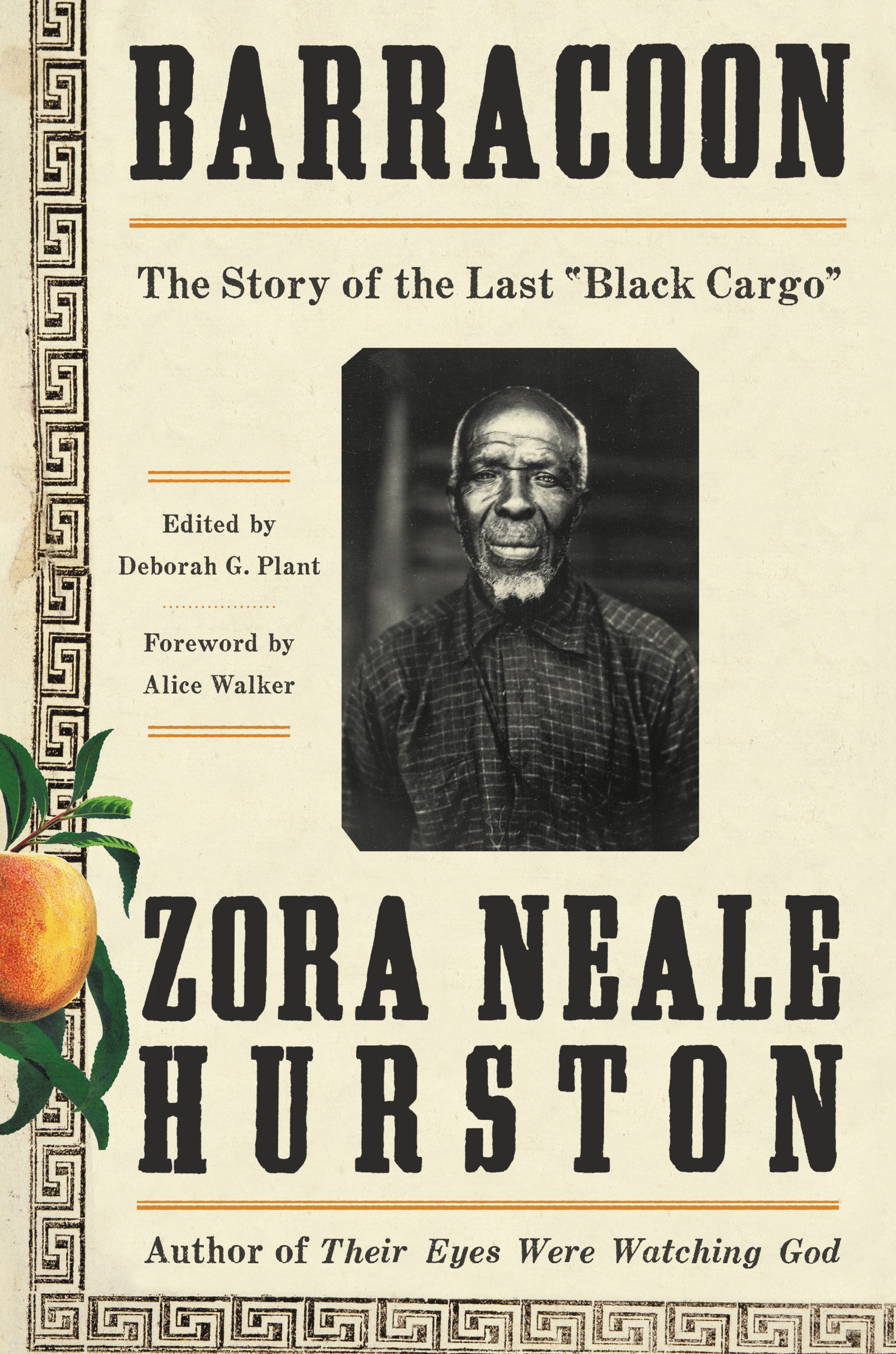
Barracoon by Zora Neale Hurston

I hailed him by his African name as I walked up the steps to his porch, and he looked up into my face as I stood in the door in surprise.  He was eating his breakfast from a round enameled pan with his hands, in the fashion of his fatherland.

The surprise of seeing me halted his hand between pan and face.  Then tears of joy welled up.

"Oh Lor', I know it you call my name.  Nobody don't callee me my name from cross de water but you.  You always callee me Kossula, jus' lak I in de Affica soil!"

What a wonderful thing, in the year 2018, to have a new book by Zora Neale Hurston.  It makes you wonder what they were thinking, all the people all those years ago, who declined to publish a book like Barracoon, Hurston's interview with the last survivor of the Mid-Atlantic slave trade.  Perhaps they didn't understand what a rare and lucky moment it was, to have such experience still alive in the heart of a man, or perhaps they underrated Hurston's gifts and importance as an ethnographer (way more impressive, in my opinion, than her work as a novelist).  There's some intimation in what I've read that people were squeamish about laying bare the role of African slavers in the Middle Passage, and quite rightly, since that stuff has always been fodder for right-wing trolls.  But whatever the case, it's quite something to have a book like this published at last.

In 1927 Hurston traveled to Alabama to interview a man named Oluale Kossula, who had gone by the Americanized name Cudjo Lewis for over sixty years.  As a teenager, Kossula's village in West Africa was decimated by the Kingdom of Dahomey, who were in the habit of massacring their enemies and selling whom they could to coastal slavers.  The title, Barracoon, refers to the kind of barracks where captured Africans waited to be bought by slavers.  One of the wonders of the book is that it gives a rare glimpse into what it was like on the African side of the slave trade.  Kossula's account of the Dahomey warriors--apparently, traditionally women--is one of the most haunting aspects of his story.

When Kossula was carried away by the Clotilde, it was in violation of  U.S. law, which had prevented new importing of slaves for over fifty years.  The Americans who put the voyage together did so because they could, and because they felt like they were entitled to it.  It was illegal, but no one, of course, got punished for it, except for Kossula.  He actually touches very little on his experience of slavery, focusing on the life he led after emancipation with his wife and children.  Like many former slaves, Kossula found himself needing to apply to his former masters for protection and employment:

"'Cap'n Tim, you brought us from our country where we had lan'.  You mad us slave.  Now dey make us free but we ain' got no country and we ain't got no lan'!  Why doan you give us a piece dis land so we kin buildee ourself a home?'

"Cap'n jump on his feet and say, 'Fool do you think I goin' give you property on top of property?  I tookee good keer my slaves in slavery and derefo' I doan owe dem nothin?  You doan belong to me now, why must I give you my lan'?"

Kossula, then, with a group of fellow Africans, saved for years to buy their own land and found a community called Africatown.  The community still exists in Mobile, and some of its residents still trace their heritage back to the Clotilde and the Dahomey raid.  It's a remarkable story of independence and will, told in Kossula's own voice and idiom.  Hurston deftly gets out of the way of Kossula's story, and records it with faithful care.  Interpolation is smartly minimized to let the power of the story, and the feeling that you are hearing a firsthand account, shine through.

Kossula's experiences after the end of the Civil War were full of hardship.  He talks about the way he and his family were looked on suspiciously by other black communities whose ancestors had come from Africa centuries ago.  He talks about the tragic death of his wife and many of his children, including a horrible story of one son's death at a railroad crossing:

"I go through the crowd and lookee.  I see de body of a man by de telegraph pole.  It ain' got no head.  Somebody tell me, 'Thass yo' boy, Uncle Cudjo.'  I say, 'No, it not my David.'   He lay dere by de cross ties.  One woman she face me and astee, 'Cudjo, which son of yours is dis?' and she pointee at de body.  I tell her, 'Dis none of my son.  My boy go in town and y'all tell me my boy dead.'

One Afficky man come and say, 'Cudjo dass' yo boy.'

I astee him, 'Is it?  If dat my boy, where his head?'  He show me de head.  It on de other side de track.  Den he lead me home.

When Hurston finds Kossula, he is more or less alone.  She does small errands for him and they share small joys, like crabs and a "huge watermelon" they "ate from heart to rind."  She paints a picture of a man slowly abandoned by family, left in a land that never quite felt familiar to him, and who longs to return to "Afficky soil" before he dies.  It's heartrending.  But there is a small consolation in the thought that finally, more than 150 years after Kossula's kidnapping and enslavement, and over ninety years from the time that Hurston recorded his testimony, that the story of this proud and lonely man is finally able to be told.