Showing posts with label new york. Show all posts

Sunday, March 15, 2026

The Price of Their Toys by John P. Loonam

The red dress is still spread out on her side of the bed, and I reach down, run a hand along its empty length once again. I take off my pajamas, pick up the dress and, raising my arms above my head, slide it down, twist my shoulders through and tug the silky sheath past my belly. As the hem flutters against my thighs, I feel the dress fill up with flesh again and turn toward the mirror, looking for Anna's native grace to come alive in my own awkward pose, but see only my hairy chest and shoulders pushing out around those spaghetti straps, my belly stretching the fabric out of shape. From the window, a loud, raucous car horn gives an extended beep, followed by a voice, shouting the one word, "Pervert," loud and clear. I fall to my hands and knees, hiding behind the bed.

I'm really pleased to be able to write this review of The Price of Their Toys, a collection of stories by my friend and workshop partner John Loonam. Several of these stories I have seen in earlier drafts, and I enjoyed being reminded of several I had forgotten about. I had forgotten how much I enjoy John's story "Make the Man," in particular, about a man who is pushed, before he's ready, to get rid of his late wife's dresses, and begins to wear them instead. His private grieving is complicated by the increasing dementia of a neighbor across the street who has been showing up in his yard without clothes of any kind, and when these two collide of an emergency--man in dress meeting man without pants--the story reaches a kind of comic fervor that belies the deftness with which it deals with the difficulties of aging and loss. I think it's one of the best stories in the collection.

John's stories often take place in the Long Island suburbs, in bedroom communities where the Catholic Church continues to circumscribe the emotional and cultural range of what is possible. The stories really evoke an era of suburban life in the 60's and 70's that is, if not gone, surely drastically changed, and the stories show, to my mind, why such an existence might have been as fragile as it is narrow. I really liked one story I hadn't read, titled "Trump" (no relation) about a young gay Catholic school student who befriends the school's new and only Black student. The relationship becomes complicated by the attentions of a Father who is deeply unpopular among the student body, and the protagonist, Frankie, ends up choosing a difficult and violent betrayal to keep his precarious place in the school's ecosystem.

Another that I liked and hadn't read moves the action to Manhattan, where a young and disillusioned legal assistant becomes obsessed with Richard Nixon, who after the end of his presidency has moved his law office into a nearby building. The protagonist, for reasons that are unclear even to him, keeps demanding to be given access to the former president--who, in the end, shows up in the public plaza to give him a bit of dubious advice. This story, I thought, has only a tenuous relationship to the politics that are the invisible backdrop of so much of the book, but the parallels it draws between the failed president and the directionless protagonist, are really powerful.

It was a real honor and pleasure to see some of these stories being crafted, but the best part of The Price of Their Toys was, for me, getting to read the ones that were totally new to me. If you're interested, you can by John's book here.

Thursday, January 30, 2025

Native New Yorkers: The Legacy of the Algonquin People of New York by Evan T. Pritchard

I think that if the Munsee and the other nations of New York are all honored once again and given their proper place in U.S. history, it will be a good sign that, in the words of the old Munsee blessing, "The sun will shine on our wigwams, and our moccasins will not get wet." We will then begin the great healing of all our people that must take place--the red, white, yellow, and black nations coming together as four parts of the hoop of life. Only then can the earth be healed. As the Cree say, "Animals don't have problems, we do!" It's our healing that will ensure a more bountiful earth and a better place for children to grow up. And that's something we can all do for each other.

At one point in Mi'kmaq author Evan T. Pritchard's Native New Yorkers, he tells the reader that the Algonquin people who call New York their homeland trust in visions, in which respected family members or guides often appear. He then tells us about one such vision of his own, walking around Manhattan. It's a clear sign that, while scrupulously and doggedly researched, Native New York is not quite like other books you might have read about Indigenous history. It is, among other things, a book that takes seriously the power of life as it was lived among the Munsee Lenape, and takes seriously the idea that it might provide a kind of schema for us to live by in the future. A good antidote, actually, to the stale land acknowledgements who present Indigenous presence as something long gone and never to return.

Mostly, Native New Yorkers is what its title promises: a compendium of Indigenous history and geography in New York State. Pritchard takes us through a tour of nearly all of New York State, from the city to the Hudson Valley to the Capital Region to Long Island--western New York is conspicuously left out--describing the names and locations of tribes, villages, and pathways. I was interested to learn that Manahatta, the island we now know as Manhattan, was not really a densely populated place, thanks to its rockiness, but instead often served as a kind of meeting place for the various tribes of the area. I was impressed by the level of detail here. A different book might have tried to pick and choose a few places to illustrate larger themes, and while that might have been (sorry to say) a slightly more readable book, there's something awe-inspiring, and informative, about seeing every single Lenape, Mohican, or Haudenosanuee village mapped out. It's impossible to read Native New Yorkers and come away thinking that Dutch colonists sailed into a "fresh, green breast" empty of people.

In between the geography, Pritchard fills in the gaps with chapters on history and culture. I really enjoyed his attempts to capture the shape of what life might have been like among the pre-colonial Lenape, and the section on "Lenape exodus" really cleared up for me a lingering question about how the Lenape got from New York to their reservations in Oklahoma and Wisconsin. (Much of the story, which I did not know, involved a gradual migration to Pennsylvania and then further into the Ohio River Valley, where they were absorbed by the Shawnee of the great rebel Tecumseh.) And although I wasn't always persuaded by the parallels that Pritchard tries to draw between history and the present--like when he insists that the chess tables of Washington Square Park are somehow a continuation of the "outdoor gaming contests" of the Lenape--they often made me laugh, and think a little more deeply about the fundamental humanity of those who once stood where I am standing.

Friday, August 2, 2024

American Ramble by Neil King Jr.

This trip was different. On a fresh morning in late March, I stepped past the threshold of our front door, tugged the garden gate closed behind me, and set off to walk to the city of New York. A slow stroll, I liked to say, down a fast lane. An easy walk along a founding swath of the country that most travelers want to put behind them. A congested landscape usually seen as a blur, along a corridor named for a train, the Acela, whose name in turn is a faster form of accelerate. Ad + celerare, from the Latin: toward something, whatever it is, swiftly; to hasten the occurrence of a thing you want over.

No hastening anything on this trip. I wanted nothing over.

In 2021, journalist Neil King, Jr. set off from his home in Washington, D.C. to walk all the way to New York City. The journey, as he describes it in his book American Ramble, was conceived after a frightening bout with esophageal cancer that left his voice strained--a lasting mark that colors each interaction with the people he meets on his journey. Cancer, King found, contracted time and space, made things slow down, and each day seem precious and full of wonders. In a way, a journey on foot, as opposed to the machines of modern convenience, does the same thing. What would it be like, King wonders, to walk through the most heavily trafficked corridor in America, not by automobile or train, but on foot?

It's not a fair comparison, but throughout American Ramble I couldn't help but think of William Least Heat-Moon's Blue Highways, perhaps because I was so impressed by that book that I still have it on the brain. But I do think they have in common a kind of take-things-as-they-come approach: for Heat-Moon, the program is not a list of destinations, but the back routes on the highway; similarly, King is constrained to come across landmarks and communities as he finds them. I wished, in fact, that he had done a little more to synthesize the different stops on his trip, or perhaps to synthesize them in a way that was more historical and contextual than personal. What I liked best about the book is the way it reveals certain historical themes of this particular landscape that have been buried by urban sprawl and the great highways. King's route takes him through the crucibles of the American Revolution, including Valley Forge and the Delaware River, which he pointedly crosses at the same place that Washington did. It also takes him through the heartland of American religious pacificism, including the Amish country of southeastern Ohio and the vestiges of Quaker and Shaker culture. In each individual instance, King, a journalist, does a great job of investigating the particularities of place and history, but there is a larger story that emerges from the happenstance of the route that I felt was missing, somehow.

On the other hand, it's hard to ignore that momentousness of the feat by the end of the book. King makes it clear that this isn't the roughing-it style hitchhiking of his youth; he stays in hotels and AirBNBs and his meals are restaurant fish tacos, not Vienna sausages on a camp stove. And yet, by the time he strolls into New York's Central Park, he's traversed some of the most pedestrian-hostile landscapes on the face of the planet, including the great wastes of warehouses he calls "Amazonia." More than a story of physical triumph, it's a story of resolve, and a stubborn desire to see a familiar landscape in a new way. 

Wednesday, April 10, 2024

Falling Man by Don DeLillo

Every time she saw a videotape of the plans she moved a finger toward the power button on the remote. Then she kept watching. The second plane coming out of that ice blue sky, this was the footage that entered the body, that seemed to run beneath her skin, the fleeting spirit that carried lives and histories, theirs and hers, everyone's, into some other distance, out beyond the towers.

The skies she retained in memory were dramas of cloud and sea storm, or the electric sheen before summer thunder in the city, always belonging to the energies of sheer weather, of what was out there, air masses, water vapor, westerlies. This was different, a clear sky that carried human terror in those streaking aircraft, first one, then the other, the force of men's intent. He watched with her. Every helpless desperation set against the sky, human voices crying to God and how awful to imagine this, God's name on the tongues of killers and victims both, first one plane and then the other, the one that was nearly cartoon human, with flashing eyes and teeth, the second plane, the south tower.

Who else but DeLillo could write a novel about 9/11? In a way, he wrote one already with White Noise, the ultimate novel about disaster and mass destruction in modern America, a novel about how, even faced with the bare physical fact of our own destruction we are too wrapped up in the images and signs to really see. As television has failed to enable Jack to accept his own mortality--incarnated as a tower of black smoke--so television, and our primitive computers, failed to enable us to understand the crushing force of history. Even those who experienced it firsthand, like Keith in Falling Man, must live with the long life of the image, the video, the photograph, always keenly aware of the ways in which it does not quite match the horror that was not quite legible, even in the moment. 

Keith is a businessman who worked on a high floor of the first tower; after he escapes it he hitches a ride to the apartment where his estranged wife and son are living. His arrival is necessitated by circumstance--his downtown apartment is dangerous--but it also harkens to, perhaps, a rekindling of their relationship. That would be the easy story, and it's kind of DeLillo's, too, though he's too canny a writer to make it that simple. Keith comes back, but he's transformed, part of him has been left behind. He's carrying a briefcase that's not his own; when he returns it to the woman who does own it, they strike up a brief affair predicated on those stories about the falling tower which neither of them can share with anyone else. 

In the weeks and months after "that fateful day," people in the city begin to see a street performer called the "Falling Man", who hangs from a harness in the position of the famous photograph of a man plummeting to his death from the height of the tower's top floor. What's the man's intention with this? In a way, it reminded me of the Guilty Remnant from The Leftovers, whose gruesome antics are meant to remind people of the horrors they'd rather forget. But the man never speaks for himself. He's only an image; the image. Images are signs and portents, but they never speak for themselves, only within the eye of the beholder. This is, I think, something that sets DeLillo apart from some of his peers. Whereas a guy like Pynchon suggests that signs have no meaning, have become space for pure play, in DeLillo everything seems meaningful, though meaning itself is elusive. Keith's wife Lianne notes that "Keith stopped shaving for a time, whatever that means. Everything seemed to mean something. Their lives were in transition and she looked for signs." The Falling Man is another piece of, in the words of White Noise, "psychic data," of "waves and radiation," and the baffling inexpression of his image is only an emblem of the larger inexpression that is the attack.

What I thought was best about Falling Man, and most DeLillo, is the way that Keith and Lianne's son Justin interprets the events. He and a couple of neighbor kids invent a kind of mythos around the event: they search the sky with binoculars for planes, which they believe will return--there's a kind of cargo cult element to it--and finish the job, not understanding that the towers have already fallen. Their cult fixates on a figure called "Bill Lawton," who only belatedly Lianne and Keith discover is their mishearing of Bin Laden. Who can say whether their understanding, their ordering and sense, is any truer than ours?:

They talked to him. They tried to make gentle sense. She couldn't locate the menace she felt, listening to him. His repositioning of events frightened her in an unaccountable way. He was making something better than it really was, the towers still standing, but the time reversal, the darkness of the final thrust, how better becomes worse, these were the elements of a failed fairy tale, eerie enough but without coherence. It was the fairy tale children tell, not the one they listen to, devised by adults, and she changed the subject to Utah. Ski trails and blue skies.

The riskiest choice, perhaps, are three brief interludes written from the perspective of the attackers. These sections could have gone very wrong--through cultural chauvinism, poor research, whatever. Just look at how Updike biffed that book Terrorist that everyone hated. But DeLillo makes it work by keeping the language simple, and focusing on the ways that the attackers are themselves not so different from the people whom they target, having found in an apocalyptic form of Islam a kind of code or key to understanding the world. The final section in which--spoiler alert, I guess, if you've never heard of 9/11--the viewpoint attacker crashes into the tower and the point-of-view leaps into Keith is one of the most audacious things DeLillo's ever done. 

I have a vague sense that this book was not well-received when it came out. Even in 2007, I wonder if we were ready for a book like it. I think time will show that it's among DeLillo's best, because it speaks powerfully to our century's most pivotal moment. It's probably the most written-about day of our lifetimes, if not longer, and yet I think we are still struggling to understand what it meant, or what it means to say "what it meant." No one but DeLillo, I think, could speak so clearly about the anxieties, the mysteries, the interpretations, the images, that have agglomerated around it.

Sunday, December 24, 2023

Lover Man by Alston Anderson

Lots of girls were leaning on the sills behind the screens in their windows. Some of them were smiling and others were just looking at us. I was about to help load the trash barrels on to the truck when I saw her. She had long, black hair curling down around her shoulders, but what with the screen and all I couldn't see her face properly. So I walked over and stood below her kitchen. As I stood there looking up at her it looked to me like she was saying 'yes' with her eyes. I didn't know yes what; just yes. I thought she was the prettiest girl I'd ever seen; even prettier than Maybelle, the first girl I ever loved. I just stood there, looking at her, much as a starving man would a ripe orange that's just out of his jumping reach.

'I'm going marry you,' I said.

She laughed as if she'd been goosed. 'You and who else?' she said.

The stories in Alston Anderson's Lover Man stretch from small-town Alabama to a residential school in eastern North Carolina to the streets of Harlem. Their heroes are a loosely connected gathering of Black men and women engaged in the petty business of small town life: courting, drinking and playing games, marrying and cheating, razzing one another in the slightly formalized fashion known as "the dozens," working, working, working, pining, dying. Their voices are marked by the off-kilter music of vernacular speech, which, for Anderson, is made of malapropisms made good: scrucial for crucial, innercent for innocent (and of course, doesn't that reflect something of the spiritual coin that innocence provides?). As the stories move northward, the vernacular is overlaid with the language and patterns of jazz, with man and kats and pad and mother-hubbers.

Lover Man, written in the late 50's, is published here by McNally Editions as a kind of lost text, and the afterword by Kinohi Nishikawa describes its falling out of favor as a consequence of its apolitical nature at a time when the pointedly political work of writers like James Baldwin and Richard Wright was in ascendance. But as they say, the personal is political, and all the great world-turning themes of class and race and sex boil just beneath the surface. Sexuality, in particular, sits just behind the narrative of a story like "North Carolina School Days," about Aaron (or "Lil One"), who, shortly after a tearful goodbye to his roommate, finds himself in bed with the girlfriend he idolizes, unable to perform. As an ending, it's--pardon me--anticlimactic, but perhaps only because Aaron must face it mutely, with a lack of understanding; he's no Baldwin character. As the reader, it's not lost on us--or it least it shouldn't be--that the roommates at this particular boarding school call each other "old gal" as a custom. Similarly, the protagonist of "Dance of the Infidels" does not, and likely cannot, explain why he gets on a train to travel hundreds of miles uninvited to the Harlem apartment of an acquaintance with whom he shared a passing love of jazz LPs.

The two characters that interest me most among these stories are the title character of "Old Man Maypeck" and the German Herr Schaub of "Comrade." The former is black, the latter white; yet, in a way, they share a worldview that makes them stand out among the "apolitical." Old Man Maypeck is the oldest man in town, and the only one who can remember slavery; he describes to a younger man (Lil One/Aaron again) the difference between "house n--ers and field n--ers": "Field n--ers walk like they ain't a care in the world, and house n--ers is right nervous and prissy-like, most like a white man. You is a house n--er. Eat up, son." It's meant to be a complement. Maypeck encourages Aaron, 
"Don't you be letting nobody put no race problem foolishness in your head up North; else you'll be just like Conscrucious"--a cautionary tale with a suspicious-sounding name--"The first thing you got to learn about the race problem is that there ain't no race problem. People ain't like cattle or hosses what you can breed and put labels on."

In "Comrade," the protagonist is stationed in Germany after the end of World War II, and helps nurse a stray dog to health before locating its owner, Herr Schaub, and returning it. Schaub is genial and appreciative, and invites the narrator into his home, but nearly provokes a fight by using the German word for "Black man," neger. Herr Schaub explains, and the narrator feels foolish, but he goes on to explain that the "N-word" itself is a Cockney corruption of German, and so it's not worth getting so upset about that either. The etymology is as dubious as the moral claim, but the narrator ends the story by saying, "But if Herr Schaub ever reads this I'd like him to know that Comrade is OK by me, and I hope we never have to fight one another no more."

What interests me about both Old Man Maypeck and Herr Schaub is that their moral outlooks are layered in irony, and not so easily dismissed. We turn away from Old Man Maypeck's toadyism, his love for the "Old Master," but we must admit that he's right that people "ain't like cattle or hosses," and the narrator's father's assertion that he's simply crazy doesn't sit right, either. Herr Schaub's wisdom curdles quickly with his bad etymology, but the narrator seems to understand that behind even this misguided claim there is a deep desire to show friendship and acceptance, to hope that fighting will end. In both figures there is a straining to understand, and find sympathy for, the "Why can't we all just get along" approach to racial reconciliation, even as it seems deeply misguided. Although, as the afterword notes, Anderson once wrote a letter in support of William F. Buckley's beliefs regarding civil rights, so what do I know? Maybe we're supposed to take Old Man Maypeck at his word.

But I don't think so. Irony is Anderson's bread and butter, and it appears throughout these stories as a kind of verbal trickery, even warfare. It's there in "The Dozens," about a boy who drowns in the middle of that teasing game that skirts the line between irony and truth, and the guilt that his friend must live with thereafter. It's there most often in the conversations between women and men, especially the Lover Men of the title, whose thickly layered irony is a ploy toward getting a woman into bed. One of the best stories is "A Sound of Screaming," about a man who takes his mistress for an abortion, and who must sit with her for the next several hours as the fetus is painfully passed. The conversation between them teeters on an ironic edge; in a moment of crisis they are simultaneously desperate for and despising one another. In "North Carolina School Days," Aaron's ironic capacity fails as surely as his libido; stuck one-on-one with Del he can think of nothing to say. By contrast, the muteness of the friendly jazz-lovers in "Dance of the Infidels" seems to suggest a total failure of irony in the face of a kind of relationship that, for the Alabamian at least, has no social governance because it's simply too unthinkable. The stories of Lover Man may seem at times quite simple. ("That's it? He couldn't get it up?") But I think those who pay close attention to the dialogue will see how multi-layered they are, and what's happening just beneath the surface.

Saturday, November 11, 2023

In Search of Love and Beauty by Ruth Prawer Jhabvala

The Point had a double meaning: it was both the point of human life--its goal--and also the point of intersection where its highest attainment, by which he meant its highest experiences, met. And what were these highest experiences? They were two-fold, he explained: one  on the physical plane, the other on the--what do you want to call it? The psychic, the spiritual? Whatever. 'Now what would you call the highest human experience on the physical plane?' he asked his audience on these Saturday nights in the sunken garden. No answer, a hushed stillness except for the incessant splash from the fountain, and the insects shrieking (sometimes a bird woke up and sang by mistake from the depths of some dark tree). 'What, no one knows? You don't even know that? What have I done to deserve this bunch of dummies?' And then he supplied the answer himself: 'The Orgasm, of course--isn't that it? Isn't that the Point of our highest physical experience?' It was, there was no question of it. Yes, Socrates.

Many years ago, Leo Kellerman enter Louise's world like an Adonis. Blonde, striking, and large, he managed to take possession both of Louise's apartment, occupied by her husband Bruno and daughter Marietta, as well as Louise herself. It's from Louise's apartment he began to court followers to his programs of physical and spiritual development. And though neither the sex nor the residency was permanent, Louise has had a kind of hopelessly entangled relationship with Leo all her life, up into old age. In the New York of the 80s, Leo has graduated to a run-down Victorian mansion in the Hudson Valley, where he runs what looks and sounds awfully like a cult. His charisma attracts the young--and young women especially--but those who have known him long can see how fat he's gotten, how shabby, and how desperate.

Ruth Prawer Jhabvala's In Search of Love and Beauty is, on a structural level, something to be admired. The way she interweaves the now and then, providing a holistic sense of Leo and Louise's lives. To these several generations of family are added: Louise's needy, insecure daughter Marietta; Marietta's son Mark, suave, cold, and gay; Natasha, an adopted daughter whose physical ugliness and shy devotion to Mark conceal the fact that, of all the characters, she's the only one who seems rather at peace. (She is the only one, it seems, on whom Leo's vulgar charms have no effect, because she lacks the the tremendous interior longings on which he preys.) Leo, of course, has no family; Louise is "as close to a wife" as he's ever desired, and it's hard not to feel that he has, in some way, parasitized them. But none of them are really fools; they more than anyone see Leo for what he is, and there is a sense that they attend to him--Mark helps finance that run-down Victorian, for example--out of pity as much as awe. It's a vision of the New Age in the 80s that has curdled, but which insists it's always been in on the joke.

One thing that really interested me in In Search of Love and Beauty was the characters' relationship to India. Jhabvala of course, was born Ruth Prawer in Germany, and married a Persian architect in New Delhi. Many of her books are about India, and she's perhaps best remembered today for her work with the Anglo-Indian Merchant and Ivory filmmaking team, including an adaptation of her India-set novel Heat and Dust. In Search of Love and Beauty is a New York novel, but it's a New York tinged by India: Leo's self-help work is pointedly influenced by Indian mysticism; Marietta goes to India yearly, to travel and be with an Indian named Ahmed with whom she carries on a decades-long affair. She learns to play the sarod, which makes In Search of Love and Beauty, somehow, the second book I've read this year in which a woman learns to play the sarod. Jhabvala's interested in the way that India becomes a focus for the Western imagination, a place whose wisdom we imagine we might turn to when our own has become exhausted. In one crucial scene, Marietta sees that Ahmed has aged terribly after a long absence, revealing, perhaps, that Eastern mysticism can't really keep us shielded from the bare facts of human nature.

In Search of Love and Beauty struck me as one of those books you might call a "real yarn," a story whose chief appeal is a plotty intricacy that keeps you engaged. It's often very funny, as with the section above, where Leo posits to his followers that the point of life is to seek a spiritual orgasm. It's written in an omniscient third person that makes it seem sort of antiquated--an 1880s voice for the 1980s. Its chief flaw might be that Leo, the novel's lodestar, never quite seems as magnetic or appealing as the story demands; his pathetic and rather ordinary nature are clear to us from the very beginning. But maybe that's the point--we even flock to gurus we don't believe in, because unlike us, at least they seem to believe in themselves.

Wednesday, April 12, 2023

10:04 by Ben Lerner

I'd been hard on Whitman during my residency, hard on his impossible dream, but standing there with Creeley after my long day and ridiculous night, looking at the ghost of ghost lights, we made, if not a pact, a kind of peace. Say that it was standing there that I decided to replace the book I'd proposed with the book you're reading now, a work that, like a poem, is neither fiction, nor nonfiction, but a flickering between them; I resolved to dilate my story not into a novel about literary fraudulence, about fabricating the past, but into an actual present alive with multiple futures.

Adam, Ben Lerner's stand-in (who also appears as a teenage debater in The Topeka School), begins 10:04 by discovering that he has a possible dissection in his heart that may kill him. The specter of death, both certain and uncertain, hangs behind the other dilemmas of his life that are, if not smaller, of obviously less permanent import. Existential questions have a way of doing that. When not worrying about the secret machinations of his body, Adam is a budding writer who has had a successful story in the New Yorker, and his attempts to think through an expansion of the story into a novel are squeezed by the pressure of a successful follow-up. At the same time, his best friend Alex has decided she wants to have a child, and wants Adam to provide the sperm sample.

First, about that: though Alex is clear that Adam can be a involved with "the child" as he wishes, the arrangement suggests a newfangled, perhaps diminished, version of the nuclear family. Which is fine, because the nuclear family hasn't proved to be all that helpful recently. Adam's feelings about the "donation" are complicated by the threat of his sudden death, and the need for legacy-leaving, as well as his own latent romantic feelings for Alex. Though what's offered to Adam isn't quite "fatherhood" in a familiar sense, the novel offers several childlike stand-ins for him to practice upon: Roberto, the elementary school-aged child Ben helps to research and write a book about dinosaurs; a young intern in Marfa, Texas who does too much cocaine and who needs safekeeping; Calvin, an advisee in Adam's poetry program who mistakes his own mental breakdown for poetic inspiration. In each of these cases, Adam is only moderately successful as a father figure, though never a failure, and the partial quality of each relationship seems like a trial run for the possibility of having a child with Alex.

How much of this is "real?" The dinosaur book, charmingly reproduced here, is actually the work of Elias Garcia, a kid Lerner really did mentor, but we are told that in all other ways "Roberto" is a fictional creation. Likewise, the New Yorker story is real, and we tend to believe Ben/Adam when he says that the book in our hands is the product itself, though if Ben is not quite Adam and Adam is not quite Ben, it's puzzling to wonder how the two of them ended up creating the same book. Lerner really is one of the very best at the sort of "autofiction" that dominates the literary consciousness today (see, for example, Annie Ernaux's recent Nobel Prize), because the lines between the real and the fictional are so blurred, and because the blurring of the lines becomes the actual subject of the novel. That sounds tedious, maybe, but Lerner does it so well.

We get to see several versions of "Adam": the fictionalized version, for example, that becomes the writer character of the story, and we see Alex's resentment when she sees that something she's said has become fodder for Adam's fictional life. But these are only layers beneath which an inaccessible "real" Lerner also lies. He calls it a "flickering" between fiction and nonfiction, and the comparison to poetry, I think, is the key to much of Lerner's work. But I also see a metaphor of threads which are tied together, both fictional and nonfictional, and which resemble what I see as the key strength of Lerner's prose: the ability to combine vastly different threads--Superstorm Sandy, modern art, fossils, whatever--into something that works without forcing.

Maybe I've got DeLillo on the brain because we're reading White Noise in my junior class, but I see a lot of him in 10:04: The (real-ish) Institute of Totaled Art, which displays masterpieces whose damage makes them unsellable, seems right out of one of DeLillo's consumerist critiques. And the dissection that lives within Adam like a time bomb seems to me a novel revision of White Noise's Jack Gladney, who must live with the statistical certainty of his own death after the "Airborne Toxic Event." (Side note: the punning between "Marfan Syndrome," which Adam's doctors suggest he may have, and the residency he takes up in Marfa, Texas is so under-played to be almost unnoticeable. If Lerner hit that note any harder the book would tip over into parody, but he pitches it just right.) Like DeLillo, Lerner seems to me one of the few novelists with something really convincing to say about "the way we live now." The hyper-contemporary details, like the scene during Superstorm Sandy, or Occupy Wall Street, which would seem desperately faddish in another author are convincing here. The unconventional possibilities of Adam's life begin to seem like a way forward into a new world, leaving behind the forms which led us into the kind of crisis that hangs, like Marfan Syndrome or an aortic dissection, over everything.

Friday, September 23, 2022

Gorilla, My Love by Toni Cade Bambara

Back in the days when everyone was old and stupid or young and foolish and me and Sugar were the only ones just right, this lady moved on our block with nappy hair and proper speech and no makeup. And quite naturally we laughed at her, laughed the way we did at the junk man who went about his business like he was some big-time president and his sorry-ass horse his secretary. And we kinda hated her too, hated the way we did the winos who cluttered up our parks and pissed on our handball walls and stank up our hallways and stairs so you couldn't halfway play hide-and-seek without a goddamn gas mask. Miss Moore was her name. The only woman on the block with no first name. And she was black as hell, cept for her feet, which were fish-white and spooky.

Toni Cade Bambara's story "The Lesson" is one of my favorites to teach. I use it in my fiction writing class to talk about voice, the particular quality of language inherent to identity and community. In "The Lesson," a girl named Sylvia is taken, along with a group of her friends, from Harlem to F. A. O. Schwarz, where the neighborhood busybody Miss Moore shows them the expensive sailboats and paperweights that rich people can buy for the cost of what their own parents make in a year. "The lesson" Miss Moore teaches is about social class, a hierarchy on which Sylvia and her friends are toward the bottom, but there is another, more implicit lesson she's teaching: that to transcend social class, one must act right, even talk right, like the college-educated Miss Moore. Sylvia feels betrayed when her friend Sugar parrots Miss Moore's words back to her: "This is not much of a democracy if you ask me." For her part, Sylvia refuses to trade in the voice of her narration, which is feisty, slangy, and recognizably black.

I find Sylvia's resolve admirable. And I think what is amazing about "The Lesson" is that it shares that resolve. Bambara mines the language of her own Harlem upbringing, and refuses to dull the edges to make it more respectable, or even publishable. When it was published in 1972, the dominant voice of the literary short story was still that of Updike and O'Hara, and though it's easier to imagine a book written in a voice like this one today, I can't think of any. "The Lesson," along with many of the other stories in Bambara's collection Gorilla, My Love, stands alone, a testament to believing in one's own voice--and the voice of one's community and place--despite the pressures of a dominant literary culture.

But as many times as I'd taught "The Lesson," I'd never read the whole collection all the way through. I was really delighted to read "Sweet Town," another masterpiece of voice, but a different voice entirely. Kit, the narrator of "Sweet Town," is one of those teenagers who uses a vocabulary beyond their capability. I know this kind of teen well. Some of them do it to impress, but many of them do it for the same reason that Kit does: because they are entranced by the world of words, and believe that elevated words can create an elevated life. But Kit, like the teenagers I know, often misuse such words, and the resulting voice is touching and comic: "And then one day, having romped my soul through the spectrum of sunny colors, I dashed up to her apartment to escape the heat and found a letter from her which eternally elated my to the heart of bursture and generally endeared her to me forever." One can easily imagine the English teacher coming along with their red pen, crossing through words like "bursture," writing question marks next to "eternally," and ripping out the heart of that fantastic sentence.

Like "The Lesson," "Sweet Town" is a story that doesn't just use voice, but is about voice. When B. J., Kit's quasi-boyfriend, tells her that he is leaving town with a friend that Kit hates, she loses control of that  voice:

I would have liked to have said, "Apollo, we are the only beautiful people in the world. And because our genes are so great, our kid can't help but burst through the skin into cosmic significance." I wanted to say, "You will bear in mind that I am great, brilliant, talented, good-looking, and am going to college at fifteen. I have the most interesting complexes ever, and despite Freud and Darwin I have made a healthy adjustment as an earthworm." But I didn't tell him this. Instead, I revealed that petty, small, mean side of me by saying "Eddie is a shithead."

Gorilla, My Love contains a small handful of such masterpieces, bristling with sharp characters, and most of all, powerful voices. In addition to "Sweet Town" and my old favorite "The Lesson," I really loved "Mississippi Ham Rider," about a black woman helping a white Alan Lomax-like record producer trying to convince aging southern bluesmen to record their music for posterity. The power of that story comes from the gray area the narrator occupies between the bluesman "Rider" and the producer, a space of identity between them that seems to expand and contract, as if to squeeze her out of it, at will. Many of the best stories are from the perspective of children, like the bitter sexual awakening of "The Basement" or the terrific title story, about a young girl dead set on making the adults of the world keep even their idlest of promises. Stories from children's perspectives are common, but I think it's rare to see a storyteller who can find the inherent nobility and dignity in childhood, especially in a way that doesn't veer into cutesiness.

The one misstep in the collection, I thought, was "The Survivor," a story about a pregnant actress, traveling to the home of her doula mother to give birth, still struggling with the car crash death of her abusive husband, who had been her director. "The Survivor" is the story most like Bambara's lovely but messy novel The Salt-Eaters, with its erratic time jumps, italicized sections, and slippages between reality and dreams. The Salt-Eaters works because it lets you jump in and ride the flow of it, but there's no space in a story like "The Survivor" to let such tricks run their course. Similar themes are explored much better in a story like "The Johnson Girls," about a large family of sisters who quibble over what exactly is owed to one of their boyfriends, and how to bring him to heel.

Gorilla, My Love convinced me that Bambara is something of an unsung master of the short story. I'd go so far as to say the stories in this collection are like an uptown version of Grace Paley's downtown masterpieces. Not everything in Gorilla, My Love stands out as strongly as "Sweet Town," "The Lesson," or "Gorilla, My Love," but even the mid-tier stories are powerful character portraits, stories that speak from a deep and authentic place.

Wednesday, February 23, 2022

On Lighthouses by Jazmina Barrera

Almost all general histories of the lighthouse begin with Alexandria, or before--from the times of the beacons of the Celts--passing through the Tower of Hercules and the earliest medieval lighthouses in France, England, Italy, Spain, and China to the proliferation of lighthouses brought about by Fresnel in nineteenth-century France, and then the most modern ones of the twentieth century. In a few years, this history might include references to the last lighthouses, when GPS and computers have put an end to the need for them. I wonder if one day they will all be decommissioned, and if they will then return to being temples of fire dedicated to the sea, fetishes of the superstitious and seekers of esoteric knowledge, who will keep alive the legends of shipwrecks, lighthouse keepers, and the ghosts that surround them. Or if they will be (as seems their destiny) turned into hotels, museums, relics, for the amusement of millionaires, retired folk, archaeologists, historians, and the curious. Divested of their function, they are collectible objects. They now also have that attractive quality of ruins and decay. For melancholics, they are all the more beautiful.

When will the last boat arrive safely to port thanks to the beams of a lighthouse? Who will be the last lighthouse keeper in the world? Or could it be that the relationship between humans and the sea is so primordial that there will always be someone to switch on--using a button or some other future technology--a light for ships in distress or fishermen? Or perhaps they will shine out as temples or memorials to the thousands of people who lie at the bottom of the sea.

What does it mean to "collect" lighthouses? "Obsession," Mexican writer Jazmina Barrera writes, "is a form of mental collection." Traveling around to see lighthouses, and add them to one's mental collection, is "an attempt to satisfy the vain desire to possess with an immaterial, intangible form of possession, not unlike what one might feel toward a loved one." For Barrera, the attractions of lighthouses are many: they are stolid, impregnable, unchanging when compared with the changeable sea; they represent a kind of immutability of emotion or identity that is, for an anxious or adrift person, something to aspire to. Visiting the Blackwell Light on Manhattan's Roosevelt Island, Barrera imagines that she is "slowly transforming into a sealed tower." "I feel so sane," she writes, "that I must be losing my sanity."

On Lighthouses is arranged as a series of vignettes, each titled for a different lighthouse Barrera has visited: Yaquina Light in Oregon, Tapia Lighthouse in Spain, Goury Lighthouse in Normandy, Jeffrey's Hook--otherwise known as the Little Red Lighthouse--and Blackwell Light in Manhattan, Montauk Point at the end of Long Island. Each vignette mixes memoir, history, literature, and reflection in a way that reminded me of Helen Macdonald's H is for Hawk, though that book has the careful organization of an academic, and of someone who's come through the existential crisis explored in the book with a kind of resolution. On Lighthouses, by contrast, offers little change, much less resolution: whatever it is that Barrera grapples with, the limits are endemic to her methods--she writes eloquently, for example, about coming to terms with the many lighthouses she'll never "collect."

This book struck a chord with me because I'm a lighthouse-collector, too. I'm writing this from Ocracoke Island in North Carolina's Outer Banks, a short bike ride from a 200-year old lighthouse, a squat brick tower painted bright white, that is the second oldest in operation in the country. When I drive back to New York later this week, several other lighthouses will mark the stations of the journey: the barber-pole light at Cape Hatteras, the country's tallest, the striped light on Bodie Island, the distant tip of Cape Henry across Chesapeake Bay. Barrera's exploration of why she travels to these lighthouses seems right to me: they are discrete and countable, but inexhaustible; their verticality and commanding presence makes them visibly striking, even comforting; and their age makes one feel connected to history, to others. In reading about the New York-area lights, I felt the comforting presence of a fellow traveler, though what Barrera writes about the isolation of lighthouses, and the separation from the world one achieves by identification with them, struck me, too. (I can only assume that Barrera has yet to visit the lighthouses of the Outer Banks, and that once she makes the road trip a second volume is forthcoming.)

"When I visit lighthouses," Barrera writes, "when I read or write about lighthouses, I leave myself behind." This hardly seems true; it isn't true, only an expression of an attempted self-negation. But it's also true, I think, in the sense that the lighthouses, as with many places of great historical importance, invite us to enter into another understanding of time and place, one less shackled by the here and now. It leads Barrera to communion with Robert Louis Stevenson, whose grandfather built the first lighthouses along the dangerous Scottish coast, to Poe, Meville, Verne, and obviously Woolf, and to the lives of the many keepers who sacrificed their selves and sanity to protect the coasts. Even to the first lighthouse-builders, who kept towers of fire to propitiate the gods. As technology progresses and the need for lighthouses diminish, these layers of history become ever more important. Lighthouses become less utilitarian but more meaningful, landmarks on a geography of time and spirit.

Tuesday, January 4, 2022

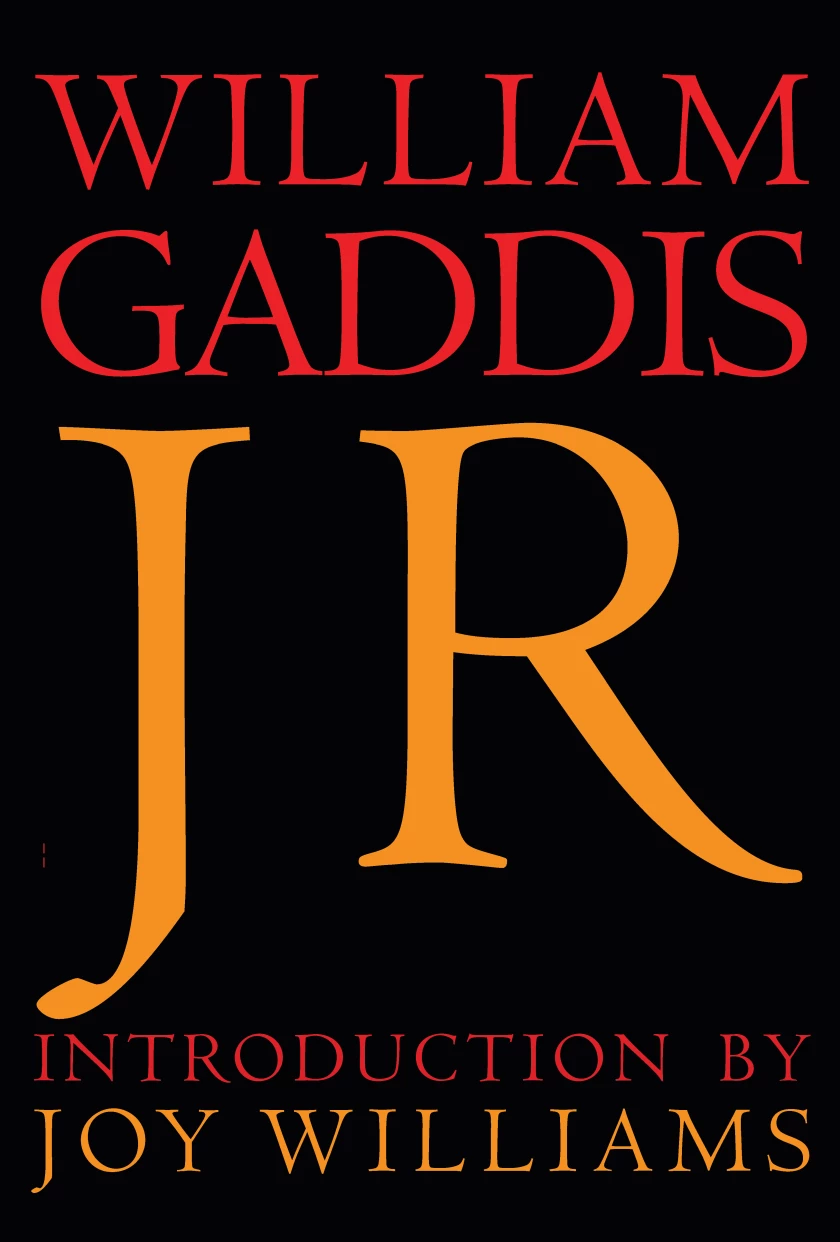
J R by William Gaddis

--No this other little boy I meant, J R he's so, he always looks as though he lives in a home without, I don't know. Without grownups I suppose, like he simply lives in those clothes of his.

--Probably does, have you ever seen him when he wasn't scratching himself somewhere?

--Oh I know yes, I have felt he doesn't bathe often but, no there's something, something else, when you talk to him he doesn't look at you but it's not as though, not like he's hiding something. He looks like he's trying to fit what you're saying into something utterly different, some world you don't know anything about he's such an eager little boy but, there's something quite desolate, like a hunger...

J R Vansant is an eleven-year old from Massapequa, on New York's Long Island. He has an obsession with sending away for things, the free periodicals you get from people who are trying to sell you something. His sixth-grade class buys, as a collective project, a single share of a company called Diamond Cable during a field trip to Wall Street. It's this single share, in J R's possession, that will become, over the course of 800 pages, an upstart corporation that controls shipping companies, toilet paper companies, companies that make matchbooks and wallpaper, factories, a brewery, a film studio, and acres of land that belong to a First Nations tribe in Alberta, among dozens of others.

How does he do it? I could barely tell you. J R has a reputation as a "difficult" novel, but that's as descriptive as saying it's a novel made out of words: what makes J R difficult is that it boasts some thirty-odd principal characters and 99% of it is in pure, unattributed dialogue. "French scenes" blend seamlessly from one to the next, leaping over days and miles, and there are no chapter or scene breaks of any kind. Much of that dialogue is a dizzying kind of businessese that Gaddis learned from his day job, either in J R's voice or the many plutocrats and apparatchiks that get sucked into the orbit of the J R Family of Companies--none of whom know their boss or business rival is in the sixth grade. I'd honestly love to hear someone knowledgeable unpack the actual business moves that J R uses to build his empire. It starts with a shareholder suit J R pursues with his class' single share of Diamond Cable, I know that much, but when that's spun off into a tangle of debentures, mining rights, leasebacks, and liens, I could barely make heads or tails of it. And yet the novel has no interest in being understood, not in that way; what it's interested in is the sheer music of an indefatigable American idiom. What's most amazing about the novel, maybe, is that it manages to make the dreariest American jargon, Wall Street jargon, something of a thrilling circus ride.

J R is not a genius. He's a fairly ordinary eleven-year old; his dirty clothes and torn sneakers suggest that he is thoroughly neglected by absent parents. He thinks that the Inuit models in the American Museum of Natural History are stuffed, and when he instructs the company lawyer to incorporate in Jamaica, he believes it's the one in Queens. But neither is he purely lucky, like the Horatio Alger heroes the story cribs from. His superpower is a relentless philistinism, a child's inability to see past an obsession--in this case, an obsession that the country works tirelessly to inculcate in him. Twice during the novel, adults implore J R to look away from taxes, bonds, and securities and pay attention to something intangible. His class teacher, Amy Joubert, begs him to look at the moon: "Is there a millionaire for that?" she asks. Another teacher, the composer Edward Bast, who becomes J R's unwilling sidekick in the venture and is actually much closer to what one might call a "main character," tries to get him to listen to a tape of Bach. (J R thinks the German opera singer is singing "up yours.") But J R, a good American in training, simply cannot understand that there is such a thing as an "intangible asset."

I might give the impression that J R is a constant presence in the novel, but actually, the title character--though the engine that drives the events of the book--disappears for hundreds of pages at a time. Other characters fill in the space: teachers, businessmen, generals, senators, writers, painters. The heart of the novel might actually be a trio of failed artists--Bast and two writers, Gibbs and Eigen--who rent a small apartment on East 96th St. to work in. It's this apartment that becomes the headquarters of the J R Family of Companies, and which quickly fills up with unstoppable shipments and stacks of mail. J R's business has a way of sucking people in; in this apartment, it literally crowds them out. J R's "big idea" might be put very simply: money is the death of art. Bast, who dreams of being a great composer like his father (J R tells a magazine profiler he was a "famous conductor on the Long Island Rail Road) dreams of writing an opera, and over stages his dream shrinks: an opera, then a cantata, and finally, at the novel's end, a "piece for unaccompanied cello."

What do Bast and the others receive for the death of their artistic dreams? Nearly nothing; Bast spends half a time trying to chase down a salary from J R, who ties his employee's compensation up in unsellable stock options. But there's nothing to gain, because the J R Family of Companies is a paper tiger, collection of acquisitions that are spun into acquisitions, mostly in the hopes of being written off for tax purposes. The scheme never seems to generate any income for anyone, but it leaves a lot of destruction in its wake, squashing pension funds, defrauding indigenous nations, and even igniting sectarian war in a small African nation. No other novel captures so perfectly, or humorously, the great gaping hole at the center of American capitalism. I found myself wondering as I read what Gaddis would say about cryptocurrency or NFTs, those newfangled instruments that seem so transparently empty to everyone except those whose mania drives their "value" up. Some people may get rich, but mostly the people who are already rich; the rest of us, like J R and his associates, will get caught up in a flurry of empty noise and false promises.

Saturday, November 27, 2021

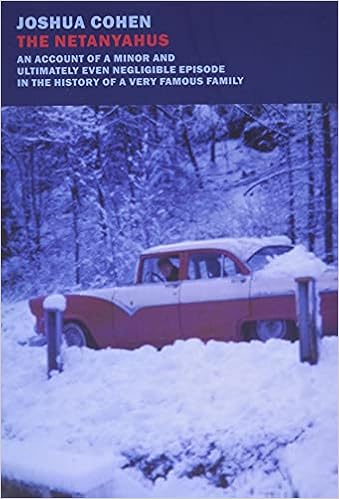
The Netanyahus by Joshua Cohen

You, Ruben Blum, are out of history; you're over and finished; in only a generation or two the memory of who your people were will be dead, and America won't give your unrecognized descendants anything real with which to replace the sense of peplehood it took from them; the boredom of your wife--who's tearing your program up into little white paper pills she'd like to swallow like Percodan--isn't merely boredom with you or her work or with the insufficiency of options for educated women in this country; it's more like a sense of having not lived fully in a consequential time; and the craziness of your daughter isn't just the craziness of an adolescent abducted from the city to the country and put under too much pressure to achieve and succeed; it's more like a raging resentment that nothing she can find to do in her life holds any meaning for her and every challenge that's been thrust at her--from what college to choose to what career to have--is small, compared to the challenges that my boys, for example--whom she's been condemned to babysit--will one day have to deal with, such as how to make a new people in a new land forge a living history. Your life here is rich in possessions but poor in spirit, petty and forgettable, with your frigidaires and color TVs, in front of which you can munch your instant supper, laugh at a joke, and choke, realizing that you have traded your birthright away for a bowl of plastic lentils...

Ruben Blum is the only Jewish faculty member at Corbin University, a small liberal arts college in the vast icefields between Albany and Buffalo, and the only Jewish person--excepting his wife and daughter--in the town of Corbindale. He's treated well, though condescendingly, though no one else seems satisfied with this role: not his wife, Edith, shouldered into menial work at the college library, not Edith's cosmopolitan parents, who look at Corbindale as a site of rural horrors, not his own parents, who believe he has forsaken the Bronx community of Jews that raised him. And certainly not his daughter Judy, who--in one of the novel's most, but not only, shocking scenes, plants her face in front of a doorknob so that her noticeably Jewish nose will at last be broken and repaired. Into this ripe pit of dissatisfaction a group of strangers enters: the family of Ben-Zion Netanyahu, an Israeli historian interviewing for a position at Corbin, and whom Ruben has been asked to shepherd around campus.

The Netanyahus is based on a real anecdote told to Cohen by the late Harold Bloom, another Jewish scholar who left the Bronx behind for the cold wilds of Northeastern academia. Bloom really was asked to host Ben-Zion Netanyahu, whose middle son Benjamin would later become the longest-serving prime minister of Israel. Bibi plays a surprisingly small role in the novel: he and his brothers enter the Blum household like three tiny tornados, fighting among each other and breaking television sets. It's Ben-Zion who really threatens to upend the fragile balance of Ruben Blum's existence. He's irascible, self-absorbed, contemptuous of the job offer and the school, and of the life that Blum leads willfully in America (while presenting himself as a kind of exile). Ben-Zion's scholarship focuses on the Jews of Medieval Iberia, but this description is too narrow: because the Jews have been caught in cycles of expulsion and reabsorption, he argues, they have truly been outside of history. Only the creation of the state of Israel brings to the Jews the possibility of living within history:

The world is full of real events, real things, which have been lost in their destruction and are only remembered as having existed in written history. But Zion, because it was remembered not as written history, but interpretable story, was able to exist again in actuality, with the founding of the modern state of Israel. With the establishment of Israel, the poetic was returned to the practical. This is the first example ever in human civilization in which this has happened--in which a story became real; it became a real country with a real army, real essential services, real treaties and real trade pacts, real supply chains and real sewage. Now that Israel exists, however, the days of the Bible tales are finished and the true history of my people can begin and if any Jewish Question still remains to be answered it's whether my people have the ability or appetite to tell the difference.

A careful letter from a concerned Israeli scholar describes Ben-Zion as a zealot, a dangerous man, and when at last he arrives in Corbindale, this assessment is hard to doubt. The way "the Yahus"--Ben-Zion, wife Tzila, children Jonathan, Benjamin, and Iddo--thoughtlessly take over the Blum household provides the novel with a manic energy punctuated by tremendous comedy. But Blum is unsettled, too, by what Ben-Zion says. It is true that the faculty chose Blum to babysit the Netanyahus because he's Jewish; though he is a scholar of American history his Jewishness can be abrogated or activated by his superiors at will. Certainly there is something frightening in the way his daughter Judy wishes to erase the very Jewishness of her face. Is Dr. Netanyahu's zealous Zionism the only alternative to expulsion or erasure? Would anyone in Corbindale say to Blum, as Ben-Zion does--though they clearly dislike each other--"And if the situation were reversed and your feet were in my shoes and you came to Israel, I'm not positive I could get you a job, but I'd do absolutely everything to find you a good apartment, and in a war, I'd die for you?"

I would leave it to a Jewish reader to say whether The Netanyahus resonates with the dilemmas of Jewish identity in the 20th century, but for me it seemed like a plausible and powerful presentation of the question, "How should a Jewish person be?" It's funny how a book set in upstate New York manages to outline so deftly the way the project of Israel intersects and makes demands on questions of Jewish identity, ones that might seem--to us goyim--as simplistic or strange. The Netanyahus is on Blum's side, not Ben-Zion's, whatever that might mean, but it captures what is so urgent in that worldview.

Wednesday, August 18, 2021

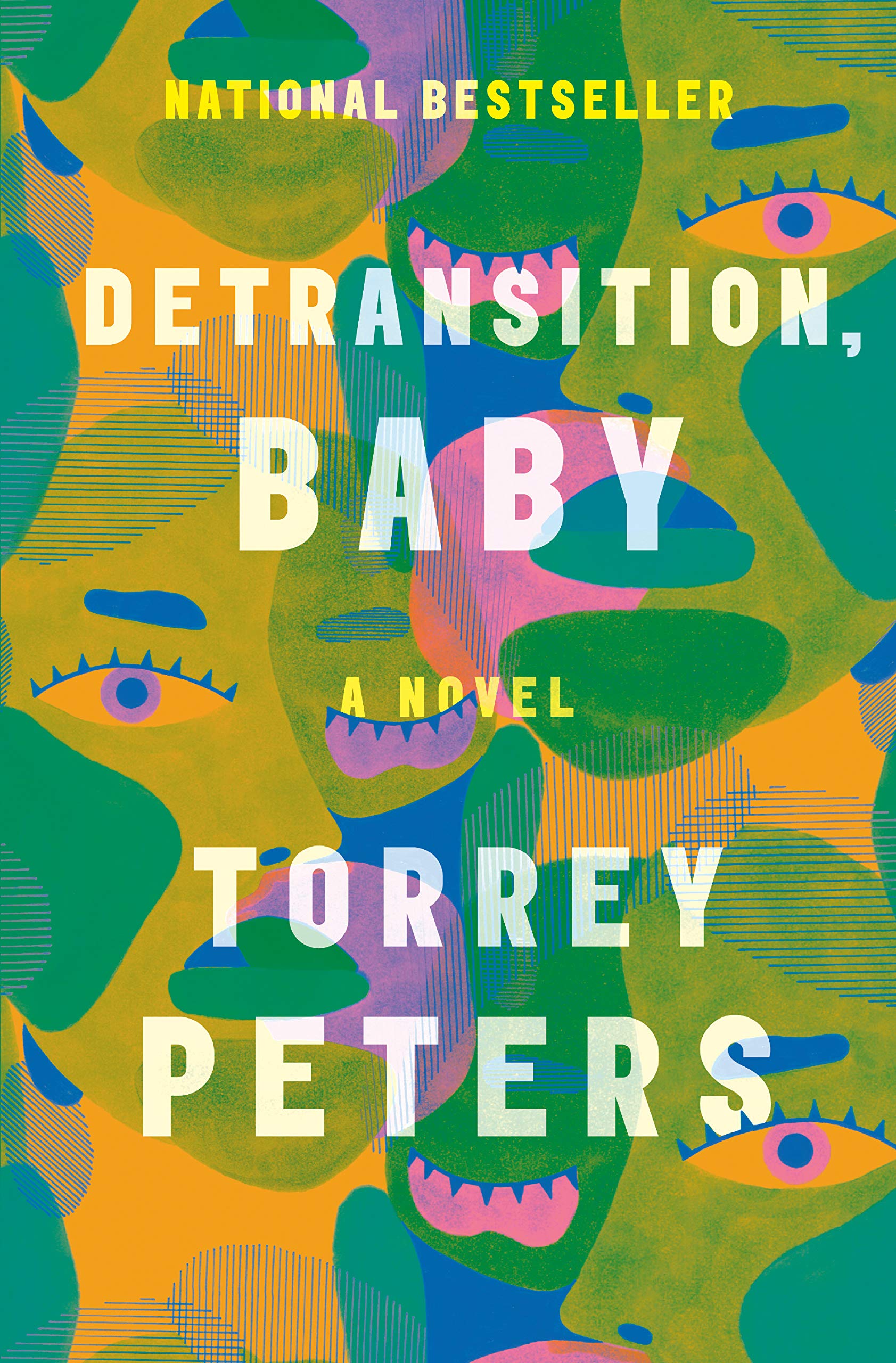
Detransition, Baby by Torrey Peters

Ames, having explained the condition of juvenile elephants, drew this metaphor: Trans women are juvenile elephants. We are much stronger and more powerful than we understand. We are fifteen thousand pounds of muscle and bone forged from rage and trauma, armed with ivory spears and faces unique in nature, living in grasslands where any of the ubiquitous humans may or may not be a poacher. With our strength, we can destroy each other with ease. But we are a lost generation. We have no elders, no stable groups, no one to teach us to countenance pain. No matriarchs to tell the young girls to knock it off or show off their own long lives lived happily and well.

Ames has been seeing his boss, Katrina, but he's kept a secret from her: for years he was Amy. Born James, he transitioned after an adolescence of confusion and crossdressing, only to detransition after a brutal beating at the hands of a chaser and bigot. When Katrina becomes pregnant--something he thought his former hormone therapy would prevent--he is thrown for a loop. The possibility of becoming not just a parent but a father is so repulsive, he reaches out to his former girlfriend, a trans woman named Reese, to ask if she wants to raise the baby with them as another mother. This sounds like lunacy, of course, but Reese, who has always wanted to be a mother--a difficult prospect for a trans woman, for reasons as much social and legal as physical--is drawn to the idea, and even Katrina seems to think such an unusual family might be possible.

Detransition, Baby must be the most high-profile fiction work by a trans author and about trans people ever written. It's interesting that it would focus so much on detransition, a phenomenon that is often seized upon by transphobes writing for glossy magazines to delegitimize trans lives. Peters makes it clear that Ames' detransition occurs not because of disenchantment or regret, but because living as a cis man, without the scrutiny and threat of violence, is just easier. It's a sad decision but one the book treats with respect, and in bringing together the three women--cis, detransitioned, trans--Peters examines just some of the many paths available to women and how they intersect. In fact, perhaps one of the most sadly remarkable things about Detransition, Baby is simply that it is a work of popular culture with more than one trans character. These snapshots of diverse experiences are, one hopes, a kind of antidote to the flattening narratives about trans people in America.

At the heart of Detransition, Baby is an old question: is it better to infiltrate heteronormative institutions, or undermine them? At one point, Peters talks briefly about how trans people have always been a part of the "gay" rights movement, though often marginalized and overshadowed, and this question is an endemic one in that movement, answered in different ways by different generations. Is the triad-parent scheme at the heart of Detransition, Baby an infiltration or an undermining? Certainly it's not a version of the family that will past muster with Focus on the Family or Fox News. But Reese's maternal desires are profoundly shaped by her own normie Wisconsin upbringing, and the two mothers-to-be bond over the most normie baby ritual of all: the baby registry. When the characters imagine trans parenthood, it looks a lot like cis parenthood. Of course, parenthood is not quite like marriage--it's a necessity of life and all--but it's certainly institutionalized, and the novel effectively narrativizes the tension created by queer participation in the institution. This tension is at the heart of what works about Detransition, Baby, I think.

However. Though this tension hums at the level of theme and plot, it gets resolved at the level of style. Destransition, Baby is formally straightforward, and its language seems most to resemble those online magazines that balance the language of informed forward-thinkingness with breezy chattiness. It is intensely middlebrow, intensely book-clubbish. In fact, it is a "Roxane Gay's Audacious Book Club Pick." That is to say that aesthetically, the novel is on the side of the normies, and aesthetically, it really struggles. The best parts of the book are the "flashback" scenes in which we see Reese and Ames/James/Amy in their most formative years, when their gender dysphoria is at its most raw.

But in the "now," when the three women actually get together, the novel becomes poisonously dreary. Their first conversation together, at a GLAAD award ceremony, is so clogged with abstractions about gender, identity, and family, that Ames quips at the end, "Credit to GLAAD... Tonight they have achieved their mission of facilitating another hard-hitting discussion of LGBTQ rights." Detransition, Baby tries very hard to cover every Very Important Trans Topic: suicide, HIV, violence, chasers, hormones, surgery, etc., etc. No doubt each of these things shapes the life of trans people daily, and yet there must be a way to explore them in a story about people, rather than a "hard-hitting discussion of LGBTQ rights."

There is a moment when Katrina steps off the train to visit Reese in Greenpoint, Brooklyn. (The book's loveless and sour depiction of my neighborhood is a criticism I'll keep mostly to myself.) Katrina points out the word Tranny on a nearby poster, which repulses and angers Reese, even though it turns out to be an advertisement for the memoir of that name by Against Me! singer Laura Jane Grace. Now, I haven't read the memoir, but Brent tells me it depicts the musician at a moment of near-homelessness and extreme precarity. Katrina tells Reese that, as a marketing exec, she wouldn't have chosen that title. ("Can you imagine a trans woman buying that book? I mean, what, is she going to read it on the subway?") This observation supposedly endears Katrina to Reese; for the first time she's able to see Katrina as an ally and a possible partner in motherhood. But I was strongly repelled by this small detail, partly because of the authority rooted in Katrina's job as a marketing executive. Grace's title is provocative--I think the intentions, like it or not, are clear--but is it good branding?

This moment also makes the book's ambitions clear: It's the trans book that a trans woman can read on the subway. It is respectable and palatable. And you know, we probably need books like that. I suspect their power is culturally and politically limited, but what do I know? I recognize that I don't really have any standing to pass judgment in that regard. I can say that I found the book artistically limited for these reasons. I'm a little wary of saying I didn't like it, because it's so important, but I think that really gets to the heart of why I didn't like it: it's too busy being important to be good.

Thursday, August 5, 2021

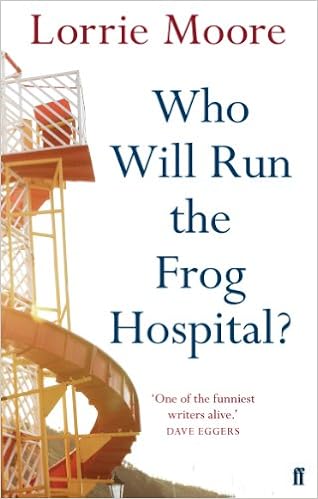
Who Will Run the Frog Hospital? by Lorrie Moore

Through the whole drive back I kept trying to steal glances at Sils to see if she looked any different. She had now gone through so many things that I hadn't, I wondered more than ever whether she could still like me, be the same as she had been, or even remember things we'd done together. Was there a ghost, an amphibious baby ghost, flying out behind us, above us, all the way home like a kite? Under Sils's arms there were dark circles of perspiration on my green shirt. her hair had grown oily and the front had separated into strands. I leaned over to loosen the buckle of my sandals, and when I turned to look up at her, from that angle, I could see a small, golden bugger floating in the dark of her right nostril like a star--odd and alone, speaking dizzily without words.

Berie Carr is sitting at a cafe in Paris eating brains with her husband. Their marriage may be at an end--he's stupid but also too clever, and boring, and on top of all that he has just recently pushed her down the stairs--and facing the watershed of that failure she begins to think back on her childhood. Growing up in the small Adirondack mountain town of Horsehearts, New York (what a name!), her life was organized around her best friend Silsby, called Sils, a luminous presence that still shines in her memory. She thinks back through the story of how she and Sils once worked together at a chintzy amusement park called Storyland--Berie as a ticket-taker, Sils as Cinderella--when Sils became pregnant by her boyfriend, a motorcycle-riding meathead. Berie, enamored with her friend without the words or judgment to explain it to herself, promises that she will take care of Sils' predicament, and begins skimming money from the park cash box to pay for Sils' abortion.

I really loved the richness and humor of Who Will Run the Frog Hospital?. It reminded me of Kathryn Davis' Labrador, another novel about one young girl enamored with another, and which shares some of the same luxury of detail and sparkle of prose. But in Labrador, the narrator's obsession with her sister is rewarded with cruelty and belittlement; Sils is beautiful and kind, even as the experience widens the gulf between her and the yet-to-bloom Berie.

I never quite felt the way Berie does about Sils as a character--she's too distant--but I believed wholeheartedly in Berie's belief, which strikes at something sad and true about the fleetingness of childhood love. With a few notable exceptions, like Sils' abortion and her boyfriend's motorcycle accident--which both he and she come to associate with the abortion itself, as a kind of manifested guilt--Who Will Run the Frog Hospital? avoids high drama. There's no big break between Sils and Berie, no shouting or tears or grand pronouncement, but Lorrie Moore plumbs the great depths of the small moments that life is often truly made of.

Memory, Moore writes, "can do nothing: It pretends to eat the shrapnel of your acts, yet it cannot swallow or chew." Berie's trip down memory lane stands in stark contrast with her present marriage: though let down by the dissolution of her marriage, nothing can stand next to the slow fade of her relationship with Sils; the marriage simply never reached the same heights. Can any marriage, entered to as adults, really match the ardor of your first crushes? I thought that Who Will Run the Frog Hospital? captured this truth, as much about adulthood as it is about youth, quite beautifully.

Monday, August 2, 2021

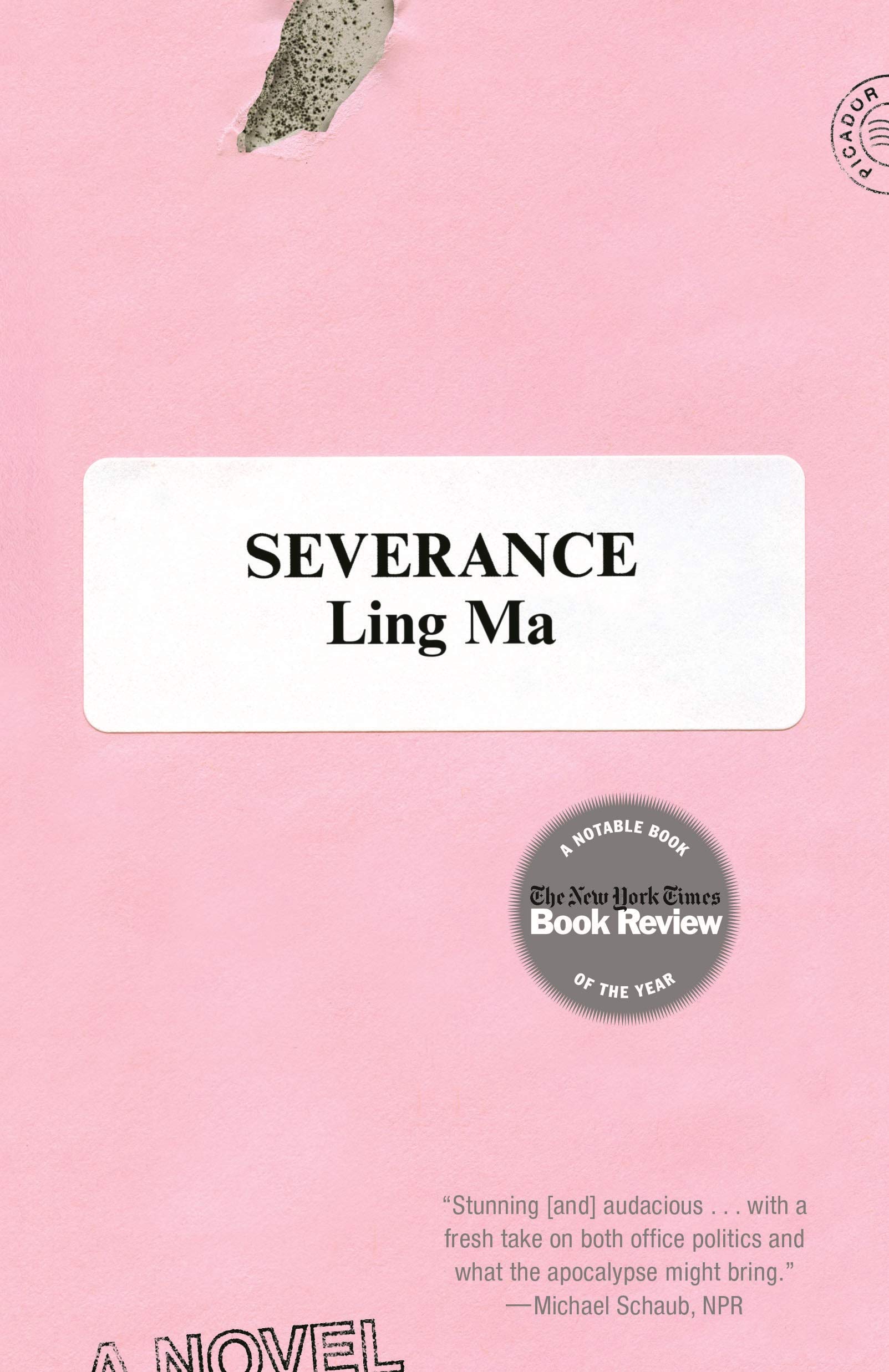
Severance by Ling Ma

Memories beget memories. Shen Fever being a disease of remembering, the fevered are trapped indefinitely in their memories. But what is the difference between the fevered and us? Because I remember, too, I remember perfectly. My memories replay, unprompted, on repeat. And our days, like theirs, continue in an infinite loop. We drive, we sleep, we drive some more.

A mysterious disease emerges from China. The U.S. border is shut down, but it's too late: the infection spreads uncontrollably. Things in China are even worse, we suspect, but the Chinese government keeps a tight lid on information coming out of the country. Americans try to protect themselves with mask, though not everyone believes they provide any protection at all. Basic services begin to fail; the supply chain buckles; people flee New York as it begins to collapse. Those who stay attempt to work from home, but without the interconnectedness of the modern world, things go quickly south.

In 2021, Ling Ma's Severance seems awfully prescient, doesn't it? What stands out the most is perhaps the ways in which Ma's imagination falls short of the real thing: the number of dead, for example, that provokes the U.S. to stop publishing statistics, is 280,000. (We're at 600,000 and counting.) The main character's employer offers a colossal sum to continue working from the office while everyone else transitions to remote work. This last bit seems particularly egregious, given how interested Severance is in the economic structures that seem both so fragile and so binding: of course, in the real world, many people have simply been forced into work. But these are not really criticisms, just grimly funny observations; in truth Severance seems to have gotten the shape and import of a 21st century global pandemic exactly right.

The protagonist, Candace Chen, is a Chinese-born American who, in her former life, works as a production director for a book publisher. Her job is in Bibles: sourcing the leather, the paper, the little gemstones attached to their most expensive product line. This work involves contracting Chinese companies; she travels between America and Shenzen and gives her a first-hand look at the realities of the global manufacturing economy. This job is exactly as fulfilling as you expect it might be, and she drifts through her New York existence in profound alienation: the second meaning of the word severance, and a state that the pandemic only intensifies. After the "Shen Fever" hits, she escapes the city, only to be captured by the megalomaniac leader of a group of travelers who sees her pregnancy as link to the future existence of humankind.

What I liked most about Severance is that it doesn't overexplain the connections between Candace's pre-pandemic profession and the reality of social collapse. Shen Fever, unlike Covid, is a fungal disease, and though it's not explicitly stated, one suspects that it travels around the world on the billions of products with MADE IN CHINA inscribed on them. Candace's own relationship to China, a country where all of her surviving family lives, but about which she remembers little, is a fraught one, circumscribed, like most Americans, by the logic of economics and production, rather than affection. "The future just wants more consumers," her boyfriend tells her, but Severance is a story about a future that consumes itself to death and is unable to stop. Sufferers of Shen Fever can often be discovered in zombie-like reenactments of what they loved most in life, and often this becomes acts of empty consumption: trying on clothes, walking around an abandoned mall. Severance describes a world in which production and consumption govern our most intimate and far-flung relationships, and suggests that the most frightening thing about those relationships somehow is the possibility of their collapse.

Saturday, July 10, 2021

A Children's Bible by Lydia Millet

Before the storm we'd caught sight of the parents' screens sometimes, snagged their devices when we needed a quick fix. Gotten flashes of TV through a doorway. But these days we mostly had what was in front of us, the cottage and the barn and long grass in the fields. Long and short, tussocks and bare patches. Topography. We had the wood of the walls and fences, the metal of the parked cars with their near-empty gas tanks.

We had the corners of buildings and the slope of the hills, the line of the treetops. The more time passed, the more any flat image began to seem odd and less than real. Uncanny delicate surfaces. Had we always had them?

We'd had so many pictures. Pictures just everywhere, every hour, minute, or second.

But now they were foreign. Now we saw everything in three dimensions.

A group of teens and near-teens have gathered with their parents at a beach house on Long Island. They exist aloof from their parents, who embarrass them with their drinking and drug use, their sexual neediness and general carelessness. They are so detached from them that the teens play a game: who will be the last of them to have their parents "identified" by the others, and thus claimed by them? (How, I wonder, do you end up with a group of adult friends whose teenage kids don't know whose parents are whose?) Meanwhile, a storm is coming, a monster created by climate change that promises to unleash an apocalypse on the country. The teens, fed up with their parents' cluelessness, escape to safety on their own, fleeing to an abandoned farmhouse in Westchester County.

There's a powerful dynamic at the heart of A Children's Bible: the affective gap between generations, created by climate change. The increasing precarity of the world has sundered the trust that children ought to have in their parents, and while it's nothing new for each generation to distrust their elders, a hippie-like confidence in the future is no longer possible. Millet's choice to make the teens sober cynics and the parents hedonists--an inversion of our usual expectations for stories about generational clashes--captures something true and sad about the world in the climate change era. The teens, and the book, are a little too smug about this difference sometimes, but it works.

I'm sorry to say I didn't like almost every other thing in this book. I didn't buy the voice of the protagonist Evie or her friends, which often felt false to me, like an old person trying to talk like a young one. ("True dat.") I didn't like that the book became a kind of thriller movie, when a roving militia kidnaps the teens and the helpful adults who have gathered at the farm in search of food, and I didn't understand the bizarre deus ex machina that resolves the siege. And I especially didn't like the character of Evie's little brother Jack, who is inspired by his Children's Bible--hence the title of the book--to save two of each animal, Noah-like, and who becomes convinced that he has "cracked the code" of the Bible: God is Nature and Jesus is science. If we only put our trust in science/Jesus, we will be saved, Jack insists. Now, he's nine, but it's clear we're supposed to see him as one of those babes out of whose mouths truth emerges. I don't think "science is Jesus" is an idea that reflects well on science or Jesus.

We're going to have to figure out what the new world we have created demands of us, artistically. (Art, Evie concludes, is the "holy spirit" in the Trinity that includes Nature and Science. Blech.) We're going to stumble into that new world, and stumble into the new art. A Children's Bible offers one very good, very chilling contribution: a powerful symbolic representation of the way we have betrayed our future and our children, unable to pull ourselves away from the party.

Tuesday, July 6, 2021

Parakeet by Marie-Helene Bertino

One week before my wedding day, upon returning to my hotel room with a tube of borrowed toothpaste, I find a small bird waiting inside the area called the antechamber and know within moments it is my grandmother. I recognize the glittering, hematite eyes, the expression of cunning disapproval. The odor of a gym at close of day encircles her.

A woman about to be married discovers that a parakeet has gotten into her hotel room, and the parakeet is her grandmother. The parakeet-grandmother is not all that excited about the impending wedding--she shits on the wedding dress--but neither is the Bride, to be honest, who moves through the various arrangements that lead to a wedding with disassociated trepidation. The parakeet-grandmother tasks her with finding her brother, warning her, however, You will not find him. In a sense this turns out to be true: her brother Tom has become a woman named Simone.

Parakeet is a novel about strange transformations. A grandmother becomes a parakeet; Tom becomes Simone. Of course, Simone is the person who Tom has always been, and as Simone she and the Bride may be able to have the kind of relationship they have never before had. Parakeet holds out the possibility of transformation as a discovering wholeness, a way of becoming oneself. But a wedding, too, is a kind of transformation, from a single woman into a wife, but perhaps not all transformations are welcome ones. In one brief chapter, the Bride finds herself transformed into her own mother. While unwelcome, occupying her mother's body allows the Bride to learn things she never knew about her mother: that she's consumed by lust, and also prone to uncomfortable bouts of farting. If this episode is an exercise in empathy, it's discarded by the end of the novel, when the Bride's mother viciously rejects Simone, who shows up to the wedding at last--becoming her own mother only gives the Bride permission, perhaps, to hate her more.

This is all a lot. Parakeet struck me as a novel that has a few too many good ideas, a few too many transformations. It has a kitchen-sink quality that crowds out the Bride's sense of listlessness and woundedness; it's overstuffed and gaudy. It takes patience, I think, to unravel the themes as they emerge: for example, we learn late in the book that the Bride associates her grandmother with parakeets because they, too, are immigrants from another climate to New York. (I'm very familiar with the monk parakeets who live in and around Green-Wood Cemetery in Brooklyn, but Bertino is taking some license when she describes them as having striking "indigo foreheads"--their foreheads are the same gray color as their breasts.) This observation unlocks, it seems, the connection between her grandmother and the traumatic attack the Bride keeps alluding to, when an anti-immigrant gunman stabbed her at a coffee shop where she was working after shooting to death two customers and her Asian-American coworker. There is an undercurrent of racial animus in her marriage--the grandmother-parakeet observes, disapprovingly, that her fiance is white--but otherwise this theme manifests mostly as a conspicuous attention to the Bride's brown skin that seems oddly bereft of any real cultural or ethnic implications.

The big theme, though, is trauma. The Bride has become a bride because she thinks it is the "normal" thing to do, and while she has craved normalcy in the aftermath of her stabbing, she has come in this last week to doubt whether such normalcy is really the solution to, or opposite of, that trauma. Though Parakeet is much more thoughtful and clever than Migrations, another book about trauma and birds, it struck me as presenting a similar ethos. Both books layer their traumas over one another, laying at the center, like the proverbial pea in the princess sheets', the Big Trauma. Layered over the stabbing, though not necessarily in a chronological way, are the Bride's distant mother and rocky childhood, her sister's absence, Simone's insistence on staging a play about her stabbing, Simone's own wedding, which ended in a heroin overdose, etc., etc. But for me, these layers fail to illuminate each other; they only make render them murky and illegible.

Sunday, December 20, 2020

Light Years by James Salter

Their life is mysterious, it is like a forest; from far off it seems a unity, it can be comprehended, described, but closer it begins to separate, to break into light and shadow, the density blinds one. Within there is no form, only prodigious detail that reaches everywhere: exotic sounds, spills of sunlight, foliage, fallen trees, small beasts that flee at the sound of a twig-snap, insects, silence, flowers.

And all of this, dependent, closely woven, all of it is deceiving. There are really two kinds of life. There is, as Viri says, the one people believe you are living, and there is the other. It is this other which causes the trouble, this other we long to see.

Nedra and Viri are married. Nedra is beautiful, creative, mysterious; Viri is a middling architect who dreams of being famous. They live in the suburbs of New York City with their daughters, Danny and Franca. From the outside, their life seems perfect, and often it seems that way from the inside, too: see, for example, the pair painstakingly huddled over the kitchen table writing an illustrated book about the mystery of eels for their daughters. Viri puts on plays for them, and elaborate Easter egg hunts (the speckled ones are more points than the plain, and there are several golden bees worth five times as much--some, he explains, should be hidden so that they are never found). But of course, there are cracks: both of them are carrying on affairs.

Is it that kind of novel? You know the one I mean: a mid-century family, a home in Westchester, adultery, prose that leers at women, an insistence the American family is in disarray, but for reasons having to do entirely with postwar ennui, and not with, say, income inequality or the stifling nature of patriarchal institutions. Well, it is and it isn't. It certainly checks all of those boxes, but the description seems to fall short of capturing what Light Years really is or does. It's highly impressionistic, floating, it often seems, from one dinner party to another. Friends of Nedra and Viri drift in and out like friends in real life do, appearing for a while to be crucially important and then fading away, having left few traces of themselves. The marriage does begin to dissolve, does end, but in the final reckoning it's hard to figure out why; it certainly doesn't have anything to do with the affairs, which mean next to nothing. A few moments shine out brilliantly--like the collaboration over eels, or Viri's encounter with a tailor who has devoted his life to making beautiful shirts, like a kind of yogi--but fail to generate conflict. Conflict is there, but it seems to have birthed itself.

The prose is absolutely impeccable, yet Light Years often left me feeling cold. "Cold," in fact, is one of the words that seems to characterize the novel most perfectly. The first line of Part Two might as well be the novel's epigraph: "In the morning the light came in silence." Everything in this novel is cold, light, silence; Salter lingers over the image of the Hudson on a winter's afternoon, or the sensation of being in a dark room in the middle of the day, doing nothing at all. I found it a relief, actually, when toward the novel's end the divorced Viri relocates to the sweaty chaos of Rome, where his life is reinvigorated by a new woman and a new environment. But for much of the novel I felt myself skipping off of the words like--oh, I guess, a stone being skipped on the frozen Hudson river, with some seagulls scattered around.

One thing I think Salter does really well is capture the way that violence, sickness, and death punctuated the sterility of bourgeois existence. Those things haunt the edges of the novel, affecting at first acquaintances, then friends, and then family. The death of Nedra's father is one of the most touchingly rendered passages in the book, and perhaps even moreso because it's neither young nor unexpected. As they age, Nedra and Viri must confront these things among their friends:

His voice was the only thing unchanged, his voice and character, but the structure that held them was dissolving. All the old and interconnected knowledge--architecture joined to zoology and Persian myth, recipes for hare, the acquaintance with painters, museums, inland rivers dark with trout--all would vanish when the great inner chambers failed, when in one final hour the rooms of his life dropped away like a building being wrecked. His body had turned against him; the harmony that once reigned within it had disappeared.

Of course, the tragedy of these dissolutions is always, in part, due to the fact that you know they'll come for you one day, too, and they do. The title Light Years, I suppose, is meant to emphasize the way that life is both vast--it is the only time and space allotted to us--but the way that it passes so quickly. I've found life a little warmer and more messy than Salter seems to, but it's easy to see why others, whom the novel has touched more deeply, have found it to be underappreciated.

Monday, March 30, 2020

Young Man with a Horn by Dorothy Baker

That's the story, and it could never be called a grand tragic theme; it does not depict the fall of a noble person from high to low estate--Rick Martin never got anywhere near high estate, though he did make a lot of money for a while.  But it is a story that has the ring of truth and an overtone or two.  It is the story of a number of things--of the gap between the man's musical ability and his ability to fit it to his own life; of the difference between the demands of expression and the demands of life here below; and finally of the difference between good and bad in a native American art form--jazz music.  Because there's good in this music and there's bad.  There is music that is turned out sweet in hotel ballrooms and there is music that comes right out of the genuine urge and doesn't come from money.

Dorothy Baker's Young Man with a Horn is a fictionalized version of jazz giant Bix Beiderbecke, who, while largely forgotten among Americans today, was one of the first real virtuosos of the genre in its early days, and who died tragically and mysteriously young.  Her version of Beiderbecke is Rick Martin: a wayward kid from Los Angeles who discovers an aptitude for music by fooling around with a piano in an unlocked church, and who then finds there's no room for anything else in his life.  It's a story, at least in part, about race: like Beiderbecke, Rick is welcomed into the almost entirely black world of jazz music, and his talents and passion for the music are what are able to overcome the prejudices he's inherited.

Moreover, it's a story about the gifts and poisons of genius; Rick is the best trumpet player in the world because it is the only thing he's able to fit into his life.  Baker underscores this when, in an early scene, the teenage Rick hears that the drummer in the band he adores has suddenly died of a burst appendix.  Rick's best friend Smoke, a world-class drummer in his own right, is going to inherit the job, but while Smoke is wracked with grief, Rick can only think about the band:

"When you going to start?" Rick said.  He didn't have anything to say about death; the only thing he ever had anything to say about was music.  From his own point of view as a pianist and trumpet player he could tell you whether a piece was hard or easy; in a larger sense, as a critic, he could say right off whether a thing was good or bad.  His instinctive taste was infallible within the bounds of his chosen field.  Outside of that he was deaf, dumb, and blind, even slightly halt and more or less lame.  What was death to him; what was plane geometry; what was Spanish Conversation and Composition?  He looked steadily, with appraising eye, at the late George Ward's drums.

I was surprised how different Young Man with a Horn is from Cassandra at the Wedding, a book published almost 25 years later than Young Man, and which possesses a kind of mid-century modernist air that Baker apparently had yet to develop.  In place of Cassandra's third person limited POV, Young Man with a Horn is narrated by an unidentified and unnamed narrator whose account of Rick's life is steeped in vernacular and colloquialisms.  It seems right for the novel, and by the end, the novel itself becomes kind of jazzy, taken up with elaborate counterpoints between Rick, Smoke, bandleader Jeff Williams, and the other early jazz figures that make up Rick's world.  Even Rick's brief and ill-fated marriage to an ironic and aloof woman seems to take on the forms of great jazz improvisation.  At the same time, the narrator--and Baker--are cagey about the ability of the written word to capture the feeling or sensation of music, and while Baker writes lucidly and without repetitiveness about the experience of playing music, her reticence to reach for unsatisfying metaphors or florid language is one of the book's strengths.

Like Beiderbecke, Rick is doomed to die young, a fact that the narrator warns us of from the very outset of the book.  Beiderbecke's death is somewhat of a mystery, but Rick drinks himself to death.  Alternatively, Baker suggests that what really kills him is that love of jazz, a need to play music so powerful there's no room for anything else in Rick's life, even his life itself.  The climax comes when Rick, playing on a recording behind Smoke's sister Josephine (everyone in this L.A. neighborhood seems to grow up to become a jazz virtuoso) when, for the first time in his life, he plays a bum note.  The rumor is that Rick is washed up, that he's finally exhausted his talent, but the bandleader hears something different:

They waited a minute and Jeff went on almost as if he were talking to himself: "I don't know what the hell that boy thinks a trumpet will do.  That note he was going for, that thing he was trying for--there isn't any such thing.  Not on a horn."

Rick dies because his dream has outstripped life; as the note he is imagining cannot be played, so the life he wants to live cannot be lived.  You can't live jazz and only jazz.  But jazz, as genteel and milquetoast as it seems today, strikes me as the only musical form, except for its cousin blues, that might ever have inspired anyone to believe such a thing.  No one seems to be under the impression that trap music might offer a transcendent existence, or house music, unless maybe those on molly.  Young Man with a Horn really gave me a sense of how special it was to be around jazz in those early days and what a loss it is that those days are gone.