Showing posts with label Lorrie Moore. Show all posts

Saturday, May 18, 2024

I Am Homeless If This Is Not My Home by Lorrie Moore

He then remembered: others did not see his and Lily's as a mutual love and why would they. There were too many jealous bumps, sudden disappearances, pointed rebukes--no one saw theirs as the passion it was. It looked like weariness and defeat and sometimes it was, but it was weariness and defeat as attachment. It was passion-at-peace, adoration gone awry and away, then returned, love in the armistice, which one never had without a little war. Finn and Lily's love was a shared secret--though shared secret was one of those phrases that also meant its opposite. Like cleave. Or overlook. Nor one seemed to have seen what he had seen, or known what he had known: that he and Lily were water birds who'd mated for life--and yet often conducted their lives separately in another part of the meadow or the pond.

Finn leaves the side of his dying brother to face urgent news about his estranged partner, Lily: she's killed herself, and in gruesome fashion--letting the water from the shower in the psych ward fill her lungs. He wanders to the "green burial" site where she has been deposited, only to find her sitting in the dirt, alive. It's the ultimate fantasy, the dream that follows everyone who's lost a loved one, the dream of more time. Finn and Lily climb into his car for one final road trip, from New York to Knoxville, Tennessee, where, we are told, a more desirable sustainable cemetery awaits. Joyed at Lily's return, Finn ignores that the road trip must needs head toward a second death, a second loss. For a moment, they are the couple they once were, joking and sniping at one another, indulging in the hokey wordplay that characterizes Moore's writing, though this time Lily's longing to die haunts him in a more concrete way.

This is the first of Moore's novels that I've read that I thought just didn't work. Moore's jokiness works well enough, but not always, in the repartee between Finn and Lily, but in the lengthy opening scene with Finn and his brother Max, it seems (for the first time) pointless and cheesy. The road trip is too talky, with no sense of motion or change, no interest in landscape or event--leaving us only with the words that don't quite work. More confusing still, I felt, were the interwoven passages from a 19th century innkeeper who admits to killing a chauvinistic resident-slash-suitor, and which turn out to be leaves in a diary that Finn reads in a Tennessee inn while Lily sleeps. The antiquated voice is not quite right, and the story too thin to stand of interest on its own. Yet the connection with Finn and Lily--between, perhaps, the urge to kill and the urge to die--seems also half-baked.

I sort of expected this to pull together in the end; in each of Moore's books there have been moments of doubt for me that were ultimately put to rest. She has a knack for prodding a reader with the ridiculous, and then justifying it, but here, the final act never seems to come. It's a shame, because the core moment of the novel--the pure, unlooked-for grace of finding the dead living, followed by the bittersweet realization that death can only be postponed, never stopped--is powerful.

Sunday, October 29, 2023

A Gate at the Stairs by Lorrie Moore

From our perspective that semester, the events of September--we did not yet call them 9/11--seemed both near and far. Marching poli-sci majors chanted on the quads and the pedestrian malls, "The chickens have come home to roost! The chickens have come home to roost!" When I could contemplate them at all--the chickens, the roosting--it was as if in a craning crowd, through glass, the way I knew (from Art History) people stared at the Mona Lisa in the Louvre: La Gioconda! its very name like a snake, its sly, tight smile encased at a distance but studied for portentous flickers. It was, like September itself, a cat's mouth full of canaries. My roommate, Murph--a nose-pierced, hinky-toothed blonde from Dubuque, who used black soap and black dental floss and whose quick opinions were impressively harsh (she pronounced Dubuque "Du-ba-cue") and who once terrified her English teachers by saying the character she admired most in all of literature was Dick Hickock in In Cold Blood--had met her boyfriend on September tenth, and when she woke up at his place, she'd phoned me, in horror and happiness, the television blaring. "I know, I know," she said, her voice shrugging into the phone. "It was a terrible price to pay for love, but it had to be done."

After three books, I see what Lorrie Moore is up to. She wants to make us laugh, and then devastate us. We're not supposed to see it. I'm onto you, Lorrie. In this case, the set-up centers on Tassie Keltijn, the daughter of a small organic farmer who enters a college that looks and sounds suspiciously like the University of Wisconsin. Tassie takes a job as a nanny from a woman named Sarah, but she starts before the baby arrives: Tassie and her husband Edward are trying to adopt. She's whisked off on a flight to Green Bay to pick up a biracial child who becomes Tassie's charge. Tassie becomes enamored with the girl, who begins as Mary, extended to Mary-Emma, then just "Emmie," and she finds herself fascinated by the steely, middle-aged Sarah, who seems alternately impossibly self-assured and strangely desperate.

A Gate at the Stairs has all the hallmarks of a coming-of-age novel: Tassie, on her own for the first time, looking to Sarah and her unconventional family, contemplating Sarah as a model--or a warning. Tassie is wry and jocular, in a way that sometimes sounds a little too much like Lorrie Moore, and not enough like a 20-year-old, even a particular observant or knowledgeable one. Moore has a real gift for the humorous detail, one that thrives on a brisk pace: not every joke lands, but before you have time to think about it, she's onto the next one. And Tassie is growing up in a rapidly changing world: 9/11 has rapidly transformed the country, and though the Twin Towers and the war may seem distant from this Wisconsin college town, it intrudes upon Tassie's life in surprising ways, not least of which is her younger brother's decision to join the army when he graduates from high school. 

From there Moore ushers the reader into a series of utter shocks--spoiler alert: first, Tassie's new Brazilian boyfriend Reynaldo turns out not to be Brazilian at all, or Reynaldo, but a young Muslim en route to vague missions in the U.S. Sarah admits to Tassie that she has a horrible secret: she and Edward once had different names, which they changed after running over their own son in a horrible and negligent car accident. (The parallel between Reynaldo and Sarah--the hidden identity, the assumed name--stands out, and contribute to the feeling that Tassie's life has destabilized, become uncertain.) When the adoption agency discovers their deceit, Mary-Emma is taken away from them, and never seen again. Finally, Tassie's brother is one of the first servicemen killed in Afghanistan. In one bold scene, Tassie climbs into her brother's coffin, feeling his mangled body, stuffed with replacement parts because he was blown apart, and is accidentally whisked away inside the coffin to the graveside. It's a scene that probably shouldn't work, but the fact that it does is testament to Moore's writerly skill.

I've had a similar experience with all the Moore novels I've read, which include this, Who Will Run the Frog Hospital? and Anagrams: I start impressed by the writing, if a little impatient with how loose and silly it can be, and by the end I'm absolutely devastated. Moore writes like that, I suppose, because sometimes life is like that, with humor and grief mixed in unequal measure.

Saturday, May 7, 2022

Anagrams by Lorrie Moore

When I was little, I didn't understand that you could change a few sounds in a name or a phrase and have it mean something entirely different. When I told teachers my name was Benna and they said, "Donna who?" I would say, "Donna Gilbert." I thought close was good enough, that sloppiness was generally built into the language. I thought Bing Crosby and Bill Cosby were the same person. That Buddy Holly and Billie Holliday were the same person. That Leon Trotsky and Leo Tolstoy were the same person. It was a shock for me quite late in life to discover than Jean Cocteau and Jacques Cousteau were not even related. Meaning, if it existed at all, was unstable and could not survive even the slightest reshuffling of letters. One gust of wind and Santa became Satan. A slip of the pen and pears turned into pearls. A little interior decorating and the world became her twold, an ungrammatical and unkind assessment of an aging aunt in a singles bar. Add a d to poor, you got droop. It was that way in biology, too. Add a chromosome, get a criminal. Subtract one, get an idiot or a chipmunk. That was the way with things. When you wanted someone to say, "I love you," approximate assemblages--igloo, eyelid glue, isle of ewe--however lovely, didn't quite make it. "You are my honey bunch" was not usually interchangeable with "You are my bunny hutch." In a New York suburban bathroom, early in the morning, a plea for sight could twist, grow slightly, re-issue itself as an announcement of death.

"There was a period," writes Benna Carpenter, the protagonist of Lorrie Moore's Anagrams, "where I kept trying to make anagrams out of words that weren't anagrams? moonscape and menopause; gutless and guilts, lovesick and evil louse." Near-likenesses dominate the novel. In each section, Benna, along with her friend Gerard, leads a slightly different life: in the first, they live as quasi-lovers in two adjoining apartments, in the next they are friends collaborating on a garage sale. He's a kindergarten teacher, then an opera singer. It's enough to make the reader go back and re-read, looking for something they've missed: how did we get from A to B? But these are parallel stories, not chronological ones, versions of a life that don't quite superimpose neatly upon another. The effect is of a novel in constant self-revision, first in short bursts, then a much longer section--in which Benna is a hapless instructor of poetry who has an affair with her most talented student--finds the story it wants to tell. But what's happened to Benna's other lives?

At first, I thought I could tell that Anagrams, Moore's debut novel, was less sophisticated than her novel Who Will Run the Frog Hospital?, which I thought was terrific. For one, it's obsessed with puns, and not always good ones: a character tossing a pillow is said to "throw cushion to the wind." Surely, I thought, this is the work of a writer who will later find more interesting and subtle kinds of wordplay. But the more I read, I became convinced that the silly puns emerge from the same place as Benna's compulsion to look for anagrams that don't really exist, or her childhood wonder at how changing a single letter can change a whole word: the frightening belief that, if one detail in one's life changes, everything might change. Which means that there are all sorts of phantom lives out there that you might have lead. They might even be collected in the same book.

For the Benna of "The Nun of That," the long last section, one of those unlived lives is the one in which she had a child. Throughout the section, Benna spars verbally with her precocious and creative young daughter George, who happens to be entirely imagined. Moore says this from the outset, "my imaginary daughter," but then drops it, so that the reader easily forgets--or thinks, perhaps, surely that's not what she meant. But George really is imaginary, and by the section's end--marked by a profound, sudden, and surprising loss, the reminder that Benna's daughter isn't real amplifies the staggering sense of being left totally alone. Though Anagrams has a silly and anarchic vibe at times, with its wordplay and silly puns, I wasn't prepared for how much of a gut-punch this would be. One expects, or hopes, to turn the page, have the narrative reset again, to see the characters in new professions, new lives, new roles, but in the end the life you receive is the one you must end up living.

Thursday, August 5, 2021

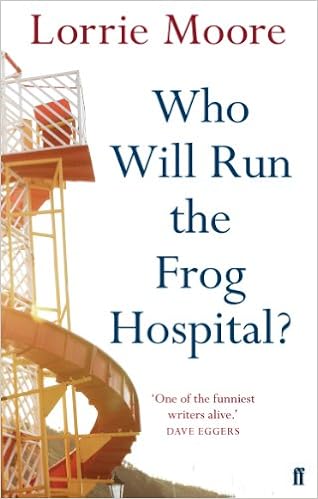
Who Will Run the Frog Hospital? by Lorrie Moore

Through the whole drive back I kept trying to steal glances at Sils to see if she looked any different. She had now gone through so many things that I hadn't, I wondered more than ever whether she could still like me, be the same as she had been, or even remember things we'd done together. Was there a ghost, an amphibious baby ghost, flying out behind us, above us, all the way home like a kite? Under Sils's arms there were dark circles of perspiration on my green shirt. her hair had grown oily and the front had separated into strands. I leaned over to loosen the buckle of my sandals, and when I turned to look up at her, from that angle, I could see a small, golden bugger floating in the dark of her right nostril like a star--odd and alone, speaking dizzily without words.

Berie Carr is sitting at a cafe in Paris eating brains with her husband. Their marriage may be at an end--he's stupid but also too clever, and boring, and on top of all that he has just recently pushed her down the stairs--and facing the watershed of that failure she begins to think back on her childhood. Growing up in the small Adirondack mountain town of Horsehearts, New York (what a name!), her life was organized around her best friend Silsby, called Sils, a luminous presence that still shines in her memory. She thinks back through the story of how she and Sils once worked together at a chintzy amusement park called Storyland--Berie as a ticket-taker, Sils as Cinderella--when Sils became pregnant by her boyfriend, a motorcycle-riding meathead. Berie, enamored with her friend without the words or judgment to explain it to herself, promises that she will take care of Sils' predicament, and begins skimming money from the park cash box to pay for Sils' abortion.

I really loved the richness and humor of Who Will Run the Frog Hospital?. It reminded me of Kathryn Davis' Labrador, another novel about one young girl enamored with another, and which shares some of the same luxury of detail and sparkle of prose. But in Labrador, the narrator's obsession with her sister is rewarded with cruelty and belittlement; Sils is beautiful and kind, even as the experience widens the gulf between her and the yet-to-bloom Berie.

I never quite felt the way Berie does about Sils as a character--she's too distant--but I believed wholeheartedly in Berie's belief, which strikes at something sad and true about the fleetingness of childhood love. With a few notable exceptions, like Sils' abortion and her boyfriend's motorcycle accident--which both he and she come to associate with the abortion itself, as a kind of manifested guilt--Who Will Run the Frog Hospital? avoids high drama. There's no big break between Sils and Berie, no shouting or tears or grand pronouncement, but Lorrie Moore plumbs the great depths of the small moments that life is often truly made of.

Memory, Moore writes, "can do nothing: It pretends to eat the shrapnel of your acts, yet it cannot swallow or chew." Berie's trip down memory lane stands in stark contrast with her present marriage: though let down by the dissolution of her marriage, nothing can stand next to the slow fade of her relationship with Sils; the marriage simply never reached the same heights. Can any marriage, entered to as adults, really match the ardor of your first crushes? I thought that Who Will Run the Frog Hospital? captured this truth, as much about adulthood as it is about youth, quite beautifully.