Showing posts with label james wood. Show all posts

Wednesday, February 2, 2011

The Broken Estate by James Wood

The last and titular essay in James Wood's The Broken Estate is uncharacteristically schizophrenic. It is sometimes about literature and sometimes about religion, and only infrequently about both. In it, Wood claims that both our literary and religious landscape are an inheritance of the nineteenth century, when "historical biblical criticism began to treat the Bible as if it were a biography or even a novel, and when, in turn, writers such as Ernest Renan and Matthew Arnold began to treat the Bible as if he were the hero of a mystery tale." This "broken estate," Wood argues, blurs the line between truth and fiction, and thereby blurs the line between belief and the pretense to belief, the kind of believing we do with a novel and the kind of believing we do with a hymnal. Wood, in a sternly un-postmodern mood, condemns this empty religiosity:

Were Christianity simply true, its effect on the world could not be a way of measuring its truth. "Success" would be immaterial. But Renan and Arnold do not believe it to be true; its "truth" lies only in its usefulness. It is painful to see them wallow in the most primitive consequentialism. Both are defensively triumphant, and entirely circular... Such thinking, which does not deserve to be called thinking, with its clownish contradictions and repulsive evasions, positively deserves Nietszche's decisive hammer.


This is contrasted with Wood's defense of his own atheism, buttressed by the story of his own evangelical upbringing in England. It is not a unique defense but it is lucid, and takes a mutant form of the pretend-religion that he deplores:

The child of evangelicalism, if he does not believe, inherits nevertheless a suspicion of indifference. He is always evangelical. He rejects the religion he grew up with, but he rejects it religiously... Nominal belief is insufficiently serious; nominal unbelief seems almost a blasphemy against earnest atheism.


There is a final station this train of thought that does not quite reach: "Only when Christianity is understood as a set of truths," he writes, "does it retain uniqueness... [t]he 'great strength' of biblical Christianity is that we need it." Except it isn't true, and therefore we don't need it. In this way Wood neatly justifies any and all suspicion and revulsion toward religion he has exhibited in the 200 pages of literary criticism that precede this essay.

At least Wood is upfront about the origins of his points of view. I say this without sarcasm; we should all be so honest. After all, "the writer-critic, wanting to be both faithful critic and original writer, does it acutely, in a flurry of trapped loyalties." But it puts the two of us at eternal odds. Eliot's orthodoxy is "clenched, spiritless, and wrong." Luther's belief of justification by faith "was a cruelty that not only demanded an inhuman mental loyalty, but that, brought to its logical end, abolished the purpose of Christian conduct on earth." The narrator of Knut Hamsun's Hunger begins to devour himself because to do so is a "Christian perversion" by which "infinite humility is the soul's aim." Gogol's conflicted sense of self becomes Manichean:

On the one hand, he is the earnest Christian who argued, in an essay in 1836, for satire's traditional moral divide-and-rule... this Gogol renounced literature and food, incinerated the manuscript of the second part of Dead Souls and, in 1852, starved to death.

On the other hand, there is the satirist who is always falling over in laughter, who is never a convincing Christian, whose fanaticism seems parodic... The fanatical Gogol, we are told, destroyed Part 2 of Dead Souls because fiction was an unworthy activity for a saint. But it is not possible that the writerly Gogol, who had devoted twelve years to this manuscript, saw that a fiction of religious exhortation was no fiction at all, and not worth having?


It is possible, but not quite probable enough to justify the monstrous imposition of proclaiming Gogol's thoughts. I can buy the split-personality theory of Gogol, but the Puritan Gogol won out; Wood's stony absolutism--religious fiction is worthless!--cannot rewrite the historical record. Without irony, he later writes that D. H. Lawrence "is a mystic literalist. He is always a poet and a preacher at the same time. He should not be opened in two."

I find most of this fascinating but wrong. If The Broken Estate cleaved as tightly to this framework as I have so far suggested, I doubt I would have enjoyed it. But "Jane Austen's Heroic Consciousness" has little to do with the literature of belief, and "Thomas Pynchon and the Problem of Allegory" even less. These and many other essays seem to be here for no other reason than Wood wanted to write them. They hang together not because they have been marshaled into his anti-Crusade, but because Wood remains tremendously readable and thoughtful. He eschews the inscrutability of the academic in favor of writerly metaphor and turns of phrase: The preacher Lawrence is "the bully of blood, the friendless hammer." Pynchon's sense of allegory points "like a severed arm to nowhere in particular." I love John Updike, but I am continually amused (and a little chastened) by the thought that Updike "finds the same degree of sensuality in everything, whether it is a woman's breast or an avocado."

Wood's How Fiction Works succeeded because it was written with a non-academic, though educated, reader in mind, but when compared with the author of The Broken Estate he seems to be stooping low. The Broken Estate is simultaneously more academic and more personal, both more enthusiastic and more savage. It is brilliant but bitter, and despite Wood's assertion that loss of faith "brings great unhappiness to others, but not to oneself... It is like undressing," his book finishes disconsolately:

Why must we move through this unhappy, painful, rehearsal for heaven, this desperate antechamber, this foreword written by an anonymous author, this hard prelude in which so few of us can find our way?

Sunday, July 25, 2010

How Fiction Works by James Wood

So let us replace the always problematic term “realism” with “truth”… Once we throw the term “realism” overboard, we can account for the ways in which, say, Kafka’s Metamorphosis and Hamsun’s Hunger and Beckett’s Endgame are not representations of likely human activity but are nevertheless harrowingly truthful texts.

How Fiction Works was not what I expected. Because Chris recommended it, I expected it to be drab and lifeless, full of terms like mimesis, queer theory, and death of the author. I was expecting something more like the small book I own titled Literary Theory, which has a bookmark between pages 12 and 13 that will probably never be moved.

But seriously, this book was great. It was extremely readable, probably moreso than something by, say, Chuck Palahniuk, and Wood’s exuberance for his topic really comes through. He’s read everything worth reading apparently, but still seems free of snobbery. This might be the least snobbish nonfiction book about books I’ve ever read.

As far as the content, the book is short, and I don’t feel the need to summarize it, but I really enjoyed the last section of the book, about realism. It tied in closely with a discussion I was having the other day about how some literature seems more true than the truth—that is, how a novel about, say, sexual deviants, can seem more real than a nonfiction work about a real one. It seemed silly to me, even though I’d felt it, but the excerpt at the beginning of this review crystallizes it so clearly, I don’t feel like I can add much. I’d like to force read it to every idiot who’s ever said “I don’t read fiction” with a condescending look on their face. Nonfiction will make you smarter; reading (good) fiction will make you a better person.

So, good book, even though I don’t read nonfiction. If you have any interest in the thesis of the title, check it out.

p.s. When I Google image searched "How Fiction Works", the first result was Chris's cover image from his review for this very site. Moving up, fellas!

Tuesday, January 26, 2010

Madame Bovary by Gustave Flaubert

She thought sometimes that, after all, this was the happiest time of her life--the honeymoon, as people called it. To taste the full sweetness of it, it would have been necessary doubtless t o fly to those lands with sonorous names where the days after marriage are full of laziness most suave. In post-chaises behind blue silken curtains to ride slowly up steep roads, listening to the song of the postilion re-echoed by the mountains, along with the bells of goats and the muffled sound of a waterfall; at sunset on the shores of gulfs to breathe in the perfume of lemon trees; then in the evening on the villa terraces above, hand in hand to look at the stars, making plans for the future. It seemed to her that certain places on earth must bring forth happiness, as a plant peculiar to the soil, that cannot thrive elsewhere. Why could not she lean over balconies in Swiss chalets, or enshrine her melancholy in a Scotch cottage, with a husband dressed in a black velvet coat with long tails, and thin shoes, a pointed hat and frills?

Critic James Wood writes, "Novelists should thank Flaubert the way poets thank spring: it all begins again with him. There really is a time before Flaubert and a time after him." Wood argues that modern realist begins here, with the author of Madame Bovary, with its carefully chosen detail and the way that observation is refracted through the lens of its characters. Flaubert famously searched for le bon mot, the perfect word, perfectly arranged. Knowing all this, I was nerdily excited to read Madame Bovary.

And, of course, Wood isn't wrong; what Flaubert does in many places is exceptional. Emma, the titular Madame Bovary, is fully realized and expressive. The writing is meticulously mannered, and Flaubert manages to say very much with a very limited arsenal of literary tools.

But for all this, I had a lot of trouble caring about Madame Bovary. I am not one who needs a thrilling, action-packed book, but I couldn't help but feeling that the plot here was exceptionally dull. The focus is on Emma Bovary, the wife of a mediocre doctor living in a rural French town called Yonville-D'Abbaye. Emma loves romantic fiction, and quickly realizes that her marriage simply can't live up to the whirlwind, exciting Parisian romances of her favorite books. She seeks release in two separate affairs, one with a dashing rake named Rodolphe and another with a mild-mannered clerk named Leon. These unfold in the manner that affairs do, with secret meetings, banal lies, and the like, and the entire time we are aware that neither of these feel quiet about Emma the way that they do about her. Perhaps I am just weary of adultery stories--after all, Bovary was roundly criticized as glorifying adultery when it came out, so it was then sort of unique--but my attention flagged. The final chapters of the book stand out as an exception, in which the extravagant bills that Emma has stockpiled in service of her affairs come to a head, and the prospect of financial ruin drives her to desperate acts.

Perhaps also I am just not the right audience. Bovary has been praised for capturing perfectly the manners and attitudes of the French bourgeois, which I suppose it does--I have nothing by way of comparison--but I admit that, try as I might, I cannot make myself care about the manners and attitudes of the French bourgeois.

So let me address one aspect I did find interesting: How are we meant to see Emma? Emma is certainly tragic in that she is undone by her own flaws; her fatuous attachment to romance is what leads her to expense, which leads to her downfall. For example, when Leon suggests that they might be happier in a smaller, less expensive hotel, Emma objects, unable to fathom anything short of the sort of opulence she reads about. Uncharitable audiences might find her character repulsive. I admit that this is my first reaction, as well--her disaffection is understandable, but her husband Charles is at his heart a good man and she treats him cruelly. Yet, there were no options available for a rural doctor's wife to escape her situation in nineteenth-century France, and many have seen Emma as a proto-feminist heroine.

Flaubert once famously remarked, "Je suis Madame Bovary!"--I am Madame Bovary! Reflecting on this, I recalled something I had said to Brent about Catcher in the Rye: That perhaps those who rejected the book because of Holden's character flaws were being willfully ignorant of the same tendencies in themselves. Who of us has not felt like Emma, imagined ourselves in a favorite book, or imagined a scene in our lives that more resembled a movie? Emma's defining characteristic is an aspect of ourselves writ large, and for this I think we ought to show the same empathy that Flaubert does.

Thursday, February 5, 2009

The Prime of Miss Jean Brodie by Muriel Spark

And there was that day when the enquiring young man came to see Sandy because of her strange book of psychology, "The Transfiguration of the Commonplace," which had brought so many visitors that Sandy clutched the bars of her grille more desperately than ever.

"What were the main influences of your school days, Sister Helena? Were they literary or political or personal? Was it Calvinism?"

Sandy said: "There was a Miss Jean Brodie in her prime."


I loved this book, though I never thought I would. I had heard of it years ago, on Time's list of the 100 Greatest Novels of the 20th Century, and I admit I said at the time "I'll never read that one":

A slender novel but far from flimsy, The Prime of Miss Jean Brodie enrolls the reader at Edinburgh's fictional Marcia Blaine School for Girls under the tutelage of one Jean Brodie, a magnetic, unconventional instructor whose favorite pupils—"the Brodie set"—are set apart from the rest of the student body by their superior attitudes and their intellectual awareness. The archly, tartly narrated adventures of these young girls and their eccentric, autocratic leader form a delightful group portrait, and something more: an immortal parable of the temptations of charisma and the dangers of power.

Edwardian girls' schools aren't exactly my thing. But I decided I would read it on the recommendation of James Wood, who had a lot of quite glowing things to say about it. In a discourse on character, he uses the titular character as a paragon of what a character can do who is not fleshed out in the most common sense--not bogged down by a thousand details in an effort to seem "round," which is a trope that Wood disdains.

"In the course of the novel we never leave the school to go home with Miss Brodie," Wood writes. "We never see her in private, offstage. Always, she is the performing teacher, keeping a public face." Instead, we come to know Brodie through her pupils, the "Brodie set," whom she has picked to be her special clique in the school. And yet they provide us with much information--we know, in a roundabout way, that Brodie is in love with the art teacher, one-armed Mr. Lloyd, but he is married and so she is having an affair with the music teacher, Mr. Lowther. We know that there is a great deal of sadness and desperation in this situation and in her, but we only come to realize these things through the filter that is the Brodie girls. When, as young girls, two of them invent the details of a long-ago torrid affair between Brodie and a slain soldier, it becomes as much part of her identity as anything else in the novel.

And yet, it is Brodie who has her hands on the marionettes. The Prime of Miss Jean Brodie is a novel about predetermination. The setting, Scotland, is the epicenter of Calvinism, and it is no coincidence that Brodie is eventually ousted for having fascist sympathies. In one of the most chilling bits, she encourages a girl to leave school and fight for Franco in Spain, where the girl meets her death.

For similar purposes Spark uses a technique that Wood calls "flash-forwards"--though the book is mostly written chronologically, at certain points Spark provides us with information about what happens to the characters. We know early on that the stupidest of them, Mary MacGregor, dies in a fire; we know that Brodie is ousted because of the betrayal of one of her own set. We even know that the traitor is Sandy, who later becomes a nun. Very little mystery is left, as if Spark is telling us that Brodie--as odious as she can be--is essentially successful in determining her girls' path in life, brick by brick, though perhaps in ways she did not anticipate.

Beyond all this, or in the midst of it, is Spark's style, which is economical to the hilt. The Prime of Miss Jean Brodie clocks in at a clean 150 pages; not a word is wasted on extraneous description or puffery. Really, everything I've ever read seems like a cluttered mess in comparison. But form, in this case, is function: Perhaps Spark, whose style is so mannered, so well-organized and structured, is asking us if her role as a novelist isn't a little bit like Brodie's role as a teacher, guiding her proteges through every step.

Even still, The Prime of Miss Jean Brodie has a charming lightness and an slight sense of humor. Jean Brodie is a clown, meant to be laughed at, a series of sayings that become more absurd as they are repeated. How many times and for how many years can you tell people that you are "in your prime" until it becomes demonstrably false? Perhaps we really have free will, perhaps we move along like trains on rails--but what can you do besides smile at it?

Side note: This is the 49th book I've read from the Time list. I am considering going for the whole thing.

Sunday, January 25, 2009

How Fiction Works by James Wood

No, not James Woods, acclaimed actor--this book was written by James Wood, acclaimed literary critic. If it had been written by James Woods, I would have enjoyed it a lot more, but as it is, I enjoyed it pretty well, so I guess it's hard to complain.

How Fiction Works is basically a fundamental treatment of what Wood feels are the essentials of the modern novel: dialogue, character, and detail among others, and what makes them work in some books and not in others. It is inspired by similar books, like E.M. Forster's Aspects of the Novel and Milan Kundera's The Art of the Novel, but those books belong to the last century and James seems to have cannily realized that it's time for an update. Also, those books are by novelists; Wood's book is unique in that it comes from a critic's outside--dare I say less biased--perspective.

Outside of Brent and Helen, I have trouble imagining that this book would interest anyone here, though I found it pretty engaging; Wood does an excellent job dissecting the genre and explaining the guts. The book starts, oddly enough, with a discussion of free indirect style, which can be perfunctorily described as the attribution to the narrator words or statements that really belong to a character:

Free indirect style is at its most powerful when hardly visible or audible: "Ted watched the orchestra through stupid tears." In my example, the word "stupid" marks t he sentence as written in free indirect style. Remove it, and we have standard reported thought: "Ted watched the orchestra through tears." The addition of the word "stupid" raises the question: Whose word is this? It's unlikely that I would want to call my character stupid merely for listening to some music in a concert hall. No, in a marvelous alchemical transfer, the word now belongs partly to Ted. He is listening to the music and crying, and is embarrassed--we can imagine him furiously rubbing his eyes--that he has allowed these "stupid" tears to fall. Convert it back into first-person speech, and we have this: "'Stupid to be crying at this silly piece of Brahms,' he thought." But this example is several words longer; and we have lost the complicated presence of the author.


I'll understand if you could care less about free indirect style, but I'm pretty fascinated by what Wood has to say here--especially that an aspect of literature could be so small and indiscernible, but so powerful. Keep an eye out for free indirect style when you read; I think you'll be surprised how omnipresent it really is.

Ultimately, this is a book for book nerds--but it's also quite a bestseller. I had been wondering what makes a piece of literary criticism--not exactly on par with The Da Vinci Code--so popular. I think part of it has to do with the breadth of Wood's topic; which could possibly attract any reasonably curious book-reader (unlike a treatise on gender imagery in the latter works of Poe, or something). Another part is Wood's style, which is smoothly readable and without waste. Wood isn't a novelist, but you wouldn't know it by reading How Fiction Works, which is remarkably uncluttered for a work of non-fiction.

Bonus points: That retro-simple cover is totally sweet and you'll never convince me otherwise.

Thursday, November 13, 2008

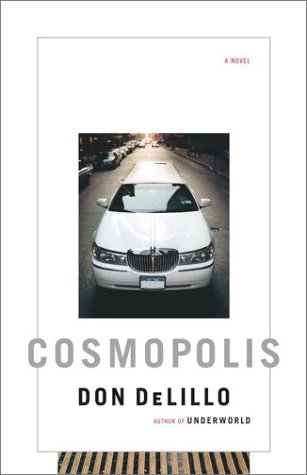
Cosmopolis by Don DeLillo

We declare that the splendor of the world has been enriched by a new beauty: the beauty of speed. A racing automobile with its bonnet adorned with great tubes like serpents with explosive breath ... a roaring motor car which seems to run on machine-gun fire, is more beautiful than the Victory of Samothrace.

--"The Futurist Manifesto," F.T. Marinetti

Beneath the data strips, or tickers, there were fixed digits marking the time in the major cities of the world. He knew what she was thinking. Never mind the speed that makes it hard to follow what passes before the eye. The speed is the point. Never mind the urgent and endless replenishment, the way data dissolves at one end of the series just as it takes shape at the other. This is the point, the thrust, the future.

--Cosmopolis,
Don DeLillo

It struck me while reading Cosmopolis that perhaps if Marinetti, the founder of the Italian mindfuck philosophy that was Futurism, were alive today he would love this book. Marinetti wrote his manifesto in 1909, not long after the invention of the automobile, and one can only imagine what he would say if he could see today's cars, which make the racecars of one hundred years ago look tortoise-slow.

On the other hand, it may not be the automobiles which capture his imagination. In Cosmopolis, Don DeLillo places his anti-hero, multi-billionaire Eric Packer, in an automobile, one of the world's finest stretch limousines, but the power and speed of the vehicle is wasted in the novel-length crawl across the width of gridlocked Manhattan. It takes Packer an entire day (and novel) to accomplish his goal, which is to drive crosstown and get a haircut. On this interminable journey he is an observer to a presidential motorcade, a rapper's funeral, and a violent process, and a participant in a small handful of sexual escapades. All this traveling at what must be a fraction of a mile per hour!

But that is not to say that the limousine does not embody Marinetti's love of speed--though the limousine may be nearly stationary, it is the conduit through which Packer can monitor all facets of his global finance empire, through which information moves at speeds which would give Marinetti wet dreams.

In fact, information in Cosmopolis moves so quickly that it surpasses even real time. Take the security monitor inside the limousine, for instance, that shows Eric his actions a split second before he even commits them. Cosmopolis is a messy, sprawling novel (even at a slim 200 pp.) but I think that it can be whittled down to this idea, that in our modern era we live on the edge of precipice so razor-thin that we are in danger of falling off.

The Futurists wished to destroy the museums, which they considered graveyards; true art, they felt, must be continually and violently replenished and started anew. Cosmopolis seems to argue that we live in the Futurists' ideal world, that the tides of progress have moved on without us, past all human control. Packer's other mission during his limo ride, besides the haircut, is to pursue a bet against the yen, which despite his best efforts, rises impossibly. By the end of the novel, in a matter of hours, Packer is penniless. This, DeLillo says, is our reality: fortunes amassed and lost in afternoons, and getting faster all the time. As Marinetti says, "Time and Space died yesterday." And as the things that Marinetti cherished--the automobiles, the guns--seem almost antiquated to us, so Cosmopolis forces us to face our own hurtling toward obsolescence.

I think perhaps that Marinetti was born one hundred years too late. Cosmopolis is the ultimate Futurist novel, but also quintessentially 21st-century; it is so cutting-edge that it edges beyond even postmodernity. But this also nurtures, and perhaps necessitates, its biggest flaw: a severe lack of humanity. The awesome James Wood, writing for the New Republic, notes that "Eric is really no more than a vessel for theory; he is given not thoughts but meta-thoughts." How true. Here is a novel with much to say, but at times seems so drunk on its ideas that it forgets that ideas are only as relevant as the people they impact.

I struggled with this--after all, isn't this the point of it all, that the human being has become as passe as the Sony Walkman? But I remember DeLillo's White Noise, a novel that managed to break through the ominous haze of turn-of-the-century paranoia and find two people simply scared shitless of dying. Where White Noise had power, Cosmopolis has portentousness.

And besides, isn't the Futurist ideal fundamentally flawed? I recall a conversation I once had with an Italian professor of mine who noted that though the Futurists believed that mankind would become more and more like the technology they created in the automobile, in truth la macchina e stata humanizata--the automobile has become humanized. Though DeLillo taps into an essential modern fear about technology run amok, the fact is that our creations are becoming more and more like us instead of the other way around. Though we may feel obsolete, it cannot be ignored that those feelings are ours; our machines and software have no opinion.

DeLillo comes around toward the end of the novel, when Packer, in a plot point I've neglected to mention, comes face to face with a would-be assassin. Face-to-face with the barrel of a gun, Packer recalls that he'd "always wanted to become quantum dust, transcending his body mass, the soft tissue over the bones, the muscle and fat. The idea was to live outside the given limits, in a chip, on a disk, as data, in a radiant spin, a consciousness saved from void."

There, confronting death like the protagonists of White Noise, Packer comes to realize from what stuff he really is made:

The things that made him who he was could hardly be identified much less converted to data... So much come and gone, this is who he was, the lost taste of milk licked from his mother's breast, the stuff he sneezes when he sneezes, this is him, and how a person becomes the reflection he sees in a dusty window when he walks by. He'd come to know himself, untranslatably, through his pain... His hard-gotten grip on the world, material things, great things, his memories true and false, the vague malaise of winter twilights, untransferable, the pale nights when his identity flattens for lack of sleep, the small wart he feels on his thigh every time he showers, all him, and how the soap he uses, the smell and the feel of the concave bar make him who he is because he names the fragrance, amandine, and the hang of his cock, untransferable, and his strangely achy knee, the click in his knee when he bends it, all him, and so much else that's not convertible to some high sublime, the technology of mind-without-end.