Showing posts with label postmodern. Show all posts

Sunday, June 27, 2021

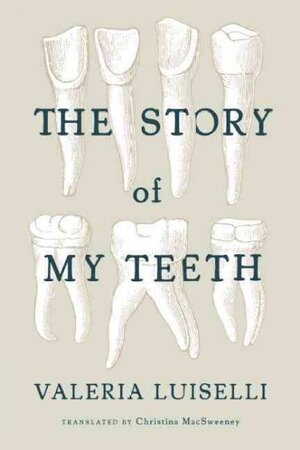
The Story of My Teeth by Valeria Luiselli

I'm the best auctioneer in the world, but no one knows it because I'm a discreet sort of man. My name is Gustavo Sanchez Sanchez, though people call me Highway, I believe with affection. I can imitate Janis Joplin after two rums. I can interpret Chinese fortune cookies. I can stand an egg upright on a table, the way Christopher Columbus did in the famous anecdote. I know how to count to eight in Japanese: ichi, ni, san, shi, go, roku, shichi, hachi. I can float on my back.

This is the story of my teeth, and my treatise on collectibles and the variable value of objects. As any other story, this one begins with the Beginning; and then comes the Middle, and then the End. The rest, as a friend of mine always says, is literature: hyperbolics, parabolics, circulars, allegorics, and elliptics.

Gustavo Sanchez Sanchez--Highway--is in his forties when he discovers his true calling: to be an auctioneer. He's always loved collecting things, from straws to ribbons, and auctioneering allows him to express his attachment to these objects. He describes his method in terms of conic sections, the hyperbolics, etc, etc, described above, which as any mathematician will tell you, are distinguished by their eccentricity, meaning some orbit very closely to their central point while others careen into distant topics. A simpler description of his method might be lying: his first great sales, which he recounts to us, are the sale of his own teeth, which he describes as belonging to famous people from history, from Plato to Virginia Woolf. He sells each tooth by telling a simple story about its owner, and he replaces the teeth he's had removed with a set belonging to Marilyn Monroe he purchased. At the end of the auction he's so overcome with his storytelling that he offers himself up to be bid upon, and is bought by his own estranged son, eager for revenge.

The story of The Story of My Teeth is a unique one: Luiselli was originally commissioned to write a piece of fiction for a catalog of the art collection belonging to Grupo Jemez, a juice company. The gallery and juice factory can both be found in Mexico City's heavily industrialized suburb of Ecatepec, and Luiselli conceived of a project that would bridge the divide between the two. After writing each section, she sent it to the factory to be shared with the workers--in an imitation of the "tobacco readers" that can still be found in Cuban cigar factories--who were recorded discussing it, and their conversations were then incorporated into the text.

This collaborative process resulted in a book that feels fresh and clever, engaged in constant revision and regeneration of itself. But it also grounds the book in the material world which it parodies and critiques. Absurdist narratives like The Story of My Teeth can often feel untethered from the real world, like exercises in self-referentiality that lack any kind of context that makes them readable. Yet for all its absurdity, Luiselli's novel feels like an honest window into the factory life of Ecatapec, where both Highway and his son Siddhartha are employed as guards. The unusual process manages not only to bridge the factory-gallery divide but inscribe, in a way, Luiselli's collaborators onto the page. It's a book that is, as Luiselli describes in the afterword, "not so much about but for the factory workers."

One of the things that The Story of My Teeth understands so well is the way in which both factory and gallery are connected sites of commercial production. The factory makes juice to buy and sell, and the artworks in the gallery, too, are bought and sold; what makes them different from juice? Highway offers an understanding of value, in its capitalist sense and otherwise, that is about storytelling. Having stolen the various artworks from the gallery, he sells them--or perhaps he only imagines he does--by enacting the same strategy as with the teeth, writing brief stories about the famous people who once owned the objects. The differences between these stories and those about the teeth illustrate the difference between "parabolics" and "allegorics," but what struck me most is the way that the line between production and self is blurred: we don't make our teeth in the same way we make an artwork, but what if the difference is reducible to the kind of story we tell about each? How is storytelling at the heart of our possession of ourselves?

Thursday, January 28, 2010

Foe by J. M. Coetzee

'But if you cannot rid yourself of your doubts, I have something to say that may be of comfort. Let us confront bur worst fear, which is that we have all of us been called into the world from a different order (which we have now forgotten) by a conjurer unknown to us, as you say I have conjured up your daughter and her companion (I have not). Then I ask nevertheless: Have we thereby lost our freedom? Are you, for one, any less mistress of your life? Do we of necessity become puppets in a story whose end is invisible to us, and towards which we are marched like condemned felons?'

After 4 years of intense reading, having completed over 200 books ranging from Stephen King to James Joyce, it's finally happened. When I closed the covers on Foe, I realized that I just didn't get it. Not in the vague sense that I read Faulkner and feel like I'm only picking up the tip of the iceberg, but more in the "this book might as well have been in another language" sense.

Foe is built around a retelling of Robinson Crusoe, as seen through the eyes of the narrator Susan Barton, a young woman who is marooned on Crusoe's island after mutineers set her adrift. Alone with only Crusoe and his tongueless, African manservant Friday, she explicates on his life, surprised by the mundanity of it. A year after her arrival, they are rescued. Crusoe dies of homesickness on the way back to England, and Susan, along with the speechless Friday, seeks out an author, a Daniel Foe, to write down her story and make a successful novel of it.

Upon hearing her tale, Foe feels it isn't exciting enough and asks her permission to add extra episodes--a cannibal attack, romantic entanglements between Susan and Crusoe, etc.--but Susan refuses, wanting to tell her story truly or not at all.

Now, to this point I was following along, but then the story takes some strange twists. First, a young girl shows up, claiming to be Susan's lost daughter, the one for whom she was searching when she was cast away, and another woman whose exact role I couldn't pinpoint. This leads to discussions with Foe about the nature of truth and writing, and to a bizarre epilogue that further set in my mind that I'd missed something important along the way. There's also a subplot--important based on the space it's given--regarding Friday: how he lost his tongue, attempts to communicate with him, etc., and it relates in some ways to the discussions Foe and Susan have near the end of the novel. One of them is excerpted above, and concerns the nature of reality, the inability of humans to comprehend whether their actions are predestined, and a short bit about the Inferno.

Here, in summation, is what I got from Foe: the themes revolving around communication, specifically writing; the actual prose in the novel was a little dry, but well-crafted; and I really didn't get it. So there you have it.

Thursday, November 26, 2009

Infinite Jest by David Foster Wallace

I think today’s irony ends up saying: "How totally banal of you to ask what I really mean."

---


The so-called ‘psychotically depressed’ person who tries to kill herself doesn't do so out of quote ‘hopelessness’ or any abstract conviction that life's assets and debits do not square. And surely not because death seems suddenly appealing. The person in whom Its invisible agony reaches a certain unendurable level person will kill herself the same way a trapped person will eventually jump from the window of a burning high-rise. Make no mistake about people who leap from burning windows. Their terror of falling from a great height is still just as great as it would be for you or me standing speculatively at the same window just checking out the view; i.e. the fear of falling remains a constant. The variable here is the other terror, the fire's flames: when the flames get close enough, falling to death becomes the slightly less terrible of two terrors. It's not desiring the fall; it's terror of the flame yet nobody down on the sidewalk, looking up and yelling ‘Don‘t!’ and ‘Hang on!’, can understand the jump. Not really. You'd have to have personally been trapped and felt flames to really understand a terror way beyond falling.

I read Infinite Jest mostly because it was a big, long literary novel I'd never read. At the time, I knew nothing about David Foster Wallace at all. His death last year didn't impact me at all. In my mind, I think I'd linked him together with authors like Don DeLillo and Thomas Pynchon, great authors who write substantial books that nevertheless tend to eschew genuine emotional impact and human characters for satire, impeccably-structured prose, and witty bon mots just dripping with irony and self-awareness. I'm a fan of this style of writing (Underworld is one of my favorite books of all time), but undertaking a novel the size of Infinite Jest, 100pp of which are taken up with just endnotes, was intimidating.

Now that I've actually finished it, my perspective is different. Infinite Jest isn't really much like Pynchon or DeLillo at all. In spite of its postmodern trappings--the extensive footnotes not being the least of which--IJ isn't a particularly difficult read. The length is intimidating, but it's a truly human book. It is at turns hilarious, heartbreaking, psychologically penetrating. Now, in retrospect, I feel a sense of loss at DFW's death.

The plot is all over the place, winding, taking detours in weird, unexpected places, combining ultra-realistic setpieces with vaguely sci-fi trappings. The time is the near future, where years are named after products, i.e. Year of the Depend Adult Undergarment, and North America has become a unified entity known as O.N.A.N., at least, the sections of North America that weren't made uninhabitable by massive toxic waste dumps in the midwest. The principles of the cast are pretty numerous, but the bulk of the narrative revolves around the following:

- Hal Incandenza, a tennis prodigy living and breathing the sport at the prestigious Enfield Tennis Academy, athletically-skilled, socially awkward, and confused by his father's inexplicable suicide.

- Don Gately, a hulking, former small-time burglar now working at Ennet House Drug and Recovery House (sic), who barely remembers certain drug-fueled episodes from his past and is ultra-sensitive to be such a big, nearly-indestructible guy.

- Madame Psychosis, a former rado talk show host, now possibly deformed and always wearing a veil, who's time at Ennet House began after a suicide attempt of unknown motivation

- Les Assassins des Fauteuils Roulants (The Wheelchair Assassins) - A Quebecois seperatist faction made up of, obviously enough, assassins who are incapacitated.

- Various other drug addicts, cross-dressers, tennis students, Incandenza family members, Enfield staff, etc. Honestly, the cast is large, although it expands and contracts somewhat depending on how you identify some of the more ambiguous characters.

The actual storylines are more divergent than the cast of characters. The unifying object in the narrative is The Entertainment, possibly the eponymous Infinite Jest, a video so fulfilling that anyone who watches it once becomes a drooling moron who only wants to see it again. It serves as a metaphor for the whole novel, which, as you might guess, focuses at least partially on addiction in all of its various forms. Drugs, sex, power, entertainment, athletic pursuits, etc. There are so many weird intersections of the various characters that I won't even attempt to explain them all here, but I will say that nothing comes together the way you'd expect and--fair warning--there's a fairly large coningent of internet critics who absolutely hate Infinite Jest because of its ending, which I won't spoil, but which you should know does not exactly tie up the loose ends.

To be honest, I don't even know how to begin to deconstruct IJ thematically or even narratively, which is probably obvious from this review. Addiction is a major theme, but to say that it's what the book is about is doing it a grave disservice. It could be read as a political or social satire, a high-comedy, a tragedy in the Greek mold, a commentary of sorts on society and the lengths to which it will go to entertain itself. I'd like to postulate though that while all these interpretations (and many, many more) hold water, I don't see how you could read IJ without getting the feeling that all this stuff is peripheral to the characters, the people and their relationships. Wallace himself said “Fiction’s about what it is to be a fucking human being, [Good writing should help readers to] become less alone inside.” It is on this count that I think IJ succeeds most brilliantly. In spite of any conflicted feelings I may have about the narrative itself, the characters are so richly drawn, so completely and unironically human, that I couldn't help but get wrapped up in them.

This is an uncharacteristically personal ending to one of my reviews, but Infinite Jest did something for me that maybe no piece of fiction has ever done to me before: It made me feel like I was a better person for having read it, and it accomplished Wallace's stated goal: it made me feel less alone. It's just too bad it couldn't do the same for Wallace himself.

Saturday, October 31, 2009

Men and Cartoons by Jonathan Lethem

Men and Cartoons is a collection of stories by Jonathan Lethem, who wrote Motherless Brooklyn and Gun with Occasional Music, both of which received positive reviews from this site. The cartoons of the title are not, as the cover art would suggest, the humorous variety that provide connotation to the word "cartoonish," but superhero comics, which appear in various manifestations throughout the nine stories contained here. In that way, Lethem seems to be one of a long string of male postmodern authors intent on deconstructing the comic book, but most of these fall somewhere south of Kavalier and Clay in quality.

The book starts off very strong with a story called "The Vision," which begins with the narrator recalling a friend of his from grade school who never took off his superhero costume, only to discover that in adulthood the boy (having abandoned his altar ego) has moved in next door. The narrator attends the Vision's party, where they play the party game Mafia. It's a pleasantly melancholy investigation of what games and play mean to adults and children, and Men and Cartoons is at its best when its absurdity and strangeness is complemented by these small, disaffected moments. The best of the bunch are "Vivian Relf," about a man and woman who keeping meeting by accident, and "The Glasses," which is nothing but a conversation between two opticians about why a customer's glasses seem to be smudging all the time.

By contrast, the strangest stories in the compilation usually fall flat, such as "The Dystopianist, Thinking of His Rival, is Interrupted by a Knock at the Door," or "Super Goat Man," about a superhero who upon his retirement takes up teaching at a small Northeastern college. The gimmicks here are clever, but the disconnect from any real human emotion is simply too strong. No wonder, then, that "The Spray" retains that strangeness but works in quite simple a fashion--it's about a spray that creates an image of anything that you have lost or forgotten, whether it be a stolen television set or an ex-boyfriend. (Also, it's the clearest connection that Lethem makes to Philip K. Dick, whose influence seems to be all over the place.) An excerpt:

I jumped up. "If you spray me I'll spray you," I shouted. The spray hit me as I moved across the room. The wet mist fell behind me , like a parachute collapsing in the spot where I'd been, but enough got on me. An image of Lucinda formed, glowing and salmon-colored.

Lucinda was naked. Her hair was short, like when we were together. Her head lay on my shoulder, her arms were around my neck, and her body was across my front. My shirt and jacket. Her breasts were mashed against me, but I couldn't feel them. Her knee was across my legs. I jumped backward but she came with me, radiant and insubstantial. I turned my head to see her face. her expression was peaceful, but her little salmon-colored eyelids were half-open.

"Ha!" said Addie. "I told you it would work."


All in all, not a bad collection, and worth the ninety minutes it might take to read. I wouldn't read it before Motherless Brooklyn, though.

Saturday, December 13, 2008

The Crying of Lot 49 by Thomas Pynchon

Having no apparatus except gut fear and female cunning to examine this formless magic, to understand how it works, how to measure its field strength, count its lines of force, she may fall back on superstition, or take up a useful hobby like embroidery, or go mad, or marry a disc jockey. If the tower is everywhere and the knight of deliverance no proof against its magic, what else?


The Crying of Lot 49 was confusing. I don't say that as a pejorative, but a simple statement of fact. Although it's Pynchon Lite from what I hear (certainly lighter than the 800pp Gravity's Rainbow), it's still an exercise in maximalism and absurdity, full of inside jokes, historical references, and weird names.


The plot, as far as I can interpret it is this: Oedipa Maas, happily married post-modern woman, stumbles across a worldwide conspiracy that may or may not involve the government and every person she has ever known (including her disc jockey boyfriend). Actually, the conspiracy may not even exist. It centers around an auction (The auctioning of Lot 49) and a symbol resembling a trumpet. Also, the postal service and a play that is written out in play format about halfway through the book.


I'm sure Crying is a very good book if you study it. It was entertaining and fairly amusing even when I didn't. Still, the lack of resolution and the distance created between the reader and the characters reminded me of the first third of Cosmopolis, and my uninformed opinion about Crying is similar: It's a good book, maybe even very good, for those who are drawn in enough to draw out the references on top of references on top of everything else. The writing is strong, the story is interesting, and I didn't care for it a whole lot.

Thursday, November 13, 2008

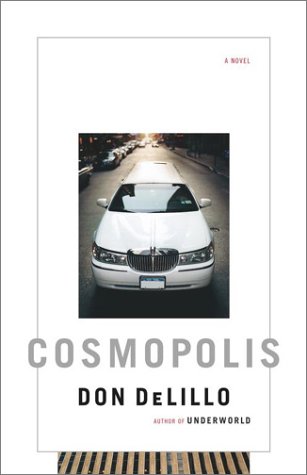
Cosmopolis by Don DeLillo

We declare that the splendor of the world has been enriched by a new beauty: the beauty of speed. A racing automobile with its bonnet adorned with great tubes like serpents with explosive breath ... a roaring motor car which seems to run on machine-gun fire, is more beautiful than the Victory of Samothrace.

--"The Futurist Manifesto," F.T. Marinetti

Beneath the data strips, or tickers, there were fixed digits marking the time in the major cities of the world. He knew what she was thinking. Never mind the speed that makes it hard to follow what passes before the eye. The speed is the point. Never mind the urgent and endless replenishment, the way data dissolves at one end of the series just as it takes shape at the other. This is the point, the thrust, the future.

--Cosmopolis,
Don DeLillo

It struck me while reading Cosmopolis that perhaps if Marinetti, the founder of the Italian mindfuck philosophy that was Futurism, were alive today he would love this book. Marinetti wrote his manifesto in 1909, not long after the invention of the automobile, and one can only imagine what he would say if he could see today's cars, which make the racecars of one hundred years ago look tortoise-slow.

On the other hand, it may not be the automobiles which capture his imagination. In Cosmopolis, Don DeLillo places his anti-hero, multi-billionaire Eric Packer, in an automobile, one of the world's finest stretch limousines, but the power and speed of the vehicle is wasted in the novel-length crawl across the width of gridlocked Manhattan. It takes Packer an entire day (and novel) to accomplish his goal, which is to drive crosstown and get a haircut. On this interminable journey he is an observer to a presidential motorcade, a rapper's funeral, and a violent process, and a participant in a small handful of sexual escapades. All this traveling at what must be a fraction of a mile per hour!

But that is not to say that the limousine does not embody Marinetti's love of speed--though the limousine may be nearly stationary, it is the conduit through which Packer can monitor all facets of his global finance empire, through which information moves at speeds which would give Marinetti wet dreams.

In fact, information in Cosmopolis moves so quickly that it surpasses even real time. Take the security monitor inside the limousine, for instance, that shows Eric his actions a split second before he even commits them. Cosmopolis is a messy, sprawling novel (even at a slim 200 pp.) but I think that it can be whittled down to this idea, that in our modern era we live on the edge of precipice so razor-thin that we are in danger of falling off.

The Futurists wished to destroy the museums, which they considered graveyards; true art, they felt, must be continually and violently replenished and started anew. Cosmopolis seems to argue that we live in the Futurists' ideal world, that the tides of progress have moved on without us, past all human control. Packer's other mission during his limo ride, besides the haircut, is to pursue a bet against the yen, which despite his best efforts, rises impossibly. By the end of the novel, in a matter of hours, Packer is penniless. This, DeLillo says, is our reality: fortunes amassed and lost in afternoons, and getting faster all the time. As Marinetti says, "Time and Space died yesterday." And as the things that Marinetti cherished--the automobiles, the guns--seem almost antiquated to us, so Cosmopolis forces us to face our own hurtling toward obsolescence.

I think perhaps that Marinetti was born one hundred years too late. Cosmopolis is the ultimate Futurist novel, but also quintessentially 21st-century; it is so cutting-edge that it edges beyond even postmodernity. But this also nurtures, and perhaps necessitates, its biggest flaw: a severe lack of humanity. The awesome James Wood, writing for the New Republic, notes that "Eric is really no more than a vessel for theory; he is given not thoughts but meta-thoughts." How true. Here is a novel with much to say, but at times seems so drunk on its ideas that it forgets that ideas are only as relevant as the people they impact.

I struggled with this--after all, isn't this the point of it all, that the human being has become as passe as the Sony Walkman? But I remember DeLillo's White Noise, a novel that managed to break through the ominous haze of turn-of-the-century paranoia and find two people simply scared shitless of dying. Where White Noise had power, Cosmopolis has portentousness.

And besides, isn't the Futurist ideal fundamentally flawed? I recall a conversation I once had with an Italian professor of mine who noted that though the Futurists believed that mankind would become more and more like the technology they created in the automobile, in truth la macchina e stata humanizata--the automobile has become humanized. Though DeLillo taps into an essential modern fear about technology run amok, the fact is that our creations are becoming more and more like us instead of the other way around. Though we may feel obsolete, it cannot be ignored that those feelings are ours; our machines and software have no opinion.

DeLillo comes around toward the end of the novel, when Packer, in a plot point I've neglected to mention, comes face to face with a would-be assassin. Face-to-face with the barrel of a gun, Packer recalls that he'd "always wanted to become quantum dust, transcending his body mass, the soft tissue over the bones, the muscle and fat. The idea was to live outside the given limits, in a chip, on a disk, as data, in a radiant spin, a consciousness saved from void."

There, confronting death like the protagonists of White Noise, Packer comes to realize from what stuff he really is made:

The things that made him who he was could hardly be identified much less converted to data... So much come and gone, this is who he was, the lost taste of milk licked from his mother's breast, the stuff he sneezes when he sneezes, this is him, and how a person becomes the reflection he sees in a dusty window when he walks by. He'd come to know himself, untranslatably, through his pain... His hard-gotten grip on the world, material things, great things, his memories true and false, the vague malaise of winter twilights, untransferable, the pale nights when his identity flattens for lack of sleep, the small wart he feels on his thigh every time he showers, all him, and how the soap he uses, the smell and the feel of the concave bar make him who he is because he names the fragrance, amandine, and the hang of his cock, untransferable, and his strangely achy knee, the click in his knee when he bends it, all him, and so much else that's not convertible to some high sublime, the technology of mind-without-end.

Saturday, December 29, 2007

The Corrections by Jonathan Franzen

Here is my 62nd, and most likely final, book of the year, The Corrections by Jonathan Franzen. Here is a review of the same book by Brent.

For those of you too lazy to click the link (Carlton), here is a plot summary: The Corrections follows the Lambert family as it deals with the quickly deepening Alzheimer's of its patriarch, Alfred. Five major narratives are weaved together: Alfred's, his wife Enid's, their sons Chip and Gary's, and their daughter Denise's. Chip is a former university professor disgraced by an affair with a student who gets involved with a complex scheme by a Lithuanian politician to defraud American investors. Gary is a wealthy but intensely unsatisfied broker whose family life is like a battlefield. Denise is a restaurant chef dealing with her sexuality.

On the surface The Corrections is very boring; most of the issues at hand are commonplace to the point of being uninspired. But Franzen imbues them with a deep wit and cautiously observed meticulousness that lends them the fullness of realism, tracing each character's life from early childhood. The Corrections has an epic sweep to it; it endeavors to capsulate five lives in five hundred pages and does pretty well.

I liked The Corrections, but I didn't really love it. For one, it reminded me of too many other books--White Noise, Disgrace, Money, Absurdistan--at different points, but each isolated part didn't really measure up to the work that it reminded me of. Furthermore, Franzen's prose is extremely bloated--some sentences ramble on for half a page. Here's a sample:

It was the alarm bell of anxiety... By now it had been ringing for so many hours that the Lamberts no longer heard the message of "bell ringing" but, as with any sound that continues for so long that you have the leisure to learn its component sounds (as with any word you stare at until it resolves itself into a string of dead letters), instead heard a clapper rapidly striking a metallic resonator, not a pure tone but a granular sequence of percussions with a keening overlay of overtones; ringing for so many days that it simply blended into the background except at certain early-morning hours when one or the other of them awoke in a sweat and realized that a bell had been ringing in their heads for as long as they could remember; ringing for so many months that the sound had given way to a kind of metasound whose rise and fall was not the beating of compression waves but the much, much slower waxing and waning of their consciousness of the sound.


It isn't that this style doesn't work; to the contrary, the way that it pyramids upon itself accurately reflects, I think, the jagged but connective nature of human thought and experience, which Franzen seeks to capture. But at times it can often be straning. Information in The Corrections comes at an overload pace, and because the phrasing can be so ungainly it seems anything but effortless. It's as if you can hear Franzen typing--as opposed to say, someone like Cormac McCarthy, whose sentences are so carefully composed and minimalist that they seem to exist absolutely and without a creator. Franzen's style works for the purpose; but to me it wears out its welcome.

Still, I enjoyed the book. If I hadn't known how much Brent liked it already, I probably would have recommended it to him because it has that quirky, true-to-life feel that seems to me in Brent's own style.

Postscript: I forgot another thing that bothered me about the book. There are lots of references to modern pop culture, but Franzen seems to be of two minds: at one point, he references a "famous director," but at another point, he namechecks Stephen Malkmus. One style suggests that Franzen wishes to strip temporal reference points from his book in order to give it the tone of timelessness; the other suggest that Franzen wants to act as a testament to his own place and time in the universe. Choose, dammit.

Thursday, December 27, 2007

Underworld by Don DeLillo

"They had the rear of the bus to themselves on the ride back, the motor right below them, heat beating up, and they dozed on each other's shoulders, faces sun-tight and eyes stinging slightly, tired, hungry, happy, the bus belching heat below them."

"I long for the days of disorder. I want them back the days when I was alive on the earth, rippling in the quick of my skin, heedless and real. I was dumb-muscled and angry and real. That is what I long for, the breach of peace, the days of disarray when I walked real streets and did things slap-bang and felt angry and ready all the time, a danger to others and a distant mystery to myself."

If you require a strong, linear plot to propel you through a novel, then Don DeLillio's massive tome about Cold War America isn't for you. If you like endings that time up everything neatly, or where all the loose ends are tied together into a nice braid, this probably isn't the book you should pick up. If Hemmingway is your favorite author, well, the excerpts at the top of the review should tell you all you need to know.

If you've enjoyed DeLillo in the past and you like sprawling, epic novels, you owe it to yourself to check out Underworld. Ostensibly tied together by the movement from person to person of the home-run ball from "The Shot Heard Around the World." Within its path are the lives of dozens of characters, the main one of which, Nick Shay, has a secret that forms what tension exists in the book. The book isn't intended, however as a thriller. It's a slow moving slice-of-life about paranoia, death, religion, growing old, America, the Cold War, and the latter half of this century. I personally found it hard to put down, and I have to say that the prose is some of the most beautiful I've ever read. There's a passage near the end of the book that describes a landfill in such a tragic, nostalgic way that it almost gives me chills. That takes some skill.

The book is 827 pages long, but despite that, felt a lot shorter than Cosmopolis, one of the other two DeLillo novels I read this year. Underworld also eschews DeLillo's usual trademark of keeping a safe emotional distance from his characters, choosing instead to relate their inner turmoil through incomplete sentences, awkward pauses, strange guestures, and every other tool at his disposal. This book was recently chosen as runner-up for the best work of American fiction in the last 25 years. I would say it deserves those accolades. It was a challenging book, and it ends my 50 with a bang.

Saturday, December 8, 2007

The Corrections by Jonathan Franzen

Jonathan Franzen's The Corrections is probably most famous for the brouhaha that occurred when Oprah selected it for her book club. Franzen made some unflattering comments about Oprah's audience and that ubiquitous sticker, and Oprah retracted her invitation for him to appear on her show. The Amazon reviews for The Corrections are split almost exactly between 1 and 5 star reviews, with many of the 1 star reviews mentioning Franzen's slight of Oprah and barely commenting on the work itself. Even Carlton, a huge fan of the greatest woman who has ever lived, dismissed the book after reading it because of what he termed Franzen's "inappropriate comments." I ask you, how is a book like this supposed to get a fair reading? Well, by being read, of course.

The plot of the book is rather simplistic on its face. Alfred Lambert is suffering from progressive dementia brought on by Alzheimers. Enid is his put-upon wife. Their son Chip is a disgraced college professor turned slacker. Their other son, Gary, has been financially successful but feels like an outsider in his own family, due partly to his clinical depression and partly to his shewish wife, and their divorced daughter Denise, who is experimenting with lesbianism. The storyline in the Corrections takes place mostly in the past, showing how each member of the family arrived at their current state and ultimately culminating in the family's last Christmas reunited. I won't say much about their eventual decisions and the results because Chris is reading the book and I don't want to spoil it.

This year, I've read more postmodern literature than ever before, and The Corrections seems to fall in that class. Most notably, I detected echoes of Delillo's White Noise. Many of the trademarks of pomo lit are here: the trivialization of the personal, the degeneration and reinvention of traditional roles, and the isolation and impersonality of the modern world. What was more surprising to me is the heart present here. Although there are elements of nihilism in The Corrections, the tone of the book overall is fun and incisive, and the characters, though deeply flawed, aren't emotionless caricatures. I wanted Chip to come home for Christmas, for Gary to reconnect with his family, and for Denise to succeed in something, and the book wants them to as well.

I am curious about why postmodern writers seem to have a fixation on bodily functions. There were two or three passages in the book about Alfred being tormented by a small chunk of fecal matter. I don't think that happened in any of the other books I read this year.

Wednesday, October 17, 2007

Cosmopolis by Don DeLillo

I would say that Cosmopolis is the strangest book I've read this year with the possible exception of The Wind Up Bird Chronicle. It follows a day in the life of Eric Somethingortheother, an extremely wealthy stock picker in the near future. He's so powerful that when the Yen makes an unexpected rally, his faulty recommendation nearly cause a market crash. He spends most of the day in his cork-lined car (it doesn't keep the noise out, but the lining is the point) watching things on televsion that seem more real to him than real life. All he wants is a haircut, but a political assasination, a funeral for a rapper, and shooting for a bizarre movie impede his progress.


This is the second book of DeLillo's that I've read, and I found it rather difficult intially. The first half of the book is so strange that it's offputting, particularly an episode that involves a Eric receiving a prostate exam while talking to his sweaty coworker. At some point during the conversation, the look at each other and have a mutual, uh, climax. It's really bizarre in a way that even the rest of the book is not. Still, the themes are familiar ones for postmodern literature. The equation of the trivial and the personal to the same level of importance, the growing distance between people (comically illustrated by Eric's inability to recognize his wife immediately as he runs into her throughout the day).


Portions of the book are brilliantly written and even somewhat moving, such as the funeral for the rapper. Other parts, like the prostate exam, are offputtingly bizarre. Still others are confusing and probably laden with symbolic significance that I'm incapable of picking up on, such as the running theme of assasinations. (In the book, there is one actual assasination, one attack by the “pie assasin,” a man who throws pies at celebrities, and the repeated atempts on Eric's life). The end of the book is appropriately bizarre and oddly satisfying, but I can't really recommend this book to hardly anyone. Read White Noise or Underworld instead. Both are beter and more accessible than Cosmopolis.