Showing posts with label Mexico City. Show all posts

Sunday, March 10, 2024

You Dreamed of Empires by Alvaro Enrigue

Where Tenoxtitlan had been there was now a Spanish city: palaces, churches, convents. There was a nun who was purest light, who also dreamed, and who, though she spoke Spanish, at mole and pipian and papalo and nogada. It was a huge coutnry: ravines, mountains, deserts, jungles. But it was a country of purest suffering too. The macehualtin uprisings, the slave ships, the priests fighting under the banner of Guadalupe, a republic fractured yet worthy in its way. The fucking gringos; a Zapotec tlatoani who won a war with France. Books, wars, universities, cities with many more people than anyone could ever have imagined; another tlatoani, a Mixtec--everybody was Oaxacan--and Eufemio Zapata walking through Moctezuma's palace dressed like a Spaniard; another republic that rose the best it could; and another hundred years and this book and you reading it and it was then that Hernando woke up.

It's the year 1519. Spanish conquistador Hernando Cortes has been invited into the city of Tenoxtitlan by Moctezuma, but the emperor has made himself scarce. Instead, Cortes dines with the city's priests, with the princess who is both Moctezuma's sister and his wife, with his own generals, with his Maya translator, Malinalli. He schemes and plots, knowing his allies the Tlaxcala are stationed just outside the city. But with Moctezuma absent, the killing blow will have to wait.

Alvaro Enrigue's rendition of Moctezuma is, perhaps, the most interesting thing about his new novel You Dreamed of Empires. At first glance, it seems that his Moctezuma shares many of the flaws that have been assigned to him through history: his superstition, his indolence and indifference, his weakness. He seems to be overly dependent on psychedelic drugs; while Cortes is making his plots, Moctezuma is getting high on mushrooms and refusing to forego his daily nap. Enrigue's Moctezuma is obsessed with the conquistadors, these strange men from far across the ocean, but mostly he is obsessed with their cahuayos, their large deer--their caballos, their horses--which have eaten up one of the palace's interior gardens. Is this another kind of superstitious predilection, or is it evidence that Moctezuma, who recognizes the strategic promise of the cahuayos, is cannier than he is letting on? Does he, in fact, have a plan to foil the conquistadors who are only pretending to be good guests?

I had the good fortune to see Enrigue speak about this novel at the New York Public Library a month or so ago. He is all charm, with the dashing long-haired look of an older novelist, buttressed by a tremendous bank of knowledge and a gregarious laugh. It's easy to read You Dreamed of Empires, which is at times chummy and chatty, in his voice. The novel begins with a conquistador, Caldera, nearly nauseated by the smell of the human skin cloak he must wear while dining with the priests. This is a novel, we see, about cultural clashes, about two groups who must look past the unfamiliarity of their respective cultures to understand each other, to see one another's capacities for friendship, or malice. Enrigue emphasizes the clash with a pointedly anachronistic style, full of cliches and over-familiar phrases that stand out as strange purely through context. In one scene, which much interested his interviewer, Moctezuma overhears a snatch of spectral music that "he couldn't place, though in a possible future we would have recognized it. It was T. Rex's 'Monolith.'" I myself didn't find these qualities of the novel all that successful, but when I imagined Enrigue reading them aloud in his own voice, I felt more disposed to them.

I wanted to like You Dreamed of Empires a little better than I did. I was sort of interested in its lack of forward motion. Both the Mexica and the Caxilteca--a cutesy Nahautl-ism formed from the Spaniards' Kingdom of Castile--spend most of the novel sort of milling around and figuring out what to do; the strangeness of the context almost seems to paralyze them. In one scene, Cortes' generals get totally and utterly lost in Moctezuma's palace, which is labyrinthine in its orderliness and repetitiveness. I was a little lost as to what was happening with the literal "palace intrigue." But I did admire the boldness of the novel's final scenes, in which--spoiler alert--Moctezuma, finally face to face with Cortes, offers him a lick of a psychedelic cactus. The lick sends Cortes into a hallucinatory dream, in which he sees the future of Mexico after the Spanish conquest--but then he wakes up, and is killed. That's right, Enrigue pulls a Tarantino on us. But it works, especially because of the unsettling suggestion that we, too, are part of the dream. One day, You Dream of Empires suggests, we may all wake up from history.

Sunday, June 27, 2021

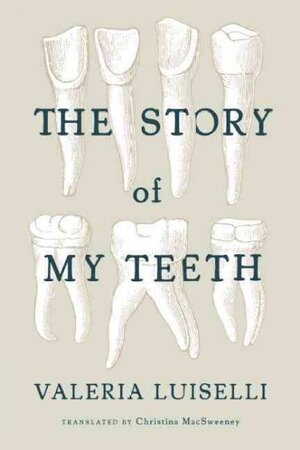
The Story of My Teeth by Valeria Luiselli

I'm the best auctioneer in the world, but no one knows it because I'm a discreet sort of man. My name is Gustavo Sanchez Sanchez, though people call me Highway, I believe with affection. I can imitate Janis Joplin after two rums. I can interpret Chinese fortune cookies. I can stand an egg upright on a table, the way Christopher Columbus did in the famous anecdote. I know how to count to eight in Japanese: ichi, ni, san, shi, go, roku, shichi, hachi. I can float on my back.

This is the story of my teeth, and my treatise on collectibles and the variable value of objects. As any other story, this one begins with the Beginning; and then comes the Middle, and then the End. The rest, as a friend of mine always says, is literature: hyperbolics, parabolics, circulars, allegorics, and elliptics.

Gustavo Sanchez Sanchez--Highway--is in his forties when he discovers his true calling: to be an auctioneer. He's always loved collecting things, from straws to ribbons, and auctioneering allows him to express his attachment to these objects. He describes his method in terms of conic sections, the hyperbolics, etc, etc, described above, which as any mathematician will tell you, are distinguished by their eccentricity, meaning some orbit very closely to their central point while others careen into distant topics. A simpler description of his method might be lying: his first great sales, which he recounts to us, are the sale of his own teeth, which he describes as belonging to famous people from history, from Plato to Virginia Woolf. He sells each tooth by telling a simple story about its owner, and he replaces the teeth he's had removed with a set belonging to Marilyn Monroe he purchased. At the end of the auction he's so overcome with his storytelling that he offers himself up to be bid upon, and is bought by his own estranged son, eager for revenge.

The story of The Story of My Teeth is a unique one: Luiselli was originally commissioned to write a piece of fiction for a catalog of the art collection belonging to Grupo Jemez, a juice company. The gallery and juice factory can both be found in Mexico City's heavily industrialized suburb of Ecatepec, and Luiselli conceived of a project that would bridge the divide between the two. After writing each section, she sent it to the factory to be shared with the workers--in an imitation of the "tobacco readers" that can still be found in Cuban cigar factories--who were recorded discussing it, and their conversations were then incorporated into the text.

This collaborative process resulted in a book that feels fresh and clever, engaged in constant revision and regeneration of itself. But it also grounds the book in the material world which it parodies and critiques. Absurdist narratives like The Story of My Teeth can often feel untethered from the real world, like exercises in self-referentiality that lack any kind of context that makes them readable. Yet for all its absurdity, Luiselli's novel feels like an honest window into the factory life of Ecatapec, where both Highway and his son Siddhartha are employed as guards. The unusual process manages not only to bridge the factory-gallery divide but inscribe, in a way, Luiselli's collaborators onto the page. It's a book that is, as Luiselli describes in the afterword, "not so much about but for the factory workers."

One of the things that The Story of My Teeth understands so well is the way in which both factory and gallery are connected sites of commercial production. The factory makes juice to buy and sell, and the artworks in the gallery, too, are bought and sold; what makes them different from juice? Highway offers an understanding of value, in its capitalist sense and otherwise, that is about storytelling. Having stolen the various artworks from the gallery, he sells them--or perhaps he only imagines he does--by enacting the same strategy as with the teeth, writing brief stories about the famous people who once owned the objects. The differences between these stories and those about the teeth illustrate the difference between "parabolics" and "allegorics," but what struck me most is the way that the line between production and self is blurred: we don't make our teeth in the same way we make an artwork, but what if the difference is reducible to the kind of story we tell about each? How is storytelling at the heart of our possession of ourselves?