Showing posts with label absurdism. Show all posts

Tuesday, November 1, 2022

Invitation to a Beheading by Vladimir Nabokov

"Today is the eight day" (wrote Cincinnatus with the pencil, which had lost more than a third of its length) "and not only am I still alive, that is, the sphere of my own self still limits and eclipses my being, but, like any other mortal, I do not know my mortal hour and can apply to myself a formula that holds for everyone: the probability of a future decreases in inverse proportion to its theoretical remoteness. Of course in my case discretion requires that I think in term of very small numbers--but that is all right, that is all right--I am alive."

Cincinnatus C. has been sentenced to death for a vague crime specified only as "gnostical turpitude." He sits in jail, tortured not by the certainty of his sentence but its uncertainty: he has no idea when the hour of his execution will come; no one will tell him. Maybe nobody knows. In the meantime, he shares his cell with a persistent spider and a zealous jailor, and soon a cell mate, a noxious little snob named M'sieur Pierre. He has time enough for visits, each one with its own cryptic refusal to provide any closure: his absent mother, his unfaithful wife, her large and vituperative family. He orders books from the library, and reads the newspaper, though references to himself are cut out of it. And he writes.

In the passage above, Nabokov makes explicit a central fact that underpins Invitation to a Beheading: Cincinnatus is basically in the same position as all of us. We all know we must die, but none of us knows the hour. Cincinnatus' life is lived on a contracted scale, but in its nature, he's like everyone else. Understanding this, his scribbling becomes especially poignant: over and over, in his writings, Cincinnatus expresses the desire to be able to express himself clearly, but he always feels that he has not quite said what it is he means to say. The desire, made urgent by the ticking clock, is a kind of manifesto about writing: the desire to say something real, and the understanding that there is limited time in which to say it.

Invitation to a Beheading is one of those capital-L Literature books about the Human Condition: the certainty of death, and what we do with it. Nabokov claims in the introduction that he had never read Kafka's The Trial when he wrote Beheading, and though the surface similarities are the same, there's nothing in the novel about authoritarians or autocrats. Cincinnatus is not degraded by his sentence, not tortured or physically punished; in fact, his jailors seem eager to treat him as some kind of honored guest, much to his annoyance. It's funny, actually; after having been chased out of Russia by the revolution, Nabokov would have had reason to imbue his prison story with such flavors, but he reaches for something much more universal.

Invitation to a Beheading is very funny, more Beckett than Kafka. It even has a kind of Vaudevillian flair to it, with Cincinnatus acting as the straight man to an increasingly mad world. Its best parts, I think, are actually the stream-of-consciousness writings that Cincinnatus pours out onto the page--though he may be dissatisfied with them, the pathos of their insufficiency really only makes them more touching. I was also taken with the novel's final scenes, which resolve the dreary questions of foreshadowing and climax--what will happen to Cincinnatus?--with a dreamy flare of imagination.

Sunday, June 27, 2021

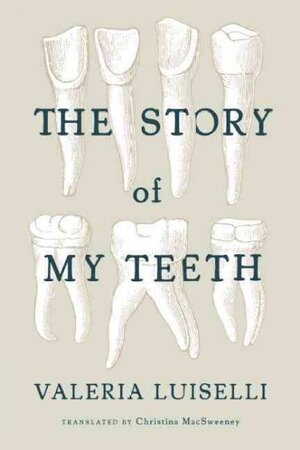
The Story of My Teeth by Valeria Luiselli

I'm the best auctioneer in the world, but no one knows it because I'm a discreet sort of man. My name is Gustavo Sanchez Sanchez, though people call me Highway, I believe with affection. I can imitate Janis Joplin after two rums. I can interpret Chinese fortune cookies. I can stand an egg upright on a table, the way Christopher Columbus did in the famous anecdote. I know how to count to eight in Japanese: ichi, ni, san, shi, go, roku, shichi, hachi. I can float on my back.

This is the story of my teeth, and my treatise on collectibles and the variable value of objects. As any other story, this one begins with the Beginning; and then comes the Middle, and then the End. The rest, as a friend of mine always says, is literature: hyperbolics, parabolics, circulars, allegorics, and elliptics.

Gustavo Sanchez Sanchez--Highway--is in his forties when he discovers his true calling: to be an auctioneer. He's always loved collecting things, from straws to ribbons, and auctioneering allows him to express his attachment to these objects. He describes his method in terms of conic sections, the hyperbolics, etc, etc, described above, which as any mathematician will tell you, are distinguished by their eccentricity, meaning some orbit very closely to their central point while others careen into distant topics. A simpler description of his method might be lying: his first great sales, which he recounts to us, are the sale of his own teeth, which he describes as belonging to famous people from history, from Plato to Virginia Woolf. He sells each tooth by telling a simple story about its owner, and he replaces the teeth he's had removed with a set belonging to Marilyn Monroe he purchased. At the end of the auction he's so overcome with his storytelling that he offers himself up to be bid upon, and is bought by his own estranged son, eager for revenge.

The story of The Story of My Teeth is a unique one: Luiselli was originally commissioned to write a piece of fiction for a catalog of the art collection belonging to Grupo Jemez, a juice company. The gallery and juice factory can both be found in Mexico City's heavily industrialized suburb of Ecatepec, and Luiselli conceived of a project that would bridge the divide between the two. After writing each section, she sent it to the factory to be shared with the workers--in an imitation of the "tobacco readers" that can still be found in Cuban cigar factories--who were recorded discussing it, and their conversations were then incorporated into the text.

This collaborative process resulted in a book that feels fresh and clever, engaged in constant revision and regeneration of itself. But it also grounds the book in the material world which it parodies and critiques. Absurdist narratives like The Story of My Teeth can often feel untethered from the real world, like exercises in self-referentiality that lack any kind of context that makes them readable. Yet for all its absurdity, Luiselli's novel feels like an honest window into the factory life of Ecatapec, where both Highway and his son Siddhartha are employed as guards. The unusual process manages not only to bridge the factory-gallery divide but inscribe, in a way, Luiselli's collaborators onto the page. It's a book that is, as Luiselli describes in the afterword, "not so much about but for the factory workers."

One of the things that The Story of My Teeth understands so well is the way in which both factory and gallery are connected sites of commercial production. The factory makes juice to buy and sell, and the artworks in the gallery, too, are bought and sold; what makes them different from juice? Highway offers an understanding of value, in its capitalist sense and otherwise, that is about storytelling. Having stolen the various artworks from the gallery, he sells them--or perhaps he only imagines he does--by enacting the same strategy as with the teeth, writing brief stories about the famous people who once owned the objects. The differences between these stories and those about the teeth illustrate the difference between "parabolics" and "allegorics," but what struck me most is the way that the line between production and self is blurred: we don't make our teeth in the same way we make an artwork, but what if the difference is reducible to the kind of story we tell about each? How is storytelling at the heart of our possession of ourselves?

Monday, September 1, 2014

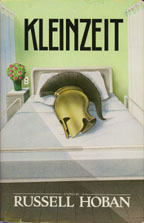
Kleinzeit by Russell Hoban

Kleinzeit leaned on his fear, hobbled into the black sunlight with trembling legs, found an entrance to the Underground, descended.  Underground seemed the country of the dead, not enough trains, not enough people in the trains, not enough noise, too many empty spaces.  Life was like a television screen with the sound turned off.  His train zoomed up in perfect silence, he got in.  In the empty spaces his wife and children spoke, sang, laughed without sound, the tomcat shook his fist, Folger Bashan was smothered with a pillow, his father stood with him at the edge of a grave and watched the burial of trees and grass and blue, blue sky.  The train could take him to the places but not the times.  Kleinzeit didn't want to get out of the train, there was no time here, nothing had to be decided.  He dropped his mind like a bucket into the well of Sister.  There was a hole in the bucket, it came up empty.

Kleinzeit, middle-aged ex-advertising copywriter, is admitted to the hospital with pain in his hypotenuse, which spreads quickly to his diapason, asymptotes, and stretto.  That baffling sentence tells you a lot about the world of Kleinzeit, which is not quite our own.  For one thing, everything talks--anthropomorphism is the principle stylistic tool Hoban employs in Kleinzeit.  See for yourself:

Under the bed Death sat humming to itself while it cleaned its fingernails.  I never do get them really clean, it said.  It's a filthy job I've got but what's the use of complaining.  All the same I think I'd rather have been Youth or Spring or any number of things rather than what I am.  Not Youth, maybe.  That's a little wet and you'd hardly get to know people before they've moved on.  Spring's pretty much the same and it's a lady's job besides.  Action would be nice to be, I should think.

Elsewhere Action lay in his cell smoking and looking up at the ceiling.  What a career ,he said.  I've spent more time in the nick than anywhere else.  Why couldn't I have been Death or something like that.  Steady work, security.

When Kleinzeit is admitted to the hospital, he doesn't merely enter a building; he contacts a rapacious, sadistic anthropomorphic being who wants to devour him:

You understand things, said Hospital.  You're clever.

Ever so, said Kleinzeit, looking for a mousehole small enough for him.

Yes, said Hospital, and became one infinite black mouth.  Didn't even bother with teeth.  Just an infinite black mouth, fetid breath.  Kleinzeit backed into a mousehole.  If the hole is this big the mice must look like oxen here, he thought.

Everything is personified: Death, Action, Hospital, Memory, Underground, the bathroom mirror, the sheets of yellow paper that beckon for Kleinzeit to write on them (and may have some sinister connection to why Kleinzeit is in the hospital in the first place).  That sounds like it might get annoying, but it works because Kleinzeit is a story about a man facing the powers which are outside of his control, and threaten to destroy him.  Giving a voice to "Hospital" allows Hoban to revitalize the conflict between a person and his own bodily health.  Who, being in poor health, has not found the hospital itself to be ominous, even malicious?

While in Hospital, Kleinzeit and his attending nurse, called Sister, fall in love.  I'm not sure I can describe the rest of the plot without sounding a little ridiculous: Kleinzeit and Sister go busking in the London underground; Sister finds an ancient Greek helmet; Kleinzeit struggles to figure out the connection between the yellow paper to his illness and those of the others in his ward; Hospital tells Kleinzeit the true story of Oprheus and Eurydice; other minor characters with names like Flashpoint and Schwarzgang and Dr. Pink come and go.

Kleinzeit is so scatterbrained and strange it seems as if it ought to fall apart like Nathanael West's The Dream Life of Balso Snell or Mervyn Peake's Titus Alone, two books which are nearly unreadable.  But somehow, Hoban manages to unite all these disparate parts into a touching meditation on man's relationship with Death--a creature that turns out, in the end, to be not nearly as hostile as Hospital.

This is the third novel I've read by Hoban, after Riddley Walker, which I loved, and Pilgermann, which I did not.  Each one is weird in its own way, and accomplished in its own way, but none of the three is like the other--so much so that it's hard to believe that they were written by the same person.  If nothing else, Hoban has a range that few other authors can rival, perhaps none.

Monday, January 10, 2011

Waiting for Godot by Samuel Beckett

"The tears of the world are a constant quantity. For each one who begins to weep somewhere else another stops. The same is true of the laugh. Let us not then speak ill of our generation, it is not any unhappier than its predecessors. Let us not speak well of it either. Let us not speak of it at all. It is true the population has increased."

Waiting for Godot is a short little play by Samuel Beckett that’s often considered one of the most important plays ever written. Representing a near-complete break from the necessities of plot and coherency, its plotless plot—two men, Estragon and Vladimir, wait in front of a weeping willow for the never-to-show Godot, and interact only with a madman, Pozzo, and his mostly-mute slave, Lucky, and then start the whole process over again the next day—brought the absurd and unknowable to the mass audience of the theater.

Reading the play—I have a performance downloaded which I haven’t yet watched—I was struck by how involving it is. In spite of the nothing that happens (twice!), it still kept me wondering what wouldn(n’t) happen next. Never having read the play, I wasn’t sure if Godot would show, but after the first act, it became pretty evident that he wouldn’t be making an appearance in the second.

Because of Godot’s complete refusal to show its hand, it can be interpreted in any number of ways. Partially due to my own interests and partially due to the text itself, I found it most effectively read as a modern lament of the absence of God. Godot, inexplicable and unseen, never shows, never really explains, and only sends a young boy to tell the two men, at the close of every day, that he’ll come tomorrow which, of course, he never does. This smacks of deism, but there’s a strong strain of humanism in the play as well, in spite of its dim trappings. Beckett himself said it was only about symbiosis, and that symbiosis is evident in the exchanges between Vladimir and Estragon: they can hardly stand each other at times, but they certainly can’t make it alone.

It’s also worth noting that the play is pretty funny, in an absurd way, and if that’s your thing, you can enjoy it on that level as well. It seems like a work that would reward rereading; perhaps I’ll read it again next time I’m at the DMV.

Monday, October 11, 2010

The Metamorphosis by Franz Kafka

When Gregor Samsa woke up one morning from unsettling dreams, he found himself changed in his bed into a monstrous vermin.

In the annals of opening lines, very few can top the beginning of The Metamorphosis. How can you help but wonder what’s going on when a novel begins with its protagonist turned into a giant bug? Unfortunately, readers who are wondering what exactly is going on are likely to be disappointed. Kafka, one of the founders of absurdism, isn’t too interested in telling us how or why Gregor became a bug. This is the first Kafka I’ve read, but from what I understand, Kafka never was particularly interested in the mechanics of things. In fact, picking out what Kafka was interested in can be quite a challenge, as evinced by the size and variety of analysis his work inspires.

So, plot summary: it’s mostly up there in the opening quote. Gregor Samsa, primary provider in a household that includes his mother, father, and sister, wakes up one morning to find that he’s become something resembling a giant dung beetle. As the novel progresses (such as it does—it’s less than 100pp), his family discovers his malady and their reactions, and his coping, form the core of the narrative.

Initially, Gregor’s family, although frightened of the creature Gregor has become, try to help him. They call for the doctor, who never actually sees him, and they try to make him comfortable. The most accommodating member is his sister, and Gregor’s thankfulness for her small graces—bringing a variety of foods for him to allow him to discover what he likes, talking to him, straightening his room—form the novel’s emotional core. As time goes on, however, the family grows more and more frustrated with Gregor and the way he inconveniences their life. At the same time, Gregor becomes more and more animalistic, caring less and less about the house’s other occupants. Everything comes to a head one night when, entertaining boarders taken in to compensate for the lack of Gregor’s income, Gregor’s sister is playing her violin. The music touches Gregor’s remaining humanity, and he reveals himself to his family at an inopportune time. It’s the last straw.

The Metamorphosis is such a strange absurd piece of work that it’s difficult to know how to react to it. Parts of certainly comical enough, especially in the early going, but Kafka’s descriptions of Gregor’s bug-life are quease-inducing, and ultimately, Gregor’s story is desperately sad. Take this passage, where, in a moment of clarity, Gregor reflects on his wasted life:

In his imagination appeared again, after a long time, his boss and the manager, the chief clerk and the apprentices, the excessively spineless custodian, two or three friends from other businesses, a chambermaid from a hotel in the provinces, a loving, fleeting memory, a female cashier from a hat shop, whom he had seriously but too slowly courted—they all appeared mixed in with strangers or people he had already forgotten, but instead of helping him and his family, they were all unapproachable, and he was happy to see them disappear.

Gregor’s transformation has been interpreted as everything from a mental condition to a metaphor for transubstantiation, but upon this initial reading, what I took away was a sense of alienation. Gregor, in spite of spending his life toiling for his family, never knows them, never spends time with them, pushes everything important to some hazily-defined future, and, with his separation taken to illogical extremes, is now as irrelevant as any other bug.

I mentioned earlier that Gregor’s story is sad, and it is, but the novel itself ends on a bittersweet note: the family realizes that they now have more money than before, since they are all working. They move to a more convenient place, and they are all happy. Gregor and his horrible experience seem to fade into the background by the end of the last page. In a way, I guess, that’s the saddest part of all.

Friday, April 24, 2009

The Phantom Tollbooth by Norton Juster

Milo is blasé attitude about life in general. But one day, upon coming home from school, he finds a mysterious package waiting for him. Inside is a tollbooth that ushers him into another world, a world of witches and monsters and princesses. But this world hinges on some of the very things that Milo finds utterly uninteresting: the importance of words and numbers.

Not long after Milo enters this new world, he is charged with a quest. He must rescued the princesses Rhyme and Reason from the Castle in the Air so that they can be restored to their rightful places and that the world will run smoothly again. He is helped along the way by two friends. Tock is a giant dog with a wind-up clock imbedde in his side. Humbug is a large well-dressed bug who is wrong about nearly everything. Of course, by the end of his quest, Milo learns how interesting seemingly simple aspects of life can be.

I did not like this book as much as I excepted I would. However, at times it is quite clever and original. It is Alice in Wonderland meets Lord of the Rings.

Tuesday, December 25, 2007

Alice's Adventures in Wonderland and Through the Looking Glass by Lewis Carroll

Christopher wrote a nice review of this book, in which he placed the work within the larger historical context of children's literature. That is an interesting facet of the book. At the time when Wonderland was published, children's literature was instructive and largely religious in nature. So, Carroll's absolute absurdism was something out of the ordinary.

The comedian Jim Gaffigan does a bit about dreams, in which he points out how people are alway really keen to tell others about their dreams, but to anyone but the ones having them dreams are horribly boring. That's how I felt about Wonderland and Looking Glass. While each had their moments of creativity, I generally found them to be quite tedious. I am sure that within the pantheon of children's literature, these works are extremely important, that they marked a veritable sea change...I just didn't care for either.

Wednesday, September 12, 2007

Alice's Adventures in Wonderland and Through the Looking Glass by Lewis Carroll

If I wanted to, I think I would be justified in calling Alice's Adventures in Wonderland and Through the Looking Glass two books, but I'm so ahead that I think I'll have some mercy on you people and just call it one, since I read them together in a shared volume. Hell, I'm not even reviewing all the Shakespeare plays I'm reading this year--I'm just that nice of a guy.

Anyway, I'd never read either Alice book, but I pretty much got the gist from the movie, which sort of squashes both books together. The books are actually a little trippier than I imagined, since the whole thing is actually a sort of dreamscape (literally in Wonderland), the transitions between scenes and events are often vague. Numerous times Alice ends up somewhere without knowing how she got there, or babies change into pigs, shit like that. Much of it is very creepy, and I wonder exactly why more people don't find it more disturbing--I suspect it is because, like me, few people have actually read it. A woman in my class made the interesting observation that kids who have chaotic childhoods often seem to be disturbed by the novel's absurdism, while children with healthy childhoods do not.

In any case, Alice is a pretty colorful piece of absurdism. The wordplay is amazing, from the Jabberwocky to little puns like the Mock Turtle--from whom mock turtle soup is made. At its heart, the Alice books are a response to children's literature, which up to this point (mid-19th century) had been dominated by very didactic books about God and righteousness which presented clear morals and encouraged children to become better people through their reading. Alice is a rejection of all that, to the point where it is almost completely stripped of meaning, down to a celebration of absurdism and nonsense. It's not so much a book (or pair of books) about nothing as on nothing, that is, nothing is its chief concern. In that way, I think it very interestingly foreshadowed modernism a genre that didn't appear for another seventy years after this was written.