Showing posts with label Laguna. Show all posts

Thursday, March 7, 2024

House Made of Dawn by N. Scott Momaday

Later, when the sheep had filled into the arroyo and from the bank he could see them all, he dropped a little bread for the snake-killer dog, but the dog had quivered and laid back its ears. Slowly it backed away and crouched, not looking at him, not looking at anything, but listening. Then he heard it, the thing itself. He knew even then that it was only the wind, but it was a stranger sound than any he had ever known. And at the same time he saw the hole in the rock where the wind dipped, struck, and rose. It was lager than a rabbit hole and partly concealed by the chokecherry which grew beside it. The moan of the wind grew loud, and it filled him with dread. For the rest of his life it would be for him the particular sound of anguish.

I don't usually re-read books before teaching them, especially if I've taught them more than once. But N. Scott Momaday's House Made of Dawn is an exception. Perhaps it's just because the book is too dense, too rich, to get away with "faking it." But maybe it's because I love it, and it feels to me like one of those books whose wonders never cease to unfold. This time around, it feels especially poignant, given that Momaday himself died earlier this year at age 89. This time around, it has the feeling of a great legacy--wisdom, maybe, from the next world.

I don't have much to say about it here because I'm sort of doing a running thread about it on Twitter. One thing that did stand out to me, that I hadn't really noticed before, is the passage above, where a young Abel is spooked by a hole in the rock through which the wind is moaning. This stood out to me for a few reasons. One, it reminded me of a similar moment in Death Comes for the Archbishop in which the bishop Latour is guided, in a snow storm, to a secret cave by an Indian guide, where he hears a great moaning coming from within its inaccessible recesses. It reminded me so much of it, actually, that I wondered if Momaday was pointedly referencing it: a moment of the Other, which in Cather is racialized and exotic. That it should strike Latour that way is no surprise, but Abel--always half an outsider because of his uncertain parentage--is, or ought to be, different.

It also brought to mind certain vague aspects of the Pueblo religion, which, like many Native American religions of the West, supposes a number of worlds laid one on the other. Many of these religions hold that humankind came up from another world through a hole like this one; some of them, like the Lakota, can even pinpoint the exact hole. The sipapu, the ceremonial hole in the sacred kiva of the Pueblo religion, represents this place of emergence. Perhaps what Tayo is hearing here--and what terrifies him so--is the sound of that other world: the unmediated touch of the real, which other characters (like Angela) long for, and seek to find in Indian country.

I loved re-reading House Made of Dawn this year. I don't know why, but it felt cleaner, simpler to me, more manageable and recognizable and familiar. Maybe having tackled some of its knottier aspects--its strange place-shifting, its many voices, its modernist structural tricks--what's left is the purity and simplicity of Momaday's language.

Saturday, January 8, 2022

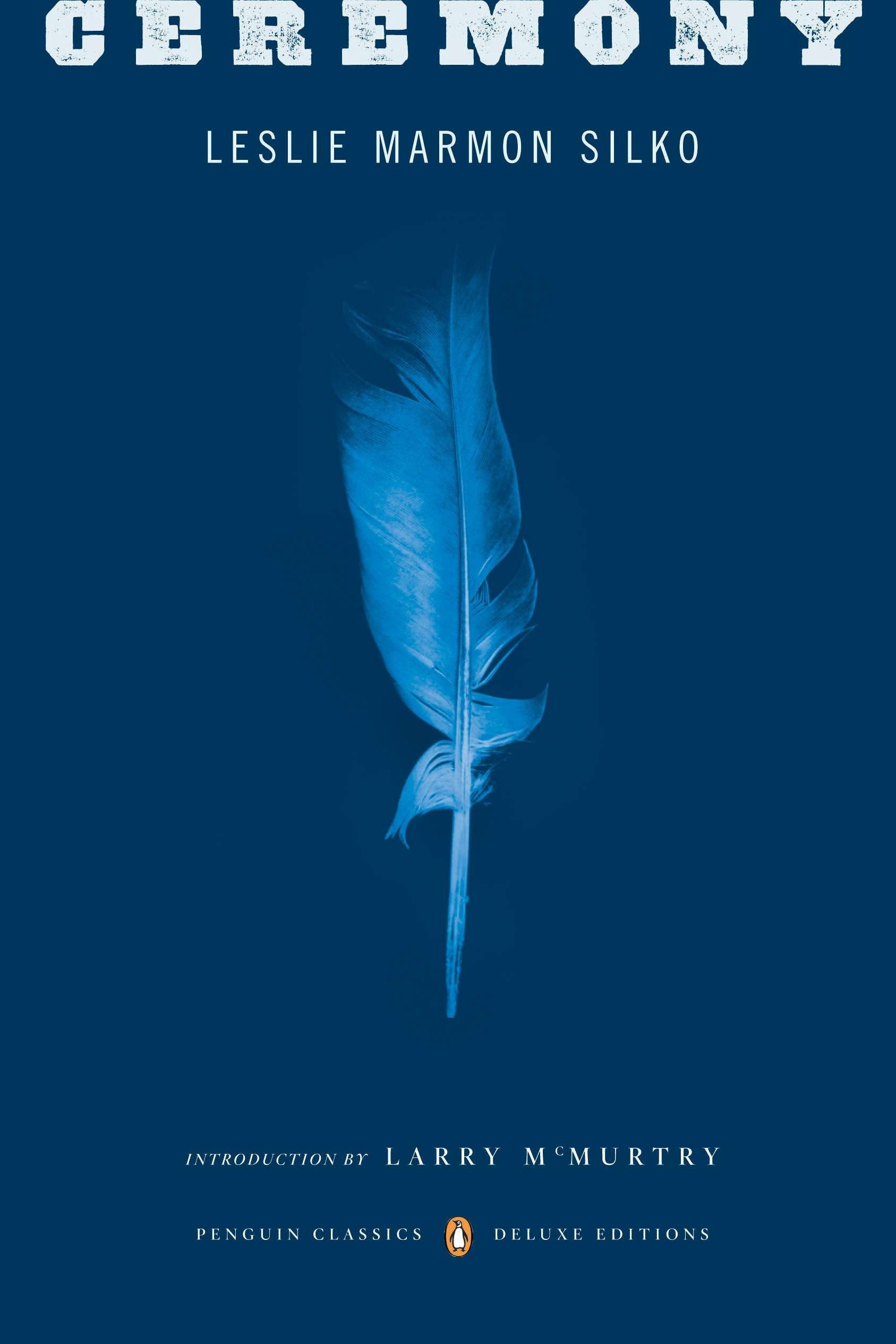
Ceremony by Leslie Marmon Silko

The dreams had been terror at loss, at something lost forever; but nothing was lost, all was retained between the sky and the earth, and within himself. He had lost nothing. The snow-covered mountain remained, without regard to titles of ownership or the white ranchers who thought they possessed it. They logged the trees, they killed the deer, bear, and mountain lions, they built their fences high; but the mountain was far greater than any or all of these things. The mountain outdistanced their destruction, just as love had outdistanced death. The mountain could not be lost to them, because it was in their bones; Josiah and Rocky were not far away. They were close; they had always been close.

I re-read Ceremony because, for the first time ever, I'm going to teach it in class this year. I'm looking forward to that but also I have a little trepidation; much of the time I spent re-reading it I spent trying to figure out what about the novel seems so difficult and enigmatic. The language is measured and plain, but the structure can be a little deceiving: it's the story of Tayo, a Laguna Pueblo man who has returned from World War II and the Baatan Death March with extreme PTSD, and who returns to mental and spiritual health by the aid of a ceremony rooted in Laguna and Navajo storytelling. The beginning is fractured, as is fitting for the narrative of Tayo's inability to move on from the horrors of war and death, but the process of healing, too, is strange, jumping from time to place and from person to person elliptically. Of course, perhaps it is a mistake to think that healing is a process that take something crooked and makes it straight.

I appreciated more, this time, the fine distinctions that Silko makes in her description of "witchery," an enigmatic evil force that is responsible for the creation of white people and European cultures. I can imagine this would be quite an unsafe book to teach in one of those states where anti-"CRT" bills have passed: ALABAMA TEACHER ASSIGNS BOOK THAT CALLS WHITE PEOPLE EVIL DEMONS, that sort of thing. But Silko is always quite clear that "witchery" victimizes indigenous and white people alike, and perhaps even that white people are in the most danger because they refuse to wake up and see it for what it is. "Witchery" is a destructive force; it loves death--it has something to do with capital in the Marxist sense, and the "love of money" in the Biblical sense, but Silko's formulation places it even further back, a black impulse in the human heart that is the root cause of these things. And a reactionary response might fail to see that it is actually invented by indigenous people, according to Silko's rendition of legend; in fact, this is the novel's central and strangest irony.

Once you see this, the outlines of the novel's racial and cultural outlook get both clearer and more complex: you see, for instance, how important to the novel it is that Tayo is of mixed race. Is his Aunt's resentment and neglect, so different than the love she heaped on his "purer" and now-dead cousin Rocky, a kind of witchery? Witchery's avatar in Ceremony is not a white person but an indigenous one: Emo, a sinister drunk who resents Tayo's white heritage as strongly as he yearns for the things that white people have. Silko shows sharply how tribalism and oppression are two sides of the same coin. You notice, too, what it means that Tayo's guide in his ceremony is a Navajo, and not a Pueblo man, despite suspicion on both sides; Ceremony manages to articulate the importance of returning to one's geographic and cultural roots while also showing the power of synthesis and syncretism. It's a subtle message and an unfamiliar one, but one I hope my students will welcome.

Ceremony is the first novel in what I'm calling "Indijanuary," despite it being nearly unpronounceable. I did this last year, too, reading eight books by indigenous North American authors in a row, and I'm excited to try it again.