Showing posts with label Pueblo. Show all posts

Monday, July 6, 2026

House of Rain by Craig Childs

I turned off my light in the back of the cave. I closed my eyes. It felt as if all these centuries, these thousands of years, were contained here, their processions playing out again and again as drips strummed the pool beside me. The same routes are traveled repeatedly, the same meridians followed across horizons, over hundreds of years. Anasazi, I thought, was never a people. It was a rhythm, a form of motion stirred up from the land. People merely fell into step.

I got to return to Mesa Verde National Park last week and tour two more of the enormous cliff dwellings built nine hundred years ago directly into the rock. They are impressive places, made up of turrets and geometric stacks of rooms and huge circular underground kivas. It's hard not to think what the first white Americans, cattle ranchers, thought when they encountered them for the first time: how could somebody build something like this and then just abandon it? The "disappearance" of Ancestral Puebloans, previously known as the Anasazi, has been compelling narrative for a long time, a puzzle to be solved. Craig Childs, in House of Rain, travels through major and minor Puebloan sites throughout the southwest and Mexico, seeking an answer to just that question.

Among other things, House of Rain is a travelogue, and some of the most impressive passages involve Childs moving across the high, dry landscape of the Four Corners area on foot, sometimes with his wife and infant son in tow. He skillfully and poetically describes the beauty of this area, which is among my favorite places in the world. So in that sense it was like comfort food to me. And I appreciated hearing descriptions of some of these Puebloan sites I'll never see; tucked away in the corners of deep canyons, undisturbed in the way those first ranchers must have seen them. You can see how much more uncomfortable Childs is at, say, Aztec Ruins, a site run by the National Park Service in the backyard of a suburb of Farmington, New Mexico. Better to pass into these regions of quietude, where the intervening years can disappear and the past reappear in the form of a broken wall, a husk of corn, a potsherd.

So what happened to the Ancestral Puebloans? As Child notes, though a little begrudgingly, the mystery is not much of a mystery at all: they migrated, probably because of an intense drought in the high country of the Four Corners. Childs puts some specifics to this that I found highly interesting: his conclusion, based on the introduction of new kinds of polychromatic pottery in the lower regions of Arizona, is that the Puebloan culture migrated to the south, mingling with Hohokam and Mogollon cultures that were already there to create the culture now known by archaeologists as the Salado. It's Childs' contention, actually, that tensions between the new elements of this multicultural society resulted in the collapse of that society, leading the Pueblo peoples to splinter into the groups that now make up the two-dozen-odd Pueblos of the Rio Grande Valley, as well as the Hopi. But Childs throws his lot in with some more outre conclusions as well, like a revisionist theory that Puebloans migrated north from Chaco Canyon to Mesa Verde and then south again along the same meridian to a location in Mexico known as Paquime (or today as Casas Grandes), which other archeologists consider more closely related to the Aztec cultures of Mexico to the south. In any case, Childs favors a version of the Puebloans that emphasizes their grandeur, claiming for them a larger sphere of influence than many of his peers.

House of Rain is only twenty years old, but it wears its age. The term Anasazi, a rude exonym that comes from the Navajo, has been entirely supplanted by "Ancestral Puebloan." And while Childs undercuts the question Where did they go, my understanding is that nobody accepts this any longer as a framework from which to begin--something which perhaps Childs should be given credit for. But my biggest frustration with House of Rain is how it keeps modern Pueblo peoples at arm's length. They appear infrequently, and often in ways that stymie Childs' research, as with a council of elders that refuses to give Childs permission to conduct research. Childs paints this as a typical reservedness, but then again, he's the one who uses the word Anasazi around them, knowing it's offensive, but catching himself too late. Childs folds in some of the stories and legends of modern-day Puebloans that support the narrative of migration, but I noticed that these stories always tend to begin "a Hopi man once told me," while the researchers have names. At a dig, Childs notes the frustration of an archeologist who is forced to stop digging when human remains are found--a key stipulation of the Native American Grave Protection and Repatriation Act--and, in way that felt telling to me, lets that frustration pass by without comment.

All of these are minor missteps, perhaps, but they add up to a sense that Childs is most interested in the version of the Ancestral Puebloans that live in his imagination, and keeps the modern-day Puebloans and Hopi who might shine light on them at arm's length because they might complicate that imagination. Which is all just to say that I think House of Rain would be stronger if it had found a way to engage more deeply with them. That said, in the end, I really enjoyed deepening my understanding of the people of Mesa Verde this way, and I was persuaded by Childs' invitation to see them not as a static society that suddenly "collapsed," but a living, moving culture passing through several stages of development over centuries: a rhythm, a form of motion.

Thursday, March 7, 2024

House Made of Dawn by N. Scott Momaday

Later, when the sheep had filled into the arroyo and from the bank he could see them all, he dropped a little bread for the snake-killer dog, but the dog had quivered and laid back its ears. Slowly it backed away and crouched, not looking at him, not looking at anything, but listening. Then he heard it, the thing itself. He knew even then that it was only the wind, but it was a stranger sound than any he had ever known. And at the same time he saw the hole in the rock where the wind dipped, struck, and rose. It was lager than a rabbit hole and partly concealed by the chokecherry which grew beside it. The moan of the wind grew loud, and it filled him with dread. For the rest of his life it would be for him the particular sound of anguish.

I don't usually re-read books before teaching them, especially if I've taught them more than once. But N. Scott Momaday's House Made of Dawn is an exception. Perhaps it's just because the book is too dense, too rich, to get away with "faking it." But maybe it's because I love it, and it feels to me like one of those books whose wonders never cease to unfold. This time around, it feels especially poignant, given that Momaday himself died earlier this year at age 89. This time around, it has the feeling of a great legacy--wisdom, maybe, from the next world.

I don't have much to say about it here because I'm sort of doing a running thread about it on Twitter. One thing that did stand out to me, that I hadn't really noticed before, is the passage above, where a young Abel is spooked by a hole in the rock through which the wind is moaning. This stood out to me for a few reasons. One, it reminded me of a similar moment in Death Comes for the Archbishop in which the bishop Latour is guided, in a snow storm, to a secret cave by an Indian guide, where he hears a great moaning coming from within its inaccessible recesses. It reminded me so much of it, actually, that I wondered if Momaday was pointedly referencing it: a moment of the Other, which in Cather is racialized and exotic. That it should strike Latour that way is no surprise, but Abel--always half an outsider because of his uncertain parentage--is, or ought to be, different.

It also brought to mind certain vague aspects of the Pueblo religion, which, like many Native American religions of the West, supposes a number of worlds laid one on the other. Many of these religions hold that humankind came up from another world through a hole like this one; some of them, like the Lakota, can even pinpoint the exact hole. The sipapu, the ceremonial hole in the sacred kiva of the Pueblo religion, represents this place of emergence. Perhaps what Tayo is hearing here--and what terrifies him so--is the sound of that other world: the unmediated touch of the real, which other characters (like Angela) long for, and seek to find in Indian country.

I loved re-reading House Made of Dawn this year. I don't know why, but it felt cleaner, simpler to me, more manageable and recognizable and familiar. Maybe having tackled some of its knottier aspects--its strange place-shifting, its many voices, its modernist structural tricks--what's left is the purity and simplicity of Momaday's language.

Wednesday, January 3, 2024

Death Comes for the Archbishop by Willa Cather

Ever afterward the Bishop remembered his first ride to Acoma as his introduction to the mesa country. One thing which struck him at once was that every mesa was duplicated by a cloud mesa, like a reflection, which lay motionless above it or moved slowly up from behind it. These cloud formations seemed to be always there, however hot and blue the sky. Sometimes they were flat terraces, ledges of vapour; sometimes they were dome-shaped, or fantastic, like the tops of the silvery pagodas, rising one above another, as if an oriental city lay directly behind the rock. The great tables of granite set down in an empty plain were inconceivable without their attendant clouds, which were a part of them, as the smoke is part of the censer, or the foam of the wave.

I'm excited to have a ticket to a dinner and seminar at the New York Historical Society next week about Willa Cather's Death Comes for the Archbishop. Only, what I thought was a seminar seems to be more of a discussion, and I'm actually supposed to have recently read the book. So, while starting the new year, with all its attendant slate-clearing and excitement, with a re-read is not ideal, there's few books that could better inaugurate the year.

The first time I read Death Comes for the Archbishop, I didn't get it. I kept waiting for the death, and I was stupid. The second time I read it, I saw the simple grandeur of Cather's prose for what it is, and having read more of her books since then, it's only grown higher in my estimation. So I thought I'd try something unusual and write a negative review of Death Comes for the Archbishop.

Let's start with the moral case against Cather's novel. Cather, it seems to me, has escaped critical censure for the small-c conservative and traditionalist aspects of her writing. In One of Ours, it's the glorification of World War I heroism and the sacrifice of young American lives for what I think we now see as little reward. In O! Pioneers and My Antonia, it's the myth-making around the long-gone days of the pioneer, which situates American identity in a past that never really existed. Similarly, Death Comes for the Archbishop is primarily about whitewashing the frontier and the "civilizing" of the American West. To see this, you need only to look at the Bishop Latour's praise for and friendship with Kit Carson, one of the premiere Indian fighters of his day, and whose depredations Latour only goes so far as to call "misguided." Or to Latour's nostalgia for the Spanish "martyrs" who were driven out centuries before by the Pueblo Revolt. The novel's central symbol is the cathedral that Latour builds from a hill of yellow rock he finds near the Pueblo of Acoma. The cathedral's design is European, French, but the rock is taken quite literally from the land, which Latour believes no one will miss, though he doesn't seem to have asked.

Cather goes out of her way to present Latour and his bosom friend, Father Vaillant, as friends of the Indians. On his deathbed, Latour rejoices that he has lived long enough to see the Navajo returned to their lands (no thanks to the "misguided" Kit Carson), and the novel's grandest villain is the gluttonous Fray Ramirez who abuses his parishioners at Acoma, and gets thrown off the cliff wall for it. But Death Comes for the Archbishop is invested, too, in a fundamental vision of Indian differentness, not simply rooted in the past but atavistic to the point of simplicity. Indians are both somehow manifestations of the land itself and an ancient prehistory. In some ways, this is meant to be a compliment: when one rebellious priest warns Latour not to try to change the old ways of the Indian religion, Latour remarks that ancientness is what he likes in the people of New Mexico--it is a quality shared with the Catholic church.

This might be the book's most significant elision: its insistence that the spread and maintenance of the Church in New Mexico is neither coercive nor particularly transformative. Latour and his fellow Catholics are consistently contrasted with "bad whites" like the murderous Buck Scales, who abuses his Mexican wife, or the town Protestants who love to violate sacred places and things. But this only serves to hide the ways in which the Church is one arm of European colonial transformation. Latour can build his cathedral because he believes that the Catholic church is catholic in that old sense of universal; it belongs everywhere. Contrary to the U.S. government, he is grateful that the Navajos have returned to "their land," but it does not occur to him, even as he digs up that yellow rock to build his cathedral, that the Church itself is a kind of invading force, using and possessing someone else's land.

Aesthetically, the novel reflects this project of elision. Unlike My Antonia or O! Pioneers, which have more conventional dramatic narratives--even as they, like Archbishop, each cover many years--Death Comes for the Archbishop feels strangely episodic and halting, without forward movement. It moves from anecdote to excursion: from a story that someone tells Father Latour (like that of the villainous priest at Acoma) to another trip out into the difficult desert. What happens at home in Santa Fe is hardly ever seen; the yellow rock is discovered, the cathedral is built. We know that the priests at Acoma force their charges to gather heavy pine trees from the distant mountains to build the church, but who builds the Cathedral of St. Francis, we're not permitted to know. I don't know either, of course, but it seems to me there's something intentionally obscured about the workings of the Church that's reflected in the book's subtly unconventional structure. Archbishop is a book with plenty of event, but no history, perhaps because it's unable to look at history with honesty.

Okay, I can't believe in any of that, even as I think there's some truth in it. Truly, I only appreciate Death Comes for the Archbishop more having seen this summer so many of the places it describes, like the cloud citadel of Acoma--which, of course, Cather describes perfectly. One thing I love about New Mexico, and the Southwest more broadly, is that the vast and striking landscape puts me in mind of eternity. It's a place for spiritual people, and I do actually think that Cather effectively imagines a profound similarity between Latour, Vaillant, and their parishioners: all are simple people, trying their best to keep their minds on the things that really matter. The anecdote about the waylaid traveler who is helped by a Mexican-Indigenous family, only to realize later that they were the Holy Family is one of the truest and most effecting parts of the novel. And the last thirty pages, in which the Archbishop--finally--dies remain among the greatest creations of American literature. I do think that Cather engages in more than her share of American mythmaking, which always requires a partly blind eye. But Death Comes for the Archbishop is about something greater than America.

Sunday, July 9, 2023

Earth Keeper: Reflections on the American Land by N. Scott Momaday

We humans must revere the earth, for it is our well-being. Always the earth grants us what we need. If we treat the earth with kindness, it will treat us kindly. If we give our belief to the earth, it will believe in us. There is no better blessing than to be believed in. There are those who believe that the earth is dead. They are deceived. The earth is alive, and it is possessed of spirit. Consider the holy tree. It can be allowed to thirst. It can be cut down. Worst of all, it can be denied our faith in it, our belief. But if we speak to it, if we pray, it will thrive.

Last week I had the great fortune to be able to visit Walatowa, the main community of the Pueblo of Jemez. Walatowa is the setting of N. Scott Momaday's novel House Made of Dawn; I received a grant in order to visit this and other Pueblo sites in New Mexico. Walatowa is closed to visitors, but has a visitor center with a small museum; a very friendly man there guided me to a photograph of Momaday's mother on the wall, in an exhibit about the local school. She was a teacher, a Kiowa who took a job with the Indian school service, and who brought her son with her. The photo reaffirmed something that I'd been thinking about during my recent re-read of the novel: Momaday, though he too is a Native person, was a stranger at Walatowa, as much a stranger as I was, and House Made of Dawn is a book written by an outsider, who saw in the place a certain fundamental beauty that speaks to larger truths about the world. Here's what Momaday writes about his childhood at Walatowa:

At the pueblo of Walatowa I came to know a world that was remote in time and space. I was twelve years old when my parents and I moved there. In my day the life of the town had remained by and large unchanged for hundreds of years. The people grew corns and melons and chili; they hunted deer and bear in the mountains, they captured golden eagles for use in their ceremonies. Time was told on a solar calendar, according to the position of the sun on the horizon. There were ceremonial dances and feast days of marked activity and color. I fitted myself into the ancient rhythm of life there and came to know that country far and wide on the back of a horse. Then that world began to change with the return of young men form World War II. Many of them had been psychologically severed from the traditional earth. It was a time of loss.

Yet, Momaday too suffered a kind of loss in the move, or if not a loss, at least a fundamental change, in the separation from the Kiowa landscape of his mother, father, and ancestors. In Earth Keeper, a new short book of prose poetry from Momaday, he writes about an old Kiowa man named Dragonfly who teaches a respect and regard for the living world. The earth, Dragonfly instructs, relies on our belief in it: "He was told every day he must pray not only to witness the sun's appearance, but indeed to raise the sun, to see to it that the sun was borne into the sky ,that each day was made by the grade of Dragonfly's words." What a responsibility--to pray the sun into the sky! And yet, Dragonfly describes a burden that each of us must take up, to be an "earth keeper" and maintain the processes that keep the spirit of the earth alive.

But Momaday never met Dragonfly, who was an old man when his father was a boy. "This happened a long time ago," Momaday writes about Dragonfly's lesson. "I was not there. My father was there when he was a boy. He told me of it. And I was there." As in House Made of Dawn, which includes a fictionalized version of the Momaday's Kiowa grandmother's story that is repeated more pointedly in The Way to Rainy Mountain, Momaday suggests that storytelling and oral tradition are methods of maintaining a link to the earth even when a physical connection is absent. I was touched to think of the young Momaday, impressed by the longstanding ties between the Jemez people and the earth, thinking of his own connection to his Kiowa lands back home in Oklahoma.

Earth Keeper is interesting because it is a reminder of the way that the lessons of House Made of Dawn and Rainy Mountain remain relevant in the 21st century. "Ours is a damaged world," Momaday writes. "We humans have done the damage, and we must be held to account. We have suffered a poverty of imagination, a loss of innocence." It's a shock to see, among Momaday's plainspoken and old-seeming language, references to climate change: "But on the immediate side there is the exhaust of countless machines, toxic and unavoidable. The planet is warming , and the northern ice is melting." Can we think of climate change as the inevitable result of the loss of ancient wisdom? That we have failed, collectively, to live up to Dragonfly's instructions to be an "earth keeper?" Earth Keeper is a small book, and may seem slight and light on ideas, but this, I think, is a powerful message, and it makes the book an important and interesting context in which to read Momaday's other books.

Sunday, April 3, 2022

House Made of Dawn by N. Scott Momaday

These things he told to his grandsons carefully, slowly and at length, because they were old and true, and they could be lost forever as easily as one generation is lost to the next, as easily as one old man might lose his voice, having spoken not enough or not at all. But his grandsons new already; not the names of the strict position of the sun each day in relation to its house, but the larger motion and meaning of the great organic calendar itself, the emergency of dawn and dusk, summer and winter, the very cycle of the sun and of all the suns that were and were to come. And he knew they knew, and he took them with him to the fields and they cut open the earth and touched the corn and ate sweet melons in the sun.

I have been trying to teach House Made of Dawn for years and years, it seems like. It took several years of pondering to conceptualize the class in contemporary Native American fiction I now teach, though I always knew that Momaday's legendary novel would be a part of it, and then just after I reread the novel in 2020, school as we knew it shut down. Reading it again I feel a kind of nervous anticipation about how students will respond to it--personally I suspect they will find it too difficult to really enjoy, though they will be challenged by it in ways they may not recognize on a surface level--and again I feel rather stymied by it. It's a weird, complicated book, one that's hard to penetrate, and one whose greatest power seems removed somewhere behind the page itself, and to see it is to see as the traditional Pueblo dancers do, "beyond the mountain": "To say 'beyond the mountain,' and to mean it, to mean, simply, beyond everything for which the mountain stands, of which it signifies the being."

Anyway. I've reviewed this book twice before, and you can read those reviews here and here, so I won't make a big review for this time around. But one thing I did notice this time around, because I've now read The Way to Rainy Mountain, is how much of that other novel is contained within this one. Momaday is Kiowa, a tribal nation native to the Great Plains, who lived for a time at the Walatowa Pueblo in New Mexico because his parents were teachers in the Indian Service. (There is a "pan-Indian" quality to the novel if you're willing to look for it, not least in the way the Pueblo reveres the customs of a small group of refugee Navajo who were integrated into the Pueblo generations prior--something that is echoed in the befuddled care the Navajo narrator Ben Benally bestows on the Pueblo protagonist Abel in Los Angeles.) The experiences of Momaday's grandmother, an Oklahoma Kiowa, are incorporated into the book as the memories of Josiah Big Bluff Tosamah, the bombastic "Priest of the Sun" in the Native American Church in Los Angeles:

The last time I saw her, she prayed standing by the side of her bed at night, naked to the waist, the light of a kerosene lamp moving upon her dark skin. Her long black hair, always drawn and braided in the day, lay upon her shoulders and breasts like a shawl. I did not always understand her prayers; I believe they were made of an older language than that of ordinary speech. There was something inherently sad in the sound, some slight hesitation upon the syllables of sorrow.

I probably wouldn't have noticed the parallels if not for Tosamah telling the story of how his grandmother was a member of a Kiowa band that traveled to Texas to beg to be sold a buffalo from a private herd, for which they were rebuffed, a moment that largely spelled doom for their religious traditions. What's interesting about this is that Tosamah is a rather ambiguous character, whose church is depicted as too syncretic, and too eager to make accommodations with the settler world into which Indian Relocation programs have dropped these characters: he makes fun of Abel for being a "longhair," but that's who Abel is--though he tries to make it Los Angeles, it's only back at Walatowa that he can really be the person he is meant to be. What was Momaday doing, I wonder, by giving a character like Tosamah his own memories?

I don't know that I find this book any easier after three readings, but I am noticing new things about it. It can be a challenging, even off-putting book, but how many books really reward repeated readings like that. I hope my students, even if they don't love it--and I don't think even I could say I love it, though I respect and admire it--find something in it worth reflecting on.

Saturday, January 8, 2022

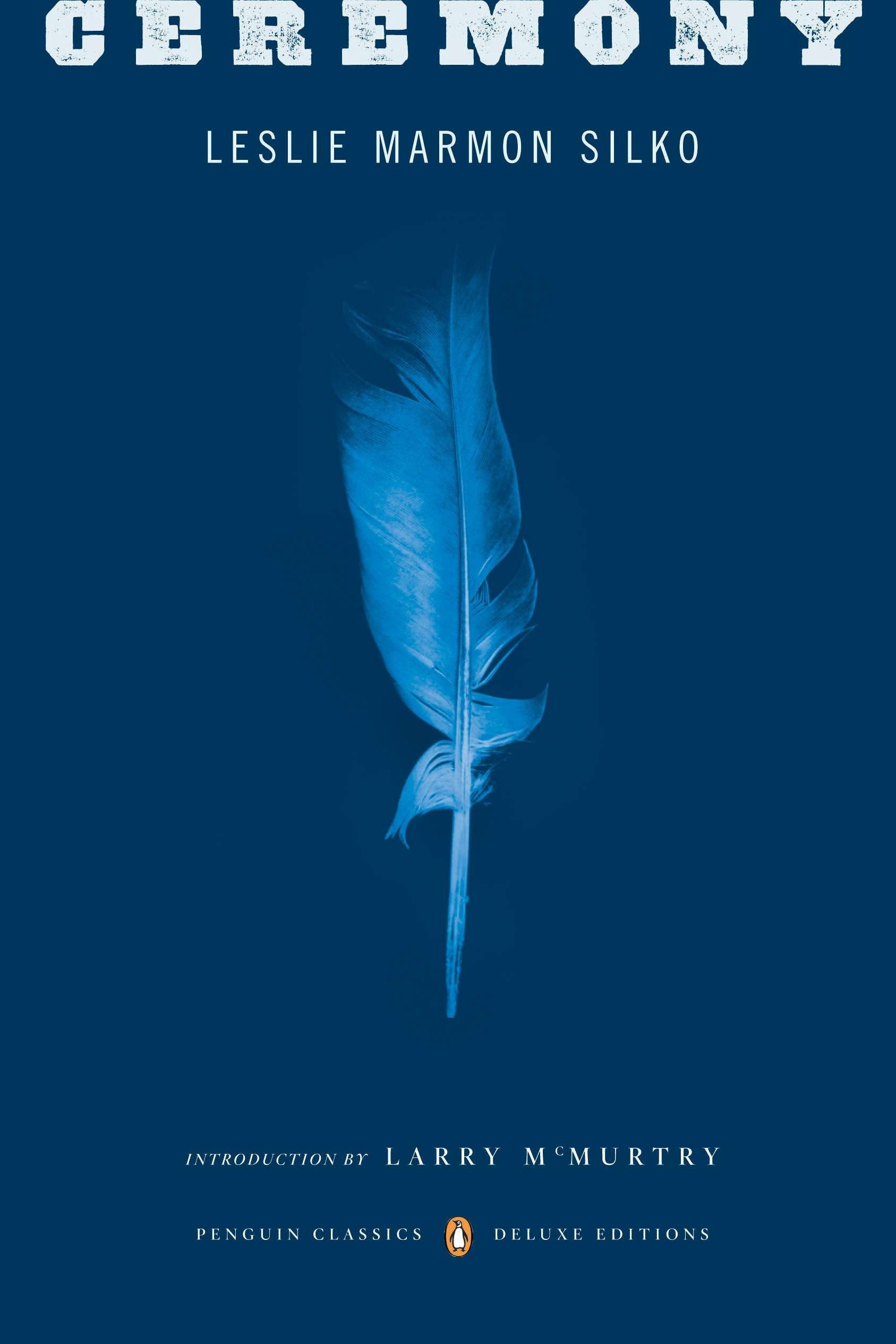
Ceremony by Leslie Marmon Silko

The dreams had been terror at loss, at something lost forever; but nothing was lost, all was retained between the sky and the earth, and within himself. He had lost nothing. The snow-covered mountain remained, without regard to titles of ownership or the white ranchers who thought they possessed it. They logged the trees, they killed the deer, bear, and mountain lions, they built their fences high; but the mountain was far greater than any or all of these things. The mountain outdistanced their destruction, just as love had outdistanced death. The mountain could not be lost to them, because it was in their bones; Josiah and Rocky were not far away. They were close; they had always been close.

I re-read Ceremony because, for the first time ever, I'm going to teach it in class this year. I'm looking forward to that but also I have a little trepidation; much of the time I spent re-reading it I spent trying to figure out what about the novel seems so difficult and enigmatic. The language is measured and plain, but the structure can be a little deceiving: it's the story of Tayo, a Laguna Pueblo man who has returned from World War II and the Baatan Death March with extreme PTSD, and who returns to mental and spiritual health by the aid of a ceremony rooted in Laguna and Navajo storytelling. The beginning is fractured, as is fitting for the narrative of Tayo's inability to move on from the horrors of war and death, but the process of healing, too, is strange, jumping from time to place and from person to person elliptically. Of course, perhaps it is a mistake to think that healing is a process that take something crooked and makes it straight.

I appreciated more, this time, the fine distinctions that Silko makes in her description of "witchery," an enigmatic evil force that is responsible for the creation of white people and European cultures. I can imagine this would be quite an unsafe book to teach in one of those states where anti-"CRT" bills have passed: ALABAMA TEACHER ASSIGNS BOOK THAT CALLS WHITE PEOPLE EVIL DEMONS, that sort of thing. But Silko is always quite clear that "witchery" victimizes indigenous and white people alike, and perhaps even that white people are in the most danger because they refuse to wake up and see it for what it is. "Witchery" is a destructive force; it loves death--it has something to do with capital in the Marxist sense, and the "love of money" in the Biblical sense, but Silko's formulation places it even further back, a black impulse in the human heart that is the root cause of these things. And a reactionary response might fail to see that it is actually invented by indigenous people, according to Silko's rendition of legend; in fact, this is the novel's central and strangest irony.

Once you see this, the outlines of the novel's racial and cultural outlook get both clearer and more complex: you see, for instance, how important to the novel it is that Tayo is of mixed race. Is his Aunt's resentment and neglect, so different than the love she heaped on his "purer" and now-dead cousin Rocky, a kind of witchery? Witchery's avatar in Ceremony is not a white person but an indigenous one: Emo, a sinister drunk who resents Tayo's white heritage as strongly as he yearns for the things that white people have. Silko shows sharply how tribalism and oppression are two sides of the same coin. You notice, too, what it means that Tayo's guide in his ceremony is a Navajo, and not a Pueblo man, despite suspicion on both sides; Ceremony manages to articulate the importance of returning to one's geographic and cultural roots while also showing the power of synthesis and syncretism. It's a subtle message and an unfamiliar one, but one I hope my students will welcome.

Ceremony is the first novel in what I'm calling "Indijanuary," despite it being nearly unpronounceable. I did this last year, too, reading eight books by indigenous North American authors in a row, and I'm excited to try it again.

Saturday, March 14, 2020

House Made of Dawn by N. Scott Momaday

Abel walked into the canyon.  His return to the town had been a failure, for all his looking forward.  He had tried in the days that followed to speak to his grandfather, but he could not say the things he wanted; he had tried to pray, to sing, to enter into the old rhythm of the tongue, but he was no longer attuned to it.  And yet it was still there, like memory, in the reach of his hearing, as if Francisco or his mother or Vidal had spoken out of the past and the words had taken hold of the moment and made it eternal.  Had he been able to say it, anything out of his own language--even the commonplace formula of greeting "Where are you going"--which had no being beyond sound, no visible substance, would one again have shown him whole to himself; but he was dumb.

This semester, I'm teaching a class on Native American literature for the first time.  I had planned on teaching four texts: Tommy Orange's There There, LeAnne Howe's Savage Conversations, Louise Erdrich's Future Home of the Living God, and this novel, N. Scott Momaday's House Made of Dawn.  Of course, the outbreak of the coronavirus pandemic has changed my plans.  I don't know if school will be happening this week or next, or if I'll be there even if it is.  If I have to cut a book from the curriculum, it's probably this one, important and vital as it is.  It's demanding, challenging--but I don't know if I'm in the right frame of mind for this kind of challenge right now, and I don't know if my students are either.

Anyway.  I did find that, reading it a second time, it wasn't as difficult a read as I had first found it.  It helps, of course, to know what happens; I spent the second time around not reading for the plot but for other things: the spareness of the language, for one, which is actually quite striking.  Some other things I discovered:

House Made of Dawn is a multiethnic and multicultural story.  On the surface, it's a story like Leslie Marmon Silko's Ceremony, in which a Native man, his spirit ravaged from war, returns to his tribal home only to find he no longer fits.  When he finds a way at last to reintegrate himself into the cultural and religious life of his community, his mental anguish disappears.  But for Silko, this means a rejection of white culture, which she associates with a malevolent force named "witchery," and complete reabsorption into the lifeways of the Laguna Pueblo.

In House Made of Dawn, on the other hand, Abel already begins as a kind of outsider: his mother is not Pueblo but Navajo.  His community, Walatowa, has opened their doors to a small group of refugee Navajo, whose ceremonies become part of Pueblo life.  The rites of the community are a mishmash of traditional Pueblo religion, Navajo religion, and Catholicism, which Momaday seems to respect.  And furthermore, my first reading of Abel's trist with the white woman Angela St. John (whose name is an Anglicization [Angela-cization?] of Walotawa's patron saint-figure Santiago, who may or may not be the St. John of of the Bible) as something nefarious now strikes me as a mistake.  Angela, after all, ends up helping to nurse Abel through his hospitalization in Los Angeles, when his hands are badly broken by a corrupt cop.  It seems hard to read House Made of Dawn as an embrace of a specific cultural tradition; after all, Abel's friend and narrator Ben Benally, who is Navajo, seems to be comfortable in Anglo-dominated L.A.

House Made of Dawn is structured around rituals and rites.  Part of what makes the book a challenge at first is that these rites are totally unfamiliar, and Momaday is not particularly forthcoming with explanations or justifications.  At Walatowa, there is ritual distance running and the Navajo practice of hunting and capturing eagles (!).  In L.A., there is the peyote ritual of the Native American church.  These rituals are what give order to life among the Native people of House Made of Dawn, and Abel's distress is clearest when he is unable to comprehend them.  During the festival of Santiago at Walatowa, Abel is bested in a strange ritual by an albino man named Juan Reyes, who rubs a bloody chicken in his face.  The first time around I read this as an act of gloating, but now it seems to me that it may be part of the ritual itself--who knows, honestly--which Abel misinterprets.  He kills Reyes in a fit of anger, perhaps because his mind remains on the field of battle, rather than the world of ritual.

House Made of Dawn is very good.  I'm sorry to think I won't get a chance to read it with my seniors, if that's really what's happening.  Doubtless some of them would breathe a sigh of relief if they knew they were being absolved of reading such a challenging text, but that's OK.  Maybe some of them will come back to it someday, like I did, and see how stunning it can be.