Showing posts with label Blackfoot. Show all posts

Thursday, January 16, 2025

The Indian Lawyer by James Welch

Now, as he remembered to look out at the small crowd, he saw the posters bobbing over the faces, red and blue with white lettering, YELLOW CALF FOR CONGRESS, and the large buttons on topcoats and wool jackets, and he became excited by what he was actually doing. All the planning, the strategy, the issues, which had seemed so academic to him, gave way to the reality that he was actually running for office, that he was qualified, not in the politician's way but in his own beliefs and values. He felt a great wave of anticipation through his body and he thought, I am on my way, I will make a difference because I am Sylvester Yellow Calf and I do count. He suddenly felt as though his life had inexorably led him to this moment and he wanted it to be momentous.

Sylvester Yellow Calf is a successful lawyer in Helena, Montana's capital. As a teenager, he was the star of the high school basketball team in Browning, on the Blackfeet reservation; this success marked him as a leader and made him what he is--which is to say, it got him off the reservation. Now he's on the precipice of considering a run for Congress, in which he hopes to become a strong advocate for the issues that affect Indians like those back home. But Yellow Calf also sits on the parole board, and a devious inmate named Jack Harwood has cooked up a plan to obtain his freedom by convincing his wife, Patti Ann, to seduce Yellow Calf and blackmail him.

It's interesting to compare Yellow Calf to the protagonists of James Welch's four other novels. (This is his fifth, and last--sad for me.) There are the historical figures of Fools Crow and Charging Elk, both caught in moments of great upheaval and change. Then there are the heroes of Winter in the Blood and The Death of Jim Loney, whose life on the reservation seems never-changing, only a dead end. Yellow Calf, by contrast, is the one who got out and made something of himself, but with the success comes the conflicted feelings of having left one's community behind. This is underlined for Yellow Calf when he sits on the parole board for another Indian his own age, whom he distantly remembers from the reservation. This man is not, perhaps, a frightening reminder of what might have been, but a reminder that not everyone had Yellow Calf's luck, or ability to shoot a basketball, and that success has meant becoming somewhat alien to the community whose hero he once was.

As a political thriller, The Indian Lawyer isn't much. It might have benefitted from a James Patterson-type, who could have turned the blackmail into something that fits a little better the desperation and deviousness we are meant to see in Harwood. Welch does try to ratchet up the intensity of the conflict; Harwood loses control of his scheme when a pair of reckless accomplices decide to take matters into their own hands. Harwood himself, though, provides an interesting contrast to Yellow Calf. Whereas we're told that Yellow Calf did all he good to "make good" on his difficult upbringing, Harwood is a shrewd, intelligent man--and a white one--who seems to have turned to crime out of pure pique. He's neither as stupid nor violent as his accomplices, but he's made an active choice to embrace criminality, perhaps for no better reason than he can. Together, the two of them seem to illustrate that the limitations of one's birth--geographic, economic, racial--are not absolute.

I don't know much about Welch as a person, but I wonder if this image of a fellow Blackfoot who transformed himself by leaving the reservation behind resonated with him. I wonder if Sylvester's success, and his grappling with it, emerged from Welch's own relative success and prestige as a writer. In any case, it's not Welch's best novel (it's probably the least interesting and effective of the five), but it's worth reading for the way it stands alone.

Saturday, January 29, 2022

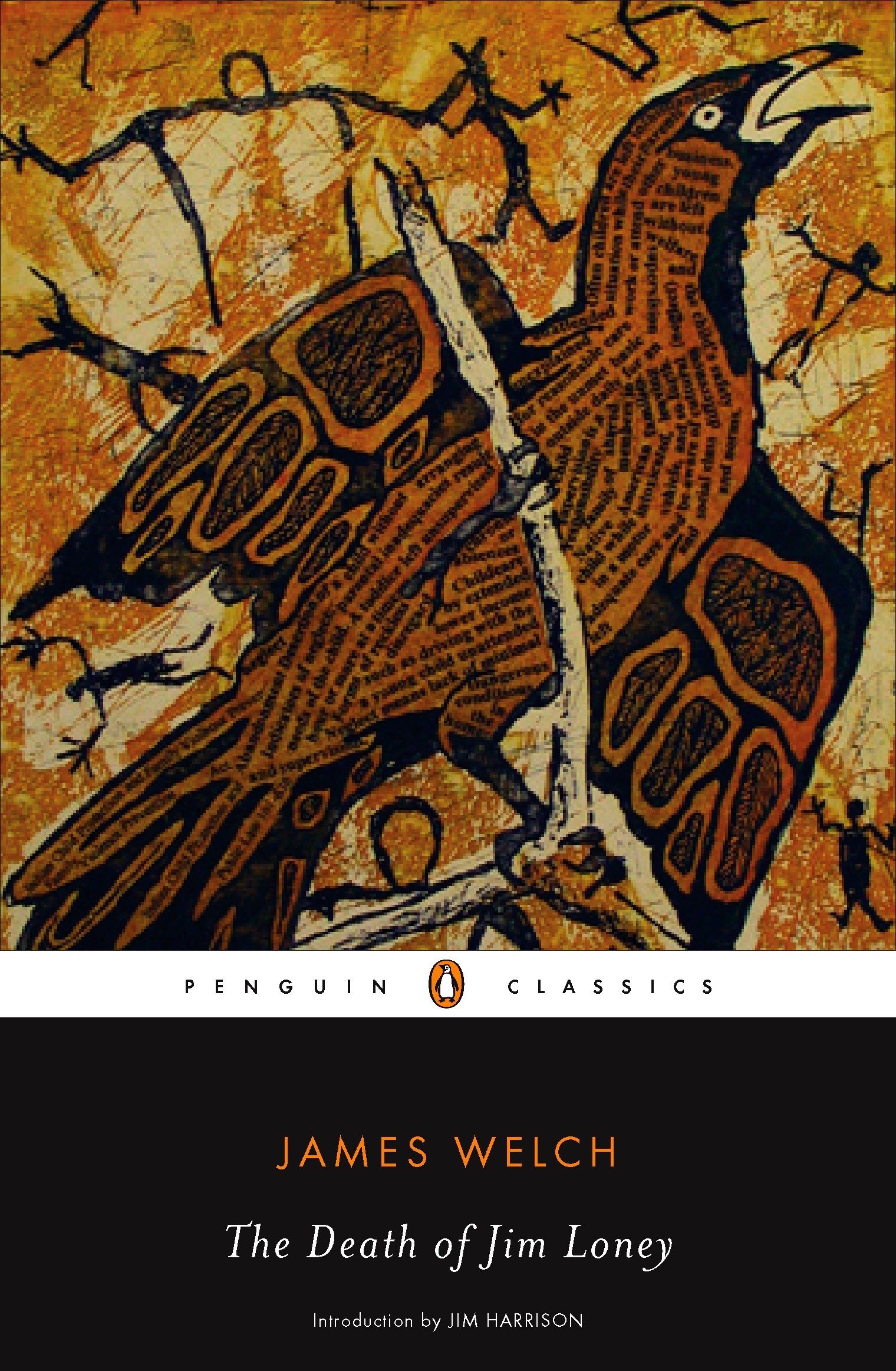
The Death of Jim Loney by James Welch

As he tried to strike another match to light a cigarette, he realized that his hands were trembling. He wanted to believe that they trembled because of the cold, but he knew without thinking it that they trembled because there was no real love in his life; that somehow, at some time, everything had gone dreadfully wrong, and although it had something to do with his family, it had everything to do with himself.

Jim Loney lives a quiet life at the edge of the Blackfoot reservation in Montana. Once a star high school basketball player, his life has shrunk down to almost nothingness. He feels detached from it, detached from himself; he feels, as the protagonist of Welch's Winter in the Blood does, "as distant from myself as a hawk from the moon." Materially, things are not so bad for him: he doesn't seem to be especially hard-up or poor, and is well-liked--his old teammate Myron Pretty Weasel is constantly trying to get him to go hunting--and he has a beautiful, intelligent girlfriend, a white Texan named Rhea. And yet these things seem unable to penetrate the solitude of his spirit.

In one sense, The Death of Jim Loney is a "half-breed" story like Solar Storms or Ceremony: about a half-white, half-Indian person trying to find their place in a divided world. Rhea believes that it must be sort of nice to have two sets of ancestors: "you can be Indian one day and white the next. Whichever suits you." But Loney feels just the opposite, unable to connect to either of his lineages, not the family of his alcoholic white father, nor his absent Indian mother and the "reservation families, all living under one roof, the old ones passing down the wisdom of their years, of their family's years, of their tribe's years, and the young ones soaking up their history, their places in history, with a wisdom that went beyond age." There is a parallel to this divided life in the way that Rhea and Loney's sister Kate, a successful bureaucrat in Washington, D.C., spend the middle of the book in a cold war over who will get to take Loney away from Montana. Rhea wants to move to Seattle, Kate to take him home to D.C.; and Loney is split between two coasts (two Washingtons) even.

But Loney is unmoved; he doesn't want to go to either place. He is already in the place he feels he needs to be to figure out the nature of his life and his self; he is home, and yet these things remain hidden to him. In a sense, The Death of Jim Loney is a rejection of the "half-breed" narrative, in which resolution and healing can be found in embracing one's indigenous side. In Winter in the Blood, the narrator returns to himself by returning home and helping to dig a horse out of the mud (think I'm remembering that right), but the people who need Loney are all headed elsewhere.  Being in Montana, that ancestral homeland, provides no answers:

He had been thinking of his life for a month. He had tried to think of all the little things that added up to a man sitting at a table drinking wine. But he couldn't connect the different parts of his life, or the various people who had entered it and left it. Sometimes he felt like an amnesiac searching for the one event, the one person or moment, that would bring everything back and he would see the order in his life. But without the amnesiac's clean slate, all the people and events were as hopelessly tangled as a bird's nest in his mind, and so for a month he had been sitting at his table, drinking wine, and saying to himself, "Okay, from the very moment I will start back--I will think of yesterday, last week, last year, until all my years are accounted for." But the days piled up faster than the years receded and he grew restless and despondent. But he would not concede that his life had added up to nothing more than the reality of a man sitting and drinking in a small house in the world.

I suspect there's something of a feint happening here, that The Death of Jim Loney suggests that these healing processes are not so easy. While both an earlier and a simpler book than Winter in the Blood, it seems almost like a response or refutation. We start to suspect that Loney has been sold, through cultural osmosis somewhere, a kind of lie, that knowledge of your past will make you whole. He searches for the name of the woman who took him in after his mother left and his father abandoned, but knowing it does nothing for him. He sees his father in the bar every day, but when they finally speak after decades, nothing is revealed. And in the process Loney passes up on not one but two opportunities to take control of his life and make it into something different. The result is not that Loney gets to know himself better but that he gets to know the world less, and the preordained "death" of the title--spoiler alert, a violent suicide-by-cop--is the result of a fundamental misunderstanding about his own deeds and their relationship to the law, to the world of others.

Saturday, January 22, 2022

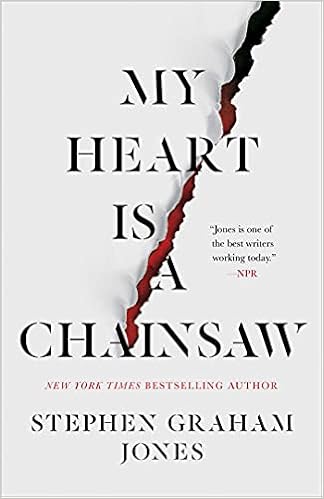
My Heart is a Chainsaw by Stephen Graham Jones

At some point this final girl has to realize that this is all about her, don't you think? That her friends and family and pets would all still be alive if this slasher had only STARTED with her instead of cutting his way closer and closer to her. So she feels guilty like maybe she's sort of the killer herself, like this bodycount is maybe HER bodycount.

What I'm saying here, sir, is that she's been groomed to become her secret and best self.

Jade Daniels is the biggest horror movie fan in all of Proofrock, Idaho. She's seen them all, from classics to modern takes to the obscure stuff you find in the bargain bin at the mall. She talks about nothing else, and that might be one of the reasons she doesn't have any friends. When unexplained killings begin to occur in Proofrock--first, a bunch of elk, and then a pair of Dutch tourists in the local lake--she decides that a "slasher" has begun, and it's her knowledge of the genre that makes her the only one who can see it.

At first, it seems like My Heart is a Chainsaw is about a traumatized girl who relies on a worldview derived from movies to keep the world sensible. There is a kind of poignancy to that idea: These movies have narratives of vengeance, of moral cause and effect, which promise that abusers--like Jade's neglectful father, perhaps--receive a taste of their own medicine tenfold. And they offer easily categorized labels of identity: the "Crazy Ralph" whom no one believes, the "final girl" who survives and defeats the slasher because she is the purest of heart. But in the end--spoiler alert--Jade's intuition proves to be correct; there is an evil force at work in Proofrock, and it's soon racking up a tremendous bodycount.

But Jade is mistaken about her role in the slasher to come. She latches onto a beautiful new student, Letha Mondragon, whose father is a tech mogul remaking the other side of the lake into a resort for millionaires. Letha's beauty and compassion convince Jade that she is the "final girl," and she devises a plan to train her for the coming onslaught by educating her in the patterns of horror movies. (That Letha is black, and horror movies are notoriously stingy about keeping black characters alive, seems to be a pattern that doesn't interest Jade or the novel in any serious way.) But when the climax of the movie/novel comes, it's of course Jade--not pure, not virginal, not popular or well-loved--who must "become her secret and best self."

I read Stephen Graham Jones' Ledfeather a couple years ago, a novel that I felt had a lot of quality writing and great ideas, but which was a little muddied and imbalanced. I had been looking forward to reading another of his books, hoping that the qualities that I admired so much would remain, and not the flaws, but I think the reverse is true: I actually feel bad about how much I disliked this book. For one, I didn't really like the slangy movie-teen voice, which works in the small doses of the interstitial "extra credit" papers Jade writes for her beloved history teacher about her slasher theories, but which is incredibly grating over 400 pages of third-person narrative. (One quick example: watching someone slide down a roof, she describes them as "Jesse Pinkmaning" down it. Blech.)

But mostly, the whole thing was just incredibly convoluted. From the beginning, we're told that Proofrock has three or four different creepy legends, including a "Lake Witch," a town that was drowned when the lake was dammed, and an old-time preacher who, I don't know, haunts them or something? Add to that several instances of remote trauma, like the murder of the sheriff's daughter before Jade was born. I couldn't keep any of it straight. There are maybe three dozen characters, most of them questionably necessary. The final 100 pages, in which Jade's premonition that Proofrock's July 4th celebration will be the slasher's bloody climax, are so intricately plotted I could not begin to summarize them.

If My Heart is a Chainsaw were a movie, it might have worked. We would have had visual cues that led us across the scene, from Jade's perspective in the water, to her father in a boat, to her love interest selflessly saving some children, to the suspected slasher creeping up with a machete, to Letha in a swan boat, to the ignorant townspeople about to get their jaws ripped off. But a book is not a movie. And that really explains much of why this book falls flat: it badly wants to be the kind of movie that Jade loves. But the jump scares don't jump or scare; the rush of escape leaves the reader behind; and Jade's constant interpolation, by which she filters everything that happens through her compendious slasher knowledge, totally deflects the kinds of emotions a real movie might inspire, like shock or fear. It doesn't work; it's just a mess. If you want to watch a slasher movie that's meta about its own structures, just go watch Scream instead.

Tuesday, December 17, 2019

Green Grass, Running Water by Thomas King

First Woman's garden.  That good woman makes a garden and she lives there with Ahdamn.  I don't know where he comes from.  Things like that happen, you know.

So there is that garden.  And there is First Woman and Ahdamn.  And everything is perfect.  And everything is beautiful.  And everything is boring.

So First Woman goes walking around with her head in the clouds, looking in the sky for things that are bent and need fixing.  So she doesn't see that tree.  So they bump into each other.

Pardon me, says that Tree, maybe you would like something to eat.

That would be nice, says First Woman, and all sorts of good things to eat fall out of that Tree.  Apples fall out.  Melons fall out.  Bananas fall out.  Hot dogs.  Fry bread, corn, potatoes.  Pizza.  Extra-crispy fried chicken.

Thank you, says First Woman, and she picks up all that food and brings it back to Ahdamn.


Four elderly Indians--like, hundreds of years old elderly--disappear from a hospital somewhere in the middle west of the United States.  They're on their way, it seems, to Alberta, where a cast of characters converges on the reserve town of Blossom: Lionel, a 40-year old man whose dreams had long been shattered by a series of anti-Native misfortunes; Charlie, grappling with his father's abandoning him to play stereotypical Indians in Hollywood; Alberta (yes, I know), who loves Lionel and Charlie but can't imagine either of them giving her the child she desires; Eli, Lionel's uncle, who has returned from a comfortable life in Toronto to reside in his mother's shack, preventing it from being destroyed by an already-built dam.  These characters are all Blackfoot Pikuni, Indians living out their lives with an uneasy relationship to their own Indian-ness.  The four elderly Houdinis bring them together to "fix" some small part of the world, meaning both the problem of the dam and the problems of these characters.

Along with this narrative, King gives four versions of Native creation myths.  Each features a different first-woman figure--First Woman, Changing Woman, Thought Woman, and Old Woman--each of whom is associated with one of the elderly Indians, who seem to be telling these stories along with the trickster Coyote.  These stories are satirical and syncretic; they pull together not only different indigenous traditions but also the Bible, Moby Dick, westerns, and other Anglo cultural staples.  (This may explain why the old men are named Lone Ranger, Ishmael, Robinson Crusoe, and Hawkeye.)  These stories are often clever and funny, riffing broadly on the allusions they mash together, and they are meant to represent an indigenous worldview imagining its own relationship to the land and community in the midst of interference from settler colonialism.

Green Grass, Running Water zips along so breathlessly that you almost miss the cleverness of the way the four old men bridge the real world and the mythical or legendary one.  It also enables you to miss the thinness of the "real" story, and how it struggles to come together in a way that feels satisfactory or complete.  The best of these stories belongs to Lionel, whose pratfalls and misfortunes seem like a slapstick version of an Erdrich character--I particularly liked the detail that, as a teenager, Lionel accidentally got put on a plane to Toronto by a hospital nurse thinking he was supposed to have a heart transplant rather than a tonsillectomy.  (Although the error was fixed in time, his "heart trouble" prevents him from finding meaningful employment!)  It's the right kind of humor: broad and genial but also somehow sharp and funny, and the novel could have used more of it.  I found that the tone of the creation stories, which feature Coyote endlessly quipping like Kimmy Gibbler, ultimately wore thin, and that the "real" narrative didn't supply enough to balance it out.