Showing posts with label Stephen Graham Jones. Show all posts

Saturday, January 22, 2022

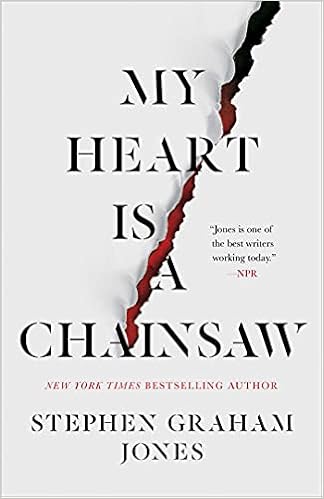
My Heart is a Chainsaw by Stephen Graham Jones

At some point this final girl has to realize that this is all about her, don't you think? That her friends and family and pets would all still be alive if this slasher had only STARTED with her instead of cutting his way closer and closer to her. So she feels guilty like maybe she's sort of the killer herself, like this bodycount is maybe HER bodycount.

What I'm saying here, sir, is that she's been groomed to become her secret and best self.

Jade Daniels is the biggest horror movie fan in all of Proofrock, Idaho. She's seen them all, from classics to modern takes to the obscure stuff you find in the bargain bin at the mall. She talks about nothing else, and that might be one of the reasons she doesn't have any friends. When unexplained killings begin to occur in Proofrock--first, a bunch of elk, and then a pair of Dutch tourists in the local lake--she decides that a "slasher" has begun, and it's her knowledge of the genre that makes her the only one who can see it.

At first, it seems like My Heart is a Chainsaw is about a traumatized girl who relies on a worldview derived from movies to keep the world sensible. There is a kind of poignancy to that idea: These movies have narratives of vengeance, of moral cause and effect, which promise that abusers--like Jade's neglectful father, perhaps--receive a taste of their own medicine tenfold. And they offer easily categorized labels of identity: the "Crazy Ralph" whom no one believes, the "final girl" who survives and defeats the slasher because she is the purest of heart. But in the end--spoiler alert--Jade's intuition proves to be correct; there is an evil force at work in Proofrock, and it's soon racking up a tremendous bodycount.

But Jade is mistaken about her role in the slasher to come. She latches onto a beautiful new student, Letha Mondragon, whose father is a tech mogul remaking the other side of the lake into a resort for millionaires. Letha's beauty and compassion convince Jade that she is the "final girl," and she devises a plan to train her for the coming onslaught by educating her in the patterns of horror movies. (That Letha is black, and horror movies are notoriously stingy about keeping black characters alive, seems to be a pattern that doesn't interest Jade or the novel in any serious way.) But when the climax of the movie/novel comes, it's of course Jade--not pure, not virginal, not popular or well-loved--who must "become her secret and best self."

I read Stephen Graham Jones' Ledfeather a couple years ago, a novel that I felt had a lot of quality writing and great ideas, but which was a little muddied and imbalanced. I had been looking forward to reading another of his books, hoping that the qualities that I admired so much would remain, and not the flaws, but I think the reverse is true: I actually feel bad about how much I disliked this book. For one, I didn't really like the slangy movie-teen voice, which works in the small doses of the interstitial "extra credit" papers Jade writes for her beloved history teacher about her slasher theories, but which is incredibly grating over 400 pages of third-person narrative. (One quick example: watching someone slide down a roof, she describes them as "Jesse Pinkmaning" down it. Blech.)

But mostly, the whole thing was just incredibly convoluted. From the beginning, we're told that Proofrock has three or four different creepy legends, including a "Lake Witch," a town that was drowned when the lake was dammed, and an old-time preacher who, I don't know, haunts them or something? Add to that several instances of remote trauma, like the murder of the sheriff's daughter before Jade was born. I couldn't keep any of it straight. There are maybe three dozen characters, most of them questionably necessary. The final 100 pages, in which Jade's premonition that Proofrock's July 4th celebration will be the slasher's bloody climax, are so intricately plotted I could not begin to summarize them.

If My Heart is a Chainsaw were a movie, it might have worked. We would have had visual cues that led us across the scene, from Jade's perspective in the water, to her father in a boat, to her love interest selflessly saving some children, to the suspected slasher creeping up with a machete, to Letha in a swan boat, to the ignorant townspeople about to get their jaws ripped off. But a book is not a movie. And that really explains much of why this book falls flat: it badly wants to be the kind of movie that Jade loves. But the jump scares don't jump or scare; the rush of escape leaves the reader behind; and Jade's constant interpolation, by which she filters everything that happens through her compendious slasher knowledge, totally deflects the kinds of emotions a real movie might inspire, like shock or fear. It doesn't work; it's just a mess. If you want to watch a slasher movie that's meta about its own structures, just go watch Scream instead.

Saturday, April 4, 2020

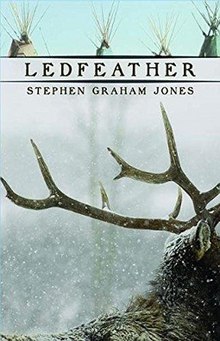
Ledfeather by Stephen Graham Jones

The only fitting sentence for his crimes would be to live as they did, as they had.  As an Indian.

It was why the girl he'd kissed up against the wall had black hair instead of blonde, and those perfect, heavier-than-the-world fingertips.

It was why he'd been remembering another's life.

It was his punishment, to become Blackfeet, to be Piegan.  To live on the reservation he'd created, the situation he was already leaving behind.  To replace his own life with an Indian one, and thus know firsthand the end result of his policies.  An end result generations away from last Winter, just so he could see the scope of what he'd done, that it still had a traceable effect.  So that, in a sense, he could be inflicting it upon himself.

Doby Saxon is a teenager living on the Blackfeet reservation that abuts Glacier National Park in Montana.  Doby is a down-and-out kid in a down-and-out place: he's missing three fingers from the time he and his father tried to poach elk from the park, and his father fell from his snowmobile and died.  He has a run of untold luck at a casino, then loses it all, and causes a violent scene that ends up putting his mother in jail.  He fails to save his friend from overdosing in a concrete tipi; he tries to kill himself in a hundred unsuccessful ways.

But Doby is also extraordinary: he discovers a cache of letters from a white Indian agent that lived on the reservation a century ago, and then begins to see the agent in visions.  Doby is torn between these two realities, and we come to learn that Doby might be the Indian agent himself, reborn as a Blackfeet Indian through a curse that condemns him to live as those he had a part in starving.

There's much to admire about Ledfeather.  It's a novel with one very good idea at its heart, but it's also a novel of terrific detail and writerly skill.  Unlike Moon of the Crusted Snow, which I bring up only because it seems to fit in the box of indigenous science fiction, though the context and community is much different, Ledfeather seems to understand that community life thrives in specifics.  Ledfeather, among other things, is a lovingly rendered version of what is often a difficult life on the Blackfeet reservation: it gives life to casinos, game wardens, schools, hospitals, chintzy little museums, basketball courts.

But I also have to admit that I found the whole thing extremely hard to follow.  Jones' novel has, if I'm counting correctly, at least four different narrative modes: 1.) first-person narratives by various people on the reservation about Doby, which ask us to piece together an understanding of him (these sections often refuse to identify clearly who the narrator is, in a way that seems self-consciously literary) 2.) the unsent letters of the Indian agent Francis Dalimpere to his wife Claire 3.) third-person accounts of the Indian agent flashing "forward" in time, 4.) second-person (!) accounts of Doby's life.  I could have managed maybe two of those, but not three, and certainly not four.  Ledfeather's not a long novel, but it just has one too many tricks up its sleeve, and I felt like some streamlining might have made it more readable.

As a result, I felt like the novel's many good ideas didn't land with enough emotional power for me.  And they are very good: I liked especially the novel's motif of self-sacrifice, which comes in both noble and misbegotten stripes.  One of the subplots of the modern narrative is that the local school's star basketball player has a terrible kidney disease, and young people from all over the reservation rush to commit suicide in order to give him their kidneys.  There's kind of grim, very grim, humor that works because it sits aside other kinds of sacrifice: the Indian agent's, for example, who first kills a herd of U.S.-owned cattle for the starving Blackfeet, knowing that he'll be put in prison, and then later "sacrifices" himself by becoming Doby Saxon.  Or Doby's mother, who goes to jail protecting her son in that casino fiasco.  These stories of self-sacrifice are linked by the image of the elk that Doby and his father go hunting:

The story, too, it was a joke mostly, like all of Earl's stories, was that one time an elk had found a white man lost and dying in the storm, and they'd talked to each other, and finally the elk, because it knew the man needed to live, to be warm, it took pity and laid on its side and let the man cut it open and crawl inside, and stay warm like that even though the snow piled up all around them for days and days and even years, only when the man finally crawled out again, everything was different, because that elk you crawl into, it's not the same one you crawl back out of, right?

In the end, Ledfeather is a hopeful kind of book, one that shows that nobility and selflessness are alive on the reservation, and that even has hope for white people, like Dalimpere, who think to make amends.  So much so that you might forgive it for asking a little too much of its readers.