Showing posts with label Christina Stead. Show all posts

Friday, October 11, 2024

The Little Hotel by Christina Stead

When Mrs. Trollope found that the bed was not for her, she went crying to her friend Madam Blaise. They were on good terms at that moment; and the next thing I knew was that Madame Blaise had moved her chaise lounge into Mrs. Trollope's room. I flew into a temper at that, and scolded them both. I was really furious. It's simple. To keep order in a hotel, everything must stay in the same place; and then there's the logic of equality. If one guest has new linen curtains, the other must have the best of the older curtains; if one guest has a plush new armchair, the other must have a cane lounge; if one has an extra table to write on, the other must have a footstool. I sometimes let Charlie fetch things from the attic or even from my own room to be sure of this equality; but I cannot allow others to make changes; I have a plan of it all in my mind.

Christina Stead's The Little Hotel is narrated by Madame Bonnard, the proprietor of an inexpensive hotel in the Swiss Alps. Her charges are more residents than guests, long term visitors who live the life of exiles. They are eccentrics, like the beautiful but dying Miss Chillard, or the wildly bigoted American Mrs. Powell. One madman claims to be the mayor of a city in Belgium; he sends Madame Bonnard and the other residents cryptic messages that are numbered as official documents for recordkeeping--Document 126 says that the coffee was particularly good this morning, etc., etc. I was a little sad to see the Mayor whisked out of the pages early on, to be replaced with characters whose eccentricities are a little more mtued.

Though narrated by Madame Bonnard, the true protagonist of The Little Hotel is Madame Trollope, an aging woman who is traveling with her "cousin," Mister Wilkins. In reality, the pair are longtime lovers, living more or less as husband and wife; though free of their former marriages, Mister Wilkins refuses to marry Madame Trollope or live openly as partners. He prefers the wink-wink artifice of it all, even though everyone at the hotel knows the deal. He also prefers to sponge off of the wealthier Madame Trollope, who, at the hotel, begins to lurch toward a breaking point. Is it possible for her to shake off Mister Wilkins, who really is a smug little creep, when she knows that the alternative is likely lifelong loneliness? What is the cost, The Little Hotel asks, of love?

The Little Hotel really has its charms. At times it approaches the heights of absurd misbehavior that make Stead's best novels so good, as when Madame Blaise complains about how her doctor husband pesters her with photos of diseased children--by producing a stack of the very same photos at dinner. Such is the world of The Little Hotel, where the residents revenge their own petty hurts and slights upon each other. There's something here about the nature of Europe after World War II; though they are nominally all supposed to get along--especially here in always-neutral Switzerland--the enmities of the American, British, and French residents toward Germans and Italians--form a powerful undercurrent. But the enmity that once sharpened the wits and feelings of Europeans no longer does; in fact, it seems to be an image of Europe slipping into a kind of bored senility, where resentments no longer have any national shape, but turn inward, toward the bedroom and the spirit. Or maybe I don't know what I'm talking about. More than anything else it seemed like a pleasant look into one of those communities where people are a little too close, and everybody would benefit from a nap or a nice walk. 

Wednesday, May 5, 2021

I'm Dying Laughing by Christina Stead

'Haw-haw-haw.' The house rang with her gigantic laughter. 'Ha-ha-ha, oh-hoho.' She got up and tried to walk about, 'Stephen -- oh-hoho, save me!' She fell on the bed and turned on her side trying to stifle her laughter. 'Haw-haw-haw, oh, my God, oh-ho-ho, I shall die!'

She sobbed, struggled, strangled, shouted, screamed with laughter, strong, immense laughter, it seemed, not hysterical, the great roaring of big lungs and a strong heart.

Stephen turned on the light and sat up. Her face was crimson, tears poured out of her eyes. Her bosom heaved convulsively. He said, 'Stop it! You'll have convulsions. Stop. Stop it!' He slapped her.

She stopped, still heaving, and sat up to glare ferociously at him, 'Don't you dare touch me. I'll kill you.'

Stephen Howard is a walking contradiction: a rich Communist. He has inherited his wealth from his mother, or perhaps only the prestige of wealth, given the tightness of her purse strings, and yet he wears the contradiction on his sleeve. It has made him both an intellectual and a hothead, that is, a writer. On a transatlantic crossing, he meets Emily Wilkes, a spirited young fellow traveler who grew up poor in Arkansas and has scraped her way to a journalistic career. Stephen is a scarecrow, sour and bony, like Cassius; Emily is fat and full of life, yet they complement each other perfectly. They are married immediately.

I'm Dying Laughing is the last book in a small challenge I set for myself to read Australian writers. But unlike those others, Stead seems never to write about Australia; her settings are cosmopolitan. I'm Dying Laughing follows Stephen and Emily from Los Angeles to Connecticut to France, where they run to escape the Puritanical American Communist Party, who cannot stand the way the Howards court heterodoxy whenever they run their mouths. One of the best set-pieces in the novel is an early chapter where the Howards' putative friends host a dinner party as a pretext for reading a soon-to-be-published denunciation of the couple, even going so far as to say they plan on petitioning the court against the Howards' custody of their daughter Olivia. I'm Dying Laughing is about what it was like to be a Communist intellectual in the post-war period, a label riddled with its own contradictions and doubly endangered--first by Party disciplinarians and then by the scourge of McCarthyism.

Most of the novel follows the couple in France, where they settle with their four children. In France Stephen and Emily court the friendship of continental Communists and former members of the French Resistance, and yet are hyper-aware of their own hypocrisy: they are unable to live within their means, spending like capitalists and talking like Communists. They are true believers, but unable to even consider what it might look like to turn talk into action. You never know how you'll react when the crisis hits and the fascists come to power, one Resistant tells them, but such is the dilemma of the post-war American Communists: prosperity means they'll never have to put their values into practice. Stephen goes in and out of favor as a writer of polemics; Emily has far more success as a humorist, writing Mencken- or Thurber-style novels with mutedly radial politics.

Emily longs to write a serious novel, but humor and bombast are her only natural modes. She is a voluminous talker--something like 95% of this novel is dialogue, dialogue, dialogue--and prone to flights of chatter that issue from her before her thoughts are complete, and we get to see her change her mind over and over in real time:

I don't want to live this way in the bright lights, going to the gilded palaces, unable to tolerate a waiter who's been eating sour cabbage, or a waitress who hasn't washed, unable to bear a hotel if the manager doesn't scrape to me, suffering if my girl doesn't change her dress twice a day. I don't want to be like that. I am like that. Why? Because I see the funny side, I'm a wise guy. I've got the angles. I know the score. How despicable! Money's filthy. It is filthy, Stephen. Don't look down your nose. And when you think that my humour, which is me, I admit, is really the way I see things, laugh at everyone, sneer at everyone's troubles -- I really am cruel. I often wake up in the night, Stephen, to think out what I am. I'm like a doll with two faces glued together. They used to have those. I disliked them. One back, one front.

In the three novels of Stead's I've read since since The Man Who Loved Children, Emily strikes me as the closest thing to the outrageous Sam Pollitt in that novel: like Sam, her eccentricities put her beyond reason and beyond accommodation. She is incisive, a skilled wordsmith, but prone to strange and unshakeable beliefs: one of the complaints made by the American Party hacks who ambush her is that she "thinks all birds are snakes." (She does think this, and says so repeatedly, probably misunderstanding the fact that all birds are descended from dinosaurs--while snakes are not.)

Stephen, too, is outrageous, but Emily's outrageousness outpaces and overwhelms him. One of the few moments that get close to the dysfunctional family horror of The Man Who Loved Children comes when Emily, having caused a miserable Stephen to temporarily flee, begins to obsess--romantically and/or sexually, I'm not sure which--over her adopted son, Christy. Only Stead could write a scene like that, where the dream of the nuclear family turns itself inside out, and becomes grotesque melodrama. Other people try, I guess, but nobody really does it like her. Nobody captures the way such horrors emerge, without or noticing, from the commonplaces of love and family.

The Man Who Loved Children is like watching a bunch of people on a train headed toward a crash everyone but the conductor can see coming. I'm Dying Laughing is also a tragedy, ineluctably led toward bloodshed, but it's not quite the same. It's more like a party you can't leave, a party where everyone's just a little too drunk, and you know it's only a matter of time before somebody does something to bring the good feelings to an end.

Thursday, October 1, 2020

Miss Herbert (The Suburban Wife) by Christina Stead

"Work, work," she muttered, "dear work, it is my lifeblood." She sat on the edge of her bed. "I must think this out. Yes, I am a woman first, a real female. I must have the experience of love, marriage, children. The lust for life has been my trouble; I have avoided the easy paths. I must marry and then life will be an open book, not chewed-over stories from magazines."

My favorite scene in Christina Stead's Miss Herbert comes at the very beginning. A young Eleanor Brent, along with her friends in a young women's club, are asked to name their first sexual experience. One woman describes kissing her stepbrother goodbye as he sails to Canada, another separating two mating beetles, which gave her a "horrid but hot feeling." (A penciled note in this used copy remarks: "That beetles all!") One woman describes a game called "Butcher's Shop" where she, as a three-year old, is undressed by her cousins who pretend she is a slab of meat and slip off imaginary chops with a stick. Not all of the examples are so outrageously pointed about the relationships between men and women, but they all do the trick, signifying that this is a book in which women's sexual and romantic feelings develop in ways that are stunted by the expectations of men.

Eleanor (Herbert is her mother's maiden name, which she'll take after her divorce) is free spirited as a young girl, experimenting in romance and sex with men by the dozens, even while a vaguely considered fiance strings her along for years. She enjoys these escapades, and the breathless style of the novel's early pages reflect the whirlwind of a youth well enjoyed, but the promise of marriage lingers in her future like a certainty. Eleanor, who is not flighty as these chapters might suggest, but hardworking and egalitarian, finds the same kind of joy in throwing herself into work: she's not above being a charwoman, but the work she loves best is writing. She has some minor success with a novel co-written by her father, but work always seems like a distraction from the real life of husband, house, and home, a promise which, for Eleanor, is never really actualized.

If The Man Who Loved Children is a fictionalized version of Stead's childhood, then Miss Herbert reads an awful lot like a fictionalized version of her adulthood. I don't think you have to know anything to pick up on it: the torturous life of a writer, her inability to break through the cloistered gates of the literary world, and the novel's general sagginess--it has that "this happened, then that happened" quality of fictionalized biographies--suggest it. But I did read that Stead herself married an Estonian-American man who changed his name from Blech to Blake, which must be the paradigm for Eleanor's husband Henry, who changes his name from Heinrich. Henry is the novel's best character: an embarrassed foreigner who transforms himself into a priggish Tory. He loathes Eleanor's egalitarian streak and is scandalized by her willingness to bring a cup of sugar to the neighbors, who are beneath him even though his wealth and theirs are by necessity equivalent.

He alienates himself from Eleanor, sending her and her children to live with her parents on their farm. While they're separated he carries on numerous affairs, but sends letter after letter blaming Eleanor for the breakup of their marriage, inventing new reasons she's made him unable to love her. Eleanor, for her part, is unable to chuck Henry once and for all, even though she is in other ways headstrong: her obsession with a happy marriage won't allow her to let him go. What might Eleanor have been, or been able to do, if she had been able to throw herself at the work she loved, rather than commit herself to a life she'd been told to want? These are old questions, and maybe obvious ones, but Stead brings a frenetic wit to them, and a recognition that the answers are always muddled, and that love is inextricable from the cultural pressure to love.

I thought that Miss Herbert covered a lot of ground covered better by Letty Fox, a bigger and more imaginative book. I wonder if Stead's own life didn't get into this one a little too much. With The Man Who Loved Children it shares an understanding of how people's most innate and selfish desires are sublimated into ideologies. Henry is one example: he creates out of his selfishness a whole worldview, an ideology about nationality, race, and masculinity that he uses to cudgel Eleanor over and over. But Eleanor, too, intellectualizes what Letty Fox calls "the tom-tom, the blood sacrifice, the human mystery." Why do we want marriage? Stead wonders--is it really what we long for, or is it a longing dressed up in a different guise?

Wednesday, August 2, 2017

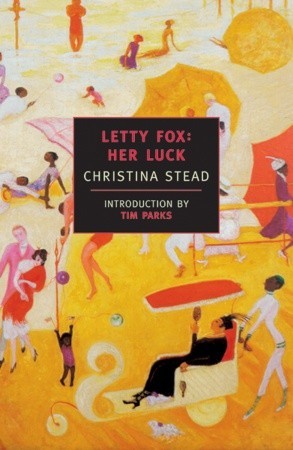
Letty Fox: Her Luck by Christina Stead

I got up, and the fever that raged through my body was intolerable.  Yes, this is the love that the nymphs knew on afternoons when Pan chased them, I thought, this is the meaning of all of those stories.  I thought I was passionate; now, I know what growing up is.  I thought, if it is going to be like this, this suffering and madness, I will kill myself now, for in the difficulty of getting married nowadays, and of getting a child, that cooling cold stone of a child, which stands in the hot belly and makes a woman heavy and tired, forgetting all her cruel fervors, that thing that drags her to the doors of the death house and away from the intolerable ardors of the sun, in this slow world, for women, I cannot live; I will kill myself.

Letty Fox wants nothing more than to get married and start a family.  She's not a shallow person, or one with a narrow view of the world, as you might expect from someone who has been planning their wedding since she was fourteen.  (In the "present" of the novel Letty is twenty-four, with ten years of frustration under her belt.)  That, in fact, is the seeming contradiction that makes her a compelling character: Letty is well-read, intelligent, independent, sexually free, and devoted to her "radical" causes, but she is also obsessed with marriage.  She enters into any number of love affairs, many with men who are already married (and some who claim they might not be, in the future), but marriage and motherhood continue to elude her:

It seemed to happen to others--most others; never to me, and I thought it very peculiar.  I couldn't figure it out; perhaps I was too young, anyway; but it savored to me of magic, and I felt very miserable that in this modern world something so primary, this first of all things to a woman, smacked so strongly of the tribal priest, the smoky cult, the tom-tom, the blood sacrifice, the hidden mystery.  It didn't seem fair.  We should have abolished all that with enlightenment.

Letty Fox is a hefty novel.  The back of the book calls it a "vast Flemish canvas of a novel," which is a great descriptor for the way that Stead peoples the pages of Letty's life with innumerable characters.  Hell, we're introduced to every single member of Letty's extended family, which must number in the dozens.  Some of these characters are vivid and entertaining, like her uncle Philip, who is a serial groom and a serial cheat, or her uncle Percival, who lives in a house in northern New Jersey called "The Wreck" that he's constantly renovating and changing, so that doors seem to appear and disappear at random.  Or a man with the excellent name of Gallant Stack, who seems to exist in the book for the express purpose of telling dirty jokes.  And her father, the charismatic Solander Fox, who lives with his mistress Persia throughout Letty's childhood, refusing to return to Letty's beleaguered mother Mathilde (not so far from the beleaguered mother of The Man Who Loved Children.)

But I admit I had a lot of trouble keeping track of Letty's different lovers, a collection of millionaires, Dutch statesmen, British socialists, distant cousins (blech), and various neurotics and philanderers.  Of course, Letty can't seem to always keep them apart either.  I also had the same problem with Letty's two grandmothers--which one is the sickly one, terrified of death, and which is the one who seems to gather male admirers with age?  But the scope of the novel is so wide--it's hard to imagine that anything was left on the cutting room floor of this six-hundred page novel--that the strongest observations, and the most comic episodes, get easily lost among the rest.  Although I really liked a lot of the humor in Letty's dysfunctional childhood, in which she's shuttled back and forth between the US and Europe by her selfish parents and extended family members, it's a lot to get through en route to the marriage-madness that provides the book's central conflict.

The biggest disappointment of the novel, though, was one I expected: it never approaches the sublime weirdness and grotesqueness of The Man Who Loved Children.  No doubt that's because a lot of what happened in that novel happened to be true, as it was inspired by Stead's own eccentric father.  But I got the sense that a lot of what got left out of the depiction of David Stead in The Man Who Loved Children made it into Letty Fox.  As Letty says, "I don't know what imagination is, if not an unpruned, tangled kind of memory."

Sunday, July 10, 2016

The Man Who Loved Children by Christina Stead

He himself, Sam, had had the pleasure of being a father, five times already, and imagine the joy when he found that at one birth he had twins!  He could never have it enough.  Each time, he explained to Naden, he felt an immense pride, a belief in a limitless future, in an unfolding universe, a hope for the proliferating human race in that shadow of dust, and infinitesimal corner of dimensionless space, even so.

Oh, man.  Some books are just sui generis--completely in their own category, impossible to ever reproduce, even by the same author.  I can't imagine even Christina Stead writing another book like The Man Who Loved Children.  How could she?  The family that she writes about--a fictionalized version of her own, you're horrified to find out--is so unique and irreproducible that it can only exist once.  It's like Tolstoy's thesis that "every unhappy family is unhappy in its own way," expounded on for 500 pages.

The title character is Sam Pollitt, a low-level bureaucrat in the Fisheries Department of some division of the federal government.  Sam is a classic early-20th century Progressive Rationalist, full of far-flung ideas about the future and mankind, a patronizing attitude toward foreign races and a keenness for eugenics.  Sam loves children, especially his own, and sees them as an extension of his own fine feelings about humanity.  He has a private language with them, a mish-mash of pet names and baby-talk:

'Bring up your tea, Looloo-girl: I'm sick, hot head, nedache [headache]; dot pagans in my stumjack [got pains in my stomach]: want my little fambly around me this morning.  We'll have a corroboree afterwards when I get better.  Mother will make the porridge.'  He was begging her, yearning after her.

This stuff is hard to read, even when Stead gives bracketed translations; but it seems true to life.  All books teach you how to read them, but The Man Who Loved Children requires you to study really hard.  ("Corroboree," by the way, gives away the Australian Stead's scrupulous Americanizing of her own father.)  Sam's child-language, and his childish behavior--indifference toward money, even when it's short, his selfishness and laziness--drive his wife Henrietta to madness.  He calls hims "Sam-the-Bold," she calls him "The Great-I-Am."  For most of the book, they are not on speaking terms, except to shout and claw at each other violently:

As Henny sat before her teacup and the steam rose from it and the treacherous foam gathered, uncollectible round its edge, the thousand storms of her confined life would rise up before here, thinner illusions on the steam.  She did not laugh at the words 'a storm in a teacup.'  Some raucous, cruel words about five cents misspent were as serious in a woman's life as a debate on war appropriations in Congress: all the civil war of ten years roared into their smoky words when they shrieked, maddened, at each other; all the snakes of hate hissed.

And if these two powerful characters weren't enough, Stead adds a third in the child Louisa, or Louie, Sam's daughter from a previous marriage.  Louie is a dark and troubled genius, literary where her father is scientific, gloomy where her father is sanguine, and sensitive to the dismay of others, like Henrietta, when Sam blithely ignores them.

Sam's love for his children is really a kind of narcissism.  He loves them to the extent that they are reflections of himself, and when they fail to live up to his fantastic ideals his fine feeling turn to cruelty.  This happens over and over, in scenes that are funny, grotesque, and vivid.  Louie writes a play in a made-up language called Tragos: Herpes Rom (Tragedy: The Snake-Man) and has the children perform it for her father, with the aid of a translation.  ("Did Euripides write in English?" she asks).  The play is about a father who wants to hug his daughter, but she feels threatened by his constrictor-like embrace, and refuses.  Louie wants desperately to show her father how he mistreats her, and with the play Stead shows cannily how we crave the approval of our parents even as we want to overthrow them.  But Sam cannot hear this, he only sees feminine silliness: "I did not expect you to be so silly," he says, "you were the child of a great love... I never heard so much idiotic drivel in my born days.  Go and put your fat head under the shower."  When another of his sons complains that the smell of the fish they have been boiling for oil is making him sick, Sam forces him to carry the fish's rotting remains to the shed piece-by-piece while he vomits over and over again.

The novel has the downward-hurtling trajectory of a great tragedy.  Halfway through the book, scandal forces Sam out of his job at the Fisheries Department, and he refuses to recognize evil by responding to the accusations.  His idealism forces them into a rundown shack in Annapolis, where they live in increasing squalor and tension.  Henrietta is forced to steal money from her own children to make ends meet, while Sam prattles about the nobility of poverty, until his own petty wants are not addressed:

Sam flushed with anger.  'Why aren't there any bananas?  I don't ask for much.  I work to make the Home Beautiful for one and all, and I don't even get bananas.  Everyone knows I like bananas.  If your mother won't get them, why don't some of you?  Why doesn't anyone think of poor little Dad?'  He continued, looking in a most pathetic way round, at the abashed children, 'It isn't much.  I give you kids a house and a wonderful playground of nature and fish and marlin and everything, and I can't even get a little banana.  And bananas are very healthy.  Who here likes bananas?'

Such selfishness is hard to believe.  And yet, Stead makes us believe it: Sam, Henny, and Louisa are each in their own way fully bizarre, but they are believable in every respect.  Making the absurd seem plausible is one of a writer's great achievements, I think.  At the same time, Sam is not wholly unsympathetic: perhaps he cannot help his ignorance, can never see that his daughter hates him and his household is falling apart; maybe his own private idealistic universe is just too powerful.

When the novel comes to its expected tragic and and grisly end, it seems almost too commonplace.  The Man Who Loved Children is so bizarre, so awful, so fantastical, that there is a double sadness in the ordinariness of its tragic climax.

The Man Who Loved Children is one of those books that was a financial and critical failure when it came out, only to have its reputation resurrected by a single fan, in this case, the poet Randall Jarrell, although Jonathan Franzen has also written about his love for the novel.  In his introduction, Jarrell compares it to Moby Dick, another novel that was unloved at its publication.  And there's something Moby Dick-esque in the fullness and variability of Stead's prose, though that's not the way that Jarrell meant it.  In truth, I can think of very few people that I would recommend this to.  It requires a lot of patience and thick nerves.  The kind of reader who complains about characters not being "relatable" should steer clear.  But for a certain kind of person, this is an unforgettable book.