Showing posts with label homosexuality. Show all posts

Monday, December 21, 2015

Reflections in a Golden Eye by Carson McCullers

'You mean,' Captain Penderton said, 'that any fulfillment obtained at the expense of normalcy is wrong, and should not be allowed to bring happiness.  In short, it is better, because it is morally honorable, for the square peg to keep scraping about the round hole rather than to discover and use the unorthodox square that would fit it?'

'Why, you put it exactly right,' the Major said.  'Don't you agree with me?'

'No,' said the Captain, after a short pause.  With gruesome vividness the Captain suddenly looked into his soul and saw himself.  For once he did not see himself as others saw him; there came to him a distorted doll-like image, mean of countenance and grotesque in form.  The Captain dwelt on this vision without compassion.  He accepted it with neither alteration nor excuse.

The comparison I reached for immediately while reading Carson McCullers' Reflections in a Golden Eye is the "four-square house" of The Good Soldier, which comes tumbling down when John Dowell realizes that his wife and best friend have been carrying on an affair for years.  But the "four-square house" of Reflections in a Golden Eye is rotten and termite-ridden to the core: its four pillars--two officers and their wives on a Southern army base during peacetime--already aware of the affair going on among them, and seething with loathing.  McCullers transforms Edwardian reserve and gentility into Southern Gothic, in which things like this happen:

They had been sitting like this late one night when suddenly Mrs. Langdon, who had a high temperature, left the room and ran over to her own house.  The Major did not follow her immediately, as he was comfortably stupefied with whiskey.  Then later Anacleto, the Langdons' Filipino servant, rushed wailing into the room with such a wild-eyed face that they followed him without a word.  They found Mrs. Langdon unconscious and she had cut off the tender nipples of her breasts with the garden shears.

Damn, Mrs. Langdon!  Mrs. Langdon--Alison--is the sensitive and sickly wife of Major Langdon, who is having an affair with the wife of his superior officer, Captain Penderton.  Leonora Penderton (hey--the same name as in The Good Soldier) is oversexed and frustrated by her marriage to the cold, aloof Captain, who seems mostly indifferent to his wife's affair.  Into this volatile group, McCullers adds a fifth--a private named Williams who sneaks into Mrs. Pendleton's room every night to watch her sleep, in the nude.

Williams is something of an enigma--he rarely speaks, and has no friends or close associates.  McCullers depicts him as a "natural," an idiot more at home in the woods than in the order of the barracks.  The Captain obsesses over Williams, whose inscrutability is both threatening and mysterious.  One scholar called Reflections in a Golden Eye one of the great "gay novels," and I admit that I missed the latent homosexuality suggested by the Captain's obsession.  What was clear was the fine line between loving and loathing; the Captain's boiling hatred for Pvt. Williams is closer to real love than anything else in the novel, except perhaps for the relationship between Alison Langdon and her flamboyant servant Anacleto.

McCullers is one of the great novelists of the outsider, the marginalized figure.  Even when she gives us a character with great status and power, like the Captain, she manages to find the deep secret within that puts him at the margins.  She has the same kind of sympathy for Alison Langdon in her sickbed, and even the bitterly objectified and lonely Mrs. Penderton.  The novel's most vivid and realized character, Anacleto, is an outsider twice over: a servant and a foreigner, clinging desperately and slavishly to Mrs. Langdon.  Yet, he professes the kind of bravado and eccentricity that only a marginalized figure can; he's made in the mold of the deaf hedonist Antonapoulos from The Heart is a Lonely Hunter.  McCullers' contempt, on the other hand, is saved for figures like Major Langdon, whose banality and conformity are far greater crimes than his infidelity.

As a closeted homosexual--if that's the best term for him--the Captain is shoved to the margins even of his own consciousness until that image comes to him, "distorted" and "doll-like."  Private Williams, so far outside the realm of human activity that not even McCullers seems to understand or comprehend him, threatens the teetering social stability of these four even without their knowledge.  It's no surprise when the novel, which hums with barely suppressed menace, erupts finally into grand violence.  McCullers wrote in The Heart is a Lonely Hunter that "violence is the most precious flower of poverty"; but she was too often aware of the many ways, poverty besides, people are forced into invisibility and indignity.

Saturday, December 12, 2015

Fun Home by Alison Bechdel


Alison Bechdel's memoir Fun Home must be one of the most lauded graphic novels of all time, and with good reason: it's incredibly complex and incredibly moving.  I resisted the urge to add "for a graphic novel" to the end of that last sentence, because I think that it stands on its own as a piece of great literature, rather than relative to the quality of graphic novels in general.  In fact, Fun Home seems vital in a way that very few novels from the last ten years really can claim.

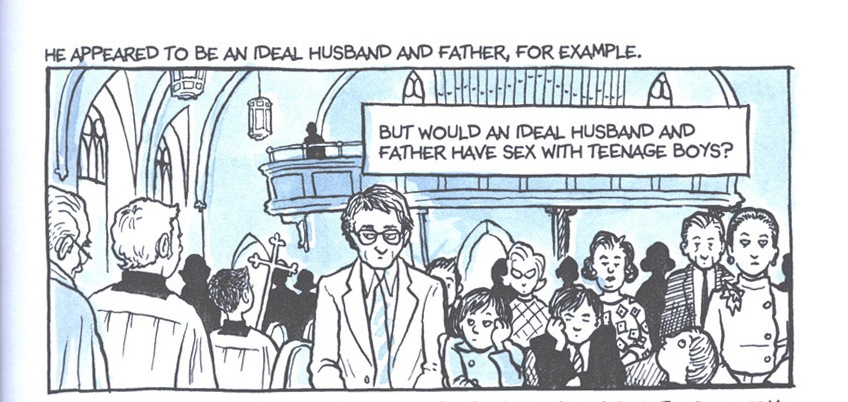
Bechdel's memoir describes her experience coming out as a lesbian, while at the same time learning that her father had been having affairs with men for decades.  He dies, hit by a car, shortly after these revelations.  Bechdel wonders in Fun Home if he stepped in front of the car intentionally, but there's no way to be sure, and she must grapple with the pain of that uncertainty.  Either way, his death is the catalyst for the novel, which seeks to do the work of reconciliation and understanding that her father's absence made impossible to do face-to-face.

One thing that surprised me about Fun Home was how literary it was.  Bechdel's father was an English teacher (in addition to running the funeral home which gives the novel its title), and Bechdel turns to numerous literary sources in search of a narrative that will make her relationship with her father meaningful.  Camus, Fitzgerald, Proust, Joyce, and Wilde all make appearances.  But these narratives never seem to quite be enough to help Bechdel pin her father down in a way that provides consolation or closure.  The choice to write the memoir as a graphic novel seems significant in this way, as an attempt to break with the insufficient narratives of the past and make something new--without abandoning or dismissing the authors of the past.


That's a really academic way of looking at it, I guess.  But essentially, Fun Home is a very human, very moving story.  Bechdel's relationship with her parents is very troubled--she describes her father as cold and aloof for most of her life--and as soon as it looks like they might have something to bring them together, he dies.  As beautiful a story as it is, there's a fundamental and ineradicable sadness about the impossibility of recovering that lost opportunity.

Thursday, June 20, 2013

Maurice by E. M. Forster

The ugliness of the interview overcame him.  It was like being back on the train.  He wept at the hideousness into which he had been forced, he who had meant to tell no one but Clive.  Unable to say the right words, he muttered, "It's about women--"

Dr Barry leapt to a conclusion--indeed he had been there ever since they spoke in the hall.  He had had a touch of trouble himself when young, which made him sympathetic about it.  "We'll soon fix that up," he said.

Maurice stopped his tears before more than a few had issued, and felt the rest piled in an agonizing bar across his brain.  "Oh, fix me for God's sake," he said, and sank into a chair, arms haning.  "I'm close on done for."

Maurice Hall is the quintessential Englishman--wealthy and from good stock, but not ostentatiously so, good-looking, pragmatic, sociable, neither too smart nor too dull, skilled with money.  The quintessential Englishman, except in one way: he is a homosexual.

Maurice (that's pronounced "Morris,"  by the way) discovers this fact at Cambridge, where an intimate friend named Clive Durham confesses his love to him.  Though Maurice has a deeply buried attraction to Clive, his first instinct is utter repulsion, and his response is both funny and horribly sad:

Durham could not wait.  People were all around them, but with eyes that had gone intensely blue he whispered, "I love you."

Maurice was scandalized, horrified.  He was shocked to the bottom of his suburban soul, and exclaimed, "Oh, rot!"  The words, the manner, were out of him before he could recall them.  "Durham, you're an englishman.  I'm another.  Don't talk nonsense.  I'm not offended, because I know you don't mean it, but it's the only subject absolutely beyond the limit as you know, it's the worst crime in the calendar, and you must never mention it again.  Durham! a rotten notion really--"

Later, Maurice will realize that he feels about Clive exactly the way Clive feels about him, and the two begin an illicit, long-lasting affair.  When Clive breaks it off, however--claiming suddenly to have switched to loving women--Maurice, alone, with a secret pain that cannot be mentioned, much less "cured," enters into a long period of agony, seeking but failing to find relief from doctors and hypnotherapists.

Forster famously wrote a note on the manuscript of Maurice that read, "Publishable--but worth it?"  And in fact, the novel, finished in 1914, was not published until 1971.  It's not hard to see why; Maurice remains a remarkable book in its treatment of homosexuality even today.  In 1914 a book merely about homosexuality must have been controversial; in 2013, what feels bold about Maurice is its claim that homosexuality makes its protagonist a better person.  Until he returns Clive's love, Maurice barely knows himself; embracing his sexuality makes him both aware and whole.  Toward the end of the book, Maurice takes up with a servant named Alec; it is his homosexuality, the "unspeakable" nature of it, even, that enables Maurice to connect with another human being outside of the narrowly prescribed social limits in which he resides.  It seems to me that this is a far cry from any narrative about homosexuality in our era, which seems to insist that it is either a deviance or an irrelevance to self-identity.

The relationships Maurice shares with Clive and Alec are depicted with frankness and convincing sentimentality.  I was somewhat surprised to find that, as a heterosexual reader, I felt as invested in these relationships as with, say, Lucy Honeychurch and George Emerson.  But the most affecting--and perhaps true to Forster's own life--part of the novel for me was the Maurice's mental torture, which seemed a kind of awful prison.  What would the reading public have thought about that in 1914?  It's tempting to think of Maurice as an artifact of a larger gay rights movement that won't really get started for another 50 years (the Stonewall Riots were two years old when Maurice was published) but it's a story, not a polemic.  It is, in fact, a very old story, about the conflict between the individual and a society that cannot accomodate him.  The novel's strength is in its solitariness, the impression that the book, like its protagonist, asks only for a little space in the world in which to be.

Sunday, August 22, 2010

The Perks of Being a Wallflower by Stephen Chbosky

Dear friend,

I wanted to tell you about us running. There was this beautiful sunset. And there was this hill. The hill up to the eighteenth green where Patrick and I spit wine from laughing. And just a few ours before, Sam and Patrick and everyone I love and know had their last day of high school ever. And I was happy because they were happy. My sister even let me hug her in the hallway. Congratulations was the word of the day. So, Sam and Patrick and I went to the Big Boy and smoked cigarettes. Then, we went walking, waiting for it to be time to go to
Rocky Horror. And we were talking about things that seemed important at the time. And we were looking up that hill. And then Patrick started running after the sunset. And Sam immediately followed him. And I saw them in silhouette. Running after the sun. Then, I started running. And everything was as good as it could be.

Despite what USA Today would have you believe, The Perks of Being a Wallflower is not Catcher in the Rye. I've never read A Separate Peace, but I'm pretty sure it's not that either. But it isn't fair for us to ask it to be, when it does pretty well on its own terms.

Perks is written in the form of a series of letters written by Charlie, a freshman in high school, to an anonymous "friend" he has never met. Charlie is a fairly typical protagonist for a coming-of-age story: Shy, sort of nerdy, and quite sensitive--god, it seems like he cries every other page--but also removed from other people and not prone to "participate". Almost despite himself, Charlie ends up befriending a pair of seniors, Patrick and Sam, outsiders and nonconformists who help to pull him out of his shell.

There is no real central conflict, but a series of unrelated plot threads, some of which end up being pretty underwritten: The young first-year English teacher who encourages Charlie to read great books. Patrick's secret affair with the high school quarterback. Charlie's crush on Sam (who is a girl). Having to deal with his best friend's suicide (this one in particular is half-baked). Charlie learning about drugs, and taking up smoking. Learning about masturbation, and then sex. His sister's secret abortion. The memory of his aunt's death in a car crash some years before. Mixtapes. There are a lot of mixtapes.

But you know what? All of that adds up to something that, if it doesn't reflect what it is to be 14, it reflects something quite incisive about the imagination of 14-year-olds. I've never quite been comfortable with the way people identify with Holden Caulfield, partially because I don't think Holden would quite want people to identify with him. But Charlie is a character overwhelmed by his own passions and sensitivity toward others, and draws readers quite easily into himself. He isn't as abiding a character as Holden is--because Perks is not literature on the same plane as Catcher--but I'll be damned if he doesn't deserve that sort of attachment more.

This was the summer reading for the students I'll be teaching in tenth grade next year. Teaching Perks is a dicey proposition because of the sexual content, and especially because of the explicit homosexuality in it. I wouldn't be surprised to get a few complaints from parents. But I think that, for the students--most of whom have a deep revulsion toward homosexuality--it will end up being something that resonates strongly with them.

Here is Christine's perspective.

Saturday, December 13, 2008

The Realm of Possibility by David Levithan


"Here's what I know about the realm of possibility-/it is always expanding, it is never what you think/it is. Everything around us was once deemed/impossible. From the airplane overhead to/the phones in our pocket to the choir girl/putting her arm around the metal head./As har as it is for us to see sometimes, we all exist/within the realm of possibility. Most of the limits/are of our own world's devising. And yet/every day we each do so many things/that were once impossible to us."

There seems to be a recent outbreak of YA fiction novels being written entirely in poetry, because like the Sones book I reviewed not too long ago, there isn't any prose to be found here, either. Levithan has created twenty different complex and believable high school students with interconnected story lines who each offer us up just one poem to summarize their situation. What I think was the most interesting about the way that the book was put together was the success with which Levithan carefully crafted the poems so that the style of each would match the fictional author's voice and personality. It's easy enough to create different characters, sure, but to each give them a different style of writing without any overlaps is another story all together. It goes without saying that in some of these poems work better than others.

My favorite of all the poems involved one of the squares (involved in Honor Club, Quiz Bowl, etc.) buying marijuana for her mother who was undergoing chemotherapy and then watching her mother laugh for the first time in ages and turn the music up so that she could get out of bed to dance. The poem continues on to the next day where the dealer offers her more pot and she declines saying she can't afford it and he insists she take it anyway, without saying too much letting her know that he knows it isn't for her and what it's for, thus challenging her assumptions about him through his strange show of kindness. One of the more amusing poems was written about how someone felt he was losing his girlfriend to Holden Caulfield, because after reading The Catcher in The Rye about a thousand times she decided that everyone, including him, was a phony that could not be trusted. I think at some point or other every book nerd falls hard for the ideology of one of their favorite authors or fictional characters but I don't know anyone that goes around lecturing others about it. (I'm partial to Atwood girl, myself.)

I wasn't wild over The Realm of Possibility but I think it did a great job of exploring a very diverse group of students--from the choir girl to the goth to the gay couple to the anorexic girl to the school jock that seems to have it all together to the angry goth chick writing things like "YOU ARE IMPLICATED" and "YOU ARE FOOLISH IN YOUR UNHAPPINESS" over lockers and desks throughout the school.

The most frustrating thing about the book is that it isn't organized very well and it's often hard to tell who is speaking due to the structure Levithan employs. It is divided into five different sections and each section has a page that has the names of the characters who are in that section in the order that they appear, but their names are not anywhere to be found on the poems themselves, so I had to keep flipping backwards to figure out what was going on.

Thursday, March 22, 2007

The Line of Beauty by Alan Hollinghurst

I lied earlier; Ishiguro's Never Let Me Go was only a Booker Prize finalist. Alan Hollinghurst's The Line of Beauty is a Booker Prize winner, though.

It tells the story of Nick Guest, a homosexual man taken in as a lodger by the family of his university friend Toby, whose father was recently elected as an MP in the Tory landslide that accompanied Margaret Thatcher's rise to power. That's pretty much what this book is about: being gay in Britain in the 1980's. Nick is forced to pursue his affairs in secret, though the entire family is basically aware he's gay. In the final section of the book, Nick's sexuality becomes tangled up in connection with an insider trading scandal that threatens the job of the MP Gerald .

That last section is actually quite heartbreaking, as Nick deals with unpleasantly becoming the center of attention and becoming a persona non grata in the household (his surname Guest is a thinly disguised metaphor), while having to endure with the long demise of his former lover due to AIDs. However, that's only about 100 pages out of a 450 page book, the bulk of which are really quite dull. Nick is a rather shallow character who has a lot to say about Henry James and Rachmaninov and what have you, but he lacks such depth that he's a very difficult character to like. The first 350 pages of this book is little more than fancy parties, social hobnobbing, summering in France, and the occasional line of cocaine--you can read pages and pages without ever being convinced that anything has actually happened.

Maybe that's the point: until AIDs and scandal put his lifestyle under the harsh social spotlight, Nick's obsessions are quite trivial. I can understand the metaphorical purpose of being lulled into a false sense of security in the dizzying word of the socialite to only have the rug pulled out under Nick, but that really doesn't excuse this book from being excruciatingly dull.