Showing posts with label Japan. Show all posts

Saturday, May 30, 2026

All the Lovers in the Night by Mieko Kawakami

In the sound of the shower or the tub, in the spray of water on the dishes in the sink, I heard the words that Mitsutsuka and I had shared, as well as all the words that we were yet to share. We'd only met up a handful of times, which made it harder to understand how I could feel like this. I didn't know the first thing about him. I couldn't even see inside my feelings far enough to know what they meant. Over and over, i asked myself if this had all been some kind of mistake. If I sat down with a cup of sake and thought about how weird it was that I spent so much time thinking about someone I didn't even know, I just wound up thinking about him anyway. I thought about him all the time.

Mieko Kawakami's All the Lovers in the Night is about Fuyuko, a young fact-checker who lives a lonely and isolated life. She's awkward around others, and doesn't make friends easily. In fact, they mostly have to make her: first Hijiri, the brash editor who encourages Fuyuko to go freelance, and introduces her to alcohol for the first time. Then there's Mitsutsuka, an unassuming older high school science teacher whose life collides with Fuyuko's when, plastered and investigating taking courses at a local college, she ends up puking everywhere. (Fuyuko's alcoholism, unwittingly provoked by Hijiri, is a major theme in the novel.) Mitsutsuka is kind, shy, reserved--exactly the kind of person, one thinks, that might pull Fuyuko out of her funk. Her feelings for him are identifiable to us as romantic, but with her diminished experience, she struggles to make sense of them, fleeing into drink or just plain fleeing.

In the center of the book, Kawakami places a flashback that explains everything we need to know about Fuyuko. She recounts how, in high school, a seemingly gentle and thoughtful boy cast his attentions on her, calling her once a week on the phone. But the first time this boy invited Fuyuko to his house, he ends up raping her and then cruelly dismissing her. Kawakami describes this scene with a painful clarity that is difficult to read. But it's clear we're meant to see this as something as a key to Fuyuko's adult strangeness: how can she reach out to others, when doing so leads to such cruel disasters? Other than this scene, All the Lovers in the Night is a quiet and uneventful book, only as big in scope as Fuyuko's shrunken life. The three central figures are well drawn, and I especially liked the ambiguity of the character of Hijiri, whose social prodding of Fuyuko is somehow both supportive and menacing at the same time; a scene where Hijiri gives Fuyuko her old designer clothes, and Fuyuko looks at her new self in the mirror, was especially effective, when it might have been obvious.

One thing that struck me when I read this, and thinking back to Kawakami's book Heaven, about a boy who is cruelly bullied, is that she shares a lot of qualities with once and future it-girl Otessa Moshfegh. The protagonist here reminds me of the heroines of books like Eileen and My Year of Rest and Relaxation, recluses who shun, or are shunned by, a wider world in which they feel unable to operate. Kawakami's book is much quieter, even compared to Heaven there's nothing really here that's shocking or lurid. That compares favorably to Moshfegh, I think, even as I think the book itself will end up being not quite memorable. 

Saturday, February 21, 2026

The Ten Loves of Nishino by Hiromi Kawakami

It takes about half a year to reach this "final conclusion," Nishino said with a laugh. It's like the laws of physics. Why is it that, eventually, all girls end up adhering to the same formula in their response, no matter whether they are chubby or skinny, laid-back or uptight, conventionally beautiful or idiosyncratically striking, pescatarians or red-blooded meat-lovers? Nishino inclined his head in wonder.

"Nishino, do you really believe that all girls are exactly the same?" I asked.

"I could be wrong," Nishino said leisurely. "All the girls I've ever known, at least, they've all been the same, down to the last."

Well, then, the girls you date must all be pretty boring, I thought fleetingly, but I immediately regretted feeling mean toward all the girls Nishino had dated whom I had never laid eyes on.

Hiromi Kawakami's The Ten Loves of Nishino collects ten stories, all about, or related to, women that have been the lover of Nishino. The women range in ages, professions, attitudes, etc. Nishino himself something of a mystery, a little bit aloof and hard to pin down. The stories, when taken together, only give one oblique views of Nishino, who never has the opportunity to speak for himself like the women do. But overall, there is a sense of someone who is magnetic and charismatic, but difficult to read, and someone to whom love, in its permanent marriage state, never seems able to attach. Like the women of the story, Nishino struggles with a single question over and over again: Am I really in love? Or do I just think I am? And if I'm in love now, when will I fall out of it? Or have I already?

Real love is the big theme of The Ten Loves of Nishino. I found this interesting, but perplexing: is "love," in its romantic comedy aspect, being satirized or undermined here? How interesting or meaningful, exactly, are we meant to take this question? My favorite of the narrators was Manami of "Good Night," who is not a lover of Nishino but another man named Yukihiko, who undermines her own relationship by insisting that Yukihiko has fallen out of love with her, until she ultimately persuades him of the same truth. This felt like a familiar story: a pair of people who end up convincing each other, by way of themselves, that a relationship couild never work out. But I do have to admit that when Nishino said that all women end up the same, I agree with him--at least in the context of the stories, where the women began to bleed together and get mixed up for me.

The most interesting thing about The Ten Loves of Nishino is what I least know what to do with: one of the narrators describes seeing Nishino as a young boy, suckling at his own sister's breast. He explains that she had recently given birth to a baby that died, and that in her mental distress she turns to him to relieve the horrible pain of her breasts filled with milk. "Are you in love with your sister?" one of the lovers ask, but we can see that whatever kind of love Nishino bears his sister is more difficult and more complex than the rom-com love he bears toward these women, less easily categorized and thus less easily understood. This quasi-oedipal relationship lies in the background of all Nishino's failed relationships, but how much it explains is entirely unclear.

Friday, February 28, 2025

The Setting Sun by Osamu Dazai

There was something wrong about these people. But perhaps, just as it is true of my love, they could not go on living except in the way that they do. If it is true that man, once born into the world, must somehow live out his life, perhaps the appearance that people make in order to go through with it, even if it is as ugly as their appearance, should not be despised. To be alive. To be alive. An intolerably immense undertaking before which one can only gasp in apprehension.

Japan, just after the end of the second World War. Kazuko is a young aristocrat in a world where the aristocracy has lost all meaning and prestige. Her father has recently collapsed and died, and her mother is increasingly ill. They are forced to move from Tokyo to the countryside, as if disappearing into the  wilderness. Her mother, though she retains in Kazuko's eyes the qualities of bearing and gentility that once marked the upper classes, seems to belong to yesterday's world, and her illness is a token of that world's vanishing. Meanwhile, her brother Naoji--their mother's favorite--reacts to the diminishment of the family's prestige by getting into alcohol and drugs. It's not that they are ashamed, really, only that each of them--Kazuko, mother, Naoji--feels increasingly ancillary in this Japan, which is already itself so transformed and diminished from what it had been.

Kazuko clings to her mother, desperate to keep the family intact as well as she can. At the same time, she has become obsessed with a dissolute artist and friend of her brother's named Uehara. Uehara is from another class entirely, and her relation to him is not so different from Naoji's; both attach themselves to the world that Uehara represents because they want to flee their own. More accurately, perhaps, Kazuko wishes to betray her class; by choosing Uehara, she turns her back on a life that only promises for her further vanishing and death. Her letters to Uehara go mostly unanswered until she hunts him down and spends a wholly unsatisfying, even repulsive, night with him. In her letters, she calls him "M. C."--my child, my comedian, even my Chekhov. Interestingly, Kazuko's cultural references all seem to be quite Western. She loves Chekhov and Shakespeare; she knows her Bible inside and out. Is it a sign of outwardness, of the noble class searching outside the world that has given it power and prestige for an intact culture? Or is it a sign of a cultural exchange that belongs to an older period, and was obliterated by the rise of Japanese nationalism and the war?

When--spoiler alert--Kazuko's mother dies of tuberculosis, everything falls apart. Naoji commits suicide, writing to Kazuko that his love for his mother was the only thing keeping him from doing it before. (His love for Kazuko, we understand, is not quite strong enough--or, rather, Naoji correctly intuits that Kazuko is strong enough, if only by bare inches, not to follow him into the grave.) Interestingly, this reflects something that Kazuko's mother had said after the death of her father and the retreat into the countryside: if not for Kazuko and Naoji, she simply would have stayed put, and died. It's easy to imagine the fragile family as a house of cards, where the removal of one sends the whole edifice tumbling. The title, The Setting Sun, is clearly in ironic contrast to Japan's identity as the "Land of the  Rising Sun," and it captures quite painfully an entire generation and class who feel at the very end of existence, for whom there is no tomorrow. Kazuko finds a small bit of hope in reading the writings of Rosa Luxemburg--again, looking to the West--whose fervor for revolution get mixed up with her attempt to ingratiate herself with Uehara. We get the sense that revolution and renewal are not to be found there--but neither, I think, does the book close the door on them completely. Whatever hope there is in the novel didn't keep Dazai from committing suicide a few years after the book's publication.

Saturday, November 2, 2024

Woman Running in the Mountains by Yuko Tsushima

For an instance Takiko closed her eyes and pictured herself holding a baby lightly to her breast and running at top speed. This was the way she had gone on imagining herself, while her mother's crying and her father's shouting echoed around her, ever since her mother had found out she was pregnant. At school she hadn't actually liked running at all, yet now she couldn't stop seeing this image of herself. It was not that she was running away. She just wanted to be tough and free and to move. A state that knew no emotion. To be allowed to exist without knowing emotion.

Early one winter morning, Takiko rises and finds that her water has broken. She gets up and calls herself a cab to the maternity ward while her mother, father, and brother sleep. She is too young to have a child, they think, and the father--a married man with whom Takiko had a brief, passionless affair--has no idea that she got pregnant. Her father beats her; her mother implores her to have the child aborted. But Takiko yearns to have her child. For her, the birth of her son, Akira, is an entrance into a world of independence and freedom, in which perhaps she can become a caretaker rather than a subordinate, driftless and subject to the whims of others. She has vivid dreams of herself on a field of ice, or running through the mountains (hence the title), and yet, in these images of isolation and movement the child is always with her.

What I liked best about Woman Running in the Mountains is the way that author Yuko Tsushima recognized the inherent drama in the everyday experiences of a mother. Takiko is carefully and specifically drawn, unique, and yet her experiences are not so different than those of other Japanese mothers, the kind she often comes into contact with at the maternity ward or the cooperative daycare. Tsushima avoids reproducing certain conservative ideas about the way motherhood ennobles a woman, or gives them purpose, or depicting Takiko as a reluctant mother who must learn to embrace the maternal nature of femininity. Instead, the novel does something quietly powerful in recognizing the possibilities that motherhood provide in fostering independence: it's becoming a mother that ultimately gives Takiko the strength to turn away from her cruel father and overbearing mother. 

As a single mother without employment, Takiko faces a number of obstacles, both practical and cultural. (Apparently, as the notes describe, it's very rare for a Japanese child to be born "illegitimate.") She struggles to find a childcare placement for Takiko; she struggles to find a job. The jobs she do find demand more of her time than she, as a new mother, can afford. Akira turns out to have been born with a hernia, an issue requiring a surgery she can scarcely afford. Tsushima solves Takiko's problems by providing her a job at a nursery whose greenhouses are high in the mountains where her dreams take place. And yet, this job comes with its own obstacles: she falls deeply in love with a gruff older gardener who cannot return her affections. And yet, in the nursery, Takiko herself flowers. It's a job she's pushed toward by her motherhood, a process, Tsushima suggests, by which she becomes more herself.

Sunday, February 11, 2024

Snow Country by Yasunari Kawabata

He had stayed so long that one might wonder whether he had forgotten his wife and children. He stayed not because he could not leave Komako nor because he did not want to. He had simply fallen into the habit of waiting for those frequent visits. And the more continuous the assault became, the more he began to wonder what was lacking in him, what kept him from living as completely. He stood gazing at his own coldness, so to speak. He could not understand how she had so lost herself. All of Komako came to him but it seemed that nothing went out from him to her. He heard in his chest, like snow piling up, the sound of Komako, an echo beating against empty walls. And he knew that he could not go on pampering himself forever.

Shimamura is a wealthy Japanese "dilettante"--the book's word, and an interesting one--who lives in Tokyo with his wife and children. He frequently takes trips to a certain onsen, a hot springs bathhouse, in Japan's western mountains, where snow is frequent, early, and late. There, over a number of trips, he becomes entangled with a geisha named Komako. On each visit, he finds Komako a little further advanced in her career as a geisha--when he meets her, she's not a geisha at all, only a nineteen-year-old apprentice--and a little more in love with him, having waited for him with a little more intensity. And yet his feelings toward her are largely cold; he's unable to wholly return her affections.

I'm gonna be honest: I don't quite know what a geisha is. Judging from Snow Country, the job is an interesting mixture of sensual submissiveness and erudition. Is prostitution a part of it? I'm actually not sure, but the relationship between Komako and Shimimura is certainly a sexual one. More than this, her job seems to be to provide a good party companion: she's hired out to groups of men who want someone who can look beautiful, sing a pretty song, and even share in knowledgeable conversation. Komako is good at her job and always in demand. She can converse expertly with Shimamura about dance and literature--he, on the other hand, discards his interest in Nobu to take up an interest in Western ballet, which he's never seen, and which represents, perhaps, the way he treasures his own disaffectation and detachment. Heavy drinking, too, is a part of her role as party guest: as Shimamura's visits continue, she increasingly begins to show up at his room at strange hours, dead drunk, ready to bare freely both her love for him and her resentment.

The power of Snow Country lies in the complexity of the relationship between these two, the power of the dialogue, and the intensity of the subtext, what goes unsaid. The dialogue, as good dialogue often does, hovers just on the other side of sense; what the characters say is clearly not the sum of what is in their heart. Like Shimamura, we come to pity Komako, because we know the intensity of her love for Shimamura is all for nothing. "Wasted love" is one of the book's frequent phrases, and both Shimamura and Komako describe their relationship this way. It captures the essential tragedy--Shimamura will always return home to his family; there is no future for them--but I think it also hints at a truth about the geisha system of pre-war Japan, which has commodified the relationship between men and women. The real tragedy, perhaps, is that Kamoko can either make money from her clients or love them, not both.

Friday, February 17, 2023

Hiroshima by John Hersey

A year after the bomb was dropped, Miss Sasaki was a cripple; Mrs. Nakamura was destitute; Father Kleinsorge was back in the hospital; Dr. Sasaki was not capable of the work he could once do; Dr. Fujii had lost the thirty-room hospital it took him many years to acquire, and no prospects of rebuilding it; Mr. Tanimoto's church had been ruined and he no longer had his exceptional vitality. The lives of these six people, who were among the luckiest in Hiroshima, would never be the same.

John Hersey's Hiroshima tells the story of six ordinary Japanese citizens who lived through the bombing of Hiroshima. They are "among the luckiest," because those who were unlucky--nearly 100,000 of them--died in the blast, and many more died of radiation sickness shortly thereafter and were unable to be interviewed. But these "lucky" six had their lives transformed, physically, mentally, utterly, and Hersey's book traces their experiences from the moments of the blast to a year later; an added section provides updates totaling decades, and brings the book, if not the experience, to a close.

In his choice of subjects, Hersey provides an odd symmetry: two priests, two doctors, and two women. The subjects seem to be connected socially or professionally, and the choice of priests seems strange; it makes you wonder whether Hersey thought the Japanese Catholics would be more sympathetic to a Western audience, or whether they were the people who were easiest to talk to. One of the priests, Father Kleinsorge, is a German who loves the Japanese so much he ultimately takes Japanese citizenship and a Japanese name. The priests and the doctors, in the wake of the blast, find themselves in similar roles, compelled to the aid of the survivors in ways that exceed by many degrees their capacity for help. I was moved by the bitter irony of Dr. Sasaki, toiling away to bind the wounds of the patients in his hospital for days, not aware that the rest of the city, too, had been leveled. Dr. Fujii and the other priests make their way to Hiroshima's public garden with hundreds of thousands of others, and the sheer scope of the death and suffering they find there is even more shocking in Hersey's plain and unadorned language.

Hersey seems to make a point of keeping his voice simple, just the facts, bare of anger or despair. Images speak for themselves: "He reached down and took a woman by the hands, but her skin slipped off in huge, glovelike pieces." Another image: six nude, dead men, fallen in unison where they had been trying to push a boat into the water. Another: a group of air defense soldiers, huddled together in blind desperation because they had been looking up at the sky when the blast happened, melting their eyes. The details, Hersey knows, speak for themselves, and they tell a story of monstrous cruelty and human devastation that casts judgment better than judgment can. It was surprising, then, to read about how many of the Japanese survivors expressed indifference toward the ethics of the bomb, or who believed that their suffering was ennobled by their sacrifice for the Emperor. For a long time, the Japanese resisted commemoration or financial support for the hibakusha, the survivors, and resentment laid dormant until the American hydrogen bomb irradiated a Japanese fishing boat a decade later. For me, Hiroshima strengthened a conviction that those involved in the bombs' use should have been put in prison, or, since it's too late for that, hell.

Wednesday, March 2, 2022

The Bridegroom Was a Dog by Yoko Tawada

One August day soon after school had let out for the summer, a man of twenty-seven or twenty-eight came calling at the Kitamura School with an old-fashioned leather suitcase but not a trace of sweat on him despite the hot sun beating down from above, and although he didn't look like a friend of Mitsuko's, with his closely cropped hair, immaculate white shirt, neatly creased trousers and polished white shoes, he seemed to know all about her house, for he walked straight into the garden through the gap in the fence, and when he saw Mitsuko repairing her mountain bike, half-naked, her hair disheveled, he went right up to her and said:

"I'm here to stay."

A Japanese schoolteacher tells her pre-teen students an inappropriate fable, about a princess whose bottom is licked clean by a dog every time she uses the bathroom. The story has several possible endings, but in one, the dog disappears at the same time a mysterious stranger appears to woo the princess. A few days later, the schoolteacher, Mitsuko Kitamura, is approached outsider her house by a man calling himself Taro, and who insists he's come to stay. Mitsuko barely has time to say anything before he's got her clothes off and his large, wet tongue up her ass.

Like the bridegroom in the fable, Taro is very doglike: he humps and licks Mitsuko, but has no interest in her appearance--or her breasts--he sleeps all day and then is gone for most of the evening; he sleeps in a patch of sunlight in the yard and is agitated by cats. Taro allows Mitsuko to indulge in her most transgressive impulses, of which she has many; she's always talking to her students, for example, about poop, or exposing her breasts to them. Taro's doglikeness is, like Mitsuko's inappropriateness, a rejection of polite social norms. Mitsuko's strange new suitor is the subject of town gossip, but the mothers of her students barely know how to express what it is that seems to be going on in her household, and without the understanding or language to talk about it, they sort of gloss over it, until someone notices that Taro looks a lot like the missing husband of another neighbor.

Taro, the woman explains, was once a sensitive and anxious man, one who was especially sensitive to harsh smells, until one day he was attacked by a strange pack of dogs, changing his personality completely. Dog-Taro seems especially attracted to Mitsuko's smell, in that dog-like way, and this attraction allows Mitsuko to begin to smell and appreciate herself. Tawada's short novella is very physical and earthy; to find release from social norms is to return to the smelly, shitting, sex-having body. In the end, Taro runs off with another man, like a dog that finds a house with better food--it's heavily implied that he and the other man are having a sexual affair as vigorous as his with Mitsuko--and Mitsuko replaces him with the other man's daughter, an awkward girl in need of a parental figure.

I'd never heard of Tawada until Brent sent me this book, but she's got a new book out this year and I feel like I'm hearing more about her. The style of The Bridegroom Was a Dog is, assuming the translator has been faithful, something unique, with its physical language and its long sentences that chug along like tiny trains. It's a strange little book, and though I don't think it will stay with me very long, it did make me interested in reading her newer, longer book.

Saturday, February 5, 2022

Heaven by Mieko Kawakami

I entertained an incredible scenario where Ninomiya and his friends had somehow forgotten all about me.

When summer was over, I would how up at school to find their memories of me erased. My arrival would provoke no feeling or emotion, nothing. Something would have happened to them over the break. they would be entirely different people, no longer interested in me at all. I knew that it was cruel to be so optimistic, but, in my solitude, I couldn't resist the urge and spent entire days basking in idiotic fantasies, sometimes verging on prayer. The longer I stayed in the house the more that everything at school felt like a fragment of some story I had stumbled upon when I was young. As if none of that had anything to do with who I had become.

The narrator of Mieko Kawakami's Heaven is mercilessly bullied at school. The bullying is not just name-calling, not just mental, but physical: his tormentors force him to eat chalk, then clean up his own vomit. They beat him again and again but somehow never leave marks. In one horrible scene, they place a torn volleyball over his head and treat him like a human soccerball. The narrator--whom they call "Eyes" because of his lazy eye--submits to this, because he knows that things will only be worse for him if he protests, or fights back. One day, when he finds a note pasted under his desk by someone wanting to be his friend, he thinks it's another cruel joke. But as it turns out, it's Kojima, a girl who is also bullied, who seeks him out, seeing a kindred spirit.

His budding friendship with Kojima transforms the narrator's life. Though they never speak at school, their letters, and their secret meetings, become a bright spot in the misery of his tortured life. Kojima explains that the things that make her the target of bullies--she rarely washes, is dirty and smells bad--are meant to be "signs" of the life of poverty she once led with her father, before her mother remarried a rich man. For Kojima, there is a secret and profound meaning in the way that she and the narrator are bullied. Their weakness means something, and their refusal to fight back has a kind of moral force that gives them superiority over their tormentors. In contrast, one of the narrator's bullies, a laconic boy named Momose, tells him that there is no meaning in any of it: people do what they have the will and the power to do, and no more. At the novel's climax, when the two friends are discovered and the bullying reaches a pitch of newfound intensity and danger, the narrator begins to suspect that these two attitudes are somehow two sides of the same coin. That is, perhaps they are both ways of justifying the unjustifiable, and extending it.

Heaven is not for the faint of heart. At its core are some of the oldest questions: why do people suffer? Why do people inflict suffering? The violence of the novel is vivid and unflinching; it is at times a difficult read. It made me think of Toni Morrison's assertion in the introduction to The Bluest Eye that there is no way to write the book from the point of view of the tortured Pecola, as well as Dorothee Soelle's chilling assertion that there are kinds of suffering that are beyond human expression and explanation. That the narrator can give his story suggests, in some small way, that there is an escaped hatch, and forebodingly, it is difficult to imagine the novel written from the perspective of the increasingly haggard and paranoid Kojima. We may be touched by the tender friendship between the two, but even this is not inviolable, and there is no guarantee that a release for one might be a release for both. This might be the most troubling aspect of a troubling novel.

Sunday, August 8, 2021

A Personal Matter by Kenzaburo Oe

And suddenly he felt himself being seized by a disgraceful desire. It had quickened in the darkness of his mind like a clot of black slugs when he had learned at the reception window that his baby was still alive, and gradually had made clear to him its meaning as it propagated with horrid vigor. Bird again dredged the question up to the surface of his conscious mind; how can we spend the rest of our lives, my wife and I, with a monster baby riding on our backs? Somehow I must get away from the monster baby.

Bird is a lecturer at a Japanese "cram-school" who is expecting his first child at any moment. Instead of being with his wife at the hospital, we see him bumming around the city unsure of what to do, failing spectacularly at a strength-measuring game at the local arcade, getting his shit rocked by a group of local youths. (A Personal Matter seems to take place in the 60's, so maybe it was not customary for a husband to be in the delivery room, but still--what a pathetic piece of shit!) He's more interested in his dreams of traveling to Africa than the reality of his wife and child. This reality emerges to shock him when he learns that his son has been born with a massive brain hernia that makes him look if he has two heads, and which the doctor tells him will make him a "vegetable" for his short life, which may only be a couple of days.

Bird is horrified by the baby's appearance and relieved that it will die soon. This deeply shameful feeling--who among us could be sure they would not feel this way? Certainly not me--is one of the subjects of Oe's book, which is admirably unflinching about the dark desires that emerge from beneath the human consciousness. (His sexual desires, which can be both exotic and violent, are another example.) And yet Bird's shame is reflected on all sides: the doctors are more interested in the novelty of the brain hernia than the life Bird's son's might lead or the choices Bird is called on to make. Bird's wife isn't even told about the hernia, only that there is an "organ problem" which has whisked the baby from her arms and into intensive care. Bird's mother-in-law pressures him not to tell her--the baby will die soon anyway and no one needs to know, right? When the baby refuses to die right away, a doctor even conspires with Bird to replace its milk with sugar water so it will waste away sooner.

For most of the novel, Bird is far away from both baby and wife. While both are in the hospital, he spends the week shacked up with an old girlfriend, Himiko, whose husband's unexpected suicide has compelled her to a newfound sexual libertinism of which Bird becomes one of many lucky recipients. Himiko helps Bird to process his shameful feelings and to exorcise his sexual desires, but she also represents a kind of fantasy life, a life Bird might have chosen instead and might still choose. When the sugar water plan fails--the baby seems to be thriving, though with what kind of mental awareness no one can say--he and Himiko hatch a plan to drop the baby off with an abortionist (ex-post facto, I guess) and run off to Africa together.

I was impressed by the complexity and honesty of A Personal Matter. I was interested in the knotty characters of both Bird and Himiko, each navigating the intersection of moral demands and their most fundamental feelings. The central moral question of the novel--what is to be done with the baby?--seems simple, but isn't; the way the needs of the baby may or may not overlap with Bird's desires--what kind of life will it have?--complicates, rather than simplifies things, and the paucity of information that Bird possesses complicates it even further. And Oe, who raised a son under similar circumstances, has special credibility.

"You're right about this being limited to me, it's entirely a personal matter," Bird tells Himiko. "But with some personal experiences that lead you way into a cave all by yourself, you must eventually come to a side tunnel or something that opens on a truth that concerns not just yourself but everyone. And with that kind of experience at least the individual is rewarded for his suffering." In this I hear a distant echo of the baby's situation: what can suffering mean when suffering is done in a locked box of the psyche? We want suffering to be redemptive, but how can the kind of suffering that takes place at such a great remove be redemptive? In the end, Bird makes what we believe is the right choice, but I think Oe suggests the terms of "right and wrong" rely on shaky epistemological grounds.

Monday, September 21, 2020

The Narrow Road to the Deep North by Matsuo Basho

It is easy enough to say, for example, that such and such a day was rainy in the morning but fine in the afternoon, that there was a pine tree at such and such a place, or that the name of the river at a certain place was such and such, for these things are what everybody says in their diaries, although in fact they are not even worth mentioning unless there are fresh and arresting elements in them. The readers will find in my diary a random collection of what I have seen on the road, views somehow remaining in my heart--an isolated house in the mountains, or a lonely inn surrounded by the moor, for example. I jotted down these records with the hope that they might provoke pleasant conversation among my readers and that they might be of some use to those who would travel the same way.

I know almost nothing about haiku. I think I taught a five-minute lesson on haiku, maybe, for my interview for the New York City Teaching Fellows many years ago. If so, I'm sure I said the same stuff that every middle schooler learns: a haiku is five syllables, followed by seven syllables, followed by five syllables. I'm sure I didn't think to discuss why the haiku is that way, or what it tries to accomplish, nor did anyone ask, nor would I have had an answer for them. To me, it made perfect sense that a haiku is little more than a formal exercise, a mental challenge.

Over the darkened sea,
Only the voice of a flying duck
Is visible--
In soft white.

But the idea of a poetic form as being purely mental is a Westernizing idea; as this collection of travel sketches by the haiku master Matsuo Basho shows, the haiku form is perfect for the expression of a single moment's experience. Basho traveled extensively throughout Japan in the 17th century, traveling from village to village and scene to scene during a time when travel for pleasure was not really known. In his own explanation, Basho talks of the haiku as a way for the reader to experience his journey, or, in a strangely practical touch, a guide for other travelers. In any case, what is most touching about Basho's haiku is the way they capture in miniature not just the visual of a scene but its emotional resonance: the strange bittersweetness of not seeing Mt. Fuji behind fog, for example, or the wonderous realization that a beauty can come from an overlooked landscape at the right time and in the right weather:

It is spring,
Even nameless hills
Are decorated
With thin films of morning mist.

Much of what is contained in this collection is probably lost on me. I don't understand, for example, the introduction's explanation of the way that haiku are often linked together in chains; the links are so subtle most of the time they elude me. And the prose travelogue mostly drifts by me because I have no point of reference for the geographic or social landscape of Japan. But the haiku themselves are arresting; they divert the attention away from the fluid relentlessness of prose and make them focus on the momentary. What I can't quite get a hold of in the prose, the haiku makes clear.

The chestnut by the eaves
In magnificent bloom
Passes unnoticed
By men of this world.

It seems to me that haiku is a way of being in the world, a meditative practice that demands the practitioner stop and see what is around them. Like the chestnut blooming magnificently, we move through the world too often without seeing it. I love the way the haiku makes me stop and take notice in the same way that Basho himself must have; but I also love their brevity, which seems to speak of a kind of evanescence, a recognition that the moment captured in the haiku lasts for only a short time before it disappears, and the road beckons again.

Saturday, March 2, 2019

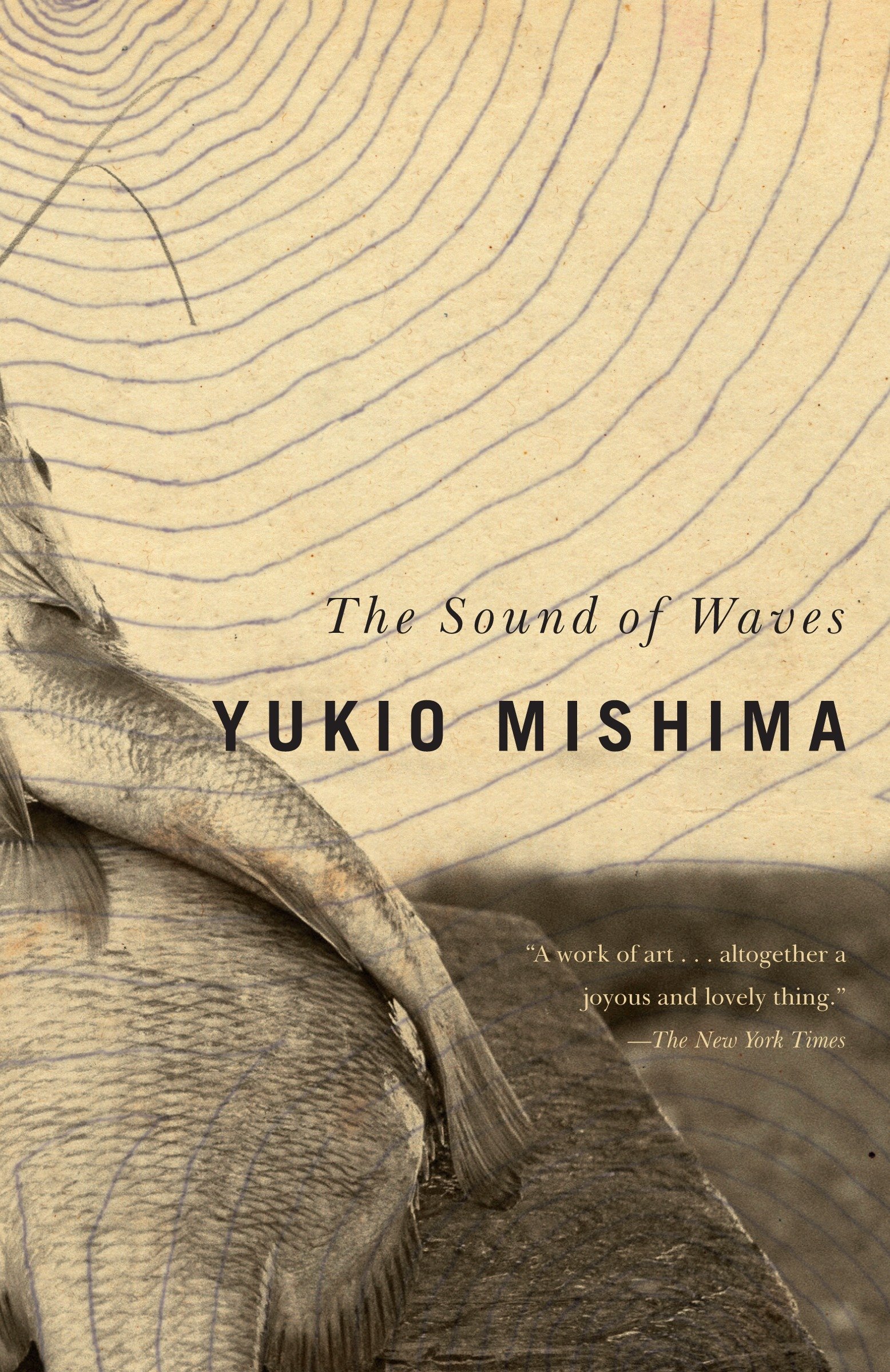
The Sound of Waves by Yukio Mishima

Even so, when the day's fishing was almost done, the sight of a white freighter sailing against the evening clouds on the horizon filled the boy's heart with strange emotions.  From far away the world came pressing upon him with a hugeness he had never before apprehended.  The realization of this unknown world came to him like distant thunder, now pealing from afar, now dying away into nothingness.

Yukio Mishima's The Sound of Waves is set on the (fictional?) fishing island of Uta-jima.  Shinji, a recent high school graduate, is a fisherman there; his mother is a traditional pearl diver.  These two jobs more or less express the way labor is divided by gender on this island, and has been for centuries.  Even the daughter of the wealthiest man on the island--whom he once had adopted, but then summoned back once his sons died, which is pretty fucked up--is a pearl diver, too.

That daughter's name is Hatsue, and Shinji, setting eyes on her for the first time, falls madly in love.  She returns his affections but others, less pure at heart, get in the way: a young ne'er-do-well named Yasuo, convinced he's entitled to Hatsue's hand in marriage because of his own wealth and status, tries to sexually assault her; a jealous girl named Chiyoko spreads a rumor that Shinji has violated Hatsue's virginity, a rumor that gets back to Hatsue's father.  The plot of the novel, which is incredibly slim and stripped down, comprises Shinji and Hatsue's struggle to be together in the face of opposing gossip.  Neither is especially clever, but Shinji is something of a holy fool, whose inherent goodness seems destined to win out in the end, and does.

The action of The Sound of Waves is always in the context of life on the island, which Mishima describes as somehow out of the reach of modern life.  Big fishing freighters pass by the island like ghosts from another world, suggesting, but not explaining, the life that Shinji might otherwise have.  In one funny scene, Shinji's brother Hiroshi goes on a school trip to Kyoto, where he goes to see a movie.  Hiroshi and his friends complain about the hard narrow seats until someone shows them how they fold down.  In Hiroshi's reflections on his trip, Mishima captures something of the strange whiplash feeling of travel: "Those gleaming streetcars and automobiles that had come upon him so suddenly, flashed by, and disappeared, those towering buildings and neon lights that had so amazed him--where were they now?"  The Sound of Waves isn't skeptical about modern or urban life, necessarily, but it does suggest that the purity and sweetness of Shinji and Hatsue's relationship is only possible on an island like this one, forgotten by time and technology.

Mishima was a weird dude: an actor and model in addition to a writer, he was also a fierce Japanese nationalist who committed suicide after leading a failed coup to help restore the Emperor.  Very little of that militarism or anger seems present here, but there's a recognizable kind of nostalgia for a nationalist past, the idyllic past as represented by Uta-jima.  As is often the case for foreign readers encountering that sort of trope, the charms of the island seemed mostly distant and opaque.  The Sound of Waves is pretty charming and subtle, but I didn't find it very memorable.

Saturday, August 11, 2018

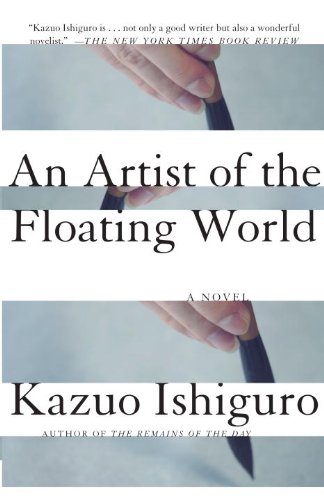
An Artist of the Floating World by Kazuo Ishiguro

If one has failed only where others have not had the courage or will to try, there is a consolation--indeed, a deep satisfaction--to be gained from the observation when looking back over one's life.

Masuji Ono is a painter.  Once, he was devoted to depicting the "floating world"--life in the pleasure districts of drinking establishments and prostitutes, which have a kind of transitory beauty.  He worked in the tradition of ukiyo-e, the 19th-century woodblock prints, whose name translates literally to "floating world."  But such an artistic tradition began to lose its relevance for Ono in the reality of pre-war Japan, and he committed himself to producing propaganda art for the Imperial cause.  Now, after the surrender, the older Ono looks back with nostalgia on the floating world that he's lost and reconciling himself to the new Japan.

Post-war Japan is not a friendly place for those who were high in the Imperial cause.  Many commit suicide as a public show of expiation for leading the country into such a costly war.  Ono's daughter Noriko seems to worry that his reputation will ultimately sink the marriage that is being arranged for her, and encourages him to seek out his old associates before her fiance's detective does.  (This seems like a common arrangement; Ono has a detective of his own.)  But there are those, like Ono's old student, Kuroda, who don't wish to see him, for deeds that Ono--and Ishiguro--keep at arm's length.

This weekend was the anniversary of the bombings of Hiroshima and Nagasaki.  (It made me think about the horrific scene describing the blast in Joy Kogawa's Obasan.)  Reading about the bombings again provided an interesting context to An Artist of the Floating World, which seeks to capture something about the state of mind of the Japanese at World War II.  The atomic bombs are not mentioned, but traditional bombing has taken a heavy, heavy toll on the country.  Ono's own wife, we learn, was killed in their home by a bomb, and many of the establishments of the old "floating world" are now rubble.  But buildings are also rising, many in a new Western style.  Ono himself finds some of these places bewildering, and his inability to adapt to the new way is underscored humorously by his conversations with his grandson, Ichiro, who would rather pretend to be the Lone Ranger than a samurai.  The turn away from militarism and imperialism requires a purge of the old guard, it needs it suicides, and though Ono finds such actions foolish, he recognizes in their actions a reflection of himself.

What Ono recognizes and understands, and what he doesn't, are the heart of An Artist of the Floating World.  Ishiguro really is the maestro of the unreliable narrator, and in a lot of ways Ono seems like a practice run at the character of the butler in The Remains of the Day, who refuses to recognize that his employer was a Nazi collaborator.  A Briton of Japanese background, Ishiguro seems to offer a kind of parallel between Japanese and British styles of repression.  Stevens the butler hides behind a kind of mannered, class-oriented sense of "dignity" that isn't so different from the Japanese style of polite avoidance practiced by Ono's daughters.  Confrontations, such as they are, are made only obliquely, and couched in equivocating language--forgive me, perhaps, etc.--that makes an honest assessment of reality difficult for the reader.

Ono himself is comparatively forthright, and considers himself to be making an honest assessment of his own position.  But a performative forthrightness can itself be a kind of denial.  Yes, Ono admits that the imperialist fervor was a mistake, but what are his mistakes?  He professes ignorance as to why his old student Kuroda might not wish to see him and only late in the novel, as if pushed back into a mental closet, that Ono reported Kuroda for "unpatriotic" sympathies.  Ono's admission that he has slightly less influence than he did before the war, but how much burden is put on the word "slightly?"  When describing his paintings, why does he focus on their aesthetic qualities, rather than their propagandistic content?  Ishiguro, as always, does a terrific job preventing the reader from getting to an objective truth, leaving us only with a sense that Ono's version is not quite right.

There's a final reveal that I admit I didn't see coming.  I'll say "spoiler alert," even though that seems a weird term for a revelation that is entirely psychological, rather than plot-driven.  Ono's ultimate denial, it turns out, is that he never really mattered much in the first place.  As his daughter says:

Forgive me, but it is perhaps important to see things in a proper perspective.  Father painted some splendid pictures, and was no doubt most influential among other painters.  But Father's work had hardly to do with these larger matters of which we are speaking.  He must stop believing he has done some great wrong.

It's so subtle, but it really turns everything on its head.  Ono isn't a powerful man whose equivocations prevent him from dealing with his misdeeds, he's an ordinary man whose equivocations actually serve to make him feel more important than he really was.  He thinks of himself as being the same kind of person as those who have committed suicides of honor, but these thoughts inflate his importance.  His misdeeds--like his reporting of Kuroda--are small and petty acts, personal betrayals, not national ones.  As his friend, the fellow traveler Matsuda tells him, "It was simply our misfortune to have been ordinary men during such times."  Ono believes there is a satisfaction in having done something great and failed, but most failures are only the ordinary kind, and that makes them somehow even more tragic.

Sunday, May 17, 2009

Silence by Shusaku Endo

But now there arose up within my heart quite suddenly the sound of the roaring sea as it would ring in my ears when Garrpe and I lay aloen in hiding on the mountain. The sound of those waves that echoed in the dark like a muffled drum; the sound of those waves all night long, as they broke meaninglessly, receded, and then broke again on the shore. This was the sea that relentlessly washed the dead bodies of Mokichi and Ichizo, the sea that swallowed them up, the sea that, after their death, stretched out endlessly with unchanging expressions. And like the sea God was silent. His silence continued.

"In my opinion one of the finest novels of our time," raves Graham Greene on the jacket of Shusako Endo's Silence. No wonder, since Endo has been described as the Japanese Graham Greene, and to be sure, here is a book that seems to originate from the same midnight crises of faith that haunted Greene, and, like Greene's books, comes to conclusions only with great reservations. In fact, Sebastian Rodrigues, the Portuguese missionary of Silence reminds me greatly of the Whiskey Priest from Greene's The Power and the Glory: both are broken men who harbor severe doubts in their power to do the Lord's work on earth; though the Whiskey Priest has been broken long before the novel starts, in Silence we are audience to Rodrigues' ruin.

Rodrigues and his partner, Garrpe, volunteer to travel to Japan in search of another missionary there, Father Ferreira, who has apostatized--officially renounced his faith--and gone into hiding. Ferreira is something of a mentor to Rodrigues, who is followed by the question--What could bring someone as resolute in their faith as Ferreira to apostatize? The answer, Rodrigues supposes, lies in the cruelty of Inoue, the local Japanese governor, who supposedly is fond of hanging Christians upside down in a pit and draining the blood from them slowly until they give up the faith.

Rodrigues steels himself against torture, but the torture he finds is not the torture he expects--instead of being subjected to horrible violence and death himself, it is his fate to watch others experience those trials. When the Japanese authorities hear that the missionaries have arrived, they send soldiers to pillage the Christian towns where Rodrigues and Garrpe seek shelter, taking the leaders of the local church and tying them to stakes out at sea. Rodrigues watches these things happen from his hiding place and is powerless, but the divine intervention that Rodrigues is hoping for never comes, leaving him to lament the titular silence that seems to be God's attitude towards his faithful on earth.

Endo styles Rodrigues' journey self-consciously after Christ's death, including even a Judas-like character named Kochijiro, a weak-willed Christian who will sell Rodrigues to the officials for a bagful of silver (in this way also he is like the Whiskey Priest, who is followed by a Judas figure). This is forever in Rodrigues' mind, and he wonders if he can endure the torture that Christ went through, but challenge never arises. Instead, he is to face the same kind of torture that caused Ferreira to forsake God, the torture of enduring God's silence. Trapped in a Japanese prison one night, Rodrigues remarks to a guard that he cannot sleep because of the snoring coming from the other room--but, the guard tells him, that is not snoring at all, but the moaning of Christians who have been placed in the pit, and who will remain there until you apostatize.

This is an explicitly un-Christlike dilemma. Christ suffered for the glory of God and for the mercy of Man, but what would He have done if the two goals were exclusive of one another? Ferreira, now a Japanese citizen with a Japanese wife and family, advises Rodrigues to apostatize:

"You make yourself more important than them. You are preoccupied with your own salvation. If you say that you will apostatize, those people will be taken out of the pit. They will be saved from suffering. And you refuse to do so. It's because you dread to betray the Church. You dread to be the dregs of the Chruch, like me." Until now Ferreira's words had burst out as a single breath of anger, but now his voice gradually weakened as he said: "Yet I was the same as you. On that cold, black night I, too, was as you are now. And yet is your way of acting love? A priest ought to live in imitation of Christ. If Christ were here..."

For a moment Ferreira remained silent; then he suddenly broke out in a strong voice: "Certainly Christ would have apostatized for them."


These tactics are, I believe, historically accurate and testify to why Japan is today a less than one percent Christian country. Inoue tells Rodrigues that Japan is a swamp where the seeds of Christianity cannot grow; it is an affirmation which Endo, a Japanese Christian, leaves appropriately unremarked upon. In the tradition of Greene, Endo provides glimmers of hope here and there, but leaves most of these difficult questions dangling.

Graham-Greene-o-Meter: Nine Greenes out of ten. Very much in Greene's mode, and very good. Also, this is the last book of "Graham Greene Month," which really ought to be called "Four books I read tangentially related to Graham Greene in some way or another," but that didn't really have the same ring to it.

I recommend this book to Brent, for the obvious reasons, but also to Jim, for this reason: This is currently being filmed for theaters by Martin Scorcese with Daniel Day-Lewis and Benicio del Toro. 2011 Best Picture, anyone?

Thursday, January 8, 2009

The Wind-Up Bird Chronicle by Haruki Murakami

"As you are well aware," the man continued, his voice soft but penetrating, "in the course of life we experience many kinds of pain. Pains of the body and pains of the heart. I know I have experienced pain in many different forms in my life, and I'm sure you have too. In most cases, though, I'm sure you've found it very difficult to convey the truth of that pain to another person: to explain it in words. People say that only they themselves can understand the pain they are feeling. But is this true? I for one do not believe that it is. If, before our eyes, we see someone who is truly suffering, we do sometimes feel his suffering and pain as our own. This is the power of empathy. Am I making myself clear?"

I wish I knew where to start to talk about The Wind-Up Bird Chronicle. It is, at least in my opinion, incredibly hard to wrap my mind around this story. I told Chris, when I had about 100 pages left to read, that Wind-Up might just become my favorite book. I can say now that this did not turn out to be the case. The ending left too many mysteries unsolved, even unaddressed. Although looking back, I don't know how I could have imagined the story to play out any other way.

Wind-Up's plot is far too complex for me to do any justice here, but I'll try to give the the briefest description possible for a tale this intricate. Our hero, Toru Okada, isliving in Japan with his wife, Kumiko. Toru learns from Kumiko that their house cat has gone missing. Toru, now left with little to occupy himself after quitting his job, goes looking for the beloved pet. Upon commencing the search, however, Toru finds himself trapped in a series of bizarre events involving his wife, their cat, his brother-in law, psychic prostitution, forgotten war crimes, a slightly demented 16-year-old girl, and a strange bird with a bizarre call that no one can actually see. Without giving anything away, the story quicky jumps from the tale of a man searching for his missing cat to that of a man searching for answers to riddles he can hardly comprehend.

As I said, I have a real hard time explaining this book. While it has achieved critical acclaim almost everywhere, there are some that say the story contains hundreds of unnecessary pages filled with anecdotes completely unrelated to the main plot. As I read the story, however, I felt that Wind-Up was essentially a stream of consciousness. Not the stream of consciousness of Haruki Murakami, a professional writer who could more finely tune the story and target its scope on the only matters of conseuence. To me, Wind-Up seemed to be Toru Okada's stream of consciousness, set to type after all the events had transpired. Hardly a novelist himself, it seems logical that Toru's work would be somewhat misguided and dense.

Toru's adventure has the feel of Theseus' journey through the labyrinth. Perhaps more precisely, the book itself has the feel of a labyrinth. Chapters upon chapters are spent taking wrong turns leading to brick walls, forcing the reader to turn around, forget what they just saw. It becomes a struggle to simply search your way back to the point at which you made the wrong turn. This labyrinthal motif is touched upon by Toru himself near the end of the book. Additionally, one of the story's antagonist's name partially translates in english as "Bull." We encounter Bull, or Ushikawa, once Toru finally begins to approach the center of his dark, twisted labyrinth. Perhaps it's a bit too simplistic to describe Wind-Up as a maze, though. Mazes usually have an exit. Wind-Up's maze seems to only have more entrances. More devices to trick you into thinking that escape is just around the corner, when it is actually far out of reach. In hindsight, maybe Toru's adventure is less like Theseus' and more like one of the innocent Athenians who met their end in the harsh maze.

I certainly enjoyed The Wind-Up Bird Chronicle, although I have a hard time explaining why. Murakami's writing style is addictive in his ability to write about extremely complex and bizarre concepts in an unbelievably accessible way. The book has a heavy, dense feel to it at 600 pages. But there's something about the way Murakami strings together words into sentences, sentences into paragraphs, and paragraphs into chapters. The pages simply melt together and before you know it, you're halfway through the book. This may sound like I'm trying to describe it as "A real page turner!" or saying "I couldn't put it down!" but its more than that. For example, Murakami goes from describing a sub attack on a passenger liner to a massacre at a Manchurian zoo in a single chapter that flows together so perfectly its as if the entire tale was told on a single page. Coupling that together with the fact that neither the sub attack or the zoo massacre have much to do with the general plot (if there even is one at all) makes Murakami's pacing all the more impressive.

I find myself sitting here with no idea how to tie this up. I feel like I've written 500 words without even saying anything. But then maybe thats exactly the kind of review that The Wind-Up Bird Chronicle warrants. Or maybe that's a copout. "I wonder."

Highlights: Murakami has without a doubt, one of the most readable writing styles I've ever been lucky enough to encounter
Lowlights: So many doors left unopened, so many riddles left unsolved. Also it makes me genuinely sad that I don't own a cat named Noburo Wataya.

Tuesday, January 6, 2009

Norwegian Wood by Haruki Murakami

This is the third book by Haruki Murakami that I've read (the others being Kafka on the Shore and Pinball, 1973). I've noticed a positive correlation between how recently one of his books was published and how strange it is. While I prefer his more bizarre works - those that include old men who can speak cat and Colonel Sanders as a spirit guide - this was still an engaging and powerful book, and fits in perfectly on his upward trend of oddness.

Like Kafka on the Shore, Norwegian Wood is a coming of age story, set in Japan in 1970. Toru Watanabe is an eighteen year-old, apathetic college student in Tokyo. A lot of Murakami's own passions are reflected in the character (jazz and classical music, American Literature). Slightly semi-autobiographical, the story is wrought with a series of tragic events that almost seem absurd in their regularity and predictability. Each one feels like another crushing blow to Toru Watanabe, whose broody musings can really be chilling at times.

Death exists - in a paperweight, in four red and white billiard balls on a table - and we go on living and breathing it into our lungs like fine dust.

I lived through the following spring, at eighteen, with that knot of air in my chest, but I struggled all the while against becoming serious. Becoming serious was not the same thing as approaching truth, I sensed, however vaguely. But death was a fact, a serious fact, no matter how you looked at it. Stuck inside this suffocating contradiction, I went on endlessly spinning in circles. Those were strange days, now that I look back at them. In the midst of life, everything revolved around death.
It's a gripping, nostalgic story that left me feeling miserable. Poor Toru Watanabe is a brilliant kid whose hit with one horrible mishap after another, and left alone and floundering for anything of meaning and substance. This book is dark, at times depressing, and plenty erotic (though not as wildly or strangely erotic as Kafka on the Shore). Kafka on the Shore still stands as my favorite Murakami book, but I'd recommend this one too if you're not that into otherworldly stones or disappearing isolated mountain towns.

Sunday, June 15, 2008

When You Are Engulfed in Flames by David Sedaris

I got this as an early birthday present. It was good that I received it early, because I would have purchased it on my own before my birthday (July 15, and if you are wondering, no, I still don't have an iPod Touch). I was super excited about this book and had to force myself to read it slowly, so as to not finished it in the first day. I think that I did a fairly good job, managing to spread it out over six days.

As with most of Sedaris's books, Flames covers a wide variety of topics, with essays that deal with various periods in Sedaris's life. It would be stupid for me to try and pick a favorite, but I really enjoyed "In the Waiting Room," in which Sedaris explains why it can be a problem to know so little French that you are reduced to saying yes in response to everything. The phrase Sedaris uses actually translates to, "I am in agreement." Due to his excessive use of this phrase, he finds himself in his underwear in a waiting room that slowly begins to fill with other people, all fully dressed of course.

Each essay is somewhere around fifteen pages in length with a few exceptions, chief among these is the final essay, "The Smoking Section," which was a little over eighty pages. Comprised of journal entries, this essay follows Sedaris all the way to Tokyo on his quest to quit smoking. At the same time that he is trying to break this 30-year habit, Sedaris is attempting to learn Japanese. In true Sedaris fashion, he does not allow his apparent inability to learn Japanese to stop him from pointing out all the English errors that are made by those around him and on local signage. I couldn't stop laughing at all the language-based snafus. One of my favorites was a label Sedaris found on pre-packaged sandwiches in a supermarket close to his apartment. "We have sandwiches which you can enjoy different tastes. So you can find your favorite one from our sandwiches. We hope you can choose the best one for yourself."

I have read everything by Sedaris except for Barrel Fever, which I started last night. His humor has a darkness to it that really appeals to me. One of the blurbs on the back of Flames describes Sedaris as a writer who is "revising our ideas about what's funny." This description is right on the money.

My thoughts on Sedaris's Naked and Barrel Fever

Thursday, September 27, 2007

The Wind Up Bird Chronicle by Haruki Marukami

Well, this book was strange.


It follows a man, whose name I can't remember because it's Japanese, through several months of his life, during which his marriage disintegrates, he meets a young girl who is obsessed with death, he loses his cat, he has psychic sex with a girl who fluctuates between constant pain and complete numbness, he develops the ability to suck bad things out of people's heads, and he learns that his brother in law has the ability to go inside women and split them in half... or something.


This book was really confusing.


There's a section where a man is tied down and skinned alive by a man named, appropriately, Boris the Manskinner. We learn this from an old army veteran whose past seems to parallel the life of our hero. We also learn that Boris eventually took over the prison camp in which he was originally interned, and that he cannot be killed.


So, this was sort of an odd twist.


Our hero spends several days in the bottom of a well, until the walls of the well turn into Jell-O and he pushes through them to some spirit hotel where he somehow kills his brother in law. You might expect that everything would tie together at some point, but that doesn't really happen.


This book was pretty good, if you can believe that.

Monday, June 18, 2007

Pinball, 1973 by Haruki Murakami

Haruki Murakami is such a strange man. Pinball, 1973 was published in 1985, about 20 years before Kafka on the Shore, and you can really get a sense of him fleshing out his writing style. After I read it I learned that it’s the second of “the Rat trilogy,” his first three books plus a fourth added some years later (I am aware, as I’m sure he is too, that four books are too many for a trilogy). Unfortunately, the first two books are out of print in English (apparently he refuses to allow them to be published outside of Japan, which is a real shame), but you can download a PDF file of Pinball, 1973 in English here. The only copy of his first book is $2,400 on Amazon.com, if anyone’s looking to buy me presents.

Pinball, 1973 works pretty well as a stand-alone work, in my opinion. It’s just as confusing as Kafka on the Shore, but with fewer elements. In a nutshell: the main character, unnamed, works as an independent translator and lives alone until he wakes up one day to find twin girls asleep on either side of him. One day, almost as an epiphany, he develops an obsession with one certain pinball machine, an old favorite of an acquaintance of his, the Rat. The Rat’s separate storyline is told in alternating chapters throughout; he moves to his own apartment for university, drops out after three years, and befriends a bartender named J until he decides it’s time to move on. I assume that the next book deals with what happens next, but, knowing Murakami, there’s really no way to tell without reading it. It could just as easily be about ice cream cones.

For me, it was a lonely season. Whenever I got home and took off my clothes, I felt as if any second my bones would burst through my skin. Like some unknown force inside me had taken a wrong turn somewhere, and was leading me off in some strange direction to another world.

More than anything, this book deals with being alone, from all angles. One character seems to distance himself from those around him in order to protect them from some karmic part of himself that he can’t control, in some weird way. The other just can’t seem to open himself up enough, or even know himself well enough, to connect with the people who care about him. The writing is pretty simple, or else it comes off that way after translation, but I’ve come to know it as his style. A lot of the passages are very moving, and most of the book is strangely comforting and familiar, in a way. You really want to be where his characters find themselves. I still can’t say that I completely understand Murakami, but I definitely like his work. Here’s hoping he breaks down and publishes this and his first book in the US soon.

EDIT: Very bad news, sports fans. It looks like someone forced the website to remove the file with the full text of the book. If you want it, let me know and I'll email it to you.

EDIT (again): And now it's back.

Sunday, January 21, 2007

Kafka on the Shore by Haruki Murakami

Little known fact: In Costa Rica, blogger.com is in spanish. I am exhausted from travel, nervous about studying abroad, and very confused by this book, but I will try to write a review as best I can.

This book was confusing, to say the least. It involved a 15-year old runaway escaping from an ominous prophecy straight from Oedipus imposed on him by his own father, an old man who can talk to cats, souls leaving bodies, souls entering dreams, bodies entering dreams, souls... dreaming.. bodies? I couldn't shake the feeling that this entire book was a metaphor, but for what, I have no idea. Perhaps some of the more tricky bits would make more sense if I had a background in Japanese cultural history; I get the feeling that a lot of the strange characters and elements of Murakami's story would mean more to a reader from his own country.

Murakami is an excellent writer, and completely lets his reader get inside the head of the main character, the incredibly intelligent, 15-year old Kafka Tamura (an assumed name). I really got a sense of Kafka's wandering consciousness, and some of the things that he speculated about the state of his own subconscious nearly made my head spin. Kafka on the Shore is written in a style similar to Jonathon Safran Foer's Everything is Illuminated, where alternating chapters tell different story lines, the secondary story line beginning in the past and eventually converging with the present.

I really enjoyed this book, it was an incredibly well told story, but one that is so densely packed with metaphor and symbolism, that it would take much more effort than I can offer to extract any greater meaning from it.