Showing posts with label shusaku endo. Show all posts

Tuesday, January 24, 2017

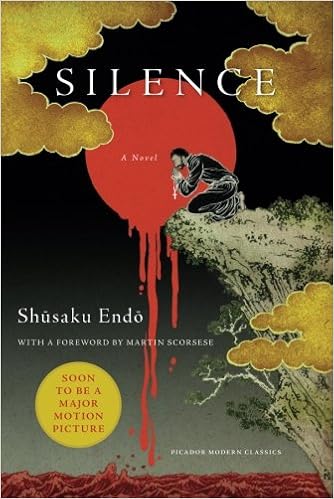
Book 4: Silence, by Shūsaku Endō

Having already read several reviews of Silence, including one on this site, I'm hesitant to launch into my own. This counts as my book set more than 5000 miles away from where I live for ye olde Reade Harder. Taking place during the early isolationist period of Japan's history, Silence follows a Portuguese priest, Sebastian Rodrigues, trying to track down a supposed apostate countryman as he tends to the faithful in Japan. Things go quickly awry thanks to a pathetic Judas figure, Kichijiro, who tries time and again to redeem himself, to no meaningful avail in Rodrigues' situation. Throughout his ordeals, Rodrigues is faced with the ineffable silence of God, despite his faith and his trials.

For many, the silence of God is basically equal to the problem of God. It's been quite a while - if ever - since people have been happy with the explanation given in Job, and Endo does a tremendous job of tracking someone's fall from total adherence to realizing, creepingly at first and with a torrent of doubt finally, that there may be a damned good reason for this silence. As many have, I found a good deal of my own struggles with God mirrored in Silence. Full disclosure, I attend Mass pretty much every week, and take my three and a half year old son along with me. Still, I find myself bristling during the homily many weeks, as the most recent manifestation of God's silence was, for me, heard on Election Day. It was probably the closest I've ever come to flat-out giving up on the faith, and yet I still found myself in the pews that Sunday. Is it because, like Rodrigues, I've been raised with the face of Christ my entire life? Because I can't deal with accepting the silence? Because I can almost hear something behind the silence? I don't know for sure, a frustrating but true answer. When I was 14, Marvel put out their Infinity War comics, a grand superhero battle with the trappings of philosophy and theology kind of slapped over top of them. Each issue of musclebound nonsense (boy, rereading comics from the early 90s is not an exercise for the faint of heart) opened with a quote that had no business being in such lunacy, and one that has always stuck with me is Tennyson's "There lives more faith in honest doubt, believe me, than in half the creeds." (I probably should've started this review with the information that I learned Tennyson and religious credos from comic books, and saved you all the time it took to read this.)

And, just because it didn't fit with the religion part of my rumination but it feels like a very vital part of this novel, I just wanted to say: Man, I don't think I've ever been presented with a view of Japan that is so ugly. When I think of the countryside of Japan, I think of Kurosawa films, woodprints, and the Maple Treeway from Mario Kart. Endo's rural Japan is mud, rain, and mudswamp. Obviously the mudswamp of Japan is one of the central themes of the book, but it was a major challenge to my preconceived notions (similar, I suppose, to the challenge of a 1950s consumer America that welcomed me in Lolita).

Sunday, May 17, 2009

Silence by Shusaku Endo

But now there arose up within my heart quite suddenly the sound of the roaring sea as it would ring in my ears when Garrpe and I lay aloen in hiding on the mountain. The sound of those waves that echoed in the dark like a muffled drum; the sound of those waves all night long, as they broke meaninglessly, receded, and then broke again on the shore. This was the sea that relentlessly washed the dead bodies of Mokichi and Ichizo, the sea that swallowed them up, the sea that, after their death, stretched out endlessly with unchanging expressions. And like the sea God was silent. His silence continued.

"In my opinion one of the finest novels of our time," raves Graham Greene on the jacket of Shusako Endo's Silence. No wonder, since Endo has been described as the Japanese Graham Greene, and to be sure, here is a book that seems to originate from the same midnight crises of faith that haunted Greene, and, like Greene's books, comes to conclusions only with great reservations. In fact, Sebastian Rodrigues, the Portuguese missionary of Silence reminds me greatly of the Whiskey Priest from Greene's The Power and the Glory: both are broken men who harbor severe doubts in their power to do the Lord's work on earth; though the Whiskey Priest has been broken long before the novel starts, in Silence we are audience to Rodrigues' ruin.

Rodrigues and his partner, Garrpe, volunteer to travel to Japan in search of another missionary there, Father Ferreira, who has apostatized--officially renounced his faith--and gone into hiding. Ferreira is something of a mentor to Rodrigues, who is followed by the question--What could bring someone as resolute in their faith as Ferreira to apostatize? The answer, Rodrigues supposes, lies in the cruelty of Inoue, the local Japanese governor, who supposedly is fond of hanging Christians upside down in a pit and draining the blood from them slowly until they give up the faith.

Rodrigues steels himself against torture, but the torture he finds is not the torture he expects--instead of being subjected to horrible violence and death himself, it is his fate to watch others experience those trials. When the Japanese authorities hear that the missionaries have arrived, they send soldiers to pillage the Christian towns where Rodrigues and Garrpe seek shelter, taking the leaders of the local church and tying them to stakes out at sea. Rodrigues watches these things happen from his hiding place and is powerless, but the divine intervention that Rodrigues is hoping for never comes, leaving him to lament the titular silence that seems to be God's attitude towards his faithful on earth.

Endo styles Rodrigues' journey self-consciously after Christ's death, including even a Judas-like character named Kochijiro, a weak-willed Christian who will sell Rodrigues to the officials for a bagful of silver (in this way also he is like the Whiskey Priest, who is followed by a Judas figure). This is forever in Rodrigues' mind, and he wonders if he can endure the torture that Christ went through, but challenge never arises. Instead, he is to face the same kind of torture that caused Ferreira to forsake God, the torture of enduring God's silence. Trapped in a Japanese prison one night, Rodrigues remarks to a guard that he cannot sleep because of the snoring coming from the other room--but, the guard tells him, that is not snoring at all, but the moaning of Christians who have been placed in the pit, and who will remain there until you apostatize.

This is an explicitly un-Christlike dilemma. Christ suffered for the glory of God and for the mercy of Man, but what would He have done if the two goals were exclusive of one another? Ferreira, now a Japanese citizen with a Japanese wife and family, advises Rodrigues to apostatize:

"You make yourself more important than them. You are preoccupied with your own salvation. If you say that you will apostatize, those people will be taken out of the pit. They will be saved from suffering. And you refuse to do so. It's because you dread to betray the Church. You dread to be the dregs of the Chruch, like me." Until now Ferreira's words had burst out as a single breath of anger, but now his voice gradually weakened as he said: "Yet I was the same as you. On that cold, black night I, too, was as you are now. And yet is your way of acting love? A priest ought to live in imitation of Christ. If Christ were here..."

For a moment Ferreira remained silent; then he suddenly broke out in a strong voice: "Certainly Christ would have apostatized for them."


These tactics are, I believe, historically accurate and testify to why Japan is today a less than one percent Christian country. Inoue tells Rodrigues that Japan is a swamp where the seeds of Christianity cannot grow; it is an affirmation which Endo, a Japanese Christian, leaves appropriately unremarked upon. In the tradition of Greene, Endo provides glimmers of hope here and there, but leaves most of these difficult questions dangling.

Graham-Greene-o-Meter: Nine Greenes out of ten. Very much in Greene's mode, and very good. Also, this is the last book of "Graham Greene Month," which really ought to be called "Four books I read tangentially related to Graham Greene in some way or another," but that didn't really have the same ring to it.

I recommend this book to Brent, for the obvious reasons, but also to Jim, for this reason: This is currently being filmed for theaters by Martin Scorcese with Daniel Day-Lewis and Benicio del Toro. 2011 Best Picture, anyone?