
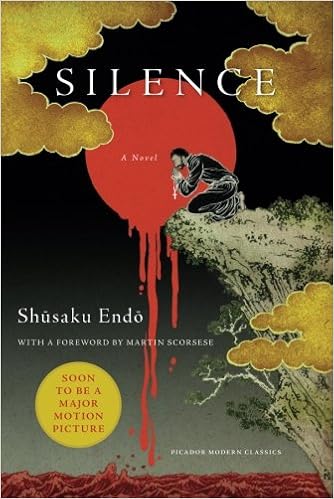
 Having already read several reviews of Silence, including one on this site, I'm hesitant to launch into my own. This counts as my book set more than 5000 miles away from where I live for ye olde Reade Harder. Taking place during the early isolationist period of Japan's history, Silence follows a Portuguese priest, Sebastian Rodrigues, trying to track down a supposed apostate countryman as he tends to the faithful in Japan. Things go quickly awry thanks to a pathetic Judas figure, Kichijiro, who tries time and again to redeem himself, to no meaningful avail in Rodrigues' situation. Throughout his ordeals, Rodrigues is faced with the ineffable silence of God, despite his faith and his trials.
For many, the silence of God is basically equal to the problem of God. It's been quite a while - if ever - since people have been happy with the explanation given in Job, and Endo does a tremendous job of tracking someone's fall from total adherence to realizing, creepingly at first and with a torrent of doubt finally, that there may be a damned good reason for this silence. As many have, I found a good deal of my own struggles with God mirrored in Silence. Full disclosure, I attend Mass pretty much every week, and take my three and a half year old son along with me. Still, I find myself bristling during the homily many weeks, as the most recent manifestation of God's silence was, for me, heard on Election Day. It was probably the closest I've ever come to flat-out giving up on the faith, and yet I still found myself in the pews that Sunday. Is it because, like Rodrigues, I've been raised with the face of Christ my entire life? Because I can't deal with accepting the silence? Because I can almost hear something behind the silence? I don't know for sure, a frustrating but true answer. When I was 14, Marvel put out their Infinity War comics, a grand superhero battle with the trappings of philosophy and theology kind of slapped over top of them. Each issue of musclebound nonsense (boy, rereading comics from the early 90s is not an exercise for the faint of heart) opened with a quote that had no business being in such lunacy, and one that has always stuck with me is Tennyson's "There lives more faith in honest doubt, believe me, than in half the creeds." (I probably should've started this review with the information that I learned Tennyson and religious credos from comic books, and saved you all the time it took to read this.)
And, just because it didn't fit with the religion part of my rumination but it feels like a very vital part of this novel, I just wanted to say: Man, I don't think I've ever been presented with a view of Japan that is so ugly. When I think of the countryside of Japan, I think of Kurosawa films, woodprints, and the Maple Treeway from Mario Kart. Endo's rural Japan is mud, rain, and mudswamp. Obviously the mudswamp of Japan is one of the central themes of the book, but it was a major challenge to my preconceived notions (similar, I suppose, to the challenge of a 1950s consumer America that welcomed me in Lolita).


