"What do you think spies are: priests, saints and martyrs? They're a squalid procession of vain fools, traitors too, yes; pansies, sadists and drunkards, people who play cowboys and Indians to brighten their rotten lives."
I hesitate to call The Spy Who Came in from the Cold a spy novel, because I think that phrase brings with it certain modern connotations. This book is an espionage novel.
The events in the book occur in the late 1950s and early 1960s, during the Cold War. The British Secret Intelligence Service asks Alec Leamas to pretend to defect to East Germany and then feed them misinformation that would lead them to believe that one of their men was a British double agent. This is the crux of the story. To make Leamas seem prime for defection, he is unceremoniously sacked and provided with only a meager pension. Leamas is given a job at a small library, from which is promptly gets fired.
By the time the East German Communists decide to come calling on Leamas, he has drunk himself into a hole. What Leamas and British Intelligence did not count on was that someone else would also coming calling on him. Liz Gold, a woman that he met while working at the library is concerned for Leamas, and comes to find him and make sure he is alright. It is unclear to the reader how much Leamas is still in control of his life at this point and--at least initially--if he has actual feelings for Gold. Perhaps Leamas wasn't sure himself. Needless to say, Gold's involvement with Leamas complicates everything.
I cannot think of a a novel with an ending that was more taut than The Spy Who Came in from the Cold.
Showing posts with label spy. Show all posts
Wednesday, July 11, 2012
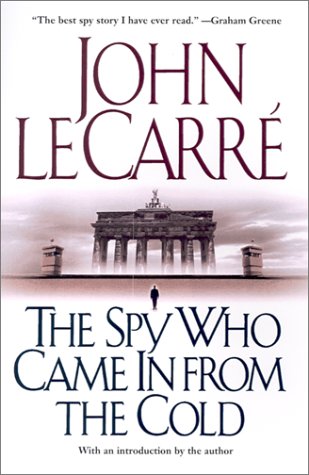
The Spy Who Came in from the Cold by John le Carré
Labels:
1950s,
1960s,
Cold War,
espionage,
John le Carre,
John le Carré,
spy
Monday, November 16, 2009
Our Man in Havana by Graham Greene
Graham Greene notoriously split his oeuvre into "novels"--literary and philosophical works like The Power and the Glory and The Heart of the Matter--and pulpier "entertainments." Our Man in Havana is decidedly an entertainment twice removed: a convoluted, jokey spy thriller that isn't really a spy thriller at all.
The protagonist is an English vacuum salesman living in Cuba named Wormold, who is recruited (perhaps only because of his Englishness) by British officials to provide intelligence on the political climate in Cuba, at this time under the dominion of Fulgencio Batista. The process of spying has its natural barriers, and Wormold rarely meets with his directors, instead communicating by book code and substituting numbers for names. Wormold quickly realizes that it is far easier to submit invented intelligence than real intelligence, and even goes so far as to recruit fake "sub-agents" so that he might pocket their salary. Scandalous, it might seem, but Greene keeps the tone light and Wormold naturally meek, casting the blame on the government buffoons.
What Wormold gives them is a diagram of a dissembled vacuum cleaner, claiming that his intelligence has sighted a massive mechanical operation deep in the Cuban jungle. British intelligence, predictably, buys this hook, line, and sinker. But there are other agents in Havana, and eventually the real people "recruited" by Wormold to be his sub-agents find themselves in grave danger, and Wormold himself is the target of assassination attempts.
Our Man in Havana is, despite the persistent threat of death, deceptively sunny and makes for an absurd, almost Coenesque farce. Compared to many of Greene's other novels which have so much more philosophical and social heft, it is also almost completely forgettable. The satire isn't toothless, but neither is it toothsome. As I understand it, Castro disliked the novel because it didn't go far enough in describing the horror of Batista's Cuba, and Greene responded that the novel was really about the British, and yet that didn't stop The Heart of the Matter from vividly expressing the reality of life in sub-Saharan Africa. And neither is there much religious content: Though Wormold is an atheist and his daughter Milly is a devout Catholic, this tension comes to almost nil and is let drop like the irrelevancy that it is. Greene may have called these books "entertainments," but for this reader, they are not nearly as entertaining as those "novels," in which the suspense came from the deeply crafted pathos of their protagonists.
Labels:
cuba,
Graham Greene,
political satire,
spy
Tuesday, May 12, 2009
The Spy Who Came in from the Cold by John Le Carre
"I expect so," Leamas replied wearily.
"Then what do you think? What is your philosophy?"
"I just think the whole lot of you are bastards," said Leamas savagely.
I have been away too long. But no matter, I am back with a vengeance, and May is--drum roll--Graham Greene month! In which I will review only books which are inspired by, loved by, or just plain written by, British author Graham Greene. Greene wrote a lot of very serious novels that explored the intricacies of his Catholic faith, but he also wrote a preponderance of what he called "entertainments"--spy novels, like Our Man in Havana, The Third Man, and The Orient Express. He called John LeCarre's Cold War novel The Spy Who Came in from the Cold, according to the book jacket, "The best spy story I have ever read." To which the New York Time retorts, "It may be the best spy story anybody has ever read." Zing!
It is decidedly not the best spy story I have ever read. Honestly, I see very little of what Greene finds so fantastic about it--it is taut, and cleverly conceived, but in other ways seems very unremarkable to me. The set up is this: Alec Leamas, a surly British field agent in East Germany, is put "out in the cold"--decommissioned, that is--after failing to prevent the murder of his best informant and the dissolution of his network in the country. Leamas takes up work in a library, shacking up with a pretty Jewish librarian--who just happens to be a communist, not that Leamas really cares--and ends up going to jail for assaulting a grocery clerk.
As an impoverished felon, Leamas is a perfect candidate to be approached by East German spies looking to "turn" British agents, and when they do, Leamas agrees to be taken across the Iron Curtain to tell them what he knows. But, in truth, Leamas has committed to undertake one last mission--using his position as a double agent (triple agent?) to plant evidence that his chief opponent in the East German network, Hans-Dieter Mundt, is actually a British double agent himself. What LeCarre does so well is to muddle things up so that Leamas--and the reader--begin to suspect that perhaps Mundt really is a British agent and Leamas has been sent to commit some act of espionage so secret he doesn't even know what it is.
That all sounds quite a bit more suspenseful than it is in practice. Except for a nice pair of bookended shoot-em-up scenes, the book is little more than a series of dull conversations between Leamas and his superiors, his girlfriends, or his various East German contacts. These conversations contain a few choice philosophical moments like the one I've excerpted above, but also a lot of pretty intricate details that Leamas provides about his work as a spy, which unfortunately seem about as dull and complex as I imagine spy work to actually be.
Graham Greene-o-Meter: I give this book five Greenes out of ten. Meh.
Labels:
Cold War,
Communism,
Graham Greene,
John le Carré,
spy
Tuesday, April 21, 2009
The Unexpected Mrs. Pollifax by Dorothy Gilman
"She (Mrs. Pollifax) had never thought of goats as smelling; she had never thought of goats at all, but of course no one bathed goats and this was the dry season."The Unexpected Mrs. Pollifax is the first in a long series of books about Mrs. Pollifax of the CIA. Mrs. Pollifax was not always a spy in the Secret Service, and this story of her very first adventure tells how it all came to be. Mrs. Pollifax is getting up in years, her children live a ways away and she hates to be a bother, but sometimes, Mrs. Pollifax thinks of not stopping when she walks to the edge of her balcony to set out her pots of geraniums.
Mrs. Pollifax decides she must do something to bring meaning to her life, and remembers her childhood dream of being a spy. So, she hops off on the first bus to present herself to the Central Intelligence Agency. Through a seemingly unfortunate mix-up, Mrs. Pollifax is employed as a courier. Her mission: to retrieve a set of microfilms that will blow Castro's dark little secrets wide open.
The trouble is, the Commies catch wind of the mission and Mrs. Pollifax along with her new friend Farrell, are whisked away to Albania to be questioned and tortured by General Perdito and the Red Chinese. Farrell attempts to kill himself by jumping off a cliff rather than give away the secrets he knows, but sustains only a broken leg and a gun shot wound. As Mrs. Pollifax realizes the gravity of their situation, a plan begins to form in her mind. With some extraordinary luck, charm, wit and the help of a few guards who have come to adore Mrs. Pollifax, she, Farrell, and an unknown Chinese prisoner escape to Yugoslavia where they are rescued by the CIA.
I read this book a few years back and really loved it. I have to say that I loved it just as much the second time through. The book well plotted, exciting and funny. Mrs. Pollifax is a truly classic character.
Labels:
Dorothy Gilman,
Mrs. Pollifax,
spy
Friday, January 23, 2009
The Human Factor by Graham Greene
Our worst enemies here are not the ignorant and simple, however cruel; our worst enemies are the intelligent and corrupt.For some reason, I had it in my head that The Human Factor was one of Greene's quartet of Catholic novels. The edition I read didn't have a summary on the back, so I was surprised when I started it and found that it was a spy story, a genre Greene touched on every so often throughout his long and varied career.
The Human Factor is the story of Maurice Castle, an MI5 agent married to a black South African woman. When information leaks are discovered in Castle's department, suspicion falls on his coworker, a young man named Arthur Davis. The bureau arranges Arthur's death, although they have no definite proof of his double-agency. It turns out that Castle is the double agent, turned during his time in Africa because of a desire to help his wife's people escape the scourge of apartheid.
The Human Factor's MI5 department is the anti-Bond. Castle and his coworkers feel about their jobs the same way a salesman or a hatmaker might feel about theirs: it's money and it keeps the lights on. No one, not even the high ranking officials who eventually seal Castle's fate, see their job as a great national responsibility. They all function as their own tiny piece of the whole, comparing their positions to “boxes” which they need never leave and no one else need enter.
Like most of Greene's books, the plot is of secondary importance to the themes he chooses to examine. However, unlike The End of the Affair, there's still much enjoyment to be gleaned from the plot. Greene does an excellent job of presenting Castle, a man ill-suited for his chosen lifestyle as informant. There is a palpable air of paranoia during even the most mundane domestic moments of Castle's life. A less capable author might have spelled out too explicitly, but which Greene lets linger and grow until the inevitable explosion.
The novel is also an examination of loyalty and integrity, and it never points a finger at Castle for his traitorous actions. The villains of the piece, such as they are, are simply doing their jobs, plugging the leaks the best way they know how. It is Castle, with his willingness to betray his natural-born country for the country of his wife, who seems most heroic, even while his character lacks most of the characteristics we've come to associate with that title.
While I wouldn't say The Human Factor is the best book I've read of Greene's, it is one of the best spy novels I've read, and there's a lot going on underneath. It was entertaining (Greene himself considered it an “entertainment”, not a novel) and worth reading if you enjoy Greene's other books or spy stories.
Fake edit: While doign some reasearch, I learned that Greene actually worked for MI5 for a while, and part of this book is based on his own experiences, although, I'd speculate, a very small part. Still, cool.
Labels:
Graham Greene,
mi5,
spy
Subscribe to:
Posts (Atom)