Showing posts sorted by relevance for query don quixote. Sort by date Show all posts

Tuesday, July 30, 2013

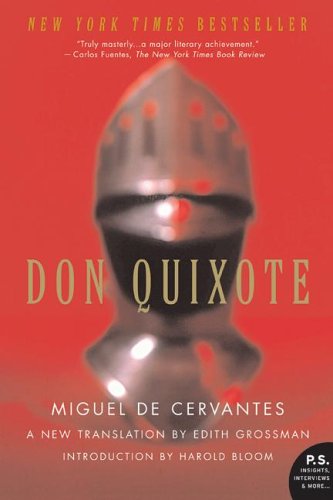
Don Quixote by Miguel de Cervantes

"Not mine," responded Sancho.  "I mean, there's nothing of the scoundrel in him; mine's as innocent as a baby; he doesn't know how to harm anybody, he can only do good to everybody, and there's no malice in him: a child could convince him it's night in the middle of the day, and because he's simple I love him with all my heart and couldn't leave him no matter how many crazy things he does."

I did it!  It took three weeks and a couple twelve-hour stretches in a rented car, but I finished Don Quixote.  I don't mean to make it sound like a slog; I probably would have finished it much more quickly if I hadn't been passing through some beautiful Montana scenery, because there's nothing really difficult or thorny about Don Quixote.  It's one of the most fun and readable "classics" I've ever read--though I'm sure part of that is Edith Grossman's recent translations, which really captures the spirit of Cervantes' up-to-date (for the time) Spanish.

Don Quixote, briefly, is a Spanish hidalgo, or nobleman, named Alonso Quijano who becomes obsessed with books of chivalry and knight errantry.  He reinvents himself as Don Quixote, the Knight of the Sorrowful Face (a name he takes on after he gets the crap beaten out of him), defender of the weak, champion of justice, devoted to the beautiful and peerless Dulcinea of Toboso--a fictional version of a peasant girl who lives in a nearby town.  Even if you're not familiar with Don Quixote, you probably know the famous image of him "tilting at windmills," that is, attacking a windmill imagining it to be a giant.  All 900 pages of the book are pretty much like that: Don Quixote imagines a commonplace person or thing is a giant or a witch or an enchantment, and tries to fight it, and ends up getting his ass kicked despite the protests of his loyal squire,  Sancho Panza.  Don Quixote's "madness" is a positive feedback loop, in which he dismisses any proof to the contrary as the work of enchanters:

"Well, Sancho, by the same oath you swore before, I swear to you," said Don Quixote, "that you have the dimmest wits that any squire in the world has or ever had.  Is it possible that in all the time you have traveled with me you have not yet noticed that all things having to do with knights errant appear to be chimerical, foolish, senseless, and turned inside out?  And not because they really are, but because hordes of enchanters always walk among us and alter and change everything and turn things into whatever they please, according to whether they wish to favor us or destroy us; and so, what seems to you to be a barber's basin seems to me the helmet of Mambrino, and will seem another thing to someone else."

Don Quixote is often praised not only as the first novel, but as anticipating most of the textual tools and tricks of modernist literature: First, Cervantes presents it as a translation of a Moorish author, Cide Hemete Benengeli.  Then, in the second part, published a decade or so after the first, Cervantes places Don Quixote and Sancho in a world where the first part of their adventures has become famous; the heroes, then, have to grapple with their own textuality.

To be sure, these aspects do a lot to make Don Quixote into a rich, fascinating text.  But Cervantes approaches the metafictional stuff with a very light touch; and in my opinion, it's not the most rewarding facet of the novel.  Don Quixote is really, great, I think, for two reason: First, the pervasive suggestion that Don Quixote is the one who is sane and everyone else who is insane.  I don't mean that Don Quixote is right that the windmills are giants or that the inn is a castle, of course, but rather that Cervantes is constantly forcing us to evaluate Don Quixote's philosophy against the attitudes of those around him.  He's frequently the butt of practical jokes invented by those who know about his "madness," from the priest and the barber of the first part to the duke and the duchess of the second; some are harmless, but many involve actual physical harm to Don Quixote.  Such cruelty and play-acting contrast sharply with Don Quixote's moral compulsion to protect those who need it.  Even when destroying a puppet show, Don Quixote seems to be the only one in the novel with a moral code:

"I shall not consent, in my lifetime and in my presence, to any such offense against an enamored knight so famous and bold as Don Gaiferos.  Halt, you lowborn rabble; do not follow and do not pursue him unless you wish to do battle with me!"

And speaking and taking action, he unsheathed his sword, leaped next to the stage, and with swift and never before seen fury began to rain down blows on the crowd of Moorish puppets, knocking down some, beheading others, ruining this one, destroying that one, and among many other blows, he delivered so power a downstroke that if Master Pedro had not stopped, crouched down, and hunched over, he would have cut off his head more easily than if it had been so much marzipan.

The second great thing about Don Quixote is the relationship between Don Quixote and his squire, Sancho Panza.  Sancho sometimes sees through his master's madness and sometimes does not; sometimes Don Quixote praises Sancho for his loyalty and sometimes he upbraids him for his cowardice and weakness, but ultimately Sancho's devotion to Don Quixote is one of the most convincing literary portraits of friendship I know of.

Don Quixote ends (spoiler?) with the Knight of the Sorrowful Face tricked into returning to his home and giving up knight errantry; once again becoming Alonso Quijano and promptly dying.  His friends and neighbors treat this as a great success, but there's an awful sadness to it.  Only the most cynical realist could think that the world is better off without Don Quixotes in it.

Friday, November 10, 2017

Lectures on Don Quixote by Vladimir Nabokov

. . . Don Quixote cannot be considered a distortion of those romance but rather a logical continuation, with the elements of madness and shame and mystification increased.

One might be forgiven for reading Mr. Nabokov's Lectures on Don Quixote and being unclear about what he thought of the novel. On the one hand, he testily chastises Cervantes for horribly bad descriptions of scenery, plot-holes, and poorly thought-out resolutions.

On the other, however, we have this, the closing lines to the lectures:

He had ridden for three hundred and fifty years through the jungles and tundras of human thought--and he has gained in vitality and stature. We do not laugh at him any longer. His blazon is pity, his banner is beauty. He stands for everything that is gentle, forlorn, pure, unselfish, and gallant. The parody has become a paragon.

Which is it then? Was Cervantes a genius or a fraud? Both, it seems. While critical of much of Cervantes's novel, Nabokov is quick to recognize the genius and beauty of Don Quixote. Nabokov feels that Quixote is a work of genius that holds up what would otherwise be a mediocre novel. In fact Quixote's character makes this novel not just good, but great.

There are two reasons to read this book. First, much like the characters bemoaning Quixote's death, when I finished the novel, I did not feel ready to say goodbye to the character of Quixote. Inspiring me to go through a not-subtle obsession with Quixote. See Exhibit A (photograph of carved pumpkin). Reading the Lectures gave me a chance to revisit and continue thinking about Quixote and what the novel means, or why it feels so meaningful.

Second, Nabokov's genius is, itself, on display here. So, the Lectures also present an opportunity to see how he tackles literary analysis. We get to see his jokes, his asides (the book is liberally footnoted to call to attention any speaking notes that Nabokov wrote for himself), and what themes or patterns Nabokov saw in the novel. Or, take, this, my favorite passage from the work:
It seems to me that the chance Cervantes missed was to have followed up the hint he had dropped himself and to have Don Quixote meet in battle, in a final scene, not Carrasco but the fake Don Quixote of Avellaneda. All along we have been meeting people who were personally acquainted with the false Don Quixote . We are as ready for the appearance of the fake Don Quixote as we are of Dulcinea. We are eager for Avellanda to produce his man. How splendid it would have been if instead of that hasty and vague last encounter with the disguised Carrasco, who tumbles our knight in a jiffy, the real Don Quixote had fought his crucial battle with the false Don Quixote! In that imagined battle who would have been the victor--the fantastic lovable madman of genius, or the fraud, the symbol of robust mediocrity? My money is on Avellaneda's man, because the beauty of it is that, in life, mediocrity is more fortunate than genius. In life it is the fraud that unhorses true valor.
Exhibit A
Here, Nabokov cannot help being himself--a writer--and improving on Cervantes's text. I have to admit, I prefer Nabokov's version, and there will always be a part of me that pretends his version is canon. (Incidentally: this passage is a good example of Nabokov's criticism of the novel. Nabokov's ending is poignant, parallels themes that run throughout Don Quixote and is itself ripe with meaning. Cervantes's version is...abrupt and almost feels like it was written because it just felt like it was time to wrap things up).

But then, who is Nabokov to criticize? It was Cervantes's genius, and not Nabokov's, who birthed Quixote.
As Cervantes would undoubtedly point out, it is not so easy to blow up a dog.

Sunday, August 13, 2017

Don Quixote by Miguel de Cervantes

Don Quixote's crazy, we're sane, and he walks away healthy and sane, while your grace is bruised and sad. So tell me who's crazier: the man who's crazy because he can't help it or the man who chooses to be crazy?

Somewhere in Nevada, in a place whose name I do not care to remember, a lady and gentleman lived not long ago, one of those couples who keeps a smooshy face dog and a terrier mutt for entertainment. The gentleman of this pair, decided that, for their honeymoon he would embark on an adventure, that being to read Don Quixote in its entirety, so one and only one book would need to be transported.

Generally when I read a piece of "classic" literature, I have a degree of apprehension because...sometimes classic literature is, like, boring, and stuff. Which is to say, a novel can enter the canon of literature because of its importance to the history of literature. This historical importance is, well, important, but for me, a more casual reader, it is sometimes uninteresting, particularly if the historical relevance is as to a literary movement I just don't care that much about.

I picked up Don Quixote to solve a practical problem: I needed something to read during our 3-week honeymoon to China, but did not want to deal with an e-reader or carrying multiple books. Don Quixote allowed me to carry one, large book that would be impossible for me to finish during the trip. I'd also started wondering about it because of its beloved status among writers I happen to love (e.g., Kafka, Nabokov).

At first, I was worried it'd be a slog. The first one hundred or so pages gave me the impression this would be 900 pages of anecdotes that follow this formula: Quixote's madness causes him to misinterpret a situation, he acts as he believes a knight-errant would in the situation, and he suffers physical or emotional punishment as a result. The initial anecdotes are amusing, but hardly something that can sustain engagement for so long.

But then something interesting happened. The anecdotes started getting funnier and funnier. For example, the famous windmill incident (130 pages in) is laugh-out-loud funny. And as the episodes got funnier, the relationship between Quixote and the other characters became more complicated. I started wondering if Quixote's madness was meant to reflect idealism of any sort, if the implication was that any kind of idealism is madness. And, I also started wondering if Quixote's madness was any worse than the madness of the characters around him, reflected in this quote:
Cide Hamete goes on to say that in his opinion the deceivers are as mad as the deceived, and that the duke and duchess came very close to seeming like fools since they went to such lengths to deceive two fools . . . .
And then (umm...spoilers ahead) the ending, which I cannot decide is meant to be tragic or ironic (or both?). Quixote's loved ones--in attempt to bring Quixote back to home life--engineer a duel that loses him his right to be a knight-errant. Quixote abandons knight-errantry and returns home with the plan of becoming a shepherd. At home, promptly falls ill, and sees the error of his ways; he realizes his entire journey of chivalry has been a waste. That everything was wrongheaded. After 900 pages in which the reader sees Quixote stubbornly refuse to acknowledge that knight-errantry is a false ideal, this is quite a shock. He disavows knight-errantry, repents, and then dies.  Yet, he death is heroic, one of the characters writes this for his epitaph:
Here lies the mighty Gentleman
who rose to such heights of valor
that death itself did not triumph
over his life with his death.
He did not esteem the world;
he was the frightening threat
to the world, in this respect,
for it was his great fortune
to live a madman, and die sane.
What are we to make of this? Is this the tragic death of a man who realized his ideals were wrong? Or the ironic death of a man whose idealism was not appreciated until he died? I don't know, but I'll close with Mr. Nabokov's opinion: "He stands for everything that is gentle, forlorn, pure, unselfish and gallant. The parody has become paragon."

Wednesday, January 1, 2014

Monsignor Quixote by Graham Greene

"Perhaps we are all fictions, father, in the mind of God."

I have had this book on my shelf for a long time, waiting to read it until I had finished Don Quixote.  As I have said before, I think that the compulsion to model or remake canonical texts is risky; most often the result is a constant reminder of how far short modern literature falls of our greatest forebears.  Graham Greene's Monsignor Quixote is no exception, I think.  While it is often touching and thoughtful, I thought that its attempts to reimagine the journey of Don Quixote and Sancho in post- Franco Spain were the least effective aspects of it.

Greene's Quixote is a priest, supposedly the descendent of Cervantes' hero.  He does not get on well with his superior, but his hospitality toward a bishop passing through La Mancha results in his nomination as a monsignor, which mortifies his sense of humility.  His friend Sancho, a Communist and former mayor of their town of Toboso, compels him to take a leave of absence and a brief trip to Madrid to purchase the purple socks and pechera of his new station.  In Greenesque fashion, the journey is complicated when the pair inadvertantly invite the attention of the Fascist police and end up on the run.

Monsignor Quixote and Sancho often pause to acknowledge, with a smirk, the parallels between their "journey" and Don Quixote's.  This approach works as well as it does because Greene wisely foregrounds it, keeping the protagonists aware of the allusions, and thus keeping Monsignor Quixote squarely in the metafictional tradition that started with Don Quixote's second part.  And the differences are just different enough--Sancho, for example, is no fool, but a cagey, thoughtful man.  Like Cervantes' heroes, the friendship between the two is unbreakable, even in the face of their philosophical differences.  I particularly liked a scene where Sancho takes the unknowing Monsignor to a whorehouse, where he tries to blow up a condom like a balloon.

Greene has a couple different goals here, I think.  He wants to draw a parallel between the two Quixotes, who are both committed to supposedly outmoded literary traditions.  Just as the Knight of the Sorrowful Face has his books of chivalry, the Monsignor has his Bible, and I think Greene is elegizing a Catholicism that he sees passing away in the conflicts of the mid-twentieth century.  At one point Sancho tells Monsignor Quixote that, were he to read the letters of Saint Paul, "I would find your taste as absurd as Cervantes found your ancestor's."  Yet that doesn't seem right; even while he pokes fun at Don Quixote, Cervantes always seems to hint that his outmoded moral code makes him a better and nobler man than the people he meets.

But also I think Greene is trying to envision a union of Catholicism and Communism that preserves the Church's commitments to the poor and the spiritual life in the face of venal capitalism.  I know Brent's favorite scene from this novel occurs at the end, where a feverish Monsignor performs a kind of "phantom" mass without the elements--an assertion of the power of even imaginary sacraments, though probably not theologically sound, with the Catholic insistence on Christ's immanence in the wafers and wine.  But my favorite scene is the one that occurs just before, when the Monsignor comes upon a small-town parade that includes an effigy of Mary papered in bank notes:

Father Quixote could not understand what he saw.  He was not offended by the customary image, with the plaster face, and the expressionless blue eyes, but the statue seemed to be clothed entirely in paper.  A man pushed him to one side, waving a hundred-peseta note, and reached the statue.  The carriers paused and gave him time to pin his note on the robes of the statue.  It was impossible to see the robes for all the paper money--hundred-peseta notes, thousand-peseta notes, a five-hundred-franc note, and right over the heart a hundred-dollar bill.  Between him and the statue there were only the priest and the fumes of the incense from his censer.  Father Quixote gazed up at the crowned head and the glassy eyes which were like those of a woman dead and neglected--no one had bothered even to lower her lids.  He thought: Was it for this she saw her son die in agony?  To collect money?  To make the priest rich?

Now, this scene wins no points for subtlety.  But it seems timely, like a lesson that we have yet to learn, one that is certainly as true in 21st century United States of America as it was in mid-century Spain.  Monsignor Quixote is far from my favorite Greene novel--I'm not sure it is measurably improved by the often-goofy references to Cervantes, which may even distract from what a strong and sympthetic character the Monsignor is.  But scenes like the one above continue to resonate--and perhaps even chasten me.

Friday, March 9, 2007

Don Quixote, by Miguel Cervantes

Of all the books I've reviewed on here, there are none of them as sweeping as Don Quixote. I began Book I back in June of 2006, and started Book II in January, so it's also been one of the more drawn out reading experiences of my life. That said, it's also been one of the most satisfying.

Summarizing Don Quixote is quite difficult, because describing the basic framework of the story doesn't even come close to doing it justice. Often described as the first modern novel, it manages to touch upon literary devices and genres that have only rose to prominence in the last 50 years, not bad for a book completed shortly after the King James Bible. Between the poetry, the interstitial novels, the occasional breaking of the fifth wall (and the indirect insertion of Cervantes himself into Quixote's word), Don Quixote as a literary powerhouse can't be overstated. But, is it any good?

I found Don Quixote to be an enjoyable read. At some points, particularly in the largely satirical first book, it read just as quickly and easily as any modern novel. In the second book, written not only to complete the story but also to make a statement about deceit, human cruelty, and plagiarism, the novel takes a darker turn, and the jokes played on Quixote and his squire Sancho Panza become so overblown that they inspire sympathy for the once-comic characters. As a result of the weightier second book, it's a bit more difficult to get through, particularly if you tackle it right after the first. I found that once I took some time off and approached book two on its own terms, it was well worth the read.


One last note: if you're considering reading Quixote, I recommend this translation (Edith Grossman). I had started several others previously, and found them amazingly dull.

Tuesday, August 5, 2008

Monsignor Quixote by Graham Greene

In some ways, Monsignor Quixote is similar to The Power and the Glory. Both feature, as their protagonist, a priest. In each, the protagonist is being run out of his parish by authorities. Both are grappling with their faith, and both become wandering envoys of the church, performing priestly duties wherever they are needed. Monsignor Quixote can, throughout most of its length, be seen as a lighter parallel story to The Power and the Glory.


Father Quixote is a humble parish priest, administering the host to his poor and uncommitted congregation in Toboso, hometown of Don Quixote. The lines between fiction and fact are blurred as Father Quixote claims to be a descendant of the infamous Don, and indeed, much of Monsignor Quixote resembles that famous story. And of course, it's impossible to pay tribute to Don Quixote without a Sancho Panza, so that role is filled by the Communist ex-mayor of Toboso, nicknamed (of course) Sancho. After helping a passing bishop whose car has broken down, Father Quixote is promoted to Monsignor, angering his local bishop and causing his resulting in his virtual exile from Toboso.


Throughout the novel, Father Quixote and Sancho journey through a series of vignettes that mirror the adventures of the Father's esteemed forefather. He helps a man on the run, and is later mugged by him; he tilts at some windmills; and he has lots of discussion of the worth of Catholicism vs. Communism. Although the Communism references seem a little dated (and Father Quixote's semi-endorsement of Marx seems a little heavy-handed), Father Quixote is another in Greene's line of sympathetic holy men, real people with real doubts and questions. Although Father Quixote never questions his devotion to the faith, he spends a large portion of the book questioning the necessity of Catholic ritual, arriving at conclusions sometimes orthodox and sometimes not.


The tone throughout is fairly light, but near the end, there's an absolutely stunning scene involving a somnambulist mass that ranks among Greene's best. It's a prime example of how hard-hitting Greene's writing can be, even in his minor works, despite his unwillingness to indulge in the sensational. Character and ideas are king, but, as in all of Greene's books, there's a driving undercurrent of drama, internal and external .


Monsignor Quixote is a minor work compared to The Power and the Glory or The End of the Affair, but behind its lighthearted premise and comical inspiration, there's substantial discussion of God, ritual, and the place of religion in the modern world.

Monday, January 1, 2018

2017: Randy's Reading Retrospective

What the hell happened, 2017? When I reflect back upon you, and my (narrow) Fifty Books Project participation, what sordid tales will my stats tell? Seventeen books? Only seventeen books?

Three of these "books" were The Paris Review--which has always had a dubious-at-best status as a "book." Six of them novels, of which half I was re-reading (One Flew Over the Cuckoo's Nest, The Satanic Verses, and The Gunslinger). Five--nearly one third--were in an amorphous and unexpected business self-help category (I am excluding these from consideration for my best-of because, well, because I can and it's a free goddam country goddammit. Don't tell me how to live my life.)

Setting aside the re-reads, The Paris Review, and the self-help books, I have three novels and three non-fiction. A measly six books. (Notably, of these six, I did manage to review five).

So, WTF, 2017? I'll say simply that the year has been busy in a way that made the Siren's song of my PS4 very difficult to resist. When I reflect back, I will see the forgiving arms of an understanding game console in a cold year.

With only seventeen books, a top-three feels right. Here they are:

<drum roll>

Bronze Medal: Executing Freedom: The Cultural Life of Capital Punishment in the United States

LaChance's book changed the way I think about the death penalty by causing me to think, for the first time, about what the death penalty represents culturally. It had never occurred to me to think about the death penalty culturally, so that merely engaging in the thought experiment would have accomplished much. However LaChance's insight also provided answers about the death penalty. The death penalty's role is clearer to me now than before. But the book did more than change the way I think about the death penalty, it also changed the way I think about our society. Die Hard is a different movie for me now because of this book, and I suspect many other movies or cultural phenomena will be different too.

Silver Medal: The Sense of Style: The Thinking Person's Guide to Writing in the 21st Century

Pinker's a book, which was a spontaneous purchase based on a half-remembered shadow memory, was a surprise strong finisher for the year. I expected to read a book that offered some helpful thoughts, but which would largely repeat truisms about writing I'd encountered over and over again before. Instead, I got a thoughtfully crafted book about the craft of writing and why good writing is good writing (and why bad writing is bad writing). In addition to the forest, though, I also got trees: Pinker gave not just the big-picture of good writing, but details too. For putting into words what I intuitively understood about good writing, and giving me the conceptual tools to be able to describe good writing, this book will have a lasting effect on my own writing.

Gold Medal: Don Quixote

Don Quixote was, reading-wise, a game changer. I became, and still am, obsessed with this book. I read Nabokov's lectures about it; I watched the musical Man from La Mancha; I am excited about this documentary; I am even more excited about this movie. I got Monsignor Quixote for Christmas. I cannot now get enough Don Quixote, and I am not sure I ever will. What is the nature of Quixote's madness, and what does it say about us? This question eats at me and the various versions of media playing with Quixote all allow me to think about it more. Are we all engaged in quixotic quests that we don't recognize? What (self-)deceptions guide us? Quixote will be back in 2018, this I believe.

Speaking of 2018: what windmills will I tilt at in the new year? I am two volumes behind in The Familiar: I will continue to review them as I read them. I think I am going to try reading the two volumes back to back to see if that helps with my relapsing memory of the plot and characters. There are some famed female writers who I'm ashamed to admit I've never read (Atwood, Munro, Bender), who I really would like to get to this year (Brittany gave me quite a look when I realized all my authors over the last year were male). So, only vague aspirations.

Still, looking forward to another year with Fifty Books.

Saturday, January 1, 2022

Randy's Top Books, 2020 & 2021!

 Well, don't I feel like an asshole. For the better part of ten years, I've been "doing" the Fifty Books Project, and for most of that time I (and, ostensibly Christopher) have lived with the quiet shame of posting few, if any, book reviews, but squeaking by with a consistent year-end review. December of 2020 rolled around,  I thought about my list, but I just didn't quite get pen to paper.

Then January 2021, I put if off, thinking, well, early February, will be okay.

And so on.

Anyway, with 2022 poking its head around the corner, and my stubborn refusal to ignore my 2020 books, I've decided to combine'em into one list. I'm going to think of this as my "pandemic" list, with all the naive optimism implied in hoping that my 2022 list will be disassociated from COVID.

Though it was weird to revisit my reading list going back to January 2020, which was both pre-pandemic, pre-parenthood, pre-2020 protests, and pre-an-eventful-for-my-family-Winter-2021. The person who read some of these books feels like a stranger to me now. Still, even that stranger is someone I might want to invite over for drinks in the future, so list his books I shall.

So, without more throat-clearing.

(10) 51 Imperfect Solutions by Judge Jeffrey S. Sutton
Judge Sutton presents an argument that we focus too much on the federal constitution and federal constitutional claims; instead, we should place more emphasis on state constitutions and state constitutional claims. For my line of work, and I think generally for rights/litigation generally, I think Judge Sutton is correct. State constitutions are the future. (even renowned Constitutional Scholar Erwin Chemerinsky agrees). Judge Sutton was my introduction to state constitutionalism, and I've spent a fair amount of time doing my own reading, trying to get up to speed. I have a dream/aspiration of writing a law review article about the Nevada Constitution, and if I ever do, it'll be because I read this book. (I have a lot of aspirations that I never seem to meet (ahem, like my 2020 book list...), though, so this'll probably just be something I spend an insufferable amount of time talking about and not following through with).

(9) Quichotte by Salman Rushdie
One of the curiosities of my life is that The Satanic Verses is one of my all-time favorite books and I somehow (a) don't have a copy of it and (b) for almost a decade it was the only Rushdie I'd read. when I heard about Quichotte, a novel-length engagement with Don Quixote--another of my all-time favorites--I knew I had to pick it up. And it did not disappoint. It's a good novel on its own, but it's also a very clever commentary on Don Quixote. I need to read more Rushdie. Maybe I'll finally get around to Midnight's Children so the 8,000 people who recommended it can feel vindicated when I tell them they were right to effusively demand I drop everything to start reading it.

(8) Piranesi by Susanna Clark
I am hesitant to say anything about this book because everyone should experience it knowing as little as possible about it. But I can't resist one comment: I love mazes. Literary mazes, literal mazes, metaphorical mazes. Mazes just really do it for me. You could say I'm amazed by mazes.

(7) On the Courthouse Lawn by Sherrilyn Ifill
With how much she accomplished at LDF, it's very easy to overlook that Sherrilyn Ifill was an accomplished academic first. This book engages with "official" complicity in lynching. The title is a reference to how lynchings would often take place on the courthouse lawn, erecting an intentional symbolic connection between extrajudicial killing and the legal system. Though I find many arguments against the death penalty compelling, this book is a good source for the argument that we should abolish the death penalty solely on the basis of its deep historical connection to enforcing racial hierarchy.

(6) Surviving Autocracy by Masha Gesson
I generally dislike books that merely collect columns into a single volume. Regular columns, pressing with relevance and urgency when published, often age poorly after even a couple of months. However, I missed nearly all of Gesson's columns as they were being published (I harbor an unfair prejudice against The New Yorker that I can't be bothered to try to explain); Gesson's columns aged very well; indeed, they probably became more relevant in the closing days of the Trump Administration, January 6, and the aftermath of both. I read a number of books to help me think about our current political situation. Gesson's was the best and most informative (for me, anyway). I'm sure both would dislike and probably dispute the comparison, but Gesson's work reminds me of Arendt, and I tend to think of Gesson as the closest we've got to a contemporary Arendt.

(5) Master of the Senate by Robert Caro
I don't know what to say about this book except that Caro is an extraordinary writer. I started reading his Lyndon Johnson biographies because of a Paris Review interview where he said that he wasn't so much interested in Lyndon Johnson as he was about how power worked. The biographies are true to that, and I find them interesting because they engage with the very human question of how we choose leaders/are led/lead. 

(4) Race-ing Justice, En-gendering Power: Essays on Anita Hill, Clarence Thomas, and the Construction of Social Reality, edited by Toni Morrison
The only book that motivated me to make time to write a review in the last two years. This is a collection of essays written all engaging with Anita Hill and Clarence Thomas. If someone were to ask for a single book to read about the Thomas Confirmation, I'd suggest this book, even over the more documentary books like Strange Justice (though Strange Justice is actually very good and worth reading too). This was my introduction to Toni Morrison's nonfiction writing, to Kimberle Crenshaw, and critical race theory (formally, anyway). (I know by typing those words, I risk being "canceled," but, like, what can you do, amirite?). A window into the debates surrounding the confirmation hearings, but also an extremely helpful primer on intersectionality, race, and sexual harassment.

(3) Thinking without a Banister by Hannah Arendt
Hannah Arendt's influence on me is so outsized at this point, I almost forgot to include this book on the list because I had so deeply internalized it that it felt like it went without saying. But, F it, right? It's 2022, maybe this is the year to say things that feel like they go without saying? I don't think I'd recommend this book to anyone unless they already have a pretty deep interest in Arendt's thinking, but for people with an interest, it's a spectacular collection that is a good way of being introduced to her thinking in a big-picture way (as opposed, say, to her other books which tend to be more focused on their specific topics). I finished this in the first weeks of the little one's life, and I kind of love that my memory of this book will always be intertwined with that experience.

(2) America on Fire by Elizabeth Hinton
I really struggled with whether this was my top book, or the #2 spot. Ultimately, I'm putting it here: America on Fire is objectively the more important book, the better book, and the only book from the last two years that I'd actually tell anyone--regardless of interests or background--they should read. I cannot emphasize enough how important this book is, or how instrumental it is for how I understand the racial justice protests of 2020. Hinton identifies a long history of protest--what she terms "rebellion"--and a longstanding pattern related to those rebellions, what she calls "The Cycle." This cycle of police violence-->rebellion-->commissions-->more resources to law enforcement-->more police violence, it's a cycle we're seemingly stuck in on endless repeat. But, the book also offers some hope, by looking to some positive developments over the last couple of decades. If I were going to suggest one book from my list for other people to read, it would be this one. Also, if you read it, you can then go watch me do a zoom hang with Dr. Hinton for our local NLG Chapter.

(1) The Cycles of Constitutional Time by Jack Balkin and Presidential Leadership in Political Time by Stephen Skowronek
What a cop out, right?! Two books in the number one spot?! Who does this A-hole think he is?! Humor me, please. Presidential Leadership puts forth a theory of political time that is, effectively: voting coalitions rise and fall, and certain kinds of presidents rise and fall with those coalitions. There is a patter to this: a candidate will recognize that a certain kind of voting coalition can be created, and will "revolutionize" the politics of his time by catering to that coalition, and then giving the coalition what it wants. This regime will then, more or less, run things; even if the other party wins elections, the opposing party's identity is basically defined in opposition to the regime's. But as time moves forward, it gets harder and harder for the regime to keep the coalition together. The individual components of the coalition get harder and harder to satisfy: the regime's success, ironically, makes it harder to maintain. Presidents fall into certain archetypes based on where in the "political time" of the regime they fall. Skowronek's point is that you can't judge a president in the early part of the regime the same way you'd judge one at the end of a regime because the presidents are confronting different kinds of political challenges (putting together a regime v. maintaining one). Balkin's book builds off this theory by thinking about its implications for constitutional law, and how federal judges and theories of constitutional interpretation play into "political time" To distinguish his discussion from Skowronek's, he refers to this as "constitutional time." These books combined made for my top read of the last two years because, as my wife will tell, I won't shut up about them; I also can't stop thinking about them. Though many books have been helpful in thinking about our current moment, these two books for me have defined the major issues I've thought about over the last 2 years. They have been the most helpful in thinking about this current moment within the context of the long-term challenges of our constitutional republic. And, for me, thinking about how those long-term challenges are playing out in the current moment, has been helpful in my thinking trying to understand WTF is happening in this world. (So, even though I'd give Hinton credit for writing a better and more important book, for me, subjectively, it's these two that have dominated my thoughts). Because the two books really are companions of each other, I felt justified having them share my top spot.

Anyway, assuming Christopher doesn't give me the boot after another recalcitrant year of inactivity, I'm looking forward to following the blog into 2022, and maybe even writing a review or two now and again. If you made it this far, I'm sorry for my clumsy narrative voice and obnoxious taste in books. See you 'round, 50bookers!

Sunday, February 25, 2007

Candide by Voltaire

Candide was recommended to me by Liz, another Fifty Booker, a couple of years ago. I knew that it was a work of satire, but beyond that, I had very little knowledge of the book.

Translations are extremely important in works such as this. The bookstore that I normally go to had about four different editions of Candide, so I pulled each one off the shelf and compared them side by side. This edition, translated by Leo Cuffe, was far superior to the others. The primary reason was the detailed endnotes (I wish they had been footnotes, instead) that helped to explain some of the passages whose meaning I no doubt would have missed. At many points the satire can only be fully appreciated with some specific knowledge, for which the endnotes were a valuable resource.

The book follows a young man by the name of Candide (Hey, that's the title of the book!) on his many misadventures. Throughout the book Candide's general outlook on life, that this is the best of all possible worlds, is continually tested. At times Candide is disturbingly graphic. Horrific fates befall many of the characters of the book.

Although it is only about a tenth as long, and was published nearly a century and a half later than Cervantes epic masterpiece, Candide bears many similarities to Don Quixote (a book that I am still working on). Both authors use their works to publicly skewer their enemies and critics, often without much subtlety. Much like Candide, Don Quixote and Sancho Panza are repeatedly presented with wild coincidences, such as running into friends they thought were dead, or encountering neighbors even though they are far away from home. This may be a tenet of satirical works of this period, for all I know. I am not that smart. Luckily you don't have to be too awful smart to enjoy this book.

Although at time bordering on naivete, there was something endearing about Candide's optimism. As he and his companions were faced with each calamitous incident, I found myself genuinely hoping that things would work out well for them. Do things work out well for them? Well, you'll just have to read it and decide for yourself.

Monday, December 23, 2013

Christopher's Top Ten of 2013

Alas, 2013!  I knew him well, Horatio.  I haven't posted all my reviews, and I won't be able to until I'm back in Brooklyn in January, but I did reach 50 once again--six out of seven years now.  Here are my ten favorites from this year of reading.

10.) The Optimist's Daughter by Eudora Welty -- This was a tough slot.  I might have easily put Herta Muller's The Appointment here or Nathaniel Hawthorne's The Blithedale Romance.  I'm going with The Optimist's Daughter because it continues to mystify me.  What begins as a story of an adult woman dealing with the death of her father and her acrimonious stepmother changes several times over until it's something stranger and less easy to categorize.

9.) Henderson the Rain King by Saul Bellow -- This is one of three Africa books I read this year (including No Longer at Ease and Out of Africa) and it's certainly the one that has the least to do with Africa as it really exists.  Bellow's Africa is an elaborate fantasy, but its message about the difficulty of living life fully is powerful and real.

8.) Speaker for the Dead by Orson Scott Card -- This was the year that Card's political conservatism caught up with him, as the Ender's Game movie forced to light some of the ugly and controversial things he's had to say about homosexuality in the past.  The thing that amazes me is that the Card who has said these things seems like a man who has never read Speaker for the Dead, much less wrote it.  The main idea of Speaker, like Ender's Game, is that it is impossible to truly understand anyone and not love them.  In this sequel Ender, disgraced but unknown, travels the universe "speaking" for the dead, as well as hoping to avert the destruction of another alien species by communicating exactly that kind of understanding.  Why is Card capable of imagining sympathy for pig-like aliens but not for homosexuals?

7.) Gilead by Marilynne Robinson -- I think I prefer Robinson's first novel, Housekeeping, but I will say that I think this book is more human and more sympathetic.  I'm not sure I've ever read a more honest and sympathetic portrayal of religion in human life.  And Robinson's prose, of course, is better than anyone else living.

6.) The Bell Jar by Sylvia Plath -- Knowing that Sylvia Plath's novel about a young woman's mental unraveling is pretty much autobiographical makes it an even more affecting read.  The way that the narrator, Esther Greenwood, moves from the typical anxieties of young adulthood to paralyzing depression is chilling--and sobering.

5.) The Lost Estate by Alain-Fournier -- I'll say it: Better than The Great Gatsby. 

4.) The Towers of Trebizond by Rose Macaulay -- Macaulay milks a lot of laughter out of the sight of her fellow Britons running around Turkey writing their "Turkey books," yet she's constantly aware that The Towers of Trebizond is exactly that: too wrapped up in itself to really say or even notice anything significant about Turkey.  Few other books I've read have been as consistently funny and deeply sad.

3.) Don Quixote by Miguel de Cervantes -- What is there left to say about Don Quixote?  It's our greatest book about friendship, and our greatest book about imagination.  Modern literature owes more to Cervantes than anybody, Shakespeare (probably) not excepted.

2.) The Private Memoirs and Confessions of a Justified Sinner by James Hogg -- My top two books this year are both from a class I took on the novel in the Romantic period.  Both are exceedingly strange.  The Private Memoirs are the story of a Puritan fanatic in Scotland who falls under the influence of his doppelganger, who convinces him to kill people for God.  Things do not go well for him.  I almost made this #1.

1.) The Monk by Matthew Lewis -- I think anyone who doesn't read literature written before fifty years ago because it's antiquated or stuffy ought to read The Monk.  It's got it all: Evil priests, Satanic pacts, forcible rape, infant corpses, dismemberment by demon, etc., etc.  This was my favorite book of the year because it was awesome.

That's a wrap!  As always, we're constantly looking for more contributors to our blog.  If you'd like to challenge yourself to read and write about fifty books in 2014, shoot me an e-mail at misterchilton at gmail dot com.

Thursday, January 1, 2009

Brent's Top 10 2008

At 9:00 on December 31st, I finished A Wind at the Door by Madeline L'Engle. That made 50 books for 2009, but didn't leave much time to write my backlogged reviews. A few of the books on my top 10 for the year don't havea proper review, so I'll leave all the 50bers with these capsule reviews and a pledge to do better next year.


Minor Spoilers.


The Martian Chronicles by Ray Bradbury

This collection of short stories built around mankind's repeated attempts to colonize Mars runs the gamut from humorous to chilling, sometimes within the same story. Less than 200 pages long, this, like most of Bradbury's work, doesn't waste a word.

In Two Words: Alien Sensation!


Bonfire of the Vanities by Tom Wolfe

Given its portenteous title and considerable length, I expected Bonfire to be tough. I read it on Chris's recommendation, and was glad to be proven wrong. Bonfire is at times hilarious, at times moving, and never dull. It satirizes the excesses of the 80's without the ironic distance characteristic of satire, and managed to make me sympathize with Sherman McCoy. Well-worth the read.

In Two Words: Flaming Fantastic!


Life of Pi by Yann Martel

Carlton recommended this to me, but, joke on him, I was already planning to read it. What plays as a religiously-tinged adventure story becomes a thought-provoking metaphor of the search for God, and has stuck with me longer than I expected.

In One Portmonteau: Indiancredible!


Monsignour Quixote by Graham Green

If 2008 stands out from a literary standpoint, it will be as the year I discovered Graham Greene. Although I've only read a few of his books, he may be the tightest prose stylist I've ever read. Very few of his books crack 250 pages, but they're all packed with thought-provoking scenarios and brilliantly simple turns of phrase. Monsignour Quixote is a riff on Don Quixote, one of my favorite books, and, although it's only the second best Greene I read this year, it didn't disappoint.

In Two Words: Monsignour Magnificent!


The Princess Bride by William Goldman

If you've seen the fantastic movie adaptation of The Princess Bride, nothing in the book is going to take you by surprise. However, the Granfather-Fred Savage framign device is replacing by a Pale Fire-esque commentating editor, and all the charm is fully intact. It was more fun than anything else I read this year, so it's on the list.

In Two Words: Truly Lovely!


Moby-Dick by Herman Melville

Unlike The Princess Bride, Moby-Dick could hardly be more different than its various adaptations. Although the base story, a sea captain's obsessive search for the mysterious white whale, is indeed in the novel, the narrative takes up maybe 1/3 of the book's 700 pages. The rest is a vast, infinitely interpretable metaphor for God, the human race, evil, obsession, all couched in the terminology of whaling and seafaring. If it sounds dull, I won't lie—sometimes it is. But the prose is beautiful and the whole, transcedent. It's also one of the primary forerunners of modernism and a serious contender for greatest American novel ever written.

In Two Words: FromHell'sDarkHeart IStabAtThee!


The Things They Carried by Tim O'Brien

I've never been a fan of war books, but The Things They Carried is hardly your standard war novel. Set in Vietnam, it's structured as a series of interconnected vignettes following the members of the O'Brien's company both in and out of wartime. It's gut-wrenching and never glorifying, which reminds me a little of my next entry.

In Two Words: Boom! Auuuuugh!


Slaughterhouse-Five by Kurt Vonnegut

I think I said everything I wanted to say about this book in my review, but it's great. Read it.

In Two Words: Kilgore Trout


Anna Karenina by Leo Tolstoy

Anna Karenina is the prototypical Russian great novel. A massive cast of characters, a setting in the 1800's, themes of redemption, Christianity, politics, fox hunting, and plenty of soap operatic melodrama. It also features Tolstoy's most brilliant passages, a forerunner to the stream-of-conciousness that dominated modernist literature. No one writes people like Tolstoy, and the Pevear/Volkhonsky translation reads as easily as Dan Brown.

In Two Words: Pevear Volkhonsky


The Power and the Glory by Graham Greene

When I finished The Power and the Glory, I knew it was very good. When began analyzing it and thinking about it afterward, I realized it was great. Greene's story of a persecuted priest in early 20th century Mexico is haunting and human in a way nothing else this year was. Greene's method of questioning Christianity, specifically Catholicism, is both thought-provoking and encouraging, and the whiskey priest's struggles are familiar to anyone struggling to reconcile or find faith in a world that doesn't always make sense. This has my highest recommendation and is one of the best books I've ever read.

In Two Words: Power, Glory


I intentionally read a lot more pulp this year, and it resulted in some real stinkers. Here they are, least bad first:


The Homing, Jeffrey Campbell – More like The Boring.


Doom: Knee Depp in the Dead, Dafydd ab Hugh and Brad Linaweaver – This book was better than I expected, but... I wasn't expecting much.


Basket Case, Carl Hiaasen – This book was so bad it almost put me off reading entirely. And, it was worse than Doom.


It's been great, everyone. See you in 2009.


Sunday, March 4, 2007

The Island of Dr. Moreau by H.G. Wells

Ah, 100-page books. While Brent is slaving away at Don Quixote and War and Peace, I'm pulling away from the crowd by reading books like The Island of Dr. Moreau. And yes, it is a legitimate book, not a comic book, Nathan, and not a short story, Alyson.

The plot of this book is likely known to you, either from the awful Marlon Brando/Val Kilmer flick or the countless parodies on The Simpsons and what-have-you. An intellectual named Edward Prendick is shipwrecked and ends up on a ship bound for the Island of Dr. Moreau, where he is kicked off with the Doctor's assistant Montgomery. Prendick remembers Moreau from a high-profile scandal in which Moreau was kicked out of London for mutilating cats in his experiments, and learns he has come to the island to continue with his work: creating people from animals. (Not, as some parodies might have you believe, combining humans and animals.)

This book, written in 1896, is one of the earliest examples of science fiction. As all great science fiction, the book's value lies not in the science but the social commentary. With the island's Beast People, who have been indoctrinated by Moreau with "the Law"--Don't walk on all fours, don't eat meat, don't scratch or claw, be human--Wells seems to suggest that we are captives of our own inner natures, as the Beast People cannot help but revert back to their feral ways. Moreau's attempt to "play God" fails utterly, perhaps undermining our concept of control over our own bodies and minds.

But it also displays what it one of science fiction's biggest faults, which is that the science dates it extremely. Moreau's methods have nothing to do with "genes" or "DNA," but "vivisection"--a word which seems almost arcane to us in light of modern science fiction, in which Dr. McCoy can fix your broken arm by waving a blinking box over your skin. Moreau teaches his beasts to talk and think, but never once uses the word "conditioning," an idea for which Pavlov didn't win the Nobel Prize until 1904. No modern reader would be fooled into thinking that Moreau could create a human being this way, though many at the turn of the century might, and that's a shame--for all its potential and even though much of it deals with worlds that don't yet exist, it tends to become dated much quicker than other literature.

Saturday, September 16, 2017

The Crossing by Cormac McCarthy

You will see.  It is difficult even for brothers to travel together on such a voyage.  The road has its own reasons and no two travelers will have the same understanding of those reasons.  If indeed they come to an understanding of them at all.  Listen to the corridos of this country.  They will tell you.  Then you see in your own life what is the cost of things.  Perhaps it is true and nothing is hidden.  Yet many do not wish to see what lies before them in plain sight.  You will see.  The shape of the road is the road.  There is not some other road that wears that shape but only the one.  And every voyage begun upon it will be completed.

Cormac McCarthy's The Crossing opens with a vagrant Native American--an Indian, in the language of young Billy Parham, the young rancher's son who is the novel's protagonist--coming upon Billy and his brother Boyd out in the wilderness around their New Mexico home.  He demands under threat that Billy and Boyd steal food from their parents and bring it to him, which they do.  That is to say that it begins more or less like Great Expectations.

But the Indian never returns.  He never comes back to pay his respects or to menace further; when Billy's parents are murdered by horse thieves there's no intimation that it's the Indian who's responsible.  He comes on the page and plays his part and then leaves.  Don't look for coincidences, McCarthy seems to say; don't expect the shapeliness of a literary story, even as one of the themes of the book is the way that we use stories to shape our knowledge about the world which is essentially unknowable.

The Crossing is really three separate crossings.  In the first, Billy traps a pregnant shewolf that has been terrorizing his family's cattle and resolves to bring her, muzzled in a homemade strap, back to her home in the mountains of Mexico.  But she ends up being taken hostage by a traveling feria and made to fight dogs.  Billy, unable to secure her freedom, ends up shooting her.  It's a Ned Stark-level surprise, because to this point it seems as if the thrust of the novel is about Billy and the wolf, but just like the opening episode with the Indian, McCarthy enjoys dashing our narrative expectations.  The second crossing is when Billy returns with his brother Boyd to Mexico in order to hunt down the horses that have been stolen from his family's farm when his parents were murdered--an event that Boyd stayed home to witness, hardening him and making him alien to Billy, whose priority is protecting him.  The third is when Billy returns to Mexico to find Boyd, who has been shot in the chest and run off with a young Mexican girl.

Each of these plays like a dreamscape, or a nightmare.  The Parhams' adventures in Mexico are episodic and lyrical, containing hundreds of characters who may appear for no more than a page or two.  There's a blind man whose explanation for his blindness is straight out of a more baroquely violent McCarthy novel like The Road or Blood Meridian, the primadonna of a traveling theater company, a band of gypsies towing a downed airplane.  It reads something like a cross between Dante and Don Quixote.  Oh, and most of the dialogue is in untranslated Spanish. 

I've found that reading McCarthy is more fun when you approach it with a sense of humor.  It keeps you from rolling your eyes when he writes sentences like, "Dreams of that malignant lesser god come pale and naked and alien to slaughter all his kin and rout them from their house."  Paradoxically, I think it makes me more receptive when McCarthy is most profound, when he deals with his major theme, which is the essential unknowability of the universe:

Finally he asked him why this was such a blessing and the blind man did not answer and did not answer and then at last he said that because what can be touched falls into dust there can be no mistaking these things for the real.  At best they are only tracings of what the real has been.  Perhaps they are not even that.  Perhaps they are no more than obstacles to be negotiated in the ultimate sightlessness of the world.

Stories, for McCarthy, are also "tracings of the real," as the corrido ballads which strike Billy as being about his missing brother's courageous and tragic exploits.  As someone explains to him, the stories are older than his brother, but his brother has become a part of them, and that is a kind of truth that is as real as any other we might trust in.  That is, not very real at all, but whatever reality is we don't have access to it.  McCarthy's at his best--and his scariest--when thinking about these things.

The book ends with Billy alone in an abandoned building back in New Mexico.  He shoos away a dog, and wakes up to a false dawn before the real one and weeps.  I could be wrong but my guess is that this is meant to be the Trinity Test, the testing of a nuclear bomb in the New Mexico desert months before it was used on Japan.  It's as ominous an ending as any of McCarthy's novels has, a suggestion of the grandeur of evil beyond the reckoning of any individual human being, and a foreshadowing of a novel like The Road. 

Thursday, January 3, 2019

Brent's Top 10 of 2018

Another year, another 50+ books, another embarassing review shortage--but what a great year of reading! I think 2018 might be the most exciting set of books I've tackled yet, and I attribute a lot of that to my decision at the end of last year to read at least half books by women. I also made a concious effort to read less mainstream "classics", and branched a little--into biography, economics, politics, history. But, as usual, the most illuminating works were fiction. So without further ado, the 10 best books I read this year, in no particular order.

Middlemarch - George Eliot
I've read a lot of the classic  doorstops, but Middlemarch sits right at the top of the list  alongside The Brothers Karamazov and Don Quixote. A wonderfully written pastoral with plenty of drama, humor, and fantastic characters, Middlemarch is really in this spot because it was the warmest, most human book I read this year. In spite of its scope, the action takes place on the ground, in kitchens, libraries, chilly estates, taverns, and the people--Dorothea, Casuabon, Lydgate, Rosamund--whose lives revolve around these seemingly mundane things.

The Man Who Loved Children - Christina Stead
If Middlemarch was the warmest book I read this year, The Man Who Loved Children was probably the second chilliest (Anna Kavan's excellent but inscrutable Ice was the first). In addition to the incredibly dysfunctional family at its center, Stead's dialog is both prevalent and cryptic--the book teaches you how to read it but it never goes down smooth. I don't even know if I entirely liked it. But it's so singular and so true somehow, so cruel and unsettling, it deserves to read.

The Death of Ivan Illych and Other Stories - Leo Tolstoy, trans. Pevear/Volkhonsky
My wife Liz read Anna Karenina this year, and it inspired me to pick up this collection fo Tolstoy's short stories and novellas. And boy, were they (mostly) bleak. This collection was laregly composed in the twilight of Tolstoy's life, and, having read War and Peace (an optimistic, early work) and Anna Karenina (a later, mixed bag on the optimism front), I felt I could see Tolstoy's faith in humanity dying. But almost every story ends with a burst of something ineffable, and those bursts--and Tolstoy's unfailing sense of how people act--make everything he wrote worthwhile.

Lives of Girls and Women - Alice Munro
This is, I believe, the fourth collection I've read of Munro's, and it might be the best overall. It's certainly the most consistent. It's basically a novel where every chapter can be read as a standalone. The average Munro story already feels like a novel waiting to happen--it was nice to read a collection where it did.

The Odyssey - Homer, trans. Emily Wilson
This was a bucket list book for me, and I'm so glad I read it first in Wilson's incredibly readable (but still very elegant) translation. It's much less of a pure hero story than I expected--Odysseus might be the first antihero. But the journey's fantastical and encompasses SO MUCH Greek mythology. It's really a lot of fun. Even if you've read The Odyssey before, it's worth picking up Wilson's translation for her great introduction, where she discusses the challenges of translating such a well-known work.

Death Comes for the Archbishop - Willa Cather
I don't love reading about landscapes but I DO love reading about priests. And I actually did love reading Cather's landscapes which, like McCarthy's, capture the feeling of the western US like most can't. The most impressive thing about this slim novel though is the way its loose structure comes together at the end to present a beautiful picture of a life well-lived and a death that feels like bliss instead of terror.

Lincoln in the Bardo - George Saunders
And speaking of death, George Saunders' fictionalization of the death of Abraham Lincoln's son was probably the most moving thing I read this year. I lost an aunt I was very close to unexpectedly in a car accident and the chapter near the end where Willie finally finds peace for himself and the other wandering souls in the Bardo graveyard has come to mind many times. And of course, Saunders is in contention for greatest livign American writer so the prose is inventive and wonderful.

My Brilliant Friend - Elena Ferrante
This book is everywhere and they just made an HBO series about it. But it's still good, a brilliant (see what I did there?) realistic novel about two girls in Italy and their complicated relationship in a time of political and social turmoil in Italy. Really looking forward to reading the other 3 volumes, and Ferrante's other work.

The Autobiography of Malcolm X - Malcom X and Alex Haley
What can I say about this? Certainly one of the most influential autobiographies of the 20th century, Malcolm's rags-to-riches story is given extra dramatic weight due to Haley's decision not to allow Malcolm to rewrite the earlier sections of the book after his acrimonious break from his spiritual mentor Elijah Muhammad, and the result is an autobiography with the dramatic structure of a novel. Malcolm touches on everything--religion, race, class, civil rights, Muhammad Ali--and the final chapter, which Haley wrote after Malcom's death, hits like a brick.

Warlock - Oakley Hall
I love a good western. And Warlock is a very good western. I actually reviewed this one so I won't say much about it here, except that it's really a joy to read about cowboys, outlaws, blood feuds, and all the rest, and still find space to be surprised.

And that's a wrap. I could include almost every other book I read this year in my honorable mentions, but instead, I want to mention Current Affairs, the great online magazine that I spent about half my time this year reading on my journey out of American Capitalism. So on that note, please join us for 2019! It's going to be a good year.


Sunday, December 31, 2006

Brent's Books

50. Underworld
Don DeLillo
49. Middlesex
Jeffrey Eugenides
48. Eats, Shoots & Leaves
Lynn Truss
47. How to Be Alone
Jonathan Franzen
46. The Optimist's Daughter
Eudora Welty
45. Invisible Monsters
Chuck Palaniuk
44. As I Lay Dying
William Faulkner
43. The Corrections
Jonathan Franzen
42. Huckleberry Finn
Mark Twain
41. Never Let Me Go
Kazuo Ishiguro
40. For Men Only
Jeff & Shaunti Feldham
39. Cosmopolis
Don Delillo
38. Of Human Bondage
M. Somerset Maughm
37. Lolita
Vladmir Nabokov
36. No Country For Old Men
Cormac McCarthy
35. The Road
Cormac McCarthy
34. The Wind-Up Bird Chronicle
Haruki Murakami
33. A Prayer for Owen Meany
John Irving
32. Amsterdam
Ian McEwan
31. Thud!
Terry Pratchett
30. Vernon God Little
DBC Pierre
29. Harry Potter and the Half Blood Prince
J. K. Rowling
28. Shadow of the Torturer
Gene Wolfe
27. Anansi Boys
Neil Gaiman
26. The Greedy Bastard Diary
Eric Idle
25. Superstud
Paul Fieg
24. Notes from the Underground
Fyodor Dostoevsky
23. Live From New York: An Uncensored History of Saturday Night Live
Tom Shales / James Andrew Miller
22. Dress Your Family in Corduroy and Denim
David Sedaris
21. Scavenger Hunt
Christopher Pike
20. East of Eden
John Steinbeck
19. War and Peace
Leo Tolstoy
18. Pale Fire
Vladmir Nabokov
17. Flatlands
Edwin Abbot
16. Black Swan Green
David Mitchell
15. The Screwtape Letters
C.S. Lewis
14. Water for Elephants
Sara Gruen
13. The Revival We Need
Oswald J. Smith
12. One Flew Over the Cuckoo's Nest
Ken Kesey
11. Coincidences, Chaos and All That Math Jazz
Edward Burger / Michael Starbird
10. Harry Potter and the Order of the Phoenix
J. K. Rowling
9. Song of Susannah
Stephen King
8. Don Quixote
Miguel Cervantes
7. The Innocent Man
John Grisham
6. Ender's Shadow
Orson Scott Card
5. American Jesus
Stephen Prothero
4. Out of the Silent Planet
C. S. Lewis
3. Ethan Frome
Edith Wharton
2. Pyramids
Terry Pratchett
1. Watership Down
Richard Adams

Thursday, December 10, 2015

Ficciones by Jorge Luis Borges

The composition of vast books is a laborious and impoverishing extravagance.  To go on for five hundred pages developing an idea whose perfect oral exposition is possible in a few minutes!  A better course of procedure is to pretend that these books already exist, and then to offer a resume, a commentary.  Thus proceeded Carlyle in Sartor Resartus.  Thus Butler in The Fair Haven.  these are works which suffer the imperfection of being themselves books, and of being no less tautological than the others.  More reasonable, more inept, more indolent, I have preferred to write notes upon imaginary books.

I recently moved.  During that ordeal, almost all of my books were packed up, and I was forced for a whole month to raid the book room at the school where I teach for stuff to read.  That was fortuitous, actually, otherwise I would not yet have gotten around to reading Borges' short story collection Ficciones, or Hemingway's The Snows of Kilimanjaro, or Alison Bechdel's terrific graphic memoir Fun Home.  But Borges' stories, stuffed as they are with labyrinths, and stories nested within stories like boxes within boxes, actually seemed reminiscent of my apartment while I was packing.

So I lived in a "Garden of Forking Paths" for a little while--but in a less tongue-in-cheek way, the famous story of that title did make me think about the way I ended up here, at this moment, moving to this place with this person, when it might so easily have been otherwise.  "The Garden of Forking Paths" is about a Chinese spy for the German government, living in Britain, who murders a renowned Sinologist because the man's name, Albert, will reveal the location of a similarly named artillery park when his name is published in the newspaper.  Albert is familiar with the legend of the narrator's grandfather, who vanished leaving his two goals unfinished--to write an intricate novel, and to create an equally intricate labyrinth.  The book and the labyrinth, Albert tells the narrator, are the same; the book sought to encompass all of the possible paths that fork in time, branching off at the junction of each decision.  And yet it is not a labyrinth we can navigate or escape, for as the narrator says:

Then I reflected that all things happen, happen to one, precisely now.  Century follows century, and things happen only in the present.  There are countless men in the air, on land and at sea, and all that really happens happens to me.

Borges' stories are all like that, tangled intellectual knots on the subjects of time, fiction, and imagination.  Many of them are only brief commentaries on longer works that never existed, playing with the illusory border between fiction and the real.  In "Pierre Menard, Author of the Quixote," he writes a fictional memoir about a fictional author whose masterwork is a line-for-line reproduction of Don Quixote, which surpasses the original because the 300 intervening years have made its allusions richer.  In "The Library of Babel," he describes a universe which is comprised of a massive library, where all books are composed of random letters and punctuation.  Those born into this universe reason that all information must be somewhere in the library--each person's biography, predictions of the future, even the full index of the library's own contents--and go mad searching for sense among the nonsense.  Their predicament sounds grotesque--but is it different from our own experience, searching for patterns in a random universe to create meaning?

I was surprised how philosophically dense most of these stories are.  In "Tlon, Uqbar, Orbis Tertius," he describes a conspiracy to create an imaginary country, Tlon, which becomes a discussion of metaphysics and subjective idealism, the philosophy which maintains only minds and ideas exist.  (At the end of the story, Borges suggests that the real world is becoming, or merging with, the imaginary Tlon!)  The influence of Borges is easy to spot, but it's hard to name a writer with the same kind of intellectual heft, or the compelling brevity.

Sunday, December 31, 2006

Christopher's Books 2013

50. The Revenger's Tragedy
by Thomas Middleton
49. The Man in the High Castle
by Philip K. Dick
48. Out of Africa
by Isak Dinesen
47. Speaker for the Dead
by Orson Scott Card
46. Monsignor Quixote
by Graham Greene
45. The Member of the Wedding
by Carson McCullers
44. The Lais of Marie de France
by Marie de France
43. How Soon is Now?
by Carolyn Dinshaw
42. Wolf Hall
by Hilary Mantel
41. The Letters of Abelard and Heloise
by Peter Abelard and Heloise d'Argenteuil
40. The Life of Christina of Markyate
by Anonymous
39. The Death and Life of Great American Cities
by Jane Jacobs
38. The Radetzky March
by Joseph Roth
37. The Metamorphosis, In the Penal Colony, and Other Stories
by Franz Kafka
36. The Adventures of Huckleberry Finn
by Mark Twain
35. Song of Solomon
by Toni Morrison
34. All Quiet on the Western Front
by Erich Maria Remarque
33. Oranges Are Not the Only Fruit
by Jeanette Winterson
32. The Bell Jar
by Sylvia Plath
31. Nineteen Eighty-Four
by George Orwell
30. Kindred
by Octavia E. Butler
29. Don Quixote
by Miguel de Cervantes
28. Catcher in the Rye
by J. D. Salinger
27. Hamlet
by William Shakespeare
26. The Rainbow
by D. H. Lawrence
25. A Wizard of Earthsea
by Ursula K. LeGuin
24. On Ugliness
by Umberto Eco
23. Maurice
by E. M. Forster
22. The Optimist's Daughter
by Eudora Welty
21. Gilead
by Marilynne Robinson
20. The Lost Estate
by Alain-Fournier
19. Human Voices
by Penelope Fitzgerald
18. The Loved One
by Evelyn Waugh
17. The Last Man
by Mary Shelley
16. The Private Memoirs and Confessions of a Justified Sinner
by James Hogg
15. Hard Times
by Charles Dickens
14. Waverley
by Sir Walter Scott
13. Northanger Abbey
by Jane Austen
12. Loitering with Intent
by Muriel Spark
11. The Blithedale Romance
by Nathaniel Hawthorne
10. The Monk
by Matthew Lewis
9. The Italian
by Ann Radcliffe
8. Mary, or the Wrongs of Woman
by Mary Wollstonecraft
7. Caleb Williams
by William Godwin
6. Maphead
by Ken Jennings
5. No Longer At Ease
by Chinua Achebe
4. Henderson the Rain King
by Saul Bellow
3. The Towers of Trebizond
by Rose Macaulay
2. Glittering Images
by Camille Paglia
1. The Appointment
by Herta Muller