Showing posts with label toni morrison. Show all posts

Saturday, September 14, 2024

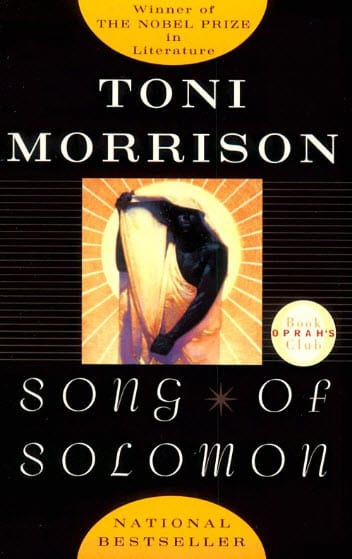
Song of Solomon by Toni Morrison

Every night now Guitar was seeing little scraps of Sunday dresses--white and purple, powder blue, pink and white, lace and voile, velvet and silk, cotton and satin, eyelet and grosgrain. The scraps stayed with him all night and he remembered Magdalene called Lena and Corinthians bending in the wind to catch the heart-red pieces of velvet that had floated under the gaze of Mr. Robert Smith. Only Guitar's scraps were different. The bits of Sunday dresses that he saw did not fly; they hung in the air quietly, like the whole notes in the last measure of an Easter song.

Four little colored girls had been blown out of a church, and his mission was to approximate as best he could a similar death of four little white girls some Sunday, since he was the Sunday man.

How could a novel like Song of Solomon exist? It's so overloaded with moments, images, ideas; it actually seems to totter like an overburdened basket, sure to fall over. Although I haven't read all of Morrison's books, I feel safe in saying that only Beloved comes close to the sheer scope and audacity of this novel (and in my opinion, Solomon easily outpaces it). I'm planning on teaching it for the first time in many years, and for every key detail that stuck in my mind--the doomed flight of the insurance salesman at the beginning of the novel, Milkman earning his nickname by feeding at his mother's breast well into his childhood, Pilate's name hanging from a box in her ear--there's another that I had forgotten all about--Reba's uncanny luck, Circe luxuriating in her dead master's house with her pack of dogs, Hagar's attempts to murder Milkman... How does it all manage to work together?

The word that comes to mind for me when reading Song of Solomon is "inheritance." What can be handed down, and what must be left behind? The inheritances in Song of Solomon are often unwanted: Milkman inherits his father Macon's self-centeredness and materialism in the same way that the mistaken name "Macon Dead" is passed down through the generations. Pilate's name is essentially meaningless, plucked out of the Bible by an illiterate father, and yet she treasures it by keeping it in her ear. Men and women fight to pass on their own secret souls to their children; when Ruth continues to give the child Milkman her breast, it seems to me that she is trying to claim him by bestowing something upon him from his own body, and thus fend off the cruel, possessive Macon's more aggressive claims on her only boy. In contrast, Pilate's navel-less stomach shows how her mother died in childbirth and was unable to pass anything on at all. And, of course, there's the literal inheritance of the book, a bag hanging from Pilate's ceiling that Macon believes contains a stash of gold they discovered together in the wake of their father's death. The bag of gold is one of literature's most powerful MacGuffins, and through a series of convoluted turns, is transformed into something far more meaningful, a real inheritance. (Although, having read this book probably four times now, I don't think I can faithfully render the shaggy dog story that results in Pilate stealing her own father's bones without knowing it.) Milkman's journey into the South undoes the great migration and performs inheritance in reverse, seeking out the secret messages and forms that lurk in his own psyche in the same veiled way as the song that children in Virginia sing about his ancestor, Jake Solomon.

But for my money, nothing in Song of Solomon is as effective or unnerving as the character of Guitar and the group of the Seven Days. Guitar is Milkman's best friend, but he comes from poverty while Milkman comes from the Black upper class. He routinely chides Milkman for caring too little about civil rights, and he's right, but Guitar's sense of bitter injustice leads him to join the Seven Days, who are tasked with "keeping the balance" by murdering an equivalent white person whenever a Black person is killed by white. (Guitar's ultimate turn against Milkman is fed by the need to fund a mission to kill four white girls after the Birmingham church bombing of 1963). What is so frightening and effective about Guitar is that his terror ideology is seductive and compelling. The reasoning is wonky, bordering on innumerate--you don't "balance" unequal amounts by removing the same number--but the larger logic of a people who face a true existential threat is hard to dismiss, especially when compared to Milkman's wishy-washiness and naivete. The Seven Days are Morrison's Grand Inquisitor: a way of thinking that the novel rejects but nonetheless finds too powerful to entirely expunge. 

Sunday, June 18, 2023

Corregidora by Gayl Jones

I wanted a song that would touch me, touch my life and theirs. A Portuguese song, but not a Portuguese song. A new world song. A song branded with the new world. I thought of the girl who had to sleep with her master and mistress. Her father, the master. Her daughter's father. The father of her daughter's daughter. How many generations? Days that were pages of hysteria. Their survival depended on suppressed hysteria. She went and got her daughter, womb swollen with the child of her own father. How many generations had to bow to his genital fantasies? They were fisherman and planters. And you with the coffee-bean face, what were you? You were sacrificed. They knew you only by the signs of your sex. They touched you as if you were magic. They ate your genitals. And you, Grandmama, the first mulatto daughter, when did you begin to feel yourself in your nostrils? And, Mama, when did you smell your body with your hands?

Ursa Corregidora is a singer in a blues club. When her husband, Mutt, throws her down the stairs, she goes to live with Tadpole, the club owner and her employer. Tadpole is protective, but perhaps possessive, too, and soon she is divorced from Mutt and married to Tadpole, though Mutt and his associates seem to always be watching from outside the door of the club. The incident makes Ursa begin to rethink her relationship with the men in her life, and it forces her to think about the story of Corregidora, the Portuguese slaveowner who was the father of both her great-grandmother and her grandmother--if you catch by meaning. Ursa is one of "Corregidora's women," a phrase that originally referred to those enslaved women who Corregidora pimped out--to himself, his wife, to others--but now refers to those who, through the cumulative effects of history, bear Corregidora's thumbprint.

In her memories, Ursa reflects on her grandmother's and great-grandmother's urging to do what must be done "for the generations," that is, the lineage of children and grandchildren that bring their heritage--and Corregidora's--into the future. But Ursa is pregnant with Mutt throws her down the stairs, and she loses not just the baby but her uterus as well. No matter what she thinks of her ancestors' urging, Corregidora's lineage will end with Ursa. But the shadow of Corregidora lives on in the men, both Mutt and Tadpole and others, who, despite being the descendants of slavery and oppression themselves, enact the same slaveowner logic that characterized Corregidora's life. Tadpole's consideration veers quickly into a resentment and possessiveness that mirrors Mutt's. The most profound suggestion Jones makes in Corregidora is that patriarchal masculinity and enslavement are intertwined, and that while the latter may no longer be around, the former still acts upon "the generations."

One of the interesting, and rather muted, things about Corregidora is that, while it's set in Kentucky, the particular story that Ursa tells has its roots in Brazilian, not American slavery--if I'm understanding it right. It took Brazil another quarter century after the civil war to outlaw slavery--a whole generation. That contributes, perhaps, to the vividness of the memory of Corregidora that Ursa still carries, but Jones also suggests that the psychic and sexual wounds of slavery are not easily forgotten or left behind. The prose alternate between a kind of fractured modernism, like the quote up top, and the brisk march of dialogue. Famously, it took the championing of Toni Morrison to get Jones' novel into print, and though it's a much different novel than Morrison's richer, more complex books, it's not hard to see what she saw in it.

Thursday, May 2, 2019

Home by Toni Morrison

It was so bright, brighter than he remembered.  The sun, having sucked away the blue from the sky, loitered there in a white heaven, menacing Lotus, torturing its landscape. but failing, failing, constantly failing to silence it: children still laughed, ran, shouted their games; women sang in their backyards while pinning wet sheets on clotheslines; occasionally a soprano was joined by a neighboring alto or tenor just passing by.  "Take me to the water  Take me to the water.  Take me to the water.  To be baptized."  Frank had not been on this dirt road since 1949, nor had he stepped on the wooden planks covering the rain's washed-out places.  There were no sidewalks, but every front yard and backyard sported flowers protecting vegetables from disease and predators--marigolds, nasturtiums, dahlias.  Crimson, purple, pink, and China blue.  Had these trees always been this deep, deep green?

Out on the west coast, Korean War vet Frank Money gets a note saying that his sister Cee, still in their hometown of Lotus, Georgia, is in danger.  Frank swore that he would never go back to Lotus, but his love and concern for Cee draws him back, and he embarks on a cross-country train trip to save her from the ambiguous threat.  A dissociative outburst has placed him in a psych ward, and so he goes without money (or shoes), depending on the kindness of strangers and navigating the complexities of segregation.  Back in Lotus, Cee has taken a job with a eugenicist who is using her for grotesque uterine experiments.

Frank Money has a pretty Toni Morrisonesque name, and this is a pretty Toni Morrisonesque novel.  Like Milkman's journey to his ancestral Southern home in Song of Solomon, Frank's journey is a variation on The Odyssey, and the contours are clear from the jump: Frank will finally get home, but not without facing some real weirdness on the way, and his rescue of Cee will help him reintegrate into his home and perhaps heal himself where he's been scarred by the horrors of war.  But too often Home feels like the outline of a Toni Morrison that's never been fully developed.  Its 140 pages (with big font) are too tight to really give the impression that Frank's journey home is an undertaking, rather than a mere symbol, and Morrison's penchant for giving every minor character a turn in the narrative spotlight means the two protagonists get crowded quickly to the corners.  The classic elements of her other novels are all there, the weirdnesses--Frank's vision of the world draining of color, a mysterious apparation in a zoot suit--but they hang too heavily on the slight narrative.

The most interesting thing about Home are the interstitial chapters narrated by Frank himself.  Morrison loves to play around with point of view (The Bluest Eye, in particular, shifts between first and third person), but the sudden realization that Frank is writing to the author herself is a welcome and worthy surprise.  He admits to her that the story he's writing is not quite an accurate one, that the narrative she gives of his time in war--from where, or whom?--minimizes his own culpability in the atrocities there.  That's an inspired choice, and it makes me wish there had been a more effective novel shaped around it.

Tuesday, November 7, 2017

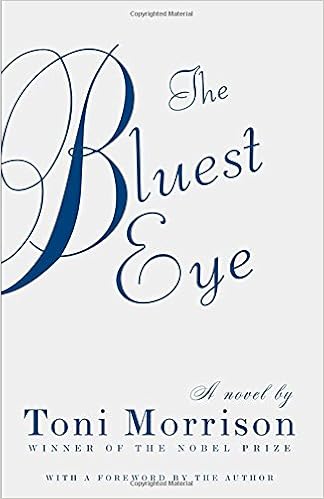
The Bluest Eye by Toni Morrison

I thought about the baby that everybody wanted dead, and saw it very clearly.  It was in a dark, wet place, its head covered with great O's of wool, the black face holding, like nickels, two clean black eyes, the flared nose, kissing-thick lips, and the living, breathing silk of black skin.  No synthetic yellow bangs suspended over marble-blue eyes, no pinched nose and bowline mouth.  More strongly than my fondness for Pecola, I felt a need for someone to want the black baby to live--just to counteract the universal love of white baby dolls, Shirley Temples, and Maureen Peals.

The first time I read The Bluest Eye, I found it to be pretty scattered, if I recall correctly.  It dwells in digressions, piles symbols upon symbols, often in a way that I found distracted from the central images of white baby dolls and blue eyes that give the novel its title.  Among other things, Morrison commits a cardinal literary sin by writing an important character--the mystic fraudster Soaphead Church, who "grants" Pecola her blue eyes--into the very end of the book, where he works the action necessary for the climax.

But Soaphead is such a fascinating character, I quickly brushed that sin aside.  Reading it a second time, those flaws, if that's what they are, failed to appear.  Because I knew the climax and Soaphead were coming, it freed me up to ignore the narrative movement of the book and really appreciate how painstakingly crafted each disparate part of the book is: Soaphead, the interludes that track the life of Pecola's mother and father, all of it.  Each of these stories is so perfectly wrought and self-contained they could exist outside of the novel without losing anything, though they also provide its halting, irregular character.  Morrison risks distracting from the intense, immense tragedy that is the story of Pecola, a young girl haunted in ways she cannot understand by the idea of physical beauty in America, but she does so out of a deep need to give each character their due.  That goes double for the worst ones, like Cholly, Pecola's father, who rapes and impregnates her in a fit of trauma-induced delusion.

Reading it a second time also allowed me to focus on just how tragic Pecola's story is.  She's an easier character to pity than to love, but perhaps that is in keeping with the tragedy: Pecola, unable to love herself, rebuffs the reader's ability to love her as well.  To a child like this, who obsesses with Mary Jane candy because of the Shirley Temple-esque white character on the wrapper, who sees the way her own mother prefers the little white girl whose house she keeps, we might say: you're beautiful the way you are!  But Pecola is not really beautiful, because the social environment represses her so heavily that anything beautiful in her has no chance to grow.  Her obsession with whiteness and with blue eyes becomes so all-consuming that it seems to carve her out from the inside.  This sad narrative gets its fullest expression in the baby that is stillborn, that "everybody wanted dead," because its mere existence would be an embodiment of the social ugliness that engendered it.  Pecola is, in a sense, as stillborn as her baby.

One thing that The Bluest Eye shows perfectly is just how difficult it is to navigate the pressures of beauty because they exist apart from the discrete actions of people.  Morrison is her own best reader and explicator, and she writes in the introduction about a friend who shared Pecola's desire for blue eyes: "Who told her?  Who made her feel that it was better to be a freak than what she was?  Who had looked at her and found her so wanting, so small a weight on the beauty scale?"  Those are good questions without good answers, which The Bluest Eye is smart enough not to offer.

Tuesday, March 15, 2016

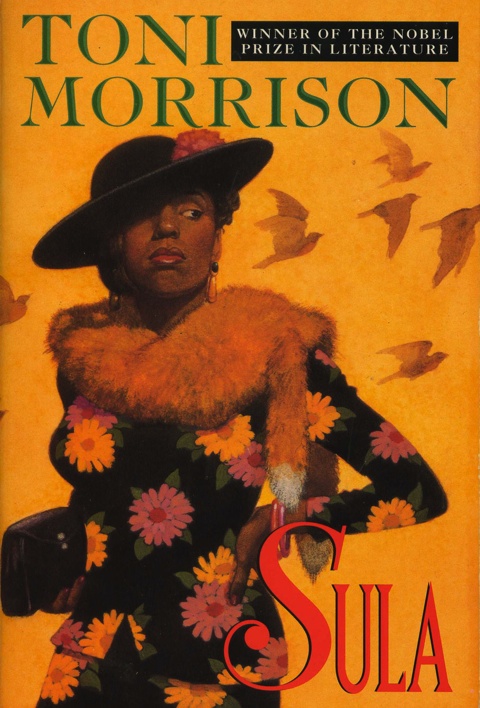
Sula by Toni Morrison

As Reverend Deal moved into his sermon, the hands of the women unfolded like pairs of raven's wings and flew high above their hats in the air.  They did not hear all of what he said; they head the one word, or phrase, or inflection that was for them the connection between the event and themselves.  For some it was the term "Sweet Jesus."  And they saw the Lamb's eye and the truly innocent victim: themselves.  They acknowledged the innocent child hiding in the corner of their hearts, holding a sugar-and-butter sandwich.  That one.  The one who lodged deep in their fat, thin, old young skin, and was the one the world had hurt.  Or they thought of their son newly killed and remembered his legs in short pants and wondered where the bullet went in.  Or they remembered how dirty the room looked when their father left home and wondered if that is the way the slim, young Jew felt, he who for them was both son and lover and in whose downy face they could see the sugar-and-butter sandwiches and feel the oldest and most devastating pain there is: not the pain of childhood, but the remembrance of it.

I love buying used books when I travel because when I pick them up, months or even years later, they remind me of where they came from.  It wouldn't be the same with new books, I think--the appeal must lie in the way they must have been possessed, and read, by someone who lived there, or at the very least passed through there.  I bought this copy of Sula in a dusty bookshop in Virgin, Utah, population 596.  In 2000 the town of Virgin, Utah passed a law mandating that every resident possess a firearm.  There's something of a Morrisonian touch there--it seems like each of her books has a "town" who is as much a character as anyone else, and one which can be quite menacing.

In Sula, the town is Medallion, Ohio, which is in every other way not very much like Virgin, Utah (though I think she'd like that name, too).  In the black district, known as The Bottom despite its place in the high hills looking over the majority-white valley, two girls grow up as friends: the conservative Nel and the brash, wild Sula.  Sula is the kind of girl who cuts off her own fingertip to scare off a group of male harassers, as if to say, you don't know what I'm capable of.  Sula and Nel bond over childhood joys as well as traumas, as when they accidentally drown a small child in the river.  (They're swinging him around by his arms and lose their grip--it's weird, and not totally realistic, in a way that's typical of Morrison's novels.)  Later, Sula comes back from a long absence, sleeps with Nel's husband, and generally attracts a bad reputation.

It's tempting, and perhaps not incorrect, to see Sula and Nel as complimentary halves of a single representation.  Sula is the one who leaves, Nel is the one who stays home.  Sula is the whore, Nel is the respectable woman.  Sula is the id, Nel is the ego.  Morrison, as always, is too complex and too cagey to let the story resolve into those easy binaries.  She goes out of her way to show Nel in the process of developing and discovering a discrete self:

She gout out of bed and lit the lamp to look in the mirror.  There was her face, plain brown eyes, three braids and the nose her mother hated.  She looked for a long time and suddenly a shiver ran through her.

"I'm me," she whispered.  "Me."

Nel didn't know quite what she meant, but on the other hand she knew exactly what she meant.

"I'm me.  I'm not their daughter.  I'm not Nel.  I'm me.  Me."

This passage rings very true for me.  Haven't you ever had that late night sensation that there is a you which is somehow separate from and beneath your face, your body, your name, all of that?

Sula seems not to need this realization, for her own discrete selfhood has never been in doubt.  When she sleeps with Nel's husband, Morrison attributes it to a sense of self so resolute and complete that it borders on solipsism.  Confronting her, Nel reminds Sula that such an existence is lonely, but Sula replies, "Yes.  But my lonely is mine.  Now your lonely is somebody else's."  Morrison is hyper-aware of the demands that other people--husbands, children, whole towns and countries--place on us, and the ways in which they limit and define us.  And yet, Nel is right--which of us would take a life as lonely as Sula's, no matter whose lonely it was?

These moments are the heart of Sula, and they're extremely moving.  But they are surprisingly brief.  Sula enters the book late and is ushered out early.  Instead Morrison, as she does in her other novels, dwells lengthily on the figures at the novel's edges.  Figures like Shadrack, the vagrant war veteran who inaugurates The Bottom's National Suicide Day, or the deweys, a trio of adopted boys who no one can tell apart (though they don't look alike) and who never age.  Nel and Sula have sisters, brothers, mothers, grandmothers, all of whom interest Morrison at least as much as the pair themselves.

In a novel like Song of Solomon, this kind of things works well because it helps to define and complement the magnetic character of Milkman, whose gradual embrace of his family history is central to the novel.  Sula is too steely and removed, and too briefly sketched, to serve the same kind of role, and Nel pales against the colorful supporting cat.  As a result, Sula never really coheres in a way that would allow its better aspects to really hit home.

Wednesday, January 21, 2015

The Bluest Eye by Toni Morrison

"Please God," she whispered into the palm of her hand.  "Please make me disappear."  She squeezed her eyes shut.  Little parts of her body faded away.   Now slowly, now with a rush.  Slowly again.  Her fingers  went, one by one; then her arms disappeared all the way to the elbow.  Her feet now.  Yes, that was good.  The legs all at once.  It was hardest above the thighs.  She had to be real still and pull.  Her stomach would not go.  But finally it, too, went away.  Then her chest, her neck.  The face was hard, too.  Almost done, almost.  Only her tight, tight eyes were left.  They were always left.

Pecola Breedlove wants blue eyes.  Baby dolls all have blue eyes, and so does the girl on the candy wrapper.  Pecola, like her mother and father, is ugly, in the eyes of most people, and she has always been teased.  But Pecola's desire is a desire for self-destruction, the want not only to become something else, but to disappear and be replaced.  What Pecola wants, essentially, wants to achieve white standards of beauty, even if it means being annihilated in the process.

Despite being the protagonist of the novel, Morrison rarely gives us Pecola's perspective.  Morrison, always sensitive to the complex histories and stories that make up a person's identity, lingers on the back story of every single character, no matter how vile they seem at first: Pecola's hateful, bitter father; her resentful mother; the prostitutes who live nearby; the scam artist Soaphead Church; the narrator Claudia, a girl whose family takes Pecola in.  These narratives help create sympathy where most novels wouldn't bother, but more importantly, they make us aware of how Pecola has been pushed to the margins, and make the novel's climax--a moment of tragic violence committed against Pecola I won't describe--even more difficult because of the narrative distance we feel from Pecola.  Morrison won't allow us to establish the sympathy we want to have; but how often do we deny sympathy to those who are less visible in real life?

The Bluest Eye is Morrison's first novel, and it shows.  Even as thorough as the various narratives are, they lack the depth and pathos of the characters of Beloved or Song of Solomon.  The truncated, postmodern snippets of a "Dick and Jane" story that begin each chapter are a distraction, rather than a necessary counterpoint to Pecola's story.  (Much better is the moment when Pecola accidentally frightens a young white girl whose family employs her mother by showing up suddenly, only to see her mother console the white girl while chasing Pecola out the door--Pecola's lack of a place in the "white picket fence" suburbs is sufficiently established.)

But that's only true by comparison.  Even at its weakest, Morrison's stuff is extraordinary.  Occasionally The Bluest Eye offers moments that rival her maturest work.  I thought the novel was strongest when Pecola visits fraudulent psychic Soaphead Church, who promises her blue eyes in exchange for a little black magic.  When she leaves, he writes a letter to God, crowing that his fooling of Pecola is more than God has ever done:

I, I have caused a miracle.  I gave here the eyes. I gave her the blue, blue, two blue eyes.  Cobalt blue.  A streak of it right out of your own blue heaven.  No one else will see her blue eyes.  But she will.  And she will live happily ever after.  I, I have found it meet and right so to do.

Now you are jealous. You are jealous of me.

This is Morrison at her best.  Soaphead, far from being a mere malicious force inserted into the novel to provide resolution to the conflict, is clearly operating from his own deep wounds.  He's right: she believes in her blue eyes.  But "happily ever after" doesn't quite describe it.

Monday, August 19, 2013

Song of Solomon by Toni Morrison

As Milkman watched the children, he began to feel uncomfortable.  Hating his parents, his sisters, seemed silly now.  And the skim of shame that he had rinsed away in the bathwater after having stolen from Pilate returned.  But now it was as thick and tight as a caul.  How could he have broken into that house--the only one he knew that achieved comfort without one article of comfort in it.  No soft worn-down chair, not a cushion or a pillow.  No light switch, no water running free and clear after a turn of a tap handle.  No napkins, no tablecloth.  No fluted plates or flowered cups, no circle of blue flame burning in a stove eye.  But peace was there, energy, singing, and now his own remembrances.


Toni Morrison's Song of Solomon opens with this very crytpic sentence: "The North Carolina Mutual Life Insurance agent promised to fly from Mercy to the other side of Lake Superior at three o'clock."  To the story, the agent is nobody, a non-character, but his attempted flight--you can guess how it turns out--provides the guiding symbol for the rest of the novel: a man, alone, making a leap that, no matter how it ends, will take him away from his town, his home, and his family.  There are other flights in the novel, too: The protagonist, Milkman Dead, learns that his great-grandfather was reputed to be part of a legendary tribe of "flying" slaves in the antebellum South; at the end, Milkman too leaps into the air, his flight perhaps the most ambiguous of them all.

It's not hard to believe that someone in the world of Song of Solomon might able to fly.  Morrison crowds her plot with a number of details borrowed from Magical Realism: Milkman's Aunt Pilate, for instance, born just after her mother's death, has no navel.  Another character seems to be immortal.  Morrison's story bumps right up to the edge of realism, and when it's not fantastical, it's consistently weird.  But at the same time, it's one of Morrison's most straightforward works.  She explains in the (really great) foreword that, for Solomon, she abandoned the more complex experiments with time that characterize some of her other books because the traditional progression seemed more fitting for the male protagonist.  That's something I never would have thought of.

At its heart, Song of Solomon is a conventional novel; a bildungsroman about Milkman that follows him from his birth to his moment of "flight."  Morrison carefully details not only Milkman himself but his family--his greedy, callous father Macon, his abused mother Ruth, his sisters Lena and Corinthians, his otherworldly aunt Pilate, her granddaughter Hagar, whom he loves then abandons.  Each of these characters gets a really intricate, detailed plotline; to Morrison's credit, nothing among them seems extraneous and unnecessary.  In the second part of the novel, Milkman retraces Pilate's life history in Pennsylvania and Virginia searching for a sack of gold she described to him.  The gold, reliably, is a MacGuffin--what he really discovers is the story of his family, of flying Solomon, and the rest of his great-grandparents.  And just as reliably, he comes out of the experience a better person--regretful for the way he has treated Hagar, loving toward his parents, etc., etc.

That sounds hokey and cliched, but man, it works.  I think part of the genius of Song of Solomon is that Morrison finds the perfect balance between this well-worn structure and the accumulated strangeness of Milkman's family.  I don't think that my description of it has been really sufficient, but the book's greatness relies in its many intricate details, and I don't think reciting them here would really provide an understanding of how well they work together.

Thursday, November 29, 2007

Beloved by Toni Morrison

When eminent critic Harold Bloom says that there are only four great living American writers (McCarthy, DeLillo, Roth, and Pynchon), it is not difficult to cry sexism and racism at Toni Morrison's omission, and I say that as a person that does not bandy those terms around lightly. Yes, those four are truly great, but why not Morrison, who's style is as vivid, inspired, and tightly controlled as any of those four, and whose works speak to something truly American? In a recent poll, Beloved was voted the greatest work of literature in the past 25 years, just ahead of DeLillo's Underworld.

Beloved is the story of Sethe, an ex-slave who now lives inCincinnati with her daughter, Denver. Eighteen years prior to the main action of the story (which has a snaking, elliptical plotline), Sethe was a runaway slave living with her grandmother Baby Suggs, when suddenly she spied her old slaveowner walking into the backyard, and instead of allowing her to return to slavery, slit her baby daughter's (unnamed, not Denver) throat--and would also have done the same to Denver and her two sons, Howard and Buglar, if she had not been caught. After Sethe was released from prison and the Civil War over, she continues to be haunted by the ghost of the murdered baby until the spirit is chased out by Paul D, a fellow slave from Sethe's former plantation who comes to live with her in Cincinnati. But then the spirit takes the form of a young girl (the age the child would have been if it had lived) who emerges from the nearby lake and comes to live with Sethe, Denver, and Paul D. Lots of other crazy and magical shit happens, and all the while you learn the strange and sordid details of Sethe and Paul D's past lives as slaves. Morrison is particularly graphic about some of the details she feels have been lost in slave narratives, such as rampant slave murder and sexual abuse.

I do not think that Beloved speaks to me as it might to an African-American, and so I haven't formed an emotional connection with it like I did other books I've read this year, but it's clear reading it that it's a true monument of American fiction. It is complex, imaginative, and brilliantly but tightly conceived. Jonathan Demme made a movie about it starring Oprah, but I cannot believe that that movie is any good--partly because it doesn't seem like Beloved, which is frequently strange and obtuse, could translate to the screen, and partly because I'm not sure Oprah really has the chops to take on a character like Sethe, who is troubled, complex, and somewhat otherworldy, none of which describes Oprah.

Highly recommended.