I thought about the baby that everybody wanted dead, and saw it very clearly. It was in a dark, wet place, its head covered with great O's of wool, the black face holding, like nickels, two clean black eyes, the flared nose, kissing-thick lips, and the living, breathing silk of black skin. No synthetic yellow bangs suspended over marble-blue eyes, no pinched nose and bowline mouth. More strongly than my fondness for Pecola, I felt a need for someone to want the black baby to live--just to counteract the universal love of white baby dolls, Shirley Temples, and Maureen Peals.
The first time I read The Bluest Eye, I found it to be pretty scattered, if I recall correctly. It dwells in digressions, piles symbols upon symbols, often in a way that I found distracted from the central images of white baby dolls and blue eyes that give the novel its title. Among other things, Morrison commits a cardinal literary sin by writing an important character--the mystic fraudster Soaphead Church, who "grants" Pecola her blue eyes--into the very end of the book, where he works the action necessary for the climax.
But Soaphead is such a fascinating character, I quickly brushed that sin aside. Reading it a second time, those flaws, if that's what they are, failed to appear. Because I knew the climax and Soaphead were coming, it freed me up to ignore the narrative movement of the book and really appreciate how painstakingly crafted each disparate part of the book is: Soaphead, the interludes that track the life of Pecola's mother and father, all of it. Each of these stories is so perfectly wrought and self-contained they could exist outside of the novel without losing anything, though they also provide its halting, irregular character. Morrison risks distracting from the intense, immense tragedy that is the story of Pecola, a young girl haunted in ways she cannot understand by the idea of physical beauty in America, but she does so out of a deep need to give each character their due. That goes double for the worst ones, like Cholly, Pecola's father, who rapes and impregnates her in a fit of trauma-induced delusion.
Reading it a second time also allowed me to focus on just how tragic Pecola's story is. She's an easier character to pity than to love, but perhaps that is in keeping with the tragedy: Pecola, unable to love herself, rebuffs the reader's ability to love her as well. To a child like this, who obsesses with Mary Jane candy because of the Shirley Temple-esque white character on the wrapper, who sees the way her own mother prefers the little white girl whose house she keeps, we might say: you're beautiful the way you are! But Pecola is not really beautiful, because the social environment represses her so heavily that anything beautiful in her has no chance to grow. Her obsession with whiteness and with blue eyes becomes so all-consuming that it seems to carve her out from the inside. This sad narrative gets its fullest expression in the baby that is stillborn, that "everybody wanted dead," because its mere existence would be an embodiment of the social ugliness that engendered it. Pecola is, in a sense, as stillborn as her baby.
One thing that The Bluest Eye shows perfectly is just how difficult it is to navigate the pressures of beauty because they exist apart from the discrete actions of people. Morrison is her own best reader and explicator, and she writes in the introduction about a friend who shared Pecola's desire for blue eyes: "Who told her? Who made her feel that it was better to be a freak than what she was? Who had looked at her and found her so wanting, so small a weight on the beauty scale?" Those are good questions without good answers, which The Bluest Eye is smart enough not to offer.
Showing posts with label The Bluest Eye. Show all posts
Tuesday, November 7, 2017
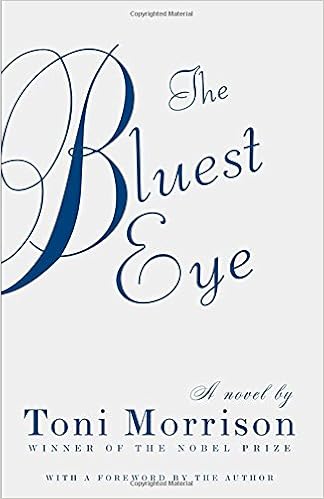
The Bluest Eye by Toni Morrison
Labels:
The Bluest Eye,
toni morrison
Wednesday, January 21, 2015
The Bluest Eye by Toni Morrison
Pecola Breedlove wants blue eyes. Baby dolls all have blue eyes, and so does the girl on the candy wrapper. Pecola, like her mother and father, is ugly, in the eyes of most people, and she has always been teased. But Pecola's desire is a desire for self-destruction, the want not only to become something else, but to disappear and be replaced. What Pecola wants, essentially, wants to achieve white standards of beauty, even if it means being annihilated in the process.
Despite being the protagonist of the novel, Morrison rarely gives us Pecola's perspective. Morrison, always sensitive to the complex histories and stories that make up a person's identity, lingers on the back story of every single character, no matter how vile they seem at first: Pecola's hateful, bitter father; her resentful mother; the prostitutes who live nearby; the scam artist Soaphead Church; the narrator Claudia, a girl whose family takes Pecola in. These narratives help create sympathy where most novels wouldn't bother, but more importantly, they make us aware of how Pecola has been pushed to the margins, and make the novel's climax--a moment of tragic violence committed against Pecola I won't describe--even more difficult because of the narrative distance we feel from Pecola. Morrison won't allow us to establish the sympathy we want to have; but how often do we deny sympathy to those who are less visible in real life?
The Bluest Eye is Morrison's first novel, and it shows. Even as thorough as the various narratives are, they lack the depth and pathos of the characters of Beloved or Song of Solomon. The truncated, postmodern snippets of a "Dick and Jane" story that begin each chapter are a distraction, rather than a necessary counterpoint to Pecola's story. (Much better is the moment when Pecola accidentally frightens a young white girl whose family employs her mother by showing up suddenly, only to see her mother console the white girl while chasing Pecola out the door--Pecola's lack of a place in the "white picket fence" suburbs is sufficiently established.)
But that's only true by comparison. Even at its weakest, Morrison's stuff is extraordinary. Occasionally The Bluest Eye offers moments that rival her maturest work. I thought the novel was strongest when Pecola visits fraudulent psychic Soaphead Church, who promises her blue eyes in exchange for a little black magic. When she leaves, he writes a letter to God, crowing that his fooling of Pecola is more than God has ever done:
I, I have caused a miracle. I gave here the eyes. I gave her the blue, blue, two blue eyes. Cobalt blue. A streak of it right out of your own blue heaven. No one else will see her blue eyes. But she will. And she will live happily ever after. I, I have found it meet and right so to do.
Now you are jealous. You are jealous of me.
This is Morrison at her best. Soaphead, far from being a mere malicious force inserted into the novel to provide resolution to the conflict, is clearly operating from his own deep wounds. He's right: she believes in her blue eyes. But "happily ever after" doesn't quite describe it.
Labels:
The Bluest Eye,
toni morrison
Subscribe to:
Posts (Atom)
