Showing posts with label fairytale. Show all posts
Thursday, September 30, 2021
In the Time of the Blue Ball by Manuela Drager
Like everyone I know, Lili Nebraska had never been talented at police work, and she surely didn’t jump for joy to know that, from now on, she would replace the police. But you can be sure that she is doing her best. Since being put in charge, if you need her, well, she does her best.
Reading the paragraph above, you might assume that Lili Nebraska is a human woman who has, through some sequence of events, found herself as the head of the police department. This is a reasonable assumption, and is also wrong. The next paragraph goes on to say:
For a long time, Lili Nebraska had been a street violinist, a virtuoso brown as gingerbread with adorable black patterning on her face and around her navel, and with a violin under her arm, a bow in her hand and no other clothing. Even behind the crate of vegetables, she had not lost this proud musician’s appearance.
In the Time of the Blue Ball is like this: lucid and peaceful at sentence by sentence level but surreal and unknowable when seen from a distance. There’s no complicated prose, no metafictional tricks, no intricate plotting. Each of the stories follows the same structure: the narrator Bobby Potemkine--who is also a private investigator--is given a job: find the man who created fire; save Auguste Didion, a sentient piece of macaroni(!); find out where all the baby pelicans are coming from since there are no grown pelicans anymore. He sets out on these journeys with the help of friends he meets along the way, like Lili Nebraska above, or Gershwin, a tiger that smells strongly of urine and can’t help but eat anything that moves like a rodent, or his dog Djinn, who accidentally eats a performing fly and becomes a virtuoso on the vaguely woodwind-sounding “nanoctiluphe”. Each story ends with the task being accomplished, and in the course of things Bobby always runs into the “very pretty” Lili Niagara, a “batte”--which I assume is a batlike creature--with whom he was infatuated in grade school and who may like him now. But of course Battes like to mock other people/creatures and she may just be gathering gossip material.
Of these three stories, I liked Our Baby Pelicans the best. It asks, in an absurd way, for us to consider various relationships: parent and child, friend and “lover”, wage slave and artist, oppressor and oppressed, but it provides very little in the way of concrete anchor points. Does Lili Niagara like Bobby Potemkine, and by the way, what even are all these characters we follow? There’s a sense of isolation and lostness about the whole enterprise, as whimsical as it is.
The last story ends with Bobby having convinced a large lake to become a mother to all the baby pelicans. Through his words and her sheer force of will, they are able to remake the world in a way that leaves everyone happy, or so it seems. But the story ends the same as the earlier two: with the mission accomplished, the companions cheerful, and Bobby alone.
The title refers to the passage of time. Rather than years, months, hours, minutes, periods are indicated by spheres of varying color. Blue, red, Azure, green, periwinkle. No reference point is given for these units, so these characters all, including Bobby, exist in a space outside our comfortable reference points, and sometimes, we suspect, theirs as well. It’s never explained why the world is as it is, or even how it was before. In the end, the people living there are as confused as the reader, and left grasping at the same fleeting moments of lucidity and hope--fire, love, a pretty face, a beautifully patterned belly, a musical fly, a stinky tiger, a baby pelican hung about the neck of someone who’s still alone.
Labels:
dorothy press,
fairytale,
manuela draeger,
surreal
Monday, January 2, 2017
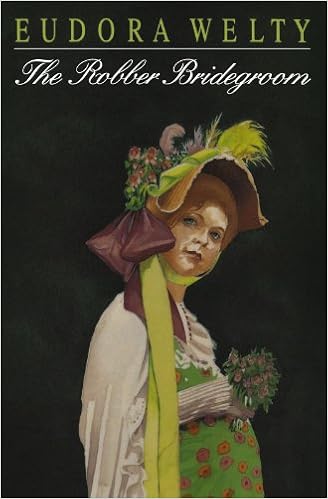
The Robber Bridegroom by Eudora Welty
"If being a bandit were his breadth and scope, I should find him and kill him for sure," said he. "But since in addition he loves my daughter, he must not be the one man, but two, and I should be afraid of killing the second. For all things are double, and this should keep us from taking liberties with the outside world, and acting too quickly to finish things off. All things are divided in half--night and day, the soul and body, and sorrow and joy and youth and age, and sometimes I wonder if even my own wife has not been the one person all the time, and I loved her beauty so well at the beginning that it is only now that the ugliness has struck through to beset me like a madness. And perhaps after the riding and robbing and burning and assault is over with this man you love, he will step out of it all like a beastly skin, and surprise you with his gentleness. For this reason, I will wait and see, but it breaks my heart not to have seen with my own eyes what door you are walking into and what your life has turned out to be."
Chloe's review of The Optimist's Daughter reminded me that I had a Eudora Welty book waiting for me: The Robber Bridegroom, her first novel. Despite the strong themes that run through Welty's work--the singularity of families and the culture of the Mississippi Delta--she really never repeated herself, and The Robber Bridegroom is like nothing else she would ever write. Welty borrows the folk tale of the Robber Bridegroom, in which a maiden unwittingly marries a savage highwayman, and melds it to 19th century Mississippi folklore.
The Robber Bridegroom is peopled with legendary Mississippi figures: Mike Fink, the braggart, brawler, and boatman, and the murderous Harp brothers (Little Harp keeps Big Harp's head in a trunk, where it keeps demanding to be let out). To these it adds Welty's own sharp comic cast, including the young boy Goat, so called "because he could butt his way out the door when his mother left him locked in, and equally, because he could but this way in when she left him locked out," as well as an evil stepmother figure who dies of exhaustion doing an Indian dance meant to prove she is more powerful than the sun.
The protagonist, Rosamond, is the young daughter of a man named Clement Musgrove. Clement's life is saved by a gentleman named Jamie Lockhart, who secretly robs travelers disguised with berry juice. When Rosamond's clothes are stolen by a thief in the woods, Clement enlists Jamie's help to find the culprit, and in the kind of perfect mishap characteristic of fairytales, not Clement, Jamie, or Rosamond realizes that the culprit is really Jamie.
The Robber Bridegroom exhibits little of the sharp realist eye that Welty later developed, but a lot of the clear-eyed humor that characterizes The Ponder Heart and Losing Battles. The characters hop from one fairytale-inspired crisis to the next, each one with its familiar contours: the innocent maiden, the evil stepmother, etc. And when Clement believes he has lost Rosamond for good, Welty's elegiac power appears out of nowhere, if a little disorganizedly:
I read The Robber Bridegroom in a single breezy sitting--I'm on pace for 365 books this year! But despite its lightness--both literal lightness and lightness of town--The Robber Bridegroom is as touching and thoughtful as the rest of Welty's work.
Chloe's review of The Optimist's Daughter reminded me that I had a Eudora Welty book waiting for me: The Robber Bridegroom, her first novel. Despite the strong themes that run through Welty's work--the singularity of families and the culture of the Mississippi Delta--she really never repeated herself, and The Robber Bridegroom is like nothing else she would ever write. Welty borrows the folk tale of the Robber Bridegroom, in which a maiden unwittingly marries a savage highwayman, and melds it to 19th century Mississippi folklore.
The Robber Bridegroom is peopled with legendary Mississippi figures: Mike Fink, the braggart, brawler, and boatman, and the murderous Harp brothers (Little Harp keeps Big Harp's head in a trunk, where it keeps demanding to be let out). To these it adds Welty's own sharp comic cast, including the young boy Goat, so called "because he could butt his way out the door when his mother left him locked in, and equally, because he could but this way in when she left him locked out," as well as an evil stepmother figure who dies of exhaustion doing an Indian dance meant to prove she is more powerful than the sun.
The protagonist, Rosamond, is the young daughter of a man named Clement Musgrove. Clement's life is saved by a gentleman named Jamie Lockhart, who secretly robs travelers disguised with berry juice. When Rosamond's clothes are stolen by a thief in the woods, Clement enlists Jamie's help to find the culprit, and in the kind of perfect mishap characteristic of fairytales, not Clement, Jamie, or Rosamond realizes that the culprit is really Jamie.
The Robber Bridegroom exhibits little of the sharp realist eye that Welty later developed, but a lot of the clear-eyed humor that characterizes The Ponder Heart and Losing Battles. The characters hop from one fairytale-inspired crisis to the next, each one with its familiar contours: the innocent maiden, the evil stepmother, etc. And when Clement believes he has lost Rosamond for good, Welty's elegiac power appears out of nowhere, if a little disorganizedly:
Like will-o'-the-wisps the little blazes burn on the rafts all night, unsteady beside the shore. Where are they even as soon as tomorrow? Massacre is hard to tell from the performance of other rites, in the great silence where the wanderer is coming. Murder is as soundless as a spout of blood, as regular and rhythmic as sleep. Many find a skull and a little branching of bones between two floors of leaves. In the sky is the perpetual wheel of buzzards.
I read The Robber Bridegroom in a single breezy sitting--I'm on pace for 365 books this year! But despite its lightness--both literal lightness and lightness of town--The Robber Bridegroom is as touching and thoughtful as the rest of Welty's work.
Labels:
eudora welty,
fairytale,
Mississippi,
The Robber Bridegroom
Tuesday, November 17, 2009
The Tale of Despereaux by Kate DiCamillo
"
Love is ridiculous."
The Tale of Despereaux is a modern-day fairy tale. In fact, one might even suspect Kate DiCamillo of attempting to add her tale to the children' canon. After all, all the ingredients are here: an anthropomorphic rodent protagonist, an antagonist who eventually sees the light, a second antagonist who gets what's coming to him, the magic of courage/love, soup, and, of course, a beautiful princess.
The thing is, the truth of the tale is in the telling. If DiCamillo didn't write so openly and so enthusiastically, it would be easy to feel cynical. But honestly, this tale of the one brave mouse and how he eventually saves everyone didn't feel contrived to me at all. It almost feels like a love letter to the classics, albeit a letter without horrible recompense as a postscript.
The movie is pretty good too, unless you're Chris and have a crippling fear of computer-generated rodents.
Love is ridiculous."The Tale of Despereaux is a modern-day fairy tale. In fact, one might even suspect Kate DiCamillo of attempting to add her tale to the children' canon. After all, all the ingredients are here: an anthropomorphic rodent protagonist, an antagonist who eventually sees the light, a second antagonist who gets what's coming to him, the magic of courage/love, soup, and, of course, a beautiful princess.
The thing is, the truth of the tale is in the telling. If DiCamillo didn't write so openly and so enthusiastically, it would be easy to feel cynical. But honestly, this tale of the one brave mouse and how he eventually saves everyone didn't feel contrived to me at all. It almost feels like a love letter to the classics, albeit a letter without horrible recompense as a postscript.
The movie is pretty good too, unless you're Chris and have a crippling fear of computer-generated rodents.
Labels:
Children's Literature,
fairytale,
Kate DiCamillo,
mice
Saturday, January 31, 2009
The Book of Lost Things by John Connolly
David loved listening to his mother read to him. But as she succumbed more and more to cancer, David had to start reading to her. His mother's death was traumatic for him. His father's remarriage only made things worse. David developed OCD and started have "episodes" where he would black out. Often after these blackouts he would have the faint recollection of talking with someone familiar, maybe someone from a book he had read or had read to him. The line between reality and fantasy continues breaking down for David, until he is sucks into a dark fantasy world, inhabited by many of the characters from the tales he is so familar with. Once in this world, he has to find his way back to his family.Connolly borrows heavily from familar fairytales and mythologies. But in his hands, they become distorted echoes of themselves, helping Connolly to weave a much darker tale. This story is about the hardships we face in life, the journey into adulthood that we all eventually make and the magical power of books.
This was an enjoyable read, albeit quite weird in many spots.
Labels:
fairytale,
John Connolly,
weird
Monday, December 1, 2008
The Unbearable Lightness of Being by Milan Kundera
Einmal ist keinmal. What happens but once, says the German adage, might as well not have happend at all. If we only have one life to live, we might as well not have lived at all. I started my review of Lolita by saying that I was really unqualified to talk about the book in any sort of meaningful way. It was dense, complex, often over my head, and completely enjoyable. I feel roughly the same way about The Unbearable Lightness of Being. The difference being that I didn't like it nearly as much as I liked Lolita. And in my way of thinking, the books do share some similarities. Both could be described as a novel of ideas. Both of their stories have a dreamlike quality to them. And both of the books deal with sex. Sex was the underlying theme of Lolita, however, it was Humbert Humbert's lust that was on display, not his acts of sex. But in Lightness, sex is front and center and standing at attention. While the book itself is about something much bigger, sex is the driving force behind much of the storyline.
The novel is set in Prague in the 1960s, around the time of the invasion by the USSR. Tomas is a highly successful Czechoslovakian surgeon who looses his job for not towing the line of the Communist Party. His wife Tereza is a politically active photographer. There are two secondary characters, Tomas's mistress Sabina and Sabina's married lover Franz. The story revolves around the intertwined lives of these four people.
I have been thinking about how to describe this book for a while now, and the best I can do is that it is a like a licentious fairytale. But while the inherent moral of most fairytales is that love conquers all, the moral of Lightness is that life is ephemeral. Take this passage in which Franz is trying to figure out if he should leave his wife for his mistress: "Human life occurs only once, and the reason we cannot determine which of our decisions are good and which bad is that in a given situation we can only make one decision; we are not granted a second, third, or fourth life in which to compare various decisions." If each of us only has only one life to live, then does not that life take on a certain degree of lightness? Kundera's characters have little epiphanic bursts throughout the novel where they seem to grasp -- or at least grasp at -- at this concept. It is when they are most happy, most content with there life. And why not? By its very nature this concept is not burdensome, but liberatingly light.
Labels:
Communism,
Czech,
Czechoslovakian,
fairytale,
Milan Kundera,
sex
Thursday, September 11, 2008
The Tale of Despereaux by Kate DiCamillo
Movies with mice played a large part in my formative years, from The Rescuers to The Secret of Nimh (based on Mrs. Frisby and the Rats of NIMH) to An American Tail to The Great Mouse Detective. To this day, I find all of these movies highly watchable. When I was a wee thing, my grandma used to make up stories about a character she created called Johnny Mouse. Johnny Mouse (he must be referred to by his full name) was sly and cunning and always outsmarting cats and the people who laid out traps for him. I am telling you all this to explain that when I see a book such as The Tale of Despereaux, it is hard for me to resist.DiCamillo has crafted a perfectly little fairytale. In the world that she created, mice can talk with humans, but they choose not to. They fear that any interaction with humans will end badly. So they scurry about from wall to wall. Despereaux, an alarmingly undersized mouse with alarmingly oversized ears, was born with his eyes wide open. His parents knew right away that something was different about Despereaux. Instead of nibbling at the bindings and pages of books in the castle library, he sat at the open books reading them, committing their stories to memory. When Despereaux breaks the cardinal rule and actually talks to the princess and her father, he is banished to the dungeon by the mouse elders. There is no assumption that he will live down there, but that he will be eaten by the rats who rule the dark places of the castle. Upon being deposited in the dungeon, Despereaux befriends the jailer and uncovers a plot to kidnap the princess.
The story is narrated beautifully, laden with many direct addresses to the reader. Such as, "Reader, do you know that there is nothing more beautiful in this world than the sound of someone you love calling your name. Nothing." The story is told from different angles and through the eyes of a few different characters that live in the castle.
While on its surface the book is about a tiny, needle-wielding mouse who saves a princess, it is also a lesson about love and forgiveness, and other complicated matters of the heart. Skip The Alchemist and read The Tale of Despereaux.
Labels:
fairytale,
Kate DiCamillo,
mice,
Newberry Medal
Subscribe to:
Posts (Atom)