Showing posts with label Wallace Stegner. Show all posts

Thursday, October 2, 2025

Crossing to Safety by Wallace Stegner

You can plan all you want to. You can lie in your morning bed and fill whole notebooks with schemes and intentions. But within a single afternoon, within hours or minutes, everything you plan and everything you have fought to make yourself can be undone as a slug is undone when salt is poured on him. And right up to the moment when you find yourself dissolving into foam you can still believe you are doing fine.

Larry and Sally Morgan return after many years to the Vermont cabin where they once spent their happiest moments. Their old friend, Charity Lang, is dying, with her husband Sid at her side. Charity's impending death promises an end to a lifelong friendship between the foursome, fused at first in the crucible of the University of Wisconsin, where Larry and Sid were professors of literature. After losing their jobs in a flurry of firings during World War II, rich Sid's Vermont property was offered as a safe haven to the poorer Morgans. An idea of a life was constructed there, in which the Langs might act as patron to their friends, but the idyll proved to be short-lived, as Sally's sudden polio whisked them away. Now, as Charity is dying, it is an occasion for narrator Larry to look back on a beautiful friendship that never quite made as large a part in anyone's life as they would have liked.

I found the first half or so of Crossing to Safety terrifically boring. We are asked to believe that these two couples are amazed and awe-inspired by what they find in each other, but outside of a clear kind of sympathy, it was never independently clear to me that any of them was quite worth the hearts in the eyes or the dropped jaws or what have you. And the setting of the academy of the 1940's, when someone like Larry could receive a check equivalent to a quarter of his yearly salary for writing a single short story and mailing it off to the Atlantic, made the book feel sort of self-consciously "literary" in a way that people tend to make fun of. (Stoner, anyone?)

But I thought it became more interesting when the cracks started to show in the friends' relationship: we're told that Sid nurses a crush on Sally, for one. More than this, I was interested in the relationship between Sid and Charity: he sees himself as a poet but she pressures him into a narrow view of success, academic success, something at which he is manifestly less talented and less passionate about. Larry's brief success as a writer activates Sid's jealousy, and more than that, his resentment toward Charity. There's a great and telling scene where the friends go hiking and Charity is so slavishly devoted to the counsel in her guidebook that she nearly kills them with undercooked chicken. (When it says "three minutes on one side," everyone points out to the stubborn charity, it means hamburger, not poultry.) Charity even tries to die "by the book," sending Sid away at the last minute and "slipping away" (I guess this means suicide?) so that she might die cleanly, without burdening anyone. Of course, this isn't what Sid wants--he wants to be by his wife's side--but even at the end of their lives, the differences between the two seem intractable.

I don't think I'd recommend this one. It has some nice elements to it, but I found the whole thing a little tweedy and twee, and it often felt that the book was too insistent, and consequently not persuasive enough, about the power of the foursome's friendship.

Wednesday, July 29, 2015

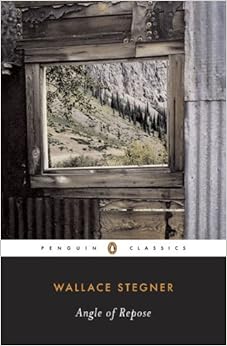
Angle of Repose by Wallace Stegner

Gone, and as painful now as the thought of a stillborn child.  Sentimental?  Of course.  Riddled with the Anglo-American mawkishness about home, quicksandy with assumptions about monogamy and Women's Highest Role, buttery with echoes of the household poets.  All that.  But I find that I don't mind her emotions and her sentiments.  Home is a notion that only the nations of the homeless fully appreciate and only the uprooted comprehend.  What else would one plant in a wilderness or on a frontier?  What loss would hurt more?

I'm a big fan of Idaho.  It's full of some of the most fascinating things I've ever had the luck to see: the towering Bruneau Dunes, the bizarre lavascape of Craters of the Moon National Park, the grand Shoshone Falls overlooking the Snake River Gorge.  Boise--an underrated city.  The isolated buttes on the way east from Wyoming, like stranded ships.

When I was heading out on my road trip to Oregon earlier this month, I wanted a book that took place in one of the places we would be passing through, and this novel came up on a list of "books set in Idaho."  The joke was on me--much as it was last year when we only passed through Iowa for five minutes when I tried to read Marilynne Robinson's Home--because we were well out of Idaho before I got to the part of Angle of Repose that was set there.  (In fact, I was back in New York before the book arrived in Boise Canyon.)

But worse, the Idaho of Angle of Repose isn't the sublime West that I like, but a real wilderness which proves an inescapable burden for Susan Burling Ward, the book's protagonist and the wife of Oliver Ward, an engineer who spends most of his life trying to find a project equal to his grand ambitions.  He and Susan go from New York to New Almaden, CA to Leadville, CO to Michoacan, Mexico, up to Boise Canyon over the course of decades.  Boise seems to finally offer Oliver the chance to build something meaningful--a set of ditches and canals that will irrigate the canyon--but the experience of living on the Western frontier proves difficult for Susan, a genteel New Yorker who is uprooted from any sense of civilization or society, and who worries about how her children will grow up amidst the savagery of Western isolation.  Boise Canyon is where those pressures finally come to break Susan and Oliver's relationship, causing a break that never seems to mend.

Telling this story is Susan's grandson, Lyman Ward, a former college professor suffering from a crippling bone disease which has left him confined to a wheelchair, as well as the dissolution of his marriage.  Lyman is bitter and recalcitrant in his insistence on being independent as possible, and writing about his grandmother is also a kind of self-finding:

Right there, I might say to Rodman, who doesn't believe in time, notice something: I started to establish the present and the present moved on.  What I established is already buried under layers of tape.  Before I can say I am, I was.  Heraclitus and I, prophets of flux, know that the flux is composed of parts that imitate and repeat each other.  Am or was, I am cumulative, too.  I am everything I ever was, whatever you and Leah may think.  I am much of what my parents and especially my grandparents were--inherited stature, coloring, brains, bones (that part unfortunate), plus transmitted prejudices, culture, scruples, likings, moralities, and moral errors that I defend as if they were personal and not familial.

Angle of Repose is in many ways a very conservative text.  Lyman frames his attempt to recover the story of his grandmother Susan as an alternative to the hippy-dippy notions of his caretaker Shelly, who has bought into the 60's counterculture optimism of creating a new society by breaking from what is old.  The strangest temporal experience of Angle of Repose, in fact, is not its demand that we sympathize with the Victorian Susan, but rather treating hippie utopianism as a contemporary idea--it's the latter, not the former, that really seems antiquated.  But the novel is also deeply critical of the way we trivialize or infantilize the past, something which I agree with very much:

What a hangup about bare skin!  What a hypocritical refusal to acknowledge the facts of life!  The Victorians were a race without biology.

Horsefeathers.  Grandmother grew up on a f arm and lived much of her life on crude frontiers.  She knew the animal facts of life as few of us are likely to again.  Without embarrassment she accepted the animal functions of, say, buggy horses that would bring giggles and hooraws from emancipated moderns... Death and life were everyday matters to Grandmother.  The breeding of horses, mules, cattle, the smug and polygamous fornications of chickens, raised no eyebrows.  When animals died, the family had to deal with their bodies; when people died, the family's women laid them out.  In the 1880s you suffered animal pain to a degree no modern would submit to.  You bore your children, more likely than not, without anesthetic.

We have only switched prohibitions and hypocrisies with them. We blink pain and death, they blinked nudity and human sex, or rather, talk about sex. 

Angle of Repose is based, not very loosely, on the life of Mary Hollock Foote, whose family gave Stegner permission to use not only the story but excerpts from Foote's actual letters within the novel.  Stegner, like Ward, fills in much of the blanks with fiction, piecing together what can be pieced with the help of conjecture.  The effort is seamless, though the choice hasn't been without controversy.

I love the American West.  Whenever I go out there, I'm struck by the scale of its landscape, and its vast near-emptiness.  But Angle of Repose reminds me that, in the end, I'm only zooming through on an interstate, and that I'll never love it--or loathe it--as strongly as those who worked on the frontier to make it a habitable place.