Showing posts with label John Williams. Show all posts

Wednesday, February 7, 2018

Butcher's Crossing by John Williams

A heavy rumble shook the earth; Andrews's horse started backwards, its ears flattened about the sides of its head.  For an instant Andrews searched the upper air about the southern mountains, thinking that he had heard the sound of thunder; but the rumbling persisted beneath him.  Directly in front of him, in the distance, a faint cloud of dust arose, and blew away as soon as it had arisen.  Then suddenly, out of the shadow, onto that part of the valley still flooded in sunlight, the buffalo emerged.  They ran with incredible swiftness, not in a straight line toward him, but in swift swerves and turns, as if they evaded invisible obstacles suddenly thrust before them; and they swerved and turned as if the entire herd of thirty or forty buffalo were one animal with one mind, a single will--no animal straggled or turned in a direction that was counter to the movement of the others.

William Andrews is the son of a Unitarian minister in Boston; he comes west with money in his pocket looking for a genuine experience with nature.  He ends up in Butcher's Crossing, Kansas, a tiny outpost flush with money from the buffalo hide industry.  He finds himself financing a hunting party to the Rocky Mountains, led by a hypermasculine tracker named Miller, and accompanied by a religious drunk, Charley Hoge, and a truculent skinner named Schneider.  Miller's promise of a secret valley laden with thousands of buffalo turns out to be true, and Miller slowly picks off every single one of the animals, already at this time starting to dwindle from its terrific population.  But his thirst for wiping out the herd presses the party to stay longer than is wise, and soon they're snowed in--not for six weeks, as they expected, but at least six months.

Butcher's Crossing is, among other things, a send-up of Emersonian Transcendentalism.  Like Emerson, Andrews comes out of a Boston Brahmin tradition looking for a real connection with the earth that will provide meaning and freedom from the strictures of civilization:

But whatever he spoke he knew would be but another name for the wildness that he sought.  It was a freedom and a goodness, a hope and a vigor that he perceived to underlie all the familiar things of his life, which were not free or good or hopeful or vigorous.  What he sought was the source and preserver of his world, a world which seemed to turn ever in fear away from its source, rather than search it out, as the prairie grass around him sent down its fibered roots into the rich dark dampness, the Wildness, and thereby renewed itself, year after year.

But what Andrews finds on the buffalo hunt is not freedom or hope but the existential indifference of the natural world, with its tendency to diminish the human ego.  The archetype of the "natural man" is not some enlightened Thoreau, but Miller, who kills buffalo not for money but for some deep and dark primeval need.  And Andrews changes, too, but not for the better; the experience manages to empty him in a way he cannot foresee, underscored by a scene in the midst of the snow-covered valley in which, stricken by snowblindness, he loses his sense of direction and his sense of self.  One of the party goes insane; one doesn't make it back at all.

Williams' novels are so different from each other: a western, a campus novel, a Roman historical novel.  But in each his style is indelible, even though it is a kind of unstyle marked by a preference for the most familiar word and few pyrotechnics.  Williams' descriptions of the Rocky Mountains are little more than an inversion of his descriptions of Kansas, "great" and "green" versus "low," "flat," "brown."  In Stoner the style reflects the plainspokenness of the protagonist; here it becomes both chilling and chilly, emphasizing the fundamental difference between Andrews and the natural world he hopes to access.  There is no vocabulary sufficient to describe it; it effaces vocabulary, as it does in the six months Andrews' party spends in the snow barely speaking to each other.

But perhaps the most chilling aspect of Butcher's Crossing is not the slaughter of the buffalo hunt, or the unceasing trauma of the Colorado winter, but what happens--spoiler alert, I guess--when the party returns to Butcher's Crossing.  The market for buffalo hides has bottomed out, and the thousands of hides which they have left stored for safekeeping in Colorado are worth an infinitesimal fraction of what they invested in the operation.  Butcher's Crossing itself is basically a ghost town.  Andrews doesn't need the money, really, but it underscores the futility of his Transcendental dream.  Not only has the experience isolated him, separated him somehow from human life, the failure of the buffalo market precludes the last hope of his successful reintegration into the civilization he didn't know he longed for.  The last image is, like every good cinema Western, of Andrews riding off into the sunset alone.

Sunday, May 14, 2017

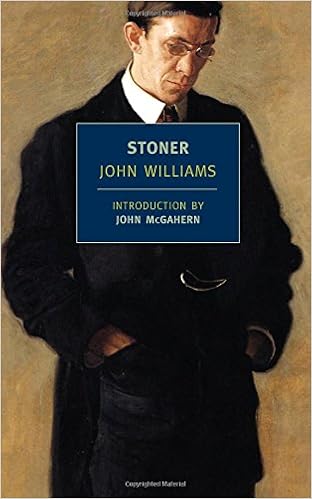
Stoner by John Williams

In his extreme youth Stoner had thought of love as an absolute state of being to which, if one were lucky, one might find access; in his maturity he had decided it was the heaven of a false religion, toward which one ought to gaze with an amused disbelief, a gently familiar contempt, and an embarrassed nostalgia.  Now in his middle age he began to know that it was neither a state of grace nor an illusion; he saw it as a human act of becoming, a condition that was invented and modified moment by moment and day by day, by the will and the intelligence and the heart.

William Stoner is the son of dirt-poor Missouri farmers, and when he goes off to the University of Missouri it's to enter the agricultural program so that he in turn can become a better farmer.  He's a good student, but meets his match in the English program, where a cantankerous teacher demands to know what Shakespeare's Sonnet 73 (my favorite) means.  Stoner is unable to answer, but the mystery has awakened something to him, and he embarks on the long and lonely life of an English academic.

Williams, like Stoner, was a relatively unimportant academic who toiled in obscurity.  It's easy to overdo the parallels and wonder if he too suffered from an unhappy marriage to a neurotic socialite, or finally found love as a late-life affair with a younger colleague.  But certainly Williams knew something of the life as lived by Stoner, measured not in its successes--Stoner publishes only one book, mediocrely reviewed, which bestows upon him a pride not related to its quality--but in its ineffable quietness and dignity.  At the book's end, on Stoner's deathbed, he thinks of himself as having been like a clergyman of literature, having led a monastic life.  Williams' prose, sometimes self-consciously plain, is designed to complement Stoner exactly.

What was it like to read this, as a teacher?  Well, I recognized certainly the feeling of "knowing something through words that could not be put in words"--perhaps as good a defense of the value of literature as ever written.  And I recognized, too, the way in which the things that touch you most deeply about the study of literature as being those things which are impossible to impress upon your students:

Always, from the time he had fumbled through his first classes of freshman English, he had been aware of the gulf that lay between what he felt for his subject and what he delivered in the classroom.  He had hoped that time and experience would repair the gulf; but they had not done so.  Those things that he held most deeply were most profoundly betrayed when he spoke of them to his classes; what was most alive withered in his words; and what moved him most became cold in its utterance.

I recognized also, I'm sad to say, the kind of student represented in the text by Charles Walker: the knowitall who really knows nothing, mistakes platitudes for depth, and despises the tedious and elaborate work of analysis without knowing he really despises it.  In Stoner's case, it's his noble insistence that Walker should not be awarded a degree that puts him at odds with the chairman of the English department and scuttles his chances of professional enjoyment or advancement for decades.  In this way Stoner is one of those stories in which a good man is attacked on all sides by selfishness and vindictiveness, and even his goodness turned into a weapon to destroy him.  But it's the simplicity of Stoner's motives that make his nobility believable, and his suffering, such as it is, profound.

I have always wondered: can anyone really write about failure, or mediocrity, successfully?  It seems to me that even the most affecting literary accounts of these things are tempered by the very fact that you can read them, that they are, in a sense, successes.  Even Williams won a National Book Award in his lifetime, though the recently renewed attention to his work is (apparently) thanks to a new posthumous French translation.  But Stoner comes as close to anything I've ever read at finding the value in a life quietly and unobtrusively lived.

Sunday, March 19, 2017

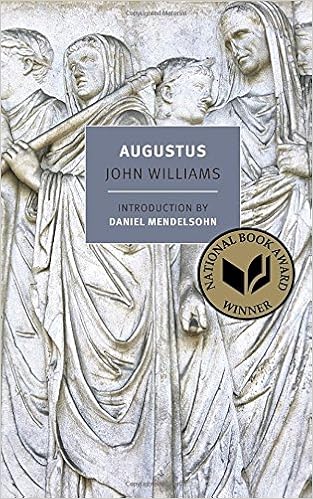
Augustus by John Williams

The young man, who does not know the future, sees life as a kind of epic adventure, an Odyssey through strange seas and unknown islands, where he will test and prove his powers, and thereby discover his immortality.  The man of middle years, who has lived the future that he once dreamed, sees life as a tragedy; for he has learned that his power, however great, will not prevail against those forces of accident and nature to which he gives the names of gods, and has learned that he is mortal.  But the man of age, if he plays his assigned role properly, must see life as a comedy.  For his triumphs and his failures merge, and one is no more the occasion for pride or shame than the other; and he is neither the hero who proves himself against those forces, nor the protagonist who is destroyed by them.  Like any poor, pitiable shell of an actor, he comes to see that he has played so many parts that there no longer is himself.

Augustus Caesar is one of those figures, like Alexander or Genghis Khan or Napoleon, whose life seems to defy the idea of interiority.  How can one really know someone whose effect on the world was so outsized?  Even Julius Caesar, the man who brought the Roman world under his heel, is humanized by the tragedy of his death, and the simple betrayal of his beloved Brutus.  Augustus, on the other hand, lived to be an old man, and put in the long, hard political work of solidifying the Roman state that Julius never had a chance to.  He created a lasting peace and an empire that lasted a thousand years; what could be said about him as a human being?

John Williams' Augustus has an interesting strategy for dealing with this problem.  His fictional life of Augustus is written as an epistolary novel, so that it seems that everyone in Rome is talking to or about Augustus--but, until the last fifty pages or so of the novel, Augustus himself is silent.

The first section of the novel deals with the aftermath of Julius' death and the long civil war that ended with the young Octavian's defeat of Mark Antony and the assumption of the title Augustus Caesar.  Antony, as most depictions do, borrows from Shakespeare's image of a vain, proud, and bungling fool who can't even get his own suicide right, yet who somehow retains a measure of shrewdness with dealing with the Roman people.  Octavian is young, and frequently dismissed, but his calm intelligence is more than a match for Antony.

The second section deals with Augustus' years in power, and focus on his conflict with his beloved daughter Julia, who was caught up in a plot against her father's life with her lovers and banished under the very anti-fornication laws that Augustus himself had passed decades earlier.  This section is interspersed with Julia's diary entries from her exile on the tiny island of Pandetaria, where she lived out teh rest of her life, never speaking to her father again.  Julia's letters show a sad and quiet resignation for her fate; others write exultantly in their political triumph. 

But the last section, a long letter written by Augustus as he knows he is dying, is what makes Augustus a terrific book.  Is the real Augustus ruthless, shrewd, loving, foolish, lucky, adulterous, loyal?  As an old man (like his adoptive father never got to be) Augustus has come to understand that all these things are true, and that at the end of his life the certitude of his ego has begun to fall away.  Williams paints a picture of a man who has given his life, his identity, even his daughter to the service of Rome even as he understands that his achievements will only be temporary.  He wonders if these sacrifices were worth it, and then zen-like waves the question away with the gesture of his hand--worth it or not, they were.  The elegiac quality of this final section--interspersed with the dry, guarded words of Augustus' actual Res Gestae, his own account of his achievements--pushes the novel beyond the self-prepossessing political intrigue of a book like I, Claudius.

All the famous characters of the early Empire are here: Julius, Vergil, Horace, Ovid, Maecenas, Agrippa, Cleopatra, Antony, Lepidus, Tiberius.  But it's the voice of Augustus himself, kept hidden until the very end, that makes Augustus feel as if it has some real insight into the past, and into the riddle of the human self.