Showing posts with label epistolary. Show all posts

Sunday, February 5, 2023

Happiness, as Such by Natalia Ginzburg

I don’t know how to explain why I feel more alone now. Maybe it was because we shared memories. Memories only he and I knew, even though we never spoke of them when we met. I realize now it didn’t matter that we didn’t talk about them. They were a presence in the hours we spent together at Cafe Canova, those oppressive, never ending hours. They weren’t happy memories because your father and I were never happy together. Even if we had been briefly and occasionally happy, everything got sullied, ripped up, and destroyed. But people don’t love each other only for happy memories. At a certain point in life, you realize that you just love the memories.

Like Waiting for Godot, Happiness as Such revolves around an absence, really a pair of absences--the physical absence of exiled son Michele and the metaphysical absence of the elusive happiness of the title. The main characters, like Michele’s mother Adriana in the excerpt above, try to articulate something about both absences, what they mean, what they look like, what it would mean if they were present. But the “as such” in the title is a guiding principle here--no one gets much closer than a facsimile of either, though sometimes it’s enough for them.

Michele, pursued by the authorities for his involvement in revolutionary activities, has left Italy, and in his wake his family--especially mother Adriana and sister Angelica--and his friends--maybe-baby-mama Mara and bestie-and-possibly-gay-lover Osvaldo--are working to clean up the mess he’s left behind. Much of the book is either epistolary, comprised of letters between those left in Italy and Michele, or dialogue. There’s no direct speech from Michele, but most of the other characters spend time conversing, often about where, exactly, Mara and her baby are going to stay, whether or not Osvaldo is gay and if he was Michele’s lover, and what, exactly, is going to be done with the property belonging to Adriana’s recently deceased husband, especially the unfinished tower that represents the ways the various relationships in the book have been left permanently unresolved by the father’s death and Michele’s absence.

Michele himself doesn’t come off so well, his political involvements facile and his actions directed only at what will bring him the most short-term happiness--that word again. He won’t come to his father’s funeral, won’t send more than cursory responses to his mother’s letters, won’t help Mara with the baby, won’t tell the family what to do with the tower which was actually bequeathed to him. Instead his letters are filled with excuses, evasions, grand statements of future plans that come to nothing, requests for pretentious books. He’s an infuriating character, made worse by the love that the closeted Osvaldo has for him, love that’s exploited so Michele’s every whim can be met.

In the end (SPOILER), Michele is killed during a protest in Bruges, cutting short all the stories being told here. The tower is sold, unfinished, to developers, and the people who’ve revolved around Michele find themselves unmoored, uncertain what to do next. But they talk, and talk, and talk. “You can get used to anything when there’s nothing else left.” Angelica says, and it’s easy to imagine these people moving on, recentering their lives on something besides the void that was Michelle.

Sunday, March 19, 2017

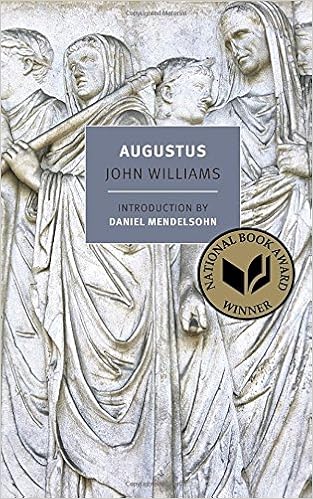
Augustus by John Williams

The young man, who does not know the future, sees life as a kind of epic adventure, an Odyssey through strange seas and unknown islands, where he will test and prove his powers, and thereby discover his immortality.  The man of middle years, who has lived the future that he once dreamed, sees life as a tragedy; for he has learned that his power, however great, will not prevail against those forces of accident and nature to which he gives the names of gods, and has learned that he is mortal.  But the man of age, if he plays his assigned role properly, must see life as a comedy.  For his triumphs and his failures merge, and one is no more the occasion for pride or shame than the other; and he is neither the hero who proves himself against those forces, nor the protagonist who is destroyed by them.  Like any poor, pitiable shell of an actor, he comes to see that he has played so many parts that there no longer is himself.

Augustus Caesar is one of those figures, like Alexander or Genghis Khan or Napoleon, whose life seems to defy the idea of interiority.  How can one really know someone whose effect on the world was so outsized?  Even Julius Caesar, the man who brought the Roman world under his heel, is humanized by the tragedy of his death, and the simple betrayal of his beloved Brutus.  Augustus, on the other hand, lived to be an old man, and put in the long, hard political work of solidifying the Roman state that Julius never had a chance to.  He created a lasting peace and an empire that lasted a thousand years; what could be said about him as a human being?

John Williams' Augustus has an interesting strategy for dealing with this problem.  His fictional life of Augustus is written as an epistolary novel, so that it seems that everyone in Rome is talking to or about Augustus--but, until the last fifty pages or so of the novel, Augustus himself is silent.

The first section of the novel deals with the aftermath of Julius' death and the long civil war that ended with the young Octavian's defeat of Mark Antony and the assumption of the title Augustus Caesar.  Antony, as most depictions do, borrows from Shakespeare's image of a vain, proud, and bungling fool who can't even get his own suicide right, yet who somehow retains a measure of shrewdness with dealing with the Roman people.  Octavian is young, and frequently dismissed, but his calm intelligence is more than a match for Antony.

The second section deals with Augustus' years in power, and focus on his conflict with his beloved daughter Julia, who was caught up in a plot against her father's life with her lovers and banished under the very anti-fornication laws that Augustus himself had passed decades earlier.  This section is interspersed with Julia's diary entries from her exile on the tiny island of Pandetaria, where she lived out teh rest of her life, never speaking to her father again.  Julia's letters show a sad and quiet resignation for her fate; others write exultantly in their political triumph. 

But the last section, a long letter written by Augustus as he knows he is dying, is what makes Augustus a terrific book.  Is the real Augustus ruthless, shrewd, loving, foolish, lucky, adulterous, loyal?  As an old man (like his adoptive father never got to be) Augustus has come to understand that all these things are true, and that at the end of his life the certitude of his ego has begun to fall away.  Williams paints a picture of a man who has given his life, his identity, even his daughter to the service of Rome even as he understands that his achievements will only be temporary.  He wonders if these sacrifices were worth it, and then zen-like waves the question away with the gesture of his hand--worth it or not, they were.  The elegiac quality of this final section--interspersed with the dry, guarded words of Augustus' actual Res Gestae, his own account of his achievements--pushes the novel beyond the self-prepossessing political intrigue of a book like I, Claudius.

All the famous characters of the early Empire are here: Julius, Vergil, Horace, Ovid, Maecenas, Agrippa, Cleopatra, Antony, Lepidus, Tiberius.  But it's the voice of Augustus himself, kept hidden until the very end, that makes Augustus feel as if it has some real insight into the past, and into the riddle of the human self.

Sunday, November 13, 2016

Lady Susan by Jane Austen

Humbled as he now is, I cannot forgive him such an instance of pride, and am doubtful whether I ought not to punish him by dismissing him at once after the reconciliation, or by marrying him and teizing him forever.  But these measures are each too violent to be adopted without some deliberation; at present my thoughts are fluctuating between various schemes.  I must punish Frederica, and pretty severely too, for her application to Reginald; I must punish him for receiving it so favorably, and for the rest of his conduct.  I must torment my sister-in-law for the insolent triumph of her look and manner since Sir James has been dismissed; for in reconciling Reginald to me, I was not able to save that ill-fated young man;--and I must make myself amends for the humiliation to which I have stooped within these few days.  To effect all this I have various plans.

I saw Whit Stillman's movie Love and Friendship a few months ago.  It's an excellent adaptation of Austen's novella Lady Susan (with a title stolen, inexplicably, from another of her juvenile works) that understand the black humor at the heart of her fiction.  But it helps that Lady Susan bares that black humor like none of Austen's other novels; the title character is, unlike the various prigs and snobs that people her major works, unapologetically nasty.

Part of that may be due to Austen's choice to write the novella in the epistolary form, as a series of letters.  There's no social code of conversation that restrains her letters to her friend Mrs. Johnson, wherein she describes just how much she hates her daughter, and her manipulative glee in forcing the brother of her late husband's brother's wife (I know) to fall in love with her.  She does it just for the pleasure of it; she's really in love with a man named Manwaring--you can tell by his name how much masculinity he exudes--whose current wife kicked Susan out of their house for carrying on an affair under her nose.

Susan wants her "stupid" daughter Frederica to marry the loathsome Sir James Martin:

Upon the whole, I commend my own conduct in this affair extremely, and regard it as a very happy instance of circumspection and tenderness.  Some mothers would have insisted on their daughter's accepting so good an offer on the first overture, but I could not answer it to myself to force Frederica into a marriage from which her heart revolted; and instead of adopting so harsh a measure, merely propose to make it her own choice, by rendering her thoroughly uncomfortable till she does accept him.  But enough of this tiresome girl.

The fun of Lady Susan stems from the way in which we get to see the characters in their private confidences.  We are so used to "reading between the lines" to see the vanities and malices at work in her novels, but here we get to see those interior motives at their fullest expression.  It would have been nice for a character as terrific as Lady Susan to have a more substantial novel in which to work her schemes, which, while nefarious, fail quickly and spectacularly.  Stillman's film does a good job of filling out the narrative to accomplish that--especially by beefing up comic actor Tom Bennett's role as Sir James.  You should see the movie--but if you're strapped for time, the novella is probably quicker!

Monday, July 16, 2012

The Postmortal by Drew Magary

“I’ve always known it was a lie. You cannot hide from the world. It will find you. It always does. And now it has found me. My split second of immortality is over. All that’s left now is the end, which is all any of us really has.”

“Who wants to live forever?” - Queen

I struggled to find a piece of prose to headline this review, because The Postmortal isn’t really built around strong prose. It’s got very little style, beyond its unique structure, which intersperses a first-person narrative with blog posts, news stories, and television transcripts and is sometimes a little clumsy or overfamiliar. It’s also not really character-based—outside of two or three characters, most of the cast was thinly sketched. It also has serious third-act problems. In spite of all that, I can’t help but qualify it as a success, largely due to its setting, a world in which science has conquered death.

The novel focuses on John Ferrell, an average guy who chooses to have his physical state frozen at the age of twenty-nine. Author Drew Magary follows Ferrell through the next 60 years, as the face of the world changes in light of mankind’s newfound immortality. Ferrell changes along with the world, gradually transforming from an average Joe who just happens to be immortal into a cynical jerk into a government-sponsored “End Specialist”—essentially a euthanasiast. In spite of the novel’s combination first-person/epistolary, it sustains some serious momentum throughout, and, even when events strain credulity, it maintains an emotional core that directs the twists, including a particularly Whedonesque one near the midpoint, directly at the gut.

Magary starts from a simple premise—what if, barring disease or violent death, we could live forever?—and extrapolates from it a worldwide culture which is surprisingly believable. Following the cure from its pre-legal stages all the way to a nuclear apocalypse, Magary takes the long view, speculating on how immortality would affect religion, marriage, healthcare, politics and personal behavior. There’s very little that doesn’t receive at least cursory treatment, and Magary’s conclusions seem logical enough. As it turns out, this is enough to sustain the whole enterprise. Even when things take a turn toward action-movie clichés, John maintains a sense of humanity that grounds the sensational events surrounding him. There’s thought-provoking material in The Postmortal, ranging from the things everyone has thought about—won’t everyone I know die, is immortality really something desirable—to the extremely unsettling, as in a transcribed interview with a woman who injected her baby girl with the cure at 9 months, rendering her an eternal infant.

However, it’s not all sunshine. In spite of some good moments, including the ending, the last third of the novel, where Ferrell (spoiler) hooks up with the most beautiful woman in the world after saving her life, feels a lot like shallow wish fulfillment and somewhat undercuts the rest of the novel’s willingness to pull the rug out from under the reader just when things started seeming too familiar. Still, none of these problems took me out of the story too much. The themes were just too universal, too primal, and the world too well conceived, to be derailed by plot contrivances. Who waits forever anyway?