Showing posts with label Missouri. Show all posts

Monday, June 19, 2023

Mrs. Bridge by Evan S. Connell

Mrs. Bridge stood alone at a front window thinking of how quickly the years were going by. The children were growing up so rapidly, and her husband--she stirred uneasily. Already there was a new group of "young marrieds," people she hardly knew. Surely some time had gone by--she expected this; nevertheless she could not get over the feeling that something was drawing steadily away from her. She wondered if her husband felt the same; she thought she would ask him that evening when she got home. She recalled the dreams they used to share; she recalled with a smile how she used to listen to him speak of his plans and how she had never actually cared more than one way or another about his ambition, she had cared only for him. That was enough.

Mrs. Bridge has an unusual given name: India. But no one ever calls her anything but Mrs. Bridge, including the author of Mrs. Bridge, Evan S. Connell: it's almost as if, in marriage, she's able to conceal at last the one possible eccentricity that follows her, in order to live a life of utter conformity. Mrs. Bridge is a portrait of 1940s housewife that might feel stale and familiar to us in 2023: a woman who permits herself to have no other ambitions than pleasing her husband. Mr. Bridge is not cruel, except in the small cruelties of isolation and inattentiveness that such a relationship fosters, but still she lives for him, cooks for him, votes the way he votes. And yet, maintaining such a lifestyle requires a force of will from Mrs. Bridge, a will that goes into not seeing the world around her as it changes.

That's the story of Mrs. Bridge: a woman who fights, without knowing that she's fighting, against a knowledge that things might be different. Mrs. Bridge is written as a collection of vignettes, snapshots of Mrs. Bridge's life, each of which shows the ways in which she fights to maintain her placidity. Sometimes it's in small ways--insisting that her daughter Ruth not wear dangling earrings in the morning, or insisting that her independent-minded son Douglas not use the back door like a servant--and sometimes the fight requires much more from her, like ignoring and rationalizing the breakdown of her friend Grace, whom the desperate life of a housewife drives to suicide.

And yet, over and over again, it seems that Mrs. Bridge might be on the brink of breaking out of her shell of cultivated ignorance. She starts listening to a training course in Spanish; she takes an art class in which she paints--without knowing why--Leda and the Swan, a famous mythological scene of rape. In one vignette, she even picks up a book titled Theory of the Leisure Class, which convinces her to change the way she votes, until she ends up in the voting booth and registers "her wish for the world to remain as it was." In each case, her housewifely duties get in the way of opening up, or she grows cold feet and puts the task away, without ever really knowing why.

One of the best scenes in the book illustrates it well: while Mrs. Bridge dines with her husband at the club, word comes through that a deadly tornado is approaching. A waiter convinces all of the other patrons to shelter in the basement but Mr. Bridge insists on continuing his dinner as if nothing is wrong. As Mrs. Bridge fetches butter from a nearby table, the tornado appears in the clattering window in all its fearsome power, but Mr. Bridge never moves, so neither does Mrs. Bridge, as much as she feels inside that she might be safer downstairs. Connell has a light and ironic touch, but the overall effect is one of deep pity and sadness; we understand Mrs. Bridge so much better than she understands herself, and we can see that the bargain she has made inwardly has provide her with stability, but not peace, happiness, or wisdom. And when her husband finally dies in his office, we know that she is truly screwed, left without the capacity to live on her own and make her own choices. The novel ends on an ominous note: Mrs. Bridge in her stalled Lincoln, discovering that the doors are wedged in tight by the walls of the garage, and there's no one around to call out to for help.

Tuesday, October 6, 2020

Jack by Marilynne Robinson

Della was speaking to him sometimes in his thoughts, or she was quiet, simply there at the edge of his vision. In her gentle way she was making everything easier. What would she find becoming him? That was what he did. And by putting himself in the way of survival, not to put too fine a point on it, he was doing as she had asked him to do, so forthrightly. Can these bones live? Oh, Lord, you know. But for you, Miss Miles, I am eating this sandwich, for you I am smiling at this stranger, for you I am trying to sleep. He could not imagine an occasion when she might acknowledge any of this. No matter. Their lives were parallel lines that would not meet, he knew that, he would see to that. But they defined each other, somehow. Equidistance was like silence. It had to be carefully sustained to exist at all.

Few books have disappointed me as much as Marilynne Robinson's Home. Coming after the mystical Housekeeping and the elegiac, ruminant Gilead, it felt maudlin and suffocating, even as it covered some of the same ground as Gilead. The problem, I think--or one of them--was that its prodigal son, Jack Boughton, was never quite prodigal enough. The entire novel is constructed around the question of whether Jack can be forgiven and reintegrated into the life of his father's home, but Jack himself never seemed like a problem: he was too weepy, too philosophical, to really push the limits of forgiveness convincingly, despite whatever misdeeds were in his past. When I heard that Robinson was returning to the character of Jack in this new novel, I was both apprehensive and optimistic: it might be another bore, but it might also be a chance to make Jack's travails more convincing.

Jack follows the title character in the events just prior to Home (and Gilead, I think?), a period in which he's bumming around St. Louis. He meets a black schoolteacher named Della, and they fall deeply in love, having principally in common the fact that they both talk like an essay by Marilynne Robinson. But Jack's love for Della is dangerous, even illegal; it means not only gossip and approbation but the possibility of being dismissed from her job at an illustrious school for black students and a break with her family, led by her father, a black separatist bishop from Memphis. Jack, whose history, as we know, includes the "corruption" of a young girl in Iowa with whom he fathered a child, has committed himself to "harmlessness," and his love for Della is anything but harmless.

For me, Jack succeeds where Home largely failed. It provides a convincing portrait of Jack as a someone who thinks very little of himself and a great deal about others, but who seems to bring chaos to their lives even still. At times this quality even takes on a kind of comic aspect, as in a strange moment when he agrees to put on the uniform of a cemetery gardener, only to realize later that the gardener is on the lam and trying to frame him for some obscure misdeed, or when he gets thrown in prison for having stolen property in his pocket--dropped there by a pickpocket panicking at the sight of the cop on the corner. These episodes are droll, but they are intimations of the darker facts of Jack's life, in which is good intentions have all turned sour. Though Jack's love for Della and his love for her are never in question, Jack spends much of the novel pursuing and abandoning her, unable to overcome the quite reasonable belief that his love is a threat or a poison.

I'm actually not surprised that Jack was notably panned in the New York Times this week by Dwight Garner, who finds Robinson's prose "airless." She has a love for abstract nouns that seems to me uniquely Protestant, insofar as Protestantism must construct a faith without the material comfort of the real presence; in Robinson's novels drama works less on the street or in the mind than in the soul, which is the realest thing there is, as Della tells the atheist Jack:

"We all have souls, true?"

He laughed. "Please go on."

"We do. We know this, but just because it's a habit to believe it, not because it is really visible to us most of the time. But once in a lifetime, you look at a stranger and you see a soul, a glorious presence out of place in the world. And if you love God, every choice is made for you. There is no turning away. You've seen the mystery--you've seen what life is about. What it's for. And a soul has no earthly qualities, no history among the things of this world, no guilt or injury or failure. No more than a flame would have. There is nothing to be sad about it except that it is a holy human soul. And it is a miracle when you recognize it."

The other side of this quality is that the novel can seem spectral when you want most for it to be down to earth. It's a novel, after all, about an interracial relationship under Jim Crow, and it's set across more than one black church across the urban heartland of America. Robinson gives the reader numerous black churchmen and churchwomen, tenderly and thoughtfully written, including Della's father, who is gracious to Jack even as he tells him that he will disown Della if she marries him, and yet something of the possible immiseration and violence--the real material stakes of the decision Jack and Della are making--seems just beyond the novel's grasp.

Actually, maybe what the novel is missing most is a sense of anger: why should Della and Jack, two perfectly matched people, not be permitted to be together? I'm reminded of the long digression in Gilead about the Reverend Ames' ancestor who fought for abolition. But that's a different family, and not so much like this pair of dreamers, whose challenge is to accept that the promise of love can outweigh the fear of ruin. Jack's character and situation are unique, but we all must embrace the fact that to love another person grants the power, not always voluntarily wielded, to harm them. Though Jack never quite captures the drama of the soul as powerfully as Gilead or Lila, it is compassionate and a little sweet.

Sunday, May 14, 2017

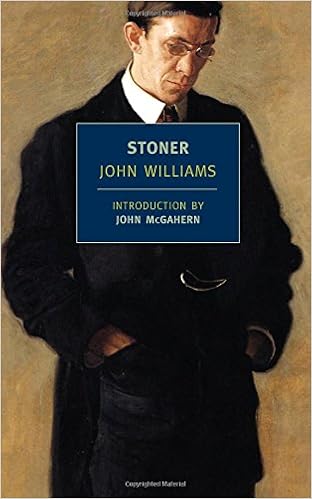
Stoner by John Williams

In his extreme youth Stoner had thought of love as an absolute state of being to which, if one were lucky, one might find access; in his maturity he had decided it was the heaven of a false religion, toward which one ought to gaze with an amused disbelief, a gently familiar contempt, and an embarrassed nostalgia.  Now in his middle age he began to know that it was neither a state of grace nor an illusion; he saw it as a human act of becoming, a condition that was invented and modified moment by moment and day by day, by the will and the intelligence and the heart.

William Stoner is the son of dirt-poor Missouri farmers, and when he goes off to the University of Missouri it's to enter the agricultural program so that he in turn can become a better farmer.  He's a good student, but meets his match in the English program, where a cantankerous teacher demands to know what Shakespeare's Sonnet 73 (my favorite) means.  Stoner is unable to answer, but the mystery has awakened something to him, and he embarks on the long and lonely life of an English academic.

Williams, like Stoner, was a relatively unimportant academic who toiled in obscurity.  It's easy to overdo the parallels and wonder if he too suffered from an unhappy marriage to a neurotic socialite, or finally found love as a late-life affair with a younger colleague.  But certainly Williams knew something of the life as lived by Stoner, measured not in its successes--Stoner publishes only one book, mediocrely reviewed, which bestows upon him a pride not related to its quality--but in its ineffable quietness and dignity.  At the book's end, on Stoner's deathbed, he thinks of himself as having been like a clergyman of literature, having led a monastic life.  Williams' prose, sometimes self-consciously plain, is designed to complement Stoner exactly.

What was it like to read this, as a teacher?  Well, I recognized certainly the feeling of "knowing something through words that could not be put in words"--perhaps as good a defense of the value of literature as ever written.  And I recognized, too, the way in which the things that touch you most deeply about the study of literature as being those things which are impossible to impress upon your students:

Always, from the time he had fumbled through his first classes of freshman English, he had been aware of the gulf that lay between what he felt for his subject and what he delivered in the classroom.  He had hoped that time and experience would repair the gulf; but they had not done so.  Those things that he held most deeply were most profoundly betrayed when he spoke of them to his classes; what was most alive withered in his words; and what moved him most became cold in its utterance.

I recognized also, I'm sad to say, the kind of student represented in the text by Charles Walker: the knowitall who really knows nothing, mistakes platitudes for depth, and despises the tedious and elaborate work of analysis without knowing he really despises it.  In Stoner's case, it's his noble insistence that Walker should not be awarded a degree that puts him at odds with the chairman of the English department and scuttles his chances of professional enjoyment or advancement for decades.  In this way Stoner is one of those stories in which a good man is attacked on all sides by selfishness and vindictiveness, and even his goodness turned into a weapon to destroy him.  But it's the simplicity of Stoner's motives that make his nobility believable, and his suffering, such as it is, profound.

I have always wondered: can anyone really write about failure, or mediocrity, successfully?  It seems to me that even the most affecting literary accounts of these things are tempered by the very fact that you can read them, that they are, in a sense, successes.  Even Williams won a National Book Award in his lifetime, though the recently renewed attention to his work is (apparently) thanks to a new posthumous French translation.  But Stoner comes as close to anything I've ever read at finding the value in a life quietly and unobtrusively lived.