Showing posts with label El Paso. Show all posts

Monday, April 15, 2024

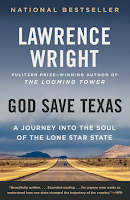
God Save Texas: A Journey Into the Soul of the Lone Star State by Lawrence Wright

I drove back to Austin, under a Turneresque sunset with a gibbous moon rising from a bank of pink clouds. A herd of Black Angus cattle moved like shadows in the places where the buffalo once grazed. I thought about how unintentional most of life is. Part of me had always wanted to leave Texas, but I had never actually gone. Sometimes we are summoned by work or romance to move to another existence, and for me those moments when there is no reasonable alternative to departure have always been joyful, full of a sense of adventure and reinvention. Staying is also a decision, but it feels more like inertia or insecurity. Most of the time I live in a state of vague discontent, tempted by the vision of another life but unwilling to let go of the friends and daily habits that fill my time. When I am in other states or countries, I'm always aware of being in exile from my own culture, with all its outsized liabilities. I wish I lived in the mountains of Montana or on the Spanish Mediterranean. I wish I had a condo in a high-rise overlooking Central Park, with a piano by the window. These thoughts have been at play in my imagination for decades. Now here I was, on a darkening highway in Texas, with so much more road behind me than what lay before.

How hard it must be to write a book about Texas. Alaska may be bigger, but it's relatively unpeopled; to encompass Texas, you'd have to write about Houston's oil booms, Austin's weirdness, tensions on the Rio Grande. You'd have to talk about Dallas and Dealey Plaza, about the great nothingness in the middle, about Big Bend and the far west. Lawrence Wright's essay collection God Save Texas might not be Texas-sized; it's hard not to sense that in its attempts to cover every corner, it's missed some of the true mystery that lies along the way, but it's good enough for an outsider like me. From the first moment, when Wright describes biking along the path between San Antonio's historic Spanish missions, it whetted my whistle for the trip I'm taking next week, where I hope to do exactly that. (Let's hope those predictions of rain are exactly that.)

Wright brings a set of necessary skills to the project: he's a journalist, and much of the novel reads like well-researched journalism, especially the section about Houston that traces the history of the oil boom. Wright clearly has access to the chambers of the statehouse in Austin; he devotes two sections--titled "Making Sausage" and "More Sausage" to the conflicts within the Texas Legislature between moderate and ultra-conservative Republicans, and no one, it seems, is unwilling to talk to him--not even Karl Rove, who pops in for a queasy hello. I could have done with less of this stuff, maybe, because Texas's political scene is the least pleasant thing about the whole state, and I'd rather not think about it. But Wright, writing during the Trump administration, makes a powerful case that Texas is--shudder to think--the crucible of the American political scene. Ironically, given its iconoclasm, Wright suggests that Texas is at the forefront of American politics, and what we see there is soon to be what we see everywhere. It's hard to say he's wrong about that.

But Wright is a playwright, too, and much more pleasant are the sections where he uses his more writerly gifts to extol the state's grandeur and beauty. I loved the section about far west Texas, a severe desert where modern artists like Donald Judd found a landscape that could match the pure shape and color of their innovations. Chapters like "Borderlands" and "The High Lonesome," the latter ostensibly about the mid-Texas landscape that birthed musical icons like Buddy Holly, manage to capture in words something of Texas's sheer, mind-altering scale.

Wright, a Texan by birth, writes about returning to his ancestral land after sojourns in New York, Atlanta, Tennessee, and even as far away as Egypt. It's beautiful and difficult, I think, to return to the place whence you came, like the spiral returning; it has an air of backwardness, or perhaps of the final stages of something. But I find it easy, actually, to imagine that returning to Texas feels like home.

Saturday, October 14, 2023

A Manual for Cleaning Women by Lucia Berlin

At first, when a voice on the intercom would say, "Nurse! Quick!" I'd ask, "What's the matter?" That took too much time; besides, nine times out of ten it's just that the color's off on the TV.

The only ones I pay attention to are the ones who can't talk. The light comes on and I push down the button. Silence. Obviously they have something to say. Usually something is the matter, like a full colostomy bag. That's one of the only other things I know for sure now. People are fascinated by their colostomy bags. Not just the demented or senile patients who actually play with them but everyone who has one is inevitable awed by the visibility of the process. What if our bodies were transparent, like a washing machine window? How wondrous to watch ourselves. Joggers would jog even harder, blood pumping away. Lovers would love more. God damn! Look at that old semen go! Diets would improve--kiwi fruit and strawberries, borscht and sour cream.

Must an incredible writer lead an incredible life? No, surely not, given how much of it takes place in a small room in front of a keyboard. But there are writers like Lucia Berlin who make you wonder otherwise: born in Alaska, having grown up in a series of mining camps from Idaho to Chile, working as a nurse or cleaning woman in El Paso or Mexico City, overcoming the ravages of alcoholism. These experiences make their way into the stories that make up the collection A Manual for Cleaning Women, though Berlin's stand-in is only sometimes labeled as Lucia--sometimes she is an analog named Carlotta--along with a number of repeating motifs that were surely drawn from real life: a sister, reconnected with only after her terminal cancer diagnosis, a sexy fling with a Mexican deep sea diver, a bitter, witty mother with her many "suicides." In the hands of Berlin the writer, these experiences are transmuted into vignettes that are blackly funny and deeply touching.

The comparisons are already there in the introduction: there's Grace Paley, whose stories of Jewish New York have a freewheeling, riotous nature that's mirrored in Berlin's. (It's a bad comparison, because it can only diminish Berlin a little, given that no American short story writer ever really reached the heights of Paley's best work.) I thought of Joy Williams, perhaps because I'm always thinking of Joy Williams, or maybe because Berlin's downtrodden but spirited desert dwellers seem as if they could come right out of Williams' Arizona

What sets Berlin's stories apart, I think is their structural boldness and looseness. Look close at the spaces between the paragraphs, which often have no connecting tissue whatsoever; they jump from idea to idea in a way that obscures the structural inventiveness and circuitousness of the stories. The title story might be the best example of this, which weaves together the narrator's descriptions of her clients with the route of a Berkeley bus, labeled by stop, and bits of guidance for other cleaning women. It's a story that seems like it's doing too much, but at length the story that binds the thread together emerges: grieving the death of a friend, the narrator is stockpiling sleeping pills from her clients with which to commit suicide. ("Ter," she addresses the dead toward the end, "I don't want to die at all, actually.")

A Manual for Cleaning Women collects over 40 of Berlin's stories. There's something a little unjust about putting so many in one place; inevitably, the awe wears off and the seams in some of the stories begin to show. I felt that the stories in which Berlin tries to take on the voice of a first person narrator who's not her own analog--as she does with the high-flying lawyer in "Let Me See You Smile"--were the weakest. But there are far fewer missteps than triumphs: the abortive Mexican abortion of "Tiger Bites," the hilarious account of a dowdy woman who sets off to have a post-menopausal affair in "A Love Affair," the joyous account of little Lucia's first child love with a mischievous mining camp boy in "Temps Perdu." A mad comic energy enlivens most of the collection's best stories, but Berlin's relentless focus on the poor and the working class, especially in the barrios of Mexico and around El Paso, means that some of the powerful are not funny at all: never again will I want to read "Mijito," the story of how poverty and neglect lead to the death of an infant child, despite the best intentions of the doctors and nurses at the free clinic. Elsewhere, Berlin describes the life of the true alcoholic, shaking with withdrawal, who wonders if they'll even be able to live before the first liquor store opens at five in the morning.

Berlin's endings are special: they always seem to flip the story on its head, or at least wrench it a little out of place. They do what's nearly impossible to do: seem both surprisingly and entirely logical. Sometimes they are little stories in themselves, moving from laughter to tears and back again:

Sally and I write rebuses to each other so she doesn't hurt her lung talking. Rebus is where you draw pictures instead of words or letters. Violence, for example, is a viola and some ants. Sucks in somebody drinking through a straw. We laugh, quietly, in her room, drawing. Actually, love is not a mystery for me anymore. Max calls and says hello. I tell him that my sister will be dead soon. How are you? he asks.