Showing posts with label Kate Beaton. Show all posts

Sunday, February 19, 2023

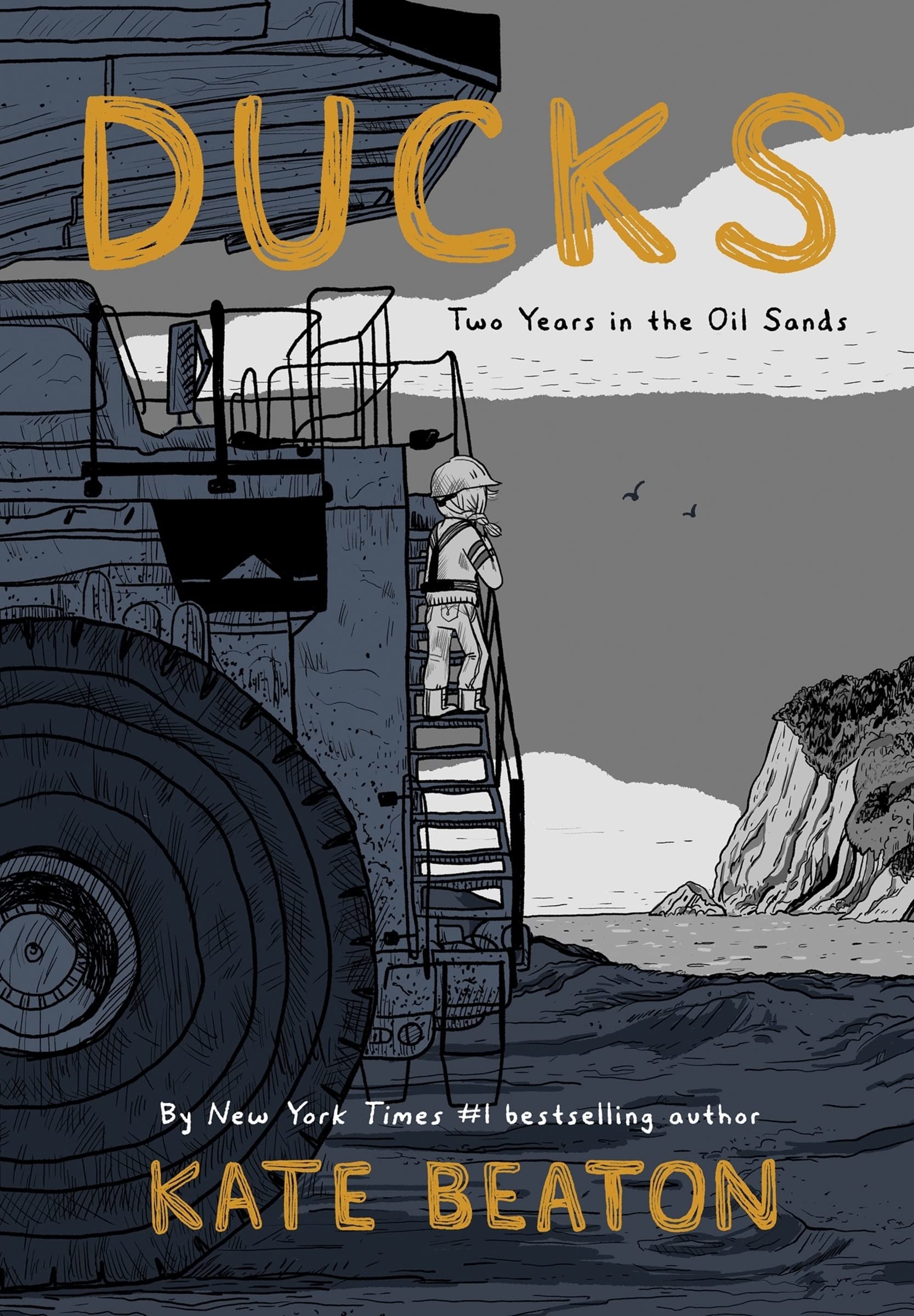
Ducks by Kate Beaton

I’ve waited too long to review Ducks, one of my favorite books of the year. I know this because I’ve already returned it to the library so I don’t have it on hand to consult. In my defense, Chris’s review is so good, I didn’t feel like I had much to add. But in the interest of reviewing everything this year, and not wanting to leave something that will likely make my year end list without a review, here goes.

Ducks is a graphic memoir, recounting the two years cartoonist and writer Kate Beaton spent working in the oil sands of Alberta, Canada. This is, I learned, a common rite of passage for young Canadians, and so, in spite of her family’s concerns, the book opens with Kate at the airport with her mother, about to leave her hometown of Cape Breton for the wild North.

The story is structured around the various camps at which Kate works plus one brief period at a museum in Victoria, and, within those sections, the story is broken up into a series of moments, interactions, and small scale events. The larger narrative emerges as the characters recur throughout various vignettes in different settings, as do the larger thematic concerns, most of which revolve around what it’s like to be one of the only women surrounded by hundreds of men who have largely been freed from the constraints of society.

And it must be said, the picture that emerges of the men here is not flattering. From her first moments in the sands, Kate finds herself being stared at, accosted, insulted, treated as inferior or, worse, as a prize, by seemingly every man she encounters. There are a few exceptions, characters whose names I can’t look up because I don’t have the book handy, and to Beaton’s credit, the portraits that emerge of the men are nuanced and complex--what are we to make of the men who are here working for their families, who gushingly share photos of wives and daughters and then make gross advances? Or of Kate’s boss who makes constant sexist remarks but also acts protectively? Or the hundreds of men with whom she never interacts, the silent majority, perhaps, who keep their heads down, make their money and go home? Beaton confronts this question head on, in a great conversation she has with her sister late in the narrative, but even there, no answers are forthcoming. Something about the isolation, the freedom from censure, the loneliness, the constant stress, causes breakdowns both internal and external, and, like the Safety Pyramid from the repetitive introductory seminars at each camp, these small disintegrations lead to larger disintegrations. Kate asks explicitly the question that the #NotAllMen contingent presumes the answer to: if our dad, our brother, our cousin were here, would they be any different?

The threat of sexual violence hangs heavy over the narrative; even before its explicitly mentioned we, the readers, can feel the looming threat, simply from the ratio of men to women. Later, it’s made more explicit, particularly when Kate visits a strip club with some of the men and learns about the practice of heating a quarter and tossing it at the dancer, with the intent that it hit and burn her genital area. Kate doesn’t know what to say to this; neither do I. But the darkest and boldest moment in the book comes when Kate, drunk at a party after being plied all night with drinks is taken to a back room and raped. And then, mere pages later, it happens again. The second time, Beaton illustrates her dissociation in a way that could exist only here, in the realm of graphic art, as she leaves her body, lets it happen, then tries to forget.

Beaton’s uncanny skill for capturing faces and expression with a few scratchy strokes pays big dividends as the cast grows. Her environments reflect the sameness and repetition of life on the sands, lulling the reading into the same cyclical rhythms without ever becoming visually boring. And the large illustrations, used sparingly, are both beautiful and imbued with meaning: the aurora borealis, the final group photo.

She leaves the sands only twice. Once to work at the aforementioned museum in Victoria, where we witness the birth of Beaton’s famous horse and, implicitly, Hark a Vagrant, her most famous work. And, at the end, when she returns from the sands and reunites with her family. In town, still with her family, she’s seen by a man she worked with on the sands, who says hello then tells her that, while she was stationed at his site, the men had a bet going about who would sleep with her first. She laughs it off, to the shock of her family, who ask why. And, like this book, she doesn’t offer them any answers.

Saturday, January 28, 2023

Ducks by Kate Beaton

I loved Kate Beaton's webcomic series, Hark! A Vagrant. It was erudite without being smug or obscure, consisting of rapid-fire riffs on literature and history, drawn in a charismatic pen-line style. It's funny to learn, from Beaton's graphic memoir Ducks, that the series began while she was toiling in the remote Alberta oil sands, a place where men--almost entirely men--come to pad their bank accounts by working under hard conditions, far away from home. For Beaton, the oil sands were a way to quickly pay down student debt, a brief but difficult experience meant to allow her to pursue her dream of being a cartoonist, as opposed, perhaps, to taking a job as a teacher or in a museum, where she might be more comfortable but never get out from under the debt, or follow her dreams.

For Beaton, the worst thing about the oil sands turns out not to be how remote they are, nor the spartan conditions of "camp" living, nor even the brutal physical ugliness of the tailing ponds. It's the men. The oil sands, like North Dakota's oil towns here in the U.S., are overwhelmingly masculine places, and they are difficult for women. Beaton immediately finds herself the object of unwanted attention: stares and leers, crude jokes, sexual propositions and harassment. Ducks shows well just how wearisome such a life can be, how it can wear one down. Each joke or crude suggestion in and of itself can be written off as men being men, or not a big deal, but they never stop, and they come from every man, even the "nice" ones. These crudities culminate in rape--twice. Writing such a thing into your own memoir, especially when you must actually draw it, and not just write about it, seems to me an act of remarkable authorial bravery. The rapes, we come to understand, are like the "safety pyramid" that illustrates how fatalities and injuries are the consequences of thousands of small negligences: they are inextricable from the larger culture of sexism and unaccountability that pervades the oil sands.

There's an interesting resonance, I thought, between Ducks and Alistair MacLeod's No Great Mischief, which I recently read. Both Beaton and MacLeod are Nova Scotians, Cape Bretoners, and both write about the way western resource extraction peels Atlantic Canadians, many of whom live in generational poverty, away from their homes. For MacLeod, it's the coal mines of western Ontario; as someone explains to Beaton in Ducks, those opportunities have all dried up and Nova Scotians and Newfoundlanders have had to move west, to the oil sands. But both depict the pain and uncertainty of leaving home, and the physically and mentally demanding conditions of this unlovely work. The ducks of the title are those who land in the oil sands' tailing ponds and become stuck in the oil, drowning and being poisoned. In a literal sense, the ducks awaken Beaton to a new understanding the environmental and social catastrophe that the oil sands represent--amplified by watching a local First Nations leader on YouTube--but in another sense, they are a symbol for the Canadians who are drawn to the oil sands' beguiling economic promise.

Beaton's style isn't much changed from the Hark! A Vagrant days: she still has a knack for creating charismatic expressions with a few simple lines only. The workers in the oil sands are cartoonish but wholly human. I liked especially how Beaton uses a simple three-by-three grid, reminiscent of the stacked "episodes" of the old webcomic, which every know and then opens up into a full page scene of massive scope: the Northern Lights over a frozen field, or a "photo" taken from a crane of all the workers at the camp. The oil sands are somehow both immense and confining, a vast landscape and a cramped cage.