Showing posts with label Alistair MacLeod. Show all posts

Tuesday, January 17, 2023

No Great Mischief by Alistair MacLeod

I think of my grandparents a great deal, and, as in the manner of the remembered Gaelic songs, I do not do so consciously. I do not awake in the morning and say, as soon as my feet hit the floor, "Today I must remember Grandma and Grandpa. I will devote ten whole minutes to their memory" -- as if I were anticipating isometric exercises or a self-imposed number of push-ups to be done on the floor beside my bed. It does not work that way at all. But they drift into my mind in the midst of the quiet affluence of my office, where there is never supposed to be any pain but only the creation of a hopeful beauty. And they drift into the quiet affluence of my home, with its sunken living room and its luxuriously understated furniture. And they are there too on Grand Cayman or in Montego Bay or Sarasota or Tenerife or any of those other places to which we go, trying to pretend that, for us, there really is no winter. They drift in like the fine snow in the old Calum Ruaidh house in which my brothers used to live; sifting in and around the window casings or under the doors, driven by the insistent and unseen wind, so that in spite of primitive weather stripping or the stuffing with old rags, it continued to persist, forming lines of quiet whiteness to be greeted with surprise.

A man drives from Halifax to Toronto to visit his older brother, and buy him a couple cases of the liquor he can no longer do without. Nearly three hundred years earlier, a Scotsman of the clan MacDonald sets out for the New World, having buried one wife already and burying another while at sea. The point of land in Cape Breton where he lands will bear his name forever: Calum Ruaidh Point. Between these two lifetimes stretches a long history of poor but hardy Highlanders who scraped a living out of the Cape Breton landscape, as fishermen and lighthouse keepers, parted from their ancestral homeland. To some extent they live as aliens in Canada, visitors from a country most of them have never seen, but their attachment to Cape Breton, somehow, only seems to become clear when they, the clan MacDonald, dissipate into a further diaspora across Canada and the United States.

The dentist who drives to Toronto is Alexander MacDonald, the narrator. His life, told as a kind of thread that is woven with the lives of parents, grandparents, siblings, and cousins, is punctuated by several significant deaths. The first is the death of his parents, who disappear into a hole in the ice on a winter's day and are never found. "I went to my grandparents' for the night," he describes, "and I never left." It is impossible to imagine him living with his three older brothers, who share their ancestral house in a kind of primeval masculine state, using a bucket for a toilet and sleeping in their clothes. From an early age, it's understood that Alexander--typically identified as gille bhig ruaidh, the little red boy--will be different; he will go to school, become a dentist. But when his cousin, also named Alexander MacDonald, is killed in a mining accident alongside the same brothers in Ontario, the narrator is conscripted to make up the number, and spends a formative summer in the mines himself:

I was also aware of a certain guilt concerning the death of the red-haired Alexander MacDonald, though I was not sure if the guilt really was or should have been mine. But there was a vague uneasiness associated with the circumstances and the timing of it all. I told myself that he had gone into the mine after high school because he was not academically inclined. But I knew also that he had done so, at least in part, to help the members of his family who had been haunted, through no fault of their own, by the echoes of a kind of regional, generational poverty which whispered and sighed with the insistence of the unseen wind. I realized that Alexander MacDonald had partially paid for the car which ferried me home from my splendid graduation, and I realized that the opportunity to thank him and make amends was now no longer there. I had often recreated the scene in which he had called me "lucky" because my parents had lost their lives, and the feeling of the callouses on his small, determined, hard-working hands seemed permanently bonded to the rising hair on the back of my neck. The touch of his small hands, it seemed, would now and forever be mine, although I told myself that his passing had affected others much more profoundly, and I had best not consider myself so precious.

The men of the mines are proud Highlanders, doubly estranged from home, and locked in enmity with their French Canadian counterparts. Among his brothers in the mines, narrator Alexander reflects on the way that history, the story of the generations, comes to bear on men, and how its burdens can lead to strange violence. In a turn both grim and funny, a third Alexander MacDonald appears: an American cousin fleeing the Vietnam War who wears that history lightly, and whose flippant ignorance of it leads to another, final murder. Two Alexander MacDonalds, I'd wager, is symbolic enough, but three begins to look downright silly, and yet the wistful plainspokenness of MacLeod's language, like a Maritime Willa Cather, makes it work.

One small thing I appreciated about No Great Mischief is the way the narrator, as he drives across Ontario, watches the itinerant farmers, from Mexico and Guatemala and other places, at work in Canadian fields. He imagines their lives, their hard work, the refuge of a nightly beer or two, the boredom of their children. The point, as I read it, is that the story of the clann Calum Ruaidh is one repeated the world over by people making a home far from home. Without MacLeod's light touch it might seem heavy handed, but here it's perfect and subtle. Like his story collection Island, No Great Mischief evokes the rocky, hardscrabble environment of Nova Scotia in a way few novels have ever really been able to evoke a place, but it also manages to find something universal about family, about history, about what is owed to our ancestors--and their descendants.

Monday, July 1, 2019

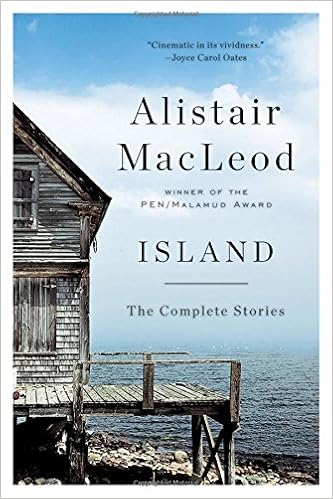
Island by Alistair MacLeod

The hopes and fears of my past and present jostle and intertwine.  Sometimes when seeing the end of our present, our past looms ever larger, because it is all we have or think we know.  I feel myself falling back into the past now, hoping to have more and more past as I have less and less future.  My twenty-six years are not enough and I would want to go farther and farther back through previous generations so that I might have more of what now seems so little.  I would go back through the superstitions and the herbal remedies and the fatalistic war cries and the haunting violins and the cancer cures of cobwebs.  Back through the knowledge of being and its end as understood through second sight and spectral visions and the intuitive dog and the sea birds' cry.  I would go back to the priest with the magic hands.  Back to the faith healer if only I had more faith.  Back to anything rather than to die at the objective hands of mute, cold science.

I'm going to Newfoundland tomorrow, a trip I've been long planning, both literally and in the corner of my mind where you think about the trips you'd one day like to take.  I've been holding on to Alistair MacLeod's collection Island for years, thinking that when I actually made it, I'd take it with me, only to pull it down to show a friend and for her to point out that the stories in it are about Cape Breton Island, the northern part of Nova Scotia, not Newfoundland.  Oh, well.  But Newfoundland is only a ferry's ride away from Cape Breton--or a fishing boat's hop, as many of the stories in the collection make clear--so let's think of it as a way of launching off.

These stories, which were written from 1968 to 1999, are almost all about the small Gaelic communities that dot the shore of Cape Breton Island.  They're communities where Gaelic is still spoken, at least by older generations, and MacLeod's prose seems to borrow something of the language's oral traditions, or at the very least, it has a slightly antiquated voice that seems in keeping with the disappearing language.  Comparing it to Acadian French and the language of the Mi'kmaq First Nations, MacLeod describes all of them "trapped in the beautiful prisons of the language they loved."  In the last story, "Clearances," a young man travels to the Scottish communities of his ancestors, where the language, and the way of life that accompanied it, have nearly died.  He is Canadian because the traditional sheepherding life died out and sent its would-be inheritors to Canada (and Australia, and elsewhere), and such tragedy repeats itself later in the man's life when, as an old man, he confronts the pressure to sell of his land in the face of mounting clear-cutting and tourism interest in the Cape Breton shore.

Many of these stories, in fact, recount the troubled relationship that Cape Bretoners have with the interest of tourists and folklorists: In "The Boat," the narrator recalls the way his traditional mother was shamed by his father's eagerness to sing old Gaelic songs for tourists.  In "The Tuning of Perfection," the CBC comes around wanting to record the Gaelic songs of man whose sung them all his life, but their demands--to cut them short, to sing them fast--rankle, because they are laments, stories that must be told in full.  Almost all the characters in MacLeod's stories find themselves, even at what feels like the most remote edge of the earth, on the precipice of change, like the lighthouse keeper of the title story who is ultimately replaced by an automated light.

These characters are lighthouse keepers, fishermen, farmers, coal miners.  They work with their bodies and have deep knowledge about animals.  A lot of the best stories, actually, are about relationships with animals: the big gray dog, for example, who gets pregnant and disappears, only to return and accidentally provoke her many grown puppies to kill her owner when he embraces her.  For many decades afterward--in a narrative that borrows naturally from the Gaelic oral tradition--the members of that family believe that sighting a "big gray dog" is an omen of impending death.  Or, more lightheartedly, the story "Second Spring," about a young boy with dreams of breeding his prized cow to a prized bull, only to have her waylaid on the journey by a horny halfbreed he can't stop.  You really get the sense from these stories that MacLeod knows what he's talking about when it comes to the lifeways of Cape Bretoners; the stories aren't just immaculately researched, but really lived.  He convinces with stories like the one of the cow who swallowed a broken beer bottle, which was found in her stomach "completely surrounded by a strange almost translucent knob of gristle," which "seemed to glow like a huge, obscene pearl."

As they live close to the land--and sometimes under it, in the case of the coal miners--they live close to death, also.  MacLeod writes about death with clear-eyed honesty and sincerity, unclouded by irony or black humor.  A story like "The Road to Rankin's Point," in which the young narrator confesses to his dying grandmother that he's been given months to live, might seem mawkish or sentimental, but MacLeod manages to strike exactly the right tone.  His stories often stretch over long periods of time, kind of like Alice Munro's, but he's more interested in seeing his characters at the very end of their lives.  Death and loss here are always not just privately tragic but generationally so, they mean the slow death of languages and communities and traditions, even as death becomes part of the landscape as it does in "The Road to Rankin's Point":

The sharp, right-angled turn and its ascending steepness has always been called by us "The Little Turn of Sadness" because it is here that my grandfather died so many years ago on a February night when he somehow fell as he walked or staggered toward his home which was a steep two miles away.  He had already covered the six miles from the village when he lost his footing on the ice-covered rock, falling backwards and shattering the rum bottle he carried within his safe back pocket.  Now I feel my own blood, diseased and dying, I think of his, the brightest scarlet, staining the moon-white snow while the joyous rabbits leaped and pirouetted beneath the pale, clear moon.

The question, only hinted at here, is: If grandma, living at the top of the hill, will be gone soon, and the young narrator is dying before his time, how long will there be someone left to call the "sharp, right-angled turn" the "Little Turn of Sadness," and thereby remember the man who died there?  MacLeod is interested in that kind of loss, but the stories themselves never seem melodramatic or distraught.  In truth, they're more pastoral than elegiac, interested in the way that people live with the seasons, the bright summers and difficult winters, and the way that such lives breed both joy and tragedies.